
The N.B.A. Legend Steve Kerr
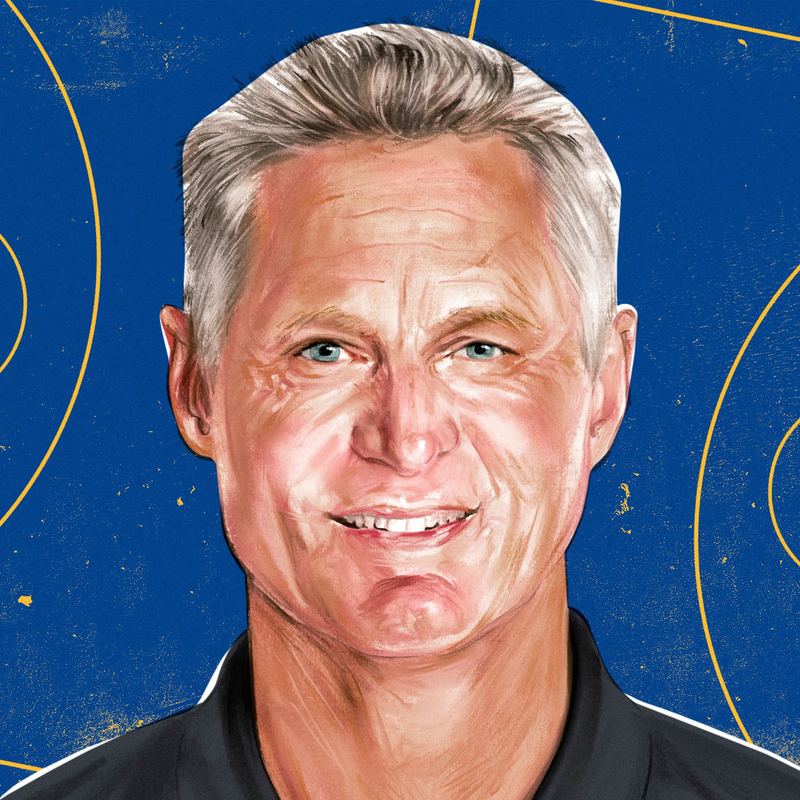
David Remnick: Basketball fans were first introduced to Steve Kerr as a three-point shooting specialist for the Chicago Bulls during the '90s and their championship runs. Playing alongside Michael Jordan, Kerr was by no means the star of the Bulls, but he still holds the record for career three-point percentage. It's in coaching that Kerr has come to the fore in the NBA. Over 12 years, he's led the Golden State warriors to 4 titles and a record 73 win season in 2016, still a remarkable record. He coached the men's Olympic team in 2024 that took home a gold medal.
Kerr has also used his platform at times to wade into politics. He spoke at the Democratic National Convention in 2024, and his name comes up sometimes in conversations about candidates for higher office. Charles Bethea, who's a staff writer at The New Yorker, went to see Steve Kerr the other day just after his team, The Warriors, finished their season.
Charles Bethea: There's some backstory to my meeting Steve. Back in 2018, I actually spent a couple days with his mother in the Pacific Palisades. I'd gone to watch her teach a class called Perceptions of the US Abroad, and rather than stay in a pricey hotel nearby, she said, "Why don't you just come stay with me?" I showed up, and she put me in Steve's room, which had mostly been stripped of the markings of adolescent Steve, though I did find a few photographs in a closet of him.
I met Steve for the first time in San Francisco. We had lunch and then we went and sat down in his office. All right. Thank you very much for doing this. I don't typically sleep in the childhood bedroom of an interview subject before talking to him. This is a first for me. Your mother, as you know, Ann, was kind enough to put me up. In 2018, I wrote a story about her for the magazine, about her class at UCLA, Perceptions of the US Abroad. Got to know her, became a big fan of her. As she says, I love this line, "The mother of two PhDs, an MBA, and an NBA, which is you.
Steve Kerr: That's right. That's right, that's her line.
Charles Bethea: Yes, it's a great line. You, you were born in Beirut, you spent time in Cairo as well in your childhood, but you spent most of your formative adolescent years in The Palisades?
Steve Kerr: Yes, mostly in The Palisades, with intermittent sabbaticals from my dad. We spent time in, let's see, a year in Aix-en-Provence in the South of France when I was in kindergarten, three years in Cairo, so 6th grade. Then back to LA, and then we went back to Cairo. 9th and 10th grade, my dad was doing research and writing a book and teaching at the American University in Cairo. Most of the time was in The Palisades but with these periodic journeys overseas.
Charles Bethea: What was it like for you growing up in Cairo and Beirut? Was there a basketball culture in either place, or what were you interested in when you were living in this place?
Steve Kerr: Born in Beirut, but only I only spent the first year, year-and-a-half, or two years of my life there. Beirut, no, but Cairo, I went to an American school called Cairo American College. I still have great friends from there who I've stayed in touch with. We didn't have a gym. We had an outdoor court. For 9th and 10th grades, I played on the school team.
Charles Bethea: Did you dominate?
Steve Kerr: I did pretty well. 9th and 10th grades would have been like 1979, 1980, '81. No gyms in the entire country of Egypt, no basketball gyms, so every one of our games was played outdoors. We played on dirt courts. To be on the team and to be traveling around Cairo playing on these outdoor courts was just crazy when you look back and think about it now.
Charles Bethea: Right. When you got used to, I guess, judging the wind, which you don't have to do when you're playing indoors.
Steve Kerr: The pebbles that were on the dirt courts, avoiding. It was like later on, I had to deal with the gaps in the floor at the Boston Garden, so those dirt courts in Cairo helped prepare me for that.
Charles Bethea: You mentioned your dad. He was assassinated in 1984 in Beirut by the Islamic Jihad Organization. He was there as president of the American University of Beirut. In that role, as I understand it, he was very much trying to foster cross-cultural respect, understanding, knowledge, right?
Steve Kerr: Yes.
Charles Bethea: There was an irony, of course, a tragic one, in his killing. The time around your father's death, you were at the University of Arizona, correct? As I understand it, your teammates wore black armbands after his death in solidarity. How did basketball factor or function in your grieving process? Was it part of how you grieved? Was it a distraction from grief?
Steve Kerr: It was literally part of how I grieved. I went to practice the next day. I found out about my dad's death from a phone call from a university colleague of his at 3:00 AM. It was the worst moment of my life, the most shocking. Even though I knew the danger in Beirut, we just always thought my dad was so well respected there, had so many Arabic friends, he spoke fluent Arabic, he was fostering goodwill between America and Lebanon. He was the victim of political terrorism near the very beginning of this current era of Islamic extremist terrorism and animosity towards America.
Charles Bethea: When did you realize realistically you could play in the NBA? When did that become a reality for you?
Steve Kerr: Maybe my senior year at Arizona. We had a great team. We made the Final Four. That year, I started to dream a little bit that maybe I could sneak into the NBA for a couple years, have a cup of coffee, make a team and be able to tell my kids I played in the NBA.
Charles Bethea: Right. You touched the court?
Steve Kerr: Yes. I thought, maybe, maybe, but it wasn't until my senior year that I even allowed myself to think about that.
Charles Bethea: What role did you play on that Arizona team?
Steve Kerr: When I got there as a freshman, it was good fortune. Coach Lute Olson was a legend. He'd come from Iowa, he took the Arizona job, and had to rebuild it from scratch. It was a terrible basketball program and it's the only reason I was there.
Charles Bethea: Because my sense of Arizona, I'm a little younger than you, I wasn't watching then, but my sense when I started following basketball is Arizona is a powerhouse.
Steve Kerr: That's right.
Charles Bethea: This was pre-powerhouse?
.
Steve Kerr: The whole reason Arizona is a powerhouse now is because of Coach Olson. He got there and he turned it around literally in one year. My sophomore year, we made the NCAA Tournament. My fifth year, my senior year, we made the Final Four. I was lucky enough to be part of it for five years and that was the experience that paved my entire basketball career.
Charles Bethea: After playing for a few other teams, you end up on the Bulls. Most of our listeners are familiar with the '90s Bulls, I think. What was your role in that team?
Steve Kerr: Until that point, I played for three different teams. I was bouncing around. I was good enough to survive, but not good enough to thrive. I was able to thrive in Chicago based on the set of circumstances, ultimately, playing next to Michael Jordan and feeding off of him because he attracted so much attention.
Charles Bethea: When necessary, roughing him up in practice a little bit?
Steve Kerr: Yes, beating him up a little bit. Yes, yes.
Charles Bethea: Your mother described that to me as you rubbing elbows a bit, which is one of her great euphemisms.
Steve Kerr: Rubbing elbows, yes. I like to say I hit him in the fist with my eye, something like that.
[Basketball game]
Charles Bethea: He possessed an incredible suite of skills that made him great. Do you feel like any of those get short shrift when people remember him? Anything in particular about him?
Steve Kerr: I think the younger generation, because they've watched LeBron, automatically says LeBron is the greatest player ever. The Jordan people who watched the game back then all say Jordan's the greatest ever, and it's just human nature. I think they're very different players, really. I think--
Charles Bethea: Can you distill that for our audience a little bit? What makes him--
Steve Kerr: Yes, I think LeBron is a better passer, more of a point forward. I've always thought he was the point forward of every team he was on. His brilliance doesn't lie in the same skill set that Michael's did. It lies in more of a holistic game where he dominates the game with his pace, his athleticism, and his passing. It's ironic, but I've always felt scoring is secondary for LeBron. He's the greatest scorer in the history of the NBA.
Charles Bethea: Right, incidentally.
Steve Kerr: Yes, incidentally, he became the best scorer of all-time. Some of that is longevity, but as part of his greatness, is he's available every single night. He's a machine. I think he's litterally the greatest athlete on the face of the planet. In the course of human history, I think LeBron James is the greatest athlete of all time.
Playing with Michael, I saw the killer instinct, the killer mentality, the emotional dominance he had over not only the other team, the officials, the entire arena. He had a dominance about him that I don't see with LeBron. They're very different. When I say that, I'm talking about the emotional part of it. I think everybody came into a series against Michael knowing they were going to lose, and that's different. There's never been anybody like that. Maybe Bill Russell was like that. In my lifetime, I've never felt the same way on a basketball floor as I did with Michael. The fact that they're such different players, I think they're the two best players of all time, but I think they're very different players.
Charles Bethea: You're starting a team from scratch?
Steve Kerr: I'll take them both.
Charles Bethea: Ugh, man, I thought I could trap you with that one.
Steve Kerr: No, I'm taking them both.
Charles Bethea: Thought I could trap you. All right.
Steve Kerr: By the way, Steph's on that, too.
Charles Bethea: You played an era that was famously physical. Charles Oakley, Bill Laimbeer, they were in their latter stages of their careers, but they were still playing when you were playing in the league. Where do you land on the question of how Today's stars like LeBron would handle the physicality?
Steve Kerr: Oh, LeBron would handle it fine. It's really a different game. When people mention the physicality, a lot of that just has to do with the way the game was played. It used to be a low post game. You throw the ball into the big guy and that's where the battles all happen. Now the battles all happen on the perimeter, and it's a game of pace and space. Back then, teams didn't spread you out with three-point shooting, so the game was played in a tighter circle and there was just naturally a lot more contact.
I think also back then, we weren't nearly as concerned with too much physicality as a league. Guys would literally punch each other and stay in the game back then till a certain point, and we got smarter. I think the game today, overall, it's faster, and it's more skilled than ever. While it's less physical, the difference in the physicality has more to do with the style of play and the fact that the league just knows people throwing punches at each other might work for hockey, but it doesn't work for basketball. It's not good business.
Charles Bethea: We've got UFC and we've got hockey?
Steve Kerr: Yes, yes.
David Remnick: Warriors coach, Steve Kerr, with The New Yorker's, Charles Bethea. We will continue in just a moment. This is The New Yorker Radio Hour.
[music]
David Remnick: This is The New Yorker Radio Hour. I'm David Remnick. Now let's continue our conversation with the veteran NBA player and coach Steve Kerr. He's speaking with our reporter Charles Bethea. Kerr was born in Beirut, the son of an academic, Malcolm Kerr. Malcolm Kerr was serving as president of the American University in Beirut when he was tragically assassinated in 1984 by pro-Iran militants.
Kerr's upbringing and losing his father to political violence led him to an interest in politics, and he's not been afraid to speak his mind about the state of our country, even while coaching in the National Basketball association, and even if that means getting into a spat with Donald Trump.
Charles Bethea: You've been refreshingly willing to speak about politics over the years. The day after Trump's first election in 2016, you delivered what you called a rant at a Warriors' press conference. I believe you described your disgust and disappointment in the result. You referenced a players meeting. You had to talk about it. That was a while ago now, and plenty has happened since, but without naming names, can you share anything you heard in the meeting?
Steve Kerr: I don't remember, but I do remember in the early days of his presidency, as he was establishing this new tone of communication that we were going to have in this country, I was so disgusted that I didn't hold back from showing my disgust and expressing my disgust. I think I've learned that I needed to be better in terms of representing our organization in a way that I could still let my feelings be known, but not get too personal because I'm representing a large group of people, not only for our organization, but our fans, too.
Charles Bethea: You called him a blowhard, ill-suited to the office.
Steve Kerr: Buffoon, I think might have-
Charles Bethea: Might have been there?
Steve Kerr: -made his way in there.
Charles Bethea: Those kinds of direct comments. Can you be specific about what you find most troubling about his leadership or his approach to leadership?
Steve Kerr: I think it's the approach. I think what really got me was the debates with Hillary, where he stalked her from behind. It was so shocking, and there was a live audience. It reminded me like The Jerry Springer Show or something. All I could think of was all that stuff that started on TV with the talk shows, like the sensationalized TV.
Charles Bethea: It was all foreshadowing, right?
Steve Kerr: Yes, it's now entered our political world. It was just so shocking because in my life, up until that time, there had been a sense of decorum that was expected. Reagan and Tip O'Neill were really good friends. They went to lunch every week. Democratic speaker of the House, Republican President, knowing they had to work together to get stuff done. That was politics. There was a decorum, there was a sense of decency that people were watching, that we wanted our country to embody a certain dignity that was embodied in politics, regardless of policy, and regardless of even corruption.
Yes, there was corruption. There's been corruption from the beginning of mankind, but that stuff would be dealt with, and so we lost that. I don't think it's all Trump's fault. I think it was happening before Trump. The forces in social media, the forces in our country, the division.
Charles Bethea: He's a symptom, in other words, not a root cause?
Steve Kerr: Yes, I think he's a symptom, but he's definitely has taken advantage of that to some extent to gain power and to consolidate power. He's using it to drive a wedge between all of us. He's not the only one who's done that, but he's the president. He's got the most power.
Charles Bethea: When you have chosen to speak out, how have you chosen what moments to choose?
Steve Kerr: I just try to do it wisely. As I said, early in his first tenure, I probably went overboard.
Charles Bethea: As judged by how--
Steve Kerr: Some of it like calling the president a buffoon. I regret that, even though I felt it in my heart. Even though a lot of people agreed with me, I don't think it was the right approach.
Charles Bethea: Because it's a low road, or because?
Steve Kerr: Because I am representing the Golden State Warriors. I think it's better to point out policy decisions, but also American values, values in general. I think we've lost our way, that's not news, but it's more valuable to point out why we've lost our way and what's wrong with the things that he does, rather than calling him a name.
Charles Bethea: You play golf. Your mother, she's my source here, obviously, a lot of this stuff, she told me you played golf with Obama. Obviously, he loves the NBA. He loves basketball. Plays basketball a bit. What was he interested in talking about just topically with you? What stood out for you?
Steve Kerr: I wanted to talk about Middle East, and he wanted to talk about the NBA, and so we ended up talking about both. It was his 60th birthday. He brought a group of friends to Monterey to play golf. We have a mutual friend, Tom Friedman, the columnist for The New York Times.
Charles Bethea: He was the Beirut Bureau chief-
Steve Kerr: That's right.
Charles Bethea: -when you were there?
Steve Kerr: Yes, he was 27-years-old, and he became friends with my dad as a bureau chief. Tom has remained a family friend ever since. Whenever I go to Washington, we get together and have breakfast, and I read all of his stuff. I think the world of him. He's friends with Obama. They played golf all week. I think they kept a spot open for one visitor every day, and I got to join and play Pebble Beach with.
Charles Bethea: Where'd you stack up in terms of the results?
Steve Kerr: There's a handicap system.
Charles Bethea: Aha, I don't know much about golf.
Steve Kerr: It was amazing. It was one of the thrills of my life to play Pebble Beach with President Obama. I got to ask him a lot about his worldview, and he got to ask me a lot about the NBA. He loves basketball. Then we had dinner afterwards. It was a really a full day and one of the best experiences of my life.
Charles Bethea: I remember seeing your remarks after the Uvalde school shootings, 2022. This was, I think during a press conference during the finals. You said that our country was being held hostage by senators who wouldn't vote for widely popular common sense gun reform.
Steve Kerr: I'm tired. I'm so tired of getting up here and offering condolences to the devastated families that are out there. I'm so tired of the-- Excuse. I'm sorry. I'm tired of the moments of silence. Enough.
Charles Bethea: I was thinking as I saw that first, "This is what informed and impassioned advocacy looks like." Second, that you might have a future in politics, if you wanted one, which I don't think you've ever suggested that you do, but just to ask you again, have you considered it? You are, it seems like at a crossroads right now, potentially. Your contract, it's run out. You're making decisions over the next few weeks. I'm not suggesting you're going to jump into the governor's race in California-
Steve Kerr: You're right. You're right.
Charles Bethea: -but you could be popular if you chose to use your platform.
Steve Kerr: That's flattering and I appreciate it. No, I don't have any desire to go into politics. I love basketball. This is my world. All of my friends and my people are in this world. Whether I keep coaching The Warriors or not, I imagine I'll be involved in basketball. I love it, my family loves it, and I'm very content doing what I'm doing. I'm very flattered that people would even bring that up.
Charles Bethea: Fair enough. On a lighter note, and we're getting towards the end here, I wrote a few years ago about adding a four-pointer to the game. I interviewed Larry Bird. Larry, who entered the league the same year the three-pointer was added, was like, "This game evolves. It's always evolving. There could be a four-pointer down the road. He'd be open to it." Do you have any sort of knee-jerk responses to that?
Steve Kerr: I would never do a four-point play. In fact, I would even consider getting rid of the three-point line.
Charles Bethea: Say more about that as the guy who holds the all time record for percentage. Come on.
Steve Kerr: I just think that the game as it was designed is really to create the best shots possible. That's why in the early days of the game, you just throw it inside to the big guy. The three-point line came from the ABA. It was in 1979 and the NBA decided to adopt it. I think it was really effective. It makes for an exciting play but the analytics revolution has created a weird situation where we all know exactly where the highest efficiency shots are. It's layups, it's corner threes because the corner three is 22 feet and not 23, 9 like the up above the break threes, and you have this whole no man's land between those areas.
If you shoot a 22 footer now from the top of the key, that's considered a really bad shot. I just think that some ways the game has gotten homogenized by the analytics revolution and the three-point line, the combination. Even though I think there's great coaches and there's a lot of creativity, I wonder if the game would get more creative if we got rid of the three-point line.
Charles Bethea: More fun to watch.
Steve Kerr: Maybe more fun to watch.
Charles Bethea: There's less of a role for Steve Kerr, the player.
Steve Kerr: Yes, I wouldn't make it in the NBA, but I just throw it out there for fun. It's not anything that I would ever propose as that's not happening. I think it's an interesting thought experiment.
Charles Bethea: Can you distill what drives you at this point, age 60?
Steve Kerr: What drives me is that I love what I do every day, so I wake up excited to come to the gym and coach basketball, collaborate with the staff and see the players and try to help them achieve something. That's an amazing life. That's all that really matters is do you enjoy what you do every day and are you fulfilled? I still am. Winning is obviously much more fun than losing, but losing is just a part of it. This year was our worst season we've ever had. No, I take that back, second worst. COVID year we had the worst record in the league.
I don't look at it like I'm a failure now, or I was wildly successful then, even though that's how everyone measures things. I'm well aware this is life. This is all part of your existence as a coach, as a human being, and you're going to experience everything. You want to help people have that perspective and really embrace the things that are going to be there for them every day, which is the joy that comes from competing and the camaraderie that comes from being part of a team. That stuff occurs even on losing teams. It's especially important on losing teams to make sure those things are happening.
Charles Bethea: You sound like a guy who wants to come back, and if it's your choice, then you would, but it's a combination of choices, right?
Steve Kerr: Yes, this is a really interesting situation. I'm very respectful of the organization and their place in the universe right now. I know how this stuff works. Most coaching runs just last a certain amount of time, and then it's best for everybody to move forward. What we have to figure out is now that time because what complicates it is we still have Steph and Draymond.
Charles Bethea: Another year each, right?
Steve Kerr: Yes, another year each on their contracts. I don't want to abandon those guys.
Charles Bethea: Green.
Steve Kerr: I love those guys, and I love working with them. I love my job but I respect the fact that the organization has to think about what's next. Is it time to bring in someone new to lay out the foundation or lay out the path and a new foundation? If that's the case, then I totally respect that. If Steph and Draymond were retiring this year, I think this would be an easy decision. We all go out together, and the organization takes their new path, but it's not that easy. I think Steph's going to play another couple years, and I think we can still do some good things together. These are all conversations that will happen in the next week or two, we'll figure it out, and whatever happens, it's going to end well.
Charles Bethea: Fair enough. Thank you very much for your time.
Steve Kerr: Yes, you got it.
Charles Bethea: We really appreciate this, Steve.
Steve Kerr: My pleasure. Thanks, Charlie.
David Remnick: Steve Kerr, coach of the Golden State warriors, talking with staff writer Charles Bethea. You can find their interview online @newyorker.com. You can also subscribe to the magazine there as well, newyorker.com
Copyright © 2026 New York Public Radio. All rights reserved. Visit our website terms of use at www.wnyc.org for further information.
New York Public Radio transcripts are created on a rush deadline, often by contractors. This text may not be in its final form and may be updated or revised in the future. Accuracy and availability may vary. The authoritative record of New York Public Radio’s programming is the audio record.