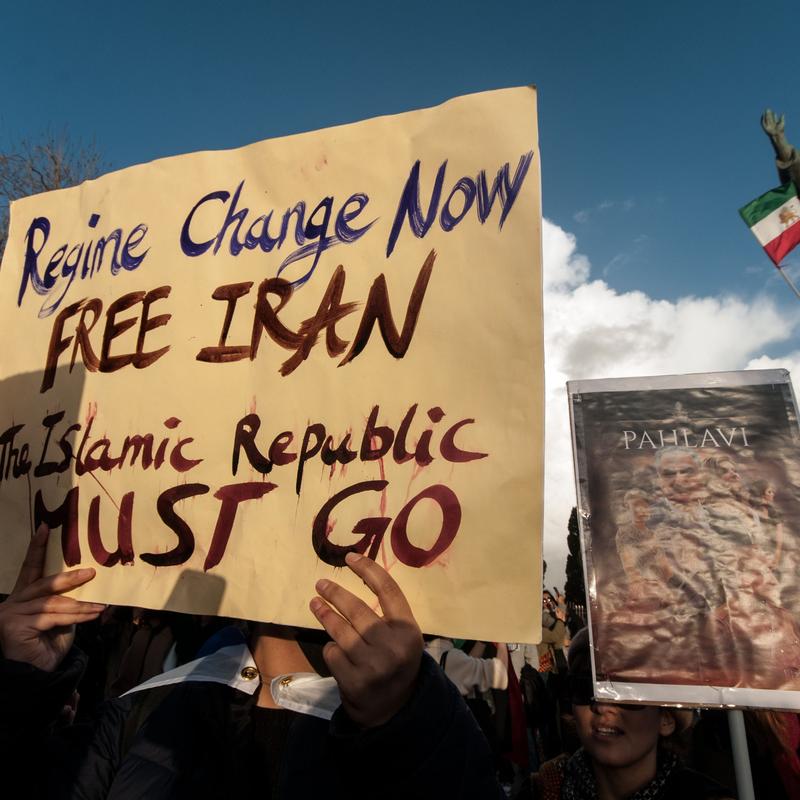
Reporter: When protests ignited across Iran in December and reports emerged that the regime was killing thousands of protesters, Donald Trump threatened to intervene then and there. He did not. The Pentagon began building up a huge military presence around the Gulf region. Meanwhile, the regime, it turns out, may have killed as many as 30,000 of its own people, according to some estimates. Iran has seen huge protests in the country before, and the regime has responded with violence before. This time seems something of a different order of magnitude. Some Iranians who oppose the regime have been in the crazy position of hoping for the US to strike, to bomb their own country, even if it leads to full scale war. Reporter Cora Engelbrecht has been recording her conversations with people in Iran who about what that could all mean. Now, we've altered or overdubbed their voices to protect these people from reprisal.
Witness 1: It is the topic of the past 40 days. It is the topic that every Iranian would speak about when they would meet.
Cora Engelbrecht: One of the people who spoke with me is a young man who works in a hospital about four hours north of Tehran.
Witness 1: I'm having a very difficult time processing all these different thoughts because on theory, like on paper, I would be against a foreign invention. I would believe that democracy would only come from within. Looking back at what happens, where are these criminals going to go? We're not going to [unintelligible 00:01:46] away, not in a million years.
Cora Engelbrecht: This hospital worker was stationed in two different emergency wards during the peak of the regime's lethal crackdown on nationwide demonstrations in January. In the weeks since, he has sent me evidence he collected of hundreds of casualties, many of them trauma injuries from these emergency wards where he was stationed.
Witness 1: These people, these plain clothes agents. For example, remember the grandmother that I told you about, the grandmother that was brought in dead to the hospital, the granddaughter who was shot in the ear was crying all the time. The daughter of that grandmother was undergoing a mental collapse. During that entire time that we were attempting CPR on the old woman, the plain clothes agents just stood there laughing and showing no empathy whatsoever. They were laughing. Essentially, mortal enemies. They were treating the patients like animals. Seeing that, realizing that we are already these people's mortal enemies helped us realize that we are at war to a good degree. Fearing a foreign invasion in this circumstances is just laughable, if you ask me.
Cora Engelbrecht: Can you hear me?
Witness 2: Yes.
Cora Engelbrecht: How are you feeling?
Witness 2: It's too hot.
Cora Engelbrecht: This is an activist who lives in Tehran. She's in her 20s. She was actually in prison during the Women Life freedom protests in 2022. Over the past few weeks, she's been attending a lot of funerals commemorating people who were killed in January. For years, she told me she would have never dreamed of supporting foreign intervention. Now, faced over and over again with the undeniable brutality of the violence from the past months, she's shifted her view. She can't help but want some kind of action from the United States which would eliminate the regime.
Witness 2: I don't know. You read the book Waiting for Godot?
Cora Engelbrecht: Yes.
Witness 2: It's like we are waiting for [unintelligible 00:04:16]. We want to [unintelligible 00:04:19] attack us because we can't fight back with the government. I don't know. I think that's a miserable situation for my people war is not good. We saw that the war and foreign engagements in Afghanistan and Iraq and Palestine, it's too bad, and it's continuing over these years. It's like we have to ways. One, the regime kills us. Two, the foreign country kills us. You know how upsetting that is? It's really upsetting.
Cora Engelbrecht: This woman is an activist in her mid-30s, and she told me she's participated in every political uprising, starting with the Green Movement in 2009. She was in her teens then, so her whole adult life, she's been protesting the current regime. She said that the 12 day war in June with the United States and Israel was still fresh in her mind and had actually made her more cautious about joining the demonstrations in late December.
Witness 2: This time I-
Voice-Over: This time I did not participate. I observed. I mostly went to the streets by car. It was both the fact that I was scared by the violence and also by the prospect, because it was-- It started-- It did not start, but it picked up with a monarch's cult. It was a monarchist movement. I had the feeling that it's like a counter revolution.
Cora Engelbrecht: Like many I spoke with, she expressed some distrust and skepticism for the royalist movement that has surged around the former Crown Prince Reza Pahlavi. He's the exiled son of the former Shah of Iran, and he hasn't been in the country since 1978.
Witness 2: The thing is that the foreign--
Voice-Over: The thing is that the foreign pressure is, it's not humanitarian completely. We are all very well aware of that. It seems like a tool for them, a negotiation tool, an excuse. It's not even what they're negotiating for, and it's naive to think so, but I'd say this whole situation, this whole dualism that either the Islamic Republic stays or there is a war, and there is no third way. This is a dangerous mindset. I don't want to choose one of them. I choose neither of them. To be honest, I wake up, I feel like I wish there was a war. I don't share that with anyone, but that's just inside my head. I wish there was a war and we were over with it.
I am quite sure about myself that I do not want that. It's just personal mood swings. I have come across people waiting for war in that sense, I mean, waiting for a celestial catastrophe, like a miracle that can save them from this situation. That's suicidal. People who are very senselessly waiting for that beautiful moment of the skies being bombarded and the earth catching fire and everything exploding and destroying. It's a suicidal wish. To me, it sounds-- people who are living, especially people in Tehran, because Tehran was affected more than other cities.
Cora Engelbrecht: When you say that Tehran was more affected than other cities, what are you referring to? Are you referring to the 12 day war?
Witness 2: Yes, the 12 day war.
Voice-Over: We're talking about two traumas and wishing for that to happen again. It just comes out of frustration and feeling that in either way, if there is a war or not, you have no control over your life and being.
Cora Engelbrecht: Are there any kernels of hope and all that? When you think about the future right now, what is giving you hope, if anything?
Witness 1: That is a very hard question, but it's a very difficult thing to find hope. Maybe we will transition to a democracy or maybe we won't. Maybe things will get even worse, but we are not in a situation to worry about this because we are way beyond the no turning back point now.
Reporter: Voices from Iran. All of these people asked to remain anonymous. You can find some extraordinary reporting from Cora Engelbrecht, all at newyorker.com We'll continue on Iran and its relationship with the United States in just a moment. This is The New Yorker Radio Hour.
[music]
Copyright © 2026 New York Public Radio. All rights reserved. Visit our website terms of use at www.wnyc.org for further information.
New York Public Radio transcripts are created on a rush deadline, often by contractors. This text may not be in its final form and may be updated or revised in the future. Accuracy and availability may vary. The authoritative record of New York Public Radio’s programming is the audio record.