Rewriting Art History at the Studio Museum in Harlem
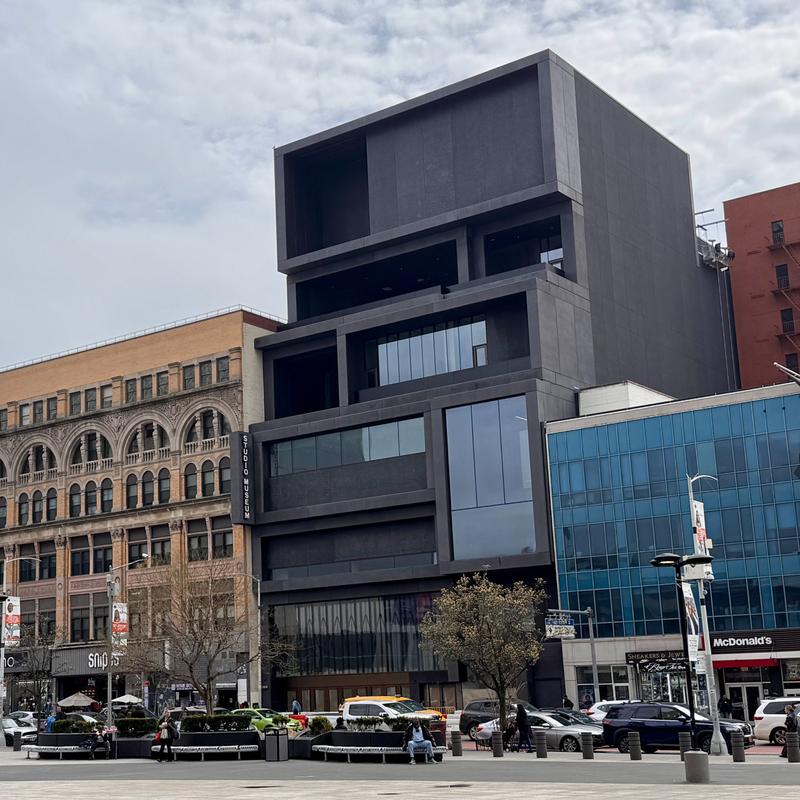
David Remnick: One morning recently, a Monday, instead of going downtown to the office, I went north to Harlem to a construction site. You've spent a lot of time in a hard hat in the last seven years.
Thelma Golden: Hard hat, ugly boots, a vest.
David Remnick: Thelma Golden doesn't do ugly boots. I was there to meet Thelma Golden, a curator and a major presence in New York's cultural life. Golden is the director of the Studio Museum in Harlem. She's also the muscle and the imagination behind the radically rebuilt and expanded museum, which has just reopened. Golden gave me a tour of the place recently, even as workers were putting on the finishing touches and installing paintings and sculpture. It smells like a new car in here.
Thelma Golden: Well, it very much is like that. Can you imagine? All of this got built.
David Remnick: Putting up a new museum is never really easy. They have very specific requirements, and they often involve name architects, and they cost a ton of money. The Studio Museum has been closed for seven years while the old building was being demolished and a new one was created on the spot.
Thelma Golden: We're in the lobby of the museum looking out onto 125th Street. Those who'd visited in the past who came through our atrium were greeted by Glenn Ligon's amazing work called Give Us a Poem, a 2007 neon work, which are the words me, we, that flash alternately in a kind of call and response with each other. This work, as you probably well know, takes its words from Muhammad Ali, who when, after giving a lecture at Harvard in the '70s, was asked, "Give us a poem." He got up in a very dramatic way and simply said, "Me, we."
In this case, creating this neon, as he did for our atrium, was a way to have a work that lived in the building but also out there, right on the street, to think of the individual and the collective, the me, the we.
David Remnick: Since its founding in 1968, the Studio Museum in Harlem has focused on artists of the African diaspora. Now, the location is critical. Instead of opening further south near other museums in town where tourists might be more likely to visit, the Studio Museum stayed in Harlem, right down the street from the legendary Apollo Theater.
Thelma Golden: We're entering the second-floor gallery. This is the first gallery visitors will encounter if they come up the stairs or in the elevator. What greets them is this work by Lorraine O'Grady, a multi-paneled photographic work made in 1983 at the African American Day Parade, an event that still happens here in Harlem. This is Lorraine O'Grady here. What she did as an artist, a conceptual artist, one of our pioneering conceptual artists, and what we see in this work is a performance, where with gold frames, referencing the kind of grand frames we see in museums, and they then allowing audiences to interact with these frames.
David Remnick: In one of these images, you have somebody holding up a frame with three or four young people who are just having a great time at this parade. Some guy out in front of a church, and it's hot as hell out, so he's got a damp washcloth on his head, but he's being framed. The cops as well.
Thelma Golden: Right. Taking these frames literally off the wall, out of the museum, into the world as a way to proclaim the power and the potency of art.
David Remnick: Something else occurs to me. On the national stage in this era, the MAGA movement is constantly trying to diminish Black culture and its complex history. The leaders of many arts institutions are in a defensive crouch, and now in 2025, the Studio Museum seems to represent something radical, something unorthodox, just as it did in 1968.
Thelma Golden: This is a well-known work in our collection, A work by the artist Barkley Hendricks. The title of this painting is Lawdy Mama from '69. Hendrix is known for his photorealist portraits of African Americans, of Black people, really around the world. Lawdy Mama is a portrait that has a gold background with a woman with a large afro, typical of the period, looking directly at us with a kind of intensity and a seriousness, but also with an incredible amount of serenity. That's something that's typical of Hendrick's art. She has been a real important icon of the Studio Museum.
David Remnick: And you use the word icon, and in fact, the shape of the frame is like a traditional-
Thelma Golden: Exactly.
David Remnick: -Christian icon or Russian icon of the centuries ago.
Thelma Golden: Exactly.
David Remnick: Where are we headed, Thelma?
Thelma Golden: We're headed here. New work in the collection by Raymond Saunders, an artist who sadly recently passed away. This particular painting is somewhat different for him. A black background, but simply with the text Watering a black Garden. This is a work that, for me, speaks to a lot of what I think the effort and intention around this institution has been about for generations.
David Remnick: It could be your cradle watering a black garden.
Thelma Golden: It is. In some ways it is.
[background noise]
David Remnick: Thelma, let's go back to the founding of this museum, 1968. What need was being filled at that time, and just as important, what was happening in Harlem and in the city and in the cultural ferment of that time?
Thelma Golden: The museum began as an idea that came from an incredible group of community activists, artists, philanthropists, cultural workers who felt at that important political and cultural moment, that there needed to be a museum in Harlem that would focus itself on Black artists.
David Remnick: What was happening in terms of Black artists in 1968? Who was getting into museums elsewhere in the city and who was not? What was the predicament?
Thelma Golden: Black artists had been making work here in America for centuries, but yet they had been excluded and marginalized from mainstream institutions and art histories, and so the museum's goal was to address that by acting as a radical voice to rewrite art history. What's interesting is that the founders also wanted to redefine what a museum could be so that it also was interested in creating a place that put the making of art, process right up against presentation.
That's how our residency program was formed, to have artists who would be in the museum making their work, work that would get shown in the museum at some point, so that it was an interesting project because it was looking at the past, but it was also projecting into the future.
David Remnick: This is the center of The Harlem universe, 125th Street, but what was going on in 1968? Maybe for those who don't remember it, who was writing, who was speaking, who was producing work that was not finding a center?
Thelma Golden: In 1968, Harlem was a political center, it was a cultural center. This community saw itself deeply in relation to its past as the home of the Harlem Renaissance, but also, in that moment, it was a part of the civil rights movement, the Black Power Movement, the Black Arts Movement.
David Remnick: You've been here for 20 years.
Thelma Golden: My relationship to this museum began when I was 19 years old in my second year as an art history major at Smith College when I interned at the museum. I wrote in my college application essay that I wanted to be a contemporary art curator at the Whitney Museum. I had a lot of focus as a young person.
David Remnick: [chuckles] You were 16, and you knew.
Thelma Golden: I knew. Before I ever got to travel around the world, I felt like I had a sense of the world through my engagements with art. That was in the museums right in this city, which, for me, growing up in Southeast Queens meant a subway or a bus ride around these boroughs, seeing art and engaging in museums.
David Remnick: You made it to Smith, and you said to a professor that you wanted to learn more about Black art.
Thelma Golden: When I went to my professor to propose this topic, he said to me, thinking, of course, that I would see this as a joke. He went to the bookshelf in the library, and he pulled down a catalogue of Frank Stella's black paintings. Frank Stella, of course, who is a white artist, and he said, "You like to write about Black art?"
David Remnick: Yes, that's a joke that didn't land, did it?
Thelma Golden: It didn't, but it did inspire me. It made me understand the possibility of what it meant to be a voice, to open up the conversation that allowed us to think more broadly about art and the art histories that needed to be present and taught and felt.
David Remnick: In 2001, you curated a really important exhibition here at the Studio Museum that made a big impact. It was called Freestyle, and you described those artists as post Black. What does that mean?
Thelma Golden: At that time in 2001, it felt as if, again, looking at our archive, that there were moments when this museum had taken a position to sort of widen the aperture of what we could understand, was art made by Black artists? Now, some of this was reactive because the world has often narrowed that definition. With Freestyle, which was curated with Christine Y Kim, she and I set out to think about artists who were coming post the Black Arts Movement, so the moment of this institution's founding. There at this beginning of the new millennium, what was a version of how they might define their work through race, culture, and identity.
Now, as a curator, I have always taken the position that the moment an exhibition opens, it's no longer yours. It creates its own forcefield of dialogue and of engagement. There are lots of ways that that got defined that were not necessarily how I would have at the time.
David Remnick: There was a debate.
Thelma Golden: Oh, a large debate.
David Remnick: What was the center of the debate? What were the arrows coming at you?
Thelma Golden: I think the center of the debate was a younger generation of artists not wanting to be defined as Black. What that debate, in its simplicity, often forgot was that this was the generation of artists who had come out of the era of hip hop. This was the generation of artists who were defining themselves through race, through gender, through sexuality, through geography. It was a way also, as an exhibition, to define a new century for this institution.
David Remnick: Let's talk about this project. You had to raise a tremendous amount of money. How much was necessary to do this project?
Thelma Golden: $300 million.
David Remnick: That's a lot of money.
Thelma Golden: That's a lot of money. The building we occupied was an amazing building, built in 1914. Had a lot of history on this storied street, but it was an old building and required constant care. Essentially, what we did was demolish the old building. That was the first part of the project, then pour a new foundation, but also create a new foundation in many ways.
David Remnick: How much has it grown? What's the percentage by which it's grown in terms of space?
Thelma Golden: The square footage of this new building is about 80,000 square feet. Our former building was 60,000 square feet, but only about a third of that was the museum. This is the first purpose-built museum in our history. The entire building is designed for our activity. In our old building, we didn't have a loaning dock, we didn't have elevators that allowed for the movement of art, so there were a lot of practicalities that we wanted to address.
David Remnick: This is a triumphant moment for you and for this building and for Black art and for art in New York, period. It also comes in 2025 when there's a lot of attacks on cultural institutions in America, and it's not just the Smithsonian and Kennedy Center, but many cultural institutions. There's a lot of tension out there. What role will the Studio Museum play in this, do you imagine, in the coming months and years?
Thelma Golden: I hope this institution will play the role that it has played since our founding, which is to be a space boldly, radically defined by the vision and voices of Black artists. I take a lot of inspiration from our founders, who opened up in a complicated moment. My own career began in the midst of the culture wars of that era, and understanding museums as a place that should be, can be, must be where we engage deeply in ideas in this moment that has to offer some hope as we consider a future.
David Remnick: Thelma Golden, thank you so much.
Thelma Golden: Thank you.
[music]
David Remnick: Thelma Golden is director and chief curator of the Studio Museum in Harlem, which reopens to the public this weekend. I've never known you to take a whole hell of a lot of time off. Do you feel like my work is done here?
Thelma Golden: Oh, my work is just beginning, David.
[music]
Copyright © 2025 New York Public Radio. All rights reserved. Visit our website terms of use at www.wnyc.org for further information.
New York Public Radio transcripts are created on a rush deadline, often by contractors. This text may not be in its final form and may be updated or revised in the future. Accuracy and availability may vary. The authoritative record of New York Public Radio’s programming is the audio record.