Jenin Younes on Threats to Free Speech from the Left and the Right
David Remnick: The issue of free speech, the struggle over separating fact from conspiracy theory, all of this is at the heart of the Trump era. Donald Trump's opponents contend that violence against protesters by federal agents is just one manifestation of that struggle. So is the arrest of a journalist like Don Lemon, whom government officials have accused of being a co-conspirator in a Minneapolis protest. You can say the same for the myriad lawsuits that Trump has filed against so many newspapers and networks. Jenin Younes is a lawyer specializing in First Amendment cases. She serves as the legal director of the American-Arab Anti-Discrimination Committee.
Now, once an ally of conservatives fighting the Biden administration, Younes has become a bitter opponent of the Trump administration. Let's begin not at the very, very beginning, but take me back to 2023. You spent several months working with the House Select Committee on the Weaponization of the Federal Government, where you helped lead an investigation in what was then called, and I quote, "the censorship industrial complex." What specifically were you investigating, and how did that issue get on your radar?
Jenin Younes: We were investigating government involvement, especially federal government involvement in social media censorship. We were investigating exactly what was going on between the federal government and the tech companies, the social media companies, and trying to figure out the extent of First Amendment-violative conduct on the government's part. This was mainly about COVID. Censorship around topics related to COVID, especially the vaccines, but also other areas like lockdowns and mask mandates. My clients were Dr. Jay Bhattacharya, who's now the head of the NIH, Dr. Martin Kulldorff, and a couple of other individual plaintiffs.
They were being censored for raising-- it was a range. So Professor Kulldorff, for instance, had a tweet censored on Twitter where he said that children and the naturally immune don't necessarily need the COVID vaccine. That was taken down by Twitter, but he believed that there was some government involvement, especially perhaps by the CDC, which had had some problems with him expressing his views. That was one type of tweet that was taken down. There was a lot that was more out there. 'chuckles] There were people saying things like the vaccines have a microchip, and they're killing people left and right.
That's not necessarily speech that I think is true or would agree with, but nevertheless, it is protected by the First Amendment, and so the government shouldn't be involved in taking it off of social media.
David Remnick: What was the Biden administration's argument in favor of doing such a thing?
Jenin Younes: They argued that it was government speech, so that the government has the right to make its own viewpoints known, which is true. But what we argued is that it can't cross the line into demanding censorship of other people's points of view. That's when you get a First Amendment violation.
David Remnick: Now, I would bet you the people in the Biden administration thought of themselves as pro-free speech.
Jenin Younes: I think they would say that. [laughs]
David Remnick: What did they get wrong? In other words, we look back at the COVID period, and I think if we're being honest with ourselves, there were definitely a lot of wild things being said, a lot of destructive things being said, but there were disputes about certain aspects of COVID that were legitimate, whether it had to do with schools and lockdowns and all kinds of things. What did we get wrong?
Jenin Younes: Nobody ever says that they're censoring protected speech. They come up with terms like it's misinformation or it's support for terrorism or it's hate speech, but in the end, these tend to all just be excuses. What they said was, this is misinformation, this is disinformation, it's killing people. They made analogies to a First Amendment exception for incitement to violence, but these exceptions are really narrow. The incitement to violence exception is if you're standing in front of a crowd and you're saying, "Go get that guy, he raped my daughter," or something, you're really riling the crowd up, creating a very dangerous situation where people are likely to react based on extremely heated emotions.
That doesn't apply in the social media context, I would argue, ever, because the idea of the incitement exception is that it's about people reacting to in heated moments, so it just shouldn't apply to social media. They drew those kinds of parallels, and people tend to sometimes accept them.
David Remnick: What did the social media companies get wrong during COVID? They were acting out of compulsion from the Biden administration, in your belief, or they were self-generated?
Jenin Younes: They had content moderation policies, and that was why ultimately we lost our Supreme Court case. I obviously don't think we should have, but the Supreme Court basically said we couldn't show that the government's involvement had led to our clients being censored. They basically said our clients didn't have what's called standing. They couldn't show that their injury could be traced to the government.
Obviously, I think that they were reacting to the government. We got emails both through discovery in the lawsuit and the investigation that I was on, where you had people high up in Facebook and YouTube saying, "The government is making demands. We can't really afford to have them on our bad side." I'm paraphrasing, but that's more or less what happened. There was one very specific one that I think encapsulated everything, where Nick Clegg, who was head of global affairs, I believe, at Facebook, wrote to someone else--
David Remnick: That's right. He had been very active in British politics before that.
Jenin Younes: That's right. He wrote to somebody else at Facebook and said, "Can you remind me again why we were censoring the lab leak theory?" The person responded, "Because we were under pressure from the Biden White House. We shouldn't have done it." I think the courts and lots of other naysayers who were saying, "Oh, no, the companies were just doing this on their own and the government was making suggestions," this and other types of emails really undermined that stance, I think.
David Remnick: Robert F. Kennedy, Jr. testified at one of the hearings, and you said that his testimony in defense of free speech really moved you. Moved you to tears, in fact. What did he say, and what specifically did you find so moving?
Jenin Younes: He gave a really eloquent and passionate defense of the underlying principles of free speech, about why we don't want government involved and deciding what's true and what's false. Why the open debate and discussion is important, and it's the best way of reaching the truth rather than censorship. I did think it was the best defense of free speech I'd ever heard.
Robert F. Kennedy, Jr.: This toxic polarization is destroying our country today. This kind of division is more dangerous for our country than any time since the American Civil War. How do we deal with that? Every Democrat on this committee believes that we need to end that polarization. Do you think you can do that by censoring people? I'm telling you, you cannot.
David Remnick: Now, RFK Jr., in his new job, has threatened to bar government scientists from publishing their work in major medical journals. How is our RFK Jr. doing today in his role as Secretary of Health and Human Services, specifically in the context of upholding free speech?
Jenin Younes: I couldn't be more disappointed after what I saw in July of 2023. I would point to one of my specific issues with him is very quickly after being confirmed, he started issuing statements about how anti-Semitism was a plague on the nation and needed to be combated. Saying that universities that did not do enough to stop anti-Semitism on campuses would have their funds withheld because HHS is in charge of a lot of fund distributions through their funding of scientific research. It was clear from what he said that this isn't about necessarily real anti-Semitism, but also criticism of Israel protest on behalf of Palestinian human rights.
That is exactly what he and other agencies within the Trump administration have been doing: using their power to silence that kind of speech.
David Remnick: Your work during COVID made you a considerable figure in the conservative world among groups like the Federalist Society, for example. You worked for the New Civil Liberties Alliance, which has been described as libertarian, which is something different. Did you have any concerns about the embrace of those conservative groups and their views on speech?
Jenin Younes: No. I will say I may have been a bit naive in that I actually believe some of them believed free speech, or many of them believed in free speech, when it turned out, under a new administration, they've been on the other side of this. I do believe that it's a principled thing to work with whoever you have to work with in order to get things done. I'm not a conservative myself, actually, despite the fact it can sometimes appear that way from internet.
David Remnick: How would you describe the politics?
Jenin Younes: Weird.
[laughter]
Jenin Younes: I don't know. I loved Bernie Sanders. I have major problems with both political parties. I don't see myself ever voting for a Democrat or Republican again, probably.
David Remnick: Donald Trump, like RFK, says that he was censored, that he experienced really serious censorship at a certain period of time. Now, Trump had the option of starting his own media company, his Truth Social, and he also was reelected President of the United States. Since being reelected President of the United States, I think you and I would agree that he has waged a crusade, call it a war, against press that he doesn't like. He's used every mechanism of power, economic and legal, to influence that situation in a way that's unprecedented in American history, so far as I can see. How do you reckon with the Trump attitude towards speech?
Jenin Younes: He's obviously not principled or consistent in any way, to put it mildly. [chuckles] I did have some hope, maybe that was extremely naive, since he claimed to understand this issue and actually issued an executive order very early on, I think January 23rd. Called ending federal censorship and restoring free speech. This was actually clearly addressing our case and the issues raised there. It was very clearly tailored to the kinds of issues we had raised. He's obviously proven that he's not even remotely committed to free speech. People ask me often if I think here Biden is worse. For a while, I didn't want to say better words.
There are things about the Biden operation that were maybe more problematic, partially that it was covert. The vast, vast majority of the conduct at issue was behind closed doors, phone calls, emails.
David Remnick: By whom to whom?
Jenin Younes: High-level government officials in the White House and other agencies to the social media companies. We have some of what was put in writing, but we don't have everything. It was very hard to get that because judges don't like to just grant discovery and let you go on what's called a fishing expedition. They want evidence that this is happening in the first place. That was a problem presented by that. I think I'm pretty unequivocal that what Trump is doing is significantly worse now. I don't think I'm worried about reaching that conclusion because, first of all, for many people, the consequences are so much more extreme.
That really has a very strong chilling effect, which is one of our big concerns in First Amendment law.
David Remnick: I think when you refer to the chilling effect, you're referring to people like me, that somehow people in the press, they're not going to get sent to jail necessarily, they might not be even involved in a lawsuit, but they'll think twice about writing X or saying Y on the air.
Jenin Younes: Absolutely, yes, that's one. There's also his policy of deporting people for speech that he doesn't like. Then that's a very harsh consequence. A lot of non-citizens, I think, are afraid to be a protest or say what they think on social media. That's a very severe consequence, or losing your job or being expelled from universities, which has also happened under his regime.
[music]
David Remnick: I'm speaking with the lawyer Jenin Younes. More in a moment.
[music]
David Remnick: You recently joined the American-Arab Anti-Discrimination Committee, ADC, as its national legal director. What sort of cases are you working on there, and are they related to free speech issues?
Jenin Younes: Yes, I was actually brought in because of the recognition that the censorship on Palestine-related issues is so severe, and it was something I had really wanted to work on. My big case right now is challenging California law that was recently passed, AB 715, that purports to buttress anti-Semitism protections in public schools, but is really about silencing speech that's critical of Israel. We argue that because the law doesn't define anti-Semitism, people don't know how to conform their conduct to it, but it heavily implies. It gives them the impression that if they criticize Israel or the concept of Zionism, that they could be running afoul of the law and end up being punished.
There's a doctrine called void for vagueness doctrine, which is under the 14th Amendment to the US Constitution and says that laws have to be clearly written so that people can conform their conduct accordingly. Courts are especially protective when the laws involve speech because of the chilling effect. Then it's also viewpoint-discriminatory because it favors one perspective over another.
David Remnick: I want to talk about the notion of free speech in America and its history. Everybody says they're for it, just about everybody says they're for it, but when it comes to practice, free speech always comes with some limitations. Can you define what free speech is and what it's not?
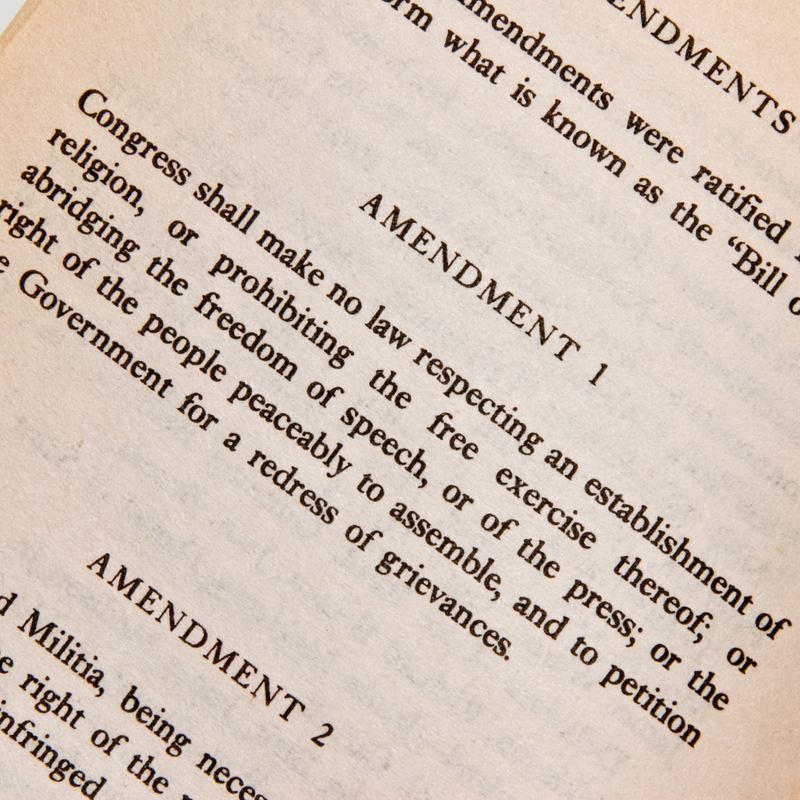
Jenin Younes: I guess there's the First Amendment, and then there's free speech, and they're not necessarily commensurate. The First Amendment prohibits the government from abridging the freedom of speech. That's the text. The text is actually Congress, but it's been widely understood that that applies to the Executive as well. It's just that the people who wrote the Constitution didn't think the Executive would be effectively making law, which they do. [chuckles] It's really a restraint on government.
Generally, when courts analyze whether or not speech is protected, they start from the premise that the most important speech that the framers saw as being encapsulated by the First Amendment is political speech. We want to be able to protect political debate on the important issues of the day. Our courts widely recognize that pretty much all speech is First Amendment-protected unless it falls under an exception carved out by the court. Those tend to be incitement to violence, threats. This is what we would call low-value speech. Then there are limitations. You don't have the right to go into a library and start shouting.
We have like time, place, and manner restrictions. We have what are called limited public fora. The government can create a public fora and then there are certain rules that apply about the extent to which you have a right to voice your view there and the extent to which the government can allow only certain perspectives. It's very complicated.
David Remnick: What was the high watermark of free speech in this country?
Jenin Younes: I think Skokie, the Supreme Court held that the Nazis were permitted to walk through this town of Holocaust survivors. I think that was reflective of the high mark.
David Remnick: Why do you think sociologically, politically, such a thing would not be possible or permitted today? What's happened?
Jenin Younes: There are a number of things. One is that we're extremely divided as a country, and I think that that creates more antipathy towards each other and less tolerance for different viewpoints. People don't like, frankly, to hear speech that offends them. [chuckles] Nobody does. I don't. Sometimes I have to resist my own impulse to want to shut people up. It sounds good to say you're for free speech, but it doesn't really come naturally. It's something you have to work on and continually remind yourself of the commitment and why we don't want the government in charge of making decisions about who should be heard and who should be silenced.
David Remnick: What is hate speech?
Jenin Younes: I don't know that there is one definition, and it's not an exception to the First Amendment, despite many misnomers. I think it's generally considered bigoted speech, probably like the N word, or if you say Hitler was right or whatever.
David Remnick: When Nick Fuentes gets on the air, and he starts talking about how cool Hitler was, he was just quoted the other day, he was reminded that he had said Hitler was cool, and he said, "You're damn right, I think Hitler was cool, and I'm tired of apologizing for it."
Jenin Younes: I don't know if I would call that hate speech, because I would say hate speech is probably more directly saying something about a group. It's obviously incredibly distasteful, to put it mildly. I don't really know exactly how you'd describe it. It's problematic speech, but again, I say the best way to counter that is through good speech.
David Remnick: It's very funny. I wouldn't have compared myself to Elon Musk in any which way, but I like to think of myself, and maybe I'm deluding myself, as as close to a free speech absolutist as it's possible to be. It's influenced by the work I do, my own politics, and so on. Then along comes Elon Musk, and he describes himself as a free speech absolutist. He's restored many removed accounts to X, and he's loosened the rules on that platform. Has that been a good thing? Is he a force for good when it comes to free speech?
Jenin Younes: You're asking me a question I ask myself a lot and still haven't come up with an answer to. I don't know exactly what's going on behind the scenes at Twitter. People are getting kicked off the platform less, but it's also become this just hotbed of absolute insanity and just people saying the most horrible things to each other.
David Remnick: Not just people, but bots.
Jenin Younes: Yes, bots.
David Remnick: Just countless bots.
Jenin Younes: I'm not sure. I still haven't figured out exactly what I think social media companies' content moderation policies should be. It's not the government, so it's not subject to the First Amendment. I think it's legitimate to have some rules to create--, in order to actually protect some free speech, sometimes you have to have rules about what can and can't be said.
David Remnick: Does the change in technology between when the First Amendment was written and now matter? When the founders wrote the First Amendment, obviously, free speech might have referred it to a pamphlet that you printed at a local printer or some such. We now have technology that can disseminate falsehoods to millions of people, billions of people, instantaneously. We have bots and troll firms that are run by all kinds of people. How does freedom of speech survive the modern technological age? You have to admit, no matter how ardent you are as a free speech enthusiast and supporter, as I am, that the pressure on it is different than it would have been in the late 18th century.
Jenin Younes: That's absolutely true. The speed with which lies can spread on social media can be very scary, and I think has real-world consequences. I agree with you. I wish I had had the solution. I do not believe that government being involved in censorship is the solution.
David Remnick: Let's say that Congress asked for your help again, and they wanted you to advise a committee about free speech and disinformation. What sort of recommendations would you make?
Jenin Younes: I think one of their biggest missteps has been this idea that noncitizens don't have First Amendment rights or constitutional rights. It's just not true, which the Supreme Court has held. Also, the spirit of the First Amendment is Congress shall make no law abridging the freedom of speech. It's not about the citizenship status of the speaker. The philosophy underlying the First Amendment is that we want to hear from people; we don't want to silence them. Immigrants have ideas and experiences that many of us are unfamiliar with. We should actually want to hear more from people from other countries, in my opinion. That's what makes us richer as a society.
That whole idea is so problematic, and I think it's so wrong-headed. That's one of the places I would tell them they got it totally wrong. Also, with the way they treat the press, the way they threaten reporters, news stations they don't like, is just a huge problem.
David Remnick: Do you think that both parties have a problem with free speech? That seems to be the crux of it.
Jenin Younes: Yes, both parties have a problem with free speech. The reason is one the framers identified, the framers of the Constitution, I mean, which is that people in power tend to want to use that power. It's just very tempting. When you're there, it's tempting to wield your authority to silence criticism, to suppress speech that might threaten your agenda, your political agenda. That's what both parties have done. I think there's also been a little bit of a loss of a cultural commitment to free speech. The public has to be on board with free speech. Otherwise, it's too easy for whoever's in power just to silence their opponents.
David Remnick: When did that go awry? When did generalized support for free speech, in your view, on both sides, become complicated and then much worse than that?
Jenin Younes: I do remember in the 2014, 2015 era, I was a public defender in New York, which is a very lefty job, [chuckles] and I was surrounded by people who would describe themselves on the left side of the political spectrum. I remember having disagreements with them about free speech. They were supportive of hate speech laws. I don't want to say everybody, but some of the people. Some of my colleagues were supportive of the idea of hate speech laws, and I was sort of pointing out the problems with that, that hate speech is not clearly defined. I think that was maybe around the time that there started to be a real denigration in public support.
I think it's been a slower drip than that. Probably since maybe the '70s, which was probably the height of the free speech era, there's been reduced protections and commitment from the public. It's a bigger problem on the right because the right is in power in the federal government, and it's usually the people in power who are doing the censoring. While the left, whatever that is, I don't even know who that is anymore, there is some censorship going on, they're not the ones who are creating the major problems that we're seeing. Perhaps in a few years they will be.
[music]
David Remnick: Thank you so much.
Jenin Younes: Thank you.
David Remnick: Jenin Younes is a national legal director of the Arab-American Anti-Discrimination Committee. I'm David Remnick, and you can find episodes of The New Yorker Radio Hour and everything we publish in The New Yorker at newyorker.com. You can also subscribe to The New Yorker there as well, newyorker.com.
[music]
Copyright © 2026 New York Public Radio. All rights reserved. Visit our website terms of use at www.wnyc.org for further information.
New York Public Radio transcripts are created on a rush deadline, often by contractors. This text may not be in its final form and may be updated or revised in the future. Accuracy and availability may vary. The authoritative record of New York Public Radio’s programming is the audio record.