
Senator Adam Schiff on How the Trump Administration Targets Its Opponents
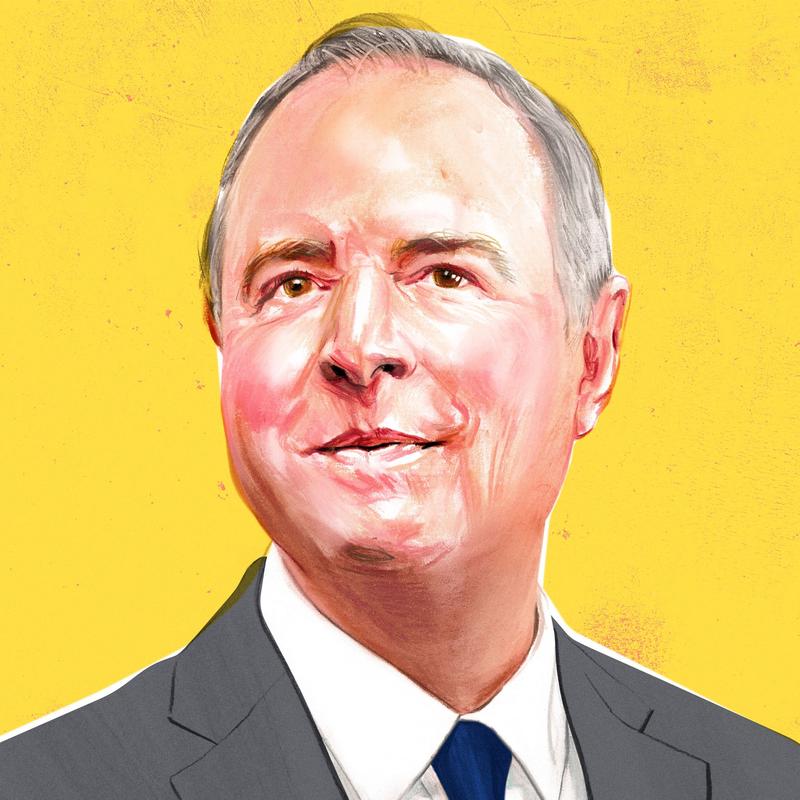
David Remnick: Donald Trump's enemies list is long and it's wide: journalists, pop stars, late night hosts, even his own architect, apparently, for the White House ballroom, and of course, Democrats, pretty much all of them at one time or another, but few public figures infuriate Donald Trump more than California Senator Adam Schiff.
Donald Trump: I would just say Adam Schiff is one of the lowest forms of scum I've ever dealt with in politics. He's a horrible human being, very dishonest person.
David Remnick: The administration announced an investigation of Schiff for mortgage fraud not long ago. Now, confusingly, the Justice Department is investigating the handling of that investigation. What did Adam Schiff do to get that prominent place on the enemies list? When he was a congressman from a district around Los Angeles, Schiff was a leader of the first impeachment proceeding. You remember what that was? That was all about Trump's so-called perfect phone call with Ukrainian officials when he asked them to dig up dirt on Hunter Biden. Later, Adam Schiff was a member of the House committee that investigated the January 6th insurrection. That inquiry brought much to light about Trump's role in those events. Adam Schiff has been one of Trump's most persistent critics when it comes to the rule of law. Trump, as a way of rewarding him, expresses his disdain by calling him pencil neck, watermelon head, and of course, shifty Schiff. For our purposes, we'll stick with Senator.
[music]
David Remnick: The President of the United States seems to really dislike you. Why?
Senator Adam Schiff: He spends an inordinate amount of time thinking about me. I live rent free in that guy's head, and let me tell you, it's pretty scary in there. I have a suspicion which I hesitate to articulate because it's a vain suspicion.
David Remnick: Please.
Senator Adam Schiff: I will share it anyway. During the Russia investigation, I'm deposing Jared Kushner. It is just shortly after Trump has first attacked me on his Twitter account. "Sleazy Adam Schiff, corrupt this, blah, blah, blah. Spends too much time on TV pushing the hoax." Something like that. I remember the time being desperate to respond. I'm being attacked by the President. At the time, a few months into Trump won, that was very unusual for a President of the United States.
David Remnick: Unpleasant or flattering?
Senator Adam Schiff: My colleagues were all deeply jealous of me, but I was frantic to figure out how I was going to respond. This was going to tens of millions of people. I would soon learn, because it became quite routine, there was no way I could respond, at least not in a way that the people he was talking to would ever hear me respond.
Nevertheless, I remember being on house floor and Mike Thompson, my colleague from Northern California, grabs my arm and he says, "Adam, you should tweet back, 'Mr. President, when they go low, we go high. Go fuck yourself.'" I so wanted to do it. If I write a book one day of the tweets I wish I'd sent, that'll be on the cover.
Like a week later or two weeks later, I'm deposing Jared Kushner, the Russia investigation. During one of the breaks, he comes up to me in a calculated and ingratiating way, and he says, "You do a really good job on TV." I said, "Well, thanks. Apparently your father in law doesn't think so." He said, "Oh yes, he does." That's why. I think in the same way that Donald Trump picks his cabinet by watching Fox, he picks his enemies by seeing who's effective against him on TV.
David Remnick: Now he loves you so much that he wrote on Truth Social to the Attorney General Pam, "I've reviewed over 30 statements and posts saying that. Essentially same old story as last time, all talk, no action, nothing is being done. What about Comey, Adam Shifty Schiff, Leticia??? They're all guilty as hell, but nothing is going to be done." Now, Comey has been encountered. Letitia James as well. What's the status of this accusation against you? I know there are limits to what you can and cannot say. Please do.
Senator Adam Schiff: I can tell you what I know, which is, frankly, all I read in the paper. We've had no word from the Justice Department, no communication from them.
David Remnick: It's coming like Christmas, no?
Senator Adam Schiff: They're, I think, having a problem, at least as I read in the paper.
David Remnick: What's the supposed case?
Senator Adam Schiff: The problem is they don't have a supposed case.
David Remnick: Spell out the accusation.
Senator Adam Schiff: The accusation is a loose accusation of mortgage fraud, and they're making it against all their political opponents. I know that we've been completely open with my mortgage brokers, bankers, so there's no there there, and they know it, too. The question is, I think, are they going to fire everyone in Maryland so they can bring in another Lindsey Halligan like they did in Virginia? We've seen how well that has gone in Virginia with both of the cases they brought against the other two Trump mentioned in that angry tweet, having their cases thrown out.
David Remnick: You seem rather serene about this.
Senator Adam Schiff: To me, what I'm facing is frankly the same fight I've been in since he became president the first time. In the beginning, it was a forward leaning, democracy, preserving effort to impeach a president who was abusing his power and then hold him accountable through the January 6th committee. This is the same fight, but now it is very much a defensive battle. Now he has new tools to abuse, including the Justice Department, but it is the same fight.
David Remnick: He talks a lot about Russia, Russia, Russia, hoax, hoax, hoax. Did you get anything wrong about that?
Senator Adam Schiff: No, I don't think we got anything wrong. I do think that at the end of the investigation, Mueller concluded.
David Remnick: Robert Mueller.
Senator Adam Schiff: Robert Mueller. I said throughout the investigation this was very possible that he could not prove the crime of conspiracy bound a reasonable doubt.
David Remnick: A lot of Democrats think there was, in the rearview mirror some legal overreach in the attempt to bring down Donald Trump. Do any of those cases seem like overreach or ill-advised in any way?
Senator Adam Schiff: Certainly the federal cases, I would say no. The January 6th case, it's hard to imagine a bigger crime against a democracy than incitement of insurrection.
David Remnick: It wasn't a day of love, in your view?
Senator Adam Schiff: I was there. It was no day of love. Likewise, the president's not only bringing of hundreds of classified documents to his residents, but lying about it by obstructing investigation into it, also very serious. In terms of the civil case, I will let Letitia James speak for herself on that case.
David Remnick: You seem a little dubious of it.
Senator Adam Schiff: No, no, I wouldn't say that at all. Whether the same standard in that case was applied against Donald Trump as would have been applied against others, I will leave her to speak to. I wouldn't be able to compare what kind of cases I brought as a prosecutor in New York without knowing what kind of prosecutors cases I brought in New York.
I do think that the argument of some kind of equivalence is a false narrative. I hear it all the time on the Senate Judiciary Committee. I hear all the time how the Justice Department under that horrible partisan Merrick Garland was so weaponized against Donald Trump. That's a complete fiction and fabrication.
David Remnick: Do you feel that Merrick Garland moved too slowly, too cautiously?
Senator Adam Schiff: I absolutely do, yes. This is the irony of it, of attacking Merrick Garland, which is they moved with alacrity against the foot soldiers who broke into the Capitol that day. They moved not at all for an entire year against the higher ups.
David Remnick: Why did Merrick Garland move so slowly? What about his character or tactics, his strategy led him to behave that way?
Senator Adam Schiff: The Justice Department in the first Trump was abused and made partisan. He wished to restore the department's reputation for independence. Now, what they did in the first Trump Justice Department is peanuts compared to today. Nevertheless, Merrick Garland wanted to restore the reputation of the department for strict non partisanship. That made him very reluctant to pursue an investigation of the president. Too reluctant.
Ultimately, that gave the Supreme Court the time it needed to drag things out further and make the case against Trump go away completely when it could have been brought to fruition. We might be in a very different place today. I think it was that laudable aim that taken too far, amounted to a immunity for the President.
David Remnick: I have to think that Donald Trump feels two things about the prosecutions against him and the impeachments. He feels that he prevailed, and that fills him with a sense of invulnerability at this point and rage at the same time. Do you agree with that? How does that shape his behavior as president?
Senator Adam Schiff: In his own head, it's often difficult to figure out, what does the president really believe? I think what the president really believes is you make your own truth through repetition. Whether he's talked himself into his victimization, he's always viewed himself as a victim of everything. Whether he truly believes it, who really knows? It's probably less important than what does he do on the basis of whatever belief he has. I've also thought there's this interesting comparison of blind spots. Trump, being a pathological liar, can't envision anyone else committed to the truth. He's just an alien idea, David. It's a blind spot.
Likewise, but from a completely opposite perspective, Bob Mueller, such a person of integrity and truth that I think he found it impossible to believe that Bill Barr would so betray him, as Barr went on to do by misrepresenting Mueller's report. In a way, they have an interesting but opposite blind spot. One unable to see people acting so unscrupulously because they comport themselves with such integrity, like Mueller, and the other like Trump, who has no moral compass and doesn't believe anyone else does either.
David Remnick: Do you think there's anything ruinous about the Epstein situation for Trump, or is this something that will fade like so many other things?
Senator Adam Schiff: If there are ruinous things in the files, the public will never see them. Bondi and company will make sure they never reach the public eye. For another, I think he's almost impervious to dirt.
[music]
David Remnick: I'm speaking with Senator Adam Schiff of California, and we'll continue in just a moment. This is the New Yorker Radio Hour.
[music]
David Remnick: This is the New Yorker Radio Hour. I'm David Remnick, and I'm speaking today with Democratic Senator Adam Schiff of California. Now, the headlines lately have been distinctly discouraging for President Trump. Disappointing economic numbers, lousy polling, and the departures of some MAGA faithful, including Marjorie Taylor Greene.
There's a sense now that Trump's grasp on Washington may be a little bit vulnerable, and yet the Democratic Party so far hasn't really capitalized on that sense or been able to seize the momentum. Adam Schiff has spent 25 years in Congress serving in the House of Representatives before his recent election to the Senate.
[music]
David Remnick: One thing I get tired of hearing, and this has been going on for years, Democrats saying, "My Republican colleagues in the halls of Congress allow to me, they admit to me that they can't stand Donald Trump, and then they don't act on it." Why not? I ask a lot of people this. Are these jobs so swell? Is it so great being a congressman or a senator that you don't want to risk going back to your home state or district and being a lawyer, a teacher, or whatever it was before that you sell your principles and soul?
Senator Adam Schiff: No, no, the job isn't worth it, and no job would be worth it. At that level, I don't understand it at all. At a different level, I understand it completely. They're afraid. I talked to one senator, for example, along with Tim Kaine, have been offering war powers resolutions. I was working the Republican senators. I know that a lot of them are deeply uncomfortable with this blowing up of ships and more uncomfortable with the idea of going to war in Venezuela.
I had one very senior Republican tell me, "You have to understand, it's not just that he will punish us, he'll punish our whole state." They're worried about their constituents. They're worried about themselves. They're worried about their personal safety. Then there was also this endless process of rationalization which goes like this.
David Remnick: Somebody worse will come.
Senator Adam Schiff: Yes. If I don't vote for RFK Jr. you should see the guy they've teed up to run against me in the primary. If I don't vote for Pete Hegseth, I'd be gone. You should see he would come after me. My feeling is, let me see him. If you're going to just vote the same way anyway, how much worse could it be? I don't really derive any satisfaction from hearing private misgivings. I long since gained any solace from that. If you're going to vote with him on these things that are destroying the country, then why be here? Some of them are deciding, as you say, it's just not worth it to them anymore and they are leaving the Congress.
David Remnick: In drips and traps.
Senator Adam Schiff: Yes.
David Remnick: You raised Venezuela, and rightly so. The Senate and House have ordered investigations into whether Pete Hegseth ordered the killing of unarmed survivors in one of those boat strikes that's been going on in the Caribbean. I don't know how many have already taken place. The numbers are growing. Is there really actual bipartisan concern about these actions, and how much longer can they go on? What's coming down the road here?
Senator Adam Schiff: There is bipartisan concern. We've had now two votes on war powers resolutions. We've had two Republicans who have voted to end the strikes or to withdraw any implied congressional approval of these things. We need four to be able to win in the Senate. We need, obviously, to carry the House, and we would need to do it by a veto-proof majority.
Nevertheless, even in the absence of veto-proof majority, it makes a statement. It has an impact. The president does pay attention when he's voted against by his own party. Up until now, the Republicans seem to take turns as to who can vote against the President and rarely allow that more than four people do so at one time.
By and large, all we're seeing is verbal expressions of concern, occasional votes of concern. The Republicans who are now saying they're concerned about these reports that Hegseth ordered the murder of these survivors on one of these ships I think does deeply concern them. The question is, will they go beyond concern? They both said they'll do an investigation in the House and Senate. Let's say this investigation reveals that yes, they were survivors and yes, they were killed--
David Remnick: Is that a war crime?
Senator Adam Schiff: It would be a war crime. If those reports are accurate, it's a war crime. It's also murder. Will Republicans take the next step to hold anyone accountable? I'm very doubtful about that.
David Remnick: One of the great spectacles, and there's so many every day in political life, is the testimony in the committee hearings involving Kash Patel and your committee and Pam Bondi as well. The technique being employed by Kash Patel and Pam Bondi seems like something new, the way they don't answer your questions and then attack personally whether it's you or anybody else on the committee.
David Remnick: Was that true what the White House press secretary said when she denied him and took the money? Did he take the money?
Pam Bondi: Senator Schiff, I answered that question multiple times.
Senator Adam Schiff: With respect, I don't think you did, but in case I just didn't hear you, what is the answer? Did he take the money?
Pam Bondi: Senator Schiff, that happened prior to my confirmation as attorney general.
Senator Adam Schiff: I understand.
Pam Bondi: I said that.
Senator Adam Schiff: Do you know, sitting here, whether he took the money?
Pam Bondi: All I know is that Deputy Attorney General Todd Blanche and FBI Director Patel said there was no case. Karoline Leavitt is one of the most trustworthy human beings I know.
Pam Bondi: Senator Schiff-
Senator Adam Schiff: Was she right?
Pam Bondi: -if you work for me, you would have been fired because you were censured by Congress for lying with your egregious--
Senator Adam Schiff: You can stipulate to all your personal attacks on the Democratic members of the committee.
Pam Bondi: Personal attacks. You've been attacking my FBI director. You've been attacking my office. You've been attacking [unintelligible 00:18:12]
Senator Adam Schiff: What we're interested in is the answer to these oversight questions.
Pam Bondi: No. Oversight. You want your five minutes of fame.
Senator Adam Schiff: You were asked by my colleague--
Pam Bondi: -attacking good people.
Senator Adam Schiff: A regular order, Madam Chair, so I can ask a question. If you watch Bondi in particular, it was so obvious because she kept turning to her notes for the pre-planned attack on Senator Blumenthal or Senator Whitehouse or Senator Schiff, or whoever.
David Remnick: Does it work?
Senator Adam Schiff: It only works if the Republicans allow it to work. If the Republicans in that committee said, "Actually, we need to know, did Tom Homan, the White House border czar, allegedly take $50,000 from undercover FBI agents? If he did, why was the case dismissed? If it was, was he allowed to keep the money? Pretty basic oversight question of a top ranking Trump official.
David Remnick: How do the Republicans respond?
Senator Adam Schiff: With silence and allowed Bondi to simply attack anybody asking that question. It's also an illustration of who they're really speaking to in those hearings, which is an audience of one person. Pam Bondi knows the only person that she owes her job to is Donald Trump. The only one she needs to please is Donald Trump, so that's what Bondi does. As long as she does that, she'll never have a problem in a hearing with her boss.
David Remnick: Does it matter that the institution involved is up in arms against its leader now? The FBI, for example, seems to be in its rank and file apoplectic about Kash Patel and Dan Bongino, that this leadership has made them furious in any number of ways. Does Kash Patel last?
Senator Adam Schiff: I don't know if he lasts. If he doesn't last, it's because he keeps embarrassing the president. The president doesn't care whether Kash Patel is competent. He does not like to be embarrassed, though. For Patel, for example, to say that the suspect was in custody after Charlie Kirk's horrible murder when it wasn't true, because Patel wanted to leap out there on social media ahead of people and say things he knew nothing about, that is a humiliation for the president. And you can count on Patel to keep on embarrassing and humiliating the president because he's incompetent and in way over his head.
David Remnick: Who else would you put in that category of incompetence in the key cabinet positions?
Senator Adam Schiff: I don't know that I would put her in the category of competent, but willfully destructive, I would say Tulsi Gabbard. She does not get as much attention as the rest of these--
David Remnick: It's hard to hear every voice in the choir.
Senator Adam Schiff: Yes, it is. [laughs] It's only an asterisk in articles now about Venezuela that the whole predicate of these attacks is a lie, that the intelligence community assessed that Tren de Aragua, this Venezuelan gain, was not being controlled by Maduro, by the government. They weren't sent to infiltrate America, carry out terrorist attacks or whatever. The National Intelligence Council writes this report. They speak truth to power. They're told by Gabbard's chief of staff basically to rewrite their conclusion and ultimately they're fired. Intel analysts know that if they write things that contradict the president's preferred narrative, they're gone.
David Remnick: Since it's the holiday season and we want to bring nothing but good cheer to our listeners, I must ask this. I know you'll say the fever will break step by step with things like the midterm elections, but we've had historians on and other political analysts who say, "Look, remember, this is not the first bad period of American history. We've had the Civil War, for God's sake. We've had all kinds of periods of enormous crisis and even existential feeling crisis." Tell me what your greatest immediate fears are and maybe go back to a little bit about how they can be avoided and tamped down for us to get from month to month, year to year.
Senator Adam Schiff: In the category of deepest fear, most profound concern, is that somehow they're successful in thwarting the one remaining mechanism for accountability, and that is the election. Barring that, their time will come to an end. What we do right now will determine how quickly it passes, how much damage is done in the meantime. Making sure that we have a free and fair election has got to be at the top of our priority list because the Supreme Court will not save us. Republicans in Congress will not save us certainly not based on current conduct.
David Remnick: Will the coherence of the Democratic Party save us?
Senator Adam Schiff: I think what will save us are the American people themselves. The most important players in our democracy are what is going to save this democracy, and that is the people with the title of citizen. If you look at what the citizens are doing, gathering by the millions to protest the president, what the citizens just did in this last election in California, there were lines around the block to vote on a ballot measure about reapportionment? Seriously? Reapportionment? Who would have thought five people would turn out to vote on reapportionment?
If anything, that election in California was the purest referendum on the president. In New Jersey and Virginia, in New York City, it was a competition of candidates. In California, there was no competition of candidates. It was simply a referendum on the President and his policies, and it drove people to the polls. It's going to be the citizens that save us. We need to make sure that their votes still matter.
The most successful tool that we've had has been litigation. We do very well in the lower courts. Even delaying harms is valuable when a country is marching towards a kind of dictatorship. The way I view my job every day, and I think this should be the same way that we all view our jobs, every day, we need to think about what can I do today to mitigate the harms.
I love how in Chicago, where they learn from the experience. In Los Angeles, you have parents driving other parents' kids to school so that their parents don't risk being arrested and deported. I love how people are dropping off food to families so they don't have to risk going to the store. People are taking steps to support their neighbors, to support each other.
These public servants who are getting fired or quitting are doing something really important to serve the country. The federal employees who are staying on the job are doing something really important to save the country. There are just lots of people showing millions of acts of kindness, of devotion to our democracy that give me the confidence to know we're going to get through this.
[music]
David Remnick: Adam Schiff, thank you.
Senator Adam Schiff: Thanks, David. Great to be with you.
[music]
David Remnick: Senator Adam Schiff of California. He served in Congress since 2001.
[music]
Copyright © 2025 New York Public Radio. All rights reserved. Visit our website terms of use at www.wnyc.org for further information.
New York Public Radio transcripts are created on a rush deadline, often by contractors. This text may not be in its final form and may be updated or revised in the future. Accuracy and availability may vary. The authoritative record of New York Public Radio’s programming is the audio record.