
The World Cup, the Knicks, and LeBron James’s Fate: An All-Time Summer in Sports
David Remnick: It would be an understatement to say that this summer has brought a flurry of incredible sports activity to the city of New York, to the country, and the world. What started with the triumph of my beloved Knicks in the NBA Finals has led to some remarkable tennis showdowns already in Wimbledon and a dramatic and already politicized World Cup tournament. Then there's all the speculation about the fate of 41-year-old LeBron James, the greatest scorer in the history of the league, who may be on the cusp of his NBA swan song.
Reporter: Breaking news out of the NBA. Shams Charania reporting that after eight years, LeBron James, the NBA's all-time leading scorer, will be playing a record 24th season in the NBA, but it will not be with the Los Angeles Lakers. The reaction is pouring in on--
David Remnick: To make sense of all the headlines and all the heroics, I sat down with my colleague, New Yorker sports writer Louisa Thomas. Louisa, it's good to talk to you again. The last time we talked was with Vincent Cunningham, all verklempt and hysterical about the Knicks' win. I still think that's the dominant story in sports, possibly for the next, I don't know, decade. What do you think?
[laughter]
Louisa Thomas: Nothing else has happened since.
David Remnick: We're going to let a few other events sneak through the door, namely the World Cup. I got to say, there are a lot of reasons to be a little-- well, I don't know, sheepish about American-ness lately, but that whole Trump episode and the American team, what do you make of it? What a disaster.
Louisa Thomas: It really was a U-turn in good vibes.
David Remnick: What compelled the President of the United States to get involved in a red card? Tell us the story?
Louisa Thomas: David, are you asking me to wax poetically about the interiority of the President of the United States?
David Remnick: Yes, why not? Why not? Why not?
Louisa Thomas: Well, I think Trump had been kind of snoozing through the early part of July. He'd actually been remarkably hands-off about the World Cup. He'd been involved in his own 250th celebrations. He had not been at any of the games so far, but he repeatedly claimed that he did not know what a red card was.
President Donald Trump: Red card. I didn't know what the hell a red card was. When I found out, I said, "You got to be kidding."
Louisa Thomas: Until that moment, that he-- [crosstalk]
David Remnick: He's had lots of thoughts about it.
Louisa Thomas: Yes. He knew that that wasn't a red card, whatever it was.
David Remnick: Generationally, a guy who's 80 years old who grew up in the New York area, soccer is not his thing. This is a guy who still thinks George Steinbrenner is the owner of the Yankees. He gets involved and he protests the red card, and then the team gets their star back. Admittedly, it was not a great call, the red card. The American team just seemed to go belly up, "What happened out on the field?"
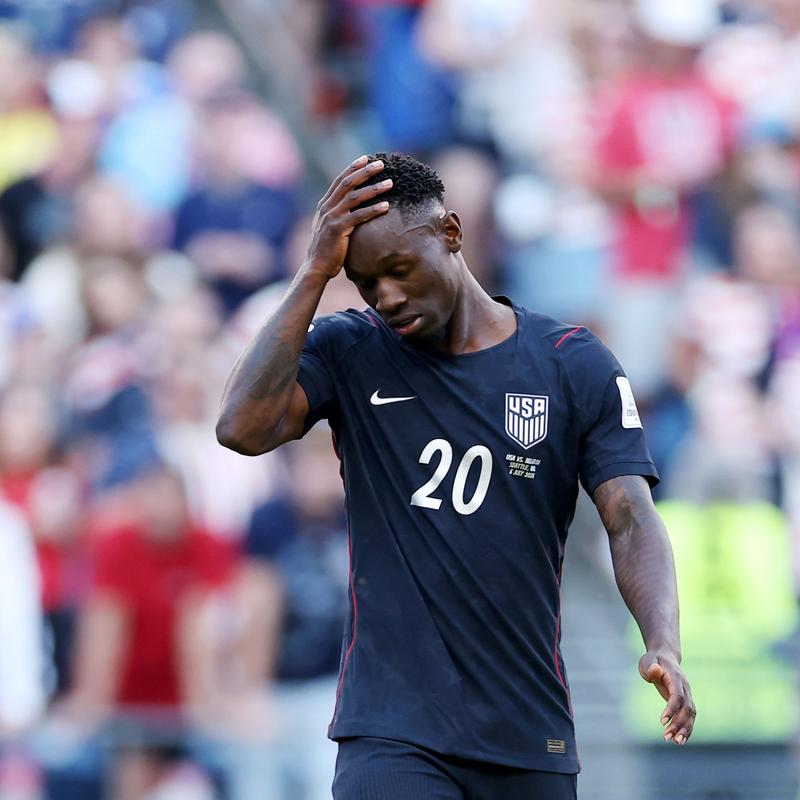
Louisa Thomas: Well, one thing that happened is that they faced a superior team, which had not yet happened. Belgium played extremely well. Belgium played like they were motivated to defend not only their honor, but the honor of football. It's interesting because the US actually came out a little flat in several of the games, even in the first game against Paraguay. For the first few minutes, they were pretty disorganized, and Paraguay was actually the one with the better chance. What happened in the first two games, especially, is that they scored early. That seemed to settle them and allowed them to get into their patterns.
In this game, Belgium came out and had an immediate chance. It was like from kickoff.
Soccer Commentator: An electric start. The USA didn't really take charge, and Belgium did. De Ketelaere.
Louisa Thomas: I think that that rocked them back after what had been obviously an emotional 24 hours. Belgium scored quite quickly, and then it was just like the wheels just not only came off, but flew into outer space.
Soccer Commentator: Belgian celebrations fill the Seattle air as the Red Devils roar into the quarterfinals. United States of America 1, Belgium 4.
David Remnick: You've got instant replay about balls and strikes and plays at first base and all the rest. We have all kinds of video second-guessing and other sports. How is that dealt with in football and soccer?
Louisa Thomas: What happens is the use of-- it's known as VAR in soccer, video-assisted referee is extremely controversial and contested among soccer fans because when it helps your team, it's obviously just objective truth, and when it goes against you, it's misused somehow. Basically, the idea, and this is infiltrating sports, all sports really, is that there's this idea that we should get calls right, and we have the technology to do it, so let's try. There is someone monitoring these TVs, basically, and they have the capacity to slow down or replay. When something is missed, the referee is alerted that they're going to go to a video review.
In this case, the original call was not even made on the field, but the video review alerted. We were going to review this. There is a rule that, basically, if you step on someone's leg, that's considered quite dangerous, because it is. There have been cases in which players have just totally flown out of control into players and stepped on their legs and then broken them. In this case, though, in the regular run of play, like in the flow of the game, it was just a typical football challenge. What happened was, when they went to video review, they actually watched the replay over and over.
When you slow these things down, they can look pretty horrific. There is a photo of Flo, as many people in soccer call him, for the obvious reasons, standing on top of the Bosnian player twisted ankle. That is pretty uncontrovertible. However, you're actually supposed to watch it as the referee has watched it. One of the US's objections here was that they had misused VAR by slowing it down and focusing on the still photos instead of watching it as the referee would have watched it, which is a more typical play.
David Remnick: This drive toward exactitude, it's kind of like a philosophical question that we no longer are going to tolerate the ups and downs of the judgment and eyesight of an umpire or a referee, and we're going to get it so absolutely right that you can now have offsides calls determined by a sensor that's in the ball.
Louisa Thomas: Yes.
David Remnick: How does that work?
Louisa Thomas: There are sensors in the ball. It works as it sounds. There are sensors in the ball that can measure exactly not only where it is, but if it's been touched. There have been several controversial calls where hasn't looked like it's been touched, but the sensor has kind of flared, and maybe it hit a few strands of someone's hair, or maybe someone was offside by a millimeter. One of the interesting things here is that there is a very small margin of error for all of these things, but we are not allowed to operate in the gray here.
This has been an issue in tennis. This has been an issue in baseball. Obviously, this has been an issue in all sorts of sports as we try and figure out what kind of human judgment we want to involve.
David Remnick: Now, another big issue with the World Cup, before we leave, is I'm now starting to see, because, as you know, trend pieces in journalism, if you have three examples, you're all set to go. Is there a Trump curse? Trump came to see the Knicks in Game 3, the Knicks lose. He goes to see the Chiefs in the Super Bowl, the Chiefs get obliterated. Now he interferes in the World Cup, and the US Team really performs poorly. Are you willing to set down the law here and say there's a Trump curse when it comes to sports, because I absolutely [crosstalk]
Louisa Thomas: I was ready to do it after two, through a series makes.
David Remnick: Yes, there you go.
Louisa Thomas: I do think there is some question about whether or not this was just a soccer question, was the US going to win? I do think that there was a different kind of energy around the team. There was a different kind of energy around the Belgian team. These are not double-blind experiments. We can't go back in time and say what would have happened if they were able to play without this kind of interference. I can say that the US Coach is very interested in energy. He thinks everything comes back to positive, good vibes. That stuff is usually overlooked because he's such a good tactical coach. In this case, I think he might be completely right. The energy around this team, it shifted.
David Remnick: Yes, it really did. Now let's get to very important things, the Knicks. I feel they did not improve substantially during the free agency period. I think they, for financial reasons and so on, are standing pat. The big news in the NBA action in recent days has been the destiny of the 41-year-old, now former Laker, LeBron James. The choice seems to be whether he goes to the Cavaliers for a poetic ending of his career or whether he goes to join the Warriors and have fun with Steph Curry. What do you think he'll do?
Louisa Thomas: Here I thought you were going to spend the entire segment talking about Mitchell Robinson going to the Celtics.
David Remnick: [laughs] Fare thee well, Mitchell. Don't break your hand. Don't punch any more trucks.
Louisa Thomas: Where does my heart go? My heart always goes to poetry. I want him to be Odysseus returning home, but much like Odysseus, I actually think that there is something in LeBron James that always needs to leave.
David Remnick: Bye-bye, Penelope.
Louisa Thomas: Exactly. I think he really is considering Golden State. There are other reasons for him to want to go to Golden State. One is to have fun with Steph Curry, which would be its own kind of poetry.
David Remnick: Yes, I'd watch that.
Louisa Thomas: For sure. Also, it is closer. He has no intention of moving his base camp back to Akron. He still has family there. He still has roots there, but his life is in L.A. now, and that's an easier trip from San Francisco than from Ohio.
David Remnick: I think you and I and Vincent, even though we're all reduced to tears, tears literally streaming down the face of Vincent Cunningham on our Substack live final night--
NBA Commentator: Pass to Wemby. Wemby tries a three, puts it up, off the mark. Anunoby the rebound. It's over. It's over. Knick fans, this is not a dream. Your long, long wait has ended. Go ahead and cry. After 53 years, the Knicks have finally-- [crosstalk]
David Remnick: We all realize that San Antonio is a great team and Victor Wembanyama is a fantastic player who's only going to get better. What does he have to do in the off-season to be that much better, particularly in the playoffs? What's the slight missing piece in Wemby that's going to have to come together?
Louisa Thomas: Well, one thing that happened is that he played 20 to 30 minutes during the regular season, and suddenly he was playing 40 minutes a night in high-pressure situations. One thing is just building up his fitness base. I think, though, that Wemby is a person who is obsessed with the completeness of the game and keeping his cool. You referred to his penchant for smushing the opposition.
David Remnick: He does do that.
?Broadcaster Richard Jefferson: This is what frustrate Brun-- Oh, whoa. Excuse me. That should be a Flagrant 1. I can understand why Brunson and then Wemby's laughing at him.
David Remnick: I think some of that was a little deliberate because he was a little bit soft and a little too nice and a little not badass enough. Maybe you don't have to try to break our hero's ankle in the process, but I think some of that might have been deliberate.
Louisa Thomas: Yes, he does do that. It's going to be interesting to see because he went-- speaking of U-turns on vibes, he went from someone who was universally admired and celebrated almost to being someone who is seen as a great villain. There is a place for villains in the NBA, for sure.
David Remnick: Finally, another thing that I was watching was tennis, and I was really taken, really, really moved by Serena's comeback match against this very young, very nervous-- it was just very touching to watch this match. Tell me about how you saw that.
Louisa Thomas: Oh, yes. I was actually surprised by how moved I was, in part because it seems to me that everybody was surprised by Serena coming back. I had been waiting for this day since she had "retired." I was not at all surprised when she came back. ESPN has these cameras everywhere. It's absolutely surveilled. In the hallway where you go from the players' locker room out to the court, they are tracking the players the whole time. Serena's opponent was-- she did not know where to put her eyes. She'd never been in this situation, and she was just like a deer.
Serena, because she has been in this situation so many times and she very much knew she was on camera, just looked as relaxed as a lake. When they stepped out there, I was like, "Wow, this is moving." It was a slow build. Just when I thought the match was going to be over, Serena did the thing that Serena does, and she started throwing down aces, down break point. In tennis, there's this classic pattern of the big surf followed by the big forehand. She did one of those. I was transported back to 2011 or 2012 or 2002. You know what I mean? It was just one of those moments.
David Remnick: There's more muscle memory
Tennis Commentator 1: Game, Williams.
Tennis Commentator 2: You don't become one of the greatest athletes of all time for nothing. Champions, champion spirit. She's stiff in this fight, Serena Williams.
David Remnick: Now Serena has knee problems. Do you think this comeback is over just as it started?
Louisa Thomas: She has actually announced, or one of her coaches, Rennae Stubbs, who is herself a doubles Grand Slam winner, that she's going to play in the US Open, and hopefully, as long as her knee is okay, she's going to probably play a warm-up event. Do I think it's over? I don't know. She is not someone who likes to go out on a loss. The problem is, in tennis, unless you win the tournament, you go out on a loss. It's also hard to imagine her going out on a win. [laughs]
David Remnick: That would be just beyond beyond.
Louisa Thomas: Yes.
David Remnick: Well, Louisa, it's always a pleasure to talk sports with you. Thank you so much.
Louisa Thomas: Always.
David Remnick: Louisa Thomas writes the Sporting Scene column for The New Yorker. You can find her writing on the World Cup, Serena Williams's attempted comeback, and much more at newyorker.com.
Copyright © 2026 New York Public Radio. All rights reserved. Visit our website terms of use at www.wnyc.org for further information.
New York Public Radio transcripts are created on a rush deadline, often by contractors. This text may not be in its final form and may be updated or revised in the future. Accuracy and availability may vary. The authoritative record of New York Public Radio’s programming is the audio record.