
How a Trump-Endorsed Republican Could Become California’s Next Governor
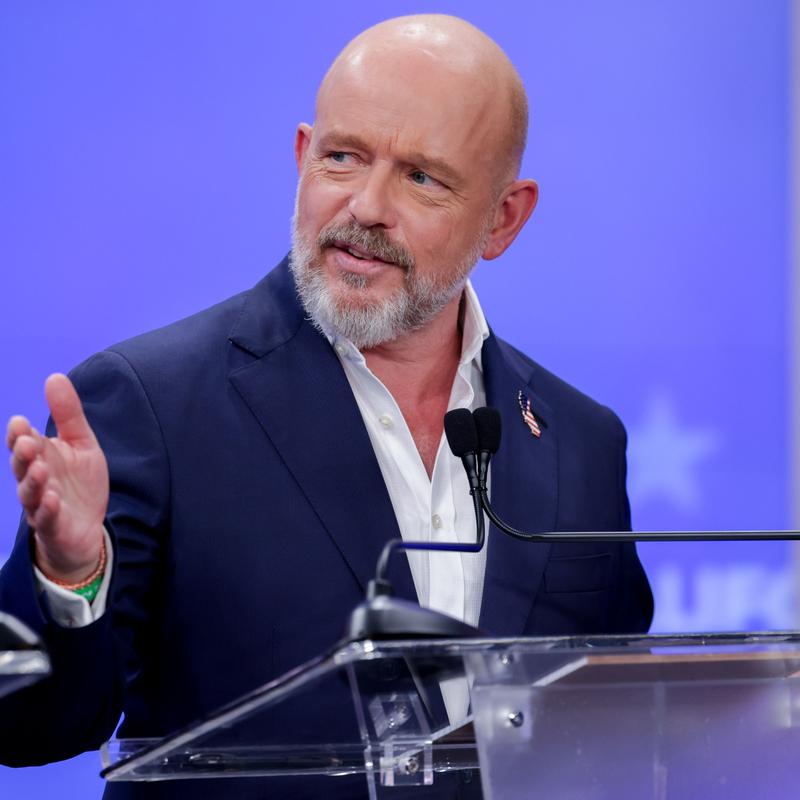
David Remnick: Now, if you've been following news about the midterm elections coming this November, you may have heard a very confusing story coming out of California. The polls are shifting all the time, and Eric Swalwell, the leading Democrat, recently dropped out following accusations of rape and sexual assault, charges that he denies. It seems that the leading candidate in the California governor's race right now is a Republican endorsed by Donald Trump. His name is Steve Hilton, a British-born political consultant and a former Fox News host.
Now, you may have been puzzled by that, since Democrats outnumber Republicans in California by no less than 20%, and Trump is deeply unpopular there. Partly, Hilton's modest lead in the polls may result from California's unusual primary system and the chaos of the general race. Now, the way this works is that the two candidates who get the most votes in this primary, regardless of party, move on to the general election. It happens that there are more Democrats running in the primary, and so the Democratic vote is all split among the candidates, at least as of now.
It's also true that big blue California has elected prominent Republicans before, Ronald Reagan, of course, and more recently, Arnold Schwarzenegger. Hilton is running on issues like affordability, cutting bureaucracy, and increasing oil and natural gas production. I spoke with Steve Hilton last week.
Mr. Hilton, you were born in the United Kingdom. You have a British accent. What are you doing running for governor of California? How did you get here, and why should the voters of California say yes?
Steve Hilton: I know, it's crazy. You can't have a governor with a foreign accent. That would be a disaster. Of course, the thing I like to point out is that the last Republican governor of California, Governor Schwarzenegger, of course, had an accent probably even more hard to understand than mine.
David Remnick: not that I can hear.
[laughter]
Steve Hilton: My favorite joke about that is that, of course, you're right. I was born in the UK, but my parents are Hungarian. I always reflect on the Austria-Hungarian empire and point out that you've had the Austrian, now let's have the Hungarian.
David Remnick: That's just what we need is more empire.
Steve Hilton: Exactly.
David Remnick: Seriously, Arnold Schwarzenegger came here and he was a big figure in sport, athletics, weightlifting. People knew him through pumping iron and Kennedy family. Then he entered politics after a big career in the movies. You came here relatively recently, right? 2012?
Steve Hilton: 2012, yes.
David Remnick: Why did you come to the United States after a career in politics and business in Britain?
Steve Hilton: In 2012, we moved to the Bay Area. My wife, she had a big job at Google at the time. She was big global job there. I was working in 10 Downing Street, I was senior advisor to the Prime Minister, David Cameron.
David Remnick: David Cameron.
Steve Hilton: Exactly. It was when our second son was born. It was just a lot, frankly. There was a lot of traveling for my wife back and forth to California, the time difference and so on. Really, it was just for our family's sanity, we thought we would make the move, not necessarily intending to be here in California forever. Actually, even before we moved here, I had a real love affair with this state. I thought, and still do think, California represents, which truly for me is the best of America. There's a phrase I use all the time, which is California means to America what America means to the world. What I mean by that is that's just the best--
David Remnick: That's fair. I think you and I would agree that if I came to Britain as recently as 2012, knowing the British press, as we both do, and I decided to run for an office as high as whatever the equivalent of Governor of California is, or ended up trying to be Home Secretary or Foreign Secretary or even Prime Minister, I would get blistered in the British press for being, well, presumptuous.
Steve Hilton: Well, isn't that the magic of America, that anything is possible? Iin particular, California. I actually make that point on the trail where I point out that the fact that this is even a possibility speaks to what an incredible country this is. For much of this year, I've been at or near the top of the polls.
I think, in the end, what's working and what I think will take me through to what I concede is a very improbable victory in the general election in November, is the simple fact that we're desperate for change in California, that you've had 16 years now of one-party rule where the Democrats have controlled everything in this state. They've controlled all the statewide offices at majority in both houses of the legislature, all the big cities and counties, and the results are in, and they're really bad.
We've got the highest unemployment rate, the highest cost of living by far, US News and World Report, when their rankings annually just ranked as 50th out of 50 states for opportunity. You could go on with the examples of where California is not just doing poorly, but doing worse than any other state.
David Remnick: What have you been doing here in the States professionally since 2012 that would give you the qualification to be governor? We mainly know you as a Fox News host, which in the era of Trump, that certainly has been a credential. We have Pete Hegseth, Jeanine Pirro, Sean Duffy, and many more come from that world.
Steve Hilton: Well, you also have in the form of a former governor here, former Governor Reagan, someone who'd make their mark in that, in what you could broadly describe as the media. Actually, what I would point to is not just what I've done here. Just to directly answer your question, when we moved here in 2012, I taught for a couple of years at Stanford, then I started a business here, and then moved into this very unexpected new career in the media.
Really, what I would point to over the course of my career is a broad set of experiences both in business and in government, which I think is a good combination for an executive role. It's that business mindset, a problem-solving mindset. I wouldn't claim that I'd had any kind of spectacular success in business, but I know how to start and run a business. I've been responsible for that. Different types of businesses over the years. Then in the UK, actually working there at the heart of a government, trying to make change happen, seeing how hard that is, seeing how difficult it is to implement policy, actually working as part of a coalition government, working across the aisle, as it were.
David Remnick: You're known as a supporter of Donald Trump, and Donald Trump has endorsed you. What's been your analysis of his one-year-plus second term as president? Has it been a successful presidency in your view?
Steve Hilton: Yes, especially when you look at the speed with which some of those changes that he promised that the American people voted for have been delivered. I think it's an interesting example of how-- the thing I'm thinking of in particular is the border. We had a situation that was completely out of control, I think looking back on the Biden years, and the speed and effectiveness with which that crisis was brought under control, I think speaks to something that it's interesting in a way, I think, Democrats ought to be talking about it more because it can restore one's faith in government action, the ability of government to actually get something done effectively.
David Remnick: What was your reaction to the deployment of ICE in Los Angeles and elsewhere in California, much less in Minnesota, Chicago, and other cities?
Steve Hilton: Yes, it was a horrible spectacle to see, and I never want to see that.
David Remnick: You would push back against President Trump if that came to the State of California when you are in office?
Steve Hilton: Well, I think it's actually a really good example of how it would be helpful to have a governor that would work cooperatively with the administration. The reason that we ended up in that situation where you had awful scenes of violence and chaos and lawlessness and confrontation was because you had a confrontational posture from the California political establishment at every level. We wouldn't have that when I'm there because we would want to make sure, just as you saw when Obama was president, where you had actually slightly higher levels of immigration enforcement going on without any of this kind of confrontation. I think that is much more the model that I'd like to see.
David Remnick: How do you feel about the personality that's in the White House? That matters. Rhetoric matters in politics, how you present yourself, how you you speak, the empathy or lack of it matters. When you hear President Trump talk about wiping out a civilization in one night in Iran, when you take into account his almost daily vituperation on truth, social and other platforms, is that a model for you?
Steve Hilton: Well, I think that whole part of the political conversation and the media conversation is almost what's gone wrong for California, because I think that nationalization of our political debate means that we haven't paid attention to what's actually going on here.
David Remnick: The President presents himself in a certain way, and you're saying you're supportive of it, and voters are going to take that into deep account. As you know, California, the President is not terribly popular. How do you feel about his rhetoric? How do you feel about the fact that his family has taken in billions since the beginning of this second term? How do you feel about the war in Iran? Are you for that?
Steve Hilton: Well, I was definitely supportive at the beginning. I've been on the record about that, not least because of the connection that it drew for me between what happened in Hungary, actually going all the way back to 1956.
David Remnick: Your family immigrated from Hungary in 1956.
Steve Hilton: That was what immediately came to my mind, which was you saw over the years since 1979 in Iran, these periodic, brave attempts by people to throw off this authoritarian rule. Each time, despite the professed support that from the West, broadly speaking, for what they're trying to do, no help ever came. It really reminded me of a thing that Hungarians say a lot, those of that generation, which is in 1956 when they stood up against the puppet regime imposed by the Soviet Union in the revolution of '56. They were hoping for help, and nobody came to help us. That's a-- [crosstalk]
David Remnick: More recently in Hungary, the candidate who was considered the authoritarian was the incumbent, Viktor Orban, who was supported very heartily by President Trump. Did you join President Trump in supporting Viktor Orban?
Steve Hilton: No, no, no. I've always been critical of some parts of what he's been doing, but not others. The point I really would want to make is, truly, this is a big state with a lot of problems, and that's what I'm focused on. I'm not a political commentator. I'm a participant in the political process, running for office to try and solve some very serious problems affecting the biggest state in our country.
David Remnick: You're pretty close to Donald Trump in your politics, and voters understand that, and you advertise that.
Steve Hilton: Well, I say on policy, I think that's the important point, because the focus for me is always what happens and what's the impact of policy on real people.
David Remnick: Does it concern you that he has a 29% popularity rating in the State of California and how that'll impact you?
Steve Hilton: No, because I think that the choice for California is not a popularity. It's not an opinion poll on President Trump. It's what will happen to me. Will my kids be able to afford a house so that they can stay in California? Right now, you talk to most young people. I get many coming to my town halls up and down the state. You ask them directly, after college, do you think you'll stay here? The answer is almost always, "No, because it's impossible to imagine that I'll ever be able to afford a home or to start and raise a family here." Those are the things that the election is going to be about in the end, rather than someone's opinion of a national leader that, in the end, has much less influence on these practical things that affect us in California than the government of California and the people we elect to positions of power here in our state.
David Remnick: You're proposing something called Cal DOGE, a California version of what Elon Musk and the President led in the very beginning of this second term. Is that an echo that you think is good for you? Do you think DOGE was a success on the federal level?
Steve Hilton: Well, it's not just proposing. We're already doing it. We've actually started the very important work of finding so that we can then stop the waste of taxpayer money. I think everyone would agree that if we're taking people's money in taxes, we should want to make sure that it's spent on the things it's supposed to be spent on. We're already finding that that's not the case. I'll give you a couple of examples. We've now published four fraud reports. The second one found that since 2015--
David Remnick: When you say we have published, meaning your campaign has published.
Steve Hilton: Yes, we have a team of volunteers working at Cal DOGE. It's obviously not an official part of the government. We're not elected yet. We have some volunteers that have been going through public data on spending. Also, we have a technology partner who's been using AI to analyze public records.
One of the examples, and there's many more, but there's one. Since 2015, from the Climate Change Mitigation Fund, there's been a program that was intended to place solar panels on low-income apartment buildings, something that many people would support. 100 million every year for 10 years. That's 1 billion total. The program was $100 million a year, solar panels on low-income apartment buildings, 1 billion now up to 2025. We found that the total amount actually spent on the intended purpose was 72 million. 928 million was instead allocated to various nonprofits and activist groups who did other things, but not what the money was supposed to be spent.
David Remnick: I should say that some of these numbers are not independently verified, just so I stipulate there, but Elon Musk was sent packing from Washington. I don't think the imagery of DOGE in the end was of a kind of organized policy success for this administration. In fact, it resulted in a lot of disaster. It just seems curious to me why you would want to even use the name DOGE as something to be recommended in the State of California, even on a political level.
Steve Hilton: It's interesting in this conversation, you're focusing a lot on image and words, and I tend to focus on actions and results.
David Remnick: Well, I think words matter.
Steve Hilton: I agree.
David Remnick: The President's words and what we say matters. Sure. I have no apology for that.
Steve Hilton: The idea of making the government more efficient, I think, is a good idea that has broad support. What you call it, I think, is less important than the work that's done. It's an idea that I think has a resonance that we should try and make the government more efficient. You can get into an argument about whether we should have called it someone else. The project that is actually serious work, and there's two parts to it. This is what that's going on right now.
I think it's illustrative of the approach I'm taking to this job, which is, I think you haven't seen from any candidate for governor in California of either party. I don't think it's ever been done, which is not just running a political campaign, but actually doing the work as part of that campaign to fully prepare to take office, ready to go with plans in place. This is an example of that. If you look at the way things have grown in the last 16 years or even longer, we've got this massive overregulation in California, sprawling bureaucracy.
That's one reason we have the worst business climate in the country, why businesses are leaving, why jobs are not being created. We have the highest unemployment rate. We got to do something about that. You don't want to get there, be elected, and start figuring this out. Actually, the work that we're doing is very serious work.
David Remnick: I want to go back to an earlier point about Britain. Ideologically or politically, you split with David Cameron, am I correct?
Steve Hilton: It was over Brexit that we had a difference of opinion. He was obviously against it, and I was for it. If that's what you're referring to, yes, we had a difference--
David Remnick: Are you glad that you were for Brexit in the rearview mirror?
Steve Hilton: Very much so. I think it's of a piece with something that's really been a driving part of my political philosophy over the years, which is the decentralization of power. I think that when you look at the way where everywhere power is accumulated and centralized, you tend to get bad results. The European Union is a classic example of that, so is California today, by the way, where bureaucracy grows, where centralization grows, where decisions are taken away from the people who are most directly affected by them, you tend to get bad results.
David Remnick: One of your former colleagues at Fox News, Tucker Carlson, I hardly need to explain it, has gone into opposition to the President. He says he regrets that he ever supported him. He feels betrayed by him. How do you feel about Tucker Carlson's turn against the President?
Steve Hilton: [chuckles] Look, I can understand why all these things are interesting, but it's so far from what I'm focused on, truly. I'm running for governor. We are in an election. We've got a big choice to make. Do we continue with another four years of the same kind of ideas and policies that have brought us to this terrible point, or do we make a change?
David Remnick: I understand that, but I'm just trying to get a fix on both for Californians, but also nationally, who this guy is that's leading the polls in California and how he feels about the most important person that's endorsed him, namely President Trump. Do you think Donald Trump is a good and decent man?
Steve Hilton: [laughs] Look, I'm not a priest or a pastor. I'm not going to make those kind of judgments, but I tell you this.
David Remnick: Why not?
Steve Hilton: I'm certain that all he wants is the best for this country and everyone who lives here. I'm certain of that, and that's what drives--
David Remnick: Thank you very much. I appreciate your time.
Steve Hilton: Thank you very much. Good to be with you.
David Remnick: Steve Hilton is a candidate for governor of California, and the primary is June 2nd.
[music]
Copyright © 2026 New York Public Radio. All rights reserved. Visit our website terms of use at www.wnyc.org for further information.
New York Public Radio transcripts are created on a rush deadline, often by contractors. This text may not be in its final form and may be updated or revised in the future. Accuracy and availability may vary. The authoritative record of New York Public Radio’s programming is the audio record.