
An American Journalist Imprisoned as a Spy in Russia
David Remnick: [00:00:00] In 2023, a young reporter for The Wall Street Journal working in Moscow was arrested by Russian authorities and charged with espionage. His name is Evan Gershkovich. For Putin's regime to lock up an American journalist on charges that were obviously blatantly false was shocking. I'm a former Moscow correspondent myself.
I'm on the board of the Committee to Protect Journalists, and so I watch these threats to the press very closely, and this felt like a distinctly dangerous escalation of Putin's authoritarian tactics in the wake of his invasion of Ukraine. Evan Gershkovich spent 16 months in prison before his release in an exchange of prisoners.
He details his experience in a new book, This Cursed Beautiful Land. We published an excerpt from the book at newyorker.com, and I spoke to Evan Gershkovich last week at a live event in New York City.[00:01:00]
Why you? There are an infinite number of correspondents. Why you? Is it because you were out of town? Is it because you grew up in a Russian emigre household? Your language skills? W- what was it? Why you?
Evan Gershkovich: So I think there's-- I mean, I don't think I'll ever have the answer, and the book doesn't actually pose a complete answer.
It's a, a bit of a question, uh, that's left open, and I, you know... But I think there's several reasons. Uh, one is that Putin addressed the FSB, uh, the domestic intelligence agency, formerly the KGB, at the end of '22, uh, near the end of the first year of the full-scale invasion and said, "You guys have to catch a spy next year."
He said, I mean, he said it in more, you know, uh, official language, like you need to do a better job of catching, um, traitors. Because they need to
David Remnick: crack down on traitors, or they needed fresh meat for a trade?
Evan Gershkovich: So I think that they, you know, it's partly he's [00:02:00] telling them, "We need to, uh, you know, shore up the war effort."
So it's partly paranoia, but it's also fresh meat for a trade because, uh, at that point, there was Paul Whelan- Right ... in Russia, an American on espionage charges, and the Americans were trying to bring him home, and the Russians were telling them, "Well, he's not going home until Vadim Krasikov, an F- FSB assassin, comes home from Germany."
David Remnick: Right.
Evan Gershkovich: He had murdered a guy in broad daylight, uh, there sent from Russia on, on a mission. Uh, and the Americans were saying, "Well, this is crazy. We can't get the Germans to do this." So then I think what, you know, and the kind of hostage diplomacy game had already been playing out for a few years. Like, they had traded Trevor Reed, a Marine, Brittney Griner, a basketball player, and I think they were looking at how they could stack Americans, maybe do a two-for-one- Yeah
like the way a trade works. Um, and so you start looking at your environment. You have this order to catch a spy. Uh, you know, I think an American is the more, the [00:03:00] valuable ones. But you also need a loud, a kind of, uh, somebody who's gonna make a splash. And so I think you start looking at a journalist as, you know, one option.
Uh, and I was up to reporting that, you know, some people might call it brave, other people might call it reckless.
David Remnick: What do you call it?
Evan Gershkovich: I call it a mix- Mm-hmm ... I think, to be, to be- Yeah ... you know, I think it's important reporting the, you know, the work that we do, the work I was doing. You know, once-
David Remnick: No, but I mean the specific thing.
You were pursuing Russian military readiness and y- your attempt, I think, was to get material that would tell you, um, more about the, the, the war effort, which is utterly verboten. And you met a source in Yekaterinburg, and he turned out to be part of a setup, obviously. You get arrested, and I want to know after, after you've been brought in, they've pummeled you, and you realize you're not being tortured, which is good news.
Evan Gershkovich: Right. Right, right.
David Remnick: [00:04:00] But what did you think would happen? Did you think that this would be a couple of days, this would be a year, this would be interminable? What did you think?
Evan Gershkovich: I thought a year and a half to f- to three. So I mean, they- Why? When they came in for the arrest and they announced that I'm under arrest, they say that they're with the FSB.
So that's your first signal that it's not the local police. You know, they don't torture me. They don't try to get any information from me. They just present me with my charges, and so you quickly realize, oh, it's a setup probably for a swap. And the first night I'm in prison, you know, we have t- we had a, we had a TV in prison, and on the state news channel, the host said, "You know, this might be cynical to say, but we've replenished our exchange fund," which is the term the Russians use as the kind of like pool of people they use for a swap.
And so then you start thinking, "Well, okay, if it's for a swap, this isn't gonna... You know, these things don't happen quickly." See, but
David Remnick: you were that collected that you were able to think without excessive emotion about [00:05:00] your-
Evan Gershkovich: Ups and downs- Uh-huh ... like big ups and s- ups and downs in the first week, two, three, and then, you know, lows.
But in the beginning, um, you know, you're in a kind of state of shock. Like I remember the first, it took me, you know, six days to start keeping a diary. And for when I started r- uh, putting the book together, I actually called my Russian lawyers and started going over some of the first memories, and they remembered me saying within the first week that I think this is for a swap, and I think it's for Krasikov.
Um-
David Remnick: Krasikov being?
Evan Gershkovich: Being the assassin in Germany. Right. Then I think they've stacked Americans, basically. Who the
David Remnick: Russians desperately wanted back.
Evan Gershkovich: Yeah. Desperately wanted back. I don't think we totally know why com- but
David Remnick: seems so. I don't think it was for his good deeds.
Evan Gershkovich: No.
David Remnick: W- what really interested me is that you end up in, in the iconic Moscow prison.
You end up in Lefortovo. Give me, in a granular way, what daily life was like in Lefortovo prison.
Evan Gershkovich: I, I think, you know, one thing to say is that the Russian [00:06:00] state's gotten much more calculating about how it, you know, keeps people in prison. And, uh, you know, Victoria Roshina was a Ukrainian journalist taken captive around the same time.
She was reporting in Russian-occupied territory, and she came back in a body bag. Her organs were removed, so her family couldn't know what happened to her. I'm held in a completely different way. So I'm allowed to get books, I'm allowed to get letters, I can watch the, you know, the TV. And so my life is more, you know, it's psychologically difficult, and it's about the drudgery.
So we would read, uh, in the mornings. Uh, you might get taken on your walk during that period.
David Remnick: Could you slow down on the reading?
Evan Gershkovich: Oh, yeah. Sure.
David Remnick: What's absolutely fa- When we first met, I'll never forget, I asked you what was available in the prison library, and you said, "Well, you know, I read Solzhenitsyn, I read Brodsky, I read this, that."
I couldn't belie- I couldn't wrap my head around that.
Evan Gershkovich: Yeah. The library's really, really rich. I mean, there's a... You know, I actually... I was [00:07:00] surprised, too, and then my lawyers, the first time they came to visit me in prison when they were allowed to, uh, come for a visit, I brought that up, and they were like, "Well, a lot of really smart people have been here."
Uh, it's ob- Like, to them, it was obvious.
David Remnick: It's not a question of- Right ... IQ. Right. It's a question of access.
Evan Gershkovich: And that changed halfway through.
David Remnick: But why are they letting you see those books in the beginning?
Evan Gershkovich: I think a bit of Russian, uh, this, this word that I bring up in the book, ""Raspi zdyestvo""-
David Remnick: Mm-hmm ...
Evan Gershkovich: which means, uh, to, you know, the best way to translate it, and I apologize for the French, but a mess as a result of not giving a, let's say, hoot.
David Remnick: Mm-hmm.
Evan Gershkovich: Um, and it's ba- You know, the nine months in, they culled the library. They took away anything written by so-called, you know, traitors and anything that showed the state in not a good light. But, uh, originally, you could have anything. What were the best books? Uh, Gulag memoirs. There were, uh, books by Ukrainian authors, uh, Russian dissidents.
Uh, [00:08:00] Michelle Obama's memoir was in there. Uh, Arnold Schwarzenegger's, too.
David Remnick: Did you read that? I did not. It's pretty good.
Evan Gershkovich: Yeah, I'm sure.
David Remnick: So these guys around you, and yet you get this from the book, th- there's a certain... The fourth wall is broken s- at certain points- Right ... during the course of the day. People let on- In the sense that I know that you know that, et cetera.
People made jokes with you. It wasn't... A- again, I'm not for a second saying this was a, a, a picnic, and the worst part of it sounds like your imagination of the suffering of your parents and friends at home.
Evan Gershkovich: Yeah. I mean, I think when you're in that situation and you realize, okay, they're gonna treat you like this kind of pristine package, uh, to be traded, I had this moment when, uh, you know, early on I real- you know, the warden would come in before any time the US ambassador came to visit me, check if everything was okay.
My, you know, the mattress was thicker than my cellmates. You know, they were treating me sort [00:09:00] of as like a higher class citizen and, you know, you You, you know, you start getting those kinds of signals, and then eventually, once he came to check on me before the ambassador came, and I'd hurt my knee exercising, and I told him, you know, like, "Actually, I'm surprised at how, you know, well you're treating me in a way."
You- Then prisoners checked it, you know, checked it out, gave me some physical therapy exercises. And he goes, "Of course we, you know, we care about your health." And I was like, "Well, the package has to be undamaged or the value will go down." And he checked his shoulder, uh, and he whispered... You know, he looked around and he whispered, you know, uh, "I didn't tell you this, but yes."
So it's this, it's very bizarre, this kind of, like, open, uh, conversation. Uh, and there was a moment actually where an FSB investigator told me that he was like, "Look, we gathered enough evidence against you to imprison you, otherwise we would have poisoned you." Uh, and they do poison people abroad, but the argument I had with him, sort of similar, was that, "No, because I'm useful in a [00:10:00] s- very specific way."
Uh, but then yeah, your, your loved ones and your family, they ne- It's always a black box. So you can write letters to them, you can explain-
David Remnick: This, this, this shocked me. I- Right. So you were friends with Josh Yaffa, who writes for- Yeah ...The New Yorker, and who at that time lived in Moscow. And I said, "You know, I don't know Evan, but I'd like to w-write him a letter.
I think that's probably impossible, right?" He said, "Oh, no, I write all the time." And tell me about th-w- the system of letter writing to Russian prisoners.
Evan Gershkovich: You know, one interesting thing about the Russian state now is I think they don't really care what people have access to or what they say because they're in complete control.
So, you know, the late opposition leader Alexei Navalny published his memoirs, which you published in The New Yorker from-
David Remnick: Mm-hmm ...
Evan Gershkovich: from prison, right? Uh, and he's much more of an opponent, uh, to them, obviously, than I was. No, those
David Remnick: were being snuck out, no?
Evan Gershkovich: They were being snuck out, but I mean-
David Remnick: By his lawyers and so on.
Evan Gershkovich: But the FSB knows, I think, to a degree, because we... You know, you meet with your lawyer in a room and it's bugged. We... You know- Yeah ...it, it's all [00:11:00] open. Um, and so I was getting letters in once a week or so, and then I would write letters and hand them in on Sunday nights. Um, and it... You know, there was a censor that stamped the letters, but I think they were only stamping for, you know, if there was some sort of code how to escape.
But my friends, I thought it was quite... It was... To me, it was, it was heartwarming and cute and, and comical. They were trying to not write any sort of curse words because they were worried that that would mean that the letters wouldn't come through. So we were all kind of guessing at what was possible and not possible.
David Remnick: Um, what was the hardest part? We've talked to... And, and I don't mean to be dismissive or in any way diminishing of this experience because there must have been periods that were immensely hard. It seems to me, if I read the book properly, possibly the lowest low was involved Alexei Navalny- Yeah ...who, of course, was [00:12:00] A dissident i-i-in the modern sense, and certainly a martyr in any sense, and who died, was I think more accurately killed, uh, in a polar camp.
Tell me about what you were thinking vis-a-vis Navalny's fate, how it affected you, and how his death affected you.
Evan Gershkovich: Yeah, so in the beginning, uh, you know Assuming it's for a swap, assuming, you know, the US government's going to be frantically trying to, you know, free me because it's a big, you know, big global uproar, and they made statements early on that they were gonna try to free me, and then, you know, my, my lawyers could, uh, come to the prison and bring their, the interns at the law firm were translating the Western press into Russian, uh, and so I could read it.
Uh, and then there was news that actually a deal started coming together with myself and Paul Whelan going to the US, Krassikov- And you were
David Remnick: well-informed [00:13:00] throughout- Well informed throughout ... about all these machinations?
Evan Gershkovich: Yeah. Yeah.
David Remnick: And s- Through, through your lawyers principally.
Evan Gershkovich: Through my lawyers, yeah, yeah, and but also just through the news.
David Remnick: What was the reaction in the prison?
Evan Gershkovich: So I'm only with my cellmate. That's the only person I actually interact with other than prison guards. They completely isolate you from everybody else, and so my reaction and the reaction of my cellmate, uh, 'cause he, you know, we had been talking about a possible swap, was one of horror.
Uh, you know, I later berated myself, uh, kind of for not thinking of Navalny first. I knew the guy, like, you know, it's a guy you've joked together with, and he's a really- Your
David Remnick: reporters, reporters knew him well.
Evan Gershkovich: Yeah, he's a really, you know, he's a incredibly brave and- Mm-hmm ... uh, one of a kind, one of a generation person who would sacrifice himself for a cause like that.
And the next four days go by in a complete, complete haze, uh-
David Remnick: Despair?
Evan Gershkovich: Yeah. I think not really, you know, sort of not thinking much at all, just sort of like you lay on your cot and you don't do anything. Um-
David Remnick: You, you, you mention your [00:14:00] cellmate. One of the, uh, most spectacular aspects of this book is the depiction of the relationship between your, you and your cellmate.
Now, you do give yourself the liberty, which you inform the reader, where you take a few cellmates and kind of make a composite of them into one, but I think one person that particularly dominates. Um, tell me about him and, and your relationship.
Evan Gershkovich: So he's a, you know, he admitted to violating the law. He had a, uh, illegal weapons, uh, factory, uh, and, or, you know, maybe workshop, however you wanna put it, uh, and was selling weapons illegally.
And so the way we got along was that he was really funny, and we had a, you know, cultural touch points was, you know, we, I grew up in a, in a home that was a kind of, like, facsimile of the Soviet Union in the way we watched Soviet comedies and, and cartoons. And, and then I'd lived in Russia for five years and caught up to pop culture.
David Remnick: What did you learn from him?
Evan Gershkovich: You know, one of the most important things I think you have to learn in a Russian prison, [00:15:00] how you step into a cell is really important. Uh, I stepped into his cell. I reached out my hand for a handshake to introduce myself, and he, you know, he said to me a Russian phrase that, uh, he said, "What's the trouble?"
Uh, and I didn't understand what that meant. And then he explained, uh, you know, I, you know, "I want you to tell me what your, your crime is." Uh, and the reasoning is that you can't shake the hand of, let's say, a pedophile. So I said, and this is where I thought he was, you know, immediately showed a great sense of humor and pop culture awareness, was, you know, I explained to him.
I said, you know, "Espionage." And so he freaks out. He's like, "You're a spy?" And I go, "No, no, no, no, no. I'm not a sp- you know, I'm a, I'm a foreign correspondent. They set me up. It's for a swap." And he starts laughing, and he goes, "It's just like in Shawshank Redemption." Everyone's, everyone here is innocent. Um, and so, so yeah.
He, you know, he's funny.
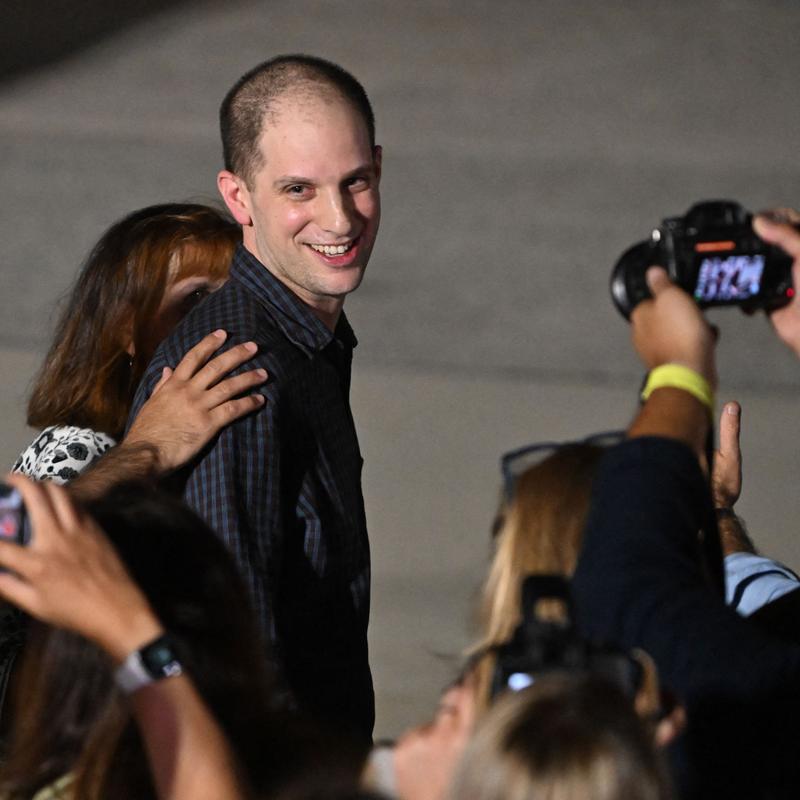
David Remnick: After you got out, you would think at, from [00:16:00] watching the scene at the airport, uh, Andrews Air Force Base, there was an, a real happiness, relief there, and you're, and exhaustion. But there's other things happening inside of you that took time. Tell me about that.
Evan Gershkovich: Yeah, I mean, I, uh, you know, you're carried in the beginning on this sort of adrenaline, and yet pure joy.
You're suddenly reunited with, uh, these people you've been missing and who've been worried about you and fighting for you. And, and but, you know, I couldn't sleep at the beginning. Uh, you know, the prison I, you know, the kind of prison experience I was in was really isolating. It felt like coming down from the International Space Station, uh, in a way.
Suddenly, you know, there's all these faces and sights and sounds, and you're-
David Remnick: People want things from you.
Evan Gershkovich: People want things from you, but you've also been in kind of kindergarten. You've been institutionalized. You've lost your agency. You don't know how to say yes to things. You just have to say yes to things, and you can't say no.
And so that, you're relearning how to be an adult again, and you're absolutely [00:17:00] overwhelmed. And one of the stranger feelings I had was this sort of pull to go back, uh, not to Russia, but to prison specifically, 'cause it's what you know. It's what's comfortable. Wh- what, what, what does
David Remnick: that mean, the desire to go back to prison?
Evan Gershkovich: It's a desire to have that kind of structure and being able to have conversations with people who unders- understand you, so fellow... If, weirdly enough- And
David Remnick: it happened in 16 months, which is a-
Evan Gershkovich: Yeah ...
David Remnick: it's, it's not a short period of time, but it's not 20 years.
Evan Gershkovich: And it happened to a person who was a political prisoner, who was, you know, had a good job, financial support, a newsroom to go back to, a family, and, you know, you can only imagine what might happen to who, somebody who didn't have all that support.
Um, that quickly went away 'cause I got a therapist. Mm-hmm. So, uh I got a... But it turned out, you, you know, I started with a PTSD therapist, and I kind of graduated that, that in six months. And
David Remnick: how long did it take to feel like your feet were on the ground? Awesome ...
Evan Gershkovich: maybe like eight months- It's a long time
seven months. Yeah. And then to [00:18:00] feel good, normal, maybe about the same amount of time as I was in.
David Remnick: So it's almost a full term-
Evan Gershkovich: Yeah ...
David Remnick: until you feel-
Evan Gershkovich: Yeah ...
David Remnick: like yourself.
Evan Gershkovich: Yep. I've, you know, w- I've been asked if I have Stockholm syndrome, uh, in, uh, s- you know, since. And I, you know, I don't know, I'm not a psychologist.
Uh, but I, I don't think I do, and I think part of it is because of this connection to the place. You know, f- s- people get wrongfully accused of murder in the US, and then they spend 20 years in prison, and then they're released, and they're angry at the judicial system and whoever, but they're not, you know, they haven't renounced the United States.
And I, I definitely don't support the the Russian state, but I have sadness about what's happening to and what it's doing to, and anger about what it's doing to its neighbors and-
David Remnick: Evan, would you go back?
Evan Gershkovich: He'd have to be long gone. Pu- Uh, but I would ...
David Remnick: Pu- Pu- Putin
Evan Gershkovich: would have to be gone. Yeah, he, yeah, he would have to be long gone, and you'd have to see what the government is like and-
David Remnick: [00:19:00] But I don't think he's gonna be succeeded by-
Evan Gershkovich: Yeah, right
David Remnick: the second coming of Andrei Sakharov or Alexei Navalny.
Evan Gershkovich: Kinda, I mean, depends when it happens, right? Uh, I don't think so either. I guess I'm, hopefully we can all hold out hope that it could happen again one day. There could be this moment.
David Remnick: Yeah.
Evan Gershkovich: Uh, but no, I don't see it coming anytime soon either, and so.
David Remnick: You miss it?
Evan Gershkovich: Uh, less and less. I did at the beginning, yeah. Yeah. I mean, it was the-
David Remnick: I don't mean jail.
Evan Gershkovich: Yeah. I mean Moscow. Yeah, Moscow, yeah. I mean, it was the place I it was the... Good, good distinction, 'cause I did- It is ... there was a moment. Um- Yeah ... yeah, I mean, it was the place, you know, I got there when I was 25.
I made some of the, you know, closest, you know, friends and people I'd ever m- I'll ever make in life, and it was a interesting and fun place to live. And I think Russia's much more complicated than just, uh, you know, trying to expand its borders or keep a, you know, uh, autocracy going. There's lovely people that live there and wish this wouldn't be happening, and you know, I grew up on this kind of food [00:20:00] and this kind of culture, and so it's close to me.
Uh, and you know, one day I would h- hope to be able to go back, but I don't, I just, yeah, I agree. I don't think that's happening anytime soon.
David Remnick: Evan Gershkovich, thank you very much.
Evan Gershkovich: Thanks, everybody.
David Remnick: I spoke with Evan Gershkovich at Temple Emanuel Striker Centers in New York City. He writes about his imprisonment in Russia in a new book, This Cursed Beautiful Land, and he continues to report for The Wall Street Journal.