Ian McEwan on Imagining the World After Disaster
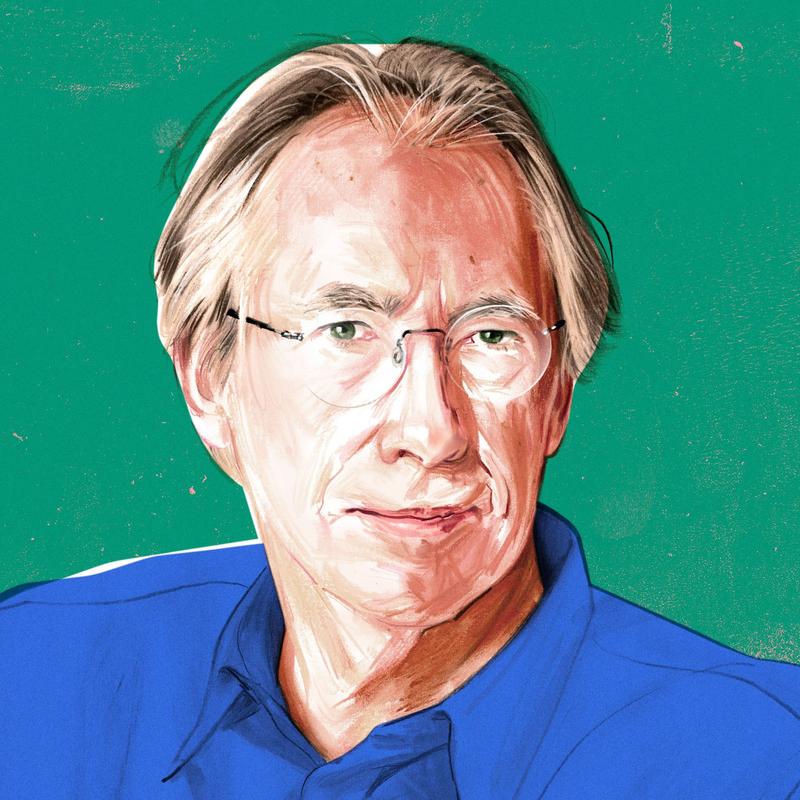
David Remnick: The British author Ian McEwan has spent the last half-century creating memorable characters who seem ordinary at first until their lives, and maybe their minds, start to unravel after some fateful event. In McEwan's early novel, The Comfort of Strangers, a couple whose relationship has grown stale are befriended by another couple who turn out to be psychopaths of the highest order. In Atonement from 2001, a man is falsely accused of rape, and that sets him on a path to prison and eventually, a lonely death.
Early on, reviewers had nicknamed McEwan Ian Macabre. Unfair, perhaps, but these are not books that usually end happily. McEwan has done something a little different in his latest book, What We Can Know. It's a kind of speculative fiction set around a century in the future, and things are certainly looking dystopian. In the wrecked world, the plot follows a scholar searching for a long-lost poem, an artifact from the time that we're living in now. I spoke with Ian McEwan at an event for the 92nd Street Y in New York City.
[applause]
David Remnick: If I were interviewing a songwriter, the idiot question would be, what comes first, the lyrics or the music? When you're writing a novel, what generally comes first in this, and in this case, the thematic concerns that you want to get at, or some version of the music or the voice of the book?
Ian McEwan: It varies. I've got awfully good, over the years, at not writing, and I quite like an extended period between books and keeping alive a notebook which offers the liberation of longhand. To have a pen in your hand is like being back at school. It's wonderful. I dreamily write into that with the special freedom of knowing that no one will ever see it. Things that have been on my mind that seem completely disparate might suddenly converge.
David Remnick: What would that notebook look like for this novel? What were the concerns that were running through it?
Ian McEwan: This novel is an example. I read a wonderful long poem by an English poet called John Fuller in a difficult form called a corona. It's 15 sonnets. I would go into all the rules, but it swept me away. I didn't think I was ever going to be writing about such a poem. Also, I was interested in discussions taking place in philosophy about what are our moral duties to the future. I was also following a rather wonderful outfit, the Long Now Foundation, started up by Stewart Brand, who wrote years back, the Whole Earth Catalog.
It was about sending basic information to the future in case civilization collapsed. How many of these things could you do yourself? How to make soap, how to make a three-crop rotation, germ theory of disease, how to make glass? Further on from that, and suddenly these two things began to merge: the poem and then the issue about the future. Different things float together.
David Remnick: What looms over the book immediately is, and although it dawns on us slowly in its accretion of details, is that the world has just about avoided the fate of ending entirely.
Ian McEwan: Yes, that's my optimism.
[laughter]
David Remnick: It's what brings us out on an evening. Why would you have anything else other than pessimism at this moment? Have you been feeling gloomier than usual?
Ian McEwan: My guess about the future. I'm drawing a line from the first 25-- because this is a history of the 21st century in part. If I look at the first 25 years, my guess is that we will limp from crisis to crisis with a couple of catastrophes thrown in. Assuming we don't have an all-out nuclear exchange, a nuclear winter, and civilization at an end, my assumption is, with a lot of trouble and pain and heartache, we will scrape through somehow.
One of the things that happens in 2036 is a nuclear exchange between Pakistan and India. I love this word, limited nuclear war. Only 10 million people die. Diplomacy rushes in; both sides pull back in horror. Then somewhat later, Israel and Saudi Arabia gang up on Iran, hoping to annihilate it before it could develop a nuclear weapon, only to discover that actually it has a couple. There's another nuclear exchange. Now, the good thing about all this is that so much dust is put up in the air that the earth cools by about 2 degrees, and we get another shot at doing something serious about climate change.
[laughter]
Ian McEwan: This is what I call nuanced optimism.
[laughter]
David Remnick: I think it's fair to say that in certainly the first half of your career, I would never have thought of you as a particularly overtly political novelist, much less a didactic novelist. In this work, and in some ones of more recent vintage as well, things like climate change, global catastrophe, politics loom very, very present and large. Do you feel, and I think a lot of novels run away from this, and they think it's for all kinds of reasons. Do you feel that you're instructing or moralizing as well as entertaining? Do you have other motives in mind?
Ian McEwan: No, I don't. I myself don't like moralizing novels. I think they really do take the heart out of it. There are things that you want to--
David Remnick: Even novels like George Eliot or Tolstoy that have moralizing or philosophizing dimensions to them, you find boring?
Ian McEwan: Well, I love Middlemarch, maybe one of the best novels in English out of England. There's a very good case to be made for that. Generally, what draws me in now, and I suppose I want to write the novels I want to read, I want some writer to give me back something about now that we can, as it were, jointly, him writing, she writing, me reading about who we are, human nature under the conditions of modernity.
David Remnick: Do you find those thin on the ground in contemporary fiction?
Ian McEwan: I do a bit.
David Remnick: More writing about the self rather than the greater world?
Ian McEwan: Yes, I was about to say that rather too many novels hiding their poor prose behind a character, for example. I like something declarative, boldness, naming things. I think that a younger generation rather lost its ability to do that, but I think it's coming back. One must never lose sight in literary fiction. The pursuit has also got to be of pleasure. The moralizing, no, but trying to understand, just taking a stab of the feel of now. Saul Bellow was very good at it. John Updike, Toni Morrison. Lots of people have done it in our lifetimes, and I admire them profoundly.
David Remnick: Did you feel that way as a young novelist, this dimension of the social novel, or the realistic compendia, something like Trollope or Dickens?
Ian McEwan: No. I started off as a writer of short stories. I did a very long apprenticeship with stories, and they were dark, weird, perverse, as I was constantly being told. On my second novel, when I'd finished that, I thought I'd written myself into so dark a corner that I had to take a rest from fiction because, somehow, I was not communicating to myself even all the things that else, the other things of my life: the music, the history, the science, the politics.
David Remnick: What book represented to you the final one in that phase?
Ian McEwan: Comfort of Strangers. I often wonder whether it was the novel that depressed me or whether I was so depressed I was writing a very depressing novel that made me feel even worse. I had to get out, out into the world. Unfortunately, a young director who's been a friend all my life came and asked me if I'd like to write a television play. Wonderful to collaborate, to get out. Then we wrote a movie together.
David Remnick: Comfort of Strangers is the last one in that. What then propels you forward?
Ian McEwan: Three years later, I went back to the novel, and I wrote a novel called The Child in Time, which was overtly strayed into some politics, but in an exploratory way. It wasn't interested in instructing anyone on anything. Then I wrote a novel about the Cold War, which was called The Innocent, and that was set in Berlin in 1955. I'm very proud of the last page of that novel because I finished in June '89. The last sentence is, the two characters, man and woman, have to meet because he knows the wall is going to come down soon. I was ahead of the CIA.
[laughter]
Ian McEwan: Actually, no one was more surprised, I have to admit, when, in November the 9th, I found myself at Potsdamer Platz.
David Remnick: You're now 77.
Ian McEwan: Yes.
David Remnick: Do you feel it's harder or easier to work now? You have the practice of 50 years of writing, and at the same time, God knows I'm right there behind you. Things don't necessarily get easier.
Ian McEwan: They got easier for me because they were so hard in the beginning. I was such a paranoid writer, and I would write a sentence and stare at it and think, "Is it doing what I want to do? Is it laughing behind my back, as it were? Is there a dangler in there somewhere?" I inched forward. I was describing this process some years ago. Someone in the audience said, "How many words do you write a day?" I said, "I'd be happy somewhere between 500 and 1,000 regularly." We were in Italy, somewhere in the south, and they misheard me, and they wrote down that I wrote 15 words a day.
[laughter]
David Remnick: It's only going to get easier.
[laughter]
Ian McEwan: This is out there in the Internet. It can never be expunged. However bad it was at the beginning, I managed more than 15 words a day. To answer that question, seriously, I've sort of got in my stride. I got a stronger sense of flow. Those precious moments that happen with all writers, or one hopes, they're very rare. Those two or three hours where you just barely know you exist and you're neither happy or you have no emotional tone. You are completely the thing that you're doing. You're absolutely lost to it, to time, to memory, just this task. Those are the moments I still live for.
David Remnick: You experience writing at least some of the time as pleasure itself?
Ian McEwan: Absolutely.
David Remnick: Because most writers, as you know, not only experience it very often as pain, but they revel and love to talk about the pain of writing. They like having written, perhaps, but not writing itself.
Ian McEwan: I don't believe a word of it.
[laughter]
Ian McEwan: I think there isn't a nicer life, really, to spend-- I mean, every novel is like going to university, as it were. Three or four years, total absorption, and yet you're still free. If someone phones you on a Monday afternoon and says, "Come for a long walk in the woods," you can do it.
David Remnick: Because of the subject matter that you're learning, you're learning about neurosurgery for Saturday, or you're learning about global politics, or a particular poem for this novel, or is it the matter of craft?
Ian McEwan: I'm not saying there aren't days when I get stuck, but I don't believe in writer's block. I believe in creative hesitation. If you just rename it, you can get off the hook of this. Call it pain if you like, but it's self-inflicted, I think. As long as you can live by your writing, because an awful lot of writers have to do other things and teach, and so on. As long as you can live by writing, it is, I think, one of the most extraordinary luxuries and privileges that you could have as a working person. No office, no boss, and a lifetime exploring what you want to explore.
It's not as if every book is the same. Every book is another voyage. I used to love research. Attaching myself to a surgeon was probably the most intense. I'd arrive at the hospital each morning, six o'clock, go and scrub up with the rest of them, put on a green gown, we'd sweep down corridors, and then we'd go into the operating theater, and work would begin. The very first time I watched a brain exposed, I was close to tears. I thought I'd rather be here seeing this than on another planet.
Here it was, just over a kilo of matter. I was already a materialist, as it were, philosophically then, but still. In fact, maybe it was only because I was, I just thought how amazing that this is full of desires and regrets and memories and intentions and dreams. It's just this matter that gives rise to mind, and the mind is so extraordinarily wondrous.
[music]
David Remnick: I'm speaking with the novelist Ian McEwan, and we'll continue in just a moment. This is The New Yorker Radio Hour.
[music]
David Remnick: This is The New Yorker Radio Hour. I'm David Remnick, and I'm talking with the novelist Ian McEwan. McEwan's new book, a terrific one, is called What We Can Know, and it's set in a future ravaged by climate change and nuclear war, and the characters look back at our time and wonder how we could possibly have been so complacent. The scenario is grim, and yet one reviewer in The New York Times wrote, "It gave me so much pleasure, I sometimes felt like laughing." Let's return to my conversation with Ian McEwan.
Ian one of the elements of the book, and there are so many in this kind of very crowded universe of a novel, is technology. In my job, this phone, this thing, is very present. So much so that if I'm at home trying to read a novel, I have to put it in the kitchen or something. In modern life, there are many calls on one's attention, many machines, and that'll only get sleeker and more discreet and more consuming at the same time. Is the realist novel, which you've practiced for so long and at such an extraordinary level, is it in danger of not being up to the job of describing modern life? Is it up to the job of holding the attention of the modern reader?
Ian McEwan: I think that the realist novel, well written, is our best instrument of understanding who we are. It's worked out conventions through the giants, from Jane Austen, through Flaubert, Tolstoy, and particularly Joyce and George Eliot, of representing the flow of thought and feeling and of representing the fine print of what happens between individuals and all of those individuals to their surroundings, their family, their society.
We have not yet found a compelling replacement, although I accept that it gets harder and harder to give up those 20 or 30 hours to read a serious novel. A very depressing poll came out recently in the States. In 10 years, the number of adults reading for pleasure has dropped by 40%. That's dismaying. At the same time, I go to a lot of literary festivals. It's pouring with rain, it's a Wednesday morning, it's half past 11.
David Remnick: Those are the self-selecting--
Ian McEwan: There's a lot of them.
David Remnick: Yes.
Ian McEwan: A lot of them.
David Remnick: You do a lot of research for certain kinds of books, and research, as it were, comes to you through life. One of the experiences that's come to you and found its way into fiction is that your mother suffered from vascular dementia, which you described as, and everybody would describe as, harrowing. Artists are magpies; they make use of what's in front of them. How did you make use of that experience?
Ian McEwan: In this novel, there is a long account-- It's a very important part of the novel. The poet's wife, Vivien Blundy, before she's married to the poet, looks after her first husband. He's a violin maker, a splendid person, rather the last physical shape of a guy you'd expect to be doing such fiddly work. He gets Alzheimer's, and she cares for him. The central feature of the illness is the increasing loss of memory, as everyone knows. It seemed right to be putting this in here because we're talking about history.
When someone loses their memory, they've basically lost their identity. I wanted to explore this on the personal level, surrounded by reflections on the nature of history, because we, as a society, desperately need a memory. I was very sad when history as a subject was downgraded in the central curriculum in Britain. I thought we really want societies where everybody has at least some kind of thread of a narrative, if not of the last 800 years, maybe the last 100 years.
One of the reasons I think we find ourselves in dangerous political times is that those people who either were participants in the Second World War or grew up in its shadow and were trying to find the peace across nations that would hold and would not allow us to do this ever again, all those people have gone. They've all gone. The extraordinary thing about the Second World War is that far more civilians died than combatants, and estimates vary, but getting on for 90 million deaths.
If you take the view, as some historians do, that the First World War and the Second are really just one long war with a 20-year peace. Then, of course, that figure goes up considerably more. That was such a shock to the generation, not only in it, but shaped by it and growing up with it at their back. What happens when a society gets Alzheimer's is my worry, and becomes reckless and ignorant and mouthy. Power is difficult and needs its constraints, and it seems to be getting forgotten. I'm not saying it's forgotten, but it's getting subdued in our political conversation or our social conversation.
David Remnick: A question from the audience. In Atonement, one of your characters says that the novelist is, in essence, God. Do you agree?
Ian McEwan: Well, I don't believe in God, but I know what's meant by that. Here's the thing is I've got involved in making movies quite a lot. When what's at issue is one of my own movies, and you're sitting around a table with 12 people, and they're talking about one of the characters, and someone says, "No, but I don't think this character would say that." I realized that I was God, and now I'm a kind of putty, a cherubim, maybe. I've been really knocked off my perch because I'm having to negotiate what people say and do in a movie.
David Remnick: Finally, Atonement had a female narrator. You write from a woman's perspective in much of this book. I know that you're tuned into lots of things, but maybe one of them is the academic argument that writing from a woman's perspective for a man, or a white person writing from a Black person's perspective, is, in some circles, considered outre or verboten, that you shouldn't do it for moral reasons or political reasons. Others would argue that that's exactly what the novel is about, is exercise in empathy and imagination, and much more. Tell me about that.
Ian McEwan: The reduction to absurdity of that kind of point of view is you can only write about yourself. Lots of people do that, of course. It's such a nonsense that I can hardly bring myself to address it without falling out of my chair.
[laughter]
David Remnick: I'll strap you in.
Ian McEwan: Okay. Let's just say, away with ye. It's nonsense. Anyway, who are these people telling you what to write? Guardians of the culture?
David Remnick: Have you ever felt in your pretty long career as a writer, cultural pushback, political pushback on your work?
Ian McEwan: No. I seem to have dodged that one somehow. I have written lots of women or children-- The first thing I think is, if you make a list of all the differences in men and women, it would be shorter than all the similarities. Humans. There are other humans. I just try to write them as sympathetically as I can. That's the only-- I think, as readers, and one can only be critics rather than commissars in this. I hate it. It happens sometimes in France a lot. I'm sitting on stage with some other novelist, and he or she is saying, the novel today must something, something, something. I can't bear that kind of talk. It's Stalinist. You need the novel to flourish. It wants its readers, and it must have air to breathe.
David Remnick: Ian, finally, you certainly don't believe in God. You've been on stages and had that discussion with Richard Dawkins and engaged with that very thoroughly. When you're dead, you're dead, I think, is part of that theology. Do you care about the afterlife of your books or not?
Ian McEwan: I care about it at the same time, knowing that I can't do a thing about it. Yes, I would like to be read. I notice it's quite a bad career move for novelists to die.
[laughter]
David Remnick: It does seem to hurt.
Ian McEwan: It does. What happens is I think they sink into some kind of pit and then some of them crawl out of it about 10 or 15 years later and get maybe discovered by, if we can say, generations of these days.
David Remnick: I look at John Updike for one, very close to The New Yorker. I think about--
Ian McEwan: Well, there are a lot of books, but those stories in the first half of his career, certainly. Then, about certainly a half dozen novels, the Robert novels, and much else. I don't see people reading them at all.
David Remnick: Then I think maybe you're right, that something will happen-
Ian McEwan: It will.
David Remnick: -at some point.
Ian McEwan: With Updike, it most certainly. Same with Saul Bellow. Norman Mailer, completely gone. Don't die.
[laughter]
David Remnick: Good advice from Ian McEwan. Thank you very much, and thank you all.
[applause]
David Remnick: Author Ian McEwan, his novel, What We Can Know, came out in September. We spoke at an event recently in front of a live audience organized by the 92nd Street.
[music]
Copyright © 2025 New York Public Radio. All rights reserved. Visit our website terms of use at www.wnyc.org for further information.
New York Public Radio transcripts are created on a rush deadline, often by contractors. This text may not be in its final form and may be updated or revised in the future. Accuracy and availability may vary. The authoritative record of New York Public Radio’s programming is the audio record.