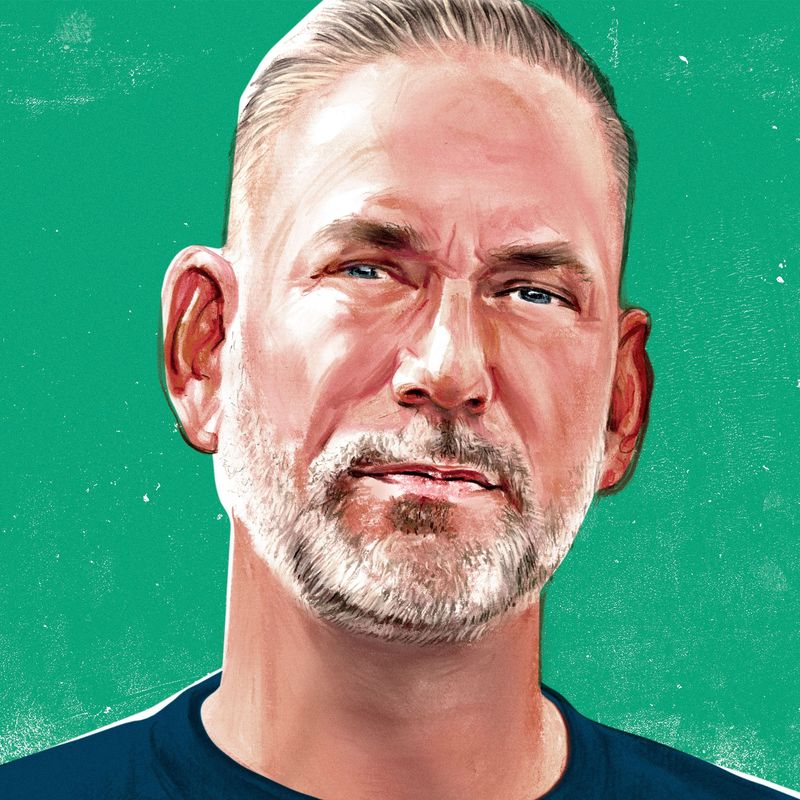
Dan Osborn, the Independent Senate Candidate Who Could Tip Nebraska
David Remnick: When you look at the current makeup of Congress and the Senate in particular, Democrats have got a big numbers problem. For a generation or more, they've been concentrating in big urban areas, leaving more rural states trending heavily Republican. Now, we often hear that Democrats are fighting to be competitive in parts of the country where they've already been counted out, but that's easier said than done. With partisanship so high in the country, that means winning over voters who are not just skeptical, but hostile.
Dan Osborn: Right now, it's a government for the 1% and the corporations, and I think we're fed up.
[applause]
David Remnick: Dan Osborn of Nebraska would probably be a dream candidate for the Democrats. He's a blue-collar mechanic in the food processing industry. He's a union leader, an economic populist, and a veteran of the Navy and the Army National Guard, but Osborn isn't a Democrat, and he doesn't want to associate with either party.
He's running as an independent, which is not an easy choice for him because it makes fundraising and generally running a campaign a great deal harder, and yet polls are showing that Dan Osborn is running neck and neck with Pete Ricketts, the Republican incumbent in a very Republican state. The Democratic nominee in the race just stepped aside to clear the field for Osborn. I sat down with Dan Osborn recently to talk about the Senate and his race and how he got into politics in the first place.
[music]
David Remnick: Dan, some people know your story well, particularly if they're in Nebraska, but you're about to run for Senate. I just wonder how you got into politics. You're a union guy. Love to know your working history and how you decided to make this leap.
Dan Osborn: Yes, well, if you don't mind, I would like to go back to graduating high school.
David Remnick: Okay, okay. [chuckles]
Dan Osborn: Because I went into the Navy, I've always felt compelled to serve. I then met my wife. We had our first daughter, and my life changed. I was like, "Man, I need a job with some insurance." It's easy to take care of yourself. As soon as you have to, you start taking care of somebody else. I went into the workforce, dropped out of college, and started working at Kellogg's as an industrial mechanic. One of the first days on the job, an old guy by the name of Ron Jabowski, old Polish guy. He looked like Tom Selleck from Magnum PI. I'm dating myself again. These kids probably don't know.
David Remnick: We'll explain. We'll have liner notes.
Dan Osborn: There you go. We were wrenching on a machine, and he looked over at me, and he said, "Hey, kid, have you joined the union yet?" I said, "No, sir, I have not." He's like, "Well, you might want to think about doing that." I said, "Well, crap, Tom Selleck's telling me to join the union. I better go do that." Nebraska's right to work--
David Remnick: What were you making at Kellogg's at that time?
Dan Osborn: At that time, I was making-- This was in 2002, roughly. I was making $19 an hour. I joined the union. I just worked hard, and I kept my head down for a lot of years just going to work. Well, old guys like Ron used to take care of the union business. We started to lose on some contracts. Those guys started to retire, and so I wanted to get involved. I ran for executive board of my local. I got elected as vice president. About three months later, the president stepped down, because you get yelled at a lot in that role by both your members and management alike. I knew the role was important, so I assumed it.
David Remnick: When you say you lost some contracts, what does that mean?
Dan Osborn: 2015, we made a lot of concessions. It was a two-tier wage system. It was the massive one. That was a killer for us. Now, you have somebody working right next to you making half the wages you are and a different insurance policy. During COVID, we were all working seven days a week, 12 hours a day that whole year. No time-off. In fact, at one point in time, 50% of our workforce was forced quarantine and/or sick, but we kept all four of those plants running at maximum capacity. The CEO gave himself a $2 million raise. The board enriched themselves, stock buybacks, capitalism working at its finest. Got no problem with that.
Problem I had was our contract expired at the end of that year. They sat across the negotiating table from us, and they said, "We're going to take your health insurance. We're going to take your cost-of-living adjustment, our only form of wage increases designed to keep us even with inflation, and then we're going to implement a two-tier wage system that's permanent with no path for a lower-tier employee to go the upper tier." For me as president, that was my oh-crap moment. This is really where my story begins in politics. I cut my teeth in politics on the picket line. The strike was 77 days.
David Remnick: It's a long strike.
Dan Osborn: Yes.
David Remnick: That's a long time not to get paid. Did you get popular support?
Dan Osborn: We did, yes. Joe Biden came out and talked about our strike. Our favorability rating or union's favorability rating around the country was some of the polling data that we saw. Sentiment was about 72% were in favor of what we were trying to do.
David Remnick: What kind of contract did you come to? What kind of agreement?
Dan Osborn: I believe it was a 3% raise over five years. It wasn't a ton. We weren't asking for a ton. The two-tier wage system, we were able to negotiate more lower-tier employees to go to the upper tier yearly. We held our insurance.
David Remnick: Now, you ran two years ago for Senate, and you came up short. What's different about the political climate now that you think will make your candidacy more of a possibility?
Dan Osborn: Fundamentally, the difference is my opponent. In 2024, I ran against Deb Fischer. I had no name recognition. I took the truth that wage-earning people deserve a seat at the table in Washington, DC. Pretty simple. I took that out. I did over 200 public town halls in Nebraska and just learned everything I know right now from people of Nebraska and their towns from boots on the ground. We turned that into 47% of the vote.
David Remnick: Right. You came up short by six points.
Dan Osborn: Six points.
David Remnick: Even though in the same state, Trump won by 20, I think.
Dan Osborn: Yes, so we did well.
David Remnick: That was encouraging.
Dan Osborn: It was, yes. Fast-forward to 2026, and I have to decide now, "Am I going to do this again?" It's hard, especially for-- This is why less than 2% of our elected officials in the House and Senate come from the working-class because it's hard. I don't have a law firm that can go run itself. Why I go run around the state.
David Remnick: When you say it's hard, you mean personally hard?
Dan Osborn: Yes.
David Remnick: Tell me a little bit about that.
Dan Osborn: Yes. Well, I'm getting ready to remortgage my house so I can pay my bills.
David Remnick: That's probably unique for Senate candidates.
Dan Osborn: Yes. Last Friday, I just quit my job as a pipe fitter so I can campaign full-time.
David Remnick: What does politics look like to you? When you look at the Senate, the way it's composed, what its concerns are, the language it speaks, where do you think it's failing you?
Dan Osborn: Robin Williams, the late comedian, he said it best. He said our politicians should be wearing NASCAR jackets with patches of their sponsors so we know how they're going to vote.
[crosstalk]
Dan Osborn: The corrupting money. Citizens United. Corporations are not people. Money's not free speech. You shouldn't be able to donate an unlimited amount of money to an independent expenditure. It's how Elon Musk pumped $300 million into the election. That is too much influence and control. You can almost relate every single issue that we are going to talk about and people talk about to a money interest at some point, right?
If you want to work in Washington, DC, and you want to continue, especially in the House, where you got to run every two years, and I was told a House member spends four hours every single day just dialing for dollars, how are you supposed to be effective? Who are you going to be working for? Are you going to be working for the people that got you elected, that voted for you, or are you going to be working for the people giving you money so you can continue to work, right?
David Remnick: Right.
Dan Osborn: It's a dichotomy that doesn't work.
David Remnick: I got to ask you, how are you going to get money to run?
Dan Osborn: I don't take corporate PAC money. My average donation is $48, and I've received small dollar donations from all 50 states. My campaign is powered by the people.
David Remnick: Why do you want to run as an independent and not either a Democrat or Republican?
Dan Osborn: I've always been an independent from the time I could register to vote. I grew up in a very conservative household. My dad actually sent me trick-or-treating when I was a kid dressed as George Bush, Sr., but I knew when I went off on my own into the Navy that I didn't line up with everything that he lined up with.
David Remnick: How would you differentiate your politics from your dad's?
Dan Osborn: Well, first of all, where we do line up is being fiscally conservative.
David Remnick: Wait a minute. Fiscal conservatives, though, they don't want even rich people paying all that much tax. Do you want to see that?
Dan Osborn: I want to see people pay their fair share.
David Remnick: What does that mean?
Dan Osborn: Well, and here's the thing, because you look at Jeff Bezos and Elon Musk, and you look at their tax bracket and how much they pay. It's hardly anything. I'm not going to go into the statistics of what I owe this year, but I'm getting killed. That's one of the reasons I have to remortgage my house to pay my taxes.
David Remnick: Forgive me. On that issue, you sound awfully like a populist Democrat. Where do you differentiate yourself from--
Dan Osborn: If you want to put labels on it, we can just put labels on it. At the end of the day, for me personally, when I earn a certain wage and I get taxed a certain percentage off that certain wage, if you're on the other end of that and you're just clicking a keyboard and you're making millions of dollars on stock buybacks and dividends, why isn't that an earning as well? Why isn't that taxed at the same rate I'm taxed at? It's just people making money regardless of whether I do it with my hands or they do it with the click of a button. To me, boiled down, that's as simple as I can make it.
David Remnick: What are the issues that you would consider yourself conservative on? Social issues?
Dan Osborn: Some, I guess, but mostly, it's-- Where I would agree with Trump is I think he did a good job on the border. I think without a border, we don't have a country. The flip side of that is immigration. That's where I'm going to break from him. Especially thinking of it fiscally, we could talk about ICE, and the fact that I understand and I agree with the fundamental mission of enforcement, and that's to get the criminal elements that shouldn't be here out of the country. That's to keep the people safe. They've done this mission off of about $7 billion. Now, with the Big Beautiful Bill, they have $80 billion. Why do they need that increase to perform the exact same mission? Now, we're seeing them go into the streets with their masks. Now, we have American citizens dead. I can't get behind that.
David Remnick: How do you feel about the Trump presidency, the second term?
Dan Osborn: I think it's playing out in real time as damaging, especially in my state. It's an agriculture state. We are second in corn. We're fifth in soybean exports. We're first in the nation in beef. Bad policy is bad policy. Sweeping tariffs. The cutting of USAID closes markets to our bean farmers. 52% of our exports for beans in the fifth largest bean economy in the state. That means then we now have beans rotting in silos. What's that cause family farmers and ranchers? Bankruptcy is up 46%. Farmer suicides are on the rise. I'm tired of people saying, "Oh, you voted for it. You deserve it." No, you don't, right? They're human beings, and 2% of our population feed the rest of us.
[music]
David Remnick: Dan Osborn, who's running as an independent for the Senate in Nebraska. We'll continue our conversation in a moment. This is The New Yorker Radio Hour.
[music]
David Remnick: This is The New Yorker Radio Hour. I'm David Remnick, and I'm talking today with an independent candidate for the US Senate, Dan Osborn of Nebraska. Osborn has never held government office, but this isn't his first rodeo either. He ran for the Senate in 2024, and he lost the incumbent, Deb Fischer, by seven points. In a state as solidly Republican as Nebraska, that was considered a pretty good showing.
Osborn is a mechanic, and he was the president of his union local, which makes quite a contrast to his opponent, the current senator, Pete Ricketts, whose father founded TD Ameritrade. Meanwhile, President Trump has become deeply unpopular, and anti-incumbent sentiment is likely to be very high. I'll continue my conversation now with Dan Osborn. Dan, do you find a lot of people in Nebraska who voted for Trump the second time out regret that vote now?
Dan Osborn: Yes, that is the sentiment in the focus groups. It's like, "Eh, this isn't exactly what we thought it was going to happen," especially if you're a farmer. Last year, you couldn't sell your beans. This year, you get a bailout that's falling short because the inputs are so high. Fertilizer. I was talking to a row crop farmer who only farms 1,900 acres, so he's small. $50,000 more as his fertilizer is going to cost than it was pre-war with Iran, because of the natural gas, is how we get our fertilizer, and it's stuck there. It's jacking up prices. Their inputs are high now. Their fuel's high for their tractors, and they're hurting.
David Remnick: How do you feel about the war in Iran?
Dan Osborn: I think the war in Iran, I think this is a Trump war. Do I think Iran should have nuclear weapons? No. Do I think the Ayatollah was a bad guy and killed a lot of his citizens that were trying to rise up? Yes. Do I think this could have been done diplomatically? Yes, I do. I believe that.
David Remnick: It was once.
Dan Osborn: It was in 2018, yes.
David Remnick: Well, in 2018, we walked away from it.
Dan Osborn: We walked away from it, correct. That makes no sense.
David Remnick: You oppose abortion, but you've supported the Roe decision. Since Dobbs, Nebraska's passed a 12-week ban. How has that affected the state, and what would you support when it comes to reproductive rights?
Dan Osborn: Yes, I think I tend to take a bit of a libertarian stance at, "Stay out of our bedrooms in our doctor's offices." That's not the role that Congress should have. I would support codifying Roe at a federal level. In my own personal life, I'm an Irish Catholic. In my own personal life, I would never advocate for anybody to have an abortion, but I support the right for women to choose.
David Remnick: We began our conversation by talking about your union history. You led that strike at a Kellogg's plant in Omaha in 2021. That plant is going to be fully closed by the end of the year, cutting about 500 union jobs, as I understand it. How did that happen. What does this mean for the labor movement? After you go on strike, you win some concessions. The company just closes up shop, and that's it.
Dan Osborn: Well, first of all, I'm not 100% convinced they're going to close. They again tried this in 2015 in our contract. They said they were going to close Battle Creek, Michigan, if we didn't give them the two-tier wage system. We gave them the two-tier wage system. They left Battle Creek open. This could be just a ploy for negotiations. If it's not and they close that plant, well, that goes back to Kellogg's business model, right? They've sold that company to Kellanova. I think Kellanova sold it again. They spun off North American cereal, so there's a lot of things at play behind the scenes, and the fact that cereal sales are down--
David Remnick: Just curious. Why are cereal sales down?
Dan Osborn: There are so many other breakfast options, too. There's healthier breakfast options, probably that people and ever since--
David Remnick: Healthier than Frosted Flakes?
Dan Osborn: Get out. Chocolate-frosted flakes.
David Remnick: [laughs] They make that?
Dan Osborn: Yes, no, everything's fine in moderation, right?
David Remnick: Even chocolate-frosted flakes?
Dan Osborn: Oh, yes.
David Remnick: All right. Okay.
Dan Osborn: You could treat yourself. You'll be fine.
[laughter]
David Remnick: There were a lot of things that happened in the last presidential race, but one of them was, quite obviously, the Democratic Party was losing union support in some areas. How do you assess that?
Dan Osborn: Well, I think they were better at boiling everything down and putting it on bumper stickers because here's the thing about most people. Like I said, I was this guy for a long time. I would get my news probably in small increments in my car and maybe scrolling on Facebook on my 15-minute break.
David Remnick: No newspaper in your life?
Dan Osborn: No. If you're talking to that person and you have two competing messages, you have one that was coming from the Republican side saying, "Hey, I'm for you. They're for they/them. I'm for the worker," and then the other side is seemingly talking down to people saying, "You need to respect people's pronouns, this, and that." Who's that guy going to listen to at the end of the day?
David Remnick: Did that affect you adversely?
Dan Osborn: No, no, it didn't because I live in a pretty urban area. I have friends. My time in the Navy, I've traveled a lot. I've seen a lot of cultures. I'm friends with tribal people and so many different walks of life. I've had experience in my life.
David Remnick: That, you think, made you more broad-minded or empathetic?
Dan Osborn: Yes, I would say we're all a product of our experiences. If you're somebody who's never left your town and you get typically one message, and then it's echoed in your coffee shops at the watering hole at night, then you're going to form an attitude and an opinion based off of that information.
David Remnick: The America First wing of the Republican Party has been, let's put it this way, skeptical about US support of Ukraine, and I think Trump himself has been more than skeptical. Many are turning away also from support of Israel. How do you feel about those issues?
Dan Osborn: Well, I think we should support our allies.
David Remnick: Who would those be? Well, Israel is an ally, right? They're the only democracy in the area. I support Israel, but what I'm seeing right now is Israel going on the offensive. I'm having a hard time supporting that. I'm having a hard time supporting, thinking that anything that says "Made in USA" is dropping on schools and hospitals. At the end of the day, I have empathy and compassion for all people. Now, in regards to Ukraine, I support Ukraine. A lot of that comes from when I was in second grade. I had to put my head underneath the desk and prepare for a nuclear warhead to land, and growing up--
David Remnick: Me too. I don't know if our younger listeners know this, but we had these drills in school as if the desk was going to protect us from a nuclear blast. [chuckles]
Dan Osborn: I know. It's so ridiculous if you think about it, and it's actually more sad today. Now, they have to do active shooter drills in schools.
David Remnick: That's surreal. That's as real as it gets.
Dan Osborn: Way more real than what we had to experience. Now, you have this generation. I go out to a lot of colleges, and I talk to the young Kids. I have three of them that age myself. They are having a sense of nihilism right now.
David Remnick: How do you mean?
Dan Osborn: Well, they have no faith in government. In Nebraska, they're registering as independents in record numbers. They don't see the government working for them at all. They see that the statistics that the first-time age for a home buyer in this country is 40 years old. They're almost just gambling more on stuff. Just like, "Screw it. Why do I need to save money?"
David Remnick: Your kids going to vote for you?
Dan Osborn: Yes, they better.
[laughter]
David Remnick: Are your politics informed by what you're hearing from them?
Dan Osborn: Yes, a lot of it, for sure.
David Remnick: How so?
Dan Osborn: Well, I want to fight for them. They're going to be cut from the same cloth as me. They don't have any privilege in this world similar to my opponent does, coming from a family of a billionaire. That's the way I'm going to operate in the US Senate. I'm going to approach legislation and policy based off of knowing what it's like to put Christmas on a credit card.
David Remnick: Do you get any sense that the Trump era is ending, or will it continue after Trump?
Dan Osborn: There's only one Trump.
David Remnick: Was he appealing to you in '16? Did you vote for him?
Dan Osborn: In 2016? No, I did not vote for him. Actually, I was the undecided pretty much until I walked into that booth.
David Remnick: What did you do?
Dan Osborn: Well, I didn't vote for Trump. [laughs]
David Remnick: You voted for the Democrat?
Dan Osborn: Yes, I did on that one, because I just don't think the billionaires are going to come save us, right? That's why I like the Jon Testers of the world, the guys who are salt of the earth who just have lived their lives honestly and purely. I just didn't see him as that.
David Remnick: You don't see Donald Trump as pure?
Dan Osborn: No.
David Remnick: [laughs] You do a pretty good Trump, by the way. This would be your moment.
Dan Osborn: [in Donald Trump's voice] Quite frankly. I don't know, maybe pure. I'm the most purist. You've never seen anybody more pure than me.
David Remnick: [laughs] It's not bad. You do that on the stump?
Dan Osborn: Yes, sometimes. It depends on the room I'm in.
David Remnick: How's it go?
Dan Osborn: I guess it's out in the open now.
David Remnick: Exactly. It's now coast to coast.
Dan Osborn: [in Donald Trump's voice] Coast to coast.
David Remnick: [laughs]
Dan Osborn: [in Donald Trump's voice] We're here with David. Maybe the worst David. I call him "Do nothing David."
[laughter]
David Remnick: Looking at 2028, because this is going to start happening. It's already happening. You're starting to see people line up. You see the Vice President of the United States and the Secretary of State start to jostle in the Republican Party. You see all the obvious names in the Democratic Party. Anybody you like?
Dan Osborn: Oh, for president?
David Remnick: Yes.
Dan Osborn: No, no.
David Remnick: You're a tough audience.
Dan Osborn: I am.
David Remnick: What do you want to say?
Dan Osborn: All the time, when you have the undecideds, I hear people like, "How could you be undecided?" I'm like, "I just am." They don't believe me, but I'm just skeptical. I was raised, and I raised my kids, to question everything. Just don't take something at face value. Another reason why I'm independent because I believe in principles over party. I'm not just going to vote a letter. I want to know who that person is and what they stand for, what they talk about, how they live their life, where they come from. That all plays into it.
David Remnick: What are your chances in your election?
Dan Osborn: [in Donald Trump's voice] 100%, hands down landslide. Nobody's ever won bigger in Nebraska than me.
David Remnick: [laughs]
David Remnick: No. Yes, my chances are great. I'm going to go out and do this the old-fashioned way. I'm going to continue to do. I've already done 60 town halls. I'm going to do another 200 town halls like I did in 2024. The message is the same. It hasn't changed a bit. Us wage earners deserve a seat at the table in Washington, DC, because if you're not on the table, you're on the menu.
David Remnick: Appreciate your time. Thank you so much.
Dan Osborn: Yes, thank you.
[music]
David Remnick: Dan Osborn is running for the Senate as an independent in the state of Nebraska.
[music]
Copyright © 2026 New York Public Radio. All rights reserved. Visit our website terms of use at www.wnyc.org for further information.
New York Public Radio transcripts are created on a rush deadline, often by contractors. This text may not be in its final form and may be updated or revised in the future. Accuracy and availability may vary. The authoritative record of New York Public Radio’s programming is the audio record.