Salsa Star Rubén Blades on Acting, Politics, and the Power of Music
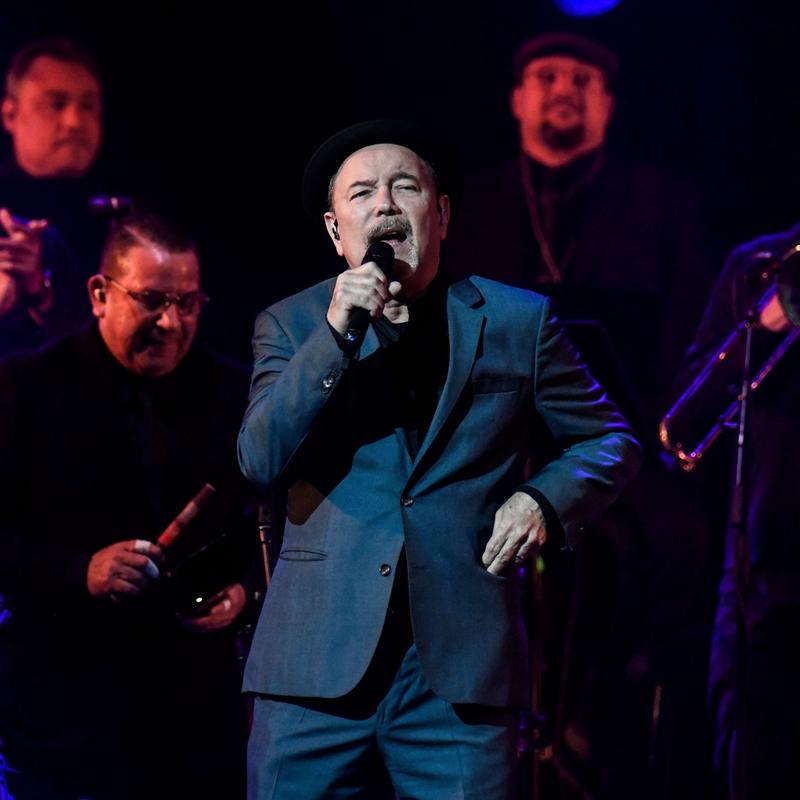
[MUSIC - Willie Colón and Rubén Blades: Buscando Guayaba]
David Remnick: In the world of salsa music, Rubén Blades is one of the greats. His 1978 album Siembra, a word that means planting or cultivating, remains one of the best-selling salsa albums of all time.
Graciela Mochkofsky: Rubén Blades, or as we call him in Latin America, Rubén Blades, though his name is actually Rubén Blades, is one of the most important figures in salsa.
David Remnick: Graciela Mochkofsky writes for The New Yorker about Latin American politics and culture.
Graciela Mochkofsky: He's an incredibly prolific artist, a writer, a singer, an activist, and a Hollywood actor.
Rubén Blades: Hi. My name is Rudy Veloz, and I have this music that is going to blow you away.
Graciela Mochkofsky: He grew up in Argentina, and he really sings for an entire people. We all feel like Blades' songs are speaking about the struggles of our own countries. It's not about Panama or Latinos in New York. It's really about all of us. Forty-five years ago, he released his very first really big album, Siembra, that he recorded with Willie Colón, who was at the center of the salsa movement then. It was the first album that really brought salsa outside of New York and outside of the US and Latin America to the world.
Now, there's salsa. The salsa movement is very much alive and vibrant in Israel, in Taiwan, in Japan. You could say that Rubén Blades sort of did for salsa music what Bob Marley did for reggae, and he really brought it into the global consciousness.
David Remnick: This year, Rubén Blades' record, Fotografías, is up for a Grammy Award, and should he win it, it would be his 13th Grammy. He also wrote a new song for the film Black Butterflies, which just came out, and it's vying for the Oscar for Best Animated Feature. The film is about the impact of climate change, and Blades' song is called Inmigrantes, Immigrants. Graciela Mochkofsky sat down to talk with Blades back in 2023 about a life in music, politics, and acting.
Graciela Mochkofsky: Okay. Pues empecemos. Buenas tardes.
Rubén Blades: Muy buenas tardes.
Graciela Mochkofsky: I always start at the beginning. I wanted to start in 1969, when you were 21, and you came to New York City for the first time. In that trip, you recorded what I believe was your first album, From Panama to New York, De Panamá a Nueva York, with Pete Rodriguez and his orchestra. Let's listen for a moment to a song from that album, just to get a sense of what it sounded like.
[MUSIC - Rubén Blades and Pete Rodríguez: De Panamá a Nueva York]
Graciela Mochkofsky: Tell us about that album and where it came from.
Rubén Blades: As anything and most of the things in my life, it came as a result of total unexpected occurrences. I had quit music by that time because the dean of the law school in Panama asked me if I was going to be a musician or a lawyer, because somebody saw me playing at a private house with a band called Los Salvajes del Ritmo, and the professor went and told the dean that he had seen me and that he didn't think that that was a good idea, to have a student singing on the weekends.
Graciela Mochkofsky: Was this a very conservative environment?
Rubén Blades: Yes, it was very, very, very, very, very strict. Anyway, then a friend of mine that was a musician, Francisco Buckley, the first recording studio ever to have been built in Panama, Discos Izmenos, had asked him to come with his band and perform to make sure that everything was in its right position to record. Bush, knowing that I sang, called me and asked me to be a part of the group, and I said, "I can't do that." He said, "No, this is a private thing. No one's going to be there, and it's just a band. Please help us with this." I said, "I'll go and help as a backup."
I went, the owner of the record label had brought somebody from New York called Pancho Cristal, which was one of the biggest producers in New York at the time, to supervise the happenings. The band was, I think, three horns in the rhythm section, so eight people. One or two of the guys got lost, so they couldn't play the arrangements. That required, then, improvisation. Benito Guardia, who was the piano player for Bush, said, Rubén, let's do El Ratón," which was a very popular song from Cheo Feliciano at the time, and I did it.
Pancho Cristal was at that moment in the cabin, and when he heard my voice, he ran out and went to me, because at that time, my voice sounded very much like the sound of the voice of José Cheo Feliciano, who was a recording star, and he was stunned. He asked me if I ever wanted to record an album, and I said, "Not now, I can't do music." The thing is, he said, "Look, if you ever get to New York, call me," and he gave me his number. Then, in Panama, in 1968, we had had the military coup. One of the first things they did, the military did, was to shut down the university. Now, my mother was very afraid that I was going to join any of the movements.
Graciela Mochkofsky: [Spanish language]
Rubén Blades: She was concerned that I was going to join. She came up with this notion, if I wanted a holiday, I remember, for my birthday, she wanted to send me to New York. I called Pancho Cristal, that producer that I had met the year before, and then he said, "Oh, yes, come over, and I'll record you." Then we recorded this, basically, salsa album, and that's how this album got done. I left New York, went back to Panama. The university was reopened. I went back to law school.
Graciela Mochkofsky: You finished your degree there.
Rubén Blades: I finished my degree. I never got involved in music again until the album came out, I believe, in 1970. I didn't even know about it when it came out.
Graciela Mochkofsky: It didn't come out in Panama. It only came out here.
Rubén Blades: It was released in Panama. The first song of the album was a song I had written about a guerrilla fighter who was murdered by the army.
Graciela Mochkofsky: Juan González.
Rubén Blades: Juan González. In order not to be arrested, I thought I can deflect the whole notion by saying that these events were occurring in a mythical place. I said, "[Spanish language]." This is all fiction. I'm doing this. This is fiction. [Spanish language]. If this looks like Che Guevara, it's just a coincidence.
Graciela Mochkofsky: [laughs] You didn't settle in New York then. As you said, you came back to Panama, you got your law degree, but you ended up coming back to the US in 1973 to Florida, where your parents were.
Rubén Blades: '74.
Graciela Mochkofsky: '74.
Rubén Blades: My father was accused by Noriega, who was then a colonel. He was accused by Manuel Antonio Noriega, my father being involved in a plot to kill him. My mother took my family--
Graciela Mochkofsky: Was that the truth?
Rubén Blades: I don't think so. I don't think it was the truth, but my father was a detective. He was working with the DEA. DEA had just started. The DEA was using my father in Panama as a contact and investigator because my father was one of the few Panamanian detectives who spoke English. The fact that I think the DEA was closing in on Noriega made him want to get rid of it. In 1974, I graduated from law school. I was working with people in jail at the time. I finished my thesis, I presented it, and I was approved.
I decided to leave because I didn't see no point in being a lawyer under a military dictatorship. I went to Florida, and my family was having a lot of trouble. My mother was working in Florida. My father could not get a job. I had three small brothers. My diploma was not accepted by the Florida Bar. I didn't know what to do. I felt useless, and I didn't know what to do. Then all of a sudden, I thought of calling Fania Records, which was the biggest salsa label at the time.
[MUSIC - Fania All-Stars: Introduction Theme]
Rubén Blades: I called, and I offered myself as a writer and a singer, and they said no to both. Then I said, "Do you have any jobs?" Then they said, "As a matter of fact, we just had an opening today in the mail office." I said, "What does that mean? What are the chores?" They explained it to me, and I said, "I'll take it."
[MUSIC - Fania All-Stars: Estrellas de Fania]
Rubén Blades: When Barretto's band broke for the second time, Tito Allen, a wonderful, great local singer, left the band. Barretto had to find another singer, so somebody told him that I sang. Then he came to the mailroom to ask me if it was true that I sang, and then he sort of interrogated me for a while, for like an hour, trying to understand what it was that I was doing there. Finally, he gave me a date for an audition, and I went. He hired Tito Gomez, who had been working with La Sonora Ponceña, Papo Lucca in Puerto Rico. Excellent singer, Tito. He hired me as well. He had two singers in case that one singer left, the other one was still there.
Graciela Mochkofsky: This is how you started, really.
Rubén Blades: That's how I started full-time as a musician in 1974, '75, I'm not sure.
Graciela Mochkofsky: From the start, you were politically engaged, and you sang about political topics. You talk about you were writing poems about what was happening in Panama when you were in high school. Juan González, the song you referred to in your first album, is about the death of a guerrilla, a guerrillero. Pablo Pueblo from 1977 is about this poor man who comes home and tired and hopeless after working all day. The politicians he voted for have never made his life better. Here's a bit of Pablo Pueblo for those who haven't heard it.
[MUSIC - Rubén Blades and Willie Colón: Pablo Pueblo]
Graciela Mochkofsky: You've written a song about class, about the struggles of people, about dictatorships and revolutions, about the desaparecidos in Latin America, et cetera, but you've always rejected the label of political singer or protest singer, and you've never wanted to be seen as somebody who sings political songs. Why?
Rubén Blades: Because political songs are propaganda. By definition, if you start singing about political ideology, you're not an artist, you're doing propaganda, basically. I try to be as close to a newspaper person as I can. Of course, you can't really say that you're objective by writing songs that reflect a point of view. You have a point of view, but you can't be balanced, and you have to be careful in how you write it so it doesn't become a lie. Basically, what I thought at the time was that music, and especially salsa music, was creating what did not exist at the time, and I did not see it at the time, which was this excuse or this vehicle for total strangers to meet and all of a sudden share a common ground.
Imagine that incredible possibility of having all these people who come from all these different walks of life in one place. You can dance, let's think, too. Enhance the experience you're having right now, which is of contact. You're touching a total stranger to you in sometimes intimate ways because it's a contact dance. All of a sudden, I'm talking to you about a priest that was killed, or I'm talking to you about your mother that died of cancer, or I'm talking to you about the girlfriend that went away because you were Black and she was white, or I'm going to talk to you about the gay guy who doesn't dare to say that he's gay because he may have reprisals.
Some people had never heard songs that touched politics or political aspects before, and some of them got very upset with me because they called me a communist, because I was not using music only to escape. They wrongly interpreted the direction of my criticism and ascribed it to a political ideology, which really pissed me off because I was always trying not to go there.
Graciela Mochkofsky: I was remembering Charly García, the Argentine rock star.
Rubén Blades: Oh, yes, I do.
Graciela Mochkofsky: Those questions: What advice would you give to young artists or young musicians? He said that the only piece of advice he had was to not make compromises at the start, because people always thought that you had to compromise at the beginning to be able to be famous. He said by the time you're famous, you're not going to be able to walk out of that box.
Rubén Blades: Absolutely.
Graciela Mochkofsky: It's too late.
Rubén Blades: Absolutely. Very smart. My goal from the beginning was not to become famous or rich. My goal from the beginning was to communicate, to present a position, and create a conversation.
[music]
David Remnick: Singer Rubén Blades talking with Graciela Mochkofsky. This is The New Yorker Radio Hour. Stick around.
[music]
David Remnick: This is The New Yorker Radio Hour. I'm David Remnick. We'll continue now with the salsa legend Rubén Blades, who's talking here in 2023 with contributor Graciela Mochkofsky. Blades is now up for his 13th Grammy Award, and he has a song featured in the film Black Butterflies, which is potentially up for an Oscar this year. It's about refugees fleeing the impact of climate change. That kind of socially aware songwriting has been a hallmark of Rubén Blades' career. In his over 50 years of making records, he's often looked for ways to push the bounds of what he was doing musically as well.
Graciela Mochkofsky: Let's talk about jazz. I attended your performance in 2014 with Wynton Marsalis at Jazz at Lincoln Center.
Rubén Blades: Yes, that was great.
Graciela Mochkofsky: That was great. I remember the beginning was mostly jazz, and then you started singing some of your classics. Then all these people who had been restless in their rooms, they just [laughs] finally could dance. Everybody just jumped off their seats and started dancing on the sides of the aisles. It was wonderful. I believe, and correct me if I'm wrong, but if I understand it correctly, that was the origin of SALSWING!, this project of three albums that you recorded in 2021 with Roberto Delgado, the Panamanian big band leader.
[MUSIC - Roberto Delgado & Orquesta and Rubén Blades: The Way You Look Tonight]
Graciela Mochkofsky: It's so gorgeous. It's always so joyful.
Rubén Blades: The thing again, to bring it into context, my father is a gambling man. One day, he showed up in the house with a record player. It was the biggest record player I've ever seen. With the record player, it came some albums, and these albums were some of the songs that I picked when I did the SALSWING!. There was a Tony Bennett record, there was, of course, a Sinatra album, there was a Sammy Davis Jr. album. I learned to sing on top of the records, and that's why I lost my accent singing.
As a matter of fact, I learned how to breathe because I started mimicking Sinatra. I ended up learning how to breathe just by following what he was doing on his records. The point is that the jazz-Latin connection is an old one. It's a very old one. In Panama, you have from Luis Russell, that ended up being Louis Armstrong's band leader, Danilo Pérez, who played with Wayne Shorter. Carlos Henriquez, who's the bass player for Wynton Marsalis' Lincoln Center Jazz Orchestra, approached me to say, "Would you like to do some shows with us?" We did, and it worked.
Graciela Mochkofsky: At one point between 2004 and 2009, you interrupted again your career as a musician for those, what, five years, to take on the role of Minister of Tourism in Panama. This was after you had run for president of Panama in 1994, which you didn't win, obviously. When you came back from Panama, you took on an acting role in Fear the Walking Dead, a post-apocalyptic TV series, the spin-off of The Walking Dead.
Rubén Blades: Yes.
Graciela Mochkofsky: You said that you did it as a way to go back to relevancy. You said people were asking, "Is he dead?" [laughs] I don't know if that's true.
Rubén Blades: No, it is true.
Graciela Mochkofsky: Is it?
Rubén Blades: Sure.
Graciela Mochkofsky: This was not your first acting role. You've acted in like 30 movies, and you've been in Hollywood for a long time. I wanted you to talk a little bit about this decision to be a killer in a zombie movie as a way to go back to popular culture.
Rubén Blades: There were many things. One of them was, I went back to public service because it was a way, I hope, to inspire the young in my country, Panama, to become involved in politics. Most people don't think, at least in Panama, to become involved in politics because they consider that it's corrupt and it's horrible. I tell them it's corrupt and horrible because people like us don't participate. You have to eliminate the space for the corruption. For five years, I didn't do any singing or writing or touring or doing movies or anything.
For five years, I just stayed in the public service. I did not want to go first to be a minister of tourism. I wanted to work in the correctional system in Panama because that's what I had been involved with when I was in law school. The president felt that I would be more helpful in an area that was going to contribute to the national gross product, and they needed somebody there that can push it forward.
Anyway, once I left Panama, not having recorded and not having done anything, I didn't even have an agent anymore. I needed work. It wasn't just the fact that people were going like, "Where is he?" It was also like I was thinking in more practical ways as well. For instance, to get the medical insurance of Screen Actors Guild. I ended up being offered a role. What attracted me to the role was that it was a total opposite of me. It was a guy who had worked with the death squads in Salvador.
Graciela Mochkofsky: Daniel Salazar.
Rubén Blades: Daniel Salazar, so that when the event occurred and death people were rising and killing living people for reasons that have never been totally explained. The thing is that his skills ended up becoming the thing to have to survive in this new apocalyptic world. It provided me with that access, not just to audiences in this country, but also worldwide. All of a sudden, you have somebody in Nigeria that maybe doesn't know about Pedro Navarrete and all of a sudden goes like, "Oh, Daniel Salazar sings?"
Graciela Mochkofsky: [laughs]
Rubén Blades: "I didn't know that."
Graciela Mochkofsky: You've run for president in Panama, but how about your political participation here in the US?
Rubén Blades: I wouldn't do it here because I would have to be a citizen.
Graciela Mochkofsky: Oh, you're still not?
Rubén Blades: I'm not a citizen. I'm a resident because if I had become a citizen, then I could not participate in politics in Panama.
Graciela Mochkofsky: Of course, right. You've said, coming back to the US, that Latinos have no political power to speak of because we act like tribes and we don't identify as one people. What did you mean by that?
Rubén Blades: Basically, it's, again, an interesting scenario. When you think about Latin America, you think about really the world. In Latin America, you have white, Black, brown. You can't really say that one group represents all groups because it's not true. That's one very important difference. The second is that people like myself ended up in this country, came running from dictatorship or a scenario where we didn't have opportunities.
When people arrive to the United States, most people don't want to talk about politics. They feel, "You know what, I'm not going to rock the boat and I'm not going to say anything. I'm just going to be quiet." As a result of that, we don't have the political representation and/or power and/or recognition. We're not even considered in films.
Graciela Mochkofsky: I think it's 4% of all acting roles that are played by Latinos.
Rubén Blades: Then when you go and see who goes most to the movies? Latinos. Who eats more popcorn? Latinos.
Graciela Mochkofsky: [laughs] I don't know [unintelligible 00:24:12].
Rubén Blades: Who drinks more soda? If we were the top ones going to the movies, we should eat more popcorn than anybody else.
Graciela Mochkofsky: [laughs] [unintelligible 00:24:20] eating the popcorn.
Rubén Blades: I'm saying, where are we? When are we going to break away from the roles of a narcotrafficant, a maid, illegal alien, hoodlum?
Graciela Mochkofsky: Do you feel that you were able to break away from that?
Rubén Blades: I was able to say no, and I'll never forget, I lost a role in a movie called Q&A. I turned it down because it was a drug dealer. As a career move, it was not a wise move because if I had done that role, which was a lead, I maybe would have been seen for something else, but I could say no because I had the music. I'm not criticizing those who need to work because they need to support themselves. I had an option that was brought to me by music, so I said no.
Graciela Mochkofsky: My second question about staying relevant. You do a lot of collaboration with younger musicians, not just across genres, but also with people who are much younger and with much shorter careers. You play with Calle 13, with Natalia Lafourcade. I love your song with Natalia Lafourcade. If you ask my son, who is 12, about Rubén Blades, he will tell you that Blades is the guy who played with Stay Homas during the pandemic.
[laughter]
Graciela Mochkofsky: Stay Homas from Stay Home, in case people don't know what we're talking about, was a group created during the COVID-19 lockdown in Barcelona. Three guys who play on their rooftop and invited artists to play with them via their cell phones. All my son's friends, those kids, were listening to them on YouTube.
[MUSIC - Rubén Blades and Stay Homas: Es por Ti]
Rubén Blades: I thought they were great. Melodically, I love where they go. They're very good musicians on their own. Then through the net, I sent a message, "Hey guys, I'd love to do something with you," and then they called me. I live in Black and white.
[MUSIC - Rubén Blades and Stay Homas: Es por Ti]
Rubén Blades: I saw them again and I sang with them live in the festival in Barcelona.
Graciela Mochkofsky: Oh, that's great.
Rubén Blades: 25,000 people, which is something. Again, I'm going like, "Oh, this kid's going from being in a rooftop, singing with a glass and with a can, to all of a sudden 25,000 people." Their tour was bigger than mine.
Graciela Mochkofsky: That's great. [Spanish language]
Rubén Blades: [Spanish language] Thank you all for listening.
[MUSIC - Rubén Blades and Willie Colón: Pedro Navaja]
David Remnick: Rubén Blades' record, Fotografías, is nominated for a Grammy Award. He spoke back in 2023 with Graciela Mochkofsky, who is a contributing writer at The New Yorker. She's also the dean of the journalism school at the City University of New York.
[MUSIC - Rubén Blades and Willie Colón: Pedro Navaja]
Copyright © 2026 New York Public Radio. All rights reserved. Visit our website terms of use at www.wnyc.org for further information.
New York Public Radio transcripts are created on a rush deadline, often by contractors. This text may not be in its final form and may be updated or revised in the future. Accuracy and availability may vary. The authoritative record of New York Public Radio’s programming is the audio record.