Has MAGA Lost Faith in Donald Trump?
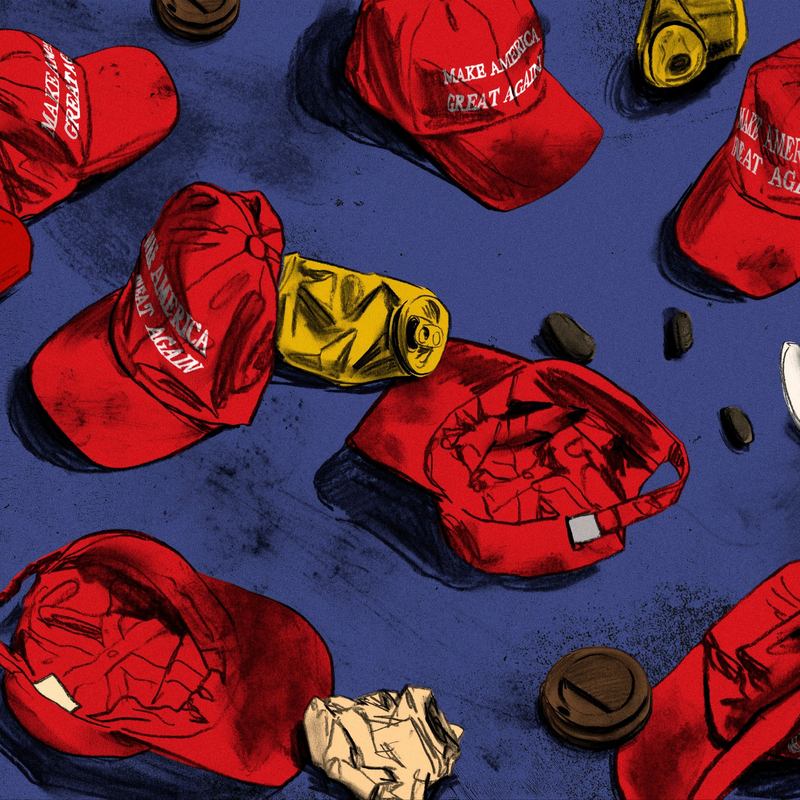
David Remnick: Denial has been one of the core traits, the default mode, you could say, of Donald Trump's presidency. Denial is the grease in the machinery that keeps it all turning: the abuses of power, the self-dealing, the bulldozing of our civic life. Donald Trump lives in a realm of alternative facts, but sooner or later, the actual facts will impinge on Donald Trump, and it may be just a couple of weeks away in the midterms. As I wrote in The New Yorker last week, a growing percentage of the electorate appears to recognize the mayhem that he has instigated from the Oval Office. That percentage includes some of the people who put him in office in the first place.
Rich Baris is a pollster. He runs an outfit called Big Data Poll. On X, he calls himself The People's Pundit. Baris predicted the 2016 election correctly, and like many pollsters, he's now predicting disaster for Trump, but unlike many of them, Rich Baris has been an admirer of the president. He's sometimes identified as a MAGA pollster, and he appears regularly on The Charlie Kirk Podcast and other right-wing outlets. When Baris tells you that MAGA is failing, that's not a prediction that he's happy to make.
Rich, you've been labeled a MAGA pollster, and at places like The New Yorker, we usually cite polls from what we think are nonpartisan polling organizations that try to be unbiased, so what exactly does it mean to be a MAGA pollster?
Rich Baris: Thanks for having me, David, first and foremost. I can't stand that label. I'd say I'd let you in on a secret, but in the industry, everybody knows that I can't stand it. It's just something that got slapped on me because I think it's fair to say that I did see the polling very differently than everybody else since 2016.
I thought, as a pollster, and I still obviously do think this, that basically the pollster is the lobby for the voter. They don't have a lobby. Every other special interest has a lobby in DC and on K Street. I pushed back a lot in the beginning of the Trump era on the media and university polls. I thought they were wrong. For that, you get labeled as, "Well, he's really defending Trump," and I think most of MAGA now has found out the hard way that that's not true.
David Remnick: We'll get to that, but just for everybody's bona fides here, would you identify yourself as a MAGA voter or sympathetic to Trump?
Rich Baris: I would say sympathetic. That's fair. Yes.
David Remnick: What attracted you to Trump, and has that attraction borne the test of time?
Rich Baris: I think Donald Trump was able to exist outside of the typical, what I used to call the construct. I'm a bit of a realist, so anyone who's going to take money from these billionaires and their PACs and all of that, it's an IOU. It's an unfortunate reality of our system. I thought Donald Trump was a rare opportunity for an individual to put himself august of that and to be able to make decisions using a different calculus.
David Remnick: Are you suggesting that he's immune to the funding of the wealthy?
Rich Baris: Not totally immune. Not totally, but to some degree, at least a little bit more independent, and that's certainly less true in '24 than it was in '16. I think we can go through the FEC records, and we can tell that the 2024 Trump's campaign very, very different than 2016.
David Remnick: Now, the bond that many Trump voters have with him sometimes appear to be emotional as much as it is ideological. Do you think that is starting to fray?
Rich Baris: I do. I think that Rush Limbaugh gave the president some of the best advice. He said that nobody can break the bond that Donald Trump or you have with your voters from external force. The FBI coming after you for Russia or the media coming after you. Whatever it may be, if it's perceived by the voter as an external force that's trying to take you out, then they'll perceive it as those same forces they blame for their lives being miserable, and they'll just side with you. It'll be a knee-jerk reaction, even if you're wrong, by the way. This time Donald Trump did this to himself, and sometimes it pains me to talk like this.
David Remnick: What was the breaking point for you?
Rich Baris: I think the very first breaking point was when many of his voters were upset about the mishandling of the Epstein file situation, which was not a tremendous issue at the top of everybody's minds. Why it bothered them is that it was a bit symbolic of the ruling class that they feel rigs the system at their expense. Trump saying, "If you care about this issue, I don't want your support anymore," was the first fissure. It was the first crack.
David Remnick: January 6th did not have that effect?
Rich Baris: It did not. It did not have that effect.
David Remnick: I could name 15 other things, but look, we're here mostly to talk about polls. I think we can stipulate right away, Rich, that you and I probably agree on very little when it comes to Donald Trump. You voted for Trump all three times?
Rich Baris: I did, yes.
David Remnick: Do you regret it in any way?
Rich Baris: I'm certainly more partisan than the average person. I'm more political than the average American. I can't say I regret it because I wouldn't have voted for Kamala Harris. At the same time, I also have to recognize that most Americans aren't steeped into it the way I am, and I'm trying to get people on both sides, but particularly the right now, to understand that not everyone is going to agree with us. In fact, a lot of people will not.
Most of Trump's low-propensity vote, they didn't vote for exactly this reason. They thought no matter who they voted for, it didn't matter. We got war, and we got inflation, and we got a weakening labor market. It almost never mattered. Doesn't matter the party. Doesn't matter the person. With Donald Trump being in the position he's in right now, the right ones, they want to look at the average voter and see what they see in the mirror, and that's just not the case.
David Remnick: It seems to me that the issues that have really damaged his support are the war in Iran, certainly prices, and also the grift, the degree to which the Trump family and people around Trump have just profited in the billions of dollars in the most open and really unprecedented ways.
Rich Baris: I think it's a little bit amusing to me that here I am talking, like you said, but we probably agree on very little, but you seem to understand the disaffection better than what remains of the average MAGA supporter. I say what remains intentionally because they've undergone a purification through subtraction process, where it's okay to start cutting off limbs of your coalition if they're not stepping in line with you. That is the antithesis of what MAGA was all about and how it built a big tent coalition.
When I brought up the Epstein issue before, I used the analogy that it was almost like a boxing analogy. It was almost like a one-two punch. The Iran issue, the focus on foreign policy, that was the big overhand right. The Epstein situation was the jab to the chin that just tees you up a little bit for that big overhand right. I've tried to phrase it like that because ever since that overhand right came, MAGA's been down, and they're so out of it, they don't even realize they're on the map. The ref's been counting to 1,000 by now, and they still think they're out fighting, and their hands are up. It's unbelievable, and it's a little shocking to me that people on the outside can see it clear as day. It's a loss of objectivity.
I think the Iran issue, of course, that's absolutely front and center. We're going to hear people who, of course, supported the Iran war say, "The losses weren't caused by Iran per se. They were caused by unhappiness with the economy and gas prices." What everyone should understand is that, of course, the voters blame Iran for that. They blame the focus on foreign policy for the administration not being a domestic policy-focused administration as it promised, of course, to be, and I would argue Trump was in his first administration.
Then the grift, what you called the grift. We did a focus group, it's, I guess, almost three months ago now, and we wanted to know out of what remains of that core support, when Democrats take power, let's say, if and when they take power, and they are much more disciplined this time than they were the first time, it actually impresses me, they launch investigations into all of these stories you're talking about.
We just talked to core MAGA. One, they didn't know. They didn't know about the pardons. They didn't know about this stuff. It's amazing how much they didn't know. Then two, once they did, a huge chunk of them were very, very upset. I think this goes back to the point I was making about what Rush said. The only way to break that bond with these voters is if you do it yourself. How? I don't know, turn out to be just another politician.
David Remnick: I've heard you talk about this a little bit elsewhere, and I want to drill down on it a little bit. What you're predicting, you, Rich Baris, the People's Pundit, a MAGA supporter and a MAGA-aligned pollster, you are saying that Donald Trump and the Republican Party are facing disaster come November 3rd.
Rich Baris: Yes, that's fair. That's a fair characterization. They're going to lose states that were unthinkable that they would lose two years ago. The House is gone. I'm not even willing to entertain this, like some people are, that somehow the Republican Party's going to hold onto the House. We're seeing 15, 16-point swings in some of these districts away from Donald Trump. The problem is they're dealing with a different situation than they had in 2018. By that, I mean the base was still willing to crawl across broken glass to defend Donald Trump from potential investigations, and there was the Supreme Court issue back then. Can we get a Senate that can confirm Donald Trump's picks?
There's disaffection right now at a level that I have never measured since we started measuring the Trump coalition. You brought up January 6th before. Donald Trump is more unpopular now than he was in the weeks after January 6, and that may be one of the few events where you can point to and say, "Okay, that drew blood a little bit. That hurt him a little bit." It was temporary, but it did hurt him.
David Remnick: Insurrection on Capitol Hill hurt him a little bit?
Rich Baris: Yes, at a time when we first started polling that, when a majority did agree with the characterization that it was an insurrection. Now, Democrats, they didn't hold onto that narrative, and that disappeared over two years. That was a big part of going into the '24 election, them drumming on about it. It wasn't working because Americans had kind of shifted their views on it a little bit.
Right, at the end of the day, you could look at an event like January 6th and say, "Okay, that should've hurt him pretty badly." Why is he hurting now more than he ever was hurting after an event like that? Again, it's because it's personal. There's a lack of appreciation in the administration and supporters for how so many of these voters, especially young voters, how they felt about Donald Trump and Vice President Vance.
David Remnick: You're saying they feel betrayed, I think. I don't want to lead the witness here, but that's what I'm hearing.
Rich Baris: They're disappointed. It's a level of disappointment that can only be understood if you understand how many of these voters really believed that Donald Trump was the only reason to vote, that Donald Trump was their last chance.
[music]
David Remnick: I'm speaking with the pollster Rich Baris. We'll continue in just a moment. This is the New Yorker Radio Hour.
[music]
David Remnick: This is the New Yorker Radio Hour. I'm David Remnick, and I've been speaking today with the pollster Rich Baris. Baris runs a firm called Big Data Poll, and he's co-author of a new book called Burn It Down: What the Polls Say Young Americans Really Want. Although Baris politically identifies with MAGA and its goals, he's seeing a wave of "disappointment," that's his term for it, among the president's voters, and Baris agrees with nonpartisan polls that a blue wave is coming on Election Day. We'll continue our conversation now. You said that the House is gone. Gone.
Rich Baris: Yes, the House is gone.
David Remnick: Let's go to the crucial Senate races and break them down a little bit. Let's look, for example, if we start on the East Coast and start moving west.
Rich Baris: Yes.
David Remnick: Look at Maine.
Rich Baris: We're going to have a poll in Maine soon. If it was conducted a week before, we may have had Susan Collins up. Let me explain this because this'll go to every state we go around the map. Beginning of November, we should have seen some tightening of the polling already if things were going to go somewhat back in the Republicans' directions.
Normally, when Republicans start to chip away, and Democrats have PTSD over this, every time they think they're in mid-September, they're going to win, by late September and early October, that polling lead has been chipped away and then Republicans gain and gain and gain. Then the election comes, and they can't believe what happened. That's been the pattern, and it's a long-standing pattern. It's not just a MAGA-era pattern.
This has not happened. What does that mean? If that hasn't happened by now, what always happens is that the current trend accelerates, and pollsters have a hard time picking up that movement at the end. I feel, and we saw this in '25, by the way, with New Jersey, with Pennsylvania, with Virginia, this feels to me far more like '25 than '24. When you look at Maine, I would've said Susan Collins was up a point or two a couple of weeks ago. I think it's slipping away from her now. I do.
David Remnick: We're not just talking about Maine and Michigan. We're talking about Nebraska, Kansas. That's extraordinary.
Rich Baris: It is. I think those two, which people view as deeply red states, they're ruby red, it's not really true. There's a populous aura that is always run beneath the electorate of these plain states, and it has not always favored MAGA. Yes, in state-level races like governor's elections, we've seen Democrats win in the past, especially if Republicans nominated bad candidates, but at the federal level, people got complacent, and they thought that these states could not go. In a bad environment, they absolutely can.
David Remnick: Alaska, Texas even.
Rich Baris: That's right.
David Remnick: Now we're used to this idea of Talarico potentially winning, and admittedly, I think you would agree, his opponent is probably one of the worst candidates imaginable.
Rich Baris: [chuckles] He's definitely had some wounds from the primary. I think that's fair.
David Remnick: Your habit is for understatement, Rich.
Rich Baris: I'm trying. I'm trying to be diplomatic here.
David Remnick: I see.
Rich Baris: Look, $100 million in the primary spent against Ken to expose every one of those flaws, and it took a toll. It did damage, and now Texas is almost single-handedly bankrupting Republican organizations. If Talarico even loses, let's say Ken Paxton were to eke this out, it's still a massive win because the rest of the map, you're going to see the impact of having to drop immediately $125 million to go and save Ken Paxton.
David Remnick: Is Ken Paxton savable?
Rich Baris: I do think he is. He's in a better position now.
David Remnick: Really?
Rich Baris: We'll have another Texas poll too. We did have Talarico up. Money does matter, and that amount of money is an obscene amount of money. Will it be enough? We'll see. There are plenty of Republicans. Even with the slides and the swings that we're seeing with key demographic groups in Texas, it's white suburbanites and Hispanics. They have swung hard against Republicans. There's still enough where, if they were to go out and vote, then Ken will win. It'll eke it out. However, that's the million-dollar question, David.
David Remnick: You mean a lot of people may stay home?
Rich Baris: They're going to stay home.
David Remnick: That disaffection may keep you in a chair in the house?
Rich Baris: I think we're going to see that in a lot of places.
David Remnick: One of the surprises last time around in the general election was the swing of Hispanic voters in Trump's direction. That seems to be, and tell me if you agree with this general conception, that that has reversed to some great degree.
Rich Baris: I would argue it's at least reversed. At least.
David Remnick: Wow.
Rich Baris: Republicans, if Wednesday morning, we're all looking at the exit polls, and we're looking at Mitt Romney-level support among Hispanics, I will not be surprised at all, not in the least. We can already see evidence of that. Texas is a perfect example of this. I'm looking at some of these models, David, and they're all assigning respectable to almost Trump-level shares of the Hispanic vote to the Republican candidates in these states and districts, and that's insane. Donald Trump was able to do that. Republicans were not. They have never been able to do that. With Trump not coming through for them on a lot of these issues, that leaves no reason for them to continue to vote Republican.
We've seen it in the primary. We can tell in the border counties that Trump did so well in. We can tell that Talarico got so much of the vote in a primary that it doesn't make any sense, other than you realize that many of Trump's Hispanic voters actually just voted for James Talarico in a Democratic primary. When you're getting 60% to 80% of Kamala Harris' total vote in a general election, in a primary election, that's the only way the numbers make sense, and it wouldn't be unprecedented. We saw it in New Jersey and in Florida recently too.
David Remnick: The reason for the shift back in the Hispanic vote is what? Economic issues, or is it, and here I won't be diplomatic, the kind of obscene over-torquing in immigration policy, namely ICE on the streets and all the rest? How much has that hurt the president?
Rich Baris: I would say it's still 80/20 economic.
David Remnick: Really? Mass deportations don't compare to the rest.
Rich Baris: I think Donald Trump, had he done or made a few changes on how mass deportations were being carried out, it would've made all of the difference in the world. We have talked to countless numbers of Hispanic voters who tell us mass deportations were a problem for them. Then when asked what part of it was a problem, they'll tell you that it's because Trump wasn't going after the employers. Not that he wasn't also going after the workers and removing people--
David Remnick: The voters didn't mind the spectacle of people being herded onto planes to El Salvador?
Rich Baris: There's no doubt some did, but people who voted for Trump in November were already okay with the idea of deporting large numbers of people. They really were. Now, what they weren't okay with was not knowing who ends up on this list. There were very, very clear things they were telling us. "I don't trust the government. Just because Donald Trump is now the president doesn't mean I trust it anymore. Why are these people ending up on these deportation lists?" That was number two.
Number one was, "Take off the mask. You look like a stormtrooper. This is ridiculous. This is the United States of America. You're afraid about being doxxed? That's absurd." That was unacceptable to the American public. Number three, it stems from number two, where they were being told that it was criminals who were ending up on these lists, but then we would see, of course, stories of what just appeared to be completely unnecessary snatch-and-grabs and deportations, including with children, which always gets Americans in an uproar.
David Remnick: What can Donald Trump do between now and election day to change anything? He is surprisingly, and I think, I have to say, erratically traveling the country in a way I can't quite grasp.
Rich Baris: Yes. He can generate more turnout, but the problem with that is what I said before. This isn't '18 anymore, and yes, you can juice your base turnout, but your base is smaller than it was before. That's just the reality. Republicans hitched their wagon to Donald Trump, and that has always been for better or for worse. If you don't, you risk turning off what remains of that MAGA base, and contrary to what you hear, every election is a base election, even among independents.
The more you can gin up your base, excitement among your base, the more you can gin up the excitement among your own independents. The truth is, independents, very small amount in this country are truly independent. They lean one way or the other. When your base is depressed, your independent share is depressed, and it'll make the margin look even worse for you there, which we are seeing this right now for Republicans.
David Remnick: Let's presume you're right and there is a blue wave on November 3rd, and other pollsters are saying much the same. Where does that leave this presidency? Donald Trump, in your view, and now I'm asking you less as a pollster than as somebody who has been with Trump since the beginning in terms of your politics, is he a lame duck? Because he still has the power to do many, many things independent of any sanction of Congress.
Rich Baris: I think that'll depend on how big of a wave we're talking about. If we're talking about 55 seats in the US Senate, he's in real danger of even finishing his presidency. I don't know how people who lived through the first administration at least can't entertain that as a real possibility.
David Remnick: You mean in terms of having an impeachment proceeding and even a conviction?
Rich Baris: I do. Part of what attracts someone like me to MAGA and other voters to MAGA is the realization that the Republican Party is a scam. It's a con.
David Remnick: Whoa, whoa, whoa.
Rich Baris: They'll turn on Trump in a heartbeat.
David Remnick: Let's drill down on that. Rich Baris, MAGA supporter-
Rich Baris: Absolutely.
David Remnick: -is telling me the Republican Party is a scam. What does that mean?
Rich Baris: Their donors always win the fight between the donors and the voters. No matter what you want to say about the Democratic Party, it does happen, but it happens a lot less. That's because their donors are more in line ideologically with their own base. That is not the case with the Republican Party. Donald Trump rose to where he did and was able to take over the Republican Party because of that very real fact. Republicans let their voters down all the time.
Seven-year campaign promises to repeal and replace Obamacare. It never happens. Infinite campaign promises to seal the border and stop the endless wave of illegal immigration. It never happens. Why? Because big agriculture and big hospitality donate to Republican senators and Republican lawmakers. Donald Trump was a different kind of Republican brand that represented not being a happy loser anymore. Without him even being popular, David, they're in dire straits, and I think that's a major difference.
David Remnick: Let's then look at the main drama that will follow is the presidential race. The two candidates that are most likely on the Republican side are Marco Rubio and JD Vance, but does Trumpism end with Trump? Are either one of these people capable of continuing that legacy, or will they run as conventional Republicans? How do you differentiate them?
Rich Baris: I really only think Marco Rubio would be worth talking about if the vice president doesn't run.
David Remnick: Really?
Rich Baris: Yes.
David Remnick: You think if Vance runs, Rubio does not?
Rich Baris: I do. Even if he decides-
David Remnick: What gives you that idea?
Rich Baris: -he just can't win. This is Ron DeSantis versus Donald Trump all over again. If the vice president were to win, he's going to-- I don't want to stick my foot in my mouth here, but right now he's got a bigger lead than we saw in '24. It would be incredibly difficult for Marco Rubio to be able to make inroads with white working class, especially, because he's on the wrong side of certain issues.
David Remnick: You're telling me that Vance is a lock. If Vance runs, Vance is a lock?
Rich Baris: Without a dark horse, yes. I always keep in mind the possibility that a dark horse could rise because Vance has got a tightrope walk that he's got to pull off. There's a huge part of the Republican base who is very angry at the foreign policy wing of the party, and he's got to win back the trust of the white working class in Appalachia-
David Remnick: How does he do that?
Rich Baris: -and in the Ohio River Valley.
David Remnick: How does he possibly do that? He's the vice president of the United States.
Rich Baris: It's tough.
David Remnick: How is he not soiled by the grift, as we've called it in our conversation, soiled by the war in Iran that we're told privately he was against, but he was the vice president?
Rich Baris: The numbers are telling us right now that, for whatever reason, the voters are giving him the benefit of the doubt, and they're not blaming him in a way that I expected them to.
David Remnick: Is Tucker Carlson a factor in this race, or is he just playing games?
Rich Baris: I think he could drag people to the right. He will be a factor. I think this is a great part of the entire conversation the Republican Party's trying to avoid right now. Yes, of course, going after the president in the short term is going to make you unpopular with some people, including some people on the right, but in the long term, Tucker's won this fight already, and many people just don't even know it.
What do I mean by that? If you're a Republican who's 55 and older, maybe you agree with Mark Levin and Ben Shapiro, and maybe you're still happy with Donald Trump, and maybe JD Vance's role in the administration won't bother you at all, but if you're below the age of 55 and you're right-wing, that which is the future, then you are much, much more in agreement ideologically with Tucker Carlson. That is something that the right is just going to have to accept.
David Remnick: As somebody who supported MAGA from the start, and now maybe with a certain sadness seeing its eclipse, when Trump ends, does Trumpism end?
Rich Baris: Republicans needed to understand from the beginning of this thing that this was all about him and his new ideas that he brought forward. Your platform was never popular. Donald Trump won [crosstalk]--
David Remnick: What were his successes? I'll just stipulate my disagreement even before you answer.
[laughter]
David Remnick: If we ended the whole episode now, a decade-long episode, and it'll have two more years to play out, presumably, what do you count as his successes?
Rich Baris: Shifting the Overton window on the issue of immigration. They have been enormously successful. It'll be very hard for the Republican establishment to roll that back. I brought up the construct earlier in the interview. That construct is gone. What it was was this little box where we would have these elections in, and nobody ever left the confines of these boxes. We were only allowed to talk about issues in a certain way, and we were only allowed to talk about the impact of them in a certain way. Some people weren't allowed to say that maybe my experience with this policy hasn't led to the best results. That's gone. He's destroyed that.
David Remnick: When it's tipped over into racism, both the discussion of and the policy on immigration, did that give you pause?
Rich Baris: Yes, and I'm going to get a lot of phone calls after people on the right hear this. I think one of the sadder things for me has been to watch parts of the right begin to blame others. Call it what you want. Arab Americans, Arab voters in Michigan, in Dearborn, who just less than two years ago voted for Donald Trump. We're angry now, so suddenly we need to round them up and throw them out? They just voted for you. Venezuelans in Florida after the Maduro raid. "You know what? They got to go, too." What are you talking about?
It has. I would be dishonest if I told you it hasn't. I have a friend. His wife is Arab. She voted for Trump. They were elated. I don't know a better word to use. They were elated to see how non-white Trump's coalition was, how diverse it was. It feels good when you somehow increase your vote share with both Jewish voters and Muslim voters. That feels good. It feels like you're putting together a real coalition where people can start to come together and get things done.
From my point of view, David, I'll just tell you, I think I would personally like to see the gap between urban and rural shrink because I think they have a common opponent that is why their lives maybe aren't as good as they think they could be. It's a have versus have-not thing. It's not a white versus Black. A lot of the voters from Bernie Sanders' coalition in 2016, they were Trump voters by the time we got to 2024. That could have continued.
They could have kept expanding the appeal they were having with younger voters, with traditionally even ancestral Democratic areas that we have been seeing. They squandered this opportunity. Unfortunately, and this has been my concern for over a year, it's always going to be blamed on somebody. When there's failure and anger and disappointment, people start to look for other people to blame, and that's tragic. There's no other word.
David Remnick: Rich Baris, I know we have much that we disagree about, tons that we disagree about, but it's been a pleasure to talk with you and really talk through what you think is going to happen, not only in the midterm elections, which are just around the corner, but beyond. I thank you very much.
Rich Baris: Thank you for having me, David. It was a pleasure. All the best.
[music]
David Remnick: Rich Baris runs Big Data Poll, and his new book about young voters is called Burn It Down. The midterms, do I need to remind you, are November 3rd.
[music]
Copyright © 2026 New York Public Radio. All rights reserved. Visit our website terms of use at www.wnyc.org for further information.
New York Public Radio transcripts are created on a rush deadline, often by contractors. This text may not be in its final form and may be updated or revised in the future. Accuracy and availability may vary. The authoritative record of New York Public Radio’s programming is the audio record.