Canada’s Plans for Donald Trump
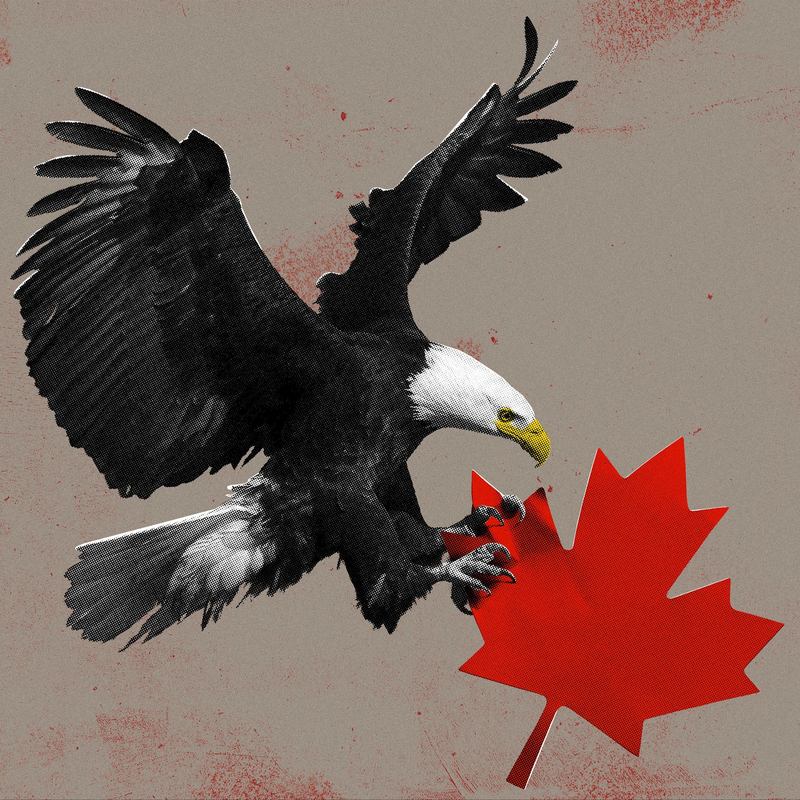
David Remnick: When Donald Trump started calling Canada the 51st state and referring to the Prime Minister as "governor," it seemed like his usual trolling sessions. More serious than renaming the Gulf of Mexico, maybe less serious than the threat to take Greenland by force. Trump has said that Canada "doesn't make sense," which, even by his standards, doesn't make any sense. It turns out, though, that the president wasn't joking. His tariffs are punishing Canada's economy. He compared Canada unfavorably to China and called it "one of the worst countries in the world" to deal with. It's like the bit from the old South Park movie came to life.
[South Park clip]
Sheila Broflovski (Kyle's mom): Should we blame the government or blame society?
Sharon Marsh (Stan's mom): Or should we blame the images on TV?
Sheila Broflovski (Kyle's mom): No, blame Canada. Blame Canada. With their beady little eyes and flapping heads full of lies.
David Remnick: But it's no joke for Canadians. They are absolutely furious. They're retaliating economically. The prime minister, Mark Carney, even said his government is looking at how to prepare for U.S. military action. It would be irresponsible not to, he said.
[music]
David Remnick: Now one of our top trading partners and closest neighbors is actively seeking allies elsewhere in the world. I called up a senior figure in Canadian politics, Chrystia Freeland. Freeland served as the deputy prime minister for five years, and she dealt with the Trump administration very closely. She was the Minister of International Trade and of Foreign Affairs during his first term. Chrystia Freeland's new book about Canada and the U.S. has the evocative title, Unreliable Boyfriend.
Chrystia, there was a time when the idea of U.S.-Canadian relations was so friendly and so warm, and we didn't think about it, almost. The idea of conflict between the United States and Canada was kind of a source of comedy. In Season 6 of The West Wing, there's a plot in one of the episodes about "should we invade Canada?" There's some crazy misunderstanding. Chrystia, how did we get to this point where the president of the United States refers to Canada as the potential 51st state, and he says all kinds of demeaning things about Canada? Did you see this coming?
Chrystia Freeland: I kind of did see this coming, David. I was around for Trump 1.0, and we got to a good deal in the end. Trump, before the inauguration, he started talking about 25% tariffs on all Canadian goods. Then he started calling the prime minister the governor. I didn't think that was a joke. I thought we needed to treat this like an existential challenge, which I'm sad to say I've turned out to be right, and it's turned out to be true.
David Remnick: It's turned out to be prolonged. It's not just one of these one-day Trumpian episodes that happens with many other issues. What are the origins, as you see it, of his animosity toward Canada and other traditional allies?
Chrystia Freeland: I think he does it because he can. I think he only knows two kinds of relationships. A relationship where someone is submitting to him or a relationship with someone who he identifies as a fellow strongman. Canada's unfortunate geography right now is: we're the country where he wants to show the demonstration effect. He wants to show the world that Canada has to kowtow to him. David, you and I both know Russia well and care about Ukraine a lot. I don't want to draw parallels between Russia, Ukraine and Canada-U.S. lightly, but my analysis of the Russia-Ukraine relationship was always that Putin needed to dominate Ukraine pour encourager les autres, you know what I mean?
David Remnick: Yes.
Chrystia Freeland: To show he could do it to them so everyone else had to fall in line. I think there was a further twist to the Putin-Ukraine relationship. He wanted to show that democracies could fail. I do think, very unfortunately, it's not an accident that this administration is going after the democracies with much more hostility than it is going after the authoritarian regimes, with the exception of Iran.
David Remnick: Donald Trump recently commented on our trade relationship with Canada, and he said this.
Donald Trump: Well, they want to have a deal with us. They call us all the time. The problem is that they've treated the United States very unfairly. They have been one of the worst countries in the entire world. We get along with China, we get along with people, and we make good deals, but Canada has been really very difficult to deal with, actually.
David Remnick: Does he have any point that you can acknowledge?
Chrystia Freeland: Truly, no. Our trade is governed by a trade deal that his administration concluded. Now, are there disputes within that deal? Sure, but the deal provides for a dispute resolution mechanism which has judges from both sides and some neutral judges. We always abide by the decisions of those panels. I think the thing that makes the president really angry—and look, I am someone who he does not like; he's called me toxic, he's called me a nasty woman. He said that I don't like America very much. Not true, American listeners. Not true, David—I think what enrages him about Canada is we are a country that has a sense of our self-worth and our dignity. We really believe in a win-win relationship with the United States. We really believe in compromise; it's like a core Canadian thing. We will not accept a zero-sum game. We will not accept a position of vassalage. I actually don't think America should want that.
David Remnick: U.S. Secretary of the Treasury Scott Bessent, and I want to talk about him, compared Canada to a little yipping dog when it comes to trade with the U.S. He said that Carney, the present leader of Canada, came to power on an anti-American, anti-Trump agenda, and he blames him for escalating trade negotiations. Now, you know Scott Bessent, and you write about him very sharply in this book. How do you understand these comments, and how do you understand Scott Bessent?
Chrystia Freeland: There are some situations in life, and you and I both as reporters have covered them, where there are good people on both sides, where it's murky, where it's ambiguous. Often those are the most fun and interesting stories. When it comes to the trade fight between the United States and Canada right now, it really is black and white. We have a trade deal; we have a trade deal that was negotiated by Donald Trump's administration that he said was the best trade deal ever. It was a remarkable thing because he supported it, and so did Nancy Pelosi. Tell me one other thing they both agreed on.
It was the Trump administration, the Trump 2.0, totally disregarding that agreement, his own agreement, impose tariffs on Canada. That's why we're in a conflict. Canada, in that situation, you have a choice. Either you accept an illegal action, you accept a breaking of the deal, or you act in response. I think Canada is absolutely right to be acting in response. On the Secretary of the Treasury, it's very hard for me to really understand, actually, because I first met him when he was working for George Soros and he was so positive about George. What is surprising to me, he seems to have embraced this role as full-on MAGA warrior.
David Remnick: One of the things that's not known to me, because I live here in New York, not in Toronto or Montreal. I can sense, certainly, the animosity that's coming from Canada, the desire to look elsewhere for friends. Mark Carney's political rhetoric is very sharp in reaction to Trump's. What I don't get a sense of is: do Canadians, not that everybody speaks in the same voice, but do they see this as an episode or as a real historical rupture? Do they think that when Trump ends, Trumpism will end and that everything will go back to status quo ante somehow, or is Canada really looking for a new, possibly European orientation in the world?
Chrystia Freeland: I think the vast majority of Canadians see this as a rupture, and they think this is it, and they think America is toxic, broken, and can never be trusted again. Now I actually am an outlier because I think we shouldn't write America off quite yet. When you saw the rise of Trump, but then you saw Biden elected, when you saw COVID, and then you saw what came after, I think fixed certainties can change much more quickly than it feels like in the moment.
In answer to your question, I was recently traveling from Toronto to, I think it was Boston, and one of the security guards recognized me. He was very nice, and he said, "Oh, Minister Freeland, it's great to see you. I haven't seen you for a while. How are you doing?" We chatted, and then he looked at me and said, "Why are you traveling to the United States? You know that we're not supposed to go there anymore." Sort of apologetically, I said, "I know we're not supposed to go there anymore, and I think that's right. I think we shouldn't go there frivolously, but I promise you, I'm going there to speak up for Canada." He said, "Okay, but tell those sons of bitches we're better off without them anyway."
David Remnick: Whoa.
Chrystia Freeland: This is like a security guard at the airport.
David Remnick: That's a widespread sentiment now, Chrystia?
Chrystia Freeland: I'm afraid so.
David Remnick: Describe how else you feel it in your interactions with people in Canada. This new attitude toward the United States. It's not just a technical tariffs question; it's something that's running much deeper.
Chrystia Freeland: It's the tariffs, for sure, but then it's the response to our response. Illegal and unjustified tariffs have been imposed on us. We have done what I think is strategically the right thing to do, which is retaliate in a measured way. It's a dollar-for-dollar retaliation. We did the same thing during Trump 1.0. During Trump 1.0, when I announced the Canadian counter-tariffs, I said, "We will not escalate, but we will not back down." I said, "We're doing this more in sorrow than in anger." I think what makes it feel like a full break is open, explicit, and repeated territorial claims on Canada. Then, I think what makes people feel that this may be a break we can't come back from is the lack of opposition in the United States.
Canadians love the opinion polls that show that Americans don't like this. Canadians love the resistance of Minneapolis. If you are from Minneapolis and you want to visit Canada, you should wear a Minneapolis T-shirt, and I guarantee you, you will never have to buy your own beer the whole time you're in Canada.
David Remnick: Because if they see the polls saying that this is not a popular point of view, if they see that the midterm elections will probably, to some degree or another, go blue, I'm not for a second suggesting that there's no reason for the animosity in Canada toward the United States, but why do you think it's a permanent rupture then?
Chrystia Freeland: I didn't say I think it's a permanent rupture.
David Remnick: You said it's a rupture for now.
Chrystia Freeland: Well, I'm actually in a minority in Canada right now in that I think the Western alliance can be rebuilt, and I think we should at least try, because for all the challenges of Trump's America, I worry a lot about China, I worry a lot about Russia. I think the uber challenge in the world today is authoritarian regimes trying to erode and weaken democracies and the Western alliance. I want the Western alliance to come back again, and I hope that it can.
David Remnick: Donald Trump said the original NAFTA, Clinton administration period, was a bad deal. There's a lot of rethinking of that period. It's what some people call the N-word, neoliberalism. That NAFTA, as a pillar of neoliberalism, is of a certain period: the '90s. Some things were not in the best interests of working people in particular. When you look back at that period, did you reevaluate NAFTA itself to any extent, much less to Donald Trump's extent?
Chrystia Freeland: 100%. The Canadian debate around NAFTA was even more intense than the U.S. debate. The Canadian debate was much more about: "Do we want to connect ourselves so closely to many metaphors?" Pierre Trudeau famously called America the elephant and said, "Always hard to sleep with an elephant, even if he's well behaved." In my book, I call America the Unreliable Boyfriend. That was the Canadian debate.
The U.S. debate was about workers. I actually have a lot of sympathy with that. That wasn't a Canada-U.S. concern, because Canadian workers: we have higher unionization rates, we have very high labor standards, we have very high environmental standards. The concern was competition from Mexican workers. And I do think that critique was right. The good news, like the NAFTA agreement, the one currently kind of in force, CUSMA, USMCA, actually has provisions that accommodate that, has provisions that require that a certain amount of content of NAFTA-qualifying cars be made by high-wage workers. I think that's great. I think that is a path forward for trade agreements.
David Remnick: Give me a sense of the atmosphere. When you were with ministers from European countries, democratic countries around the world, and Donald Trump and his ministers and his aides were not in the room, give me a sense of the conversation among the Canadians, the French, and the Brits about Donald Trump. What was said and by whom?
Chrystia Freeland: I'll tell you one story that I think gives you a sense of it. Cecilia Malmström, who was the EU trade commissioner, and I were both negotiating with the Trump administration on trade. We developed a kind of jokey shorthand. If you went to Washington, we would tell each other and text each other "en route to Mordor." Cecilia once said to me that Gandalf was traveling to Mordor.
David Remnick: [chuckles]
Chrystia Freeland: That obviously meant Angela Merkel.
[music]
Chrystia Freeland: I thought the Canadians were obviously the hobbits. Small, earnest, but profoundly decent. Europeans were the elves. I think you know who Sauron was.
[music]
David Remnick: I'm speaking with Canadian politician and journalist Chrystia Freeland. We'll continue in just a moment. This is The New Yorker Radio Hour.
[music]
David Remnick: This is The New Yorker Radio Hour. I'm David Remnick. I've been speaking with the Canadian politician Chrystia Freeland, a former deputy prime minister who negotiated trade deals with the Trump administration. Freeland and I go way back. Before she ever entered politics, she was a journalist. She covered Ukraine in the late Soviet period while I was posted in Moscow. She attracted quite a bit of attention from the KGB while she was doing so. Freeland went on to work for the Toronto Globe and Mail, for Reuters, and eventually for the Financial Times in New York. Then she went to work for the government.
Chrystia, for a brief period of time in our lives, we had a somewhat parallel track. You were a reporter; I was a reporter. At a certain point, you did what is considered almost verboten among our tribe, among journalists. You entered—wait for it, trumpets blaring ominously—politics. Why did you do it, and how did it change your view of the world?
Chrystia Freeland: Well, I did it really because Justin Trudeau asked me to. There were lots of reasons that I ultimately agreed. Probably it boils down to the fact he was really nice to my dad at my book launch, if I'm really honest with myself.
David Remnick: Wait, you got into politics because Justin Trudeau—and you do write about this in your book—because he was nice to your dad at a book party.
Chrystia Freeland: My dad was one of the few people in Canada who didn't know him, who thought Trudeau was going to make it. He wanted to meet him. Then my dad loved ideas, loved politics. Didn't have that many people to talk with about these ideas. Like, everyone in town already knew what Dad thought. Afterwards, I said to Trudeau, who I didn't know, I was like, "I'm sorry no one came to save you." He was just so great. He said, "No, your dad was great. I don't meet very many Liberals from northern Alberta. It was good to hear from him."
David Remnick: You were very close to Justin Trudeau. That relationship did not stay in the same place. It eroded. Why?
Chrystia Freeland: I wouldn't say we were ever close at a personal level, if you know what I mean. We were never friends. We wouldn't have supper with our spouses together or anything like that. I'm not sure what happened on the prime minister's side, but then ultimately, two things happened. One, he wanted to fire me, and I had to decide whether I wanted to accept that or not. I guess this is the thing about politics. When you're making decisions, they're not just about you. They're not just about you and your career, what might be good for your career, and what you might personally want.
If you're deputy prime minister and finance minister, as I was, you have to think about "What are the consequences of this for the people I represent?" I guess, David, you've led me to what is maybe the hardest thing about politics. You're a human being with human emotions, desires, feelings about other people, and feelings about yourself. If you are a minister of the Crown, if you are deputy prime minister, you have to try to set those aside and try to think what's the right thing to do for the country.
Also, you sometimes don't know until 10 years later what was right and what was wrong. You have to be able to make compromises. You have to find ways to survive politically to be in a position to do what's right for the country. It's hard.
David Remnick: One thing that reporters and editors generally don't do is they don't stand for election, either before Parliament or the people. I think we have a picture of what winning might be like because we see the victory celebration and so on. Losing sounds like a miserable experience. After Trudeau resigned as prime minister, you ran for the leadership of your party, and you lost to the current Prime Minister, Mark Carney. He got 86% of the vote. That's a painful experience. Tell me about that.
Chrystia Freeland: Losing, there is no way around it; it is terrible. I feel like I made some choices that were not fantastic for my personal political career. In the dark hours of the night, I don't berate myself for having failed Canada. That is a powerful comfort.
David Remnick: What's the dark path you're referring to, Chrystia?
Chrystia Freeland: Oh, the dark path would have been had Pierre Poilievre been elected Prime Minister.
David Remnick: That would have been dark indeed.
Chrystia Freeland: Yes, it would have been terrible for Canada. Had I not resigned from the Trudeau government, it's hard for me to see a path where Poilievre was not elected. A friend of mine once said to me—this is kind of a dark way of looking at it—but when making life decisions, think about what you would like to appear in your obit. If a line in my obit is, "She resigned as deputy prime minister, and that was an action that made it possible for Pierre Poilievre to lose and Mark Carney to be elected prime minister," I would be really happy to have that line in my obit.
David Remnick: You're okay with that?
Chrystia Freeland: More than okay. I would be glad to have that in my obit.
David Remnick: Americans are now watching current Prime Minister Mark Carney, and we particularly pay attention when he speaks about us, because, after all, as you know, Chrystia, it's all about us. He is extremely popular. Never more so than when he's given speeches in defiance. I would say, quiet defiance. Restrained Canadian defiance, but defiance nevertheless. Will that popularity sustain itself?
Chrystia Freeland: Here I have to just admit, I am fiercely partisan. I'm a partisan Liberal. I'm a patriotic Canadian. I really like Mark. I've known him longer than anybody in Canadian politics. He's my son's godfather, and I think he's doing a fantastic job. Really outstanding.
David Remnick: Help us understand Carney's strategy of confrontation with the United States. What is it that he will say and do, and what will he not say and do? How do you analyze the way he's handled himself in all of this?
Chrystia Freeland: I think a leader is successful if he or she is channeling what people really want. I think that that is what Mark is doing right now. I think in big struggles, a country is successful when the country wants the right thing, and then if it's lucky enough to have a leader who understands what the country wants and can express it.
Again, I'm going to go back to Ukraine now. A good friend of mine, a guy called Boris Gudziak, who is the archbishop of the Ukrainian Catholic Church, lives in Philadelphia. He said "People outside Ukraine see Zelensky's greatness, and he is great, but people inside Ukraine recognize that the real greatness is the people of Ukraine. Zelensky's power is he's able to express it." I don't think Mark would disagree if I were to say the greatness of Canada right now is Canadians. Canada is lucky to have a leader who understands and recognizes that and is able to express it.
I'm so proud of Canadians. Canadians understand that their sovereignty matters, and they are prepared to suffer economic pain to stand up for their sovereignty. Stephen Harper, who is a Conservative, former Canadian prime minister, said very early on in Trump 2.0 that Canada should be prepared to endure any level of economic damage in order to defend our sovereignty.
David Remnick: Let me ask you about that question of sovereignty and pain. Just recently, Mark Carney announced a new pipeline meant to export crude oil to markets in Asia away from the United States. That could generate billions and billions of dollars in GDP for Canada. Is there a future where Canada just doesn't need to export oil to the United States at all, and can Canada manage without much of an economic relationship with the United States, or is that just dreamland?
Chrystia Freeland: On the pipeline front, one of the things I'm proud of as finance minister that I did is I built a pipeline. Not with my own hands. The government bought a pipeline. We concluded the construction of that pipeline while I was minister. That is the Trans Mountain pipeline to the West Coast. The entire theory of the building of that pipeline was to diversify Canada's exports from the U.S. Canadian Western crude trades at a discount to Texas or Brent because Canada has fewer places to sell its oil. This is a longstanding Canadian strategy. It's hard because we're so close to the United States and also because the U.S. is so dynamic, such a robustly growing economy, and so appealing.
What I will say, David, and here I am at odds with what I think is the Canadian view right now: I don't think we should give up on America. I really don't. I don't think we should write America off. I think the Western alliance will be much stronger if America rejoins the Western alliance. I hope that Canada's actions are going to help regular Americans recognize that their country is on the wrong path right now. A lot of people will say there's no path back for America. I don't believe that. I really think there should be a path back for America, and I hope America chooses that path.
What the world is watching, and especially what America's allies are watching, is: What are regular Americans doing and saying? What are journalists doing and saying? What are editors saying? What are heads of universities saying? What are business leaders saying? I'm actually so proud; I consider myself still a journalist. I don't know if you think I should be kicked out of the tribe for having-
David Remnick: Out of the guild.
Chrystia Freeland: -flirted with-- Out of the guild for having flirted with politics. I think that the way that journalists stood up to the White House is absolutely brilliant. I would love to see law firms do the same thing. I would love to see universities do the same thing. I'd love to see businesses do the same thing and show that kind of solidarity. I am hopeful that we will see more of that. I don't know. Did you see Jamie Dimon's piece-
David Remnick: I didn't.
Chrystia Freeland: -in The Wall Street Journal this week? You did not?
David Remnick: That's the CEO of, I think, the biggest bank in the United States.
Chrystia Freeland: I predict the piece that Jamie Dimon published in The Wall Street Journal this week is the beginning of business breaking with MAGA; that's my prediction.
David Remnick: But, my God, Chrystia, not a moment too soon.
Chrystia Freeland: For sure, it would have been nice earlier, but-
David Remnick: Yes. [chuckles]
Chrystia Freeland: -it's a big moment, and I give Jamie a lot of credit. It's carefully written. It's not explicitly hostile to the administration in any way, but it is explicitly hostile to America First.
[music]
Chrystia Freeland: It explicitly calls for the rebuilding of the Western alliance, which I agree with. I think we need that.
David Remnick: Chrystia Freeland, thank you so much.
Chrystia Freeland: My pleasure.
[music]
David Remnick: Chrystia Freeland was deputy prime minister of Canada under Justin Trudeau. Her new book about the U.S.-Canada relationship is called Unreliable Boyfriend.
[music]
Copyright © 2026 New York Public Radio. All rights reserved. Visit our website terms of use at www.wnyc.org for further information.
New York Public Radio transcripts are created on a rush deadline, often by contractors. This text may not be in its final form and may be updated or revised in the future. Accuracy and availability may vary. The authoritative record of New York Public Radio’s programming is the audio record.