
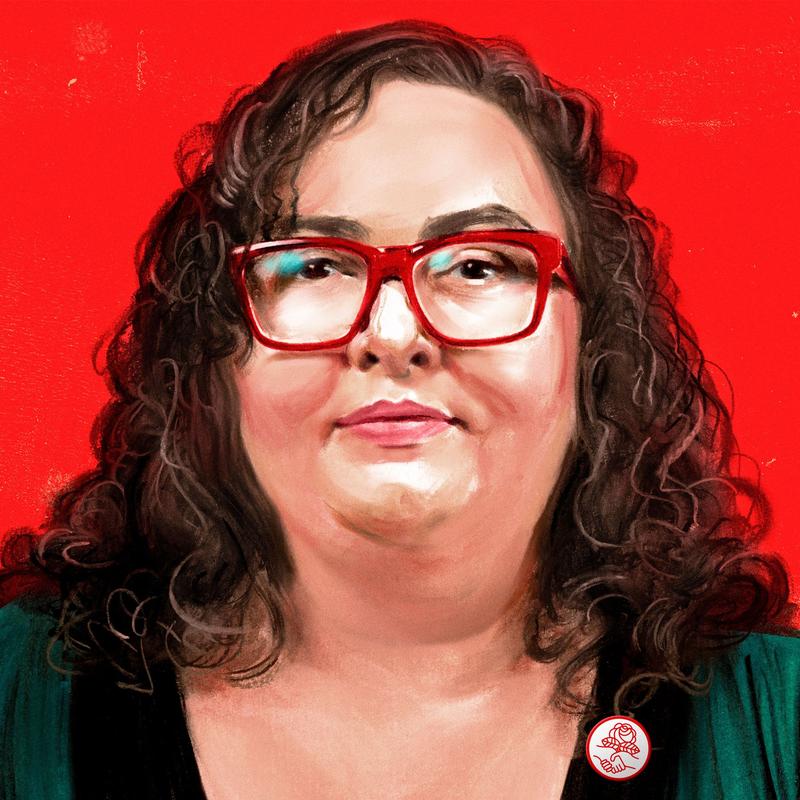
How Socialist Is the D.S.A.? Megan Romer Explains
David Remnick: One of the biggest stories in American politics right now is the emergence of democratic socialism as a force on the national stage. That surge really began with Bernie Sanders running for president in 2016.
Bernie Sanders: The 40-hour work week, collective bargaining, the rights of workers to engage in negotiations were all described in one way or another as socialist.
David Remnick: Then Alexandria Ocasio-Cortez won her seat in Congress as a member of the Democratic Socialists of America. She really put the DSA on the map for a lot of Americans, particularly younger people. Zohran Mamdani is also a DSA member, and his election has had a galvanizing effect on young voters well beyond New York City. As of now, the DSA lists seven candidates for Congress who have won primaries against more establishment Democrats.
Now, that is hardly a sweep of the Democratic Party, but these candidates are commanding outsized attention. When I talked to individual members of the DSA, it's not always easy to tell what the group stands for or where those members stand within the DSA. When I talked to Nithya Raman last week or Mayor Mamdani or to AOC a while back, they often sound, at least to my ear, more like FDR Democrats than followers of Karl Marx.
Abdul El-Sayed, the Michigan Senate candidate, shares some policy goals with DSA, but he's not part of the group at all. In fact, he told me on this show the other day that he's a capitalist. How socialist is democratic socialism in America these days? That's just been one of my many questions about the group and what it stands for. To get more of a purchase on the subject, I sat down to talk with the co-chair of the DSA, Megan Romer. Now, you may have seen a clip of Romer recently on Fox News, where she seemed happy to do a lightning round on the group's more radical positions.
Shannon Bream: I want to ask you, just give me a true or false on these. Abolish the Senate?
Megan Romer: True.
Shannon Bream: Okay. Replace the presidency and Supreme Court as we now know them?
Megan Romer: Yes.
Shannon Bream: Abolish ICE?
Megan Romer: Absolutely.
Shannon Bream: Abolish borders and give amnesty to anyone currently in the US illegally?
David Remnick: Now, I should note that Romer stressed to me that she doesn't make policy for the DSA. Her job is to represent and implement the agenda that the members themselves vote on. I spoke with Megan Romer this past week. Megan, let's start with first principles. What, to your mind, is democratic socialism?
Megan Romer: Just very simply, it is people having a democratic say-so in all of the things that they need to survive, so democratic control of their workplace, democratic control of their housing, and democracy in what we already know as democracy in the political process.
David Remnick: Okay, [laughs] so that proposes about a million questions. What does democracy in the workplace mean? Does everybody get a vote on what we're going to do today, tomorrow, and the next day?
Megan Romer: The way we look at it is mostly, probably pretty similar to how a unionized workplace would work today. You get to collectively decide with your co-workers what demands you want to make of your boss, what your schedule looks like, what your working environment looks like, and negotiate collectively with whoever the boss is.
David Remnick: Okay, but that sounds like simple unionization, which we already have, even though unions are not in the best spot they've ever been in this country.
Megan Romer: That's true. We'd like to see everybody have a union. Right now, it's quite low. It's in the teens, I think, percentage of unionized workplaces. We think everybody should have a union of some sort.
David Remnick: What does it mean for the larger economics of a country, for example, Google or Apple or the biggest corporations in the country? Are they no longer privately owned under democratic socialism?
Megan Romer: Well, that's a good question. We specifically say that the industries that you need, power, I would say that the internet is a necessity at this point. You can't really function without it. Water, things like this, a lot of these things are public in some places. We want them public everywhere.
David Remnick: Do you believe in the "owning the means of production," as the Marxists used to say?
Megan Romer: I do, yes. Yes.
David Remnick: You speak for whom?
Megan Romer: Well, I speak for the Democratic Socialists of America. I think that you will find the demand long-term for the working class to be in charge of the means of production is one that is pretty universally held. Again, we are not trying to flip a switch so that everything changes tomorrow. We're thinking about ways you can incrementally make life better for starters, but also shift the balance of power from the billionaire class to the working class.
David Remnick: Okay, so what is the difference between democratic socialism and what exists in a lot of Europe, which I would call social democracy, which is to say a greater emphasis and maybe a higher tax rate in order to have things like what we would call Medicare for all or single payer or either free or radically less expensive higher education? I'm going to take a wild guess here. If you were using that vocabulary instead of the socialism category, you might have more adherence.
Megan Romer: Maybe, but the reality is that we're not fighting for a kinder, gentler capitalism. We think that a democracy that's really controlled by the working class is the ultimate goal.
David Remnick: Forgive me, Megan, but when you say "we," how is that stance arrived upon? Who's we?
Megan Romer: That's a great question, and one that I love to talk about. DSA is fundamentally and sometimes excruciatingly democratic. The highest decision-making body of the Democratic Socialists of America is our convention. It happens every two years. Chapters elect delegates. We come together, vote on a bunch of proposals that may or may not shift our overall strategies or our overall stances on some things.
David Remnick: These are representatives from a base of how many people?
Megan Romer: Well, right now, I think we're at 129,000 people. We have grown significantly since Zohran Mamdani's election, which came after our last convention, and then we're seeing a growth spurt recently with the recent congressional primary wins as well.
David Remnick: It's very interesting to me that maybe the highest-profile political race that we're now seeing nationally for the midterm elections on the left is the ascent in the state of Michigan. If Abdul El-Sayed, who, when I asked him about democratic socialism, said, "No, no, no, no, I'm a capitalist." Disappointed?
Megan Romer: He is not a DSA candidate. If he was a DSA candidate, I would absolutely be disappointed. I'm glad that there is a movement across the board of people taking on some of these policies, because I do think they will improve life for the working class.
David Remnick: What is the working class in this country? Zohran Mamdani, mayor of New York, just gave an interview, I believe, to The New York Times. He was asked, "Please define the working class," and he said, "Anybody making under $1 million a year," which, I got to tell you, was news to me.
Megan Romer: Yes.
David Remnick: How about you?
Megan Romer: That is not how I would define the working class.
David Remnick: How would you define it?
Megan Romer: We're coming out of a socialist tradition where class is defined based on your relationship to capital. The working class is essentially people who make a paycheck.
David Remnick: If I'm a dentist, I can't be working class?
Megan Romer: Well, it depends. Are you a dentist who is working for a corporation and selling your labor and getting paid hourly, or are you a dentist who owns your dental practice? It does get fuzzy around that edges. There's a lot of socialist theory happening right now about gig work. Technically, a gig worker works for themselves, but they're obviously not really the ownership class. There's definitely a hot topic of debate. The simple definition is, do you make a paycheck, or do you make money off other people working for you, or renting a place that you own? Are you making the money from the payoff of your capital investments, or are you making it because you sell your labor?
David Remnick: Let's dig down a little bit here. The DSA refused to endorse Hillary Clinton over Donald Trump in 2016. You happy about that decision?
Megan Romer: I think it would have hurt our credibility a bit as people who are actually standing for socialism and against neoliberalism.
David Remnick: Yes, but on the other hand, you let an authoritarian through the door. I'm not blaming you specifically. A lot of factors went into it. Did you stay home in 2016?
Megan Romer: I didn't, no.
David Remnick: You voted?
Megan Romer: I voted for Hillary Clinton, and I voted for Joe Biden in 2020.
David Remnick: Why did you do that against the recommendation of the organization?
Megan Romer: Well, I wasn't a DSA member in 2016, first of all, but I did believe in a harm reduction vote. I don't think that the couple of hundred thousand socialists are the ones who swung that vote. It's the millions of people who stayed home because all they were being offered was a rainbow flag-painted version of the same thing.
David Remnick: Well, in fairness, millions of people stay home every election. It's quite a shameful--
Megan Romer: Yes, and we think that's a huge problem. A big part of our strategy is trying to engage people who do not vote regularly, who do feel disenfranchised by the [unintelligible 00:09:35]. Absolutely.
David Remnick: Kamala Harris versus Donald Trump. No endorsement. You agreed with that?
Megan Romer: Yes, I voted on that statement. I was a member of the National Political Committee.
David Remnick: Tell me about your rationale.
Megan Romer: Yes, so most DSA members, I think, certainly in swing states, voted for Kamala Harris, I believe. We felt that our credibility really stood on saying, "We are socialists. We are offering you a real alternative." I didn't think that our endorsement would really make a difference one way or the other, and I don't think it would have. I think, again, people don't vote because they feel totally locked out, not because DSA told them to or to not vote for a presidential candidate.
When we endorse somebody, that doesn't just mean we're putting a rubber stamp on it anyway. It means that we are turning out our people to hit the doors and hit the phones and really do a major voter outreach operation. We weren't going to do that for Kamala Harris. I don't know that it would have made a difference if we had. I don't know that she wanted it.
David Remnick: This article in Jacobin, which, as you know, is a DSA-aligned journal. It's called A Blueprint for a New Party. It said the goal is not to immediately form a third party, which is seen as suicidal in today's two-party system, but to "mount the electoral equivalent of guerrilla insurgency" by using the Democratic Party line.
Megan Romer: We do love to talk like that, don't we? [laughs]
David Remnick: Is that a good idea, Megan?
Megan Romer: I think people like us being rather bold. I think the boldness actually--
David Remnick: It's the badass imagery.
Megan Romer: Someone's got to be. People are furious about Trump and the Democratic Party. James Carville's writing op-eds that say, "Roll over and play dead." What is that? People want a fighter. I think they appreciate that we just come right out and say it.
David Remnick: Before we came on, we alluded to the fact that you were just on Fox News, and you were read a series of position statements. You very cheerfully responded, "Yes," without any embarrassment to this series of issues. I think open borders was one. Why are you for open borders? I think to a lot of viewers, it sounds like a John Lennon song, not a political reality.
Megan Romer: [laughs] Well, John Lennon was very popular. [chuckles] Again, all of these policy points, they're all part of this long-term goal where we are putting huge amounts of resources into alleviating poverty, into stopping destabilization of countries internationally that are causing a huge migrant flow. Most people in the US are here because of a prior period of unrestricted immigration or of much looser immigration. We put caps on certain countries and don't allow migration from other countries, and then wide open for some countries.
David Remnick: I understand that, but people would argue back and say, "Okay, there may be deep flaws in both the history and the system of immigration." Why not correct those flaws and make them more just? By just throwing the gates open, whether it's the gates of prisons or the gates of immigration, that chaos will ensue. I think you probably get that argument a lot.
Megan Romer: Sure. We're not saying, "Throw the gates open." We're saying, "Let's do that. Let's look at where the system is really flawed, really problematic."
David Remnick: I think that's called immigration reform.
Megan Romer: It is, but we think that you have to look at all of these things from first principles, right? We started here from first principles. What do we want out of an immigration system? Let's start there. That doesn't mean just throwing "open the borders" and then building from the ground up. It means reforming the system we have while we rethink the system, while we build this new one from the ground up, and then hopefully, eventually flipping the switch.
David Remnick: Do you believe there should be millionaires in this country?
Megan Romer: I'm less concerned about millionaires, more concerned about billionaires. I don't have a hard line where you're good, or you're bad. I think the question is less about how much is too much and more about, "What are you doing to keep and maintain and get that wealth in the first place?" I think most billionaires got their wealth because they exploited the working class in some very significant way, usually. "Are we exploiting people?" is the bigger question as opposed to some arbitrary red line of, "You can have this much money or not have that much money." We do believe in taxing the hell out of millionaires. Yes, absolutely.
David Remnick: Well, what does taxing the hell out of them mean?
Megan Romer: Again, I don't have a solid, but I think--
David Remnick: Shouldn't you?
Megan Romer: That's a good question.
David Remnick: If you're the co-chair of the DSA, shouldn't you be more specific than just taxing the hell out of something? What exactly do you mean?
Megan Romer: Again, it's democracy, right? We have to look at what we need to spend and what we need. We don't want to depend on the existence of millionaires because that means people are still getting exploited. Yes, we need to look at what we need to pay for in the interim, what tax base we need for that to happen, and build from there.
[music]
David Remnick: Megan Romer is co-chair of the Democratic Socialists of America along with Ashik Siddique. We'll continue our conversation in just a moment. This is The New Yorker Radio Hour.
[music]
David Remnick: This is The New Yorker Radio Hour. I'm David Remnick, and I've been speaking today with Megan Romer, the co-chair of Democratic Socialists of America. Candidates affiliated with DSA are running all over the country in congressional races, Wisconsin governor's race, some big mayoral races for some state houses and city councils as well. Megan Romer is one of the chief spokespeople for DSA, and we'll continue our conversation now.
[music]
David Remnick: Is support of Israel in any form essentially a red card in DSA? As I understand it, in 2024, DSA's National Political Committee withdrew its endorsement of Alexandria Ocasio-Cortez over her support for House resolutions stating that denying Israel's right to exist is a form of anti-Semitism. Her local chapter stuck with her. This was an argument that continued on. Where are you on it?
Megan Romer: Yes, so that was a very complicated and very inter-DSA bureaucratic question. Convention decided that, yes, this is a solid red line. No defense or economic support for Israel.
David Remnick: Does Israel have the right to defend itself according to DSA? What is the position that DSA is headed toward here? Is it for a two-state solution? Was it a binational, one-state solution? What, in fact, is the position of DSA?
Megan Romer: Yes, so our position is a free Palestine with the capital in Jerusalem. I think that could be safely read as a one-state solution.
David Remnick: The Camp David Accords that were being negotiated at the beginning of the century under the Clinton administration, had the Palestinians accepted it, that would have satisfied you?
Megan Romer: Good question. I need to look at what the actual specifics there were. I don't know them off the top of my head, but humans, peoples have the right to live in safety. Absolutely. If that safety means doing genocide to somebody else, then no, that's not defensible.
David Remnick: Darializa Avila Chevalier recently won a primary election in New York City for Congress, and she's almost sure to win the general election there, too. She attended an October 8th pro-Palestinian, pro-Hamas rally, which many people saw as a justification of the October 7th violence. Some of her tweets have been extremely ugly on this score and on other things, too. Do you fully support her in all these activities and what she's had to say?
Megan Romer: I think Darializa can speak for herself, certainly. I think she's apologized for some pieces of that and has been-
David Remnick: Not for attending that rally.
Megan Romer: -quite unapologetic about other pieces of that.
David Remnick: Do you support her yourself in that?
Megan Romer: Yes, I do.
David Remnick: Why? In other words, you would have gone to that rally had you been able.
Megan Romer: That's a good question. I probably would have, yes. I don't live in New York City, so I wouldn't have--
David Remnick: One day after the slaughter of 1,200 people and taking over 200 hostages, you would have come and rallied behind Hamas.
Megan Romer: I think that October 7th was largely inevitable. If you put people in an open-air concentration camp and you deprive them of rights, of dignity, of food, of the ability to live in safety, you have to expect that they are going to not take that for that long. That is not defending any harm of civilians or of non-combatants.
David Remnick: Well, sure, it is.
Megan Romer: Do you think it is?
David Remnick: You're saying you're supporting it.
Megan Romer: I'm saying that I think it was inevitable. I think that you cannot put people in a cage and expect them not to revolt. I think that supporting the civilians, the non-combatants, the children who are being killed, that's really the primary thing.
David Remnick: You live in Upstate New York. You describe yourself as a Jon Stewart liberal. Tell me about your life until 2018.
Megan Romer: Sure.
David Remnick: What were you doing, what was your mindset, and why did it change?
Megan Romer: Absolutely true. Got most of my news from Jon Stewart. That was my primary news source. I'd read the Sunday Times and I'd read Jon Stewart. Actually, I did read The New Yorker, and sometimes even for more than the cartoons.
David Remnick: I appreciate that.
Megan Romer: [laughs] Absolutely.
David Remnick: Keep it up. What happened? What turned?
Megan Romer: After Hillary Clinton did not win-- and I was supportive of Hillary Clinton. I was not a registered Democrat at that point. I was registered independent, and then she didn't win. I was horrified. I was baffled. I tried to become involved in the Democratic Party. What I ended up involved in was this women's club where you have speakers. You weren't actually making any decisions. You were hearing people talk about a book.
That was all really frustrating because I was like, "Who's doing anything? What are we pushing anything toward?" A friend who is a folk musician said, "We are starting this DSA chapter. You should come to a meeting," and I was like, "Ugh, the socialists." I was like, "All right. Well, I'll come to your meeting because we're friends, but I'm not saying comrade." I was just so relieved. They were actually doing something, just anything.
They had plans to just do something. "We're going to lobby for this bill. We're going to do this community service activity together. We're just going to do stuff." I was like, "Great," and then organizing and actually thinking constantly about what an actual change to the system. Eventually, I read some theory. I didn't go to college, but most of the great socialist theorists were writing pamphlets to be distributed to factory workers.
David Remnick: Megan, I think what might have disturbed some people who were watching that Fox clip, there was a certain kind of breezy, "Yes, I'm for that. I'm for that," and there was no detail at all. When you come to an issue like prison abolition and just say, "Yes, I'm for that," or, "Defund the police? Sure, I'm for that," it was a little startling. Now, it might have been the form of the show, so let's flip the switch here and dig down a little. What do you mean by prison abolition? We've had on this show Michelle Alexander, who wrote The New Jim Crow. Plenty of people in the Democratic Party, even in the establishment, have rejected mass incarceration. Some things have been done to bring it down. What does prison abolition mean to you?
Megan Romer: Again, let's start from first principles, right? What do we need? We need safety. We need our community--
David Remnick: Let's not begin from first principles. Let's begin from what is to be done, to use a Leninist phrase.
Megan Romer: [laughs] No, I think you have to start from first principles, and that is the core of this. We need community safety. We need people to be safe. We need people to be able to live their lives without fear of being assaulted, without fear of being robbed, without fear of violence. What communities do we know are the safest? It's not communities with cops on every corner. It's communities that have good schools, good jobs, good park systems, good recreation for their teenagers, things like that. Those are the safe communities.
David Remnick: What does defunding the police mean in your mind?
Megan Romer: Every year, police budgets go up. Every year, there's a backlog of rape kits that don't get tested.
David Remnick: Should they be maintained?
Megan Romer: I am not in favor of getting rid of police entirely tomorrow.
David Remnick: No, defunding the police means no funding. I think that's complaining--
Megan Romer: I don't think so.
David Remnick: Well, tell me what it means.
Megan Romer: I think it means taking funding back and moving it elsewhere, so pulling some of that funding back and moving it elsewhere.
David Remnick: To what extent?
Megan Romer: To the extent to which we are fully funding social services, to which we are fully funding schools, lunch programs for kids, after-school programs for kids. Communities should be clean, and they should be safe. We should be funding putting trees up so people have more--
David Remnick: I don't think anybody's going to argue about any of that, trees, or anything of the like, but they're concerned--
Megan Romer: They do. They do because there's always more money for the police budgets, and there is never money for, "How do we just literally make our communities safer, nicer, healthier?" That does come to the question. We say we don't have enough money.
David Remnick: Why do you think a number of politicians in your orbit who use the rhetoric of defund the police have taken it back or muffled it or gotten rid of it entirely?
Megan Romer: I think you see different phrasings of the same idea. If we're just talking about branding, I think that's not really the exercise we need to be spending a bunch of time on. I think we need to be talking to people about, like, "What makes your community safe?" That is how DSA functions. We have a million conversations on the door. We are out in the communities actually changing minds. Democrats really like a slogan. They like an ad. They like a mailer.
David Remnick: You've made an argument for abolishing the Senate. We both live in a state that has a-- I don't know what multiple of a population of Wyoming, which also has two senators. We all understand that, the Electoral College. We understand why it was put in place in the first place and why it's outdated now, but I think we can also agree that the chances of amending the Constitution to that effect are about zero. Does taking that kind of theoretical position, however principled, distract from GSA policies that might really succeed or be more urgent?
Megan Romer: I don't think so. I think taking principled positions tells people that you're principled. I think we see voters really responding to that. We see people saying, "Oh, you're actually thinking about the systems." Even Thomas Jefferson, for all of his heinous problems, I think he was writing letters to James Madison where he talked about, "We need a new constitution every 19 years," because he did some calculation in his head that that is when a generation changes over. He said, "People should not be haunted by these rules set for them by previous generations." It's not a new concept to say, like, "Hey, wait a second. Why are we doing this thing this way?"
David Remnick: Give me the dynamics within DSA. Alexandria Ocasio-Cortez and Zohran Mamdani, too, have been criticized by people in DSA for moderating various positions. AOC took advice from Nancy Pelosi. Mamdani retained the New York City police commissioner from the previous administration.
Megan Romer: What I think often on the outside looks like infighting or mess, we just call it democracy. We think it's good. We're always happy to pick apart anything. Ruthless critique of all that exists, to use a Marxist phrase.
David Remnick: You've quoted Marx now a few times in our conversation.
Megan Romer: I did quote Thomas Jefferson, too.
David Remnick: Not happily, not without ambivalence.
Megan Romer: [laughs] Well, I was ruthlessly critiquing him for all that exists.
David Remnick: You think you're going to get far by quoting Marx's theory in this country, or do you think that kind of Cold War antipathy to Marx, to say the least, is gone?
Megan Romer: I think that people see that capitalism is not working for them. I think when you talk to people on the doors, they don't care if you're quoting Marx or Thomas Jefferson. They care about whether or not their building is safe, whether or not there are rats crawling around in their children's bedrooms.
David Remnick: Of course, but--
Megan Romer: You can say, "Hey, guess what? There's this thing in Vienna called the Karl-Marx-Hof. It's a house, and it's named after Karl Marx. It is dignified, clean, high-quality social housing." That is a real thing that exists. I think people aren't afraid--
David Remnick: Is there a model for a politics or a society that is real and existing in this world that you would like to see the United States copy or somehow be close to?
Megan Romer: I wish. I wish that more socialist experiments could be happening without CIA interference, without US sanctions messing with it. I wish that we weren't spending billions of dollars to destabilize Cuba. I think there are lessons we can take from different socialist projects. I think the Cuban Family Code is a really interesting one in participatory democracy and the way that they changed their constitution to make it more egalitarian. It is now in the world the most queer-friendly constitution that exists. I also think there are some serious problems. I think those problems are caused by the fact that we are spending billions of dollars to destabilize them, and they overcorrect.
David Remnick: Queer-friendly is a good point. Earlier, you expressed some support, I think I was reading you right, for Hamas. I wouldn't call that a queer-friendly organization, would you?
Megan Romer: I would not call Hamas queer-friendly. I would not say that you can get a lot of social rights when you're under siege. I think that most queer people who have been killed in Palestine have been killed by Israeli bombs.
David Remnick: In the weeks preceding the invasion of Ukraine, DSA's international committee released a statement blaming NATO expansion and the United States essentially for the crisis. After the invasion, DSA released a statement condemning the invasion and calling for a ceasefire. There have been people in DSA who have been even more firm that it was mainly the United States' fault that Russia felt compelled to invade Ukraine. How do you feel about it?
Megan Romer: We do not believe in pouring US money, military weapons into anything. We don't think it makes it better anywhere. Obviously, Russia is this oligarchic dictatorship, which is hyper-capitalist, and Putin is this crazy right-wing oligarch. Of course, he is going to make horrific human life-ending decisions.
David Remnick: Well, isn't this precisely why those countries wanted to be in NATO?
Megan Romer: Yes, but why aren't we doing any amount of actual diplomacy, sending actual human beings to talk to human beings and figure out what--
David Remnick: I don't understand. There's been all kinds of diplomacy, however, failed since the beginning of the invasion. We shouldn't send weapons to the Ukrainians?
Megan Romer: No.
David Remnick: Just allow Russia to overrun Ukraine entirely?
Megan Romer: We should be sending huge teams of diplomats. We should be figuring out how to negotiate, how to get Russia off Ukraine's back. Yes, absolutely.
David Remnick: Russia would get off of Ukraine's back by us sending diplomats?
Megan Romer: I don't think that there is adequate negotiation. I don't think that there has been anywhere near adequate diplomacy.
David Remnick: Okay. Who would be your ideal candidate for president in 2028?
Megan Romer: Oh, God.
David Remnick: Surely, there's been discussion about this at DSA.
Megan Romer: Yes.
David Remnick: What is that discussion like?
Megan Romer: Our convention, again, our highest decision-making body, last year passed something that we want to create a labor-left coalition to run a labor-left candidate for president. There are some labor leaders whose names get tossed around. Nobody will be surprised that Shawn Fain, of course, gets mentioned. Sara Nelson, quite popular among DSA members.
David Remnick: Shawn Fain being president of the United Auto Workers Union and Sara Nelson of the flight attendants' union?
Megan Romer: Yes, and then also there are folks from Congress. Obviously, AOC is the-- It's the big question. Is she going to run? We're also seeing progressive candidates who are not socialists. Folks like Ro Khanna seem to be laying the groundwork for a run.
David Remnick: Is Ro Khanna not too wealthy for you?
Megan Romer: I think there are people in DSA who would potentially endorse a progressive who is not a socialist. That's part of our internal democracy. We would hash it out and come to a conclusion. That would be democratically decided, and then we'd be like, "All right, let's do this." If the organization decided to endorse Ro Khanna, I would knock doors for Ro Khanna. Absolutely.
David Remnick: Megan, what do you want to get across that I haven't asked you about? I want to be fair here.
Megan Romer: There are always questions about these pieces of detail, but the answer is always we decide it democratically. We decide it together. If you're looking to me to be the one true arbiter of DSA thought, I'm absolutely not.
David Remnick: Who is, or that doesn't exist, it never will?
Megan Romer: DSA. It doesn't exist, yes. Convention, I guess, would be the closest to the one true arbiter of DSA, and it happens every two years.
David Remnick: Megan Romer, thank you so much.
Megan Romer: Thanks so much.
[music]
David Remnick: Megan Romer is co-chair of the Democratic Socialists of America. You can find all of The New Yorker's coverage of politics and the 2026 midterms at newyorker.com, and you can subscribe to The New Yorker there as well. "NewYorker," one word, newyorker.com.
[music]
Copyright © 2026 New York Public Radio. All rights reserved. Visit our website terms of use at www.wnyc.org for further information.
New York Public Radio transcripts are created on a rush deadline, often by contractors. This text may not be in its final form and may be updated or revised in the future. Accuracy and availability may vary. The authoritative record of New York Public Radio’s programming is the audio record.