America at 250: A View from Britain, with “The Rest Is History”
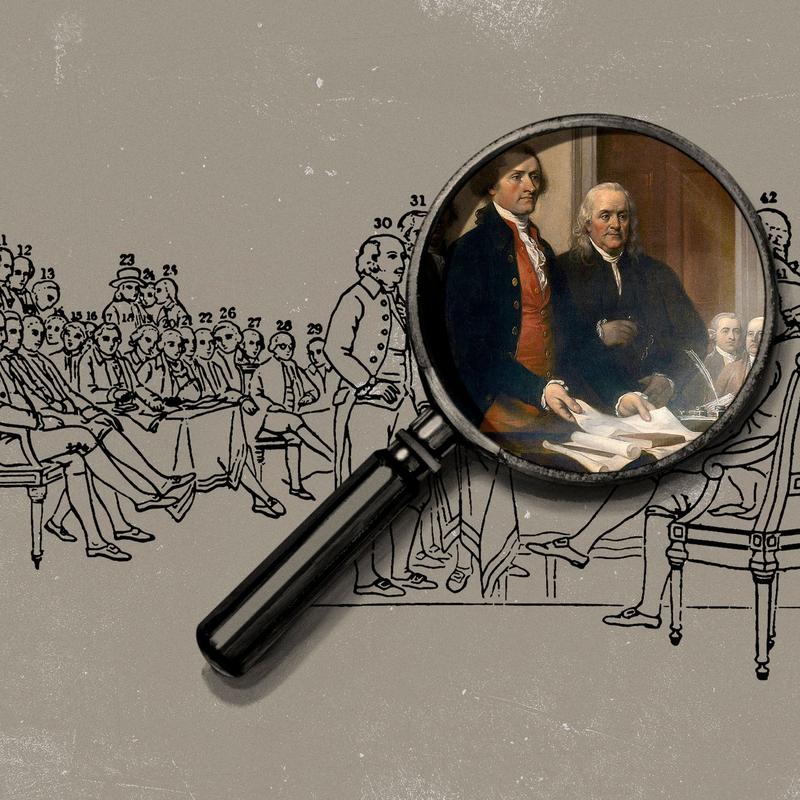
David Remnick: If I can generalize a little bit for one moment, we Americans are not terribly modest about our place in the world. We think of the United States as not just the mightiest in the military sense or the wealthiest in the economic sense, but in some way, the most important, the most central, "The city on the hill," in the famous historical phrase, the nation that others look up to or should. America rejected monarchy and asserted the right to self-rule during the Revolution, and that was the great shot heard round the world, and everybody supposedly has been playing catch-up ever since. That's the prevailing view in a nutshell, the historical cliché.
Now, my guests today have a very different view of the matter. Dominic Sandbrook and Tom Holland are the historians who host The Rest Is History, a terrific podcast from the UK, and I wanted to see what America's 250th anniversary looks like from a few thousand miles to the east in Great Britain. We're going to spend our program today with Tom Holland and Dominic Sandbrook of The Rest Is History.
We are always happy to have you on, but we waited for this occasion because I knew you'd have something to say on the occasion of the signing of the Declaration of Independence in 1776. I think it's fair to say that after having listened to you for hours on this subject, that your take on it collectively, your take on the American Revolution and the Declaration of Independence, after a four-part series that I listened to, you had the temerity to suggest that it was not the most important event in the history of civilization.
Dominic Sandbrook: [laughs] It's not even the most important event in the history of America.
Tom Holland: It's not even the most important revolution that happens in the late 18th century, to be honest.
David Remnick: We'll get to that in the French-- and many more things, but tell me this, let's start with you, Dominic. Why do you have a rather diminished view, I would say, of the American Revolution and the Declaration?
Dominic Sandbrook: I don't think I do have a diminished view. Well, first of all, an interesting thing that may be surprising to some American listeners. In Britain, the American Revolution is never really taught, it's not discussed, it doesn't really feature in our collective historical imagination. Americans often say, "Ahaha, that's because you lost." That's not really the case because there's nothing the British like more than a tragic defeat. Actually, it's because it's eclipsed by the French Revolution and the Napoleonic Wars.
We only have time, we only have space in our heads for one late-18th-century thing, and that is the French Revolution and Nelson and Wellington smiting Napoleon. It's not really taught, the American Revolution. It was always called the American War of Independence, so it didn't really feature in my historical imagination certainly growing up as a great revolutionary moment.
I thought of the French Revolution, of course, or the Russian Revolution, but the American Revolution just seemed to be--, and I'm not a specialist in 18th century history at all, but it seemed to be a parade of quite boring men talking very earnestly about liberty, battles that involve 20 people in a field somewhere in the great vastness of North American continent. It's not Waterloo, it's not Borodino or something.
When we came to it--, and I think also, Tom and I, we've seen all the sorts of Ken Burns style, the flag of Liberty over Gobblers Creek or whatever it might be, and sort of a slight smirk perhaps playing on our lips in a true Redcoat manner as we see the Americans congratulate themselves as they go back to their slave-inhabited plantations on the great victory of liberty and so on.
I must admit I very much enjoyed the great furore about the 1619 Project because as a Brit watching that, it was entertaining to see Americans flagellating themselves and tearing themselves apart about whether they were the good guys after all. Of course, the 1619 Project, people said that the British were the heroes in the end. That was tremendous news for us.
David Remnick: Well, the 1619 Project is definitely something I do want to talk about, but before we get there, help us understand what was going on between the colonies and the British in the run-up to the Revolution, or at least what we call the Revolution. Tom?
Tom Holland: Just to broaden it out on why maybe it doesn't have the saliency in the British imagination that the French Revolution does. It relates to your question. I think, for people in Britain, the American War of Independence, American Revolution, whatever you want to call it, is part of a broader continuum, which is the English-speaking Atlantic world. There is a case for saying that, that the War of Independence is a British civil war, it's another civil war in the line that descends from the civil wars that rent Great Britain and Ireland back in the 17th century. A lot of the tensions and conflicts that gave rise to the war in the 17th century were exported to the New World.
Whether it's the Puritans in Massachusetts or the Quakers in Philadelphia or the Catholics in Maryland. Those religious tensions to us are very familiar, and they seem, certainly to me, very, very religious. Just as in the 18th century in Britain, those religious tensions kind of blur and fade into what you might call Enlightenment dynamics. The same thing seems to be happening in America, and that's why there are lots of people in Britain who are backing the American rebels.
Just as, obviously, there are lots of people who are opposing them. I think that the conflict makes best sense when seen in the Atlantic context rather than being seen as something that is merely bred of American concerns, because those concerns exist in the broader Anglosphere dimension, I think.
David Remnick: Tom, what was the nature of the rebels? Some of our listeners will be surprised to hear that in fact, in New York in particular, this was a stronghold of pro-British sentiment, but there were rebels in the colonies. What was the nature of the early sense of rebellion, or was it just a kind of tax dispute? [crosstalk]
Tom Holland: It varies from colony to colony, and the difference in character between, say, Massachusetts and New York and Pennsylvania and Virginia is very, very salient. It is something that threatens to derail the whole project of, say, issuing a Declaration of Independence. The great achievement of the rebels in the war is not just to defeat the British, but to forge a genuine sense that these are United States.
Dominic Sandbrook: Just to jump in. David, you were talking about the wider context. As I would see it, the wider context is this. The Seven Years' War is the moment that kind of changes everything, what you call the French and Indian War. The British have acquired huge-- they've conquered huge swathes of North America from the French. That does a couple of things. First of all, it removes the threat of the French, so from this point onwards, the colonists don't need the protection of the British army as much as they once did.
It also left Britain with a crippling debt to pay. The British budget, British borrowing, ballooned during the course of the war, and by the end of the Seven Years' War, Britain is paying about half of its national budget on interest payments alone. As the British authorities see it, this is the moment when basically they need to sort out that the Empire, as it were, has expanded beyond all imagination. The system for regulating it is very ramshackle and rackety. Actually, you could argue that the British projects, sorting that out is an Enlightenment project, that it's a modernizing project.
The Parliament sits there and it says, "Okay, we've basically got these 17th century colonies, it's all a bit of a mess. We're going to sort it out. It's mad that they're not paying the same taxes that people pay in Britain, the stamp tax on documents and so on. We should extend-- The British gentry have paid for the cost of this war. They are very heavily taxed by historic standards. We will make the Americans pay, the colonists, we'll ask the colonists to pay a little bit towards their own defense."
I think that's perfectly reasonable, and no one could really disagree with that. There's that element to it, as Tom, I think, absolutely rightly says, there is an element of it being a successor to the religious conflicts of the 17th century, conflicts about the church, parliament, king, and so on that we associate with Charles I and Oliver Cromwell. There's also, of course, the element that the British basically don't really want the colonists to keep expanding westwards.
In 1763, they said, "Hold on. This far, and no further" because they don't want to provoke expensive conflict with the native tribes. A lot of the colonists, George Washington is a brilliant example of this. They've got a lot of investments in land speculation and stuff, and they want to keep expanding westwards, and they're annoyed.
David Remnick: Dominic, what you're suggesting is that the great imperialists in this picture are not the Brits, but George Washington.
?Speaker: Well, I think that would be pushing it too far because Britain at this time is also seizing much of India, so there is no question the British are imperially minded.
?Speaker: Right, but the Americans are not anti-imperial freedom fighters. I mean, they want to take the whole continent for themselves.
?Speaker: George Washington is the classic example of this. He is hard up, he's looking to make land deals further west, and as he sees it, the British are saying no to this. Washington in the American context is much more of an expansionist/colonialist figure than George III, for instance.
David Remnick: Dominic, in your series, you quoted The New Yorker's very own Adam Gopnik, who asked the question if the American Revolution was in fact a mistake.
Dominic Sandbrook: Right. Yes.
David Remnick: You get into that. I'd love to hear you on that subject.
Dominic Sandbrook: Here is the question that, I think, would puzzle me if I were American. It puzzles me that Americans don't discuss this. It is this, Canada exists, and Canada is not a terrible place by any means. Also, Australia exists, or New Zealand. When Americans look to Canada, I'm curious about what they think about this country that is still subject to the Crown, remained, as it were, loyal "to Britain."
Tom Holland: Well, we know what Donald Trump thinks.
Dominic Sandbrook: We do know what Donald Trump thinks, but Americans, more broadly, I'm curious whether they think that Canada, how that fits into the language of liberty, the discourse that this was a tremendous triumph of freedom against oppression. Because if that is the case, then presumably Canada is not truly free. People in Canada are leading the lives of helots subject to-
David Remnick: To the yoke of the British Crown.
Dominic Sandbrook: The yoke of the British Crown. Obviously, no sane person thinks that, so there is an alternative reality. My question would be, is it possible that events in the late 18th century could have played out differently, and the United States might have not have ever existed, and British North America might now be united under the overlordship of Mark Carney?
[laughter]
Tom Holland: I can absolutely imagine a world in which America and Britain, their common political language remains something that unites rather than separates. One of the ways that this goes off-piste in what becomes the war is the fact that the rebel colonists are weaponizing a very specific English language, an English vocabulary of liberty. When the rebels in, say, Massachusetts are opposing the colonial government, they're doing it in the context of what they call English liberties. They're looking to England as the source for the ideology that they are then using to turn against British rule.
Dominic Sandbrook: John Locke [crosstalk].
Tom Holland: John Locke, well, yes. Obviously, it expresses itself in various ways with the key figures in the American Revolution. If you look at Thomas Jefferson, he becomes, I think, pretty Anglophobic. I would say that he is as hostile and as dangerous an enemy as the British Empire has ever faced.
David Remnick: Thomas Jefferson?
Tom Holland: Yes, and yet he is passionately devoted to ideals of liberty that he traces back ultimately to the Saxons when they lived in Germany in the Roman period before they crossed to Britain. On the United States seal, he wanted to have Hengist and Horsa, the primordial ancestors of the Angles and the Saxons, when they settle in Britain. He sees these kind of ancient ideals of liberty as being portrayed by the Hanoverian regime, as he would frame it, in the 18th century. That's one way in which that mutates.
Another figure who I think represents a possible way in which Britain and America could have stayed together is Benjamin Franklin, who is at least as British a figure as he is American and who right up to the Boston Tea Party, is kind of saying, "This is a terrible mistake. Can we not have a form of accommodation?"
David Remnick: I'm speaking with Tom Holland and Dominic Sandbrook, hosts of the podcast The Rest Is History. We'll continue in just a moment. This is The New Yorker Radio Hour.
[music]
David Remnick: This is The New Yorker Radio Hour. I'm David Remnick. I'm speaking today with Tom Holland and Dominic Sandbrook, who together host The Rest Is History, one of my favorite podcasts and one of the most popular things in the world, at least in English. Sandbrook was on the history faculty at Oxford University, and he's written a number of books on modern British and American history.
Holland wrote about the classical world, and he's translated works from the Latin and ancient Greek, but on The Rest Is History, they cover just about anything; a Roman emperor one week, the Rolling Stones the next, a series on Hitler, and then the Samurai period in Japan. That's the way it goes on their podcast. The relevant thing for our conversation today, our subject is a four-part series that they produced on the American Revolution.
I'll continue my conversation now with Tom Holland and Dominic Sandbrook. Well, let's take on a very big subject in this, and that's the element of slavery. There were many slaveholders who considered themselves or would be considered in the rearview mirror as revolutionary. How to grapple with this? How do you grapple with that?
Tom Holland: Well, one of the differences between, say, the Irish War of Independence and the American War of Independence is that in the Irish War of Independence, the rebels are looking to draw on ideas and myths and slogans that come from specifically Irish history rather than British history. Whereas in the American War of Independence, all the slogans are coming from British language, British vocabulary,-
Dominic Sandbrook: Ironically.
Tom Holland: -ironically. In that mythology, in that vocabulary, the words like liberty and freedom are fundamental. It is English liberties that are being defended against the Redcoats in Massachusetts when the war goes hot. The British also have massive slaveholdings in the Caribbean. It is a growing problem, I think, for the slaveholders that this is rubbing up against all kinds of ideological concerns and anxieties within the metropolis, within Britain.
The notion that there can be no slavery in Britain, that a slave who steps foot on British soil, as a result of that, becomes free, is starting to bed down, and you have those historically salient ideals of political liberty blurring with religious concerns about it, which are deriving from Quakers, from evangelicals, so you have a political and you have a religious project that is starting to look at the institution of slavery and to question it very, very radically. This is happening in exactly the decades where the revolution is brewing in the United States.
I think that that sets up a massive, massive accusation of hypocrisy that enemies of the revolution can aim at the revolutionaries in America, British critics, of whom, again, Samuel Johnson is the most famous. He has--, "How is it that it is the drivers of Negro from whom we hear the loudest yelps for liberty?"
David Remnick: Right. There was a piece in The New Yorker not long ago by the historian Jill Lepore in which he was describing the drafting, the group editing process of the Declaration of Independence. If you've ever written a piece or a book, you know that editing by group always ends in sadness. Jefferson himself was struggling in various drafts with the inclusion or not of the slavery question.
Tom Holland: He wanted it gone, didn't he?
Dominic Sandbrook: Yes.
Tom Holland: He wanted slavery gone. He absolutely was passionately committed to it, and he was furious when those passages then got written out, but when he dies, he does not even do what Washington did, and try and free most of his slaves.
Dominic Sandbrook: Yes, it's a complicated picture. Washington is a good example. Washington has slaves. Washington at Valley Forge, when he's holed up there with his army, it's at that point when Rhode Island, struggling to fulfill its recruitment quota, becomes the first state or colony to buy the freedom of African Americans in order to recruit them and to meet its total and to send them to the Continental Army. Washington, even though he's a slave owner, even though that cuts against the philosophy of slavery, he accepts it.
It's interesting that in 1778, it's after Black men have joined the Continental Army in large numbers, that he writes to his steward back at Mount Vernon. He says, "We should stop selling slaves against their consent." There's a note in a letter to his steward where he mentions the enslaved people at Mount Vernon in passing, and he says, "I wish we could kind of get clear of this whole business."
David Remnick: One point we should clarify, and something that you make clear, is the 13 colonies that rebelled were not actually the British Empire's prized possession.
Tom Holland: No.
Dominic Sandbrook: No. That amazes people when we say that.
David Remnick: Just for clarity, what was the prized possession?
Tom Holland: The Caribbean.
Dominic Sandbrook: The Caribbean, because that's where the wealth was coming from.
Tom Holland: Sugar. Yes.
Dominic Sandbrook: That's why the French entry into the war is such a game-changing moment. Because when the French joined the war in a big way, when French ships appear and the first 4,000 Frenchmen come ashore, that is a game-changer, precisely because for the British, the priorities have completely changed. From this point onwards, for the British, it's like, "Let's protect. We need to protect those colonists in the Caribbean because the health of our economy, the strength of the country depends on the sugar islands of the Caribbean. We can lose Rhode Island or Delaware. I mean, who cares about them? But keeping Jamaica is all important."
From London, that is the perspective. Funnily enough, when you get to 1783, the Treaty of Paris, for the British, sure, they're annoyed that they've lost the 13 colonies of the North American seaboard, but they think to themselves, "You know what? It could have been a lot worse. We could have lost India, we could have lost the Caribbean. We'll take it."
David Remnick: Let me ask you this. There was a big history war hubbub in the United States not so long ago when The New York Times published its 1619 Project, which began in, I think it was 2019, and it focused on slavery as integral to American history in the period that we're discussing. What is your sense, Tom, of what the 1619 Project got right, what was important about it, and maybe where it fell short?
Tom Holland: I think that it is right that the project of establishing a viable colonial project in North America and in the Caribbean for the British was dependent on forced labor. There was no way in which it could really be viable without that. The British came up with-- It's initially the English, but then in due course the British, they are always looking around for sources of labor.
To begin with, it's usually transported people from Britain. Lots-- In the civil wars of the mid 17th century, Scots are transported there, Irish are transported there, but because there has been a massive infrastructure of exporting slaves from Africa to the Spanish New World, largely being done by the Portuguese, that exists. That is a framework of exploitation that is ready to be used.
The English have begun trying to muscle in on this very early on. Some of the earliest voyages that Francis Drake, the great maritime hero of the reign of Elizabeth I, that he does is he goes on a slaving expedition. By the early 18th century, the fact that not just North America but the Caribbean as well is dependent on slavery, is becoming a vast moral and economic crisis for people across that British Atlantic world.
The opposition to it is being bred by the scale of horror that the growing industrialization of the British Empire in the 18th century is generating. I think one of the things that people now might get wrong is the idea that the British Empire is dependent on slavery. I think it's the other way around. I think it is the fact that Britain is industrializing, that makes the exploitation of slavery brutal and unspeakable to a degree that had not previously been witnessed. It is hideous.
There's a passage in the Marquis de Sade-- I think it's Juliette, where he is writing with immense approval of all the horrors and tortures and violence that ancient empires had inflicted. He says that none of our modern states can compare with the Persians or the Romans for their cruelties, the only exception I will make are the English colonists in the Caribbean and the Atlantic seaboard of North America. They know the horrors.
David Remnick: Amazing.
Tom Holland: He lists the horrors in great detail. I think that you can see-- There's a representative figure who is a Quaker from Essex in England called Benjamin Lay, who goes to the Caribbean and witnesses the horrors there and is so appalled that he has a religious conversion. He then goes to America, to Philadelphia, because he's hoping that this is the great city of the Quakers, it's city of brotherly love, surely there'll be no slaves there, and he discovers slavery and is appalled by it.
He becomes the first activist, really. He does all these stunts where he goes to the Quaker meeting house and he pulls out a Bible and he's put purple juice in it, and he stabs it with a sword, and all this purple juice comes out looking like blood. He retires to a cave and leads this incredibly effective campaign against slavery, which ends up shaming the Quakers into effectively becoming abolitionist.
This, in turn, is an influence on Benjamin Franklin. I think it's one of the most admirable things about Franklin and about the American Revolution, is that lots of the Founding Fathers are prepared to wrestle with these issues. It's not like we have just discovered them ourselves. They do wrestle with them. They come to different solutions, perhaps. Franklin is an example of someone who by the end of his life, the final months of his life, he is devoted to opposing slavery.
This man who had thought to run an advert in the British press requesting the return of a slave. He presents a petition to Congress saying, "Please get rid of this. It's terrible." In his final piece of published writing, he pretends to be a Muslim advisor in the Barbary States. He says, "It would be ridiculous for us to free these Christian slaves. These Christian slaves would be helpless without their servitude. They wouldn't possibly survive." He's parodying the language that he himself had earlier used to justify slavery.
The degree of self-flagellation about the founding of America, the sense that slavery is the original sin, that slavery had accompanied the making of America, I think that is true. I don't think without that, it would have been possible to generate the colonies and give it the prosperity that it did. At the same time, the horrors that are consequent on this do generate the process of abolitionism that today has come to be taken for granted across the world.
I think it is important to try and think yourselves back into the shoes of people for whom the notion that slavery was an institutional wrong would have been unthinkable. It's bred out of this world, this notion. It's come to seem so obvious to most of us today, to almost all of us, that we cannot imagine not thinking it, and yet, it was more than possible. People completely took it for granted.
[music]
David Remnick: Tom Holland, the co-host of The Rest Is History, along with Dominic Sandbrook. When we come back, we'll discuss the fate of the British monarchy and the American president that these guys call colossally consequential. This is The New Yorker Radio Hour. Stick around.
[music]
David Remnick: This is The New Yorker Radio Hour. I'm David Remnick. As we get ready for the 250th anniversary of the Declaration of Independence, I've been speaking with Tom Holland and Dominic Sandbrook, the British historians who co-host the podcast The Rest Is History. We'll continue our conversation now. Let me ask you about the way you and Britain, or you two, as British historians and podcasters and thinkers, are looking at the United States now as we're celebrating this 250th anniversary of the Declaration of Independence. Recently, on one of your broadcasts, you called Donald Trump colossally consequential.
Dominic Sandbrook: Yes.
David Remnick: Colossally consequential, someone who defines his age as opposed to many other presidents of contemporary times.
Dominic Sandbrook: Right.
David Remnick: Explain what you mean.
Dominic Sandbrook: If you look back at recent presidents, let's say Barack Obama, good example, maybe Bill Clinton, George Bush Sr., and so on, you have a number of presidents who perhaps over time-- Barack Obama, different, of course, because he's the first African American president, but in the long run, will they leap out of the history books in a way that Benjamin Harrison or Grover Cleveland or Calvin Coolidge do not? I don't think they will.
In the 22nd century, I don't think people will be terribly excited. They might be excited about the more colorful aspects of Bill Clinton's personal life, but I think as a president, as a political operator, they won't be terribly interested. Donald Trump seems to me much more interesting for various reasons. First of all, it's such an American life. Imagine being the person who writes the definitive biography of Donald Trump in 10 or 20 or 30 years' time.
What an extraordinary Robert Caro-esque book that will be, because it takes in so many different things. Trump, I think, is so fascinating because there are aspects of the American character and American history that have reached fulfillment in Trump. In other words, I don't think Trump is exceptional. I think all the newspaper coverage after the storming of the Capitol and stuff, you know, "This is not America. This is very un-American," I think that was wrong.
I think Trump is profoundly American. Trump is not all there is of America, but I think there are nativists, there are ultra-patriotic, nationalistic, whatever, whatever, impulses that reach fruition in Trump. I also think Trump has changed history. Trump's tariffs, Trump's attitude to China, Trump's war in Iran, Trump's attitude towards the war in Ukraine.
David Remnick: To NATO.
Dominic Sandbrook: Yes, to NATO. By the end of Trump's tenure as president, he would have changed the course of human events, of world affairs in a way that Barack Obama never did.
David Remnick: Well, let me ask you this, as an observer, sitting where you are, and I don't necessarily disagree with you, how much of this is an expression of him and the constituents he represents and the fact that he prevailed in a couple of elections. How much of do you think that will be post-Trump? How much of this will persist after Trump is gone, presumably in 2028?
Dominic Sandbrook: Why would it go away? Why would it just vanish overnight?
David Remnick: I'm not saying the phenomenon itself will disappear. I'm not saying that nativism will disappear or the corruption or any of these other aspects you've rightly pointed to, but--
Tom Holland: I think that certain aspects will not go away because Trump has been successful, because he understood, I would guess, instinctively, he has a kind of feral intelligence. I mean, he's not an intellectual. He senses it in the way that a stoat might sense a wounded bird and goes for it. His mastery of social media, his ability to control narratives, which is obviously evident in the pre-history, before the Internet. His fascination with wrestling, which is scripted, but pretending not to be scripted.
His fascination with reality TV and TV generally. It was in his bones. He was the person who was perfectly equipped by his upbringing, by his instincts to go for the jugular with the opportunity that social media presented. What he has done with that is a lesson that people will be drawing on for decades and decades to come, because it's obviously not going to go away.
I also think that his character, his unbelievable rudeness, the violent quality of his statements, the everyday language that he uses to frame that, that also has established a template for how to succeed in American politics. That, again, is simply not going to go away, but I also just think he is better at it than Farage or Orbán or Le Pen or anyone else that you would want to compare him to.
Dominic Sandbrook: Well, Trumpism is not new. Actually, even within the international context, somebody like Silvio Berlusconi in Italy in the 1990s, again, a kind of precursor of Trump. What does it mean for the United States? I think the Trumpist style of politics, as Tom, I think, says, is not going to go away. That's partly because of the changes in the media ecosystem. They reward Trumpist politics. I think there are other structural causes.
There are lots of people who feel disenfranchised by deindustrialization. There are lots of people who feel alienated from the culture of the big cities, for example, people who feel left behind or whatever, people who feel angry about immigration, for example. Again, those things are not going to change. Where does it leave the United States? Arguably, you might say it leaves the United States where it's always been, for two reasons.
Number one, I think populist politics has always been a distinguishing feature of American political life, far more so than in Europe. There is populist politics in Europe, of course, but the populist rhetoric of the common man against the corrupt elite, that is hardwired into American political culture. Richard Hofstadter pointed that out more than half a century ago. I think that's one aspect.
The other aspect that I think is so interesting, a historian called Felipe Fernández-Armesto wrote a few years ago a book in which he said, "Maybe it would be interesting to look at the United States; instead of looking always in isolation from the other successor states to the American colonial empires, why don't we look at it as one of them?" Is it so different from Mexico, from Argentina? Is its political culture so completely different?
Of course, distinctive elements, because of the influence of English political culture, but the fondness for a strong man, the fondness for an authoritarian populist, the kind of caudillo politics. I wonder whether-- You could easily see the United States moving in a direction where that becomes more and more pronounced.
David Remnick: I get the anxiety, but Trump is Trump, and his popularity ratings are now in the 30s, and there's an election coming, and he's about to suffer, one believes and maybe hopes, a defeat in the midterms and an expiration date in 2028. The argument is, if not a one-off, it certainly represents tendencies in American politics, just as racism and antisemitism represent persistent tendencies not only in the United States but elsewhere, that those are not going to go away, but it's possible that through electoral politics, they become submerged.
Tom Holland: I think one of the ways in which you can measure the consequential character of an actor in world history is if they have an "ism" named after them and people talk about it seriously.
?Speaker: Right.
Tom Holland: There haven't been that many. There's Caesarism, Napoleonism, and it's interesting that all of them kind of involve a strong man emerging from a republican system.
David Remnick: But there's also something called liberalism.
Tom Holland: There absolutely is.
David Remnick: Do you think that's been eradicated from American political culture?
Tom Holland: No, I don't. I am relatively sanguine about the prospects for American liberty, because I think it's had a very long innings and has done incredibly well for itself. I think that, within the character and the myths of the American republic, there is an inherent anxiety that the republic will turn to autocracy, and that's because it was founded as a simulacrum of the early Roman Republic. The lesson of Roman history is that at some point a republic will become an autocracy. People have been dreading the emergence of a Caesar since the Constitutional Convention. When Benjamin Franklin came out and people said, "What is it to be?" He said, "A republic, if you can keep it."
David Remnick: Nancy Pelosi always reminded us, yes.
Tom Holland: Right from the very, very beginning, this has been an anxiety, and yet, people were anxious about it in with relation to Jackson or to Lincoln or to Roosevelt.
David Remnick: Hang on. Is it not an anxiety in Britain as well? You have a current of populism that's running very strong now. You have a very relatively wealthy London and it's said that the rest of the economy in Britain more resembles Alabama than New York. These resentments, these changes in the media, again, it's not on the same scale as the United States and sheer population and military power, but do you not have the same anxieties about, call it Trumpism, if you will, or faragism or--?
Tom Holland: Of course.
Dominic Sandbrook: I would say no. I don't agree with Tom about this at all. Because in political culture, I think political culture in Britain is completely different. That's not to say that populism isn't a feature, of course, but political culture in Britain is quite different from the United States, I think, for two reasons. It's much less moralistic. Threats are not usually cast as a danger to the integrity of the republic.
You have changes of governments, and there's a little bit of overheated rhetoric, the newspapers get excited, but by and large, we rub along pretty well. The other big thing, I think, in Britain, and the difference that the United States has actually with Europe in general is the United States has only two parties. There are us, the good people, and there are the other people who are evil.
?Speaker: [laughs]
Dominic Sandbrook: Now, in Britain, by definition, we've always had a-- Even at the point of the-- where the two parties, Conservative, Labour, the strongest, there were still other parties, there were still a few Liberal MPs. Of course, now in Britain we have effectively a multi-party system. It's very hard to cast your opponents as a terrifying danger, threat, and survival of the nation-state itself when there are so many shades of gray, as it were, and there are so many shades of nuance. In that sense, I think Britain is much closer to European democracies than it is to the United States.
David Remnick: Gentlemen, I can't be sitting here with two British historians and not ask about the state of-- Well, the monarchy. Is it just about done, or are you just having a low period in the history of the monarchy in many ways, and it will revive itself?
Tom Holland: [laughs]
Dominic Sandbrook: Why do you assume it's a low period? I'm intrigued why you think it's a low period.
Tom Holland: I think the monarchy is doing fine.
Dominic Sandbrook: Yes.
David Remnick: I didn't ask about constitutional monarchy as systemic, but the Royal Family seems in a state of struggle.
Tom Holland: To a degree, I disagree with Dominic. I think that Britain and America do still remain shaped by that common legacy from the 18th and 17th centuries. Both our histories are marked by the tension between, of course, in the civil wars were parliamentarians who ended up chopping the head of the king, and then also decided that actually we'll have the monarchy back.
The sense that you can have a degree of monarchy and have a very thriving democratic system as it emerges, I think is something that is shared by both America and Britain in its own ways. The America, I think, demonstrates that it's perfectly possible to have a monarchy and a republican system. In a way, Britain does as well. It's often said that America is a monarchy pretending to be a republic, and Britain is a republic pretending to be a monarchy.
Dominic Sandbrook: [laughs]
Tom Holland: I think that there is an element of truth about that. I think that the legacy of the centuries that have preceded this current moment, I think should give us an element of reassurance and perhaps also should make us ponder, "Are we not being very arrogant in assuming that we uniquely live at the end point, the end of days?" There's a kind of fulfillment in feeling that we are witnessing the end of a great and ancient story. I don't think we are, and maybe I'm being Pollyanna-ish about it. Adam Smith said, "There is a lot of ruin in a nation." Neither of us are remotely near that.
Dominic Sandbrook: David, I'm puzzled by your question. The implication is that the monarchy is in an unprecedented state of--, or a low point. Republicanism in Britain is very much a minority pursuit. It's an enthusiasm for political hobbyists who by definition are not representative of the great mass of people. Of course, there's the scandal about the former Prince Andrew and Jeffrey Epstein, for example. The one thing that has always been a feature of the British monarchy has been terrible sex scandals, sort of soap opera-style shenanigans, terrible secrets, skeletons in closets, and so on. This is absolutely standard. This is not a bug, this is a feature.
David Remnick: Oh, I agree, but it doesn't have the contemporary media accelerative aspects that you have now.
Dominic Sandbrook: No, it doesn't, but in a world in which the contemporary media is accelerating every story, this is just one story among many.
David Remnick: So, it doesn't stick, you're saying?
Dominic Sandbrook: No. For the monarchy to change, for the change to the system, just think about how this would work. People always talk about this very eerily, "Oh, there could be a change. They could get rid of the monarchy. People aren't interested anymore." What it would require would be for an elected government to decide that it wanted to spend its five-year mandate on an extremely controversial referendum that would--
David Remnick: And an unpopular one.
Dominic Sandbrook: And an unpopular one. That all the indicators show that they would lose in changing to a republic. I don't think there's ever been a majority in the history of opinion polling for change to republic. That would have to be a Labour government. In doing so, even if they won, they would immediately shed a large proportion of their own heartland constituency, that is to say working class, small-c conservative, patriotic, monarchist, Labour supporters. Would any Labour government take that risk? It's unthinkable, I would say.
Tom Holland: I would say the only-- perhaps one possibility is that the United Kingdom breaks up. There is a greater strain of republicanism, I would say, in Scotland or in Wales, let alone in Northern Ireland. That is one possibility. I don't think that's going to happen either because I think the appeal of the status quo in times of trouble is always immense.
Dominic Sandbrook: It kicks in.
Tom Holland: I think the very predatory nature of contemporary media culture actually can work in the monarchy's favor. Of course, Prince Andrew being arrested, absolutely shocking news. Lots and lots of articles saying this is the end of the monarchy. Then I think within literally a month, King Charles was visiting Washington and delivering a speech and everyone saying, "Oh, why can't we have the king back? He's tremendous. He's much better than Donald Trump." Prince Andrew was forgotten.
David Remnick: That is true. That is true, except in the Daily Mail, maybe.
Tom Holland: I think the short attention span can work in favor of the monarchy as well as against it.
David Remnick: Let me ask you a business cultural question. There was recently an article about the decline of "dad books." Dad books, in American parlance, are usually tomes about modern history, biographies of Mountbatten, as it were, or King so and so, or President so and so. It seems that you are among the guilty. One of the things that's cutting into the reading time of dads everywhere is podcasts, sublime as they may be, like The Rest Is History.
Tom Holland: I would say not guilty.
Dominic Sandbrook: [laughs]
Tom Holland: My sense is, from what friends who write "dad books" tell me, is that if we mention a dad book on The Rest Is History, the sales of that dad book go up. I hope that we are helping people to go into bookshops and buy these huge volumes on, to take an example, the Early Roman Empire. That would be wonderful if that was happening.
Dominic Sandbrook: Well, I don't agree with Tom on this. I think we're clearly responsible, and I think the reason for that is there is a move generally away from a literary culture, so you see the sales of books generally in decline, reading in decline. The reason for that is so many people say, "Well, actually I wanted to find out about the Spanish Civil War, but you know what? I'm going to spend an evening watching YouTube clips about it, or I'm going to listen to a podcast when once I would have picked up a book by Hugh Thomas or Paul Preston." I think it would be mad for us to deny that's happening. There is a move towards a much more visual digital culture, frankly.
Tom Holland: I would deny that.
David Remnick: You would disagree, Tom?
Tom Holland: Again, I haven't looked at the stats on this. Obviously, there are people who are sitting down and watching us on YouTube, but I think the vast majority of people are listening to podcasts while they're driving or they're on the walk or they're going to work or whatever. It's something that is in addition to the time that you might have to read a book.
David Remnick: I hope you're right. I hope you're right, because I think there's a lot of room in the world to listen to The Rest Is History, which I take great pleasure in, as well as reading, reading, reading. Gentlemen, thank you.
?Speaker: Thank you so much for having us.
David Remnick: And Happy Independence Day, sort of.
[laughter]
Dominic Sandbrook: Thank you, and to you, David.
David Remnick: All the very best.
Dominic Sandbrook: Thank you.
Tom Holland: Thank you.
[music]
David Remnick: Dominic Sandbrook and Tom Holland of The Rest Is History. I'm David Remnick. To stay on the theme of the 250th--, a few weeks ago, the great historian Jill Lepore, who's also one of our staff writers, hosted an episode of The Radio Hour all about this moment in America and what it means.
[clip begins]
Female Speaker: I talk to a lot of people lately who say it's a hard time to be out in public, running for office, engaging in any kind of political discourse or public activity, but their response is, "Tend your own garden," but they think of it as a kind of a community garden, and I really love that, which is like, "All right, we're going to have a potluck for the July 4th, and we're going to invite everybody in the neighborhood, figure out what our neighborhood used to do for July 4th, and write July 4th speeches in our 5th grade classroom."
The idea that we're sitting around waiting for the occupant of the White House to tell us what American history means. That's the thing where you just kind of want to walk into traffic, but--
[laughter]
[clip ends]
David Remnick: You can find that on the podcast of The New Yorker Radio Hour. All of Jill's work for The New Yorker is at newyorker.com, and of course, you can subscribe to The New Yorker while you're there. Newyorker.com. I'm David Remnick. That's our program for today. Happy Independence Day, and see you next time.
[music]
Copyright © 2026 New York Public Radio. All rights reserved. Visit our website terms of use at www.wnyc.org for further information.
New York Public Radio transcripts are created on a rush deadline, often by contractors. This text may not be in its final form and may be updated or revised in the future. Accuracy and availability may vary. The authoritative record of New York Public Radio’s programming is the audio record.