
Rahm Emanuel Says Israel’s Path Is “Not Sustainable Politically”
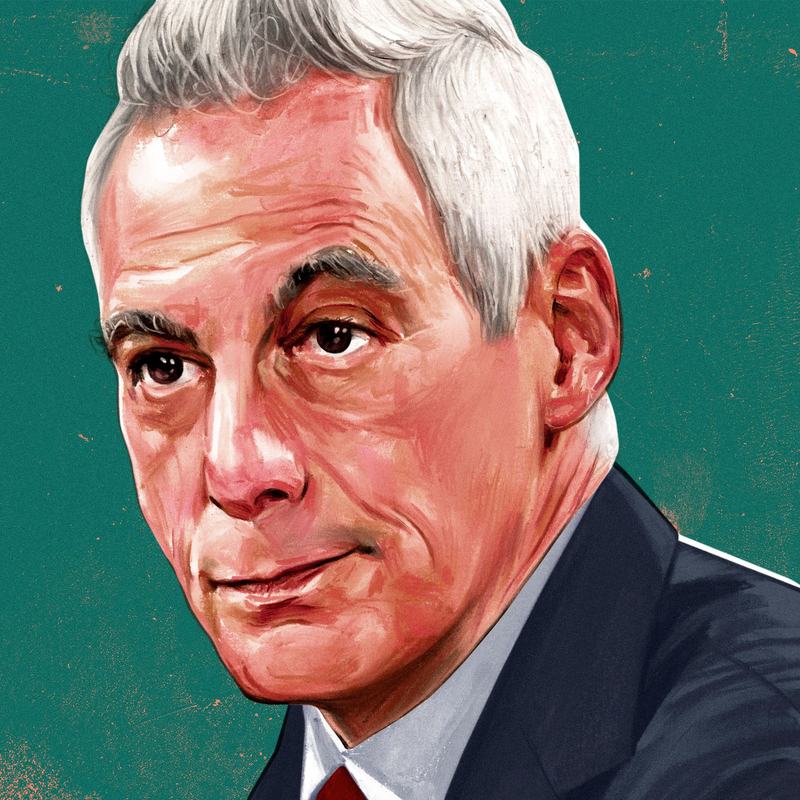
David Remnick: Rahm Emanuel is by now a Democratic Party elder. As a fundraiser, he helped bring Bill Clinton to power. In the Clinton White House, Emanuel was instrumental in the 1994 crime bill, and NAFTA, and much else. Some of those positions turned out to be deeply unpopular in the Democratic Party, but Barack Obama made Emanuel his chief of staff. Emanuel is a combative centrist in the party, someone who prizes winning over ideology. Putting points on the board, he once called it. It's remarkable in a way that Emanuel just gave a blistering speech to an audience in Israel on the direction that Benjamin Netanyahu has taken that country in recent years. Emanuel said that Israel's devastating war in Gaza and the settler violence in the West Bank, as well as Netanyahu's role in promoting the current war in Iran, is pushing Israel toward pariah status in many corners of the globe.
Emanuel argues that the US Government should no longer reflexively lend Israel military support, as it has for so many decades. This is a man whose father was born in Jerusalem and fought in the 1948 war of independence. Rahm Emanuel is making no bones about it. He's contemplating a run for the presidency. We spoke this past week. Rahm, I was just in Israel for a long reporting trip. While I was there, you show up, and you delivered some pretty bitter medicine to the Israelis. You gave a speech at Tel Aviv University. You basically said to Israelis, "You don't have a problem with the Democratic Party, you have a problem with America." What was your message that you wanted to bring to Israelis? Why did you bring it? Why now?
Rahm Emanuel: You're a small country and an important ally, so let's step back. Somebody spent time as ambassador to Japan. Japan is quite popular. It's a long pole of America's Indo Pacific policy. NATO enjoys not only bipartisan support in the House and Senate, but bipartisan support in the United States is above, I think the last time I saw 57%, 58% support. You're the one ally with unbelievable degradation. Its numbers are 32% support, used to be 64%. Among kids 30 or younger, my own three children's generation, you're in the low 20s, sometimes high teens.
In 22 years, the country that my father fought for its existence and my uncle, who the family is named after, will be 100. We just celebrated 250 years. It's not sustainable politically. You've decided that your military power isn't a tool, but is your national security toolbox. To you, every security challenge is a nail. Israel has more Nobel science winners than any other country on a per capita basis. Yet those scientists can't go to international conferences and join on research papers.
David Remnick: Many of them may leave if Netanyahu wins the election again.
Rahm Emanuel: Yes. I met with the CEO of a top, top, top cybersecurity firm. He said if the government wins again, people will already leave. Many companies today that are Israeli-based, Israeli-founded, are setting up their companies outside the state of Israel.
David Remnick: Did you find that Israelis understand that this is not an ideologically narrow feeling? This ranges from J.D. Vance to Zohran Mamdani and now you, who I think can be described as a centrist Democrat.
Rahm Emanuel: Oh, I am. I laid out a 23-state solution that is actually a variation of the Arab League's proposal that would give Israel 21 countries with full diplomatic relations in the region to an economic strategy that also breaks out of its isolation and dependence on Europe, but makes it both of them heads and tails. Makes Israel a member of the Middle East, a full participant in the Middle East, rather than standing apart from the Middle East.
David Remnick: Part of your message, Rahm, was that unconditional support from the US has to stop. It has to be conditional. It has to change. Now, this is not a recent problem or a recent idea. You've worked for the Clinton administration and then later for the Obama administration. Was ARC support for Israel too unconditional in those days?
Rahm Emanuel: The short answer is yes, but not just limited to those two presidents. I did work with President Clinton on both the Oslo Accords, the Wye Plantation, and while I wasn't an employee, I consulted with him often on Camp David with Ehud Barak and Yasser Arafat. When I worked for President Obama, I was direct to the Prime Minister. This is 18 years ago. I didn't need a war to realize there was a problem. I said, "What you're doing on housing in the West Bank not only undermines the possibility of a two-state solution, will lead to the isolation of Israel and will lead to perpetual conflict.
David Remnick: Your reward for that was that he called you a self-hating Jew.
Rahm Emanuel: Loathing.
David Remnick: Okay, that's better.
Rahm Emanuel: Self-loathing, publicly. I was also in the room. I think these two go together. I was in the room when President Obama made a decision. I encouraged him to make this decision to fund the Iron Dome. I happen to think being against provocative housing on the West Bank that undermines the two-state solution in funding the Iron Dome that saves thousands of Israeli civilians' lives, are complementary, not contradictory. I do get the politics in Israel today doesn't support a two-state so you have to make it more valuable. A 23-state solution is a more valuable solution both for the Israelis, Palestinians, and the Arabs.
The Arab League gets stability so they can get the economic big bang that they're looking for. Israel gets security, and they get a problem, meaning the West Bank, removed. The Palestinians get sovereignty and get the determination of their own. You make the politics actually work together rather than against the policy.
David Remnick: How did you feel about the way the Israelis prosecuted the war in Gaza? Somebody like David Grossman, who's hardly a self-loathing Israeli, used the word genocide. With great pain, used the word genocide. Other people like Ehud Olmert, the former prime Minister, has talked about war crimes. This is not just an opinion on the far, far left in Europe or something like that. How would you describe the prosecution of the war?
Rahm Emanuel: Yes, I think Israel was reckless. You had no day-after plan. Your own military begged for a day-after plan. Now what you have is occupation and isolation. Again, look, I say this out of care for a country that's not only our allies, as an American, this was a country my father fought for its existence. My uncle lost his life trying to create. This is the first kind of canary in the coal mine. By way of example, Israel is 78 years old. The last two years, something happened that's never happened in the first 76; more people left than came.
You think you're going to occupy the West Bank and Gaza, suppress the Palestinians' rights to self-determination, which I happen to think are legitimate. Not more legitimate than Israel's security. One example that gets lost in this, for 50 years there's been an Assad in Syria, father and son. You now have a Syrian president who has said publicly to Israel, "We share a common enemy in Iran." He has asked for and seeking a security agreement. I will give you my AT&T calling card. Call him, have the United States, where he's very desirous of United States economic and political, and military relationship. Have them facilitate the conversation.
David Remnick: Rahm, when I got back just the other day, I was on the phone doing a reporting call with Naftali Bennett, former Prime Minister, minister of many other departments, former ally of Netanyahu. I said, "What did you think of Rahm Emanuel's speech?" He said, "I don't like it when people come here and angrily lecture us on our security." Even somebody who's now in the opposition was not pleased. I don't imagine you made that speech to please anyone. How much of it was for domestic consumption here in the United States? It is very likely that you're going to run for president. We'll talk about that in a bit. How much was the speech directed toward particularly Democratic Party voters for a, I don't know, primary down the line?
Rahm Emanuel: Maybe possibly a primary. David, since you wrote about my upfrontness to the Prime Minister in 2009, I wasn't thinking about a Democratic primary for president then. I was thinking about what was in the interest of both peace and Israel's security. The through line from working with President Clinton on the Oslo Accords and the peace with Egypt all the way through to that speech at Tel Aviv University, I've been consistent.
David Remnick: Has he changed? Has Netanyahu changed in your view?
Rahm Emanuel: There's no doubt. Netanyahu once called for a two-state solution.
David Remnick: Under pressure from the Obama administration at the Bar-Ilan speech. As soon as he made that speech, he came off the stage, and he looked at Martin Indyk, an American diplomat, and said, "Okay, there, I've said it. Now, can we move on?" With respect, I have to tell you that I feel sometimes the Americans are deluded by this. There's a famous clip of Netanyahu in an apartment, and he says in the ear of one of the people, loud enough for the cameras, of course, to pick it up, "Don't worry about the Americans. I know how to handle them."
In other words, he's had full confidence that he can manipulate American public opinion, not least American Jewish public opinion, by going over the heads of presidents. You remember all too well he came to the United States-
Rahm Emanuel: 2015.
David Remnick: -and he managed to get an invitation to Congress from the Republicans and got standing ovation after standing ovation after standing ovation.
Rahm Emanuel: David, even then, and I was mayor, but I said it publicly, as others did, "You have now made Israel a partisan political issue." He has mismanaged US-Israel relationships. I'm not going to live with myself biting my tongue. Now, I have told the Prime Minister 18 years ago the truth. When I've been here, I have been honest about- to the Democratic Party- how the cultural cul de sac has led us into a dead end.
David Remnick: Rahm, how does your view differ on Israel from the critique from the left of the Democratic Party? How do you differ on your view of Israel from Zohran Mamdani?
Rahm Emanuel: This actually is a classic thing. The mayor wins his first election, but not the final. His team knew that I was coming and asked he would like to have a meeting. We met. The bulk of the conversation was, "Tell me about when you were mayor of Chicago," things like that. "What's the combination to the luck?" Kind of. "It's a big job." When he walks in, I said to him, I said, "Who's going to hate this more? AOC or my rabbi?" He started laughing, and I said, "I've listened to my rabbi sermon. I prefer my rabbi sermons. Okay?"
Last 20 minutes of an hour and a half, we got to the Middle East, and I said, because being mayor of New York, like Chicago, you do do foreign policy,-
David Remnick: Whether you like it or not, yes.
Rahm Emanuel: -I said, "Look, I'm going to be clear to you. The river to the sea will never happen because you're calling for the elimination of the Jewish democratic state and the Jewish people." I don't believe in a Greater Israel because it means there will be never ever the self-determination of the Palestinian people.
David Remnick: The [unintelligible 00:12:01] is really in the annexation of the West Bank and Gaza.
Rahm Emanuel: Yes.
David Remnick: Interesting.
Rahm Emanuel: I said, "The difference between you and I is I want to acknowledge the Palestinian people's right to self-determination. You don't want to acknowledge the state of Israel or the Jewish people."
David Remnick: How did he reply to you?
Rahm Emanuel: Oh, I haven't really thought about it in about a year. I think he was in the receptive mode. We didn't get into an argument because I think he probably made a decision.
David Remnick: I ask because I want to be fair to him, that he didn't just take your description of his views.
Rahm Emanuel: No, he didn't do that. Listen, when you ask me how do I differentiate, there are elements in the Democratic socialists and maybe even activists in the Democratic Party that do not believe in the state of Israel. I, at least, in my own view, support something you're advocating, which I happen to think is in Israel's interest, which is the Palestinian people will finally have a homeland. They have to spend money. Part of my visit was what I call healthcare diplomacy, we'll get to that, maybe in this conversation, of how to build that up. I said, "You have to understand when you say what you say, don't give me your crap about one nation, everybody will live together. There's no Kumbaya." I said, "I hear what you say."
David Remnick: There's no binational state.
Rahm Emanuel: No. I said, "I at least understand the legitimacy of the Palestinian sovereignty and self-determination. You do not understand the Jewish people and what Israel means to them." We didn't get into a big discussion because we weren't going to persuade each other. I made my point. He heard it. It wasn't something he wanted to argue about.
David Remnick: Let me ask you this. There is an election going on. Gadi Eisenkot, who's a 40-year army veteran general, maybe you know him, is suddenly leading the polls, and he has the possibility, when there's an election in October, that he may form a government. What difference would a Gadi Eisenkot-led Israel mean, and one in which Netanyahu, after 19 years in office, is eclipsed?
Rahm Emanuel: Do I think that a new government would exercise the muscle of the political diplomatic front of Israel that's been atrophying? I do. Do I think they'll do it on Day 1? No. I think there's opportunities besides just Palestinian front. There's an opportunity on the Syrian front, and there's opportunities beyond occupation isolation in Gaza. That's why the 23-state when you're in a pariah is a valuable political. You get 21 countries that will have full diplomatic relationship with Israel. All members of the Arab League signed on to this proposal.
My attitude is game on, it's your proposal. The difference between 1990s and now, you actually have to stand up a Palestinian Authority that doesn't exist. The other piece of this today, while you and I are talking, David, there's a story about how the UAE is building new ports around the Strait of Hormuz. The India Mideast European trade corridor that I outlined is the IMEC. That is the economic lifeline for the most technologically sophisticated country of that corridor. It will bypass the Strait of Hormuz, which is what Iran is trying to hold the world economy hostage. That too offers a compliment. You can't beat something with nothing. You don't like my ideas? Fine. I can find fault with my ideas. I can tell you what the weaknesses are. Tell me what yours are.
David Remnick: I have to tell you, as you indicated in all the debate I've been hearing in the run for Prime Minister and for Knesset, it's obviously a parliamentary system, the impermissible thing is to mention the Palestinian question.
Rahm Emanuel: Correct.
David Remnick: The Arab-Israeli. It is not to be discussed. Even Yair Golan on the left barely does, except to say there needs to be some resolution. You're not even allowed to say that we'll make an alliance with the Arab parties when Palestinian citizens of Israel are 20% of the population.
Rahm Emanuel: 22%, and they're 10% of your Knesset. They are one-third of the entire medical staff, and hopefully, we can talk about that, of all of Israel.
David Remnick: Exactly.
Rahm Emanuel: The reason we have also an interest in changing this, the United States, as you and I are talking today, is involved in one war right now with Iran. I don't want to be led or engage or make a decision to go to war. I want a different type of Middle East. That means changing up the dynamics and then build.
David Remnick: I spoke the other day with Danny Citrinowicz, who was years and years in Israeli military intelligence, and he said this war has been a strategic disaster for Israel, for the United States, and for the entire Middle East. Who do you blame for it?
Rahm Emanuel: I blame the President.
David Remnick: President Trump.
Rahm Emanuel: Yes. The Prime Minister has shopped this idea of military action to George Bush, turned it down, and did the Olympic Games. Barack Obama turned it down and did more than the Olympic Games. To Donald Trump, 1.0, he turned it down. To Joe Biden, turned it down. I blame the president for saying yes to something because you have agency, and you are responsible for the men and women of this country. The JCPOA by President Obama, you had Russia and China on the side of enforcement. Today, they're backing Iran and funding them to kill allies and American soldiers.
Two, you had all the uranium moved out. Today, the uranium is in the country. Three, the uranium was at 3%. Today it's at 90% and in the country. Four, Europe and the rest of the world was part of this agreement. Now the world is split on not only that agreement, but how to approach Iran. Five, you had international eyes and ears on the ground inspecting the nuclear facilities. They have been kicked out and haven't been in the region. Six, the Strait of Hormuz was open. Today, you fought a war, and all your negotiating is the Strait of Hormuz getting open.
David Remnick: It's a great triumph all around.
Rahm Emanuel: Okay. [laughs] When I look down this list, and again I was for JCPOA, but I wasn't like, "This is Nevada." It was a 51-49 to 52-48, and I thought it was worth the equity. Now you've taken the military action, and these are the consequences. They now not only have trying to build a nuclear weapon, they have a nuclear option, and it's called the Strait of Hormuz. That is a disaster. Others in Israel's security know that this war was a total debacle, and the prime minister has been shopping this for 19 of his 20 years.
[music]
David Remnick: I'm speaking with Rahm Emanuel, and we'll continue in just a moment. This is The New Yorker Radio Hour.
[pause 00:19:38]
[music]
David Remnick: This is The New Yorker Radio Hour. I'm David Remnick. I've been speaking today with Rahm Emanuel, an advisor to Bill Clinton and Barack Obama, a former congressman, and a former mayor of his native city of Chicago. Rahm Emanuel hasn't exactly declared that he's running for the presidency, but he's touring battleground states and releasing policy proposals at a pretty steady clip. He just gave a major speech in Israel criticizing that country's direction and saying that unconditional US Support for Israel is a mistake.
Emanuel has also been very forward in his characteristically blunt way in going after people in his own party for what he sees as a fixation on identity politics. I'll continue my conversation now with Rahm Emanuel. Rahm, I don't think you're going to announce one way or another on this program whether you're going to run for president.
Rahm Emanuel: I am not.
David Remnick: You haven't been shy about critiquing the Democratic Party.
Rahm Emanuel: Your ability to spot the obvious is a gift, Mr. Remnick.
David Remnick: It's amazing. It's taken years. You say you're "done with the discussion of locker rooms, I'm done with the discussion of bathrooms. We better start having a conversation about the classroom." Now, bathrooms in this context means transgender rights in general. You'd like Democrats to be done with that, but Republicans clearly aren't. Should Democrats really be silent in response to attacks on trans people? It just seems that this line is clever, but it doesn't do service to some human beings who want their rights.
Rahm Emanuel: Two things. Since it's about education and I spent a good part of my tenure, the entire tenure as mayor, taking the worst public school system to what Sean Reardon at Stanford called the single best. In 2016, I passed a law a decade ago on bathroom access. Did I take my eye off of the graduation rates that we took from 56% to 84%? Not a chance. That's why parents send kids to school.
David Remnick: Why can't you do both?
Rahm Emanuel: Because you have an issue in which coming out of COVID also is a lightning rod that distracted. I didn't take Abraham Lincoln's name off a school in San Francisco. I didn't ask for defunding the police. I didn't get yourselves wrapped around a axle on the term Latinx, which nobody identifies with. It was an example, David, not just of this particular issue, of a party. When people's backs are against the wall, they're holding on to that windowsill, and they can't make a college payment, they can't make a home mortgage payment, their health care is now being denied to them, they expect us Democrats to show up.
We're showing up talking about bathroom access, sporting events, who gets to participate. We just come out of COVID. Our reading scores and math scores are in the tank. 50% of our kids cannot read or do math at grade level, and we're going to talk about bathroom access? My view is if you want to win elections, and you also want to help kids get prepared for the future, focus on the bottom line of what schools--
David Remnick: I understand that, Rahm, but all I would say, that there were earlier times with other groups that didn't have their rights, and they were told to be patient, too, as focus on their rights was distracting. That's what Letter from Birmingham Jail is all about, patience versus urgency.
Rahm Emanuel: Okay. As a country, we proved we couldn't do it, because you haven't told me and asked me a single question how to get 50% of our kids--
David Remnick: We'll get there.
Rahm Emanuel: No, wait a second. You started where you thought was a priority. I'm going to tell you, you don't like it.
David Remnick: No, but I'm asking you, Rahm, about what's become, in a lot of your speeches and interviews, a tagline to differentiate yourself. I think that's the motivation.
Rahm Emanuel: It's not just a tagline. I passed a bill in 2016, 10 years beforehand, I made sure the kids had access to a bathroom. I just didn't let it distract from reading, math, or graduation rates. This is why I went down to Mississippi before anybody knew about the reading scores, because I pay attention to this. Not that others don't, but they went from 49 to 9. You have a president of the United States who's never mentioned it. No governor has called for an emergency meeting, like you had other governors of both parties. Mayors aren't doing anything.
You don't have a department of education, and people have accepted failure, and 50% of our kids can't read in third grade level, which doesn't make fourth and fifth and sixth grade in high school any easier. You have to prioritize what's an A and a B. I'm going to make sure children feel accepted. The best way to make sure they feel accepted is they know reading, math, and high school graduation. One of the things we did in Chicago, only city to do it, only education system, nobody gets a high school degree without showing us a letter of acceptance from a college, a community college, a branch of the armed forces, or a vocational school. That makes every child ready for tomorrow.
David Remnick: I want to ask you a little bit about the political moment. How much will Trumpism trail after him in 2028? How much of it is a cleanup operation if a Democrat wins, of any kind? A centrist like yourself, somebody more to the left, whatever it might be, how much does the hangover of Trumpism persist? Last week we had on Atul Gawande, and Atul Gawande estimates that the destruction of USAID has led already to 700,000 deaths and demonstrably will run into the seven figures. That's one little part of Trumpism. What is the damage report that a new president is going to have to deal with?
Rahm Emanuel: The presidency, whoever wins it, will be known as Hurt Locker. You're going to be cutting the wires everywhere, making sure that the bomb doesn't blow. There's going to be one on the fiscal side. You're going to have the level of corruption that has been normalized and that degrades people's conscious support for a government that can meet their needs, not just serve those in office. You're going to have an economy. I don't think, and I want to say this, you can't have a free market system with corruption. They're inconsistent.
For all these corporate leaders that have bitten their tongue in the destruction of the rule of law and replacing how much you can buy access and influence and making it the norm, it is undermining the most important thing, which is a system based on law and free of corruption and doesn't accept the degradation corruption brings to the free market. I think across the board, the failure in education, the failure, I think, in enforcing good environmental laws that advance our public health every year, he has proposed and actually driven cuts in our major research at the National Institute of Health, National Science Foundation, DARPA, the Defense Department.
At the very time that China is advancing on research and increasing their funding, the genius, with the Republican Congress support, is cutting funding. I don't see how you win the future by cutting your way there. Across the board, there will be not only cleanup, but I think there will be crises that have been delayed, that are going to be accelerated.
David Remnick: Rahm, we have midterm elections coming in a very few months.
Rahm Emanuel: I've noticed that too.
David Remnick: The presidential race is already taking at least some form. How do you see that race shaping up?
Rahm Emanuel: Here's what I think is exciting. We've had two presidents, both President Biden and Trump, when you really step back, are trying to restore a past that's not coming back, David. Build Back Better, MAGA, while different in values, is retrospective. 2028, both for the Democratic Party and more importantly, for the country, will be the first election since I think Obama '08 versus McCain, that will be about the future. The reason I've been going to Mississippi or laying out ideas on research education, high school, affordability of college education, political reform, 75 years you're up and out.
You can't be involved in the predictive marches, because I think we not only need fundamental change, but it's most importantly, to your core question a minute ago, how do you make sure the next 75 years of the 21st century are not China's but America's? To the second point, a little more granular. 2024, Democrats didn't have a choice, we were told who our nominee was. Truth is, 2020, we didn't have a choice. Biden versus Bernie. It was over like that. Even though he lost, Biden lost Iowa and New Hampshire. Bad. 2016, not really also. You're going to have 31 flavors. It's going to be Baskin and Robbins. As I said, if I decide to do this, I'm going to be Rocky Road. That's the flavor I'm going to go with, brother. [laughter] Okay? I think that's good for the party.
David Remnick: No, but you remember very well one of the advantages that Barack Obama had in 2008 was he was all potential. There was not much of a record there. Right? He was a senator for 25 minutes.
Rahm Emanuel: 24.
David Remnick: Ah, and a state senator. There was nothing to really hold onto. You have a record as long as your arm, as they say in the criminal justice system. y
Rahm Emanuel: Did you have to use that metaphor?
David Remnick: [laughs] You've had ups, and you've had some things that people are going to bang away at.
Rahm Emanuel: Of course, it's true.
David Remnick: They're going to bang away at was NAFTA the right thing to do in the Clinton administration, where, as mayor of Chicago, the Laquan McDonald case will trail you?
Rahm Emanuel: Sure.
David Remnick: The Crime Bill in 1994 will trail you. Do you see the fact that you have such long experience and arguably mistakes as well as triumphs to your record as something that can drag you down in a race that's all about the future?
Rahm Emanuel: The only thing I can offer you is I've learned from my mistakes. Hopefully, like John F. Kennedy learned from the Bay of Pigs, and he applied it to the Cuban Missile Crisis. I've learned from my mistakes. I've made them.
David Remnick: Give me an example of that, a serious one, not that you love too well, but give me a serious mistake that you've learned from.
Rahm Emanuel: Look, I'm very proud of the record I built on education, very proud of what we did in Chicago. I made a mistake cornering the teachers' union early when I pulled the last year of Rich Daly's contract with the teachers, 4%, and I made Karen Lewis, who was then the president of the teachers' union, put her back in the [unintelligible 00:30:51] wall. We would have our disagreements, but I made it existential for her, and it made everything we were trying to do much more difficult. I own that. When we had the second contract, they worked a year without a contract, which is unusual because Karen and I were trying to solve the pension, and we did.
Second is on all the other contracts I did with the other labor unions across the city on everything. About four weeks before you would commence, I would ask the president incumbent, and say, "Give me your five priorities for this contract. Know when you come in, I'm going to give you five from me. I want you to take those five. I want you to tell me what you can live with, what you can't live with, or what you would like to change or maybe meet me on the 50-yard line. I'm going to do the same to yours," so that before the contract started, we had a meeting of the minds and understanding what was an A, what was a B, and where was the compromise? Did I make mistakes? Damn right, I made a mistake. Did I learn from it? Yes. Did I apply it forward? The biggest supporters I had when I ran for mayor or ran for reelection, the building traits.
David Remnick: Rahm, I think you've made clear that you have no truck with socialism as an economic system. I think you'd also agree that the level of income equality in this country has gotten so radical and the flagrant behavior of the ultra, ultra rich has gotten so distant that it--
Rahm Emanuel: They've walled themselves off from the rest of the country at every level.
David Remnick: You know that world, too. Your brother, one could arguably say, is a big Hollywood mogul, knows Trump well, has done business in his area. Is he wrong to live like that? Is there something systemically wrong with the country that you can live like that?
Rahm Emanuel: I know that world, which is why I can upend it.
David Remnick: How would you upend it?
Rahm Emanuel: Look, I don't accept redistribution, and I don't accept crony capitalism and the corruption. I believe in growth. I think there are five pillars to it. One is turning a tax code away from preservation of wealth to creation. Two, which is true about American history, we live in a age where you earn what you learn, making sure everybody has something post high school. Everybody. 100%. Set it as a goal, and I've laid out a plan from pre-K to BA and everything between. Three, double our research. I'm going to tax the prediction markets, and I'm going to attack online sports gaming, and it goes into an innovation fund for R&D, NIH, National Science Foundation, DARPA. Not replacing money, doubling it.
Four, modernize our energy and digital infrastructure. Then fifth, as I proposed in the Dignity Act, where you have 23 Republicans and 23 Democrats, an immigration bill that's true to being a nation of immigrants and a nation of laws. I tell you this one example from a bike trip I just had in New Hampshire. Met a couple not far from Hanover. He's a plumber. She sells real estate. They both are on the ACA for Obama, separate. Their premiums just went up $150 a month. He wants to move into a home. They're not sure they can afford their health care.
The whole system of the middle-class dream that I not took for granted, but I know I could achieve, and I know my kids can, it's broken for everybody else. I think being an American is winning the lottery ticket of life. If I decided to restore confidence that that possibility still is open, doesn't mean you're going to walk through that door, but the door is open to you. For a lot of people, they feel it's shut.
David Remnick: Rahm Emanuel, thanks so much.
Rahm Emanuel: Thanks, David.
[music]
David Remnick: Rahm Emanuel served in the Clinton and Obama administrations and as mayor of Chicago.
[music]
Copyright © 2026 New York Public Radio. All rights reserved. Visit our website terms of use at www.wnyc.org for further information.
New York Public Radio transcripts are created on a rush deadline, often by contractors. This text may not be in its final form and may be updated or revised in the future. Accuracy and availability may vary. The authoritative record of New York Public Radio’s programming is the audio record.