Is Cuba Trump’s Next Target?
David: Since the beginning of this year, President Trump has turned sharply from his promised focus on domestic issues, America first, to a series of foreign military adventures that have shocked many of his own supporters and much of the world. In January, there was the invasion of Venezuela and the seizure of its president, Nicolás Maduro. Then came the threatened invasion of Greenland, and now there's a war with Iran that has engulfed the Middle East, killed many hundreds of people, and threatens the entire global economy.
Yet, no sooner was the bombing of Iran underway than Trump and some of his allies began teasing a new move.
President Trump: Taking Cuba. That'd be good. That's a big honor.
Reporter: Taking Cuba?
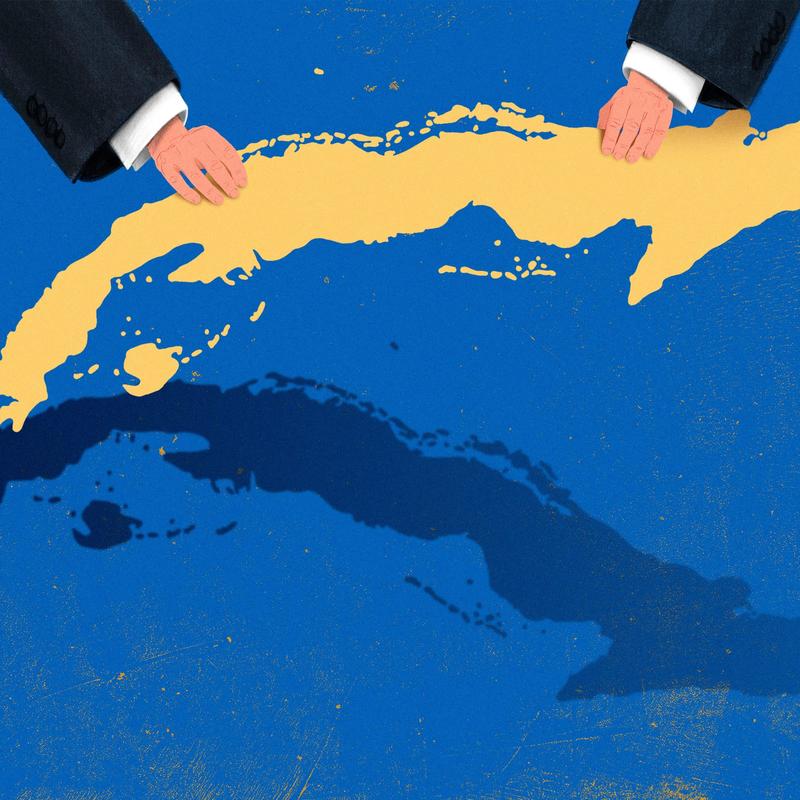
President Trump: Taking Cuba in some form. Yes, taking Cuba. I mean, whether I free it, take it, I think I could do anything I want with it. You want to know the truth? They're a very weakened nation right now.
David: The US has effectively shut off Cuba's oil supply, and the electrical grid had a near-total blackout last week. New Yorker staff writer Jon Lee Anderson has been to Cuba countless times in his career, and his most recent trip followed the invasion of Venezuela. I spoke with Jon Lee Anderson this past week. Jon Lee, the Trump administration has recently said that the president of Cuba, Miguel Díaz-Canel, has to step down. Let's start there. Who is Díaz-Canel? What's his role in the regime, and what would ousting him even accomplish?
Jon Lee Anderson: Díaz-Canel is the handpicked successor to Raúl Castro. He's a party apparatchik. He was a provincial party chief, and he has served, how shall I put this creditably, as the face of the ongoing regime. He's not had an easy time of it. There's been, as we know, a huge economic downturn in Cuba, et cetera, the falling apart of relations in Trump 1.0 and now Trump 2.0. Biden did nothing during his four years to alter the things in Cuba, for better or worse. Díaz-Canel is a kind of-- yes, he's a working stiff, really, and doesn't have a huge amount of respect from the population, but nor is he seen as particularly evil.
He's seen as the frontman for the regime, which continues to be controlled from behind the curtains by the elderly Raúl Castro and his family. Raúl Díaz-Canel, you know, he won his reelection three years ago, so he has two to go. He has to leave office in April 2028. He won his reelection. To give you an idea of the kind of politics on the island under the slogan of continuidad, continuity, which doesn't appeal to people under 30 years old. He's uninspiring.
David: Uninspiring? The description you've given me when we've talked on the phone and in your coming piece about Cuba is of a Cuba in desperate straits. People are leaving and leaving and leaving. The streets are filled with garbage.
Jon Lee Anderson: That's right.
David: There's blackouts all the time. The economy is in desperate straits. Events in Venezuela and elsewhere could not have been all that encouraging. Continuity seems a kind of a grim way to put it.
Jon Lee Anderson: Yes, exactly, but you have to put into context that this is a regime that presents itself as the revolutionary continuation, which includes notions of sacrifice. In a way, there's analogies here to Iran. This idea of sacrifice, a common enemy, the Yankee imperialist empire just there over the sea, as ever oppressing us. Increasing numbers of Cubans don't believe that anymore, but they have little agency to alter the situation. Díaz-Canel always succeeds in disappointing. He even defers, almost as if Raúl Castro was the supreme leader, as Iranian presidents do.
Back to part of your first question. What does it do to remove him? Zip. Because he has no real power. I think for someone like Trump, as we know, he's rather simplistic. He thinks "We got rid of Maduro, and now it's mine, Venezuela's mine. If we get Díaz-Canel out of there, it'll look good because he's the top guy."
David: I have to say, though, Jon Lee, the war with Iran is not going particularly well. It's chaotic. The rationale for it has never really been explained coherently. The entire Middle East is in a state of chaos. How do Cubans perceive this situation where the American president, in the midst of all this, gets up and rather blithely starts talking about regime change through the good agencies of the United States in Cuba?
Jon Lee Anderson: I think that the quagmire of the US in the Middle East, because of the Iran war right now, plays into the hands of the Cubans that are having to negotiate their survival or whatever with the Americans. They have a few days of oil supplies left. The Americans have been blockading them ever since they captured Maduro on the 3rd of January and not been allowing any other energy supplies to come into Cuba for the government's use. They're in the 14th round, and against the ropes here. They have to figure out how to get the Americans to give them some fuel.
Of course, there's a front end, which is, as we've heard through leaks, Marco Rubio basically wants an economic opening. He's not going for regime change, but a kind of Maduro-like thing where they find Delcy and its regime kind of succession stabilization. They don't want chaos in Cuba, but the tail end of that, of any package they are going to try to force the Cubans to agree to, will include some kind of notional political succession or transformation. The Cubans are very unlikely to agree to that because that would mean negotiating themselves out of existence.
As people on an island, they have nowhere to go, so they won't face bombs or guns like the Iranians are right now. It'll be, we think, more like Venezuela. These are people who have spent the last nearly 70 years conjuring up strategies to survive American strategies of containment, outright hostility, attacks, and usually bested them, and also negotiations. If I'm them, I'm thinking to myself, "The Americans have gotten themselves into a mess over there. This plays to us. Let's spin out the negotiations, let's do some economic concessions," which we're already seeing talk about, "but let's tread water on the political thing."
David: You've been to Cuba a million times over your life. You wrote a terrific biography of Che Guevara, and you've made two especially recent trips to Cuba, one in May and one in the wake of the invasion of Venezuela much more recently. Just give me a sense of what it's like to walk around and be in Havana and other cities and towns in Cuba compared to previous trips. What's it like?
Jon Lee Anderson: Oh, gosh, look, since 2021, there's been an exodus, nobody knows exactly, but anywhere up to 20% of the population have left.
David: That's incredible.
Jon Lee Anderson: It is incredible. Of course, it's an island, people have to pay to leave. Therefore, you can imagine if it had land borders, how many more would have left. Maybe similar to Venezuela, where about a third of the population has left over 10 years because of economic collapse, but primarily young people and anybody with skills. You might be a doctor with a cardiac specialist in Havana, and you end up pushing some ancient person around Miami in a care home or driving an Uber somewhere. That's what's happened to a lot of Cubans.
When I first went back, I hadn't been in a while, I was struck by the emptiness of Cuba. I went to Havana and three other towns in the interior, and everything was just empty. There was no people. I really felt the exodus. I visited old friends. The friends I have are mostly quite old people now. Some have died, their kids have left. Many of them are being sustained by the remittances their kids can send for wherever they're living, Spain, the United States. The houses around them are empty and also inhabited in some cases by also elderly people because their kids and grandkids have left as well.
David: When the Soviet Union collapsed, there was a period that Cuba really struggled because they had been subsidized and propped up by the Soviet government. Then the Venezuelans stepped into the breach, and there was a relationship there that helped Cuba get from day to day.
Jon Lee Anderson: That's right.
David: How is Cuba getting by at all? What's the economy?
Jon Lee Anderson: I lived there during that period, David, in the early '90s when the Soviet rug was pulled out from them. People went from driving cars to riding bicycles, and in the countryside, they went from tractors, literally, to oxen. And. The average Cuban lost, I don't know how much of their body weight. There was a lot of suicide, and it was bad. It was bad when I was there in the early '90s. Then, as you said, Venezuela stepped in. Chávez and Fidel formed this-- Hugo Chávez, the late Venezuelan wannabe, really acolyte of Fidel Castro, and they did this oil for expertise deal.
Venezuelan oil that began this was 25 years ago, for Cuban expertise in everything from doctors to teachers to sports instructors, and of course, intelligence and military security guys. That's what's ended with Maduro. Comparing that period of the early 90s following the Soviet implosion to the period now, there are differences, but also many similarities. These long blackouts, for instance, just yesterday, the national grid collapsed for the umpteenth time in Cuba.
David: The whole electric grid went down in Cuba? For how long?
Jon Lee Anderson: I don't know exactly, but sometimes back in, I think it was October of last year, it went on for almost a week. You can't get gasoline for love or money. And some people with dollars on the black market find ways, of course, but basically, there is no fuel. They haven't received any in three months. That's disappearing.
David: Jon Lee, what does somebody like Marco Rubio, who seems so influential when it comes to Cuba policy in the Trump administration, what does he want? What are these negotiations with the Cubans about?
Jon Lee Anderson: The package, as I understand it that the Americans want, start with a sweetener. That is to say, "You open up economically to investors, be nice to private enterprise, which will help you anyway, and will allow us to invest and da, da, da, and make money, and we will start to allow fuel in." Or it might even be, "We will sell you the Venezuelan fuel you used to get for free, and then you'll owe us." The point, what they're trying to do is basically make Cuba a dependency of the United States in the same way that Venezuela is now a neo-dependency.
This new imperialism has Trump's name all over it. Yesterday, when he talked, he was like, "I can do whatever I want with it." He didn't say, "We, the United States." He said, "I." It's all about him.
David: Is there any way in the world you envision a better future? What would have to happen?
Jon Lee Anderson: There does have to be a shift by the party.
David: In Cuba, the Communist Party.
Jon Lee Anderson: In Cuba, yes, exactly. Look, yes, you do have to have joint ventures. You already have an entrepreneurial class in Cuba, so there's already an island-wide network of conspiracies evading state control. You need to legalize that. You need to bring it out to the surface. Cubans are terribly resourceful people, as they've had to be, and like people everywhere, they want to live good lives and want to make money. You might as well get over yourself and let them do that.
David: That means that's the end of the ideology, which is already at the end of its rope.
Jon Lee Anderson: Yes, it is.
David: It's also the end of the Communist Party, inevitably, no?
Jon Lee Anderson: I would think so, yes. The fact that it's remained as long as it has has to do with the fact, I think a lot of it's geographic, the fact that it's an island. It's just harder to change things on an island. However, this could be tougher than the Americans think. Even Rubio, whom I think has adopted, interestingly, a more sophisticated policy approach with both Venezuela and now Cuba than I would have expected. It's got this imperialist kind of veneer, which one wonders, really, is that going to work forever?
This idea of making countries dependencies in this new era, will it last beyond Trump? I think that they may be, as we've seen with Iran, the Iran intervention, this arrogance, a hubris, a kind of denialism about history and human nature, and a lack of knowledge about other countries and their pasts. Quite apart from whether or not the Cuban Communist Party goes down the ditch, I don't think there'll be too many lamentations about it in Cuba. There will still be residual nationalism that's going to rear its head.
At some level, it may well cause these negotiations to be difficult, more than difficult, and strung out over time. On the one hand, the Cubans who are having to do these negotiations are looking at Iran, and they're thinking, "The Americans are in this quagmire, this benefits us." On the other hand, they're thinking, "We've got to get some energy supplies somewhere here." They're going to go into this like maybe a canny poker player, and they're handicapped because of the fuel thing. On the other hand, they may have some resources that the Americans can't see right now.
One of those resources, it may sound paradoxical, is the fact that there's already been some protests and some unrest on the island that could spread further. Yes, that threatens the regime, of course, but they have the ability to suppress most of it. However, it's also a threat to the United States because if chaos begins in Cuba, and the people, they want to stabilize it, that is, the remnants of the Communist Party and the military are incapable of controlling that chaos. You have chaos not 700 or 800 miles away, as is Haiti, but 90 miles away.
You could be seeing a re-immigration flood to the United States if there's real chaos on the island.
David: Jon Lee Anderson, thanks so much.
Jon Lee Anderson: Thank you, David.
David: You can read Jon Lee Anderson on Cuba at newyorker.com, and you can subscribe to the New Yorker there as well, newyorker.com.
Copyright © 2026 New York Public Radio. All rights reserved. Visit our website terms of use at www.wnyc.org for further information.
New York Public Radio transcripts are created on a rush deadline, often by contractors. This text may not be in its final form and may be updated or revised in the future. Accuracy and availability may vary. The authoritative record of New York Public Radio’s programming is the audio record.