Spike Lee and Denzel Washington on a Reunion Making “Highest 2 Lowest”
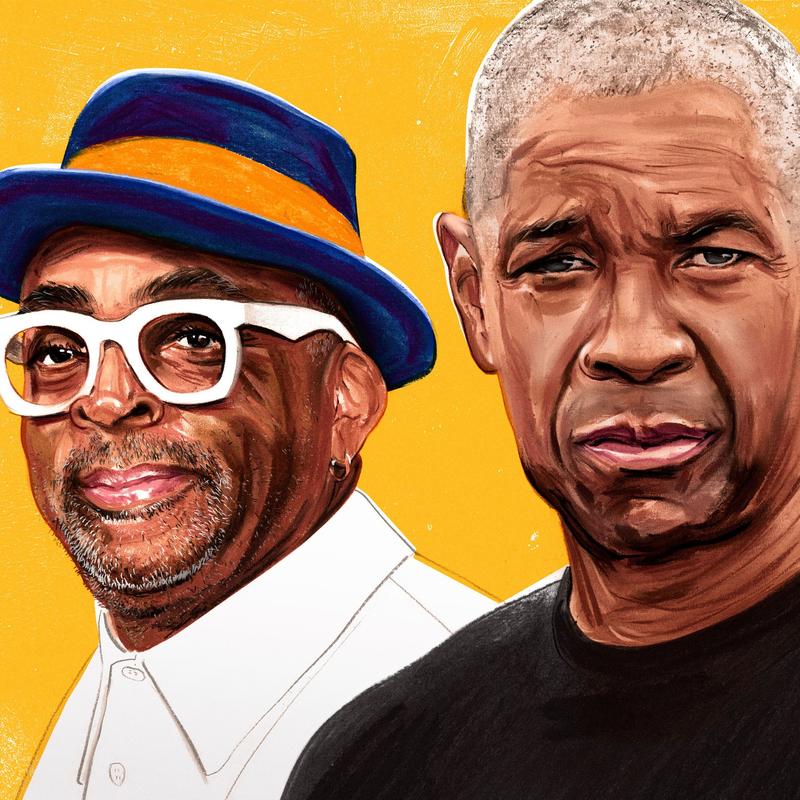
David: Spike Lee and Denzel Washington first worked together in 1990. They were relatively early in their careers, and the movie was Mo’ Better Blues. Washington starred as a trumpet player scrambling to make a living in jazz clubs, and Lee played his manager. [movie playing - Mo’ Better Blues by Spike Lee and Denzel Washington]
Denzel Washington: G, you're doing a half-assed job, man.
Spike Lee: You okay'd the deal. You told me to get you a dog, and I did. I got you the best terms possible at the time. You understand that we do it on the back end, down the line.
Denzel Washington: Well, this is down the line.
Spike Lee: I'm working on it.
Denzel Washington: Well, you ain't working hard enough. I think you're taking advantage of me.
Spike Lee: How can you say that? We grew up together. I'd rather chop off my left hand than take advantage of you. You're my boy.
Denzel Washington: Look, this is about more than friendship, G.
Spike Lee: I'm breaking my friggin' neck for you. Does it look like I'm rich? Somebody's been talking to you.
[music]
David: Washington and Lee, actor and director, have collaborated with some frequency, Malcolm X and many other films. Inside Man, the last film together was almost too decades ago, so Highest 2 Lowest is kind of a reunion. Washington plays a music mogul targeted in a kidnapping and ransom plot. The film is inspired by Akira Kurosawa's film High and Low from 1963.
Last week, I had a chance to talk with Spike Lee and Denzel Washington. Spike, we spoke a couple of years ago and you were telling me that for She's Gotta Have It, you borrowed from Kurosawa's Rashomon, the way different perspectives complicate the narrative and so on. Why did you go to High and Low, as kind of the source material and inspiration for the new movie?
Spike Lee: Well, first of all, I got asked to do it by my brother right here, Denzel Washington. That's how this whole thing happened. It was a gift given me by Mr. Washington. The last film we worked before that was Inside Man, which was how many years?
Denzel Washington: 19.
Spike Lee: 19 years before, but here's the thing, though. I was amazed when I was told that number, because time flies, and I did not know that it had been that long. I had hoped that I would work with Denzel again because Inside Man was our most profitable.
[laughter]
Denzel Washington: It is called show business.
David: It is. I've heard that.
Spike Lee: Another thing I'd like to say is we'd learned how we worked together.
David: Really?
Spike Lee: No, it was like the next day. We had that relationship, and so I know I'm using the word blessing a lot, but I'm going to say it again. It was a blessing.
David: I've read your long list of best films, and Kurosawa is one of the directors that really stands out there for multiple films on it. These are things that you've loved since being at NYU. Why High and Low, essentially a business story, amazingly, about the shoe business [chuckles] in Kurosawa.
Spike Lee: Well, we made an adjustment with that.
David: Yes, I saw that.
Spike Lee: Here's the thing, though. This film, to me, is about morals, and what someone will do, and won't do.
Denzel Washington: Right.
Spike Lee: I believe when this film opens, on August 15th, Friday, go see the movie. See it in the theater. Don't see it in your house. August 15th, Friday. I know that they will put themselves in the place.
Denzel Washington: Yes, what would you think?
Spike Lee: The character that David King is, they will ask themselves, "If you were in this situation, would you pay the ransom?" How much would you pay? I think the audience is going to put themselves in that situation.
David: Denzel, have you ever said no to Spike Lee when he's tried to cast you?
Denzel Washington: He never tried to cast me.
David: How do you mean?
Denzel Washington: We don't work for each other.
David: How does it work?
Denzel Washington: In this case, the script came to me first. I hoped that Spike would be interested in, so I called him up, he said, "Send it to me." He read it, he said, "Let's make it," and here we are.
Spike Lee: Here we are.
David: Quick as all that.
Spike Lee: It was that simple.
Denzel Washington: Yes.
Spike Lee: Denzel Washington is Denzel Washington, and there are certain figures in this industry that-
Denzel Washington: We made almost a quarter of a billion dollars on the last picture we did together, so it was good business. It's not rocket science.
David: You're talking Inside Man?
Spike Lee: Yes.
Denzel Washington: Exactly.
Spike Lee: Exactly.
David: Now, over time, there have been lots of, well, a fair number of directors and actors who have had long associations. In fact, Kurosawa had one with Toshiro Mifune, and De Niro has one with Scorsese, Hitchcock, and Jimmy Stewart. Tell me a little bit about--
Spike Lee: Sidney Lumet, and Al Pacino?
David: That's right. Tell me about working together for the first time, and how that relationship has evolved.
Spike Lee: I sent Denzel the script, and that was it.
Denzel Washington: When I started acting, there were two or three actors that I followed. De Niro, Hoffman, Pacino, the filmmakers that made those films never called me. I was never asked to be in any of their films. When Spike called me, we developed a relationship, and we made our own films. When I was in a position to return a favor to Spike that he started by calling me with Mo' Better, I said,"Hey, I'm calling a guy who called me, and who can tell a New York story as well as any of the other New York storytellers."
David: Did you feel iced out by those directors?
Denzel Washington: I don't care. Worked out all right.
David: It did, but I hear something in your voice that's--
Denzel Washington: You hear God in my voice? I fear God, not man. I could care less what man thinks about what I've done, or about what I'm doing. Wherever I go from this day forward, you remember that God is leading me. Not the industry, not Apple, not interviews, not interviewers, not Spike Lee, not this world. I'm being led by the Almighty. That's what's most important to me.
David: What sense do you make of where God is leading you as an artist? Toward what end? To fulfill what goals?
Denzel Washington: To lead more souls to our Heavenly Father. That's what I'm here for.
David: As a human being, and as an artist.
Denzel Washington: As a human being and as a human being. The platform is film, but that's not the purpose for me personally.
David: How has collaborating changed as your careers have grown?
Spike Lee: I've become a better director working with Mr. Denzel Washington. What he does, there's a scene in this film. A scene where Jeffrey Wright is really begging. His character on his knees, begging Denzel's character to pay this ransom, $17.5 million. It's really a scene where it's heartbreaking. At the end of the scene, Denzel picked up a grenade [chuckles] with some prop. That is not in the script. He grabbed this grenade and said, "You know sometimes I feel like blowing this motherfucker up."
David: [laughs]
Spike Lee: It's not about just what's on the script. It has to be deeper than that.
David: How much do you discuss this?
Spike Lee: When did you see that grenade?
Denzel Washington: Huh?
Spike Lee: When did you see the grenade?
Denzel Washington: I don't even remember.
Spike Lee: [laughs]
Denzel Washington: I don't even remember, to be honest with you.
David: You said you don't remember that moment, Denzel?
Denzel Washington: I remember picking it up. Yes.
David: How much do you discuss scenes ahead of time, and how much do you leave it to chance and improvisation?
Spike Lee: What we do is that we have a reading, but before that, we're auditioning. It's a lot of times we audition actors. We see there's something, we don't have to fix this part in the script, because up to that point, we haven't heard the lines read. There's 100%, I got to tell young filmmakers, reading the script is not the same as hearing the words that are written. It is day and night.
Over my career, I've had to do a lot of rewriting during auditions, because what was written, I'm talking about stuff that I wrote, too. When Denzel and I audition to people, we'll both say, "You know, we've go to change that line." It's the process.
Denzel Washington: Then Spike hired great actors.
Spike Lee: [laughs] Yes, I hired great actors, because I know if we got-- Don't get mad. We got Jordan here, [chuckles] we're not going to have some Okie dokes Rudy poo around him. We got to have a pippin. Horace Grant, you've got to have surround a team. There you go. A team.
David: Somebody that knocked me out as an actor in this is A$AP Rocky.
[movie playing - Highest 2 Lowest featuring Denzel Washington and A$AP Rocky]
Yung Felon: King David, now, ain't this something?
King David: Sorry?
Yung Felon: I got your full attention now, huh? You finally listening to me?
King David: Yes, I'm listening.
Yung Felon: Good.
King David: You know you got the wrong boy, right?
Yung Felon: Yes, so I've heard, and I also learned you can never trust the help.
King David: [laughs]
Yung Felon: But luckily for me, it was never about the boy. It was always about you.
King David: Well, fair enough, but if it's about me, then you can't expect me to pay $17.5 million for somebody else's son. If it's about me.
Yung Felon: Well, then his blood is going to be on your hands, then. How you want it?
King David: Nah, man, come on now.
Yung Felon: This ain't no fucking negotiation. This a day of reckoning. You not God no more than I am.
King David: All right, listen. God give you everything you want, right? No, God gave you everything you need, so the question is, what do you need? How can I help you? I ain't saying I'm God, but I can help.
David: There's one scene where they're separated by a panel of glass. It's an amazing scene. It's shot with the two characters in profile with this prism effect representing the glass between them. Spike, talk a little bit about that just as a piece of filmmaking, and the technical side of it, and the imaginary side of it.
Spike Lee: Well, you had to go to that. That's from the original. That's one of the highlights of Kurosawa's film, High and Low. I always shoot with two cameras, and I've never done this before. We have Denzel, A$AP Rocky, as you said, separated by glass and their profile. What we did, we had two dollies that were attached, so they'll move at the same exact time.
Denzel Washington: Oh, the two dollies were attached?
Spike Lee: They were attached. I've never done that before.
Denzel Washington: They were like they were on either side of what was supposed to be the glass?
Spike Lee: Yes, we had two cameras on-
Denzel Washington: Like the glasses right here?
Spike Lee: -in the middle.
Denzel Washington: Okay.
Spike Lee: In the middle. You had [chuckles] another scene before that in the recording studio, which turned into a rap battle. [laughs] Here's the thing. I'm going to tell this, don't tell this to Dee. Again, my brother surprised me, because it wasn't in the script. We're going in--
Denzel Washington: You improvised the rap battle?
Spike Lee: Well, it wasn't. It was badly written. Dee- [chuckles]
Denzel Washington: Improvised.
Spike Lee: -he comes out with-
Denzel Washington: The brutalizer.
Spike Lee: Nas' elematic. [laughs]
Denzel Washington: He's going to be pissing in the elevator. Type of rap game, the crap game used to sport ballads in the [unintelligible 00:12:30] [laughs]
Spike Lee: I got to give credit to A$AP Rocky, because he was there right with it. Even though it wasn't scripted, he was ready, and then finally, as the line says, "What is this? A rap battle?
[laughs]
Spike Lee: I didn't know that was going to happen. A$AP was rolling with it and lifted that scene, too.
Denzel Washington: Which is why I call Spike, Trust. I trust Spike completely. I didn't even know the way he was shooting it. I'm learning today because I wasn't there for that. He was handling that, and we were battling, and we had that over five films and whatever amount of years it's been that shorthand. I completely, 1000% trust Spike and I do my part and he does the rest.
Spike Lee: I would like to say I trust my brother. Here's the thing, though, David, we work together. It's not a lot of discussion. It's like this relationship we built up over how many years, over five films? We could say Scorsese, De Niro, that's the great Sidney Lumet, and Marty's great, too, but Sidney Lumet and Al Pacino, and there's Francis with Brando in the Godfather, and Apocalypse now. When you have that, it's like a great band. We're all playing the same part, but it's not something that's discussed. It's a feeling. It takes over time. It's very rare you're going to have that from the jump. that's just--
Denzel Washington: A 35-year overnight sensation.
[laughter]
Denzel Washington: 36 years.
Spike Lee: It's hard to explain. I know people might think it's some type of magic or voodoo, whatever you want to call it, but it's being human beings. That's the best way I can explain that.
Denzel Washington: I was going to say, like those other relationships, Scorsese and the other filmmakers, and actors that you talked about, those films were in the theater. I would ask all of my followers, and Spike Lee's followers to follow us to the theater on Friday. The movie opens Friday, August 15th.
Spike Lee: Here's the thing, though, again, I know it might be more convenient to sit home and you live on your big, big ass TV, but it's not the same experience as going to a theater. I remember going to the Ziegfeld. I loved going to Ziegfeld. What I saw, and it's a shame it's a ballroom now, but when a big film came out, you went to the Ziegfeld, and the theater is packed and there's energy it's like there's nothing like it.
David: No, it's amazing.
Spike Lee: A great sport event, too, but to go to a packed theater, I remember seeing Jaws, Alien, Close Encounter. I waited two hours in the freezing cold to see The Ex. Remember the Paramount Theater?
David: I do.
Spike Lee: It used to be called the circle, where you had to go right, go down. I saw The Exorcist there. Two hours must have been 2 degrees. People were screaming. You could hear people vomiting.
David: [laughs]
Spike Lee: You can't get that at home, [laughs] so go to the theaters Friday and vomit.
David: [laughs]
Denzel Washington: Everybody, Friday, go to your local theater and throw up.
Spike Lee: No, don't throw it to somebody else. Don't blame yourselves. [laughs]]
David: Yes. Denzel, I spoke a while back to Judi Dench, and like you, she's spent a lot of time performing Shakespeare. She told me something really surprising and interesting. She said that playing a role like M in the James Bond movies was as hard for her as being on stage in a Shakespeare tragedy. What do you think?
Denzel Washington: No. Shakespeare play's much harder.
David: Tell me why.
Denzel Washington: Well, because I am a pentameter to begin with. Her father loved me, often invited me, still questioned me the story of my life from year-to-year. The battles, the misfortunes that I have passed. I ran it through even from my boyish days, at the very moment he made me tell it. Wherein I spake of most disastrous chances, of moving accidents by flood and field of hairbreadth escapes, naming a deadly breach of being taken by the insolent foe and sold to slavery. That's harder than yo.
[laughter]
Spike Lee: Also film is, you stop and start. You don't have that on the stage, but Judi, that's what she thought, right?
David: She did.
Spike Lee: Okay.
David: She did. Spike, I came back from the screening of this movie and I told a friend of mine who works here, who's a musician, that one of the great parts of the movie was the chase scene, and it's propelled by the Puerto Rican Day parade music of Eddie Palmieri-
Spike Lee: And the salsa orchestra.
David: Oh, it was fantastic. Then, as I was telling him this, Eddie Palmieri probably died that very same day, because the next day I read his obituary.
Spike Lee: Huge loss. Big loss for the culture, for the world.
David: That's something forever you think a lot about is the propulsion of these movies through music and through--
Spike Lee: Driven by the music.
David: Tell me about thinking about that and conceiving that for a movie to make it move.
Spike Lee: It's three words. The French Connection.
[movie scene playing - The French Connection]
Speaker 1: Hold on.
David: The chase scene.
Spike Lee: That scene is from The French Connection.
Denzel Washington: When you say that, though, what do you mean? The style of it?
Spike Lee: Yes. The first of all, the big scene in High and Low is the scene where they have to dump the money, because really, I had to show that young Dylan was not just some dog. He's smart. Well, NYPD, they're going to catch your ass. He's thinking, "How am I going to orchestrate. Oh, oh, how can I orchestrate this drop of 17.5 million in Swiss francs in a Michael Jordan jumpman black backpack and not be caught?" Looks at the calendar. Oh, the hated Boston Red Sox is going to be [chuckles] in Yankee Stadium-
David: That was cold.
Spike Lee: -and steal the afternoon game.
Denzel Washington: This is why I called him Spike.
David: That was cold.
Spike Lee: Well, so that's not enough. Number four train, the last stop-
Denzel Washington: Rome Avenue line.
Spike Lee: -is 161st, Yankee Stadium. What happens on a Sunday every year? Puerto Rican Day parade. [laughs] Right away, I went to the Blue Note to see Eddie Palmieri, [laughs] and I told him, "You got to do it." He said, "Good." I said, "Eddie, word can't get out. It has to be a surprise. This has to be On the Low. In post-production, I need another song." He said, "Okay, I got you, Spike." He said, "There's another song, and the title is On the Low."
[laughter]
Denzel Washington: He said he performed the song?
Spike Lee: Yes, and then-- Thank you, D. Also, that was not the playback. We went six, seven takes. Every time we did it, they performed it live from beginning to end. Then we have Anthony Ramos and Rosie Perez, two famous Boricuas.
Denzel Washington: Bor-EE-kwuh.
David: [laughs]
Spike Lee: Introducer.
Denzel Washington: Bor-EE-kwuh.
Spike Lee: Bor-EE-kwuh.
Denzel Washington: Bor-EE-kwuh. No, you say it. Boricua.
Spike Lee: Boricua.
Denzel Washington: You're close, not far.
Spike Lee: Boricua.
Denzel Washington: That's not it, but keep going.
Spike Lee: Then we recruited as many Boricuas as we could find in the Bronx.
[laughter]
Denzel Washington: Puerto Rican ladies.
Spike Lee: Yes, I got it. To be in the crowd, we hand out the Puerto Rican flags. It was a joyous, joyous day.
Denzel Washington: Smartest thing I ever did, calling Spike Lee.
[laughter]
Denzel Washington: The smartest move I've ever made.
David: Spike, one last question. What do you want more in life? Best Director Oscar or a Knicks Championship?
Spike Lee: Knicks Championship. I said this already.
Denzel Washington: Oh, Lord.
Spike Lee: I said two Oscars. I'll give one away.
[laughter]
Spike Lee: We haven't won since the 72, 73 season. We only got two. How many did Lakers got?
David: Don't ask him that.
Spike Lee: Let me see.
Denzel Washington: Listen, I'm from New York, friends. Stop now. Come on.
Spike Lee: How long you haven't seen the tickets with the Lakers though?
Denzel Washington: Ever since McHale clotheslines Rambis.
Spike Lee: [laughs]
David: I was at that game covering it.
Spike Lee: August 15th. [laughs]
David: Oh, man.
Spike Lee: All right, David.
David: Thank you all.
Spike Lee: David, thank you.
David: Take care.
[music]
David: I spoke with Spike Lee and Denzel Washington last week. Highest 2 Lowest opened, in case you missed the date.
Spike Lee: Oh, what, you didn't know?
David: No, I didn't. [laughs]
Spike Lee: Oh, August 15th. It's a Friday.
David: It's in theaters now.
[music]
[END OF AUDIO]
Copyright © 2025 New York Public Radio. All rights reserved. Visit our website terms of use at www.wnyc.org for further information.
New York Public Radio transcripts are created on a rush deadline, often by contractors. This text may not be in its final form and may be updated or revised in the future. Accuracy and availability may vary. The authoritative record of New York Public Radio’s programming is the audio record.