The Wicked Smoocha: Anglerfish Break A World Record
[RADIOLAB FOR KIDS INTRO]
LULU MILLER: Three, two, one. Imagine ...
MOLLY WEBSTER: You live alone in darkness.
ALAN GOFFINSKI: But one day you catch a scent.
LULU: A waft of a beautiful smell.
MOLLY: And you begin swimming toward it.
ALAN: For weeks you follow it.
LULU: Until suddenly you find her!
MOLLY: A luminescent creature.
ALAN: Then you pucker out your lips ...
MOLLY: Your fleshy lippy mouthparts.
LULU: And you begin to smooch.
MOLLY: And smooch.
ALAN: And smooch.
LULU: For days you smooch.
MOLLY: For weeks!
ALAN: For years!
MOLLY: And you do not let go ...
LULU: Until you die!
LULU: [laughs] You have become ...
ALAN: The mysterious creature with the world record for the longest kiss.
MOLLY: That we know of.
LULU & ALAN: That we know of!
LULU: Now is the part where we make you sing the theme song with us. "Terrestrials. Terrestrials, we are not the worst. We are the ...
MOLLY: Best-rials.
LULU: Yeah, you got it! Terrestrials is a show where we uncover the strangeness waiting right here on Earth. I am your host, Lulu Miller, joined as always by my songbud ...
ALAN: Here fishy fishy fishy!
LULU: Alan. And joining to tell us all about the smackiest of smackeroos is the senior correspondent/reporter from our sister show Radiolab, Molly Webster! Molly!
MOLLY: Hi!
ALAN: Welcome to the clown car.
LULU: Buckle up, everyone. So Molly, in your years of reporting for Radiolab, you have done some of the best animal stories. I mean, you have an incredible one about butterflies.
MOLLY: Yes.
LULU: But you have also covered whales, snails, chimps, shrimps, mice, mushrooms, dinosaurs.
MOLLY: It's true. I do like nature. I mean, originally I thought that I would do science journalism just so I could be outdoors all the time.
LULU: Totally.
MOLLY: I was like, "I'm gonna find a way to just hike around the world and tell stories.
LULU: Do you?
MOLLY: I think I hike in a slightly different way.
LULU: Yeah. Benefits of science reporting. Okay, and today you have a story about what might be the longest kiss in the animal kingdom, but it is a story that is way less lovey-dovey and far more gnarly-warly than you might expect. This is a story that is gonna challenge our understanding of where one creature ends and another begins.
MOLLY: That's right.
LULU: But before you tell us this story and what this creature is, I brought Alan because he once broke an actual world record.
ALAN: That's right.
MOLLY: Wow, that is ...
LULU: Do you have any guesses what it is?
MOLLY: Oh gosh. Alan has a world record for building a giant house of cards.
LULU: Ooh, like the biggest house of cards?
MOLLY: Yes.
LULU: Okay.
MOLLY: The biggest.
LULU: That's a great guess, but wrong.
MOLLY: Okay. No idea then.
LULU: So I also polled the audience to ask what they think Alan might have a world record for.
ALAN: You did?
LULU: Uh-huh. And some of their guesses were?
AUDIENCE MEMBER: Oh, maybe it's the world's longest toot?
LULU: Nope.
AUDIENCE MEMBER: The most rats smuggled into a radio studio?
ALAN: [laughs] I did smuggle in nine for our rats episode.
MOLLY: That's wild.
LULU: But? Wrong. Okay, drum roll. What did you actually break a world record for doing?
ALAN: It was the record for the world's longest hug.
LULU: Aww!
MOLLY: Wait, I had no idea. How long is that?
ALAN: The record we were trying to beat was 24 hours and 17 minutes.
LULU: Oh!
ALAN: So this was back in 2010. Me and my friend Doug wanted to break a world record. We weren't great at, like, running super fast or lifting weights or whatever, so we picked the longest hug.
LULU: Okay.
ALAN: We started precisely at 9:30 pm. We had a big crowd, official observers.
OBSERVER: Can we have another round of applause for our huggers who are breaking the world record?
[applause]
ALAN: This is the actual recording of our big day.
OBSERVER: Let's go!
ALAN: We kicked it off with a countdown.
CROWD: Three, two, one!
ALAN: And then we started hugging and hugging.
OBSERVER: Both arms are wrapped around each other at all times during the whole embrace.
ALAN: All through the night.
MOLLY: Did you sleep?
ALAN: No.
OBSERVER: They must be awake at all times.
MOLLY: Did you get tired?
ALAN: I mean, yeah, my legs were killing me.
OBSERVER: Standing the whole time.
MOLLY: Whoa!
ALAN: Oh yeah, that's part of the rules. Like, you have to stand.
LULU: You can't just lie down and ...
ALAN: No laying down, no leaning at all.
LULU: But did you have to pee at some point?
ALAN: Yeah. Yeah.
MOLLY: How did you pee?
ALAN: Jugs.
LULU: [laughs] Okay, jugs.
ALAN: It was weird. Another hour passed, and then another hour. Sometimes we'd talk, sometimes we'd just be silent.
LULU: Aww! Did you ever, like, rest your head on Doug's shoulder?
ALAN: Yeah, it was a long night.
LULU: Yeah!
ALAN: We were friends since middle school, so ...
LULU: Wow!
ALAN: ... we trusted each other. When the sun finally rose the next day, we were exhausted.
OBSERVER: Let's get a time check from our official timers. What's the official time right now? Ladies and gentlemen, it's 9:48, which means we're more close than we've ever been in our entire lives to the world record of longest hug.
ALAN: The second hand ticked so slowly throughout the day until it was evening again.
OBSERVER: Thirty seconds. Okay, ladies and gentlemen, this is about to happen.
ALAN: Our feet were swollen, our arms felt like wet noodles, but the whole crowd was electric.
OBSERVER: I want you guys to lead the countdown.
ALAN: Ready to bear witness to hug history in the making.
CROWD: Four, three, two, one!
OBSERVER: Whoa! That's it, ladies and gentlemen!
ALAN: We did it, and actually we kept going for another eight minutes until we hit the 24-hour and 25-minute mark.
MOLLY: Hugging for an entire day. Wow!
ALAN: And I remember, like, I jumped up in the air in celebration like, "We did it!" And my legs just kind of gave out.
MOLLY: Oh, you fell?
ALAN: Yeah, fell to my knees.
OBSERVER: Record for longest hug, established!
MOLLY: Is that a real headline?
ALAN: Yeah, we made the newspaper.
LULU: I, like, authentically think this is one of the sweetest things about you. I love telling people, "He has the record for the longest hug!"
ALAN: Me and Doug.
MOLLY: You and Doug. The Doug hug!
ALAN: The Doug hug. But our celebration was ultimately cut short.
MOLLY: Aww!
ALAN: Though we did reach our goal, another couple of Canadian huggers outdid us.
MOLLY: No!
ALAN: Edging us out by an extra eight minutes.
LULU: That's so close! But still, round of applause to you and your buddy Doug, for having for a brief moment in time hugged the longest hug of anyone in America, at least.
ALAN: Thank you.
LULU: Very well done.
ALAN: Thank you.
LULU: Okay, so we are going to move from the longest hug to the longest smoocharoo.
MOLLY: The longest kiss.
ALAN: [laughs]
LULU: Molly, in advance of this, I did a quick bit of research and was surprised to discover that actually a lot of creatures do kiss or do kiss-like things. I mean, you got wolves, monkeys, polar bears, bonobos, prairie dogs—even ants. But only one creature can hold the world record. So Molly, who has it? Who's got the longest kiss?
MOLLY: Are you finally ready for the big reveal?
LULU: Yes, please bring it.
MOLLY: Anglerfish!
ALAN: Anglerfish?
MOLLY: Anglerfish. This is a story about anglerfish.
LULU: For people who I don't know, what are anglerfish?
MOLLY: Anglerfish are these creatures that live in the deep sea.
LULU: Okay.
MOLLY: Deep, deep down in the ocean, up to two-and-a-half miles.
LULU: Oh!
MOLLY: And to get that deep, humans would have to dive down in a submersible for over an hour.
ALAN: I didn't know the ocean went that deep!
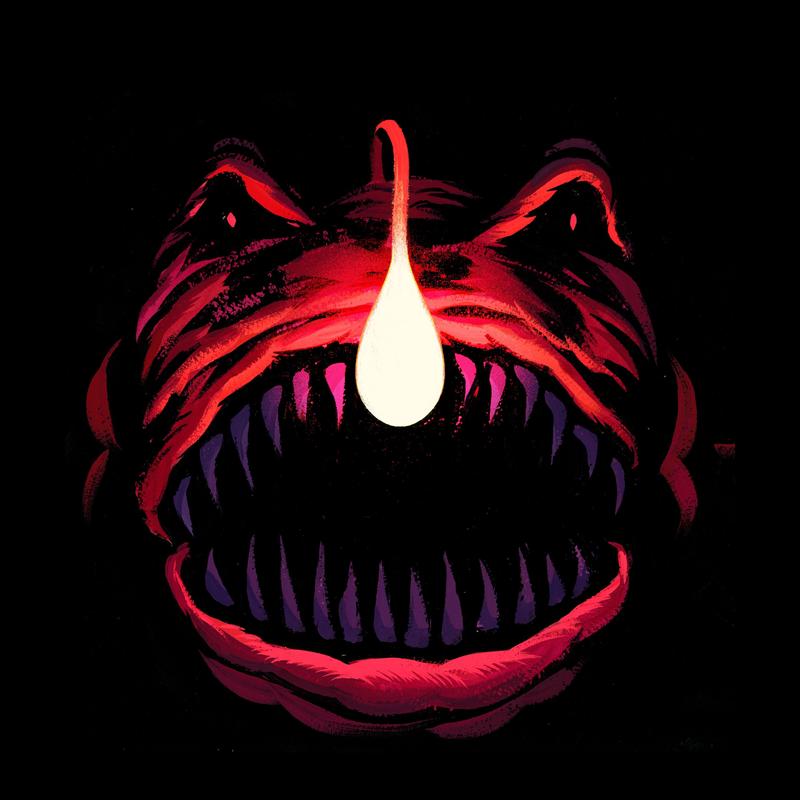
MOLLY: It's very, very cold down there and very, very dark. It's quiet. And then out of the darkness comes this flash of light. And behind it is this face with a kind of terrifying jack-o'-lantern smile and very sharp teeth.
ALAN: Almost more teeth than face.
MOLLY: Yes.
ALAN: Do they even have eyes?
MOLLY: They do have these sort of dead-looking eyes. And jutting out from their foreheads, they have this fishing pole sort of thing. And then at the very, very, very, very, very end of that little pole, there's a little ball that shines with a mysterious little light that will attract mates—or prey.
LULU: Huh! So do they truly have, like, a built-in light bulb?
MOLLY: Essentially. I mean, that's what it would look like to a fish swimming by.
LULU: Wow! Imagine that being like a tiny little fish or shrimp or whatever just floating around in complete darkness, when you see, like, a little glimmer in the distance, and then you swim toward it to investigate, and then ...
MOLLY: The anglerfish cracks open its jaws, and then the upper teeth and the bottom teeth close like a cage.
LULU: Ooh!
MOLLY: They surround the prey.
ALAN: It's nightmare fuel.
MOLLY: Nightmare fuel. Yes, it is scary from the perspective of the prey, the little fish who might get eaten. But from the perspective of the anglerfish who has to live in this total darkness, when you think of its glowing lure, what a feat to make light out of darkness. The way that they do that is ...
LULU: Can I guess?
MOLLY: Oh, yeah.
LULU: Okay. At summer camp, one time we went in a cave, and it was really dark. And my camp counselor brought wintergreen Lifesavers.
MOLLY: I love this!
LULU: And she handed them all out, and she said, "Chew." And we chewed, and there were green sparks. And it was the coolest thing ever. So do they chew wintergreen Lifesavers?
MOLLY: [laughs] Amazing. Alan, what is your guess?
ALAN: I know that you can take a potato and plug wires into it and, like, use it as a battery for a clock or something like that. Do they eat potatoes is the question.
LULU: Great. We've got winning guesses here. All right.
MOLLY: These are very good guesses. But the correct answer, the anglerfish's signature glow in its lure ball is actually from teeny tiny bacteria.
ALAN: No!
LULU: Ah!
ALAN: Wait, it's not even them? They're outsourcing their spark?
MOLLY: Yes, they are outsourcing their spark. That little lure ball is hollow, and bacteria that glow live inside the ball. And so the anglerfish will give the bacteria oxygen and nutrients so that they can live in there and be very happy. And then in exchange, the bacteria glows. The bacteria glows. Anglerfish.
ALAN: [sings] How do you glow? If you wanna glow, outsource your spark. Outsource your spark. Grow a little ball on your head. It's called an esca.
MOLLY: Latin for "bait" or "lure."
ALAN: [sings] Get your little disco ball. Fill your esca with yum-yums—carbon, nitrogen, phosphorus—for the bacteria's tum-tum.
LULU: Glow, glow, glow, glow. But can they disco?
MOLLY: Oh, you know it.
ALAN: [sings] Dance little fishy, dance little fishy, fishy, fishy, glow. Underwater disco! Millions of bacteria. We're not sure how they got in there. When the fishy wants the light to shine, it cranks the oxygen supply. Give a little extra fuel. Disco ball time, right for you. But if we want to go stealth mode, the esca has a kind of hood to turn the light down real low and go incognito.
MOLLY: They have this twinkly ball that dazzles their prey and bobs along in the water in a very hypnotic way. Hypnotize! Hypnotize! Hypnotize! Hypnotize! The disco ball is like their little friend, a deep-sea dance partner that they spend their time with. It's like their own little Doug.
ALAN: [sings] Find your Doug. Doug, find your Doug. Doug.
LULU: [laughs] Okay, round of applause to evolution for that relationship of bacteria and fish. But okay—but getting back to our kiss story, the whole reason for that glowing disco ball is to lure creatures closer to the razor-toothed mouth. Is this the creature we're gonna kiss? I don't want to kiss that.
MOLLY: You don't have to kiss it.
LULU: Okay.
MOLLY: There is some kissing, but you're not involved.
LULU: So who is the poor soul that has to kiss this toothy gremlin?
MOLLY: Oh, I'll tell you, but after the break.
LULU: Terrestrials is back. We are talking about the world's longest kiss with anglerfish superfan Molly Webster.
MOLLY: Mwah!
LULU: Okay, so before the break, you revealed to us that the creature that's gonna be doing the kissing is the anglerfish, those scary-looking toothy beasts of the deep with the light bulb protruding from their head. So what happens? Do two of these things just come together and smooch and try not to, like, bite each cut each other's lips off with their razor teeth?
MOLLY: No, here's the deal. What I learned is that that scary fish with the lure on its head, that's the female. The male looks nothing like that.
ALAN: Really?
MOLLY: So the females can get bigger than a basketball, but the males are super teeny tiny, like, could be the size of a marble.
ALAN: No way!
MOLLY: The males don't have the lure.
LULU: Oh!
MOLLY: Yeah, it's only the females that have the light.
LULU: Okay.
CURATOR: That right there is the anglerfish.
MOLLY: Okay. Eee, I'm excited! I'm really allowed to touch it?
CURATOR: Of course.
MOLLY: Okay.
MOLLY: I went to the American Museum of Natural History in New York to see preserved anglerfishies.
LULU: You got to feel it with your bare hand?
MOLLY: Yeah.
LULU: Wow!
MOLLY: I held it. I poked it.
LULU: Cool! [laughs]
MOLLY: Oh, it's so squishy! It's so smooth. It's like the skin of a fruit or something.
CURATOR: Yes, exactly. Like a banana. Like an overripe banana. [laughs] This species, the skin is relatively smooth. Other species, it can be rougher, bumpier.
MOLLY: He just looks so grumpy!
CURATOR: They all look so grumpy.
MOLLY: They have, like, a—I mean, this one that we just picked up is, like, the size of a jellybean.
MOLLY: The male, he was just this tiny, sad-looking little thing. No big teeth, no light-up disco ball. They're just, like, in the deep sea darkness by themselves, all alone. Teeny weeny beeny. And the Atlantic Ocean is so big.
LULU: It feels kind of doomed or hopeless to be a male anglerfish. Like, you're the size of a jellybean, you don't have a light to attract food. How do you survive?
MOLLY: Strangely enough, this is the question that leads us to the kiss.
LULU: Okay. [laughs]
MOLLY: So the male is far away, floating around the depths of the ocean.
LULU: Okay.
MOLLY: And then the female lets off a smell like a chemical perfume.
LULU: Okay.
MOLLY: And one day the male, who has a shockingly good nose for a tiny prune-like fish ...
LULU: Oh, whoa. You're showing me a picture. He has huge nostrils on that tiny face!
MOLLY: Yeah. The male smells a female and follows that scent through the vast ocean.
LULU: Wow! Like a little chemical trail of breadcrumbs.
MOLLY: Yeah. For weeks and weeks, he swims along covering huge distances, just sniffing, until he finds her. And then the male swims up to the female. And the females can be, like I said, 60 times bigger than the male. So imagine that.
LULU: That's like a human going up to a toothy, dead-eyed school bus.
MOLLY: This tiny little thing gets to this big old fish, and the little thing kisses it.
LULU: On that big giant mouth?
MOLLY: No, we're not going for lips.
LULU: Okay.
MOLLY: It takes its teeth and it clamps down on the female's skin. Like, it could bite on the back or on the belly or on the side of the fish, and it just hangs on.
LULU: For, like, a few seconds?
MOLLY: In some species, forever.
LULU: What? Why? Why does he do that?
MOLLY: Well, once he's locked in, he can start mooching off of her for food.
LULU: Hmm!
MOLLY: So everything she catches with that very cool lure dangly ball system, she'll start to digest it, and then he'll get some of the nutrients, some of those calories through the kiss.
LULU: Whoa!
MOLLY: Which is weird, because usually if a creature sticks itself with its mouth onto your side, you're gonna try and fling it off, right? Any creature would try and get rid of this extra creature.
LULU: Totally! Like, "Get away!"
MOLLY: But with anglerfish, something very special is happening inside the kiss. The male is sending out a little enzyme. This is a little chemical that makes its own mouth dissolve. And so his mouth starts to dissolve, and then he starts to kind of melt and become one with her. And she starts to become one with him.
ALAN: [sings] Two fish. Two fish merge into one. Our love has just begun.
MOLLY: Just mouth fused into skin.
LULU: Oh my gosh!
ALAN: The kiss never ends?
MOLLY: The kiss never ends. It lasts forever. The male kind of just dissolves partway into the female. Her circulatory system, her blood, his digestion, her digestion, it all becomes the same thing. And he just fully—slurp!—I don't know, integrates into the female.
ALAN: Wow!
LULU: Talk about a hanger-on! [laughs]
MOLLY: Some species lose their eyes and lose their internal organs.
LULU: What?
MOLLY: And then from there, once they're kind of, like, fused in this melty way, they just go everywhere together. And so the male is fused into the female, and it makes it quite easy for him to fertilize her eggs at some point, which results in little anglerfish babies.
ALAN: [sings] And I know that I've found in you, fish, my endless kiss.
LULU: Okay, wait, wait, wait, wait, wait, wait. Does he still poop?
MOLLY: No, their digestive tracts, like, become the same.
ALAN: Oh. So at some point right before its first kiss, a male anglerfish takes its last poop ever?
LULU: [laughs]
MOLLY: Yeah. I guess he does poop, but through her.
ALAN: Is the male its own fishy person still, or does it forfeit everything and just become this sort of, like, organoid pimple?
LULU: Yeah. Like, do they become one being, or are they still two beings that are connected?
MOLLY: That is a very tricky question to answer. It probably changes over time, with more and more of him becoming her, which can last for years.
LULU: Whoa!
MOLLY: And the two just acting like one creature. And it basically goes on like that until their light together flickers out and they die.
LULU: And scientists just have no way to know for sure what's happening existentially or spiritually between these two beings. But they are trying to figure out what's going on physically. Because see, this fusing together of tissue from two different individuals into one working body, well, it's incredibly rare in nature. And it's something that we humans wish we could figure out how to do, because if we could, it could help save lives with way better organ transplants.
MOLLY: Yeah, so maybe you need a new kidney, Lulu. That's the organ that helps filter toxins out of the body. So since I have two of them, I could give you one of mine. And sometimes that works. That would be a successful kidney transplant. But sometimes your body might try to reject my kidney because it's like, "Wait, this is not a part of us. This is probably dangerous." And so it tries to get rid of it.
LULU: Hmm.
MOLLY: Like, so this is the mystery of organ transplants.
LULU: Okay.
MOLLY: And the thinking is if we could figure out how anglerfish fuse together in this, you know, eternal kiss, then maybe we could take some of those same principles and apply them to an organ transplant so that Molly giving Lulu her kidney, you won't reject it.
LULU: Whoa!
MOLLY: You just fuse with me like an angler kiss.
LULU: Wow! Some scientists think the clues, the secret chemicals that are released when the little parasitic male jellybean blob lays his kiss upon the female, could one day lead to more successful life-saving organ transplants.
MOLLY: Yeah, the smooch holds the secrets.
LULU: And if we figure that out? Well, that would be a reason to disco!
ALAN: [sings] Anglerfish, anglerfish, anglerfish. Get down, get down, get down, get down.
MOLLY: [sings] To the depths of the ocean.
ALAN: [sings] Turn around, turn around, turn around, turn around.
MOLLY: [sings] I see you swimming.
ALAN: [sings] Get down, get down, get down, get down.
MOLLY: [sings] To the depths of the ocean.
ALAN: [sings] Turn around, turn around, turn around, turn around.
MOLLY: [sings] I see you swimming.
ALAN: [sings] Anglerfish.
MOLLY: [sings] 'Cause I'm an anglerfish.
ALAN: [sings] In the deep dark ocean void. Anglerfish.
MOLLY: [sings] I'm an anglerfish.
ALAN: [sings] We are highly dimorphic ceratioids. Anglerfish.
MOLLY: [sings] Anglerfish.
ALAN: [sings] They say true love will set you free. Anglerfish.
MOLLY: [sings] I'm an anglerfish.
ALAN: [sings] But these lips are locked for eternity. They say that distance makes the heart grow fonder. But I'll never leave your side. I'll never stray or wander. Anglerfish. We will be eternally together. You have my heart forever. No, I mean that, like, literally. We share a circulatory system now. Anglerfish, anglerfish.
MOLLY: Personal space is overrated.
ALAN: [sings] Anglerfish, anglerfish, anglerfish, anglerfish.
MOLLY: [sings] Together forever.
ALAN: [sings] Anglerfish, anglerfish, anglerfish.
LULU: Alan Gofinsky. That fin is like an anglerfish fin. With backup vocals by Molly Webster. Anyway, there is nothing else cool about—what's that?
BADGER: Excuse me, I have a question.
BADGER: Me too.
BADGER: Me three.
BADGER: Me four.
LULU: The Badgers! Listeners with badgering questions for the expert.
LULU: Are you ready?
KORY EVANS: Yes.
LULU: And joining us from Houston, Texas is Dr. Kory Evans, a marine biologist.
KORY EVANS: And I specialize in fish and fish skulls.
LULU: Fish skulls?
KORY EVANS: Yeah.
LULU: Okay, before I jump into the Badgers' questions, would you be up for playing a quick round of Meet the Expert?
KORY EVANS: Yeah, absolutely.
LULU: Okay, so number one, you said you are a fan of fish skulls. Do you have any fish skull tattoos?
KORY EVANS: Well, I've been thinking about getting a swordfish tattoo.
LULU: Really?
KORY EVANS: Yeah.
LULU: But he says he just can't decide between that or ...
KORY EVANS: A barracuda. That's a classic mean fish.
LULU: A barracuda skull and crossbones would be pretty metal. Next question is: How did you get interested in fish?
KORY EVANS: So I got interested in fish growing up in North Philadelphia. There are these really long creeks that run throughout the city.
LULU: And he says at first he wouldn't even use a fishing pole, just a long ...
KORY EVANS: Handline. So a handline is just some fishing line wrapped around your hand.
LULU: Wow!
KORY EVANS: And then you have a hook on the end of it, and you could just throw it out that way.
LULU: Huh!
LULU: And as for bait, sometimes he'd use nice juicy ...
KORY EVANS: Earthworms. We also used hot dogs.
LULU: Okay, and does that actually work? Like, you'd catch stuff?
KORY EVANS: Depending on what we were trying to catch, yeah. So I wanted a nice tank with a bunch of little fish swimming around, and so I went to the creek and I caught a ton of minnows.
LULU: So he put them in a bucket.
KORY EVANS: I might have put, like, 30 in there.
LULU: Took them back to his room, poured them into a tank.
KORY EVANS: I had the tank right on the windowsill, so I actually had the afternoon sun coming in and it was, like, shimmering off these silvery fish. It was really, really beautiful. It's relaxing. It's really calming.
LULU: So calming he fell into a deep, blissful sleep surrounded by about 30 minnows. And when he woke up the next morning ...
KORY EVANS: Things changed really rapidly.
LULU: There were only about 10 minnows in the tank.
KORY EVANS: I think by day three, I had one minnow left in that tank.
LULU: Oh no!
KORY EVANS: Yeah.
LULU: They were eating each other.
KORY EVANS: I was like, "Man, all these dead minnows."
LULU: And Cory says as gnarly as that was, that moment changed his life, because he wanted to understand what had just happened.
KORY EVANS: So I went to the library, and I found the Pennsylvania State Fishing Guide. I learned that there was, in fact, many more species of minnows than just the one that I thought existed.
LULU: Each with their own personalities. And Kory has been hooked—heh!—on fish ever since.
LULU: All right, are you ready for the badgers?
KORY EVANS: I'm ready.
LUCY: Hi, I'm Lucy. I'm eight, and my question is: How many colors of the light bulbs are there?
KORY EVANS: Yeah, so there are—usually the light bulbs are either blue or green colored.
LULU: Okay.
KORY EVANS: And one light bulb that you likely won't ever see is a red colored light bulb. And the reason for this is because the red light doesn't actually make it that far down where the anglerfish live. So in the deep ocean, because the red light doesn't make it that far down, many of the fishes and other invertebrates have actually lost the ability to see red light.
LULU: Oh, so then it wouldn't work as a lure.
KORY EVANS: Exactly.
LULU: No one would come toward it. Okay.
KORY EVANS: Exactly. Now if you're a dragonfish and you're pursuing prey, these guys actually have patches underneath their eyes that emit red light.
LULU: No!
KORY EVANS: And they can still see red light.
LULU: No! Like glow-in-the-dark little flashlights under their eyes?
KORY EVANS: Exactly. Yeah. And it ends up functioning like a flashlight that only they can see.
LULU: What? That's so sneaky!
KORY EVANS: Yeah.
LULU: So they basically get, like, a view of what's in front of them, but the other—it's like night vision.
KORY EVANS: Exactly. Yes. It's literally night vision. Yeah. It's really impressive.
LULU: That is so cool.
JENNY: Hey, I'm Jenny. I'm 44. What eats an anglerfish?
KORY EVANS: What eats an anglerfish? Other anglerfish would definitely eat an anglerfish.
LULU: Oh, man! Okay, can I fact-check something with you? I have heard that anglerfish have multiple rows of teeth, so if an anglerfish were to eat an anglerfish, would that mean there would be jaws inside jaws inside jaws inside jaws?
KORY EVANS: That's absolutely—yes, that's absolutely possible, yeah.
LULU: [laughs]
KORY EVANS: And in a lot of our research, actually, we use X-rays to scan fish, so we'll find other fish inside fish all the time. So there's oftentimes, like, four sets of jaws.
ALAN: Jaws! Inside jaws! Inside jaws! Inside jaws! Chomp!
LULU: Wow! Recursive jaws.
AUGGIE: My name is Auggie and I'm three years old. Does any fish kiss on the lips?
MOLLY: Aw, do any fish kiss on the lips?
KORY EVANS: Yes, so lots of fish kiss on the lips, but the kissing isn't romantic in this case. Usually it's aggressive. There's actually a fish called the kissing gourami, and they have these big fleshy lips. And they're popular in aquariums because they'll kiss too, and it really looks like they're kissing, but usually it's two males and they're fighting each other.
ALAN: Hey, get over here! Kissy kissy! Mwah, mwah, mwah, mwah, mwah, mwah, mwah, mwah, mwah.
SETH: Hi, my name is Seth. I'm eight years old. If you could have any part of your body be bioluminescent, what would you choose?
KORY EVANS: Definitely fingertips. I'd definitely have light-up fingertips. You know, if I'm working in the dark, light-up fingertips would be really, really helpful.
LULU: Do you think Rudolph the Red-Nosed Reindeer's red nose was caused by bioluminescent bacteria inside?
KORY EVANS: I like to think so, that yes, there were—he had a little colony of bacteria in his nose that allowed it to glow red.
JACOB: Hi, my name is Jacob and I'm 11 years old. What is one of the most surprising encounters you've had as a fish scientist?
KORY EVANS: Probably encountering a walking catfish, like actually walking around.
MOLLY: What, walking on ...
KORY EVANS: Walking on land. Yeah, walking. He was walking on land on my college campus. I saw this, like, shiny, wet thing that was kind of flopping across the path.
LULU: What?
KORY EVANS: Yeah. And I walked up, I was like, "I know that's not what I think it is," because I knew of walking catfish. They're invasive in South Florida. But, like, it was actually walking around. It was the most shocking thing.
LULU: But wouldn't it die? It can't—it's like fish out of water is the classic—like, wouldn't it literally die? Can't they not breathe out of water?
KORY EVANS: So some fish have adaptations to allow them to breathe out of water. One of the big issues with fish out of water is that their gills collapse.
LULU: Huh.
KORY EVANS: And when that happens, you can't get gas exchange. So ...
LULU: Oh, and you can't get oxygen out of the air?
KORY EVANS: Exactly. So as long as you can keep the gills spread apart and the fish wet or moist, it actually—they can do pretty well.
LULU: How long—I mean, how long could they stay alive out there?
KORY EVANS: At least several hours. The record that I've seen personally was I actually caught this little baby armored catfish in the Amazon one time during ...
LULU: Wait, wait, wait. Is a baby catfish called a kittenfish?
KORY EVANS: It is not, but we can definitely start.
LULU: Kory put it off to the side on his bedside table because he was busy sorting some other fish.
KORY EVANS: But it took longer than I thought it was gonna take. And I remember I—like, I finished sorting and I just took a nap.
LULU: Okay.
KORY EVANS: And when I wake up, all I hear is like a squeak almost, like a "Mrrr."
LULU: [laughs] Okay.
KORY EVANS: And I was like, "What is that?" And it did it again. It was like, "Mrrr." And I turn on my bedside table, and the little catfish is actually still there, it's still alive. So I was in really close to the waterside, so I, like, walked all the way down to the waterside and let him go.
LULU: And he was okay?
KORY EVANS: He was totally fine, yeah.
LULU: He was your little kittenfish alarm clock.
KORY EVANS: Yep.
[meow, meow, meow, meow]
LULU: It's incredible that it can just stay alive. And I think that is the best place to leave it. And I won't tell you that anglerfish use those outer layers of teeth as a cage to trap fish before they swallow them down. And sometimes the little fish will try to escape, but the jail bars of the cage, aka the anglerfish teeth, are so sharp that chunks of flesh sometimes get caught in there. And scientists who have caught anglerfish have found the chunks of flesh from the failed fugitive fish. And if you could imagine how rank that breath would be, like, just swimming around not with spinach in your teeth but dead fish in your teeth, anyway, I won't tell you that because I'm nice.
LULU: Terrestrials was created by me, Lulu Miller, with WNYC Studios. This episode was reported by Molly Webster and produced by Alan Goffinski, with sound design by Mira Burt-Wintonick. Sarah Sandbach is our executive producer. Our team also includes Ana González, Tanya Chawla, Natalia Ramirez and Joe Plourde. Fact-checking this episode by Emily Krieger. Support for Terrestrials is provided by the Simons Foundation, the Arthur Vining Davis Foundations and the Templeton Foundation. Thank you!
LULU: Big thanks to Molly Webster for lending her talents to this episode. Go check out all of her Radiolab stories, and if you want to hear the really amazing one about butterflies, listen to the one called "Goo and You." And also big thanks to Doug, the Doug hug Doug, Alan's friend Doug, whose name is Doug Pearce. And Doug and Alan were part of an artist collective called No No Stranger, which is when they did their big hug. Big shout to No No Stranger. I think they often did stuff with puppets. And also to their ringleader, Mike Runge, whose voice you hear announcing, and to another member, Brandon Schoff, for providing the world's longest hug audio.
LULU: If you have something special you're good at and think you could hold the world record in, draw us a picture and let us know. Have your adult email it to us. The email address is in the show notes. And finally, this is dropping right before Mother's Day, so maybe, you know, go give a smooch to the maternal-like adults in your life that you appreciate. And we've got Mother's Day and Father's Day coming up, so we wanted to give you some ideas for animal cards you could draw for the adults in your life. Okay, we got one that's from Sylvie that says, "I love my parents berry much," and then she drew some berries. There was a warthog with glasses on and it just said, "Dad." And then of course there's the one I came up with, which is a drawing of an owl, and then it goes, "Who, who is the best parent?" And then you open it and that says, "You are. Thanks for owl that you do." Anyway, do you have some ideas? Make a drawing, have your adult email it to us at T-E-R-R-E-S-T-R-I-A-L-S [at] wnyc [dot] org.
LULU: Oh, that sound means we've got some April birthdays to shout out for our Explorers Club members. Ready?
ALAN: Ready. Here we go.
LULU: Ansel, Benny, Austin and Maisie.
ALAN: Colt, Emerson, Emmett.
LULU: Evelyn and Ingrid and ...
ALAN: Karen.
LULU: Maybe Corinne.
ALAN: Gabriel, Henry, June, Jules. Leonardo, Lev, Sasha.
LULU: Mila, Tiernan.
ALAN: Viva Anaïs.
LULU: Willa, William, Yafa Sultan. And happy belated birthday to Aidan! Woo-hoo! I hope you are all surrounded by bacteria, like friends who are as committed to making you glow as the bacteria that surrounds the anglerfish. Or just, you know, propped up by somebody like Doug. If you would like to help support the show, join the Explorers Club. You'll not only get slightly off-key singing from me and Alan, you'll also get ad-free listening and other perks. Just go to Terrestrialspodcast.org/join and see if it's for you. Thanks so much for listening. See you in a couple spins of this dirty ol' planet of ours. Bye!
-30-
Copyright © 2026 New York Public Radio. All rights reserved. Visit our website terms of use at www.wnyc.org for further information.
New York Public Radio transcripts are created on a rush deadline, often by contractors. This text may not be in its final form and may be updated or revised in the future. Accuracy and availability may vary. The authoritative record of programming is the audio record.