The Wallowers: A Buffalo Comeback Story
[TERRESTRIALS INTRO]
LULU MILLER: Three, two, one! Imagine you grow a long beard, and your shoulders get bigger and bigger until you are almost ...
ERVIN CARLSON: Seven feet tall at the hump.
LULU: And your hair goes wild.
ERVIN CARLSON: All big and shaggy.
LULU: And out of your fuzzy head sprouts ...
ERVIN CARLSON: Some real good horns.
LULU: And your feet harden into ...
ERVIN CARLSON: Hooves.
LULU: As you kick and run over dusty grass with your whole herd ...
ERVIN CARLSON: You'd be grunting.
LULU: You have become ...
ERVIN CARLSON: ... a buffalo.
LULU: Now's the part where I make you sing the theme song with me. "Terrestrials, Terrestrials. We are not the worst, we are the ..."
ERVIN CARLSON: We are the puzzle to me is what they would be. [laughs]
LULU: Opposite of worst?
ERVIN CARLSON: We are the best.
LULU: Bestrials! You got it!
ERVIN CARLSON: I was gonna say that in the first place!
ANA GONZÁLEZ: Well, then you should have trusted your gut.
ERVIN CARLSON: I should have.
LULU: Terrestrials is a show where we uncover the strangeness right here on Earth. I am your host Lulu Miller, joined as always by my songbud ...
ALAN GOFFINSKI: What is fluffy but no touchy?
LULU: ... Alan.
ALAN: A buffy-lo.
LULU: ... and also by producerbud ...
ANA: Buff-hello!
LULU: ... Ana! Who is bringing us a big-shouldered tale about these massive horned beasts that involves cliff-jumping, horse-racing, and even resurrection. Sorta. You'll see. Ana, where do we begin?
ANA: We begin out where the wide open prairie meets the mountains.
ANA: It's so windy.
ANA: I'm on the Blackfeet Reservation in Western Montana. It's bordered by Glacier National Park to the west and Canada to the north. And right now I'm on this huge ranch, thousands of acres of rolling grass, snow-capped mountains in the distance. This is big sky country, and hoo boy can weather roll through!
ERVIN CARLSON: It gets a little windswept. You know, it gets pretty dry.
ANA: Until winter rolls around, and—wham!—that dry sea of grass becomes a blanket of snow.
ERVIN CARLSON: And be there all winter.
ANA: But for now, it's spring. And looking out over Buffalo Spirit Hills Ranch on a breezy day, I imagine it doesn't look too different from what it would've been like hundreds of years ago, except instead of cars and roads there'd be thousands of what we call American buffalo. Which are technically bison. Early European settlers got the names all mixed up when they first came to North America. The scientific name is actually bison bison bison.
ALAN: [laughs] I'm gonna go by Alan Alan Alan from now on.
ANA: Oh, Alan! But out here in Blackfeet country, they've only ever had one name for the animal.
ERVIN CARLSON: Iinnii.
ANA: Iinnii is the Blackfeet word for "buffalo." And teaching it to me is Blackfeet elder and director of the Blackfeet Buffalo Program, Ervin Carlson.
ERVIN CARLSON: Iinniiwa.
ANA: Iinniiwa is the plural word for "buffalo," because Ervin's ancestors were used to seeing plural buffalo, thousands, even millions of buffalo roaming these lands. And that seems almost as hard to picture today as a bunch of woolly mammoths wandering around. Because by the time Ervin was growing up, the buffalo had disappeared.
ERVIN CARLSON: Yeah, did not grow up with buffalo. As far back as even my grandparents didn't grow up with buffalo here. They've been gone that long.
ANA: But Ervin heard stories about these long-gone beasts, and the superpowers that they had that allowed them to survive in this rugged place—and even conjure up new life! Meet Buffy-lo the Grizzly Slayer.
LULU: [laughs]
ANA: This giant beast ...
ERVIN CARLSON: Can get up to 2,000 pounds.
ANA: Whoa!
ANA: Almost seven feet tall, with shoulders towering over its big, bearded head. And on that head? Two curved horns so sharp they can buck away wolves, coyotes and even grizzly bears! Oh, and this brute can also go full snowplow mode in winter, digging deep under pounds and pounds of heavy snow all to find ...
ERVIN CARLSON: Grass.
ALAN: Yum? I guess?
ANA: That's right, this massive beast fills its massive tummy with grass salad, transforming into a grass-powered lawnmower that actually helps keep invasive brambly plants from taking over the land.
ALAN: Take that, brambles!
ANA: Oh, and you think a cute widdle baby bison might be easy prey? But wait, what's that rumble shaking the ground? A giant herd of buffalo running towards you!
ALAN: Ah!
ERVIN CARLSON: 35, 40 miles an hour.
ANA: Because these beasts do not travel alone. They're basically a herd of minivans with the speed of Ferraris.
ERVIN CARLSON: They are agile, and they can just stop and turn on a dime.
ANA: And you can imagine hundreds, maybe thousands or millions of minivan Ferraris zooming around the plains. They're gonna leave some marks on the ground. But it turns out, that's a good thing!
ERVIN CARLSON: The hooves, they churn up the ground. They're aerating. That's good for the ground.
ANA: With blazing hot temps in the summer and whipping winds year round, the land out here needs help keeping its water. That's where the buffalo hoof superpower helps. They poke holes in the ground, which loosens up the soil and lets water seep deep down so plant roots can grow deeper. Over centuries, this made the American West one of the most ecologically diverse ecosystems on the continent! And it wasn't just buffalo hooves.
ERVIN CARLSON: Well, the wallow is where they dig up in the dirt, and they build these buffalo wallows that they roll in.
ALAN: [sings] Follow me, follow me, down to the wallow. We wallow quite whimsically, muddily, muckily. We roll on our backs, we splish-splash with each otherly. We've all been too itchy and hairy and buggily. So kick up your hooves, settle in nice and comfily. Ooh, that's nice! Mud-delightful! We buffalo know how to muck, muck quite muckily. Mucking our butts, backs, and bellies quite merrily.
ANA: See, because they have hooves they're not really able to scratch that thick fur on their backs and kill off any bugs. That's why they flip and use the dirt to get that itch. Kind of fun. But because buffalo are so huge, and all their buffalo buddies do it at the same time, that joyful act of wallowing actually creates giant pits in the earth that scientists call "wallows." And when it rains? Those wallows collect water and become pools.
ERVIN CARLSON: You know that brings back a lot of the wildlife.
ANA: Like insects and frogs and snakes.
ERVIN CARLSON: And also birds.
ANA: Who eat the insects and pick up any loose buffalo fur.
ERVIN CARLSON: Because they use buffalo fur for their nests.
ANA: With every little plop into the dirt, buffalo wallows ripple out into the landscape, bringing and sustaining life.
LULU: Wait, wait, wait. So just by rolling around in the mud, chillaxing, these buffalo change the whole landscape that much?
ANA: Yeah! That's why buffalo are given the rare title of ...
ALAN: Ecosystem engineers. Bup-buh-duh-duh!
LULU: Wow!
ANA: Yup, just like beavers, buffalo are some of North America's most important mammals. But to Ervin, buffalo superpowers were the stuff of fantasy, like a comic book. Because for most of his life, he had never seen a buffalo. Not in the wild. Not anywhere. All he had was stories about them from the past.
ERVIN CARLSON: That was our way of life was buffalo. And we roamed right along with them, because that was our lifeline. That was our food, clothing and lodging.
LULU: Wait, lodging?
ANA: Yeah, Blackfeet traditionally used buffalo skins for tipis.
LULU: Huh!
ANA: And their horns they'd fill up with woodchips and moss and burning coals to make these sort of torches.
LULU: Rad!
ANA: That could help them carry fire from one place to the next. And they'd use their furs for blankets, and their meat to eat in stews and jerkies.
LULU: Mmm! Wait, but back in the day, before, like, guns and bullets and fast cars, how would a little human even catch or take down one of these 2,000-pound beasts that runs faster than a horse and can buck a grizzly bear?
PAUL WEATHERWAX: I'm gonna explain a way of hunting to you.
ANA: This is Paul Weatherwax, a Blackfeet educator and language speaker.
PAUL WEATHERWAX: So I'm gonna introduce myself in Blackfoot. [speaking Blackfoot]
ANA: And Paul can explain exactly what you're wondering: How did the Blackfeet ever catch these grizzly-bear-fighting racecars? Well, one way was ...
PAUL WEATHERWAX: A buffalo runner.
ANA: The bravest and fastest runner around would put on a costume of an animal.
PAUL WEATHERWAX: And it would make this herd of buffalo look at them and chase them.
ANA: And he'd run and run, as dozens of buffalo ran after him.
LULU: What? That's so brave! And terrifying.
ANA: Uh-huh.
LULU: And then where does this buffalo runner go?
ANA: Towards ...
PAUL WEATHERWAX: The top of this cliff.
ANA: And the buffalo runner would ...
PAUL WEATHERWAX: Dive under the cliff.
LULU: [gasps]
ANA: Onto a hidden little ledge. And the buffalo would follow, and a lot of them would fall off the cliff.
LULU: Aww!
ANA: Which is sad, but the thing is the Blackfeet people would only do this every once and a while, taking only a tiny fraction of the herd, leaving tens of millions of buffaloes to roam free. And of the buffaloes that did die, they'd use every bit of them. By smoking and preserving the meat, one cliff hunt could be enough for the community to survive the months of bitter, cold winter.
PAUL WEATHERWAX: So it was ingenious for them. It was not just now, it was preparation for later and after later.
ANA: And together, the buffalo and the Blackfeet coexisted on the land for hundreds of years, grazing it, working it, and of course relaxing in it from time to time, and making it healthier just by being there.
ANA: But then something changed. In the 1800s, the United States was this relatively new nation. And it was growing. More white Americans were moving out West, and they wanted places to farm and build homes. The problem for them was people. Indigenous people already lived on that land—and so did the buffalo.
ERVIN CARLSON: They decided that they wanted to use the land for settlement and their cows and all of that.
ANA: So they hunted the buffalo by the train load for sport and for money. Because they were able to send the furs away to big cities to be bought by fancy people looking for the warmest fur in high fashion. And the worst part? Because people were mostly interested in the hides, when these newcomers killed the buffalo, they left the meat and bones just out on the plains to rot. And the buffalo, they began to disappear.
ANA: So too did the wallows and the ponds and the birds. And one day, the Blackfeet looked out over the prairies, and saw no birds, no buzzing insects and no buffalo. And soon, without the buffalo, the iinnii, the Blackfeet began to struggle.
ERVIN CARLSON: So that was their—the plan, you know, to get rid of them and then also get rid of us, too.
ANA: There are stories of hundreds of Blackfeet not getting enough food that first winter without the buffalo, and dying from it. The US government offered them boxes of food shipped in from other places, filled with things they'd never eaten before, like sugar, flour and beef. People ate it because that was their only option, but over time, it started making them sick from things like heart disease and diabetes.
ANA: And outside of their buffalo hide tipis, the lush landscape of grasses and wildflowers and wallows became drier, flatter and less colorful. And it became harder for critters to cool off and take a drink. So that bustling biodiversity? It withered.
LULU: Hmm, that's so sad!
ANA: And that could have been the end of the story if it weren't for a discovery of a talking skull.
LULU: What? A skull that talks?
ANA: I mean, the skull wasn't, like, talking-talking, but the skull, it had a message that would change the course of history.
LULU: And I guess we get to hear what it was right after a break?
ANA: You got it!
LULU: Ah!
ANA: Terrestrials is back, and we are in Montana, where buffalo disappeared in the 1800s. And they were still missing more than a hundred years later by the time Ervin Carlson was a young man living on the Blackfeet Reservation. In all of his 30-odd years, he had never seen a buffalo. Until one evening, he was roaming the dry mountain lands of his home ...
ERVIN CARLSON: We were riding horseback. Sun was almost going down.
ANA: There had just been a big rainstorm, and it had wiggled some dirt loose.
ERVIN CARLSON: And I looked down, and there was this—something all kind of white-like looking. Don't know if it was a human or bone or whatever, but it was some type of bone, being white. Curious, I get down there to look at it, you know, and dug it out. And it was a buffalo skull, an old buffalo skull.
ANA: It was as big as his torso, with two curved horns on top. It was almost like finding a woolly mammoth fossil from another time. But something inside Ervin made him pick up this skull and carry it home.
ERVIN CARLSON: You know, I had to be real careful with it, pieces would fall off, you know, moving it.
ANA: He placed it on his shelf and began to look at it each day. And he starts imagining what it was like when these massive creatures roamed the land. He'd heard stories of them wandering around like bearded wizards, who just by being there, transformed the land into something green and healthy. And the more the skull sat on his shelf, the more he began having a kind of wild dream. What if he could resurrect the herd? Bring the buffalo, not just the iinnii, but the iinniiwa, back to Montana?
ERVIN CARLSON: To create a free-roaming herd along our mountain front.
ANA: And so he started researching. Were there any buffalo left anywhere? And then he found something amazing: Up just over the border in Canada, there was a buffalo herd of around 500 wild buffalo. And they weren't just any buffalo, hundreds of them were descendants from the original Blackfeet herds!
LULU: Wait, but how? I thought they were all killed off.
ANA: Well, Ervin's ancestors had a secret.
ERVIN CARLSON: There was a couple of our Blackfeet people here, they captured these calves here.
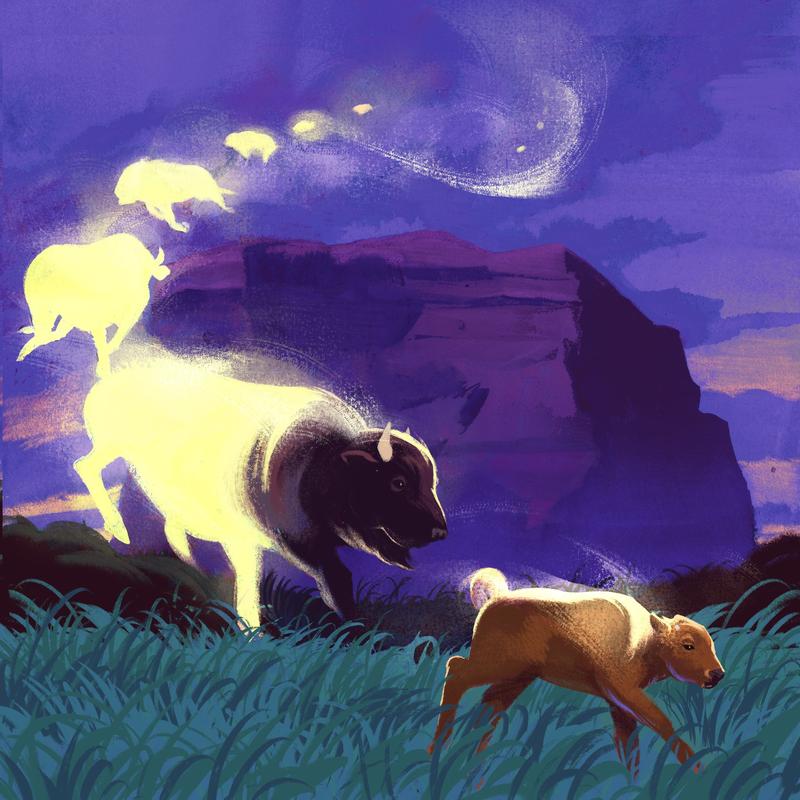
ANA: Back in the 1800s, they watched as fur trappers started killing all the buffalo. So they went out on horseback, on foot, in the dead of night, at dawn and dusk. They used their horses and their knowledge of the buffalo, and they scooped a couple calves away from the dwindling herds, ushered them off the land where they'd become targets, and brought them to safety. Eventually, they went up to Canada, where a couple dozen babies had more babies and more babies. And now, more than a hundred years later, there were hundreds! And Ervin thought, well, what if we bring them back?
ERVIN CARLSON: We went over there, and we met the lot.
ANA: This thriving herd of beautiful wild buffalo.
ERVIN CARLSON: And we visited with the superintendent there, and he was really excited about giving some of these animals to us.
ANA: But it turns out it's not so easy to bring hundreds of wild buffalo into another country.
ERVIN CARLSON: They gotta have a calfhood vaccination. Shipping, all the blood work.
ANA: They decided to make it easier by transporting only calves, baby buffalo, so they were a little bit smaller and easier to work with. So the Canadian parks officials rounded up ...
ERVIN CARLSON: Almost 90 calves.
ANA: These young, wide-eyed, fluffy buffies, horns still growing. And they led them into trailer after trailer, and Ervin and his team started the buffy caravan down south to the open plains of the Blackfeet Reservation, where they parked the trailers on the windswept grasslands and opened the doors.
ANA: And after a quick little 30-day quarantine in some pens, the calves looked out with their big round eyes and turned their giant, bearded faces side to side, taking it all in. And then? They ran! They galloped out into the grasslands.
ERVIN CARLSON: It just hit me that those calves there, they left here as calves, and they wanted to come back as calves. And it hit me that they made that happen, and all the things that I had been doing along the way, it was them buffalo that made all of that happen.
LULU: Wow! I love picturing these sweet baby buffalo returning to their ancestral homeland. But aren't they soon gonna turn into adults, like, these giant 2,000-pound horned beasts that are just freely stampeding around? Like, I'm thinking about the gardens and the farms and the playgrounds. How are people not gonna get randomly trampled?
ANA: Well, this is where Ervin's son comes in!
ALAN: Yee-haw!
ANA: One of the best horseback riders in all of Montana.
[ARCHIVE CLIP, announcer: Here we go!]
ANA: Please meet long, lean horseracing machine, Chazz Racine.
CHAZZ RACINE: My horses are looking good. I got three for the relay.
ANA: Chazz wears a bandana low over his piercing eyes, along with a brightly embroidered vest, cargo shorts and sneakers, he's almost as tall as his horses, who are painted for war. And he just so happens to be a world champion Indian relay rider.
[ARCHIVE CLIP, announcer: Looks like the teams are entering on the north side.]
ANA: Okay, so an Indian relay is basically like a regular horse race: fastest horse wins. Except in an Indian relay, each human rider has not one, not two, but three horses, and after each lap, they hop off of one and onto another.
ALAN: Just jumping from horse to horse?
ANA: Yup!
ALAN: In motion?
ANA: Uh-huh.
ALAN: That is talent.
ANA: Serious talent. Talent that could come in really handy if you had to wrangle some buffalo.
ANA: Who do you think's gonna win?
CHAZZ RACINE: Well, I'm gonna be giving her, so ...
ANA: So they're pulling the horses over, jumping off and then getting on!
ANA: I watch him zoom around the track, his chestnut horse kicking up dust as he holds onto reins with no saddles. This ain't no Kentucky Derby!
ANA: Chazz is way out front. Chazz is annihilating the competition right now. [laughs]
ANA: As soon as he makes it around the track, he flies off the horse he's riding and leaps onto another. And he does it again, faster than everybody! And then Chazz wins!
[ARCHIVE CLIP, announcer: A big round of applause for that entertaining run.
ANA: My mouth is full of dirt because I was yelling a lot.
ANA: This extreme sport goes back hundreds of years, to the time of the buffalo runners, when hunters from tribes like the Blackfeet needed to be the fastest and bravest to survive out here. And keeping the tradition alive today is part of the buffalo comeback story. It's like a renaissance, a rebirth, a resurrection of old ways that also really helps Chazz when he's working with his dad, Ervin, at his day job, which is herding the Blackfeet buffalo across the land.
CHAZZ RACINE: We move them with our ATVs or our trucks, and then we also chase them horseback, too, usually if they're in the trees and stuff. If we have some problem ones that won't come out, because a lot of times the ATVs can't get into the trees. So that's when the horses come in pretty handy.
ANA: Yeah.
CHAZZ RACINE: And those days are pretty fun. I mean, I love doing it horseback when I get to.
ANA: For almost a decade, Chazz and his buddy Sloo have been shuffling buffies through the Blackfeet Reservation, which by the way, is almost as big as the entire state of Delaware. So they cover some ground! And they've helped the herd grow from a few dozen to a few hundred.
CHAZZ RACINE: See them in the distance?
ANA: Oh, no way. That's them?
CHAZZ RACINE: Yeah, that's the herd.
ERVIN CARLSON: We got close to 700.
ANA: 700 buffalo roaming around Blackfeet lands.
ANA: That's the herd!
CHAZZ RACINE: Yeah. They're all across there. We move them around.
ANA: I see them off on the other side of the highway, like curved, black hay bales dotting the grasslands. When I got into my car, I was able to get a little bit closer to them—safely. And I saw them grazing, munching that Montana grass. I even saw one flopped on its back. Future wallow in the making! Ervin's dream of resurrecting the Blackfeet buffalo herd has come true, and each and every day these four-legged lawnmowers are helping to bring new life to the land all around us.
PAUL WEATHERWAX: Next will be, ikisaku.
KIDS: Ikisaku.
PAUL WEATHERWAX: Ikisaku. Ikisaku. That means the meat.
KIDS: Meat.
KIDS: Did they kill the buffalo?
TEACHER: Yeah, they got it. They killed it yesterday. They had a harvest.
ANA: I'm standing with a group of kindergarteners from the Blackfeet Language Immersion School in town who are watching our friend Paul, the guy who taught us about the buffalo cliff jumper, stretch out a buffalo hide. He and a bunch of other grownups are kneeling on top of it with hand tools, some of them look to be made out of buffalo bones. And they're scraping off the skin and guts of the buffalo that somebody harvested yesterday from the herd.
CHAZZ RACINE: We recruited a youth to do that.
ANA: That's Chazz again.
CHAZZ RACINE: Usually I pick out a gentleman that's hunter or he's went on hunting trips, and somebody that can handle a rifle and knows what he's doing, but still young enough, you know? And kind of give him that honoring. We had an elder come yesterday and pray, and he went out, and he shot the animal. And he went down without too much stress, so that was good. Yeah. And then everybody that was here got to take meat. So the whole community just got to take what they wanted. Yeah.
ANA: The tribe gives free buffalo meat to the elderly and people in need in the community. And here, they're smoking it in a little tipi with a fire inside. It's all part of the annual celebration of the buffalo here in Blackfeet lands. They call it Iinnii Days, because after such a long time apart, the Blackfeet are remembering how they used to rely on the iinniiwa for survival, and now the iinniiwa are relying on all of us to remember their names and keep them going strong.
ANA: Okay, how do you say "buffalo" in Blackfoot?
KIDS: Iinnii!
TEACHER: Okay. How do you say a bunch of buffalo in Blackfeet?
KIDS: Iinniiwa! Iinniiwa! [laughing]
ALAN: [singing] Run, run, you run! Run, run, you run! Run, run, you run! Like the thunder stampede! Resurrecting this wonder you hold in your fold. Run, run, you run! Stampede! Like the wind, you return to the big sky. The mountains, the meadows below! The wind whispers, the wind whispers, The soil knows your name. Hear the call! Iinniiwa! There's a wish beyond everything, a hope that remains in these valleys and calls you back home on the range. Together, this beautiful beast and protector, you answer the call. Iinniiwa! Iinniiwa! Run, run you run! Run, run, you run! Stampede! Stampede! Run, run, you run! Stampede! Run, run, you run! Like the thunder! Stampede! Resurrecting this wonder, you hold in your bones. Run, run, you run! Stampede! Like the wind! You return to the big sky, the mountains, the meadows below.
ANA: Alan Goffinski, everyone! Joined by the incredible Valerie June! Thanks, Valerie!
LULU: And there is nothing else cool about to happen. Ah! What's that?
BADGER: Excuse me, I have a question.
BADGER: Me too.
BADGER: Me three.
BADGER: Me four.
LULU: The Badgers! Listeners with badgering questions for the experts.
LULU: You ready?
ERVIN CARLSON: Yeah.
LUCY: My name is Lucy. I'm five years old, and my question is: can buffaloes, even when they're running really fast, get bitten by a snake?
ERVIN CARLSON: Yes. When they're running really fast, if they're there on the ground, I think that yes, they could get bit by a snake.
LULU: More like buffal-uh-oh, am I right?
ERVIN CARLSON: [laughs]
LEVI: Hello, my name is Levi, and I am 11 years old. How long can buffalo's horns get?
ERVIN CARLSON: I would say buffalo horns get to be, when they're full grown, they're gonna be about 12 inches or better.
ANA: Even up to two feet long!
LULU: And do all the full-grown buffalo have horns, like males and females?
ERVIN CARLSON: Oh, yeah. Male and female, they all have horns. You know, at six months they're already getting, you know, little—little nubs, yeah.
NOAH: Hi, my name is Noah. I'm 6 years old. And what things do buffalo use their horns for?
ERVIN CARLSON: Well, the biggest thing that they're gonna use their horns for is protection from predator animals. And another one is when they're—they're wallowing.
ANA: Digging horns into the ground as they flop around.
CATHY: Hello, my name is Cathy. I'm nine years old, and my question is: Why do bison have beards?
ERVIN CARLSON: Well, that's a real good question.
ANA: I think we stumped Ervin with that question! But according to the internet, the beard adds to the insulation of their faces and bodies against winter weather.
LULU: Brr! Hey, I'm Lulu. I'm 43 years old, and my question is: Is buffalo mozzarella, that cheese I love so much, come from buffalo?
ANA: I'll field this one. Okay, so you can milk a buffalo, but buffalo mozzarella is actually from a different species of buffalo: water buffalo, found in the Mediterranean, in Italy.
LULU: Huh!
ANA: And those buffalo are actually scientifically buffalo, unlike our buffalo, which are scientifically bison bison bison. So I guess if you made cheese out them, it would be bison cheese.
LULU: Hmm! Now all I want in the world is to try bison cheese.
ANA: Same. I would if I curd.
LULU: Was that a cheese curd joke?
ANA: You cheddar believe it.
LULU: Heh-heh!
JULIAN: Hi, I'm Julian Shapiro-Barnum, the host of Recess Therapy and Celebrity Substitute, I'm 27 years old, and my question is: What does a buffalo feel like?
ERVIN CARLSON: Their fur, it's not real soft, you know, but it's a little bit coarse. On the front side is real shaggy, then the back's a little smoother. And we've had a couple orphans that we had to kind of nurse them back and get them all going good and then put them back out in the herd. But so yeah, got to handle them, yeah.
LULU: And I think that is the best place to leave it, with Ervin cuddling an orphaned buffalo calf back to health. And I won't tell you how bison are more closely related to dolphins than dogs. I'll spare you that little brain buster of evolution, because I'm nice!
LULU: Terrestrials was created by me, Lulu Miller, with WNYC Studios. Today's episode was reported and produced by none other than Ana González, with sound design by Mira Buffalo-Wintonick—Burt-Wintonick. Our executive producer is Sarah Sandbach. Our team also includes Alan Goffinski, Natalia Ramirez, Tanya Chawla and Joe Plourde. Fact-checking by Sophie Samiee.
LULU: Support for Terrestrials is provided by the Simons Foundation, the Arthur Vining Davis Foundation and the Templeton Foundation. Thank you!
ANA: Special thanks to Ervin Carlson, Chazz Racine and Sloo, everyone at Buffalo Spirit Hills Ranch, the Intertribal Buffalo Council, Latonna Spotted Eagle, Cristina Mormorunni and everyone who helped organize the 2026 Iinnii Days for having us.
LULU: Oh, that sound means it's time to celebrate our August birthdays for our Explorers Club members!
ALAN: Woo-hooo!
LULU: Ready, Alan?
ALAN: You buffa-know it.
LULU: What do you like more than a buffalo, a birthday hello? Happy birthday to Arlo 1 and Arlo 2, Acacia—like a tree.
ALAN: Ada.
LULU: Bruno, Billie, Catherine, Clara.
ALAN: Clark, Diarmuis, Eleanor, Everett.
LULU: Gaia, Gideon, Graham.
ALAN: Hawk.
LULU: Heidi, Ivy, Johnny.
ALAN: Judah.
LULU: Laura, Leon, Leo, Lumen.
ALAN: Madison, Margot, and another Margot.
LULU: Morris, Margaret, Maya, Midan, Naomi.
ALAN: Nathanael, Oliver, Otto, Owen.
LULU: Ramona, Ruby, Richard, Rose, Theo, Tate, Quinn and Rowan—they are twins! Willow and Augie, born in August!
ALAN: Does that mean I shoulda been born in the month of Alan-gust?
LULU: Ha! And last but not least, a belated happy birthday to: Brooke.
ALAN: Carmen.
LULU: Dorian.
ALAN: Solomon.
LULU: Stella.
ALAN: And Xae!
LULU: I hope your day is spent wallowing in the love of your family! And if you want a birthday shout-out, and other cool perks, find out how you can join the Terrestrials Explorers Club by clicking the link in our show notes! You just click clickedy-click. That'll do it for today. See you in another spin of this dirty old planet of ours. Bye!
-30-
Copyright © 2026 New York Public Radio. All rights reserved. Visit our website terms of use at www.wnyc.org for further information.
New York Public Radio transcripts are created on a rush deadline, often by contractors. This text may not be in its final form and may be updated or revised in the future. Accuracy and availability may vary. The authoritative record of programming is the audio record.