The Snoozer: Penguin Slackerzzz Rule
[RADIOLAB FOR KIDS INTRO]
LULU MILLER: Three, two, one! Imagine you are getting sleepy.
ALAN GOFFINSKI: [yawns] Very, very sleepy.
LULU: You're fighting it!
ALAN: But your eyes start closing.
LULU: And the frosty bright whites all around you.
ALAN: Fade to dark. [snores]
LULU: Suddenly you wake up!
ALAN: Then fall back asleep.
LULU: Then wake up.
ALAN: Then fall asleep.
LULU: Then wake up.
ALAN: Then fall back asleep.
LULU: You have become ...
ALAN: A penguin that was recently discovered to take 10,000 naps a day.
LULU: How many naps a day?
ALAN: 10K!
LULU: [laughs] Now is the part where I make you sing the theme song with me. "Terrestrials. Terrestrials. We are not the worst. We are the ..."
ALAN: Most excellent-rials.
LULU: No, it's best-rials.
ALAN: Also rad!
LULU: Terrestrials is a show where we uncover the strangeness waiting right here on Earth. I am your host, Lulu Miller, here with very a special guest: Penguin.
PENGUIN: Hello!
LULU: As played by songbud Alan.
ALAN: Waddle joy to be here!
LULU: [laughs] And Penguin, you're gonna help us tell a nice cozy story for the dead of winter about the value, the power of naps!
PENGUIN: Nap-turally.
LULU: Okay, so tell us a little bit about yourself?
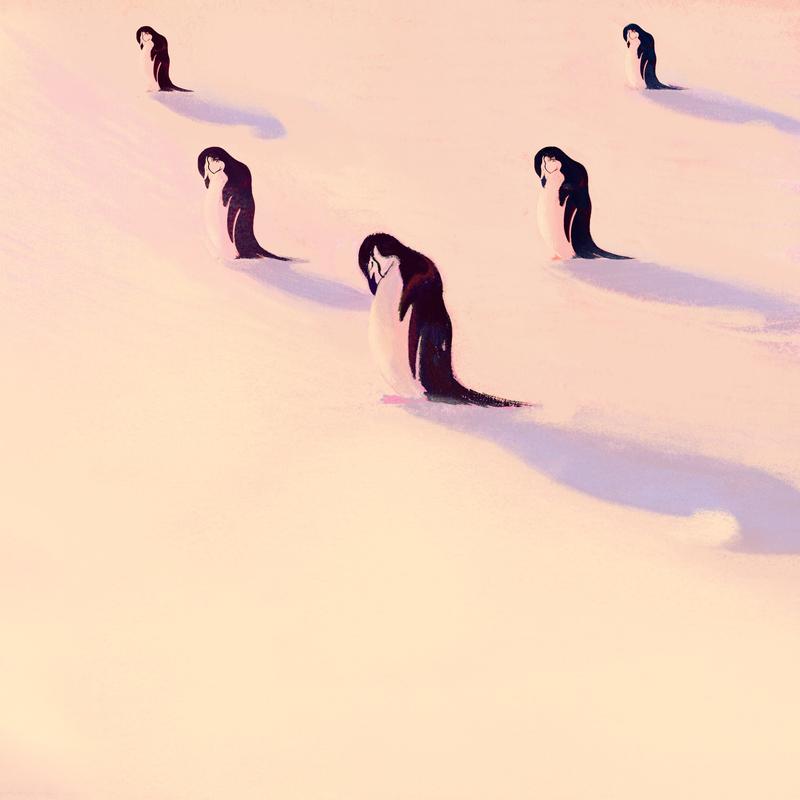
PENGUIN: Well, I'm a chinstrap penguin, which you humans call me because I have white feathers on my neck with a black line cutting through. It looks kind of like I'm wearing a black helmet with a chinstrap. But I don't really have a chin.
LULU: Yeah, I guess it is just kind of neck below that beak of yours. And you're based in Antarctica, right?
PENGUIN: Yup. But dude, sometimes my crew and I will just like hit up the coasts of Chile and Argentina. Amazing waves!
LULU: And then I guess, can I just describe for radio, you're like the height of a human toddler.
PENGUIN: You bet.
LULU: And kind of you walk funny, like a waddle.
PENGUIN: [yawns] Yeah, but that's just on land. I'm lightning in the water. I can swim, like, three times faster than your fastest human swimmer.
LULU: What? But not faster than, like, an Olympic gold medalist like Katie Ledecky or Michael Phelps.
PENGUIN: Uh, yeah! They'd be chasing my bubs, aka my bubbles.
LULU: [laughs] That is very fun to picture. Bet we are actually not here to talk about your feats of athleticism, so much as your feats of snoozeage. Because a couple years ago, you became kind of a slacker icon.
PENGUIN: Why, thank you.
LULU: When scientists figured out that you take how many naps a day?
PENGUIN: [yawns] Well, it depends on the day, but during the breeding season for us chinstrap penguins, most of us take thousands of naps a day.
LULU: That is incredible to me, because if I even think about taking one nap, I hear this inner voice scolding. It's like, "Do not give in to slumber, Lulu! Be more productive! Do not waste the daylight hours." And then if I do accidentally fall asleep during the day, then when I wake up I feel so spooked, like, "Where am I? Who am I? You know what I mean?
PENGUIN: [snores]
LULU: Penguin?
PENGUIN: [snores]
LULU: Wake up, buddy.
PENGUIN: Huh?
LULU: Can I offer you some coffee?
PENGUIN: No, I'm good. I prefer ocean water.
LULU: You can drink salty ocean water?
PENGUIN: Yeah! Thanks to this little righteous gland above my eyes that filters out the salt and then expels it with a very cute achoo! [splash]
LULU: God beak you. Okay, but how is it even possible? Like, how do you fit thousands of naps inside a day? How is that mathematically possible?
PENGUIN: 24 hours in a day, times 60 minutes in an hour, times 60 seconds in a minute, equals 86,400 seconds in a day. Meaning, you know, I can get 10,000 naps in if they're each just like a few seconds long.
LULU: Oh, okay. So teensy little naps. Like a blink of a nap.
PENGUIN: [yawns] I call them micronaps.
LULU: Micronaps. [laughs] And how did the scientists figure this out? Were they just, like camped out in your huddle watching when you blinked and counting for how long with tally marks like how many times a day?
PENGUIN: Naw, they outfitted us with electrodes that monitored our brain activity while we were just doing our thing out in the wild. And then they could literally listen in to our brain chatter and note when we were snoozing and waking up. And snoozing.
LULU: Neat!
PENGUIN: And they discovered these four-second-long naps all day and all night.
LULU: So why would you sleep like this? I mean, why not just kick back for a nice long full snooze, like us humans do?
PENGUIN: Duh! Sky pirates.
LULU: What?
[Yo ho ho and the scrappers in the sky! what do we steal? We steal while we fly!]
PENGUIN: Skuas.
LULU: Skuas?
PENGUIN: Uh-huh. S-K-U-A-S. The seabird that's basically a seagull crossed with a velociraptor.
LULU: Ooh!
ALAN: Sharp talons shooting out of its webbed feet. We call them avian pirates. They just straight up steal fish midair from other flying birds.
LULU: Mean!
PENGUIN: Yup. And their babies are even mean. Sometimes skua chicks will fight each other to the death!
LULU: Yikes!
PENGUIN: And as for the adults, can you guess their favorite snack?
LULU: Arr-ugula?
PENGUIN: Nah, bro. Baby penguins! Dun dun dun!
LULU: So the skuas want to skewer your babies and make a chicks-kabob.
PENGUIN: Lulu, how dare you make light of this? Our penguin chicks are, like, a zillion times cuter than weirdo, bald human babies. Here, let me show you a picture of my little one.
LULU: Aw, she looks like a fuzzy grey snowball with big feet! Okay, I'm sorry for my bad joke. That is a cute creature.
PENGUIN: Yeah, dude. And as soon as we lay our eggs with these sweet little babies inside, the sky pirates start circling! If we leave our eggs unattended for just a moment, the skuas will swoop in and try to get them. So we take turns guarding the eggs, keeping them warm and safe, while the other parent waddles and swims to find food. And that food-gathering parent is often gone for hours at a time, meaning if you're on baby duty it's all on you, man. You can't just pull a human and check out for, like, eight hours at a time. Your only choice is constant vigilance. Your only choice is ...?
LULU: Micronaps.
PENGUIN: [yawns] Now you're getting it.
LULU: Well, I applaud your parenting. You know what they say, "The early bird catches the worm." And "The bird that never really sleeps so can't even technically be early doesn't have its chick caught by skuas."
PENGUIN: Dude, they do say that where I'm from. It just sounds a little more like this. [squawks]
LULU: And that is why chinstrap penguins are sometimes called stonecracker penguins, because their call is so shrill it could crack stone. But I still can't really get behind the napping all the time, Penguin, because, like, sure, once in a while it's okay, but doesn't it feel like a waste of time? Like, there's something a little more important you should be doing?
PENGUIN: Wake up to the facts, Lulu! You would be nothing without your sleep.
LULU: [laughs] What do you mean?
PENGUIN: Not only does sleep wash your brains of both cellular waste and unimportant memories and information that can build up and clutter the brain, it also likely boosts immunity, regulates hormones and repairs your skin, muscles, organs.
LULU: Huh!
PENGUIN: Plus your dreams—whoa, I'm riding a narwhal to the moon!—likely help form memories of your life, and maybe even let you practice how to react better in the future.
LULU: What? Like your own little personal training session?
PENGUIN: Yup.
LULU: Neat!
PENGUIN: And there are some scientists who believe that when we penguins take our 10,000—literally 10,000—naps a day, we are living life at our peak evolutionary potential.
LULU: Why would that be?
PENGUIN: Because as we sleep, our heart rate slows, so we breathe out less carbon dioxide, making us less detectable to predators that hunt by scent. And we use way less energy, which, of course, is the fuel keeping us all alive. All of which has made these scientists reframe our constant napping from laziness to, quote, "adaptive inactivity."
LULU: [laughs]
PENGUIN: So, on behalf of my gaggle, my huddle, my cuddle puddle of other chinstrap penguins, allow me to offer you this. [clears throat] When naps beckon, but an inner voice scolds you—do not rest, your worth comes from work, work, work!—we penguins say: nap! For all the dreams that await. Nap! To lock in those memories! Nap! To increase your chance of survival. Nap! To reduce your carbon emissions! Nap! To save the planet, and above all, nap! To [snores]
LULU: [laughs] Let's give a very quiet round of flipper applause for Penguin! And when we come back ...
ERIC WAGNER: Yes, I can say very definitively that penguins have butts and they know what to do with them.
LULU: Two penguin scientists and a whole lot of badgers.
LULU: Terrestrials is back. We just heard from Penguin, the sleepy penguin who takes 10,000 naps a day, and who I think should become the new mascot for Sleepytime Tea. Move over cozy bear with a nightcap, let's put a penguin on that overstuffed armchair on the box of tea. But I digress, because—ooh, what's that?
BADGER: Excuse me, I have a question.
BADGER: Me too.
BADGER: Me three.
BADGER: Me four.
LULU: The Badgers! Listeners with badgering questions for our experts.
LULU: You ready?
ERIC WAGNER: When kids are firing questions at you, it's more stressful than, like, my PhD exams were, because they just come from everywhere.
LULU: [laughs] Sorry. Yeah, that does sound stressful, but you still down to play?
ERIC WAGNER: Sure! [laughs]
LULU: Great!
LULU: I am so pleased to introduce two very special penguin scientists, Dr. Eric Wagner ...
ERIC WAGNER: I love the penguins.
LULU: And Dr. Dee Boersma.
DEE BOERSMA: I've studied penguins for over 50 years.
LULU: Whoa!
LULU: And Dee and Eric are really special because they work in the field with wild penguins. And in just a couple days after this call, they are headed down to Argentina to a place with millions of wild penguins.
DEE BOERSMA: I don't see how you can really spend much time with penguins and not fall in love with them.
LULU: All right! Are you ready for a bunch of penguin questions?
DEE BOERSMA: Oh yeah!
ERIC WAGNER: Yeah!
LULU: Great. I would like to take the first one, which is: Have you ever hugged a penguin?
ERIC WAGNER: Absolutely.
LULU: Ah!
DEE BOERSMA: Yes!
LULU: [laughs]
DEE BOERSMA: The reason I'm a penguin biologist is I get to hold penguins.
LULU: What is that like to hold a penguin?
ERIC WAGNER: There was a time I was holding this penguin, and I had my ear kind of pressed against its back. You know, you can hear it breathing, you know, there's this kind of slow inflation of breath of, like, [breathes. And it's almost like it sounds like the ocean. So you're holding this bird that is this ocean bird that's about to go spend several months on the ocean without coming to land, and listening to its breathing, which sounds like the waves. And then underneath that is the steady thudding of its heart.
LULU: Wow! That sounds incredibly relaxing.
NINO: Hi, I'm Nino. I'm four. And my question is: How sharp are penguins' beaks?
ERIC WAGNER: Hoo boy. I guess you can kind of see my hands are covered with little scars from getting bitten.
LULU: Oh no! Ouch! So answer: Very sharp?
ERIC WAGNER: Yep.
YVE: Hi. My name is Yve, and I'm four years old. Why are penguins black and white?
DEE BOERSMA: Because they don't want to be eaten.
LULU: Oh!
DEE BOERSMA: And so if you're black on the top and a bird is flying over like a giant petrel, they can't see you because it's black like the ocean.
LULU: Oh!
DEE BOERSMA: And if you're white underneath and a shark looks up, it doesn't see you either.
LULU: Oh, because you blend into the big bright sky! That is so cleaver! It's like half and half camo!
DEE BOERSMA: Yeah, it's called counter-shading as we call it.
COLIN: Hi, my name is Colin and I'm seven years old. And here's my question: Do penguins have butts?
ERIC WAGNER: Penguin butts are pretty bulbous. You know, as a researcher who spends a lot of time holding penguins, I get pooped on a ton.
LULU: Oh no!
ERIC WAGNER: So I'm very, very familiar with butt output. And it comes in all colors.
LULU: Eww!
LULU: Apparently one color is pink. Adélie penguins eat so much of a tiny pink crustacean called krill it turns their poop pink. And they live in such big colonies that you can see this output from space.
ALAN: [sings] Pink poopy club, I'm gonna be a penguin at the pink poopy club, poopy poopy pinky poopy, pink poopy club, pink poopy club.
LULU: [laughs] Alan!
ARIA: My name is Aria Luna, from Cape Town, South Africa. I'm eight years old, and my question is: Do penguins have knees?
LULU: Yeah, do penguins have knees?
DEE BOERSMA: Yes. You've worn long skirts. Do you have knees?
LULU: I do have knees.
DEE BOERSMA: You just don't see them, do you? Their skin goes right down over their knees!
LULU: Oh, so the knees are hidden by, like, a skin skirt.
DEE BOERSMA: Yeah.
LULU: Huh! But if they do have knees, why do they walk so stiffly?
DEE BOERSMA: How do you walk with a real tight skirt on?
LULU: I don't know. I don't really wear skirts, but if I did I guess I would ...
DEE BOERSMA: You kind of waddle.
LULU: Waddle good point!
MAISIE: My name is Maisie, and I'm nine years old. Do penguins surf?
DEE BOERSMA: Yes. They surf really well. Better than people.
LULU: Really?
DEE BOERSMA: Oh yeah. And they do try to catch waves.
PENGUIN: Check me out, dude! I'm gonna ride this wave all the way to shore on my belly! Whee! Cowabunga!
STELLA: Hi, my name is Stella. I'm seven years old. Do penguins have teeth?
ERIC WAGNER: They do not. But what they do have is they have these things in their mouths called "denticles." This is gonna sound gross, but like, kind of fleshy hairs.
LULU: Oh!
LULU: That run along the roof of their mouth and tongue.
ERIC WAGNER: And they use those to catch fish, to hold fish when they catch them.
LULU: I warn you not to google the inside of a penguin's mouth unless you like nightmares. Tooth tongue!
PENNY: My name is Penny. I am six years old. Can penguins live somewhere warm?
ERIC WAGNER: So most penguins actually live in non-icy, non-snowy environments.
LULU: Excuse me?
ERIC WAGNER: Yeah. There are penguins that live up in the equator, the Galapagos penguin.
LULU: The equator! Famously a hot place!
ERIC WAGNER: Yeah, they can be quite toasty. And where I work, you know, it'll be like 85, 90 degrees.
LULU: Whoa! Wait, I feel like we've been sold a lie about penguins being, you know, snow species. I can't even picture them in hot places. How do they—how do they not totally overheat?
ERIC WAGNER: So one of the things that the species I work on does is they lose feathers around their face, so they get this kind of bare patch. And then that turns kind of pink.
LULU: Okay, like a blushing penguin? This is very cute.
ERIC WAGNER: And they pant a lot of the time.
LULU: Like a dog? They pant?
ERIC WAGNER: Yeah, you just see this penguin that's, say, sitting on its egg so it can't leave, and in the baking heat, and it's just [pants].
TAMAS: Hello, my name is Tamas. I'm six years old. I have a question: Can a penguin be friends with a human?
ERIC WAGNER: Yes.
LULU: While you can't make a penguin your friend—because it's illegal to keep one as a pet—there are some penguins out in the wild who would definitely want to make you their friend, at least according to Dee and Eric, who tell the story of one night, being out at their research station in Argentina and suddenly hearing a knock on the door.
DEE BOERSMA: And I said, "Come in. Nothing happened. And then we heard it again. And then I went to the door and opened it and there was Turbo.
LULU: Turbo. The name they gave to a penguin! A wild penguin! They figured he must have been knocking on the door with his beak.
[knocking]
DEE BOERSMA: And so I said, "Come on in, Turbo." And he came in and walked around, and he particularly liked to go underneath chairs and underneath the beds where he was well hidden.
LULU: Just checking out your home?
DEE BOERSMA: And then when he wanted to go out, he'd walk up to the door and we'd let him out.
LULU: Was he coming in for food?
DEE BOERSMA: We never fed him, so there was really no reason why he'd want to spend time with us.
LULU: Other than that maybe, she thinks, he liked their company!
DEE BOERSMA: I mean, we'd be working in the colony.
ERIC WAGNER: [laughs]
DEE BOERSMA: And you'd look up and there's a penguin coming towards you. And penguins don't normally come towards you. They should be afraid.
ERIC WAGNER: Yeah.
DEE BOERSMA: But we knew immediately, oh gosh, it's Turbo. And he'd come right over.
ERIC WAGNER: Yeah. And it was this little, you know, kind of "hello friends!" kind of, you know, man about town sort of way to Turbo.
MIRA: Hey, my name's Mira. I'm 41 years old. What kind of sound does a penguin make?
ERIC WAGNER: Oh golly!
DEE BOERSMA: [display call]
ERIC WAGNER: Yeah, that's—they have a lot of calls. Dee just did a very excellent rendition of an ecstatic display.
LULU: Which is apparently fancy speak for what they do when they're trying to attract a mate or when they're trying to shoo people away from their nests.
ERIC WAGNER: And she did the vocal part. There's a visual part to it, too, where they're standing, they have their flippers splayed, their bill is up to the sky and they're kind of just yelling at the heavens.
[penguin calls]
LULU: How neat! All right, so we started the episode with chinstrap penguins who take thousands of these little tiny micronaps—boop boop boop—a day. The penguins that you study, Magellanic penguins, do they do the micronapping thing?
DEE BOERSMA: That's what we're studying now!
ERIC WAGNER: They kind of close their eye and they seem to nod off, and then something happens, they hear a sound and they kind of pop awake.
LULU: [laughs]
ERIC WAGNER: Like nodding—pop! Nodding—pop! Nodding—pop.
LULU: [laughs] Okay, so the official scientific answer is the pop and nod.
ERIC WAGNER: [laughs] Yeah!
LULU: Okay, but what about when they are out in the water, because some penguin species can be out in the ocean for, like, months at a time during migration, right?
ERIC WAGNER: Yep.
LULU: So are they sleeping when they're out in the ocean?
DEE BOERSMA: Oh yeah. They close both eyes, or they close one eye and they can sleep really quite soundly.
LULU: I sleep with one eye open!
DEE BOERSMA: And in many cases, the penguins actually put their flipper over their bill.
LULU: [laughs] Like a little flipper sleeping mask?
DEE BOERSMA: Exactly.
EZRA: Hi. My name is Ezra, and I am four and a half years old. If penguins dream, what would they dream about?
ERIC WAGNER: Um, flight.
LULU: Oh!
LULU: Well, that brings me to our final, and most asked, question from listeners.
EVIE: Hi, I'm Evie.
SIMON: My name is Simon.
JACK: Hi, my name is Jack.
EVIE: Why don't penguins fly?
SIMON: Why can't penguins fly?
JACK: Why?
DEE BOERSMA: [laughs] No, they do fly. They fly through the water.
LULU: Dee is sort of kidding here, but sort of not. Penguins are, of course, birds. And they descended from a creature long ago that could fly. And scientists don't know exactly what that penguin ancestor looked like, maybe a little bit like an albatross, one of those magnificent diving seabirds. But at some point about 60 million years ago, that flying seabird gave birth to a chick that looked a little different. Maybe its wings were a little shorter or more rigid, something that gave it an edge underwater and let it swim faster or dive deeper to catch more fish or krill or whatever.
LULU: And then that bird had chicks with similar differences—shorter more rigid wings, and those chicks had chicks and those chicks had chicks, and other body differences occasionally popped up like more blubber that insulated it against icy water, or dense instead of hollow bones that let it dive even deeper, until eventually that lightning fast swimmer we call the penguin was born.
LULU: And it couldn't fly, because in a way, it had exchanged its wings for flippers. But what's so cool is that when you watch a penguin swim, you can see what it used to be: an airborne bird. The memory of its wings still flap and its body soars in a blue that is not sky. And evolution is on display. The story of who it was, and where it came from, still alive in who it is today.
ALAN: [sings] It's time to take flight/Now take a deep breath. Because when these feet leave the ice/We'll be plunging to the depths. The wind is a stranger/That's no lie. Because the ocean's wide open/And the water's my sky.
ALAN: [sings] In my sleep these dreams flood over me/Feel the water rush my wings. Rest for the moment, wake to the coldness/Dive down deep. We are soaring through the sea.
ALAN: [sings] Wake up, don't sleep for too long.Wake up, don't sleep for too long. Gotta keep each other safe now/Keep a lookout. Break free.
Break free/We are soaring through the sea.
ALAN: [sings] Ice can't slow us down/We're wide awake now. We are soaring through the sea.
LULU: Alan Goffinski, everybody. And that's where we'll leave it. And I won't tell you that certain species of penguins have been known to sometimes put bones in their nests. Lullaby and goodnight, please don't have a fright because there is a skull in your crib, my sweet baby! I won't tell you that because I'm nice! Terrestrials was created by me, Lulu Miller, with WNYC Studios. This episode was produced by Ana González with sound design by Mira Burt-Wintonick. Sarah Sandbach is our executive producer. Our team also includes Alan Goffinski, Tanya Chawla and Joe Plourde. Fact-checking by Sophie Samiee.
LULU: Support for Terrestrials is provided by the Simons Foundation, the Arthur Vining Davis Foundations and the Templeton Foundations. Thank you! And friendly reminder that we've got an Instagram popping off with videos and fun facts. You can follow us there @TerrestrialsPodcast. And also, if you just want Alan's songs, you can go to Spotify and look for "Terrestrials: Just the Songs." And you don't even have to listen to me talk, but sometimes you have to listen to me sing because sometimes I join on the songs.
LULU: Anyway, we have some very pressing business to get to at the end here, which is to shout some birthdays! Happy birthday to our Explorer's Club members with February birthdays. If you want to join the Explorer's Club, head on over to Terrestrialspodcast.org/join. All right, here we go.
LULU: Happy birthday to Sam, Aida, Mia, Mena, Guthrie, Fiona, Will, Ann, Neko, Luka, Ezra, Bernie, Iris, Abe, Valencia, Jude, Kay, Elliot, Anderson, Ann-Marie, Will and Zoe. Happy birthday! I hope it's a great one, and that you eat so much pink cake you'll have to go join the penguins over at the ...
ALAN: [sings] Pink poopy club. I wanna be a penguin at the pink poopy club. I'm gonna be a penguin at the pink poopy club. Ooh, poopy pinky, pinky poopy. Pink poopy club. Pink poopy club.
LULU: [laughs] All right, friends. Get outta here. We're going, too. See you in a couple spins of this dirty old planet of ours. Bye!
-30-
Copyright © 2026 New York Public Radio. All rights reserved. Visit our website terms of use at www.wnyc.org for further information.
New York Public Radio transcripts are created on a rush deadline, often by contractors. This text may not be in its final form and may be updated or revised in the future. Accuracy and availability may vary. The authoritative record of programming is the audio record.