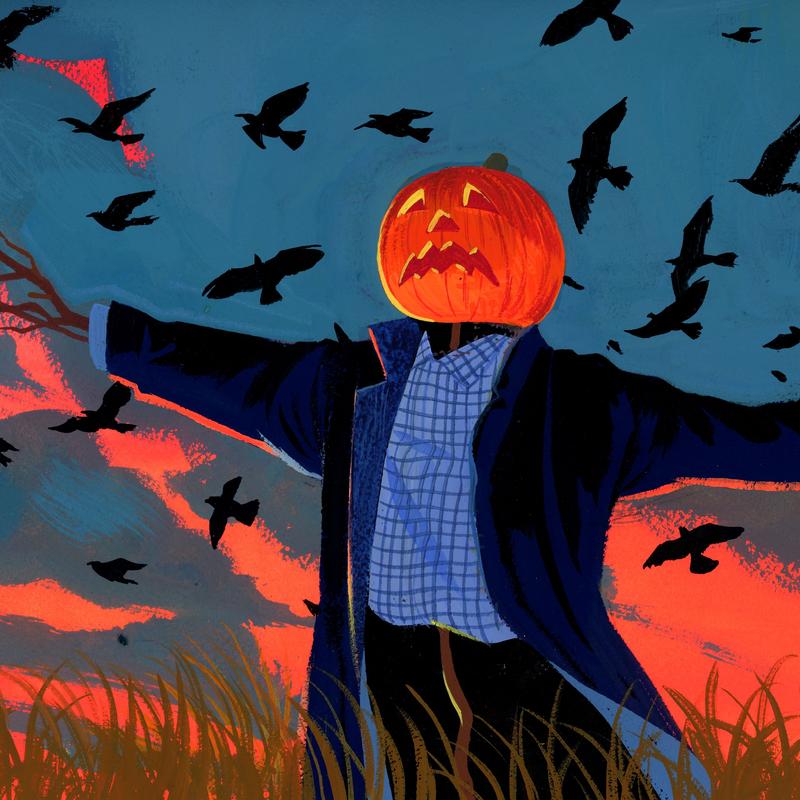
The Scarecrow: Scaring Birds with Mary Roach
[TERRESTRIALS INTRO]
LULU MILLER: Three, two, one! Imagine your brain—fwoop!—disappears, and your arms turn into sticks—pop, pop!—and your insides fill with straw, and somebody throws a very loose shirt over you and a floppy hat on your head, and they stick you onto a pitchfork.
ALAN GOFFINSKI: Oh!
LULU: You have become ...
ALAN: A scarecrow. Awoooo! Booo!
LULU: I really got scared there, Scarecrow. Now is the part where I'm gonna make you sing the theme song with me. "Terrestrials, Terrestrials, we are not the worst, we are the ..."
ALAN: I have no guesses today, because my head is filled with hay.
LULU: [laughs] All right, Scarecrow, I'll tell you. "Bestrials."
ALAN: Oooh, rhymey! [laughs]
LULU: Terrestrials is a show where we uncover the strangeness waiting right here on Earth. I am your host, Lulu Miller, joined as always by my song bud ...
ALAN: If I only had a brain ...
LULU: ... Alan, who is playing our Scarecrow today.
ALAN: I have wind in between my ears.
LULU: [laughs] And today, we're doing something a little different. Think of it as a sort of bonus, or a companion piece, to last week's episode on crows that is about how to scare crows and other birds, which will turn into a meditation on fright itself—and particularly a strange and mysterious fright that unites us with our feathered friends. And the reason the Scarecrow is our star for today's episode ...
ALAN: [laughs]
LULU: ... is because it turns out the Scarecrow isn't just a dopey character in The Wizard of Oz. The Scarecrow, or more broadly, the pursuit of scaring crows and other birds, has long been a key battleground for human civilization.
ALAN: I didn't realize that.
LULU: I didn't either, until I talked to Mary Roach.
ALAN: The Mary Roach?
LULU: The Mary Roach! Scarecrow, I love that even though you don't know much, you know her!
ALAN: I mean, she's only one of our national treasures, one of the greatest science writers alive, author of books with titles that even I can understand, like Stiff, Bonk and Fuzz.
LULU: [laughs] Yeah, and it was actually in Mary's book Fuzz, about animals coming into conflict with human society, that she writes about how birds were one of the biggest enemies to the human invention of farming.
MARY ROACH: There's a very long history, very long and sometimes entertaining history of techniques to frighten away birds.
LULU: And to tell it, Mary is going to lead us through a sort of haunted corn maze full of scary robots and lasers—pew pew!—and terrifying assemblages of sticks and hats.
ALAN: Watch out! My absolutely real arms will get you!
LULU: So buckle up your overalls, and consider this your front-row seat to a sensational spooky showdown: humans versus birds!
ALAN: Boo! [laughs]
LULU: All right, so circling around this virtual campfire to listen to Mary tell her scarecrow tale ...
MARY ROACH: Hey, I've just eaten a cheese stick.
LULU: ... is not just you and me, but also ...
LATIF NASSER: Hey, sorry I'm late.
LULU: ... co-host of adult Terrestrials, aka Radiolab, Latif Nasser.
MARY ROACH: Hi, Latif.
LATIF: Hi!
LULU: Latif, what are you gonna be for Halloween this year?
LATIF: Oh, man. I don't have a costume yet. Usually I end up with the same last-minute costume, which is I put on green pants, green shirt and sunglasses, and then I just duct tape a sign to my chest that says "chlorophyll."
LULU: Ha!
LATIF: Pretty good, right?
LULU: Very cool! Or should I say hot, because you're spending all that time soakin' up the sun. Anyway, okay. Speaking of sun, our story today begins in a sunflower field.
MARY ROACH: Say you're a sunflower farmer.
LATIF: Hmm.
MARY ROACH: In North Dakota, and you have vast fields of birdseed. Well, big flocks migrate right overhead. They come down, they eat a lot of birdseed. This is a problem for the sunflower farmer.
LATIF: This is the biggest buffet for them that they could possibly imagine.
MARY ROACH: Exactly.
LULU: And Mary explains this isn't just a problem for a random sunflower farmer out in North Dakota. It's about the food we all need to put in our bellies! See, once we humans began setting up farms and orchards and groves to grow delicious grains and fruits and nuts to eat, and help our communities grow ...
MIRA BURT-WINTONICK: Tweet tweet, ooh, that looks tweety tasty! I could use a tweet little snack.
LULU: ... we began attracting birds by the thousands, who also wanted to eat those things. And thus, an epic interspecies battle was born.
ALAN: Entering the ring on our left, it's humanity, who wants to set up farms! And on our right, it's the birds, who want to eat the things growing on the farms—berries and corncobs and seeds, oh my! May the showdown begin!
MARY ROACH: Birds cause a lot of problems in agriculture by coming in in huge flocks.
LULU: Oof, get out of here! But turns out scaring away birds? Not as easy as it sounds!
MARY ROACH: It's pretty easy to scare away birds, but to keep them away is tough.
LATIF: Hmm.
MARY ROACH: And something like a scarecrow, for example ...
LATIF: Right, I feel like that's the 1.0.
LULU: Yeah, is that where the history begins? Like, guy puts shirt on stick?
MARY ROACH: Yes. It's shirt and then on sticks and a hat.
ALAN: Boo! Did you hear me? I said boo! I am very menacing.
MARY ROACH: That is hilarious to me because not only does it not really scare—I mean, it may scare them for about 20 minutes, but ...
LULU: Yeah.
MARY ROACH: ... they very quickly realize, "That's some sticks with a shirt and a hat. That's not a threat to me at all."
ALAN: Round one goes to the birds! Yeah, I guess my stick arms aren't that scary.
MARY ROACH: And what it—sometimes what happens is that the birds fly—you know, birds migrating, going by, like they're like, "Hey, there's a scarecrow. Guess what that means?" You know, it's like the Bob's Big Boy.
LATIF: [laughs]
ALAN: Look, guys! A scarecrow! Food is that way!
MARY ROACH: Yeah. Let's pull off the highway here and have ...
LATIF: Right.
MARY ROACH: ... something to eat. And all the things that have been tried—loud noises, bright, shiny spinning things, like fake owls, taxidermied hawks, all of these things, same thing, they figure it out.
LATIF: Hmm.
MARY ROACH: They've done experiments where they, like, put out a super realistic bird of prey that would—that would specifically go after this small bird. And they set it up, and they see how long did that keep the little birds away? Well, the answer is like five to eight hours.
LULU: Wow!
MARY ROACH: And then they're like, they figure it out. They call your bluff.
LATIF: Wow!
LULU: So those—do those not really work at all for any bird? Like, my neighbors have those owl—like the fake owls over their vegetable garden.
MARY ROACH: They—they—no, they don't work very long. You can look up pictures of the fake owl with a bird sitting on top of it.
LULU: Yeah.
ALAN: Put a bird on it!
LULU: [laughs]
MARY ROACH: They work for a little while.
LATIF: Yeah.
MARY ROACH: And then they totally stop working, because the birds, they figure it out.
ALAN: Round two: humans trying to scare birds with stuffed statues of bigger, predator, bird-eating birds? Also goes to the birds! Yeah, birds!
LATIF: Because it's just the fact that it's not moving? Is that the thing?
MARY ROACH: Even if it's moving. I mean, there are, like, animatronic things that people have tried.
LULU: Robot-y beasts with moving arms.
ALAN: I'm scary!
MARY ROACH: There's some bear with, like, flashing eyes.
LULU: Robotic falcons that can fly!
MARY ROACH: Devices that play sounds, like distress or alarm calls of birds.
LULU: Ahoo!
MARY ROACH: Right, right.
LULU: Stay back! Ahoo!
LATIF: Scary. Yeah.
MARY ROACH: Yeah. They just—they don't work for very long. The animals are smarter than we think.
LULU: That is, until a guy in Ohio accidentally stumbled across something that terrified birds for months on end!
ALAN: Was it me? Wearing my Mothman costume?
LULU: It was not!
ALAN: Oh!
LULU: But if that's any consolation, I think that would scare me.
ALAN: Hay! That makes my day.
LULU: I see your hay pun, dude with no brains. That's pretty clever.
ALAN: Aw, shucks! Get it? Like corn?
LULU: [laughs] Anyway, keep those ears peeled.
ALAN: Like an ear of corn?
LULU: You got it.
ALAN: [laughs] Puns is fun.
LULU: Yeah, so keep your ears peeled to find out what works to scare birds away—and keep them away, after this short break.
LULU: Terrestrials is back, and we are in the middle of our spooky Halloween month. Last week, we talked about crows, and this week we are talking about how to scare crows—and other birds. And spoiler alert: it is not scarecrows!
ALAN: Doo doo doo doo doo doo wah!
LULU: [laughs] And before I reveal what scientists discovered does work, permit me a brief personal digression that will seem random but will tie together by the end like a straw hat being tied onto a straw head in a neat little bow.
ALAN: Mm-hmm.
LULU: Okay?
ALAN: Okay.
LULU: Great. So okay, a thing about me is I love scary things—scary movies, scary stories, Halloween. Ask me about some of my costumes. I've been a terrifying zombie bride, a vampire dripping with very realistic blood. Mwa hah hah! A scary scarecrow! No, truly. I put a burlap bag over my head, and a floppy hat and overalls, and my wife did the same thing. And we slumped on chairs, and when kids would walk up to the house to trick or treat, we'd jump out. And we made some of them cry. And so we stopped doing that. I'm very sorry, children of Charlottesville in 2015. But this is just how I am. As a kid, I was the one at sleepover parties making up stories about the ghost outside the window, making cracks and bangs and freaking everybody out.
LULU: I don't know why I am this way, but that doesn't mean I actually like being afraid. It's just that zombies and ghosts and monsters don't scare me, because I don't personally believe they are real. What does scare me is getting on a stage in front of a lot of people, not being sure how the audience will react. In the weeks before a live event, I am a wreck! I have trouble sleeping, my digestion gets all weird. Ugh! Moving to a new city scared me. When we moved to Chicago, I was so scared. I remember driving the car those 13 hours, my son in the backseat, all of our stuff packed up, turning the corner and seeing those tall buildings of Chicago and feeling my face go gray, wondering how was I gonna find my place here?
LULU: All these things I think we can group under the fear of not knowing how things are gonna work out—uncertainty, confusion. This big amorphous thing, not knowing, that personally is the thing that scares me most, and according to many neuroscientists, scares most humans, and is even a feeling we hate more than pain. We will choose the certainty of pain over the uncertainty of not knowing whether or not pain might be coming. It's so weird!
LULU: So anyway, just keep the notion of that confusing fear of confusion and uncertainty in the little front pocket of your overalls, and join me now in an open field in the middle of America, in Ohio, not too far from Lake Erie. It's the 1990s, and we meet a guy.
MARY ROACH: Tom Seamans, who works for the National Wildlife Research Center.
LULU: And Tom's job is keeping birds away from places like airports, where they could be a hazard. And it's hard work.
ALAN: Scram!
LULU: The birds keep coming back in these big flocks. And then one day Tom's passing by some communication towers where normally tons and tons of vultures like to roost. But on this particular day, he notices there are no vultures roosting.
ALAN: How odd!
LULU: And when he looks closer, he realizes there is a dead vulture way up high on the structure.
MARY ROACH: And it got hung up. Somehow, it ended up hanging from part of the structure.
LATIF: Oh, like by accident.
MARY ROACH: By accident, yeah.
LULU: And this guy Tom sees it ...
MARY ROACH: And he's like, "I'm not climbing that tower to get a dead vulture." And he left it there. And from that day forward, no vulture came to roost there.
LATIF: Wow!
MARY ROACH: And it—it was very effective, and he's like, "Hmm, I don't know."
LULU: He wondered: Could I reproduce this so that I could learn how to scare birds away? So he started running some tests.
MARY ROACH: First he tried just laying out a dead vulture, to see if that would deter them, and that didn't work. It had to be hanging.
LULU: Because, like, the first thought was just like, ooh, smelly dead of our kind. That's probably ominous. Like, was that the first thought he had, just that the death alone was the deterrent?
MARY ROACH: Yeah, just that okay, here's a dead bird. So that would suggest to the bird, "Oh, don't hang around here." Exactly.
LULU: Right.
LULU: But dead bird lying on the ground? Didn't work.
MARY ROACH: No, didn't care.
LULU: Was it the spinning?
MARY ROACH: No.
LULU: Maybe it was the smell of death.
MARY ROACH: No.
LULU: Tom found he could scare the birds away even if he used a fake bird, which some people call an "effigy," which is a fancy word for a little stuffed model of a thing, as long as that bird effigy was ...
MARY ROACH: Hanging upside down with the wings flopped out and spinning.
LULU: Weird!
LULU: And word started to spread among farmers, among people hoping to keep birds away from trash or from airports, anywhere birds were causing problems. And people?
MARY ROACH: They started talking. This seems to work.
LATIF: Hmm.
MARY ROACH: And nothing works, so it was—it's very—you have to understand, for centuries, people have wanted a way to keep birds away that works, and works for more than a few weeks. So to stumble onto something like this ...
LULU: An upside-down, twirling fake or real dead vulture.
MARY ROACH: Even though it's kind of weird and macabre, it was very exciting. This seems to keep birds away.
LULU: And really keep birds away. Researchers did studies, and found that at least for big birds like vultures and gulls ...
MARY ROACH: Within nine days of hanging an effigy, the birds stayed away as long as five months.
LATIF: Wow!
LULU: I mean, that's a game changer. That's a whole season of crops.
MARY ROACH: Yeah, yeah.
LULU: So the US Department of Agriculture started offering a manual to farmers of how to make their own effigies—DIY fake dead spinning vulture thingies. And companies popped up that started selling them.
ALAN: Better than a fake owl! Better than a scarecrow!
MARY ROACH: The effigy seems to work far longer.
ALAN: Whoa! Looks like this third round of humans versus birds might be finally turning in humans' favor. Yeehaw!
MARY ROACH: And—and of course I asked why.
LULU: So Mary asked the scientists, who have spent countless hours studying these things, stringing them up, watching birds jump away from them and stay away from them, why is this the thing that works? And the only answer she could get out of people was that they don't know. They are totally confused by it. And so Mary's best guess is that that is the answer: It is confusion itself scaring away the birds.
MARY ROACH: It's confu—yeah, it's confu—yeah, it's confusing. I mean, it ...
LATIF: Death seems like—I mean, like, a dead one of your own seems like, that's a visceral thing. Like, seeing a dead of your own.
MARY ROACH: But in that case, then the—then just the dead vulture lying down would have worked. And that doesn't work.
LATIF: That's true. That's true. That's true.
MARY ROACH: Yeah. I mean, they—the people who study this, if you ask them, they'll be like, "Yeah, that's the only answer we have."
LATIF: Hmm.
LULU: It's confusion.
MARY ROACH: It doesn't compute. And the fact that it's really strange and it's upside down and it's—yeah, it's not—it's not just the deadness, it's the upside down ...
LATIF: Hmm.
MARY ROACH: ... and the wings sticking out, and maybe moving in a way that birds never move. Yeah. It's "What is that?" And something about confusion is a threat in and of itself.
LULU: Hmm.
LULU: This story has stuck with me over the years. I think at first I loved it, picturing the birds just like me, united in our fear of the unknown. But over time, as the world, and the bird effigy, turned, I grew frustrated. Why? Why do we all have to be so afraid of that which we can't know? Why is uncertainty and confusion so scary to so many of us, human and animal alike? Even though it is a force that absolutely rules our lives.
LULU: And so I started reading about it, and I found this small world of scientists peering at the shifty, twirling, confusing force of uncertainty, and uncovering the surprising positive effects it can have on us. Like, there was this one study where scientists showed people really confusing, disorienting, surreal stories, and found that when they read those stories, they would perform better on tests for pattern recognition. Like, your brain gets this little—bloop!—charge up. And similarly, when you can't quite remember the name for an idea, when it exists in that confusing realm outside of a clear, orderly name for it, your understanding of the idea itself, the meaning of it, actually stays more active, more clearly remembered in your mind—bloop, bloop! There does seem to be this hidden power in confusion, in uncertainty. If you can brace through the discomfort, it seems to almost supercharge your mind to notice the world, to be more awake.
LULU: Okay, so last thing. Last week we did a whole episode about crows in particular, and how smart they are, so I need to know, does this modern-day scarecrow, this confusing, powerfully scary vulture effigy thing, does it also scare crows?
MARY ROACH: Um, no. They get used to it.
LULU: [laughs]
LULU: It turns out that crows, this clever species of bird that, like us, can use tools and count and speak, looks like this might be a domain where they outperform us, where they are clever enough to not be so scared of the unknown. So this spooky season, I leave you with three choices. Number one: obey your fear, cower at the unknown. Number two: harness your fear, let it activate your alertness to the world all around you. Or number three: make like a crow and let it go!
ALAN: [sings] Freaky freaky thing called fear. That freaky freaky thing called fear. Ha! That freaky freaky thing called fear. It slithers down, down, down. It slithers down. It makes your stomach queasy. Hypnotized by my fright. Ooh, creepy creepy! I'm freak freaking out. What are you so freaked about? Ooh, what's so creepy creepy? Giving me the heebie-jeebies. Hypnotized. Fear has got a hold of me. Ha! What are you so scared about? Ooh! Why so freaky freaky? Hypnotized! Terrified! Eek! I'm squealing loud! Hypnotized! Who would I be? What would I see without that freaky freaky thing called fear? Ha! That freaky freaky thing called fear. Now check it! Fear can keep me safe. Fear can be a friend to me. But if I let it get the best of me, I'm gonna be hypnotized! Terrified! Eek! I'm squealing loud! Hypnotized! Who would I be? What would I see without that freaky, freaky thing called fear? That freaky, freaky thing called fear!
LULU: Alan Crow-finski, in harmony with Jo Crow-gatz—Strogatz. Ah, should I go as a vulture effigy this year for Halloween? I mean, I would apparently scare all the local birds except for the crows. How would I do it? I guess I could dress as a vulture, have wings but put the vulture feet on my head and the head near my belly, and just spin around a lot. I don't know. Should I do it? Let me know in the comments. Vote yes or no, or suggest another costume. Or tell me what you're gonna be.
LULU: No badgers for today, but I will tell you that Mary Roach has a new book coming out in paperback, called Replaceable You: Adventures in Human Anatomy, that's all about how science is replacing more and more of parts with prosthetic limbs, frog skin grafts, all kinds of cool sci-fi stuff that is, in fact, just sci and not fi—it is not fiction, it is all real.
LULU: Terrestrials was created by me, Lulu Miller, with WNYC Studios. This episode was produced by Tanya Chawla with sound design and editing by Mira Burt-Wintonick. Our executive producer is Sarah Sandbach. Our team also includes Ana González, Alan Goffinski, Joe Plourde and Natalia Ramirez. Support for The Terrestrials is provided by the Simons Foundation, the Arthur Vining Davis Foundations and the Templeton Foundation. Thank you! Enjoy the spooky season, and see you in a couple spins of this ever-confusing, ever-spinning, ever-changing old planet of ours. Bye!
-30-
Copyright © 2026 New York Public Radio. All rights reserved. Visit our website terms of use at www.wnyc.org for further information.
New York Public Radio transcripts are created on a rush deadline, often by contractors. This text may not be in its final form and may be updated or revised in the future. Accuracy and availability may vary. The authoritative record of programming is the audio record.