The Night Flyer: How Bats sPOOkily Revive Forests (Replay)
[TERRESTRIALS INTRO]
LULU MILLER: Three, two, one! Imagine twilight descends, and you open your mouth to let out ...
ANA GONZÁLEZ: High pitched pulses.
LULU: That guide you as you're ...
ANGELO SOTO-CENTENO: Exploring the world.
LULU: From your back, you sprout massive wings. But not like a bird, more like ...
ANGELO SOTO-CENTENO: Como un dragon.
LULU: A dragon! And you spend the night prowling for unsuspecting victims. But as the sun begins to rise, you rush home ...
ANGELO SOTO-CENTENO: you stretch your wings.
LULU: And wrap them around your body until you fall asleep upside down. You have become ...
ANGELO SOTO-CENTENO: A bat!
LULU: Now is the part where I make you sing the theme song with me! "Terrestrials, terrestrials. We are not the worst. We are the ..."
ANGELO SOTO-CENTENO: Bestials?
LULU: "Bestrials." You got it!
ANGELO SOTO-CENTENO: [laughs]
LULU: Terrestrials is a show where we uncover the strangeness waiting right here on earth. I'm your host Lulu Miller, joined as always by my song bud!
ALAN GOFFINSKI: [singing] Bat to the bone!
LULU: Alan. And my producer bud ...
ANA: What's up?
LULU: Ana. And you are bringing us a spooky story about this spooky creature who flies just out of sight of humans in the dark night, stealthily making the world a better place?
ANA: Uh-huh! And here to help me tell the tale is ...
ALAN: [singing] Na na na na na na na na Batman!
ANGELO SOTO-CENTENO: Because I study bats. [laughs]
ANA: Okay, it's not undercover superhero Bruce Wayne. It's actually Angelo Soto-Centeno, a Puerto Rican scientist now living in New York City. And he's not The Batman, but as a guy who catches bats for a living, has studied bats for over 20 years, and has an arm full of bat tattoos ...
ANGELO SOTO-CENTENO: That is true.
ANA: I'm gonna call him a batman.
ANGELO SOTO-CENTENO: You gotta do what you gotta do.
ANA: And this boricua batman grew up fascinated by bats. As a kid, he would hear them rustling in the trees outside of his bedroom window, and he wanted to find out what they were doing out there under the cover of darkness. So he started poking around for bats—literally!
ANGELO SOTO-CENTENO: There was a little creek that had this little cavern, and inside that cavern, there was a roost of this Jamaican fruit bat. I would go in there with a stick and just try to poke him and just to make him fly out.
ANA: Wait, but wasn't that, like, scary? Were you scared at all?
ANGELO SOTO-CENTENO: No. Many people may be afraid of the dark. I'm definitely not.
ANA: And now, as an adult, Angelo studies all kinds of bats.
ANGELO SOTO-CENTENO: We got red bats and we got free-tailed bats, big brown bats, horseshoe bats.
ANA: And pollinator bats with long tongues like hummingbirds.
ANGELO SOTO-CENTENO: And we got little myotis bats, leaf-nosed bats, flying foxes—they look like puppies. And they're beautiful. They look like a little chihuahua.
ANA: But the star of today's show is ...
ANGELO SOTO-CENTENO: Stenoderma.
MIRA BURT-WINTONICK: Stenoderma!
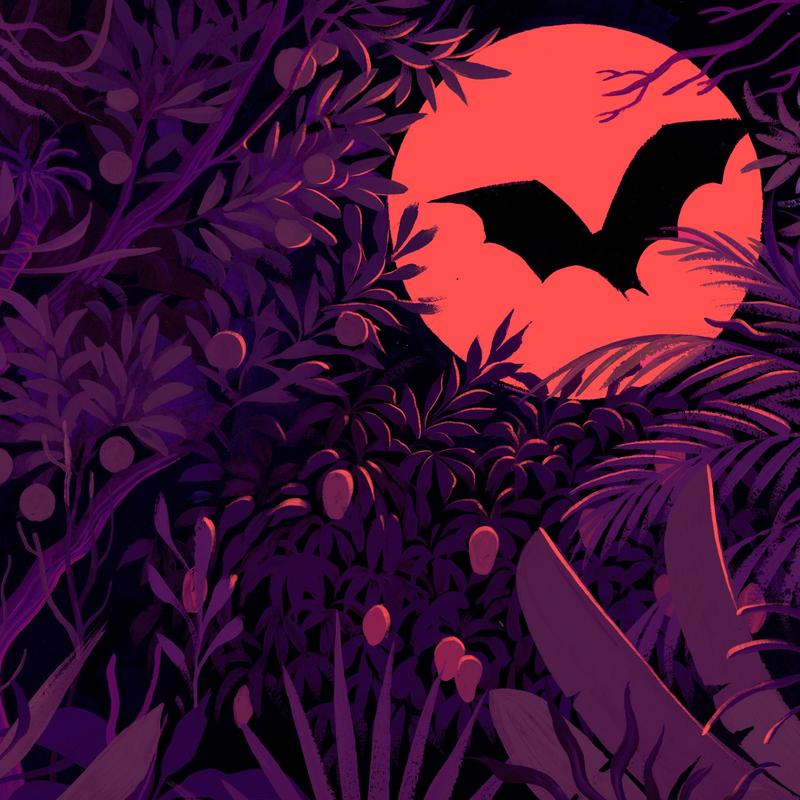
ANA: Stenoderma means "thin skinned." It's a bat with somewhat see-through wings, short reddish fur, big pointy ears that almost look like devil horns. It has beady eyes and a long pointy pig snout that stretches up towards its forehead. It has sharp fangs, and with its wings stretched out it looks like Dracula!
ANGELO SOTO-CENTENO: Stenoderma is maybe not for everybody, but I think it's—it's actually quite a cute bat.
ANA: Hmm, agree to disagree, Angelo. But he tells me that behind that creepy face, stenoderma holds something gentler, and something crucial for humanity: the ability to repair the planet after some of the most powerful natural disasters ever: hurricanes!
LULU: Bats?
ANA: Mm-hmm. And we'll get there, but first we need to wade deep, deep into the darkness of the forest.
LULU: Huh! Do I hear you actually going in there?
ANA: Mm-hmm.
LULU: Sounds scary!
ANA: Don't worry. I have a headlamp and a whole team of batmans.
ANGELO SOTO-CENTENO: Hola, Andre. Buenas tardes.
ANA: I'm tiptoeing through the woods of a small farm, a finca, in the town of Dorado, Puerto Rico. The chickens and dogs and horses have all gone to bed, and now is the time when the creatures of the night take over.
ANGELO SOTO-CENTENO: Mira, mira la sala.
ANA: Oh, wow!
ANA: Flying over our heads are dozens of winged silhouettes of bats crossing the sky, lit by the moon between trees. The batmen I'm here with are bat scientists and bat enthusiasts. And they keep telling me not to be scared.
WILKINS OTERO: No se esté.
ANA: But I can't help but feel a little freaked out as they swoop around the trees over us in their chaotic way. Because I've never really seen a bat. Not up close. I've been told to stay away from them. I've only heard bad things, like they're rats with wings, they drink blood. They want to bite me. And it feels like these ones might fly right into my head.
WILKINS OTERO: Yeah, yeah, yeah.
ANA: But then at the bottom of the hill ...
WILKINS OTERO: Yes!
ANA: ... we catch one.
ANA: Whoa!
ANA: In a huge net that these batmen have set up between the trees. The bat is all tangled up in the threads until a scientist named Wilkins reaches in with a gloved hand and gently untangles its furry little body.
WILKINS OTERO: [[translated from Spanish] This is an insect-eating bat, a big brown bat.]
ANA: This species may be called big brown bat, but it fits in the palm of his hand. And then he invites me to touch it.
ANA: Oh!
ANA: It is so soft.
ANA: I'm touching the wing. Oh!
ANA: Up close I see how adorable it is.
ANA: So delicate.
ANA: This creature that's the only mammal that flies, with its perky ears and a fuzzy little body. It's not like a rat at all.
WILKINS OTERO: Parece un perrito. [[translated from Spanish] It looks like a little dog. It's a very beautiful bat.]
ANA: Not only does it look like a dog, it is actually more closely related to dogs than rats.
LULU: Huh!
ANA: And like a dog ...
ANGELO SOTO-CENTENO: Bats are very heavy animals. If they stop beating their wings, they'll plop down.
ANA: Which explains why bat flight patterns look so chaotic to us on the ground, because every time they spot a mosquito or a moth in the air and shovel it into their mouths, their wings actually stop flapping and they drop down in the air and then start flying again in the blink of an eye.
ALAN: Bat myth busted!
LULU: Also, did I hear that right? They're using their wings as they fly to catch the bugs? They're not just using their tongue like a little—fwoop!—like a frog?
ANA: Mm-hmm.
ANGELO SOTO-CENTENO: They pick up the insects with their wings, and they bring it to their mouth.
LULU: They're just, like, shoveling them in as they go. Nom, nom, nom, nom.
ANA: Yep. Like a wing spoon.
LULU: [laughs]
ANA: But how are bats even finding these insects to eat? I thought they, like, couldn't see at all.
ANGELO SOTO-CENTENO: They can see quite well, but on top of that, they're using echolocation.
ALAN: Echolocation! Echolocation! Echolocation! Echolocation! Echolocation!
ANA: Bats use their voices to create a map of the world. Because what happens when you yell into a big cavernous space like an empty room or a stairwell? You get an echo! That's the sound of the actual sound waves of your voice bouncing back to your ears. Bats do that all the time through those high-pitched screeches they make.
ANGELO SOTO-CENTENO: It's more like pulses.
ANA: And each pulse goes out, bouncing off of things around them like tree trunks and leaves and even insects, allowing them to hear where to fly next. And it's how bats have been able to evolve into creatures of the night! Most birds can't fly in the dark because their eyes need light to see. But bats rule the skies while the little birdies are all sleeping.
LULU: Okay, but Ana, can I interrupt? Because ...
ANA: Yes, Lulu?
LULU: ... this is our spooky episode. What about the bats that, like, drink blood?
ANA: I knew you were gonna ask about that.
LULU: Thirsty bats. Is that myth real at all?
ANA: Okay. Yes, they are real.
ANGELO SOTO-CENTENO: True vampire bats, they really look crazy.
ANA: But only three species of bats drink blood. The rest of the over 1,000 species are insectivores.
ALAN: I vant to eat your bugs!
ANA: Or fruit-eating bats.
ALAN: I vant to drink your fruit juice!
LULU: Totally fascinating. I still want to know about blood-sucking bats, though.
ANA: All right, here is everything you want to know about vampire bats in 30 seconds or less in a song.
ALAN: [sings] Vampire bats only drink blood. The saliva's an anticoagulant.
ANA: [sings] Pigs and cows, deer, birds and goats.
ALAN: [sings] They search for body heat with their nose. They chomp through skin with razor-sharp teeth.
ANA: [sings] Their tongue laps up the blood. That's all they eat.
ALAN: [sings] And to share food, they puke.
ANA: [sings] Regurgitation!
ALAN: [sings] They hang together in groups.
ANA: [sings] Association! They've been roaming the Earth for millions of years.
ALAN: [sings] Longer than our Dracula myths and fears.
ANA: [sings] And they can run on the ground on all fours.
ALAN: [sings] They don't eat bugs or fruit.
ANA: [sings] They're sanguivores!
LULU: [laughs] Sanguivores! Latin for blood and devour. I love it.
ANA: Are you good?
LULU: My thirst for blood is quenched.
ANA: Great. Now we're finally gonna meet a fruit-eating bat that holds the key to regenerating forests after massive hurricanes. A key that lies deep within the bowels of a hallowed museum, and deep within the bowels of the bat itself.
LULU: Huh?
ANA: I'll explain right after the break. Heh!
ANA: Terrestrials is back. I'm producerbud Ana, on a quest to find the elusive Stenoderma that can supposedly help repair an entire ecosystem after fierce hurricanes. But so far, on my night hike through the woods of Puerto Rico, we've come up empty-handed. Luckily, Angelo knows where I can see one up close and personal.
ANGELO SOTO-CENTENO: The American Museum of Natural History holds more bat specimens than the majority of collections in the world.
ANA: Angelo works here in the museum, and he's leading me away from the tourists and the giant whale and into the secret back corridors.
ANGELO SOTO-CENTENO: This entire hallway has dozens and dozens of cabinets that are all full of bats.
ANA: We're walking down a long hallway past taxidermied coyotes and caribou heads, looking for the right cabinet of bats.
ANA: There's Stenoderma rufum rufum here?
ANGELO SOTO-CENTENO: Yes.
ANA: Angelo unlocks it.
ANGELO SOTO-CENTENO: Let me show you the creepy thing here.
ANA: [laughs] It looks like a jar of dead things.
ANGELO SOTO-CENTENO: No, this is my drink. This is my energy drink.
ANA: This is not an energy drink. It is, in fact, a jar of things that look like pickles but are actually pickled bats.
ANGELO SOTO-CENTENO: So these are basically specimens that have been collected, and their entire body is preserved in alcohol.
ANA: He opens up the jar and pulls out three wet, stinky, dead bats!
ANA: It looks like a bat zombie, Angelo. It's creeping me out.
ANGELO SOTO-CENTENO: I love it. I love this stuff.
ANA: Angelo says Stenoderma are some of the most mysterious bats out there. They spend their lives hiding in the upper canopies of trees where the forests are so thick light from the moon can't penetrate through the leaves. And they're on the prowl for fruit! As much juicy fruit as they can snarf. And then they fly back home, hang upside down and wrap themselves up in their little winged sleeping bags, all without ever getting caught in a human trap. But the true wonder of the Stenoderma only reveals itself after one of the scariest things of all: a big, powerful hurricane.
ANGELO SOTO-CENTENO: Yeah.
ANA: Living on an island, storms and hurricanes are a natural occurrence. The trees hold themselves down with their roots, and people hide away safe and warm in their homes. The animals hunker down in their burrows, waiting for the storms to pass. The word 'hurricane' actually comes from the word 'huracán,' meaning the Taíno god of storms and destruction. And bat scientist Wilkins Otero tells me that normal hurricanes have always played an important role in the ecosystems down here.
WILKINS OTERO: [[translated from Spanish] There is a succession of the forest where the biggest trees fall and allow the others to grow. You'd probably call it an ecological balance.]
ANA: The problem is that the hurricanes that we are seeing more and more of today are fueled by climate change, which warms the oceans, and makes the winds and rains more intense than anything human beings have seen before.
WILKINS OTERO: Era un monstruo lo que estaba pasando. [[translated from Spanish] It was a monster, what was happening.]
ANA: When a monster hurricane swirls over the ocean, rains and winds create a powerful winding vortex of clouds that pick up speed and travel over waters and land, threatening to destroy everything in its path. And one of the most powerful hurricanes ever to make landfall in recorded human history was Hurricane Maria, which hit Puerto Rico in 2017.
WILKINS OTERO: Te puedo decir que fue que hay un antes y un después. [[translated from Spanish] I'll tell you there's a before and after Hurricane Maria in Puerto Rico. You can see the drastic changes.]
ANA: Before Maria, the forests of Puerto Rico were lush and dark. Iguanas and little crested anole lizards hid in tangles of leafy tree branches. The song of birds and coquís filled the moist air. But Maria came with winds over 150 miles per hour. It's like a speeding train running into the forest. And it brought waters that flooded the entire island.
WILKINS OTERO: Como los ríos arrastran ... [[translated from Spanish] The rivers carried water to places you'd never think it could go.]
ANA: Entire rainforests were chopped down by the winds and rain. The floods carried away birds, lizards, frogs, cows and horses. And even caves were flooded, carrying away bats.
WILKINS OTERO: Hubieron lugares que ... [[translated from Spanish] There were places where not a single leaf remained standing. Like it was—it was very strong.]
ANA: After Maria passed, the humans of Puerto Rico began slowly rebuilding their lives. But the forests take decades to regrow, and even if human beings planted thousands of trees a day, it would take years to get back to the amount of trees that stood before the storm. But fruit-eating bats like Stenoderma? They're responsible for up to 95 percent of the regrowth of tropical forests after destructive events like hurricanes.
LULU: Ninety-five percent!
ANA: Yep. And so after Maria, they got straight to work with their ...
ANGELO SOTO-CENTENO: Caca—poop.
ANA: You heard that right. Poop. Caca. AKA guano—a special name for bats' special poop. The secret to how this tiny, freaky fruit-eating bat actually regrows a forest after a hurricane is through its poop. As we've learned on Terrestrials, squirrels will sometimes help plant trees by forgetting where they buried their nuts. But there are no squirrels in the tropical forest of Puerto Rico. And birds? Well, they can eat and poop out seeds that turn into new plants. But after Hurricane Maria, they had nowhere to escape the hot sun that beat down during the days, as the island roasted without the shade of trees. So many of them left. What about a creature that digests seeds in a more plant-friendly way than squirrels? That flies all over the place while pooping, and is impervious to the hot sun because it comes out at night? Enter the Stenoderma.
ANGELO SOTO-CENTENO: Bats, they're not only picking up the seed and dispersing it here, they are flying away with it and dispersing it in very distant places.
ANA: Scientists have seen that fruit bats travel to far-off spots in forests that have been destroyed, and that unlike birds who mostly eat where they find food, bats often take their food to go, meaning they're spreading their poop around in more places.
WILKINS OTERO: Eso es lo que comen los murciélagos, más o menos el 20 por ciento de eso. [[translated from Spanish] Some bats eat more or less 20 percent of their body weight when they feed each night.]
ANA: That would be like me eating a week's worth of food in one meal.
WILKINS OTERO: [[translated from Spanish] Imagine you eat 20 percent of your body weight. What are you gonna do when you get home? You poop.]
ANA: A lot.
ALAN: It's raining poop! Hallelujah! It's raining poop! Oh, poop, poop, poop!
ANA: And while Stenoderma might be a little too smart to get trapped in our nets, at the end of our night hike in Puerto Rico, we actually do come across what looks like their poop, filled with seeds from a native plant.
WILKINS OTERO: ¿Tú ves las semillitas? Estas son semillitas.
ANA: ¡Sí!
WILKINS OTERO: Pero mira aquí.
ANA: Ajá.
WILKINS OTERO: Eso es lo que ellos comen. [[translated from Spanish] Look at this. This is what they eat.]
ANA: Oh!
ANA: Wilkins shines his headlamp on a tree that has what looks like a tiny ear of corn on it. When most other animals poop out the seeds that they eat, they're often too digested to grow into plants. But when our flying puppy friends take a little bite, the seed in question enters the most magical chamber of forest regeneration known to humankind—a bat's furry little digestive system. That's right, because when a fruit bat poops out a seed, it's ready to be planted in the ground and turn into a plant through a process called scarification, where a bat's gut juice breaks down the shells of certain seeds just enough to get them ready to grow. Plus, bat poop is an amazing fertilizer for the soil. All of this combined is why fruit bats are known as the best reforesters on the planet.
ANGELO SOTO-CENTENO: So for keeping our forests happy and healthy, we want to have bats around, because they are the ones that are helping us planting this forest without us even actually having to try.
ANA: Tropical forests like the ones in Puerto Rico clean the Earth's air. They pull out huge amounts of carbon dioxide from the air, which makes it easier for us humans to breathe and slows down the warming effects of climate change. Plus, tropical forests are home to millions of species—insects, birds, reptiles, amphibians and mammals—that rely on the trees there for habitat. And after disasters like hurricanes and landslides, and even when human beings chop down trees for roads and buildings, it is the fruit bats who come in under the cover of darkness and lay the seeds of a new future. These creatures that so many people think are scary and ugly and bad and are actually saving our forests every single night. And the evidence is all around us.
ALAN: [sings] I was walking through the forest as the sun went down, when up in the trees I hear a screeching sound/Startled, my eyes searched all around, and to my spooky surprise, this is what I found!
CHORUS: [sings] The bats!
ALAN: [sings] Creatures of the night!
CHORUS: [sings] The bats!
ALAN: [sings] Whoosh! I see them take to the sky!
CHORUS: [sings] The bats!
ALAN: [sings] They go squeaky squeaky, squeak/I really started to freak. But then I saw something that was pretty neato/A dive-bombing bat scarfing down a mosquito. This brown bat doesn't want to suck your blood/Instead, she said, I want to eat your bugs. Phew! I use echo, echolocation/I hunt in the dark using sound vibrations. She introduced me to a bat that I'd never heard of/ My smooshed-nosed cousin named Stenoderma. A pointy-eared fuzzball that's super cute/With teensy crooked teeth for chomping fruit.
CHORUS: [sings] The bats!
ALAN: [sings] Creatures of the night!
CHORUS: [sings] The bats!
ALAN: [sings] I see them take to the sky.
CHORUS: [sings] The flying rats!
ALAN: [sings] They go squeaky squeaky squeak.
CHORUS: [sings] The bats!
ALAN: [sings] There's really no need to freak. This fruit bat explained, we're not all that spooky/And she told me about her super poopy. My gut does a thing called scarification/It helps with fruit seed germination. When she poops out the seeds from the fruit that she eats, I grow a forest full of fruity trees.
CHORUS: [sings] The bats!
ALAN: Creatures of the night.
CHORUS: [sings] The bats!
ALAN: [sings] I see them take to the sky.
CHORUS: [sings] The bats!
ALAN: [sings] They go squeaky squeaky squeak.
CHORUS: [sings] The bats!
ALAN: There's really no need to freak.
LULU: [laughs] The batty Alan Goffinski, and there is nothing else cool about to happen. What's that?
BADGER: Excuse me, I have a question.
BADGER: Me too.
BADGER: Me three.
BADGER: Me four.
LULU: The Badgers! Listeners with badgering questions for the experts.
LULU: You ready?
ANGELO SOTO-CENTENO: Absolutely.
DIDI: Hi, my name is Didi. I'm nine years old. Do any bats sleep right side up?
ANGELO SOTO-CENTENO: Not that we know of. Bats evolved to sleep upside down, and if you look at them carefully, their knees bend back.
LULU: Angelo explained that not only do they all sleep upside down, they also take off for flight upside down. Just kind of—whoop! Fall off the branch and start flying, likely because they are too heavy to easily take off from the ground.
ANGELO SOTO-CENTENO: And that is an adaptation that all bats have to be able to roost upside down and be able to take off.
SAM: Hi, my name is Sam. I'm from Brooklyn, New York, and I'm four years old. And my question is, can bats swim?
ANGELO SOTO-CENTENO: Some of them can. I mean, I don't think that they would be, you know, Michael Phelps-type of swimming, but they can move in water a little bit.
[BAT: Whoa! Splashedy-splash splash]
LULU: I'm just picturing—forget the doggy paddle. Like a batty paddle.
[BAT: Getting soggy.]
SOPHIE: Hi, my name is Sophie and I'm four years old. My question is: Why is there so many species of bats?
ANGELO SOTO-CENTENO: Right now, we are at 1,480-something. So bats generally are about 20 percent of all of the mammal diversity that we have in our planet.
LULU: Twenty percent of all mammals are bats?
ANGELO SOTO-CENTENO: That's right. And they live in all sorts of continents except for, like, the really freezing ones, of course.
LULU: It's a bat's world, and I'm just living in it.
CHARLIE: Hi, my name is Charlie. I am six years old, and my question is: How big was the biggest bat ever known?
ANGELO SOTO-CENTENO: The largest bat has a wingspan of about six feet.
LULU: Whoa! That's like Dracula spreading his arms.
ANGELO SOTO-CENTENO: Yeah, and then, like, the body's like a little dog.
STANLEY: Hi, my name is Stanley, and I'm five years old. Do different bats make different sounds?
ANGELO SOTO-CENTENO: Yeah, different bats will echolocate at different levels. Leaf-nosed bats typically are known as whispering bats because they're flying among the trees, and they don't need a really loud echolocation call. But bats that exist in very open spaces, they need to echolocate really loudly. They just kind of want to be able to detect these insects that they're eating even from a long distance.
LULU: And those creepy folded noses that some bats have? They're actually helping them hear, like an antenna. An anten-nose.
ANGELO SOTO-CENTENO: And they use that nose to kind of almost direct where these calls are going. The nose is actually quite movable. You can see them kind of like almost like ticky-ticky-ting, like Bewitched.
LULU: Oh, like the little nose scrunch from Bewitched?
ANGELO SOTO-CENTENO: She would move her nose like that.
LULU: Ana, I've got one more question.
ANA: Uh-huh?
LULU: What do you think a blood burp smells like?
ANA: Oh, like a penny?
LULU: [laughs] All right, that's where we're gonna leave it. And I'm not gonna tell you that there is this one species of bat whose tongue is way longer than the length of its body, which would be like as if the average human had an eight-foot tongue just lazing, walking around. I'm not gonna tell you that because I'm nice, but I would name that bat the Rapunzel-tongue bat. But it's not named that. It's actually named the tube-lipped nectar bat, aka Anoura fistulata. Anyway, that's it! Terrestrials was created by me, Lulu Miller, with WNYC Studios.
ALAN: [sings] It's raining poop! Hallelujah, it's raining poop! Oh, poop, poop, poop!
LULU: This episode was reported and produced by Ana González. Did I mention I am the president of her fang club? Her fang—fang club. With beautiful sound design by Mira Bat-Wintonick—actually, Burt-Wintonick. Our executive producer is Sarah Sandbach. Our team also includes Alan Goffinski, Tanya Chawla and Joe Plourde. Fact-checking by Emily Krieger. Ana, any special thanks this episode?
ANA: Special thanks to the American Museum of Natural History and Angelo Soto-Centeno and el Programa para la Conservación de los Murciélagos de Puerto Rico.
LULU: Gracias. Support for Terrestrials is provided by the Simons Foundation, the Arthur Vining Davis Foundations and the John Templeton Foundation. Fang you! [laughs] Also, big fangs to Zach Gottehrer-Cohen. And I think that's it. I was kind of winging the credits, but I squeaked them in. [laughs] That's it. See you in a couple spins of this dirty old planet of ours. Bye!
-30-
Copyright © 2026 New York Public Radio. All rights reserved. Visit our website terms of use at www.wnyc.org for further information.
New York Public Radio transcripts are created on a rush deadline, often by contractors. This text may not be in its final form and may be updated or revised in the future. Accuracy and availability may vary. The authoritative record of programming is the audio record.