The Green Goblins: Carnivorous Plants Bite Back
[TERRESTRIALS INTRO]
LULU MILLER: Three, two, one!
SAMMY RAMSEY: Imagine you're just sitting all cozy in your human body, when suddenly—foom!—you become the fastest hunter in the world!
LULU: Ooh! Are you a cheetah?
SAMMY: No.
LULU: Are you a falcon?
SAMMY: No.
LULU: Are you a shark, a wasp, a snake?
SAMMY: Noo.
LULU: Wait, what else could you be?
SAMMY: A meat-eating plant. [laughs]
LULU: Okay, now is the part where I make you sing the theme song with me.
SAMMY: Let's do it.
ALAN GOFFINSKI: Terrestrials, Terrestrials. We are not the worst, we are the ...
SAMMY: Bestrials!
LULU: Oh!
LULU: Terrestrials is a show where we uncover the strangeness waiting right here on Earth. I am your host, Lulu Miller, joined as always by my songbud ...
ALAN: [sings] Spooky plants ...
LULU: ... Alan.
ALAN: [sings] Gonna pee my pants.
LULU: And today, as part of our full month of spooky episodes leading up to Halloween, forget the haunted house, forget the haunted corn maze, we are taking you through a haunted garden! Boo! Plants upon whom evolution has cast a sort of spell and turned into predators. Predators with jaws and claws and fangs, and technically not any of those things, but they really look like them and operate quite similarly. And one of them even has plant parts that can strike even faster than the most bloodthirsty beasts on the land. So bring your shields, bring your swords, because we are about to travel the world to meet five of the Earth's most ferocious plants.
ALAN: Chomp, chomp, chomp!
LULU: Okay, and here to take us on this tour of green goblins, of bad seeds, of wicked weeds, of the leafs who like the beefs, is ...
SAMMY: I am Dr. Sammy, bug correspondent for Terrestrials.
LULU: Okay, so you are our bug guy. What are you doing in our episode about plants?
SAMMY: Insects and plants have had this relationship of hundreds of millions of years where they rely on each other. And so if you want to be a good entomologist, you gotta learn a lot about plants. If you want to be a good botanist, you gotta learn a lot about insects.
LULU: I love that. Okay, so where are we starting?
SAMMY: A coastal bog in North Carolina.
LULU: Ooh, okay!
SAMMY: The Green Swamp Preserve.
LULU: And as you step into very green and very swampy preserve, there are tall pine trees over you, casting shade. And below you you see plants—or you think they're plants. They do look rather a lot like—Jaws!
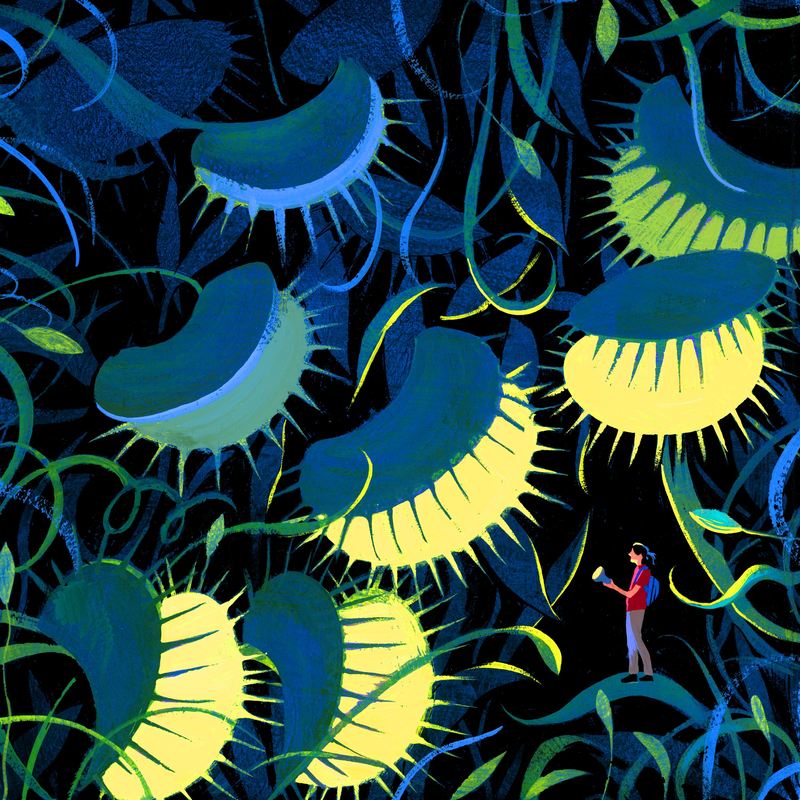
SAMMY: You see this fly buzzing around, spiral down and land on that plant. The fly walks around a little bit, when suddenly—foom! The plant slams shut.
LULU: Oh!
SAMMY: Squeezing those jaws onto the fly.
LULU: Oh, no!
SAMMY: He's not getting out of there.
LULU: Oh!
SAMMY: It's over for him.
LULU: Okay. So who is this? What plant is this?
SAMMY: This is a Venus flytrap.
LULU: Okay, so the Venus flytrap, it's a plant with jaws. Like, literally there's a version of it in Mario in the Nintendo games.
SAMMY: Yep.
LULU: And they—they've always excited me, these carnivorous plants, because it feels like they are the quintessential rule breaker.
SAMMY: They are breaking all the rules.
LULU: Like, it seems like one of the rules about plants is that unlike us, they can use sunlight to get their nom noms, they use sunlight to turn air and water into sugar.
ALAN: [sings] Photosynthesis. Photosynthesis!
LULU: And yet here's this plant that for some reason just smashes that rule, you know, breaks through this seeming animal-plant divide and gets its food by eating meat. So why would that be? Is it because there is not enough sunlight in the swamp? Like, is it just too shady?
SAMMY: The issue is not the lack of sunlight.
LULU: Huh!
SAMMY: They're able to get plenty of it.
LULU: The issue, Sammy explains, is ...
SAMMY: Poor soil.
LULU: The soil in the swamp doesn't have enough of the nutrients like ...
SAMMY: Nitrogen and phosphorus.
LULU: Which plants need, not for food exactly, but to power the process of photosynthesis that makes them food out of sunlight.
SAMMY: They need to produce the machinery that allows them to take the energy of the sun and convert it to food.
LULU: Oh, so the phosphorus and nitrogen literally run all the whirligoos and whirligigs that power photosynthesis?
SAMMY: The running of the whirlies is precisely it. Really specific whirlies that help them produce energy.
LULU: Wow! And so instead of just not growing there in the poor soil as so many other plants did, one day millions of years ago, you're saying that these Venus flytraps, they evolve this ingenious, wild, daring solution.
SAMMY: Correct.
LULU: Of trying to just get the nitrogen, phosphorus direct from the bug?
SAMMY: Yes. There's plenty of flying bags of nitrogen and phosphorous just everywhere.
LULU: Yeah.
SAMMY: We call them flies. So let's go fly fishing.
LULU: So clever. Question.
SAMMY: Mm-hmm, mm-hmm.
LULU: Why not just be like, "I as a plant won't grow there." Swamps are just a tiny part of Earth. Why not go on all the other good soil?
SAMMY: Have you ever heard of "fundamental niche theory?"
ALAN: [sings] Fundamental niche theory!
LULU: No. I actually have not.
SAMMY: [laughs]
LULU: Fundamental niche theory? Okay, a niche, or "nitch," is a fancy word for, like, your preferred place to live.
SAMMY: Yeah, basically.
LULU: Okay.
SAMMY: Your preferred conditions for living.
LULU: Your environmental sweet spot. The ideal temperature, sunlight, you know, location on the globe where a given species is happiest. Like, my niche, oh, is probably being under a shady tree on a Sunday morning all by myself for a moment, with a big cup of coffee.
ALAN: Ooh, and my niche is probably being under a shady tree on a Sunday morning all by myself for a moment with a big cup of coffee.
LULU: Wait! Hey, copycat, I just said that's my niche. I'm not sure there's enough shade and coffee here for two.
SAMMY: If you have a niche ...
LULU: Yeah?
SAMMY: ... but there's another creature that also really wants that exact same niche, sometimes both of you only get half the food that you were trying to get.
LULU: Okay.
SAMMY: Competition is always bad.
LULU: Huh! Meaning it often involves fighting. One of you may be getting hurt, one of you not getting enough resources. And—and then I guess if you go to this place where no other plants can live, if you can figure out how to live there, you are gonna have quite the leg up—or the leaf up. [laughs]
SAMMY: You rule the land.
LULU: So you're saying Venus flytraps, though they appear so gnarly and vicious, are actually quite conflict averse? They're just like, "Well, there aren't other plants in there, so I could go there and not have to fight with anyone."
SAMMY: Exactly.
LULU: [laughs] I love thinking of them as the pacifists of the plant world.
ALAN: Now, now ...
LULU: The queens of non-confrontation.
ALAN: Now, now ...
LULU: The giants of geniality.
ALAN: Do do do do!
SAMMY: Oh, they're oftentimes pretty small.
LULU: Oh, really?
SAMMY: Like—like the size of a dime.
LULU: Oh, little guy!
SAMMY: Yeah. He's just a little guy.
LULU: Short king swamp thing.
ALAN: Now, now!
SAMMY: So the insect lands on the Venus flytrap, but it takes a lot of energy to reset a Venus flytrap, so snapping shut? It's gotta be worth it.
LULU: So the flytrap waits to be sure there's a real juicy bug in there. And their secret for sensing whether or not to chomp ...
SAMMY: There are all these tiny little sensory hair-looking things sticking out of the flytrap.
LULU: Huh!
SAMMY: If you just brush up against one of them, the flytrap is like, "That could just be a small piece of dust."
LULU: Or maybe a fallen leaf.
SAMMY: But if it hits two of them, that's enough to trigger the mouth to shut.
LULU: And, says Sammy ...
SAMMY: There are some really big Venus flytraps out there.
LULU: Big enough to chomp a whole ...
ALAN: [ribbit]
SAMMY: Frog.
LULU: No, really?
SAMMY: Yeah. They release digestive enzymes.
LULU: A secretion of fluids kinda like the ones we have in our stomachs.
SAMMY: That allow them to break down the parts that they want to consume—the proteins.
LULU: Which contain the nitrogen and phosphorus that power up the whirligigs that use sunshine to spin air and water into sugar.
ALAN: [sings] Sugar, sugar, sugar, sugar! Yum yum!
LULU: Okay. Sammy, pressing question, though.
SAMMY: Mm-hmm?
LULU: If I'm a Venus flytrap, don't I, like most plants, need pollinators, aka flies and other insects to pollinate me so that I can carry on and make baby Venus flytraps?
SAMMY: You do need pollinators.
LULU: Oh, so do they not eat their pollinators, or do they just still eat their pollinators?
SAMMY: They don't eat the insects that pollinate. The ones that they're trying to attract as pollinators, they have a separate system of attractants.
LULU: Sammy says way high up in the air, way far away from their mouth parts, the Venus flytrap grows a little white flower that attracts ...
SAMMY: Bees.
LULU: Huh! And why is the flower so high up?
SAMMY: The part of you that's gonna eat insects needs to be spatially separated from the part of you that's gonna be pollinated by insects.
ALAN: Pay no attention to the deadly jaws lurking just below.
SAMMY: Because you never want to accidentally eat your friends.
LULU: [laughs] Wow! Venus flytraps are even more clever than I initially thought they were with just the jaws. They are amazing!
SAMMY: Mm-hmm!
ALAN: [sings] Time for plant number two.
LULU: Okay, so we're in the bog. I'm, I'm getting some mud off my shoe, but I think it's probably useless because are we gonna keep going deeper into the bog?
SAMMY: [laughs] I mean, we should keep going deeper into the bog.
LULU: Okay. I'm ready, yeah.
SAMMY: You got the big wader boots. So ...
LULU: Uh-huh. Yeah.
SAMMY: Okay.
LULU: Getting deeper and deeper, and eventually we come across ...
SAMMY: These really weirdly-shaped tubes, plants that are shaped like a trumpet.
LULU: Curled and long and deep, almost like a long cup.
SAMMY: This is a pitcher plant.
LULU: A pitcher plant!
ALAN: [sings] It's a pitcher plant, shaped like a pitcher for pouring water.
SAMMY: Pitcher plants' leaves are really slippery.
LULU: Okay.
SAMMY: And have a little bit of sugar right around the top.
LULU: Which is very enticing to, say, an ant.
[ANT: Mmm, yum, yum, yum! Love taking a stroll along this delicious, sugary rim! Uh-oh!]
SAMMY: And the insect will just kinda slide down to the bottom.
[ANT: Whee!]
LULU: Kinda down a waterslide?
SAMMY: Exactly.
ALAN: [sings] A waterslide of terror.
LULU: And down in the pitcher, almost like a witch's cauldron, a potion is brewing.
SAMMY: The plant itself has actually released chemicals and things into the water.
ALAN: A witch's brew, an enzyme stew!
SAMMY: The enzymes start to digest the bug and make it die more quickly so that it can't escape.
ALAN: [sings] You've slipped and slid to certain doom!
LULU: Poor critter!
SAMMY: Mm-hmm.
LULU: What is their flower like? I'm suddenly imagining a bouquet of meat-eating plants would be, like, the flowers you give if you're a vampire to your beloved. You're like ...
SAMMY: Wow!
LULU: ... "These flowers like blood just like you."
ALAN: I vant to eat your bugs!
LULU: Okay. But yeah, what does a pitcher plant flower look like?
SAMMY: They have this pink or sometimes a, a deeper red color to them.
LULU: Mm-hmm.
SAMMY: Some of them are yellow. It kinda looks like umbrellas around the pitchers. Typically, the carnivorous part of the plant is closer to the ground.
LULU: Mm-hmm?
SAMMY: And the part of it to attract the pollinators is on a long stalk far above it.
LULU: It's just like, "Nothing to see here. Don't mind—don't mind the guard dogs I have beneath me that would eat your kind in a minute."
ALAN: [sings] Under my umbrellas, flower, there a bunch of death pools. Gurgle, gurgle.
LULU: It's so funny! Now what else? Do—do pitcher plants ever eat, like, anything besides bugs?
SAMMY: Yeah. One attracts shrews.
LULU: Treeshrews, a mammal that looks a little like a pointy-nosed squirrel.
LULU: Wait. Does it eat shrews?
SAMMY: This particular pitcher plant is shaped like a toilet.
LULU: No!
SAMMY: Shrews will climb up onto the pitcher plant, and they'll stand on their back legs so that they can lick the sugary secretions.
LULU: Oh, that's so cute! They're using it as a stool to get up to the sugary part?
SAMMY: Well, "stool" is the right word.
LULU: Why?
SAMMY: Because they provide a stool sample to the plant while they are feeding on the sugar. [laughs]
LULU: Wait, wait. Are you serious? Wait, you're saying while they're feeding, they poop into the pitcher plant like an actual potty?
SAMMY: Yes.
LULU: Sammy explains that this is a stinky example of a relationship between species that scientists call ...
ALAN: [sings] Mutualism.
SAMMY: Mutualisms typically develop because both organisms want something very specific that can be hard to get.
LULU: What—so can you walk me through this mutualism? Who is getting what?
SAMMY: These pitcher plants, when they get really large, consuming insects does not provide them enough nitrogen.
LULU: So the plant trades a little sugar to the treeshrew for a little bit of poo.
LULU: It's literally manure.
SAMMY: Literally manure. Fertilizer just directly into the ...
LULU: Shrew manure. Shrew manure. Say that 10 times fast.
SAMMY: [laughs]
LULU: Shrew manure, shrew manure, shrew manure, shrew manure, shrew manure, shrew manure, shrew manure, shrew manure.
SAMMY: Mashrewer.
LULU: Okay. But is it not—I feel like what happened is this.
SAMMY: Mm-hmm?
LULU: I feel like one time a shrew accidentally did its business, and it happened to fall into a pitcher plant, and then everyone's like, "Oh, this is a thing."
SAMMY: Yes.
LULU: But is it, like, intentionally often going to a pitcher plant to do its doo-doo?
SAMMY: You have told the evolutionary story right there. There was once a pitcher plant, and it just produced a lot of sugar trying to attract insects. And a shrew walked over and started licking it.
LULU: Okay.
SAMMY: And the plant was able to grow so much more quickly.
LULU: Okay.
SAMMY: And now we have found that these pitcher plants out here, by the time they reach this size, more than 60 percent and sometimes 100 percent of their nitrogen intake comes directly from shrew poops.
LULU: Oh, like they're not even doing bugs. They're all just like, "I just want the poop."
SAMMY: It's all about the shrew.
LULU: Shrew manure, shrew manure, shrew manure, shrew manure.
ALAN: [sings] It's all about the shrew. It's all about the poops. Shrew poops.
SAMMY: But there's an even cooler situation.
LULU: Uh-huh?
SAMMY: There are some pitcher plants that are using sound to attract bats ...
LULU: What?
SAMMY: ... to do the same thing.
LULU: What's the sound?
SAMMY: Bats, they're using echolocation to find things.
LULU: Making sounds and using the echoes to map their surroundings.
SAMMY: These leaves are very, very effectively reflecting this sound back to the bat.
LULU: Mm-hmm.
SAMMY: And they're basically creating this homing beacon where they're saying, "Hey, bat. Land here. I will provide you shelter and all I want in exchange is your manure."
LULU: Wait, but why wouldn't it get, like, sizzled by the digestive enzymes?
SAMMY: Oh, it's hanging upside down from the inside of the pitcher.
LULU: Oh, classic bat mode.
SAMMY: It's not touching the sizzly fluids down there.
LULU: And then the plant gets all the nutrients from the bat guano, aka bat poop.
SAMMY: Sweet, sweet guano.
LULU: Guano. Does a body good.
SAMMY: [laughs]
ALAN: [sings] It's guano be me.
LULU: And the pitcher plant mutualisms go on and on.
SAMMY: There are also frogs that can live in pitcher plants as well.
[ribbit]
LULU: They'll use their little suction cups to hover just above the fluid and grab flies.
SAMMY: The dead bugs and stuff that end up in the plant.
LULU: And then some of them will even lay their eggs in the pitcher plant so that their babies, their tadpoles can snack on all the plant's victims. And then the plant in exchange gets all kinds of frog droppings. Mmm, breakfast of champions! But the mutualism that blew my mind the most?
SAMMY: There are some mosquitoes that live inside of pitcher plants.
LULU: What?
SAMMY: So the moms are called pitcher plant mosquitoes. They specifically lay their eggs in pitcher plants where their babies are protected from predators, because what's gonna get inside of that pitcher and try to eat them? Their babies get a free meal. They can just feed on the partially-digested corpses of other insects that couldn't hack it.
LULU: How do the baby mosquitoes survive in this death trap?
SAMMY: So it involves a snorkel.
LULU: What?
SAMMY: They stick this long tube through the water and breathe that way.
LULU: And Sammy says this snorkel? It's coming from their butt.
ALAN: [sings] Butt snorkel! The butt snorkel is just for breathing. The mosquito larvae poops out of a different opening.
LULU: I found myself thinking, "Hey, mosquito, how about you just didn't lay your babies inside a carnivorous plant?" But then the answer is fundamental niche theory? Niche theory? Is that what it's called?
SAMMY: You got it, Lulu. See, I love this!
LULU: FNT?
SAMMY: [laughs] Yes, FNT.
ALAN: [sings] FNT, find the right place for me. Putting the fun in fundamental niche theory. FNT!
LULU: Okay, cool. So it's like you see an extreme environment, and most creatures would be like, "Hazard. Stay away."
SAMMY: Mm-hmm.
LULU: But the true innovator is like, "Dive in, baby. Find a way to dive in."
SAMMY: Precisely.
LULU: And in the case of the mosquito larva, the way to dive in is with a butt snorkel.
ALAN: [sings] Butt snorkel!
SAMMY: Wow. [laughs]
LULU: Okay, on with our tour. Where are we going next?
SAMMY: I want us to take a trip to Georgia. We are going to the Okefenokee Swamp.
LULU: The Okefenokee Swamp.
ALAN: [sings] Okefenokee.
SAMMY: That's what I said.
LULU: Where we'll meet a trio of swamp goblins who would like to turn you into meat if you're a fly. That's after a short break.
LULU: Terrestrials is back. We are at the edge of the Okefenokee Swamp.
SAMMY: And it is infamous for being covered in carnivorous plants.
LULU: You know how in the Everglades there's, like, those airboats where you can go on tours to see alligators, crocodiles and stuff?
SAMMY: Mm-hmm?
LULU: Are there carnivorous plant tours in Okefenokee Swamp?
SAMMY: Oh, wow. That would be really cool. I don't know, but I sure do want to find out.
LULU: Should we quit our jobs and lead one?
SAMMY: We gotta look into this.
LULU: What would you call it?
SAMMY: Ooh, uh ...
ALAN: Lulu and Sammy's Carnivorous Plant Swamp Romp! Exploring nature's meanest little garden. Peep these leaf teeth. A tour of carnivora flora. One trap, two trap, fly trap, poo trap. You'll chlorophyll good about these killer plants! Come and see these greeny meanies! Bites like a dog, smells like a bog.
LULU: [laughs]
ALAN: Putting the "eerie" in fundamental niche theory.
LULU: Okay, people. Let's call it there.
ALAN: This salad bites back!
LULU: [laughs] Okay, Alan is muted. On with the show.
ALAN: Next plant on our haunted garden tour, lurking in the Okefenokee Swamp, behold ...
SAMMY: Sundews.
ALAN: [sings] Sundews!
LULU: Oh, wait, these things are so pretty, they look like curled, green stems glinting with all these red lollipops?
SAMMY: Well, all of those lollipops are really sinister.
LULU: Okay.
SAMMY: Because as pretty as they seem to be?
LULU: Yeah.
SAMMY: Because there's sugar that's making this stuff so sticky, if you land on them, sundews can actually curl inward so that more of the lollipops are touching you.
LULU: Oh!
SAMMY: And you won't be able to escape. At that point, they start releasing digestive enzymes all over the insect's body.
LULU: Like a shower? Like, it just comes out of that stem?
SAMMY: It's kind of a slow, gooey trickle.
LULU: Ugh! Wow, that is very Willy Wonka.
SAMMY: Yes!
LULU: It's like, "Come with me and I'll lure you with my little lollipops that won't do anything wrong, I swear. I am lying. This is a trap. This is a trap."
SAMMY: Ooh, Lulu! Okay!
LULU: Thank you.
SAMMY: I see you with the upper register. All right. [laughs]
LULU: Thank you! Man, okay, so the sundew is like the boa constrictor of the plant world. It's just, like, slowly strangling this poor little bug until it's digested and gonzo?
SAMMY: It's a slow-going way to go.
LULU: Yeah.
SAMMY: I feel bad for the flies that go out like this.
ALAN: And that brings us to plant number four!
SAMMY: Called Roridula.
ALAN: [sings] Roridula!
LULU: It grows in the nutrient-poor soils of the mountains of South Africa.
SAMMY: It kind of looks like an evergreen tree.
LULU: Totally!
SAMMY: But all the way down the stems of the plant, there are all of these sticky, gluey little lollipop things.
LULU: And just like the sundew, bugs get stuck in them. But unlike the sundew, the Roridula can't digest those bugs, meaning those bugs would just sit there in the hot sun, their little insect bodies rotting, stankifying. If it weren't for ...
ALAN: The assassin bug!
LULU: Kind of looks a little like a black cicada with orange stripes. Anyway, this bug starts crawling along those sticky lollipops, and when it finds a dead fly ...
SAMMY: It sticks its mouthparts into the bodies of insects that get glued to the plant.
LULU: Okay.
SAMMY: And sucks out their juices. And then it evacuates its waste on the surface of the plant and fertilizes the plant.
LULU: Wow! So the plant has outsourced its digestion to this bug.
SAMMY: Mm-hmm.
LULU: But why doesn't it get trapped?
SAMMY: The glue doesn't stick to it very well.
LULU: Wow!
SAMMY: That insect is doing something that's kind of risky ...
LULU: Yes!
SAMMY: ... but it's made it work. And it's the only one that's made it work. And what do we call that?
ALAN: [sings] FNT, find the right place for me. Putting the fun in fundamental niche theory. FNT!
LULU: Wow! Which brings us to the fifth and final stop in our haunted garden tour.
ALAN: The bladderwort.
LULU: Bladderwort.
SAMMY: Deep in the weird waters of the Okefenokee Swamp ...
ALAN: Actually, not very deep at all, but definitely weird!
LULU: There grows this underwater bladderwort. It looks a little like seaweed, but on its stems it has all these bladders, these little ...
ALAN: [sings] Spooky bags! Bubble bags.
LULU: Little water bags? Little bags of water?
SAMMY: Yeah. Little weird little water bags.
LULU: And in the water just beyond the bladderwort ...
SAMMY: ... there are all these tiny little things swimming around: water fleas.
LULU: Are they insects, or are they ...
SAMMY: No. No, they're crustaceans.
LULU: Okay, so like tiny little crabby vibes.
SAMMY: I encourage all of you to look up what water fleas look like. Like, their antennae are so cute.
LULU: Oh, they are! They're like little—they're like the Totoro.
SAMMY: Yes!
LULU: They're like—they're like a big—like, you got, like, a belly, but they're kind of translucent.
SAMMY: Mm-hmm.
LULU: If I was naming them, I would name them water gophers.
SAMMY: Water gophers. Okay. I call them cranky kidney beans.
LULU: But these cute little guys, they're—they're what's gonna get eaten.
SAMMY: Spoilers, Lulu! So you're already ahead of me. You know what's about to happen here.
ALAN: Dun, dun, dun!
SAMMY: One of these little water gophers, it's swimming around, and he gets a little bit too close to one of these little bags.
ALAN: Doo, doo, doo! Just swimming around!
SAMMY: The bag has a trapdoor on the front, and it opens up so fast ...
LULU: Yeah?
SAMMY: ... quicker than a millisecond. It sucks the entire water gopher right inside of that bag.
ALAN: Whoa!
LULU: It's not using jaws that snap, it's using, like, suction power?
SAMMY: It's actually using a vacuum to suck these creatures right inside.
[BLADDERWORT: Om nom nom nom nom. Gotta love a water gopher!]
LULU: This vacuum, it can suck in a prey animal in less than one one-thousandth of a second—a movement that is not just hard to say but hard to pull off. It is faster than a crocodile's jaw can snap, way faster than a cheetah can run or a falcon can dive. Meaning nature herself, evolution, has made one of the fastest predators a plant.
LULU: This has been an amazing tour. As I scrape the mud off my high socks here, I guess I wonder what have you learned from studying these things so closely?
SAMMY: There are a lot of different environments, a lot of weird places all over. And if you really want to be able to—to make your way in the world, sometimes the best way to do it is to be conflict-averse.
LULU: [laughs]
SAMMY: To recognize when two individuals are competing for the same stuff, both are losing.
LULU: By which Sammy means don't fight to compete with others by going where everyone else is. Maybe try venturing into a new niche. If you can get creative, that foreboding terrain might turn out to be fertile soil.
ALAN: [sings] I'm the queen of the bog. I'm the toilet of a frog. And I live near a log. Swampy, swampy! I'm the queen of the bog. I'm the toilet of a frog. And I live near a log. Swampy, swampy! 'Cause we're the Plant Army, goblins of green! We're living life to the extreme! Somebody said a plant can't eat a creature? Don't turn your back, because we're coming to eat ya! Don't tell me what I can or cannot do! Ooh, ooh! 'Cause I'll eat you and your bad ideas too! I'm the queen of the forest! I'm the toilet of the frog! And I live here alone. Swampy, swampy! Plant Army, goblins agree. We're living life to the extreme. Plant Army, goblins agree. We're living life to the extreme.
LULU: Wow, a trio of singers there covered in mud stage makeup. We got Alan Goffinski, Brandon Schaaf and a female vocalist really leaning on the yowls. I don't know who it could be. Maybe you have a guess. And that's it. There's nothing else cool about to happen. What's that?
BADGER: Excuse me, I have a question.
BADGER: Me too.
BADGER: Me three.
BADGER: Me four.
LULU: The Badgers! Listeners with badgering questions for the experts.
LULU: Are you ready for the Badgers?
SAMMY: I am ready for the Badgers.
ADA: Hi, my name is Ada. I'm six years old. What's the largest carnivorous plant?
SAMMY: Ooh, it would definitely be one of the giant pitcher plants.
LULU: Is there a pitcher plant big enough for me to get in? You know everyone's wondering.
SAMMY: [laughs] There is not a big enough pitcher plant for you to get inside of. I believe that Nepenthes rajah, it's large enough for you to fit almost two two-liter sodas into it.
LULU: That's big. So you might be able to get, like, a squirrel in there.
SAMMY: You could definitely get a squirrel in there. You could get a couple squirrels in there.
[SQUIRREL: Oh no!]
CAL: My name is Cal. I'm five years old. Can Venus flytraps eat other things than flies?
SAMMY: Yes, spiders and sometimes small beetles. The larger ones will even eat small frogs.
LULU: Wow. Would it eat a butterfly?
SAMMY: If the butterfly was small enough. Butterflies tend not to be attracted to that part of the plant, though. The plant wants to attract butterflies to the flowers.
LULU: Because they're pollinators, right?
SAMMY: Mm-hmm.
LULU: And turns out during flowering season, the dangerous, you know, jaw-like parts grow down low to the ground so the tall flowers are extra far away and safe.
LULU: To be like, "Butterfly, up here! Up here, girl! Up here, boy!"
SAMMY: Yes. "Up here! Don't pay attention to the death traps down there. Up here!"
LULU: [laughs] Okay, quick follow-up: Would it eat my finger?
SAMMY: No. Your finger is far too large and would easily break the trap.
LULU: Would it eat a piece of hamburger? Like, if I just dropped a little crumble in there?
SAMMY: Mm-hmm. They'd eat it.
LULU: Would it eat just some blood? Like, if I got a paper cut on my finger and I dripped blood in, would it be thankful?
SAMMY: [laughs] Muscle would probably be the best thing to drop in there.
LULU: That's nitrogen and phosphorus-y?
SAMMY: Yeah.
LULU: Okay, good to know!
LARA: Hi, this is Lara. I'm 38. And my question is, does anyone eat pitcher plants?
SAMMY: Yes. In Southeast Asia, there are people that stuff them full of rice and then cook that rice inside of the pitcher plant.
LULU: Whoa! It's a good rice cooker!
SAMMY: Exactly.
LULU: There are also Indigenous communities in North America who have long used their roots and leaves to treat coughs and fevers and back pain.
ALAN: [sings] Thanks for being a species that will kill some species but can help the species that is human beings. Like me!
ALAN: Is the bladderwort the fastest predator on Earth?
SAMMY: No. Jellyfish, they have stinging cells called nematocysts. These nematocysts are the fastest-firing biological process that we know of.
LULU: Wow!
SAMMY: They are incredible. In milliseconds, they're able to fully subdue that fish ...
LULU: Wow!
SAMMY: ... paralyze it and kill it.
LULU: Whoa!
NELSON: Hi, I'm Nelson. I'm six years old, and my question is: Are Venus flytraps the only plants that move without wind?
SAMMY: Hmm. No, there are some plants that will actually rocket their seeds. There's one called a squirting cucumber that will just pop off, and it's just launching seeds everywhere as it goes.
LULU: Almost like cannons, or—yeah, that's cool.
ALAN: Cool as a cucumber cannon!
LULU: Turns out there are also touch-me-not flowers, whose ripe seedpods spring open like jack-in-the-boxes if you disobey their name and touch them. There are exploding fruit capsules on the dynamite tree, pollen catapults in orchids, and honestly, so much more cool ballistic technology in the plant world we might just need to do another episode someday. Thanks for such an explosively good question, Nelson!
AYALI: Hello, my name is Ayali, and I'm seven years old. How long can a Venus flytrap live?
SAMMY: Oh, great question! If you are nice enough to a Venus flytrap, it can live for a very long time. Some people have kept theirs for 10 to 20 years.
LULU: Twenty? Whoa!
JACOB: Hi, my name is Jacob. I am seven years old. I've been listening for multiple years, probably most of my life, and my question is: Why do some plants use different defenses? And also, poison ivy, this is a big shout-out to you. You're suspicious, buddy.
SAMMY: [laughs] Some plants use different defenses from other plants because they don't need to defend themselves from the same stuff. Think about thorns.
LULU: Yeah.
SAMMY: Some plants produce thorns to defend themselves from, like, a cow or a bunny rabbit.
LULU: Mm-hmm.
SAMMY: But those giant thorns aren't gonna do a very good job of keeping something like a fly out of the plant.
LULU: Mm-hmm.
SAMMY: That'll burrow their way right into the leaf.
LULU: And thorns are too big. To them, it's like, "Oh, whatever."
SAMMY: The thorns don't matter in the slightest.
LULU: Yeah. Yeah. Do you agree that poison ivy is sus?
SAMMY: [laughs] You know, it's got a very sus vibe to it. And primarily what makes it so sus is that it's just out here hanging out, looking like a normal plant. There's no, like, real markings on it to let you know what's going on. It's like it wants me to accidentally bump up against it and then have a rashy leg for the rest of the week.
LULU: Okay, so our official scientist agrees with you, Jacob. Poison ivy is sus.
SAMMY: You ain't wrong. You ain't wrong, Jacob.
LULU: Okay, I love it. And I think that's where to leave it, with the scientifically certified declaration that [sings] poison ivy is sus. And I won't tell you about the parrot pitcher plant, which is kind of like a maze of doom. Easy to enter, but hard to leave! It has little translucent windows where the light shines through, making it look like that might be the way out, but they actually lead the prey deeper and deeper into the pitcher, down, down, down, where they get digested on their way to what they believe is freedom. But I won't tell you that because I'm nice.
LULU: Terrestrials was created by me, Lulu Miller, with WNYC Studios. This episode was produced by Alan Goffinsker—Alan Gold Plant Jaws—with editing and sound design by Mira Burt-Wintonick. Sarah Sandbach is our executive producer. Our team also includes Ana González, Natalia Ramirez, Joe Plourde and Tanya Chawla. This episode was fact-checked by Diane Kelly. Support for Terrestrials is provided by the Simons Foundation, the Arthur Vining Davis Foundations and the Templeton Foundation. Thank you!
LULU: If you would like to participate in a really cool mutualism called helping your little public radio show about animals and plants, you could see about joining our Explorers Club. There's a link to that in our show notes. We won't be giving you droppings in exchange for your support, but we will be giving you birthday shout-outs, cool swag, ad-free listening and that cozy good feeling that you get from supporting your local dorkupines. Those are dorks who make work about nature. That's us, dorkupines. Anyway, either way, thank you so much for listening. See you in a couple spins of this dirty old planet of ours. Bye!
-30-
Copyright © 2026 New York Public Radio. All rights reserved. Visit our website terms of use at www.wnyc.org for further information.
New York Public Radio transcripts are created on a rush deadline, often by contractors. This text may not be in its final form and may be updated or revised in the future. Accuracy and availability may vary. The authoritative record of programming is the audio record.