The Goths: Befriending Clever Crows
[TERRESTRIALS INTRO]
LULU MILLER: Three, two, one. Imagine ...
EMMA TERRY: Out of your back you grow black feathers.
LULU: And ...
EMMA TERRY: You start losing all the meat on your feet, and you get those crazy little feet.
LULU: [laughs]
LULU: Also known as "scaly claws."
EMMA TERRY: And your nose and your mouth start growing into a beak.
ALAN GOFFINSKI: A beak so sharp it could peck out the eyes of a corpse. Ow!
LULU: You lurk in cemeteries and feast on carcasses.
EMMA TERRY: Your eyes go real black.
ALAN: And in many cultures you are a symbol of death itself.
LULU: You have become ...
EMMA TERRY: A crow.
LULU: Now is the part where we make you sing the theme song with us. [sings] Terrestrials, Terrestrials, we are not the worst. We are the ...
EMMA TERRY: Bestrials.
LULU: Woo! You got it!
LULU: Terrestrials is a show where we uncover the strangeness waiting right here on Earth. I'm your host, Lulu Miller, joined as always by my songbud ...
ALAN: Pretty bird.
LULU: Alan.
ALAN: Scary bird.
EMMA TERRY: [laughs]
LULU: Caw. And before Alan and I were coworkers, we were just friends in a little town called Charlottesville, Virginia, where one of our best friends was this lady.
EMMA TERRY: Alan, you have something in your teeth.
LULU: Emma Terry.
ALAN: I—did I get it?
EMMA TERRY: I think you got it.
LULU: An artist with bouncy blonde hair, sparkly cat-eye glasses, who loves to dress in bright cheerful colors.
EMMA TERRY: How are you two? I miss you so much!
LULU: And while we were very lucky to be friends with Emma, we weren't special, because Emma is friends with basically everybody in this little town—the butcher, the baker, the candlestick maker?
EMMA TERRY: I have a—I have a friend who makes candles. Kory, yeah.
LULU: Most of the town's artists.
EMMA TERRY: Yes.
LULU: And for the last near decade, she's been on a mission to befriend most of the town's ...
EMMA TERRY: Crows.
LULU: Do you think anyone in town knows you as the crow lady?
EMMA TERRY: My friends know me as the crow lady, and—and I think sometimes are a little worried about me, but ...
LULU: [laughs] Because not only is her house covered in crow statues, crow art, a crow pillow that says ...
EMMA TERRY: "Crows before bros."
LULU: [laughs]
ALAN: [laughs]
LULU: ... when she walks around town, she's often throwing peanuts and shouting ...
EMMA TERRY: Pretty bird! Pretty bird! Pretty bird! Pretty bird!
LULU: ... to try to get crows to come to her.
LULU: Have you ever had any land on you?
EMMA TERRY: No, I would—I would die happy. That would be amazing.
LULU: So you want that. You do want that.
EMMA TERRY: Oh, I want that so badly. Yeah. Oh yeah, I want to be—if I could, like, hold out my hand and they would eat from my hand, or they would land and we could just, like, hang out together, I would—that would be a dream. That would be a dream. I would love that more than anything.
LULU: But—okay, but why? Like, aren't they notoriously annoying, loud? They're, like, often associated with death. In many myths and ghost stories, they're bad omens, and in reality they hang around dead bodies so they can literally eat them. Like, aren't they bullies? Like, why—why do you want that connection with this animal in particular?
EMMA TERRY: Yeah. Well ...
ALAN: Also I—like, if I had to sum up your visual aura ...
LULU: Hmm.
ALAN: ... it would be more rainbow ...
LULU: Sunshine.
ALAN: ... than crow.
EMMA TERRY: [laughs]
ALAN: And crows are like Edgar Allan Poe. Raven.
LULU: Goth.
ALAN: Goth.
EMMA TERRY: Yeah!
ALAN: A group of crows is called a "murder." And you are—that is not your vibe.
EMMA TERRY: Yeah. No, I hear you. That—I hear—I hear what you're saying, but these are really cool creatures.
LULU: Emma says that after looking at crows closely for years, she's come to believe that most of us have the crow all wrong.
EMMA TERRY: Yeah!
LULU: And so Emma is here today to officially un-haunt the crow, to pull it out of the ghost story and hold it up to the light so that we can see its true form.
EMMA TERRY: Oh, have you seen them under an ultraviolet light?
LULU: No.
EMMA TERRY: Crows appear black to us, but in ultraviolet light, their feathers are purples and pinks and greens. It's iridescent.
LULU: Whoa!
EMMA TERRY: And so maybe the crows are really rainbow birds, and that's why they're my jam?
ALAN: Ooh, there you go!
LULU: Boom!
LULU: All right, so growing up, Emma saw crows the same way that most of us do: as kind of ghastly, kind of spooky.
EMMA TERRY: Yeah, crows seemed a little, I don't know, dangerous, seemed a little naughty.
LULU: But then one day in her 20s, she heard a story about a very different kind of crow.
EMMA TERRY: How they helped this—they helped this old man who fell, and I just was like—and I ...
LULU: Wait, what? Okay, what's the story?
EMMA TERRY: There was a cul-de-sac in a neighborhood.
LULU: And Emma says this old man had spent a long time feeding the neighborhood crows—which, by the way, feeding wild animals is not the best hobby to get into, because it can end up hurting them or hurting other ones, but sometimes people make a sneaky little exception for birds as long as they're careful to keep it in check. Anyway, back to this old man.
EMMA TERRY: The crows were happy, and then one winter he, like, slipped and fell and, like, couldn't get up from the ice. Like, he had hurt himself. And the crows just came, like, and just started cawing super, super loudly.
LULU: [gasps]
EMMA TERRY: Like, alerting other people in the cul-de-sac ...
LULU: Hmm!
EMMA TERRY: ... that somebody needed help. And then a neighbor came out, and saw this man had hurt himself and was able to, like, get him up, get him out. And—but it was because the crows had alerted to, like, "Someone has fallen and they can't get up."
LULU: Whoa!
LULU: And that pricked Emma's friendly ear.
EMMA TERRY: I remember thinking, "That is so cool."
LULU: Wow!
EMMA TERRY: And I want to be friends with crows.
LULU: So she started reading up on crows.
EMMA TERRY: It's like you get into birds, and you get the bird books and you get binoculars.
LULU: And it was through those binocular lenses that the crow began to transform. She began leaving them peanuts in a little basket that she placed in her yard to try to lure them close. And through her binoculars, she noticed they would ...
EMMA TERRY: Pick up the shells. They'll throw them up in the air and then they'll hold them under their foot and poke through them until they get to the nuts.
LULU: Huh!
LULU: But that was just the beginning. She read about crows that, to crack a nut out of its shell, would ...
EMMA TERRY: Drop nuts in a crosswalk.
LULU: Wait. Why?
EMMA TERRY: Because when the cars pass that crosswalk, the tires will crush the nuts.
LULU: Oh!
ALAN: Even one step further, I believe they've been observed watching the crosswalk signal to know when ...
EMMA TERRY: Best to drop?
ALAN: ... it's safe. So they know when it's safe to go out and pick up their nuts.
LULU: AKA they see cars as nutcrackers.
EMMA TERRY: As nutcrackers. The car is a nutcracker.
LULU: Which Emma says was no small thing for scientists to admit, that crows ...
EMMA TERRY: They're using tools.
LULU: Because tool use used to be one of those things that we believed only humans could do. That put us on a pedestal way high above the other animals, who could never figure out how to extend their strength or reach or solve problems with tools, until one day in the 1960s scientists realized chimps could actually do it.
ALAN: By Jove! It's using a stick as a sort of termite fishing pole!
LULU: And later otters.
ALAN: By Jove, it's using a rock as a hammer!
LULU: And elephants.
ALAN: By Jove! It's using a chunk of bark to plug a water hole!
LULU: But a bird, with a literal birdbrain the size of a walnut ...
ALAN: Oh no, my crow!
LULU: And yet, as Emma read up on all the amazing things people had supposedly observed crows doing, she came across a rumor that crows, they wouldn't just use tools ...
EMMA TERRY: But they'll make tools. They'll figure out what they need.
ALAN: What?
LULU: Does that feel verified? Is that a real thing, or is that internet rumor?
JOHN MARZLUFF: No, that's definitely real.
LULU: This is Dr. John Marzluff, an ornithologist who has been studying crows for ...
JOHN MARZLUFF: About 30 years.
LULU: And he's seen crows ...
JOHN MARZLUFF: Especially New Caledonian crows ...
LULU: ... fashion hooks out of stems or palm leaves.
JOHN MARZLUFF: And so they can access grubs and things under the bark or in the soil that other animals aren't getting.
LULU: Huh!
LULU: He's also seen crows use ...
JOHN MARZLUFF: Coat hangers ...
LULU: ... to build nests or ...
JOHN MARZLUFF: The top of a container. Using it as a saucer to slide on down a snowy bank or ...
LULU: Like a sled?
JOHN MARZLUFF: Like a sled, sure.
LULU: Wait, why would—why wouldn't they just fly?
JOHN MARZLUFF: Well, it's more fun to slide, I guess.
LULU: [laughs]
ALAN: Let's take a break to consider that a crow will sled on a container lid down a hill just because maybe it feels it's fun.
LULU: Whee! And it's not just tobogganing and nuts that crows can crack. It turns out crows have also cracked one of the most complex laws of physics, Archimedes' principle of displacement, that has to do with dropping things into water to solve really complicated problems.
ALAN: No!
LULU: Yup. So this guy recently—like, a scientist—put a Cheeto in a little tube of water, but he—the crow can't get to it. It's, like, putting its little beak in, but it can't reach it, so then it grabs some stones, puts it in the tube, so the water raises, the Cheeto floats up, and then it gets the Cheeto and flies away.
ALAN: It was actually a Cheeto?
LULU: It was actually a Cheeto.
ALAN: [laughs] I love that.
LULU: Now human children, the ages of my children, aka eight and under, historically cannot figure this out. The crow routinely outperforms, like, basically up to seven or eight years old.
ALAN: So there's some kids listening to this ...
LULU: Who can't—who won't figure it out.
ALAN: ... that are learning it right now from a crow.
LULU: Yeah, exactly.
[Thanks for the Cheeto—crunch, crunch—crow!]
JOHN MARZLUFF: I had a graduate student, Loma Pendergraft.
LULU: Yeah?
JOHN MARZLUFF: He did his PhD on that.
LULU: Dr. John's student watched crows drop rocks into tubes to displace water and get Cheetos.
ALAN: Yum!
JOHN MARZLUFF: And we showed by doing brain imagery that they basically were using their brain just like we would in a complex task.
LULU: Just like we might stand back and squint at a thing, maneuvering it in our imagination.
JOHN MARZLUFF: Basically running it through mentally without doing it.
LULU: Plotting, planning, reasoning.
JOHN MARZLUFF: The crows basically, by the activity in their brain, were showing us that they were basically doing the same thing.
LULU: Wow!
LULU: And that's not all. Crows can count!
ALAN: [singing] Counting Crows is not just the name of a '90s band. It's a scientifically accurate name of a '90s band.
LULU: [laughs] Crows can also recognize human faces. John's lab in Seattle was behind a famous study that showed if someone does something that displeases crows—in this case trapping crows in nets and then releasing them—the crows will be wary of that person, and sometimes even form a mob to attack them the next time they see them! Even a couple years later! Even if it's just someone wearing a mask of the mean person's face.
EMMA TERRY: They apparently hold grudges, right? They've been studied. They hold grudges, and they pass out those grudges onto their offspring.
LULU: Wow! Intergenerational grudges?
EMMA TERRY: Intergenerational grudges.
ALAN: Intense!
LULU: Which brings us back to Emma. She wondered, if crows could hold grudges, what about the reverse? If you were really nice to a crow instead of mean, instead of mobbing you, would they perhaps leave you a gift? She had heard a rumor sometimes crows would leave a little trinket or bauble or shiny thing as a token of thanks to humans who were good to them. Emma began to dream of getting a gift from a crow. She wanted it more than anything in Santa's sleigh—one bell or shiny bauble from a crow. So even though, again, it is not always the best idea to feed wild animals, Emma did more research on what crows truly love, and it turns out, even though we associate them with graveyards and dead bodies, only about five percent of their diet is actually made up of dead stuff. Mostly, they eat typical bird fare: berries, bird seed, the occasional grasshopper or mouse if they can catch it. Grapes! And tons and tons of nuts.
ALAN: We are nuts for nuts!
LULU: So careful to only leave small amounts so as not to upset the backyard ecosystem, Emma began leaving new treats. In addition to her peanuts, she also started leaving them ...
EMMA TERRY: Grape jelly, hard-boiled eggs.
ALAN: Yummy!
LULU: And in time, as Emma kept leaving little treats ...
EMMA TERRY: I have two now who sit on a wire outside of my house, and they will call for me.
LULU: The crows started calling for Emma.
EMMA TERRY: Actually, I think, Alan, you—we may have been on a Zoom call.
LULU: Alan and Emma used to work together, and apparently once during ...
EMMA TERRY: A real business meeting, the crows were calling at my window, and I was like, "You'll have to excuse me. I need to go out there and give them some peanuts so they know that we're still in love."
LULU: [laughs]
EMMA TERRY: And—and I would do that all the time.
LULU: So they were training you. You were letting yourself be trained.
EMMA TERRY: One hundred percent trained by crows.
LULU: Yeah.
LULU: Day after day, peanut after peanut, egg after egg, Emma kept trying to show the crows she cared enough to get a present. For seven years she left treats, exuded her friendly Emma energy, sang crows her compliments on walks.
EMMA TERRY: Pretty bird! Pretty bird!
LULU: But nothing, nada, no gifts. And she wondered if maybe the whole gift thing was a myth after all. It didn't even make sense. I mean, why would they give her a present? Even if they appreciated her treats, it's not like a bird says thank you in the same way we do.
EMMA TERRY: Yeah.
LULU: The story concludes dramati-caw-ly after this short break.
ALAN: After this short beak?
LULU: Mm-hmm. Stick with us, peck with us!
ALAN: You're gonna be ravin' about it.
LULU: Something amazing is waiting in the wings.
EMMA TERRY: Lulu, Alan, go for break!
LULU: Okay, fine. Well, crow to break.
EMMA TERRY: [laughs]
ALAN: Okay, so when you see a crow up on a telephone wire ...
LULU: Mm-hmm?
ALAN: ... like, way up high on a telephone wire ...
LULU: Yeah?
ALAN: ... do you know what they are actually doing?
LULU: Is this a—is this a riddle? A joke? Is this a joke?
ALAN: Making long-distance caws.
EMMA TERRY: [laughs]
LULU: Terrestrials is back, and we are still crowin' about crows with our pal Emma Terry.
EMMA TERRY: Hi!
LULU: When we left off, Emma was leaving peanuts and globs of grape jelly and hard-boiled eggs in a basket outside her house, diligently trying to make crows appreciate her enough that they would show their gratitude in the form of a gift—a shiny thing that they'd collected. She'd read this could happen, and it wasn't happening. It had been seven years, and nearly every day she did this.
ALAN: Which to some is the definition of insanity—doing the same thing over and over and expecting a different result.
LULU: Mm-hmm. But then one soft summer day ...
EMMA TERRY: I think this is a fuse?
LULU: ... she saw this shiny bit of wire and metal under the basket where she left the crows treats.
EMMA TERRY: [gasps]
LULU: She picked it up and got goosebumps all over her body, thinking, "This could be from a crow!" And she put it on a special shelf in her bedroom, but she wasn't sure. Maybe it was just a fluke, some trash that landed there. But then a few weeks later, in the exact same spot ...
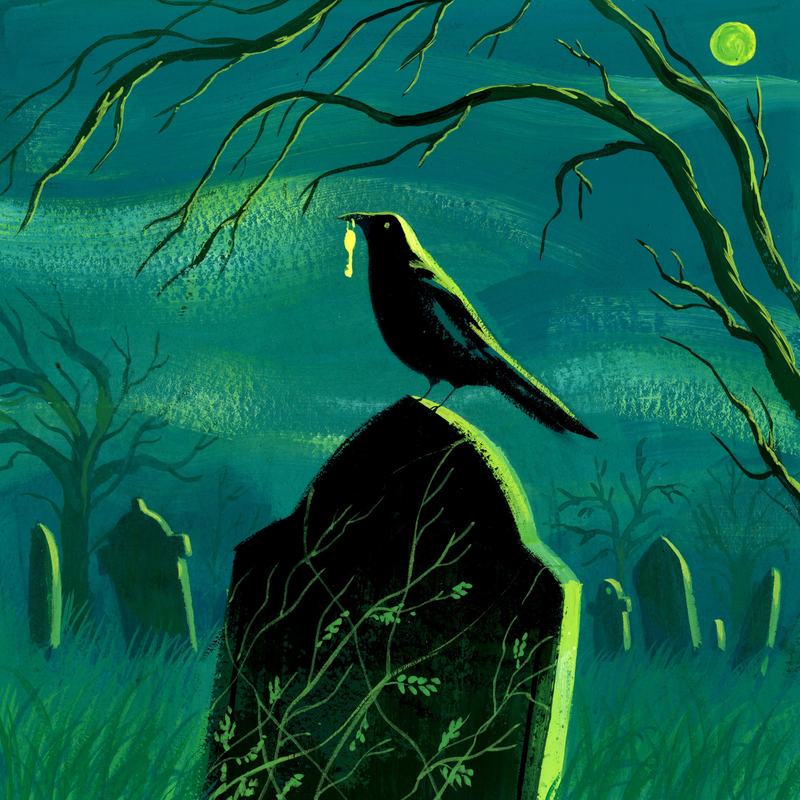
EMMA TERRY: A key.
ALAN: Wait. What does it op—what does the key open?
EMMA TERRY: I don't know! That's the thing. I tried it in every one of my doors in my apartment. So it wasn't from me. But ...
LULU: Wow.
EMMA TERRY: ... it somehow ended up there.
LULU: And then it just kept happening.
EMMA TERRY: This is my dish of crow gifts.
LULU: Your dish of crow gifts?
EMMA TERRY: Yeah. This is a little gold hair bead?
LULU: Ooh!
LULU: Right under the basket ...
EMMA TERRY: A little piece of broken mirror.
LULU: ... little trinkets kept appearing.
EMMA TERRY: Little very precious piece of foil ...
LULU: Okay.
EMMA TERRY: ... that's balled up. It's like a shell. It's got a little shimmer to it.
LULU: Wow. So it really is a sh—it's skewing real shiny stuff.
EMMA TERRY: It's skewing really shiny.
LULU: And she placed this glimmering dish of treasures in a prized spot in her room, something that she could look at each day, each sparkle proof, she believed, of their bond.
EMMA TERRY: They brought it to me, like, as a gift.
LULU: Wow!
LULU: Now I wanted to get a scientist's take on Emma's whole story, so I ran Dr. John through all of it.
LULU: About 10 years ago, she read a story about a man in a neighborhood ...
LULU: Starting with the story about the old man who fell that kicked the whole thig off.
LULU: And I wonder, first of all, if you've ever heard a story like that where crows have helped to alert to a human in some kind of danger?
JOHN MARZLUFF: It could have happened. There are cases where injured or—actually, typically more dead people have been found by search and rescue teams by seeing crows or ravens.
LULU: Huh.
JOHN MARZLUFF: Not trying to bring in help for the person, but as a potential meal.
LULU: Okay. [laughs]
JOHN MARZLUFF: So ...
LULU: So, like, "Old guy fell, maybe we could eat him?"
JOHN MARZLUFF: Yeah.
EMMA TERRY: [laughs] Oh no! Like, "Hey, come, someone's hurt. Let's get them?"
LULU: More of, like, "Hey, you guys, snack. Big old man-shaped snack."
EMMA TERRY: [laughs] Well, you know, crows need to survive too, I guess? I think they were protecting him.
LULU: Okay, you can choose to believe they were protecting him.
EMMA TERRY: [laughs]
LULU: Next up, I asked John if the shiny things that kept appearing under Emma's basket could have been left by the crows. And ...
JOHN MARZLUFF: I think that's absolutely possible.
LULU: Huh!
LULU: He said Emma was right. Crows are very curious about shiny things or anything that looks weird or different. They'll scope them out, and if they seem safe ...
JOHN MARZLUFF: They pick them up, especially young birds pick them up, play with them, carry them around.
LULU: Trying to figure out ...
JOHN MARZLUFF: "Could I use this for something?"
ALAN: Could this metal fuse help me get a snack? Caw-n I drop this key into water to get Cheeto?
LULU: [laughs] But whether these bits of metal and wire and keys that Emma kept finding near the food basket were gifts, well, John said there might be another explanation.
JOHN MARZLUFF: So it could be that young birds pick up things, carry them around, and when they see something better, like food in a basket ...
ALAN: Huh! Peanuts!
JOHN MARZLUFF: ... they take the food and leave the thing.
ALAN: Bye-bye, house key!
LULU: Oh, interesting. And that could explain why those things kept ending up near the basket.
JOHN MARZLUFF: Yup.
EMMA TERRY: Oh no! [laughs]
JOHN MARZLUFF: However, I don't think it's out of line to think that some birds might be trying to reward people for doing the right thing to them.
LULU: Oh, really?
JOHN MARZLUFF: And then keep—keep the goods coming. And an example that makes me believe they can do things like that, and that is my graduate advisor's wife rescued a crow that was stuck in a fence by its leg.
LULU: Hmm.
JOHN MARZLUFF: And after she did that, let the bird go, a crow comes to her and brings her a dead mouse.
LULU: Huh!
JOHN MARZLUFF: That's the kind of gift a crow would give to another crow to ...
LULU: That's like a true thank-you. Like, "Here's sustenance."
JOHN MARZLUFF: Yeah. And here's a hard thing for me to get. And ...
LULU: Wow!
JOHN MARZLUFF: ... they're social. They could also be socially bonding with another species that is providing for them.
LULU: Wow!
JOHN MARZLUFF: So I don't think it's out of line to think of them as forming a bond with people.
LULU: Hmm!
EMMA TERRY: Pretty bird! Oh, see? It's coming! Pretty bird!
LULU: On my last visit to see Emma in Charlottesville, it was winter. We walked by a path along the river, and she called out to the crows. And I kid you not, one perched way high up on a leafless tree ...
EMMA TERRY: Pretty bird! Pretty bird!
LULU: Okay, for radio. Yeah. Okay, we are standing over a river.
EMMA TERRY: Pretty bird!
LULU: And then a crow just headed in Emma's direction.
LULU: And then it flew toward her.
LULU: Emma is smiling so much she had to put her hands in front of her mouth. Wow!
LULU: If what's going on with Emma and the crows is a bond—and we don't know—but with your tightest scientist hat on, would you call that bond friendship? Would you call it trust?
JOHN MARZLUFF: I mean, it's—it's like forming a partnership, I would say.
LULU: So if she were to someday actually see a crow bring her a dead thing, that would really be a marker of ...
JOHN MARZLUFF: Yeah. And she probably will.
EMMA TERRY: Oh! I want a mouse. I want a mouse. I want a crow to bring me a mouse, I will say—was it last week? There was a tiny dead snake, like, no thicker than my pinky, that was near my food offerings.
LULU: [gasps]
EMMA TERRY: It literally had not occurred to me that that could have been a crow.
LULU: Oh!
EMMA TERRY: Do you think they left me a snake? Do you think they left me a snake?
LULU: Maybe? Maybe.
EMMA TERRY: [laughs]
ALAN: [sings] You misunderstand what I am doing in the trash. You misunderstand, you misunderstand what I am doing with the dead. Am I a scavenger? Am I a gravedigger? Am I a plague bringer? Above the cemetery, if you want to know the truth, if you want to know the truth, I'm not so very scary. Listen to Emma Terry.
EMMA TERRY: Crows are pretty cool!
ALAN: [sings] We've got a message for you. No longer want to pretend.
EMMA TERRY: I want to be friends. I want to be friends. Crows are pretty cool.
ALAN: [sings] Helpful and smart, haven't you heard?
EMMA TERRY: Pretty bird, pretty bird!
ALAN: [sings] You heard what Emma said, you heard how she reacted. When I fly overhead—wait, what's that? A tiny piece of tin foil? Whoops, sorry there, I got distracted. Don't be scared, don't be mean, we're here to clean your rotting things.
EMMA TERRY: Crows are pretty cool.
ALAN: [sings] We've got a message for you, no longer want to pretend.
EMMA TERRY: I want to be friends. I want to be friends. Crows are pretty cool.
ALAN: Helpful and smart, haven't you heard?
EMMA TERRY: Pretty bird, pretty bird! Crows are pretty cool!
ALAN: [sings] In ultraviolet light.
EMMA TERRY: It's iridescence. I wanna be friends. I wanna be friends. Crows are pretty cool! Purples and pinks and greens.
ALAN: [sings] A secret rainbow murder.
EMMA TERRY: Pretty bird!
ALAN: [sings] A secret rainbow murder.
EMMA TERRY: Pretty bird!
LULU: Alan Crow-ffinsky! And that's it! And there's nothing left cool about to happen, just—what's that?
BADGER: Excuse me, I have a question.
BADGER: Me too.
BADGER: Me three.
BADGER: Me four.
LULU: The Badgers! Listeners with badgering questions for the expert.
LULU: You ready?
JOHN MARZLUFF: Yeah.
EMMETT: Hello, my name is Emmett. I'm eight years old. My question is: why is a group of crows called a murder?
JOHN MARZLUFF: It's that they're often found around dead things. The group of them could be scary, especially during times of human tragedy—wars or plagues, where there were lots of dead people that were laid out, and you'd see ravens and crows on them.
LULU: Yeah.
JOHN MARZLUFF: And what would conjure up in your mind is like, "Oh, they—there's a murder there, and the crow's the culprit."
LULU: Oh! So they've been wrongly accused.
JOHN MARZLUFF: Yeah.
LULU: Though to be clear, not everyone saw the crow in this inaccurate and morbid way. Some North American indigenous traditions, Hinduism and other cultures see the crow as a vital helper in the circle of life, which turns out to be the far more scientifically accurate view of them. Because as John explains, yes, crows descend upon dead things, but by eating them, they clear away rotting matter, cleansing the land of things that could make us sick.
JOHN MARZLUFF: They have very strong stomachs, strong digestive juices, and they can really break down just about anything they get into the mouth.
LULU: And after those harmful things are broken down, they pass through the crow, return to the land, and they are actually transformed into nutrients, bringing life, and keeping the planet—and us—healthy.
EMMA TERRY: Oh, they're just so amazing! Would I want to get rid of the name, though, murder of crows? No. It gives them their edge.
LULU: Murder on the dance floor!
EMMA TERRY: Murder on the dance floor!
LUCAS: Hello, my name is Lucas, and I'm seven years old. What's the difference between crows and ravens?
JOHN MARZLUFF: Yeah, so the difference between a crow and a raven: crows caw and ravens quork. Ravens are about the size of a red-tailed hawk, a four-foot wingspan.
LULU: Wow!
JOHN MARZLUFF: Crow is more like two and a half.
LULU: Okay, so raven way bigger than a crow?
JOHN MARZLUFF: Yup. One of the descriptions that I like the best is that a crow is a bird with a beak and a raven is a beak with a bird. Very large beaks.
LULU: The beak is so big on a raven. That's good. Raven is a beak with a bird.
FIONA: Hi, my name is Fiona. I'm seven years old. Are any crows other colors than black?
JOHN MARZLUFF: Yes, there are lots of crows that are black and white or black and gray.
LULU: Oh!
JOHN MARZLUFF: There are some that are almost all gray. There's, you know, about 50 species of crow.
LULU: Fifty shades of crow? A crow-t of many colors?
ALAN: Croseph and the Amazing Technicolor Dream Crow.
LULU: Somewhere over the raincrow? [laughs] Okay, next question.
XAVIER: I'm Xavier, and I'm eight.
BEATRIX: I'm Beatrix and I'm eleven. We have a question. We've heard crows can talk.
XAVIER: Is that true?
JOHN MARZLUFF: They do.
LULU: How talky can they get?
JOHN MARZLUFF: You wouldn't know the difference that it wasn't a person talking.
ALAN: What's up? What's up? Okay, so that's just me. I'm not a real crow, but if you want to hear a real crow talking, kind of like a parrot, we'll link some videos in our show notes!
LULU: How many words could they say?
JOHN MARZLUFF: It depends on how many you teach them, I guess. You know, a lot of times they will say the person's name that they were raised with. So Bob, they will say "Bob" when Bob comes in the room.
ALAN: Bob! Bob!
LULU: John says he's heard of crows calling to dogs.
JOHN MARZLUFF: "Here, boy. Here, boy. Come on, let's go." A lot of them curse because they hear that.
LULU: [laughs] Oh no! Now I'm picturing a crow flying through the air screaming naughty words!
ALAN: Caw! Caw! Bleep!
JOHN MARZLUFF: Yeah! Well, there was one that followed a kid to school, and it had a foul mouth. It was sitting right outside the school window screaming at everybody.
JOE: Hi, I'm Joe. I'm 38. How do crows sleep? Do they sleep in nests?
JOHN MARZLUFF: They typically sleep on branches of trees. And they can grip the branch all night so they don't fall off. There is a tendon in the bird's legs. They're asleep, when you start to fall back, it makes their foot grip. But they can just grip all night.
LULU: Huh. It's like autopilot gripping!
JOHN MARZLUFF: Yeah. They're standing upright, you know, they're asleep.
LULU: Catching upright z's in the trees. That's so cool!
EMMA TERRY: Hi, it's Emma again. Is it bad to feed crows?
JOHN MARZLUFF: It can be bad if you're feeding so much you're probably increasing the number of crows in the local area, then they could have this spillover effect to other songbirds.
LULU: Because they will go after other songbirds.
JOHN MARZLUFF: They do. So keeping it in check is very important.
EMMA TERRY: Yeah.
JOHN MARZLUFF: I think if you try to befriend a crow that lives by you, that you can have a very interesting interaction with them, but just don't carry it away with it.
EMMA TERRY: Ah, yeah. I can do that. Yeah. Okay. Emma, one more time. What would it take to get crows to come to my funeral?
JOHN MARZLUFF: [laughs]Open casket.
LULU: [laughs] That's dark, but good. Okay.
LULU: Wow. And that is the perfect Halloween-y place to leave it, with the open casket and the crows. No gross fact to share today, just something really cool, which is that John and his wife, Colleen Marzluff, made an app for kids to help them do science!
JOHN MARZLUFF: It's called Crow Scientist.
LULU: Crow Scientist. I just got it. It's free; there's a picture of a crow over a green pitcher. And John and Colleen say that kids have helped them to spot and document some of these wild things that crows are said to do, from gift giving to nutcracking to ...
JOHN MARZLUFF: Anting, which I've seen. Crows like to lay on ant mounds and let the ants crawl on them. It could be that the ants are getting parasites off of the crows. Crows even will grab the ants and crush them and rub them on them. So the formic acid could have insecticidal properties.
LULU: Wow! So clever!
ALAN: [sings] Oh, crow, crow, crow, you're so smart!
LULU: Again, just get the app Crow Scientist if you too want to be a crow scientist. Terrestrials was created by me, Lulu Miller, with WNYC Studios. This episode was produced by Tanya Chawla, with sound design and editing by Mira Burt-Wintonick. Sarah Sandbach is our executive producer. Our team also includes: Alan Goffinski, Ana González, Joe Plourde and Natalia Ramirez. Fact-checking by Sophie Samiee. Special thanks to Nelson and Avery and Maureen and Calvin, and of course, to Chuck Cheeseman. If you want to check out Emma Terry's joyful art and ceramics, head over to madebyemmapie.com—link also in our show notes. Support for Terrestrials is provided by the Simons Foundation, the Arthur Vining Davis Foundations and the Templeton Foundation. Thank you!
[ringing]
LULU: Oh, and that sound means it's time to celebrate the October birthdays of our Explorers Club members! Ready to shout out these cawsome listeners, Alan?
ALAN: You crow it!
LULU: Adrian, Agnes, Agnes, Andrew, Arthur, Ava, Billy, Cairo.
ALAN: Calvin, Cameron, Carmen.
LULU: Cedar, Celina, Charlie, Charlotte, Coraline, Crosby, Desi, Dylan, Eden, Elijah, Elliott, Elodie, Emery, Esme.
ALAN: Evelyn, Everett, Frida, Gabrielle.
LULU: Harrison, Helen, Ivy, Jack, Jan, Jasmine, Jesse.
ALAN: Kirah and Luna.
LULU: Madeleine, Madeline, Manuel, Mariposa, Matilda, Misha, Oliver, Oliver.
ALAN: Olivia. That's a lot of Olive names! O-love those names.
LULU: Owen, Paxton, Piper, River, Rumi.
ALAN: Saoirse, Simone, Sterling.
LULU: Teddy, Vincent, Vivi, Willow and Forrest, Yusuf and Zoey.
ALAN: And a belated happy birthday to Dylan and Beni!
LULU: Happy birthday. I hope that everyone is raven about you as much as we are. We're raven about you. We're so thankful! Thanks for supporting the show! And thank you, all of you, for listening. We will see you in a couple spins of this dirty ol' planet of ours. Bye!
-30-
Copyright © 2026 New York Public Radio. All rights reserved. Visit our website terms of use at www.wnyc.org for further information.
New York Public Radio transcripts are created on a rush deadline, often by contractors. This text may not be in its final form and may be updated or revised in the future. Accuracy and availability may vary. The authoritative record of programming is the audio record.