The Forest Fairy: Aphids Reveal Hidden Harmonies
[RADIOLAB FOR KIDS INTRO]
LULU MILLER: Three, two, one. Imagine your back poofs out these ...
AMY RAY: ... tail feathers, almost.
LULU: Little white fluffs that are ...
AMY RAY: ... very fuzzy and sticky and cute. [laughs]
LULU: And you shrink down to be ...
AMY RAY: Really tiny.
LULU: The size of a sesame seed.
AMY RAY: You still have a really big spirit, and charisma and magnetism and draw people to you.
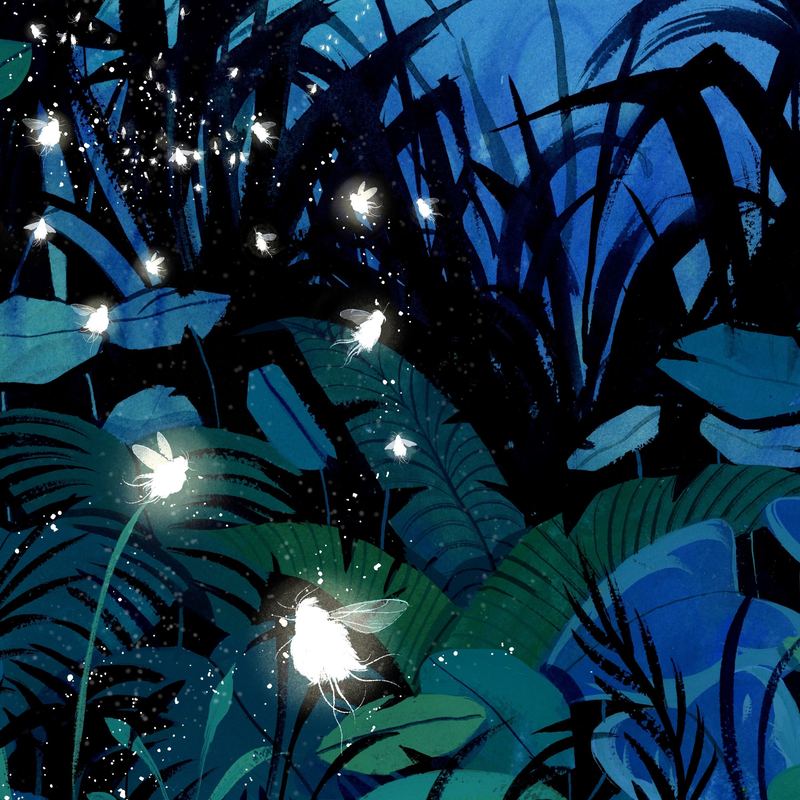
LULU: People have nicknamed you a "forest fairy," a "fuzz pixie," a "ghost bug." You have become ...
AMY RAY: A wooly aphid.
LULU: A wooly what?
AMY RAY: Aphid.
LULU: Got it! Now is the part where I make you sing the theme song with me. "Terrestrials. Terrestrials, we are not the worst. We're the ..."
AMY RAY: Best-rials.
LULU: Yeah, you did it!
AMY RAY: [laughs] I got it.
LULU: Terrestrials is a show where we uncover the strangeness right here on Earth. I'm your host, Lulu Miller, joined as always by my songbud ...
ALAN GOFFINSKI: Aphids are teeny tiny bugs.
LULU: Alan.
ALAN: And this one is snug as a bug in a rug—that's its own little wooly coat.
LULU: And talking to us today about aphids is someone it was very surreal to just sing the theme song with, because she is half of my all-time favorite musical duo.
LULU: Can you introduce who you are?
AMY RAY: I'm Amy Ray from Indigo Girls.
LULU: Ahh!
AMY RAY: Me and Emily, we're two people that have known each other since we were 10 years old, discovered that we both loved music and wanted to play it together.
LULU: Two 10-year-old dreamers, who would eventually pick up guitars, and go on to become the Indigo Girls, performing thousands of concerts, selling millions of records, and enchanting the world with their stirring harmonies. Like this one and one of my favorite songs, "Galileo." Oh! That is so pretty to listen to, and weirdly enough the aphid story that Amy brought us ends up leading us to discover the secret harmony of the forest. Now Amy had never seen a wooly aphid until just about a year ago, when she was on a springtime walk in the woods behind her home in Georgia.
AMY RAY: I'm walking on this path that I always walk, and it's right above a creek.
LULU: And with her is ...
AMY RAY: My dogs.
LULU: Okay, okay.
AMY RAY: There's seven of them.
LULU: Seven?
AMY RAY: Seven. Purdue, Scruffy, Miska, Luna, Halo, Lonnie and Picard. [laughs]
LULU: [laughs]
AMY RAY: I walk two at a time.
LULU: And as they all walk along by patches of ferns and holly bushes ...
AMY RAY: It's like a very idyllic trail.
LULU: Amy is hunting.
AMY RAY: I check in on all my little areas.
LULU: For little treasures like maybe a ...
AMY RAY: Spider lily. And it only blooms for, like, a few days.
LULU: Or ...
AMY RAY: I always walk by my chanterelles areas to see how they're doing.
LULU: Oh, mushrooms!
AMY RAY: They're kind of orange and yellow, and they look raggedy, like a—like an ear that's kind of messed up. And the turtles come at some point.
LULU: Oh!
AMY RAY: It's fun to watch them make their little hole and put eggs in it and stuff.
LULU: And about 15 minutes into this one particular walk ...
AMY RAY: I crossed a creek, I've turned a corner.
LULU: And just as she walks under a beech tree ...
AMY RAY: My shoulder kind of brushed this branch. I looked on it, and there were all these little white things on the branch.
LULU: It looked like a fur of hundreds of tiny white cotton balls.
AMY RAY: And I was like, oh, what are those? Is it a fungus, is it a weird kind of lichen or something? And then I reached my hand to investigate. I pulled a branch towards me so I could really look at 'em. I just touched the tip of the branch.
LULU: Mm-hmm?
AMY RAY: And then that's when I saw the stadium wave.
LULU: Like when people are at a soccer stadium, and people in different sections stand up and throw up their arms so it looks like a wave spreading across the crowd.
AMY RAY: It was like all these little arms that went up in the air like they were, like, waving.
LULU: But then they stopped.
AMY RAY: It looks like they're almost, like, sleeping, kind of curled up like a little ball.
LULU: Until she touched the branch again. Or even just waved her hand nearby.
AMY RAY: It startles them, and everybody goes crazy and they're waving their arms around.
LULU: And she kept doing it.
AMY RAY: I would leave the branch alone, they would stop, and then I would touch it again and they would wake up again. And I swear I was, like, completely mesmerized because I had never seen this before.
LULU: She said she almost could not compute what she was seeing.
AMY RAY: Yes! It was a reality glitch.
LULU: A glitch in reality. Like, why is this thing that looks like a plant or fungus responding to me?
AMY RAY: And then it was just like I can't wait to show this to somebody.
LULU: So she scooted back to the house, flew through the doors, where she found ...
AMY RAY: Ozie.
LULU: Her kid!
OZIE: Yeah.
AMY RAY: This is Ozie!
LULU: Hi, Ozie!
AMY RAY: [laughs] And I grabbed them and I'm like, "Ozie, you gotta see this." Because that's our thing is we like to discover things on walks.
LULU: So together they run back, over the creek, around the bend, and Amy shows Ozie the branch with all the white cottonball things—which she still didn't know yet but you have probably guessed were wooly aphids—and ...
AMY RAY: I touched my finger to the branch and all of a sudden ...
[Whee! Whee! Whee!]
LULU: A stadium wave swept across the branch, and Ozie, like Amy, was full of questions.
OZIE: Why do they wave their arms or legs when you shake the branch or get close to them?
AMY RAY: Like dancing on a branch.
OZIE: What does it do for them?
AMY RAY: Do they experience joy? It's like they're happy.
LULU: But are they? And by the way, what are they? Are these white cottony fuzzballs a growth in the tree bark?
AMY RAY: Fungus?
LULU: Larvae?
AMY RAY: A weird lichen?
LULU: Parasites? Pollinators?
OZIE: What part do they play in the ecosystem?
LULU: And as Ozie was wondering all these things, they touched the bark just beneath the aphids and wondered ...
OZIE: Why are they sticky?
LULU: Sticky?
OZIE: Yeah.
AMY RAY: So I don't know the answers to any of those questions.
LULU: Would you like some—would you like some answers?
AMY RAY: Oh, yeah. Yeah. I want some answers.
SAMMY RAMSEY: Hey, hey!
LULU: That is a voice, if you listen to Terrestrials, you probably recognize: Bug Correspondent Dr. Sammy Ramsey.
SAMMY RAMSEY: [laughs]
LULU: Who says Amy and Ozie are not alone in thinking that these fuzzy white critters look like they are dancing.
SAMMY RAMSEY: They have developed this nickname, the Boogie Woogie aphids.
LULU: [laughs]
SAMMY RAMSEY: Because they dance in synchrony. It's like a little disco. And it's so cool to watch.
LULU: Unfortunately, however, while they dance they are likely not experiencing joy as Amy hoped.
SAMMY RAMSEY: Um, you are looking at aphids that are in alarm mode.
AMY RAY: Oh no!
SAMMY RAMSEY: They are full of stress in this moment ...
LULU: Oh!
SAMMY RAMSEY: ... because they think something's trying to eat them.
LULU: Aw. And who tries to eat them?
SAMMY RAMSEY: Wasps. Or ladybugs.
LULU: Which are often seen as good luck to us, —but very bad luck to an aphid.
SAMMY RAMSEY: I need you to know.
LULU: Yes?
SAMMY RAMSEY: Ladybug jaws are no joke.
LULU: Really?
SAMMY RAMSEY: They are really freaky. Jagged, munchy, they'll just chop up the aphids with their jaws.
LULU: Like very cutely polka-dotted sharks of the sky.
SAMMY RAMSEY: Mm-hmm.
[LADYBUG: Me want aphid! Nom nom nom.]
LULU: And so, if a wooly aphid thinks a terrifying ladybug or a wasp is nearby ...
SAMMY RAMSEY: They'll all start bouncing around and dancing at the same time.
[APHIDS: Whee!]
LULU: Shaking those puffy white tailfeather things that Sammy explains are actually tiny spikes made of ...
SAMMY RAMSEY: Wax.
LULU: Huh!
SAMMY RAMSEY: And it tells the predator if you come over here, we'll poke you.
LULU: Oh wow! So can those wax spine things really, like, hurt the ladybug?
SAMMY RAMSEY: No. They are not really particularly good at defending themselves.
LULU: Is it more like a little slap? It's like, "Eh, go away!" Like it wouldn't kill the thing, but it would annoy it?
SAMMY RAMSEY: Yes, annoy it enough that it leaves.
LULU: Or it might leave? Sammy explains that often the predators are not scared away by the tiny aphids shaking their soft wax tutus.
SAMMY RAMSEY: They're easy pickins'.
LULU: Aw! So if that doesn't work, will the aphids just run away?
SAMMY RAMSEY: No. If you look at an aphid's legs, they're really thin, so they can't move very quickly. Some of them don't move their entire lives.
LULU: Oh! [laughs]
LULU: But wait, there's more! They also ...
SAMMY RAMSEY: Cannot jump.
LULU: [laughs] Can they fly?
SAMMY RAMSEY: Not really.
LULU: Sammy explains that most aphids don't have wings, and those that do can't even really flap 'em. They just kinda sail.
SAMMY RAMSEY: If the wind is not blowing very well, they can't fly very effectively.
LULU: Okay, but we are, we're in the bug world. There's some famously very cool stuff going on there. Can they shoot boiling hot liquid like bombardier beetles?
SAMMY RAMSEY: No.
LULU: Shoot webs like spiders?
SAMMY RAMSEY: No.
LULU: Spray stinky stuff?
SAMMY RAMSEY: Uh, no.
LULU: Sammy says their bodies just don't have cool features like that, but to defend against hungry ladybugs the aphids do do something incredible.
SAMMY RAMSEY: Yeah.
LULU: So remember how Amy's kid Ozie asked ...
OZIE: Why are they sticky?
LULU: It turns out this is the key to their ingenious defense. So join me if you will on a very brief and very—ugh—sticky tangent. See, what the aphids are doing as they sit on a tree day after day is sucking sap.
[APHID: Slurp, slurp, slurp, slurp.]
LULU: Turns out beech trees—just like maple trees—have sap. You can even turn that sap into syrup, beech tree syrup!
ALAN: I'd like one stack of flapjacks with beech tree syrup, please! Yum!
LULU: So as these suckers are just imbibing gobs and gobs of this fine sappy delicacy ...
[APHID: Slurp, slurp, slurp.]
LULU: ... eventually they hit a point where they need to ...
SAMMY RAMSEY: Poop.
LULU: And because basically all they've been eating all day long is sugar, they ...
SAMMY RAMSEY: Literally poop candy!
LULU: [laughs] So that sticky stuff underneath them is poop candy? Or candy poop?
SAMMY RAMSEY: Yes!
LULU: Or candied poop? Anyway, whatever you call it, the point is their excrement is full of sugar, which is highly prized in the natural world, because sugar when eaten provides a lot of fuel to power the body. And you know who adores it? You definitely do know who adores it. Who is all over you when you go on a picnic with your sticky jelly sandwiches and pastries?
SAMMY RAMSEY: Ants!
[ANTS: Yum yum!]
LULU: Ah! There's ants everywhere!
[ANTS: That poopy sugar stuff, we can't get enough. Ve are the termin-ant-ers.]
SAMMY RAMSEY: The aphids' excrement is called honeydew.
LULU: [laughs] What a rebrand of doo-doo.
[ANTS: Danke schön for this honeydew. We want to eat the aphid poo.]
LULU: And the ants cherish this sugary aphid poop so much ...
SAMMY RAMSEY: If they see a ladybug walk over ...
[ANTS: Not so fast, you ladybug.]
LULU: The ants, who are a lot bigger and musclier than the aphids, will team up and ...
SAMMY RAMSEY: They will literally grab the ladybug by all of its legs and carry it away.
[ANTS: No way, lady!]
SAMMY RAMSEY: You are not going to eat my sugar mama!
LULU: Oh my goodness!
SAMMY RAMSEY: [laughs]
LULU: So the aphid doesn't need to have big strong bodies because the ants will literally fight off the predators for them?
SAMMY RAMSEY: Yeah.
LULU: And Sammy says that's not all ...
SAMMY RAMSEY: The ants ...
LULU: If they notice a group of aphids has sucked too much sap out of a branch or plant, like if that area starts wilting ...
SAMMY RAMSEY: They will pick their aphids up ...
LULU: No!
[ANTS: Come with me if you want to live!]
SAMMY RAMSEY: ... and run them over to another plant.
LULU: No!
SAMMY RAMSEY: Yup.
LULU: Is it a piggyback situation?
SAMMY RAMSEY: The ants pick them up with their mouth parts and they just walk around with the aphids ...
LULU: In their mouth?
SAMMY RAMSEY: Mm-hmm.
AMY RAY: Are you serious?
LULU: Yes, Amy Ray, I am!
LULU: And turns out these ants are so dedicated to keeping these little defenseless aphids safe and well fed that scientists call what the ants are doing ...
SAMMY RAMSEY: We call it aphid farming.
ALAN: [sings] Old MacDonald had an—aphid. [laughs]]
SAMMY RAMSEY: If you think of the ant as the farmer.
LULU: Okay.
SAMMY RAMSEY: And the aphids as cows, and they're milking them for the sugar ...
LULU: Oh, so they're, like, taking care of them, and fighting off predators in exchange for this treasured sugary delicacy they get?
SAMMY RAMSEY: Mm-hmm. Exactly.
AMY RAY: Oh! [laughs]
LULU: So it's this really amazing example of symbiosis, like ...
AMY RAY: That's incredible!
LULU: ... they're each providing for each other in different ways.
AMY RAY: I mean, that's so beautiful and crazy to think about the ants and the aphids. It's like a little paradise.
LULU: The surprising soundtrack of this teensie paradise right after this short break!
LULU: Vroot. Terrestrials is back. We are here with Amy Ray from the Indigo Girls.
AMY RAY: Hey!
LULU: Who about a year ago fell in love with a bunch of aphids sitting on a tree branch.
AMY RAY: Yes! For days I took the same path with my dogs, just to go by the tree and make the little things wave at me.
LULU: [laughs]
AMY RAY: I'm serious. I know that's weird. [laughs]
LULU: And she asked us to find out a little bit more about what these creatures are, who they are, what their lives are like. Which led us to discover that aphids can do something pretty amazing, something I didn't totally understand was possible in the natural world, which is that, you know how we are often told that to make a baby you need a mommy and a daddy? Well, aphids, they just don't need a dad.
SAMMY RAMSEY: Mm-hmm.
LULU: The females can reproduce without males.
AMY RAY: Oh, wow!
LULU: Uh-huh.
AMY RAY: Super interesting.
SAMMY RAMSEY: We have a word for this. It's called parthenogenesis.
LULU: Parthenogenesis!
SAMMY RAMSEY: Parthenogenesis. [laughs]
LULU: And there are all kinds of creatures that can do it, from lizards to sharks to condors, which are huge birds!
ALAN: [sings] 'Cause tonight is the night, when one becomes two-ooo.
LULU: [laughs] But back to our wooly aphids!
SAMMY RAMSEY: So a female aphid will pop out another aphid without mating, and she can just keep doing this over and over.
LULU: Huh!
SAMMY RAMSEY: They're kind of like Russian nesting dolls, where you open one and then there's a smaller one inside of that, and then you open the next one and there's a smaller one inside of that. Inside a newborn aphid is a developing daughter aphid, and inside that daughter is the next one that's gonna be born.
LULU: Daughters all the way down, down, down.
AMY RAY: Wow! [laughs]
LULU: So what Amy saw on that tree branch that day was likely a big family of moms and daughters and grandmas and granddaughters, all sippin' up sap.
[APHID: Slurp, slurp, slurp.]
LULU: Getting stronger and rapidly cloning themselves, from one hundred to one thousand to maybe ten thousand, which is why some humans don't have the nicest of names for them, sometimes calling them ...
SAMMY RAMSEY: Plant lice.
LULU: ... plant lice.
AMY RAY: Oh no!
LULU: Because in addition to beech trees, aphids also love to suck the fluids out of cabbage plants, sweet potatoes, tomatoes, things we love to grow. And when a colony of all these girlies gets to sipping all day?
[APHID: Nom nom nom.]
LULU: They can do a lot of damage to a farmer's crops.
AMY RAY: Oh, that's sad.
LULU: But interestingly, it is thanks in part to how damaging aphids can be to plants that scientists discovered something incredible about plants, something plants are doing behind our backs, almost like in the movie Toy Story where the toys come to life when we aren't looking. It turns out that plants, when they are attacked by aphids ...
SAMMY RAMSEY: When the aphids stick their mouth parts into the plants, the plants are singing.
LULU: Plants?
SAMMY RAMSEY: Yeah, yeah. The plants.
LULU: Those quiet—famously quiet beings?
SAMMY RAMSEY: [laughs]
LULU: They're singing?
SAMMY RAMSEY: Sort of.
LULU: Sammy explains they aren't singing out using sound, but instead using chemicals.
SAMMY RAMSEY: Volatile organic compounds, we call them VOCs.
LULU: And these VOCs are released from the plant in a kind of a spritz of chemicals—chemicals that contain a message, a sort of alarm cry that can carry through the forest, saying something like ...
SAMMY RAMSEY: Hey everybody. Help!
LULU: [laughs]
SAMMY RAMSEY: Something is chewing on me!
LULU: [laughs] But who would these messages be meant for? Would it be other plants?
SAMMY RAMSEY: Bingo! When a nearby plant detects this chemical alarm signal, the plant can release a kind of repellent like a literal bug spray to keep the aphids from coming to get them.
AMY RAY: Wow! I love that.
LULU: That is so genius. It's like a song, or a chemical cry, that protects their neighbors.
SAMMY RAMSEY: Exactly.
LULU: And it turns out the plants' chemical communications can also be received by someone else.
SAMMY RAMSEY: Wasps.
LULU: Who then fly in to attack the aphids. Meaning ...
SAMMY RAMSEY: Plants have figured out how to get a bodyguard on speed dial. Like, I need you to think about that. That is amazing!
LULU: It is amazing!
AMY RAY: That is amazing!
LULU: Okay, Sammy, I feel just like a need to just, like, recap everything you just told us about all these different messages whizzing through the forest. So you got the aphid. Aphid lands on a plant and starts sucking the sap.
[APHID: Yum yum yum yum yum yum.]
LULU: And then that plant is like, ouch! And sends some kind of alarm cry ...
[PLANT: Help help help help help help help help.]
LULU: Which can be received either by other plants, who then release a "go away, go away" repellent. Or by wasps who will then drone in to try to attack the aphids, who then detect the wasp and start dancing their boogie woogie to fend them off.
[APHIDS: Go away, boogie woogie woogies. Go away, boogie woogie woogies. Go away, boogie woogie woogies.]
LULU: Which probably won't work, so the nearby muscle-y ants rush in ...
[ANTS: We got ya! We got ya! We got ya!]
LULU: ... to carry the aphids away to a new plant.
LULU: And Sammy says when you think about all these different messages and calls and responses coming together, you begin to hear it. The forest's ...
SAMMY RAMSEY: Harmony.
AMY RAY: Harmony.
SAMMY RAMSEY: Even though the notes that they're singing are different, they're all singing the same song.
LULU: Ooh, and what is the song?
SAMMY RAMSEY: This is the song of balance.
LULU: Amy, what actually is harmony?
AMY RAY: What a question.
LULU: All this talk about the forest's harmony, well, it got me thinking about musical harmony. Like when Amy sings with Emily on a song like, on say, "Closer to Fine."
LULU: Why does that feel so good?
AMY RAY: I mean, what is harmony? It's interesting, because music is sound waves. Sound is a wave, and harmony is different waves that fit together like a puzzle.
LULU: Huh!
LULU: A lot of us can be uncomfortable with difference when we encounter it in our lives—different opinions, different beliefs. It can make us turn away. But what Amy explains is that you cannot get harmony with sameness. You need ...
AMY RAY: Difference. That's the magic.
LULU: Huh.
ALAN: [sings] If I sing one note just as steady as can, like I'm waiting for something to bloom and begin/If I sing these notes steady like I do, you feel the tension when I'm singing alongside you/If I sing one note just as steady as can, like I'm waiting for something to bloom and begin/If I sing these notes steady like I do ...
AMY RAY: [sings] I feel it start in me, the harmony floating through.
ALAN: It can break through the sameness, and our differences ring true/I feel it start in me, this harmony floating through.
AMY RAY: [sings] There's a balance between us when I sing with you/You are a part of me, this harmony floating through.
ALAN: [sings] It's a little sound/It's getting bigger now/It's a little sound/It's getting bigger now/It's a little sound/It's getting bigger now/It's a little sound/It's getting bigger now.
AMY RAY: [sings] If I sing these songs steady like I do//You are a part of me, this harmony floating through. If I sing these songs steady like I do/You are a part of me, this harmony floating through.
ALAN: [sings] 'Cause if this world was just one bleak hum, nothing unique, nothing new.
AMY RAY: [sings] When there's a beauty of harmony floating through.
LULU: Alan Goffinski in harmony with Indigo Girl Amy Ray! Does that make him an Indigo Boy? I don't know, you tell me. And there is nothing else cool about to happen. What's that?
BADGER: Excuse me, I have a question.
BADGER: Me too.
BADGER: Me three.
BADGER: Me four.
LULU: The Badgers! Listeners with badgering questions for the experts.
LULU: Are you ready?
SAMMY RAMSEY: Yes!
TRAVIS: Hi, my name is Travis, I'm six years old. My question is how much does an aphid weigh?
SAMMY RAMSEY: So before, when I was weighing aphids in the lab ...
LULU: Oh, you have weighed them?
SAMMY RAMSEY: I've weighed a lot of aphids.
LULU: "I've weighed a lot of aphids in my day."
SAMMY RAMSEY: [laughs] 0.3 to 0.5 milligrams.
LULU: How many grains of sugar would that be?
SAMMY RAMSEY: Just a couple!
LULU: Wow, so they're little!
SAMMY RAMSEY: They're little guys.
ALAN: [sings] Just a spoonful of sugar would be hundreds of aphids or more! Yuck!
SAMMY RAMSEY: [laughs]
AURELIA: Hi, I'm Aurelia. I'm eight years old. What is a wooly aphid, and can we make sweaters out of it?
SAMMY RAMSEY: Oh, that's a great question!
LULU: I know! Like, can you shear an aphid, like you shear a sheep?
SAMMY RAMSEY: I think you would have a really hard time making a sweater out of them. It's not wool. It's wax that looks like wool, and wax is not great as a clothing ...
LULU: Oh, because it might melt in the heat.
SAMMY RAMSEY: You could make a candle.
LULU: Oh! I like that, a teensy little aphid candle. Which you could blow out for a teensy tiny wish!
ROBIN: Hi, I'm Robin. I'm 78. And I'm also Lulu's mom.
ALAN: Mom question!
ROBIN: Should we eat aphid poop?
LULU: And why did you wonder that?
ROBIN: Because we wouldn't have to grow expensive sugarcane with all sorts of chemicals.
SAMMY RAMSEY: Great question! Curious humans out foraging for edible plants in forests have indeed been known to eat honeydew, like literally right off the tree sometimes!
LULU: Wow, neat!
LULU: But wait, there's more.
SAMMY RAMSEY: And okay, I know it might sound a little gross, but it's possible that you already have eaten aphid poop.
LULU: Wait.
SAMMY RAMSEY: So depending on what kind of honey you've consumed ...
LULU: Uh-huh?
SAMMY RAMSEY: ... there are bees that will fly to aphids, they will suck up that honeydew that is officially the aphid's poop and they will use that to make their honey.
ROBIN: You're kidding.
LULU: He is not kidding! And apparently some people think it's such a delicacy that they harvest and sell this very special poop honey.
LULU: I ended up ordering some from New Zealand.
ROBIN: No!
LULU: You want to taste with me?
ROBIN: Honeydew honey!
LULU: Okay, opening the little jar here.
ROBIN: Oh my gosh, look at that.
LULU: It's a little frothy on the top.
ROBIN: Am I gonna eat that?
LULU: Yup. Okay, ready? All right, here we go.
ROBIN: Hmm. It's actually sweeter than honey, but it's an acquired taste.
LULU: The aftertaste to me tastes a little pee-pee-esque.
ROBIN: It does. It's a little sharp.
LULU: Okay, so sweeter than sweet with notes of urine.
ALAN: Taste test completed!
FELIX: Hello, my name is Felix and I am nine years old. How many aphids would it take to devour an entire sunflower in a day?
SAMMY RAMSEY: So they wouldn't chew up the flower the way that a beetle would if it was eating a flower. They suck all the juice out of it, and then the flower just kind of flops over. But how many aphids would it take? Hundreds and hundreds of aphids all feeding in one day. I bet you they could make it limp, for sure.
LULU: Okay. I need to—I need to jump the line here, because I'm still thinking about something you said, which is that aphids don't need males to reproduce. So does that mean there just are no male aphids?
SAMMY RAMSEY: They do have male and female.
LULU: Okay.
SAMMY RAMSEY: But the males are seasonal, in the fall.
LULU: Wait, wait, wait, wait, wait. The males are seasonal?
SAMMY RAMSEY: Yeah. Seasonal boys.
LULU: What does that mean?
SAMMY RAMSEY: So the aphids pick up on the change in day length as winter approaches.
LULU: Oh, like how much light there is each day?
SAMMY RAMSEY: Mm-hmm. And those females will actually start to produce male offspring. They have wings.
LULU: Oh!
AMY RAY: No way!
LULU: So describe for radio. What are you looking at? What do you see?
LULU: I showed Amy a picture of one of these winged male wooly aphids.
AMY RAY: It looks like a fairy. [laughs]
LULU: Yeah. Yeah.
AMY RAY: With these iridescent wings that are, like, rainbow-y.
LULU: Yeah.
AMY RAY: Like little beautiful delicate little wings.
LULU: Yeah.
AMY RAY: Like, how long does it take them to sprout those wings? Like, if I sit there long enough, will it happen? [laughs]
LULU: Great question. I gotta check with Sammy.
SAMMY RAMSEY: So for Amy, what she would really need to do is just visit that population over the course of the fall and watch as there's this transition that happens, almost like a light switch is flipped, where she'll start seeing ones that have wings. And her best options for seeing them will be to look all around.
LULU: Hmm.
SAMMY RAMSEY: Just kind of spin in the forest and do a "The hills are alive ..."
AMY RAY: [laughs]
LULU: [laughs]
SAMMY RAMSEY: There'll be spiraling all around her.
AMY RAY: Now I know to look for that.
LULU: All right, and I think that is a good place to leave it. And I won't tell you that aphids poop out so much honeydew that if they live in too dense of a colony, young aphids can sometimes drown in their own doo-doo, which is possibly the worst way to go. I won't tell you that because I'm nice.
LULU: Terrestrials was created by me, Lulu Miller, with WNYC Studios. This episode was produced by Alan Goffinski, with sound design by Alan and Mira Burt-Wintonick. Sarah Sandbach is our executive producer. Our team also includes Ana González, Tanya Chawla, Natalia Ramirez and Joe Plourde. Fact-checking this episode by Diane Kelly. Support for Terrestrials is provided by the Simons Foundation, the Arthur Vining Davis Foundations, and the Templeton Foundation. Thank you!
LULU: Big thanks also to Sammy Ramsey, who has a new documentary that just came out called "Secrets of the Bees" from National Geographic. It is un-bee-lievable, and I hope that it generates lots of buzz. And thank you to Amy Ray and to Ozie. It was a dream come true to get to do this with you.
LULU: Oh, that sound means we've got some April birthdays to shout out for our Explorers Club members. All right, Alan, here we go!
ALAN: Happy happy birthday!
LULU: Ada, Alden, Anaïs.
ALAN: Clover, Grace and Linden.
LULU: Cobalt, Cooper, Corina, Dean, Eleanor, Eliana.
ALAN: Elliott, Finley, Graham, Henry.
LULU: Juniper!
ALAN: Kai, Noah, Raafi.
LULU: Ella.
ALAN: Rowan, Robin Elias.
LULU: And finally Simon. Happiest bees! You are all as sweet as the doo-doo of an aphid! And finally, Amy actually has a present for you, it is a tip about how to be present, to help you notice the little treasures in this world, like aphids.
AMY RAY: Take walks barefoot.
LULU: Ooh!
AMY RAY: Because you have to really look where you're going. And it really helps see things.
LULU: Very clever! If you would like to join the Explorers Club and experience off-key singing from me and Alan, along with ad-free listening and other perks, go to Terrestrials.org/join and see if it's for you. Thank you everyone for listening. And see you in a couple spins of this dirty ol' planet of ours.
-30-
Copyright © 2026 New York Public Radio. All rights reserved. Visit our website terms of use at www.wnyc.org for further information.
New York Public Radio transcripts are created on a rush deadline, often by contractors. This text may not be in its final form and may be updated or revised in the future. Accuracy and availability may vary. The authoritative record of programming is the audio record.