The DADventure: Wild Animal Dads from Owl Monkeys to Seahorses
[RADIOLAB FOR KIDS INTRO]
LULU MILLER: Three, two, one. Imagine ...
MICHAEL: You shrink down to the size of a chihuahua.
LULU: And your eyes grow bigger.
MICHAEL: And bigger.
EDUARDO FERNANDEZ-DUQUE: And bigger.
LULU: Until they take up almost half your head.
MICHAEL: And these eyes give you great night vision.
EDUARDO FERNANDEZ-DUQUE: So when most of the forest has gone to sleep. You can come out to feast.
ALAN GOFFINSKI: [chomp]
LULU: And swing.
EDUARDO FERNANDEZ-DUQUE: And play!
LULU: You have become ...
EDUARDO FERNANDEZ-DUQUE: An owl monkey!
MICHAEL: An owl monkey.
LULU: Now is the part where I make you sing the theme song with me! "Terrestrials, Terrestrials. We are not the worst, we are the ..."
EDUARDO FERNANDEZ-DUQUE: Best.
MICHAEL: Bestrials!
LULU: You got it!
EDUARDO FERNANDEZ-DUQUE: Bestrials! Oh my!
LULU: Terrestrials is a show where we uncover the strangeness waiting right here on Earth. I'm your host Lulu Miller, joined as always by my songbud ...
ALAN: Hoot hoot!
LULU: Alan!
ALAN: Hoot do you think you are?
LULU: Now, like snowflakes, no two families are exactly the same. Families with one parent, families with a mom and a dad, families with two moms, like mine, families with two dads, families with a nonbinary parent or a grandparent parent. Like snowflakes, the shape and beauty of a family is limitless. But with Father's Day right around the corner, we wanted to spend some time shining light on daddies!
LULU: That's right! We are heading off on a dadventure that will have you swingin' high in the trees with owl monkey dads, and burblin' deep in the sea with seahorse dads, and leaping and bounding and twirling with such cool frog, bug and bird dads that it just might flip—whew!—your understanding of fatherhood, showing you why what it looks like to be a dad is way more rad than we are sometimes taught. And here to guide us on this dadventure are two human dads.
EDUARDO FERNANDEZ-DUQUE: Hello!
MICHAEL: You go first.
EDUARDO FERNANDEZ-DUQUE: No.
LULU: Dad number one. Michael. He's got a daughter.
MICHAEL: Mila. She's 11, almost 12.
LULU: And dad number two.
EDUARDO FERNANDEZ-DUQUE: My boys are 33, 30 and 23.
LULU: Dr. Eduardo.
EDUARDO FERNANDEZ-DUQUE: [bird calls] And my last name is Fernandez-Duque.
LULU: Someone chimed in. Was that a bird?
EDUARDO FERNANDEZ-DUQUE: I am surrounded by birds in my backyard.
LULU: Yeah, there was a gorgeous bird call. And you're right now in Argentina?
EDUARDO FERNANDEZ-DUQUE: Yes.
LULU: Dr. Eduardo is a biological anthropologist and behavioral scientist who has spent decades observing owl monkeys in the forests of South America.
EDUARDO FERNANDEZ-DUQUE: Let me close the window. That may reduce the bird calls.
LULU: Okay. But say hi to the bird. Say hola!
EDUARDO FERNANDEZ-DUQUE: [laughs]
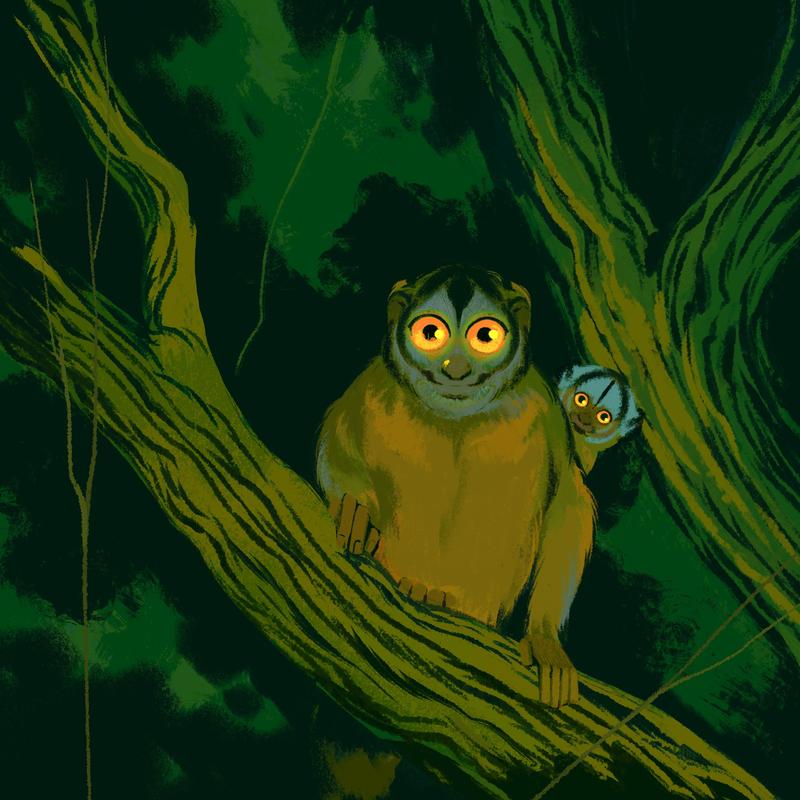
LULU: And our story begins outside that window, way out in the forest, way up high in the canopy, where there is a male owl monkey who is just moments away from becoming a father. Now picture this guy: he's about the size of a chihuahua, white face with huge orange eyes that help him see really well at night. That's why he's called an owl monkey! He does not, unfortunately, hoot like I thought he might. But like owls, he does come out at night.
LULU: Anyway, at this particular moment, next to this monkey, his mate, the female owl monkey, is pushing out a baby owl monkey the size of a chipmunk. Now this is a very charged moment in the animal world, because with some animals like chimps, lions, hamsters, goby fish, beetles—okay, the list is pretty long—the father has been known to kill their babies.
[roars]
LULU: Sometimes even eats them
ALAN: What, I was hungry!
LULU: Which is, I guess, common enough to give it a scientific name.
ALAN: Filial cannibalism! [chomp]
LULU: If they're not doing that, certain animal dads are famous for, well, bailing.
ALAN: Ooh, I'm out!
LULU: Checking out, leaving the female parent to do all the care and feeding of the baby.
ALAN: You got this, babe!
LULU: So back to our owl monkey dad, sitting right next to the baby in the Argentinian forest. The thing is, up until this moment, no one knew how that dad was going to respond, because ...
EDUARDO FERNANDEZ-DUQUE: No one—no one had ever seen a baby owl monkey being born in the wild.
LULU: But that day, Eduardo's team happened to be there, observing.
EDUARDO FERNANDEZ-DUQUE: It took about half an hour for the baby to come out of the mother's womb. And what was fascinating is that the father was also very, very close.
LULU: Really?
EDUARDO FERNANDEZ-DUQUE: And trying to help. I mean, he was touching the umbilical cord.
LULU: No!
EDUARDO FERNANDEZ-DUQUE: You know this cord that connects the baby.
LULU: Yeah!
LULU: He was possibly trying to help the mama monkey cut it, so the baby could be free.
EDUARDO FERNANDEZ-DUQUE: Dad is right there as the baby's being born.
LULU: And for the first week, the baby is just nursing nursing nursing like crazy on the mom, until ...
EDUARDO FERNANDEZ-DUQUE: Mom is like, "Enough! I've had it with the suckling. I'm done, I need some space."
LULU: [laughs] Yeah.
EDUARDO FERNANDEZ-DUQUE: But there comes dad to the rescue!
ALAN: [Tarzan yell] Here I come, kiddo!
LULU: The baby literally climbs onto the dad's back, and basically does not leave for months. The two of them bounce and swing through the treetops together.
EDUARDO FERNANDEZ-DUQUE: Dad is gonna play with the infant.
ALAN: Tag you're it!
LULU: He grooms the infant.
ALAN: Get those mites out!
LULU: He teaches him how to curl up into a tiny ball way up high in the tree so he looks almost invisible so he can sleep during the day.
ALAN: Sweet daydreams, little one!
LULU: And as the baby grows up, dad starts teaching him how to pick out tasty fruits.
ALAN: [chomps]
LULU: Which fruits to bite into.
ALAN: Yum!
LULU: Which to avoid.
ALAN: That one tastes gross!
LULU: How to catch a moth mid-air.
ALAN: Nice job!
LULU: But pretty much this whole time, the baby's little arms are wrapped around the dad's shoulders, meaning this is a three-month-long piggyback ride.
ALAN: Or should I call it a monkeyback ride?
LULU: Now around four months, the baby climbs off the piggyback ride, and starts braving the big leaps up in the branches by itself, unless ...
EDUARDO FERNANDEZ-DUQUE: Suddenly you get to a gap between branches and you need to take a jump. And so they may give you a little bit of a squeak or a squeal, and dad says, "Okay, hold on a minute, I'm gonna put him on my back and take him across the gap.
ALAN: I got ya, little one.
EDUARDO FERNANDEZ-DUQUE: What is very powerful is the evidence we have that eventually, over the years, the infant seems to have a stronger attachment or bond to the father than the mother.
LULU: Wow!
LULU: So as Eduardo and his team are discovering all the secrets of the owl monkey dad, halfway across the globe, living in Switzerland at the time, our other human dad, Michael, he's becoming a father.
MICHAEL: Yeah.
LULU: And while he is completely obsessed with his new daughter Mila, completely in love with her, he says he wasn't sure exactly what to do with her, how to soothe her, bathe her.
MICHAEL: I was—I didn't grow up sort of being super comfortable expressing my emotions.
LULU: Huh!
MICHAEL: Or super comfortable with physical touch.
LULU: Hmm.
LULU: And so at first with this baby in his arms, he just felt a little awkward or unnatural, which felt in this weird way like maybe the natural way for a dad to feel.
MICHAEL: There was this story about what's natural, you know, what's natural for the mom, for the dad, for the family. And we did have in my education a lot of comparisons to animals, but usually we were being compared to chimpanzees.
LULU: Growing up, Michael was told that since humans were closely related to chimps through evolution—we're both primates—we share a common ancestor, then some of the things chimps do might somehow be inside us as instincts, too. And chimp dads, well, at the time Michael was growing up, they were understood to be very aggressive at their worst, and at their best, well, they were just off somewhere else. It seemed like in nature, the dad role?
MICHAEL: Was about hunting and protection.
LULU: And he thought, well, maybe nature was sending him a message that he'd never be good at the softer side of parenting. And then one day a few years ago, Michael is lamenting about all this, what a dad's role truly is, when ahisfriend tells says, "Wait, wait, wait. You gotta call Dr. Eduardo."
MICHAEL: He studies owl monkeys. And I reached out to him and he was like, "I'll come over. I'll come over to your house. Let's have—like, let's have a play date," basically.
LULU: Really?
MICHAEL: And I was like, "Okay, that's awesome! Come to my house."
EDUARDO FERNANDEZ-DUQUE: It felt like that!
MICHAEL: Yeah. So he came over and we're like, "Let's go swimming."
EDUARDO FERNANDEZ-DUQUE: And I brought my goggles.
MICHAEL: He's a really good swimmer, by the way.
LULU: Okay.
MICHAEL: He's really fast. So we kept talking about all sorts of different dads.
LULU: Chimp dads and their own dads.
[mumble mumble]
LULU: And at some point Dr. Eduardo started telling Michael what he had observed with owl monkey dads.
MICHAEL: He's talking about a two- to three-month piggyback ride.
LULU: [laughs]
LULU: You guys are at your play date. I'm picturing you, you're swimming in the waves and, like, I don't know, Eduardo's like, "No, Michael." And then a wave comes, he's like, "No, no, no, really! Owl monkeys are amazing [burble burble burble] dads! Okay! So what—from your side, Michael, what did you—what did Eduardo tell you that day, and how did it hit you?
MICHAEL: Well, first I was like, that's so cute. And then at the same time I was kind of upset.
LULU: Hmm! Why?
MICHAEL: Well, I was like, why am I hearing about this for the first time? And so I was sort of like, who picked which monkey we were gonna be compared to? And why did they pick chimpanzees? Because if they had picked the owl monkeys, you know, maybe I would've learned something different. So I found myself kind of wanting to dig into sort of what other animals are out there that might do fathering differently.
LULU: Hmm.
LULU: And he will share what he finds and take us on some of the wildest turns of this dadventure after this short break.
LULU: Terrestrials is back! We are talking about the raddest of the daddest with our dad friend Michael. And he is on a quest to learn all about animal dads who defy the stereotypes and show us all the amazing ways a dad can dad. [laughs] And to start us off, we have ...
ALAN: Seahorses!
MICHAEL: The seahorse is the one that everybody knows.
LULU: Okay, but tell it.
MICHAEL: But it's important because the dads get pregnant.
LULU: So what does that mean? They really—what does that mean?
MICHAEL: He does, like, the dance, a courtship dance, and then the female will put her eggs into a pouch in the male seahorse's belly. And the pouch is kind of like a magical pouch. It will change the levels of oxygen and salt. And it's kind of like a womb, you know, getting them ready to go out into the ocean. And they're pregnant for I think a couple weeks. And then the dad seahorse goes into labor, and it could take a few hours, and they just shoot out hundreds of baby seahorses, all, like, fully formed but really tiny.
LULU: [laughs]
MICHAEL: And then they can get pregnant again a few days later.
LULU: Wow, just right off the bat, there goes nature just shattering another rule. Like, these hard lines we thought existed between what a mom is supposed to do and what a dad is supposed to do. Like, these two categories, they just aren't there.
MICHAEL: There's so many different ways to be a dad. There's a lot of options, and we're flexible and we can organize and be whatever it is that our kids need.
LULU: Hmm! Like, that flexibility, that diversities of ways to show up for the kids.
MICHAEL: That in and of itself is natural, that that is something you find in nature.
LULU: Okay, who's our next dad?
MICHAEL: I got totally obsessed with poison dart frogs.
ALAN: Poison dart frogs!
LULU: Okay. What are they—what are these?
MICHAEL: So they live in the rainforest in South America.
LULU: Do they shoot poison darts?
MICHAEL: So they're called poison dart frogs because people have used venom that comes from them to make poison tips on arrows.
LULU: Oh, cool! Okay.
MICHAEL: And they're the size of, like, your thumbnail.
LULU: Oh, tiny! Okay. Real little.
MICHAEL: So they're tiny little frogs. And they're singers—well, they chirp, right?
LULU: Okay.
MICHAEL: To kind of claim, like, a territory. And the females will listen to them chirping to see, like, who's the best singer, to decide where they want to lay their eggs.
ALAN: [sings] And I swear by the moon and the stars in the sky, I'll be there chirping.
MICHAEL: And so the females will lay the eggs on wet leaves on the forest floor, and then the dads will guard them. And this is the best part: when they hatch, the dad will take each tadpole individually on a piggyback ride.
LULU: What?
MICHAEL: So on his back.
LULU: Just like the owl monkey!
MICHAEL: Each one individually, and go and find a plant that sort of has some covering, it has some water inside.
LULU: Yeah.
MICHAEL: And he'll lay the tadpole in there so that it's safe and it has water.
LULU: Like in a pool, a little kiddie pool?
ALAN: Here, kiddo. Take a swim!
[ribbit, ribbit]
MICHAEL: And he'll lay the tadpole in, but he won't put any of them together because he doesn't want them to compete for resources.
LULU: Aww!
MICHAEL: And I think he also doesn't want, if one's born, it comes up to eat the other one. And then coming back and checking on them all the time to make sure there's enough water. And if they need to eat, the dads, they can't feed the tadpoles.
ALAN: Sorry, little froggies. Only mommy can feed you, by laying one of her eggs for you to eat.
MICHAEL: So they'll do their song again to try and persuade if there's a female in the area to come and feed them a little bit more. Remember, they're the size of your thumbnail.
LULU: Yes, teeny!
MICHAEL: And they're, like, journeying with these tadpole babies all over, placing them, coming back, checking on them. So—and they're so cute.
LULU: Like, playing music to, like, lure food back. Like, wow, that is a toad-ally awesome father.
MICHAEL: [laughs]
LULU: Next up, another contender from frog land.
ALAN: The Darwin frog!
LULU: Found in the forests of Argentina and Chile.
MICHAEL: They also guard the eggs like the poison dart frogs. But then they do this really funny thing. They put them in their mouth. They swallow them.
ALAN: Gulp!
LULU: No. Wait, like, the tadpoles or the eggs? The eggs?
MICHAEL: They swallow the eggs. And then they store them in a vocal sack in their throat, because it's safer, right? It's safer in there.
LULU: No!
MICHAEL: And then inside this pouch in their throat, they grow and they're protected. The father eats a bit less. He stops calling around so much because you don't want to draw attention.
LULU: Oh, you can't sing, because otherwise you're like, "Oh, look at my babies!"
MICHAEL: And then, like, the big reveal is when they're sort of ready to go out on their own, they just walk out of their dad's mouth into the world.
LULU: [laughs]
ALAN: So long, Pops.
LULU: They're literally taking refuge in him.
MICHAEL: Yeah.
LULU: Wow! That is talking about biting off more than you could chew. That's a big fatherly commitment.
MICHAEL: Yeah!
LULU: Next up, father number four.
ALAN: The burying beetles!
MICHAEL: So burying beetles, also tiny little beetles.
LULU: Okay. And bury, we're not talking like blueberries. You mean burying?
MICHAEL: No, like burying underground.
LULU: Okay.
MICHAEL: Because they find a small animal like a mouse or a bird that's dead. They will team up with a mom.
LULU: Okay.
MICHAEL: And they'll bury it underground.
LULU: The dead, the corpse?
MICHAEL: The carcass.
LULU: Okay. This sounds pretty gross. Okay.
MICHAEL: Yeah, it is gross. But it's also really cool.
EDUARDO FERNANDEZ-DUQUE: Full of love.
MICHAEL: They'll clean it, they'll get rid of debris and they'll shape it.
LULU: Okay. Wait, so I'm picturing—okay, let's just go with a mouse. So, like, a dead mouse. They clean it, meaning like they eat all the dead meat and fur or they get it off?
MICHAEL: Hold on, I have a picture, too.
LULU: Wait, what am I looking at?
MICHAEL: It was a mouse.
LULU: Ugh!
MICHAEL: It's gonna be a nursery.
LULU: Wait? A corpse—a skeleton crib?
MICHAEL: Yeah.
LULU: A skeleton nursery.
MICHAEL: No, it's not just a skeleton, because it's also gonna be a source of food. It's gonna be an edible nursery.
LULU: Okay, so it's a corpse nursery.
MICHAEL: Yeah. Yeah, yeah, yeah.
LULU: So it's like a corpse nursery.
MICHAEL: Yeah.
LULU: Corpse crib!
MICHAEL: Exactly. It's the corpse crib, but not so scary, because they coat it with this antimicrobial secretion. So they kind of like ...
LULU: Oh, because dead meat has lots of bacteria.
MICHAEL: Yeah. And the antimicrobial secretion—I looked this up just for Terrestrials. It comes from their mouth and from their butt. [laughs]
ALAN: [sings] Show them you care with antibacterial spray from your derriere!
EDUARDO FERNANDEZ-DUQUE: Don't try this at home.
MICHAEL: Don't try this at home.
EDUARDO FERNANDEZ-DUQUE: That's the message.
LULU: They find a dead body.
MICHAEL: Yeah.
LULU: They, like, mush the dead flesh around so that it becomes shaped like a crib. They disinfect it. And then what do they do?
MICHAEL: The babies hatch.
LULU: Okay.
MICHAEL: The larvae hatch.
LULU: Yeah.
MICHAEL: And they can hang out in there, but they can't yet eat themselves. So the dad will do this thing that you see with birds, like, chew it and then feed them from it.
LULU: Once again, the "it" is dead flesh.
MICHAEL: Yeah.
LULU: So he, like, baby birds some dead flesh from the walls of the crib.
MICHAEL: Yeah, yeah, yeah, exactly.
LULU: Oh, so sweet. Happy Father's Day.
MICHAEL: And—and they'll defend their kids from animals that could be like a hundred times bigger, like a mouse. Like there's no chance they're gonna be able to do it. One of the ways they do this is they have this nasty-smelling chemical that they can make in the glands of their butt. Again.
LULU: Like a skunk, it's like an insect skunk!
MICHAEL: Yeah. Yeah.
EDUARDO FERNANDEZ-DUQUE: [laughs]
MICHAEL: And then the last part of this—and very relevant for our conversation—sometimes the mom—the mom will just wander off. And if the mom just wanders off, the dad will raise the whole family by himself, which is like 10, 20, 30 babies per brood.
LULU: Whoa!
MICHAEL: So, like, some serious heavy single fathering goes on here.
LULU: Okay, moving onto dad numero cinco!
ALAN: The chimp!
LULU: Wait, what? Wasn't the chimp the whole symbol of the mean dad?
ALAN: This just in: not all chimp's dads are mean dads.
LULU: So in recent years, scientists observing chimps in the wild in the forests of Tanzania have discovered that chimp fathers are not always as aggressive, or gnarly, or absent as we thought. There is no one way that a male chimp parents; it depends on the individual. Some of those dads groom and cuddle their babies, and on rare occasions have even been observed taking in a baby that isn't theirs!
ALAN: That's way better than our first chimpression of them!
LULU: All right, next up: a feathery father fellow—say that ten times fast! A feathery father fellow, a feathery father fellow, a feathery father fellow, a feathery father—ugh!
ALAN: Jacana!
EDUARDO FERNANDEZ-DUQUE: The jacana. It's a wading bird about the size of a chicken.
LULU: Wading, meaning it likes water?
EDUARDO FERNANDEZ-DUQUE: Yes. Yes.
LULU: Okay.
EDUARDO FERNANDEZ-DUQUE: And so the jacanas, what happens is that moms are looking around, and they go shopping for a potential dad that's gonna take good care of the eggs.
LULU: Oh!
EDUARDO FERNANDEZ-DUQUE: So the females are fighting for the attention of a male who's gonna take good care of the eggs she lays.
LULU: Wow!
EDUARDO FERNANDEZ-DUQUE: So she finds a spot, she lays the eggs. And so the male is gonna sit with the eggs and incubate them and protect them until the eggs hatch.
LULU: And mom isn't incubating at all?
EDUARDO FERNANDEZ-DUQUE: I don't think mom incubates.
LULU: Oh, gosh! I don't know why it's so hard for me to picture a dad incubating all on his own. It's, like, proof of how strong my miseducation has been, like these beliefs about dad and mom are even in our language, because we say things like, "Oh, she's a mother hen." It's a part of our language. Like ...
EDUARDO FERNANDEZ-DUQUE: Mother Nature.
LULU: Yeah, Mother Nature. Wow! Does that hurt your feelings as men?
EDUARDO FERNANDEZ-DUQUE: No. Doesn't hurt my feelings, but I think that there's a Father Nature as much as there's a Mother Nature.
LULU: Oh, I like that. Okay, now speaking of father hen types, nesting dads, it is time now for the sixth and final dad. Don't poo-poo this papa! To meet the top of the pops, we gotta go down deep to give props!
ALAN: The stickleback fish!
LULU: Okay, this fish to me looks like a tiny stegosaurus of a fish with, like, sharp spikes down its back.
MICHAEL: And that's why it's called stickleback, I think.
LULU: Okay.
MICHAEL: So they're known as, like, underwater architects. So they build nests on the bottom of a pond or a stream, also to get the moms to want to lay eggs. And they use bits of plants that they glue together with a sticky substance that is called spiggen.
ALAN: [sings] Spiggen! One fishy way to say 'I love you' is with homemade glue.
MICHAEL: It's made out of protein-based mucus.
LULU: Okay.
MICHAEL: And so they build these nests, and then they do these zigzag dances. Like, they do dances when they see a female with a belly full of eggs, to try to get her to lay the eggs in the nest. And then she goes, and the dad will take care of them and sort of take them the rest of the way.
LULU: Wow! I just pulled up a picture of the nest, because I was trying to picture it. Because, like, usually I think of a fish nest as just like a little smoothed out bit of sand. But this has architecture. It looks like a bird's nest on its side.
MICHAEL: Yeah.
LULU: It's clearly arranged with so much care. And I don't know, it just made me think back to all your worries that started this thing, Michael, that dads don't do the nesting or the cozying, or the softer parts. And it's just like, here's another one, yet another creature where the dad is doing that.
MICHAEL: Can I jump in, Eduardo?
EDUARDO FERNANDEZ-DUQUE: Yeah, go ahead!
MICHAEL: There was this study by another colleague ...
LULU: Michael says that all kinds of scientists have been trying to understand where a parent's caretaking behavior, where it comes from. Like, is it an old part of us or something that's new and involves lots of complex thought in the brain. And they're finding some pretty neat stuff! Like, there was one experiment that took dads and watched ...
MICHAEL: How their brain activates when they see and play with the baby.
LULU: And ...?
MICHAEL: You would see activation in the really old parts of the brain.
LULU: Hmm!
LULU: And another scientist ...
MICHAEL: Called Kumi Kuroda. And she was trying to isolate what part of the brain was responsible for nesting behavior. And she had concluded that the first sort of parental instinct, the first nesting behavior, was male fish millions of years ago.
LULU: Whoa! Fish, of course, are who we came from. Mammals descended from fish hundreds of millions of years ago.
MICHAEL: It was only then when we came on land and, you know, had the babies outside the body and had to breastfeed, that these other parts came in. But one of the big lessons of all of this was, you know, get in touch with your inner fish.
LULU: [laughs]
MICHAEL: We all have that kind of biology and it's really, really old.
LULU: It's deep.
MICHAEL: Yeah.
LULU: Has learning about all these different ways that dads show care in the animal world, has it changed you in any way?
MICHAEL: The sort of joke I've been making is it's a kind of new take on dad bod.
LULU: [laughs]
MICHAEL: Like, we're actually incredibly flexible, and capable of connecting in a profound way. Like, we can do this. And our bodies, our brains are made for this, actually.
ALAN: [sings] Give it up for dads. Give it up for dads. Give it up for dads. Come in all shapes and sizes—dads. They're full of surprises—dads. Of all different species—dads. And every location—dads. The dad delegation—dads. Is sweeping the nation.
ALAN: [sings] Deep in their mind, these dads are going primal/The love and care they share with their child is wild—dads. I'm talking 'bout—dads.
ALAN: [sings] They're singing off key—dads. They don't really care—dads. They're clapping off beats—dads. They're baking dessert—dads. They're mowing the lawn—dads. They're braiding your hair—dads. They're dancing along—dads. If their back doesn't hurt—dads. Give it up for dads.
ALAN: [sings] Come in all shapes and sizes—dads. They're full of surprises—dads. When a kindness arises—dads. They don't try to fight it—dads. Of all different species—dads. From monkeys to fish—dads. Are loving and cuddling—dads. And they hug and they kiss.
ALAN: [sings] Daddies who care are everywhere, it's true. So let's do this one more time with dad-itude. I'm talkin' 'bout—dads. All kinds of—dads. We're mad about—dads. So cancel your plans and celebrate—dads. So cancel your plans and celebrate—dads.
LULU: Alan Goffinski, everyone! And that's it, nothing cool left to happen. Ah! What's that?
BADGER: Excuse me, I have a question.
BADGER: Me too.
BADGER: Me three.
BADGER: Me four.
LULU: The Badgers! Listeners with badgering questions for the experts.
LULU: Eduardo, are you ready?
EDUARDO FERNANDEZ-DUQUE: Yeah, absolutely.
EMERSON: Hi, my name is Emerson. I'm seven years old. My question is: who would win in a fight? An owl monkey or an owl-owl?
EDUARDO FERNANDEZ-DUQUE: Oh gee. I think an owl-owl. I would be scared of an owl grabbing the owl monkey with its feet and claws. Yeah, I put my money on an owl.
LULU: Well, with that scientific recommendation I would put "owl" my money with an owl-owl, too.
CASSIDY: Hi, I'm Cassidy, I'm nine years old. My question is: have you ever hugged an owl monkey?
EDUARDO FERNANDEZ-DUQUE: Full disclosure. [laughs] It was back in the day when we were allowed to do these things.
LULU: Uh-huh?
EDUARDO FERNANDEZ-DUQUE: Twenty, twenty-five years ago.
LULU: [laughs]
EDUARDO FERNANDEZ-DUQUE: Yes, I've had them in my arms and held them.
LULU: But what did it feel like?
EDUARDO FERNANDEZ-DUQUE: It moves you. I mean, you're handling these animals. You want them to do well, you are releasing them into the forest again. So it's a very nice feeling.
LUCY: My name is Lucy. I'm five years old, and my question is: can owl monkeys go on to the top of your roof somehow?
EDUARDO FERNANDEZ-DUQUE: Of course! In fact, some people told me when I started working with owl monkeys, they were showing me the roof of their houses and they said, "Can you see how clean they are? There are no spider webs! Well, that's because owl monkeys do come on the roof, and they like insects and they eat them and they do the job for us of keeping the roof clean!"
LULU: Huh! Now that's some monkey business I can get behind!
TOBIN: Hey, I'm Tobin, and I'm Lucy's dad. Why are owl monkeys toes so long?
EDUARDO FERNANDEZ-DUQUE: Because that's very important if you are walking around on relatively thin branches. That's for the same reason that them, like us, have what we call the opposable thumb. It really helps your gripping of the places, of the branches along which you walk.
PARKER: Hello, my name is Parker. I'm five years old. My question is, do owl monkeys see anything different with their orange eyes?
LULU: Ooh, I love that! What would the world look like through owl monkey's eyes?
EDUARDO FERNANDEZ-DUQUE: Black and white, for one.
LULU: Oh!
EDUARDO FERNANDEZ-DUQUE: Not in color. And we would probably have pretty very detailed skills to detect the variation of the black and white. I mean, the hues, the gradient.
LULU: And what about at nighttime?
EDUARDO FERNANDEZ-DUQUE: They see better than us. They see better than us because of specific cells of the eyes.
LULU: But Eduardo says we humans can see better in the dark than you might think.
EDUARDO FERNANDEZ-DUQUE: Get out on a night of a full moon. Give yourself 10 minutes without light, and bring a book. And if you have a full moon and you allow yourself 10 minutes, you'll be reading the book.
LULU: Interesting!
EDUARDO FERNANDEZ-DUQUE: Call me if you cannot. I bet you that you'll do it. You can read a book, no problems. But you have to let your eyes adjust.
LULU: Oh God, I'm gonna try this! There's a full moon in a couple of days.
EDUARDO FERNANDEZ-DUQUE: There you go!
LULU: Okay. Test, test. It is a very full moon. I'm sitting, you can maybe hear the waves of Lake Michigan, I'm sitting right near the lake in this dark park where there are no streetlights, and I'm gonna do the test!
LULU: Ten minutes later, I opened up my son's copy of Wild Robot to a random page.
LULU: If I really look I can almost get words, like, "Somebody grinned—compink, grinned?" I can't quite. It definitely got better, Dr. Eduardo was right, it got impressively better, my eyesight in 10 minutes. But I can't quite get there. Here's what might be messing with the experiment: number one, there are some clouds in front of the moon, and number two, I'm getting older and my eyesight has actually started to get worse, and I don't have glasses. So I don't know. If you guys try this on a full moon, see if you can read even more!
LULU: And I think that's where we're gonna leave it, with some real-life experimentation. Learning "owl" about owl monkeys has been a real hoot—ha! And you're in luck, I'm not gonna tell you about barking tree frog dads who prevent their egg clusters from getting too dry by dousing them with urine. You're in luck, I'm not gonna tell you that, 'cause I'm nice.
LULU: Terrestrials was created by me, Lulu Miller, with WNYC Studios. This episode was produced by Tanya Chawla with sound design by Mira Burt-Wintonick. Sarah Sandbach is our executive producer. Our team also includes Alan Goffinski, Ana González, Joe Plourde and Natalia Ramirez. Fact-checking by Angely Mercado. Additional editorial advising by Cassius Adair.
LULU: And big special thanks to our dads Michael and Eduardo. They actually organized a conference all about dads in the animal world—and the human world—over at Yale. That was called Fathers and Fatherhood: From Molecules to Modern Families. And that's where Michael learned all about dads in the animal world. And they recently participated in another conference on dads in Brazil. And I guarantee you they're gonna organize or participate in another one. So if you are interested in dads in the animal world and our evolving understanding of dads in the human world, keep an eye on the project Early Childhood Matters, that's earlychildhoodmatters.online.
LULU: Support for Terrestrials is provided by the Simons Foundation, the Arthur Vining Davis Foundations and the Templeton Foundation. Thank you! And you! In honor of Father's Day, go show some love on the father figures in your life, whoever it is who tells you the best dad jokes—aka the worst jokes—in your life. And if you are making a Father's Day card, here is some inspiration from listener Emmie, age nine. She drew a picture of a toucan holding up a foam finger that says "Number One," and the toucan is saying "Toucan do it!" And inside the card it says, "Together we can wing it!" [laughs] I love that, because isn't that what we're all trying to do here together, just get through it as best we can together.
LULU: Okay, finally, preview! Our next episode is all about king cobras, and we want to know: what would you draw for the episode art? What would be your episode poster of a king cobra? Send it to us at Terrestrials [at] wnyc [dot] org. Or if you want to draw the thing and send it in the real mail to us, the snail mail, the old-school way, just put it in an envelope, throw a stamp on there and send it to: Terrestrials Team, WNYC Radio, 160 Varick Street, New York, NY, 10013.
LULU: We love getting mail. That's all! See you in a couple spins of this dirty ol' planet of ours. Bye!
-30-
Copyright © 2026 New York Public Radio. All rights reserved. Visit our website terms of use at www.wnyc.org for further information.
New York Public Radio transcripts are created on a rush deadline, often by contractors. This text may not be in its final form and may be updated or revised in the future. Accuracy and availability may vary. The authoritative record of programming is the audio record.