The Charmer: King Cobras' FANGtastic Powers
[TERRESTRIALS INTRO]
LULU MILLER: Three, two, one. Imagine ...
GOWRI SHANKAR: Your whole body ...
LULU: Stretches thin and your arms and legs ...
GOWRI SHANKAR: Fall off. You can feel the vibrations of elephants walking close by.
LULU: Or humans.
GOWRI SHANKAR: You can feel every step.
LULU: And though you have eyes ...
GOWRI SHANKAR: You don't need to see, because your tongue helps you do the job.
LULU: You grow scaly armor, but if those scales get damaged, you don't really mind because ...
GOWRI SHANKAR: Every three or four months, you have a new armor to protect your skin.
LULU: And if someone starts coming after you ...
GOWRI SHANKAR: You lift your head up.
LULU: High into the air.
GOWRI SHANKAR: Five feet.
LULU: As tall as an adult human.
GOWRI SHANKAR: And open up your hood.
LULU: You have become ...
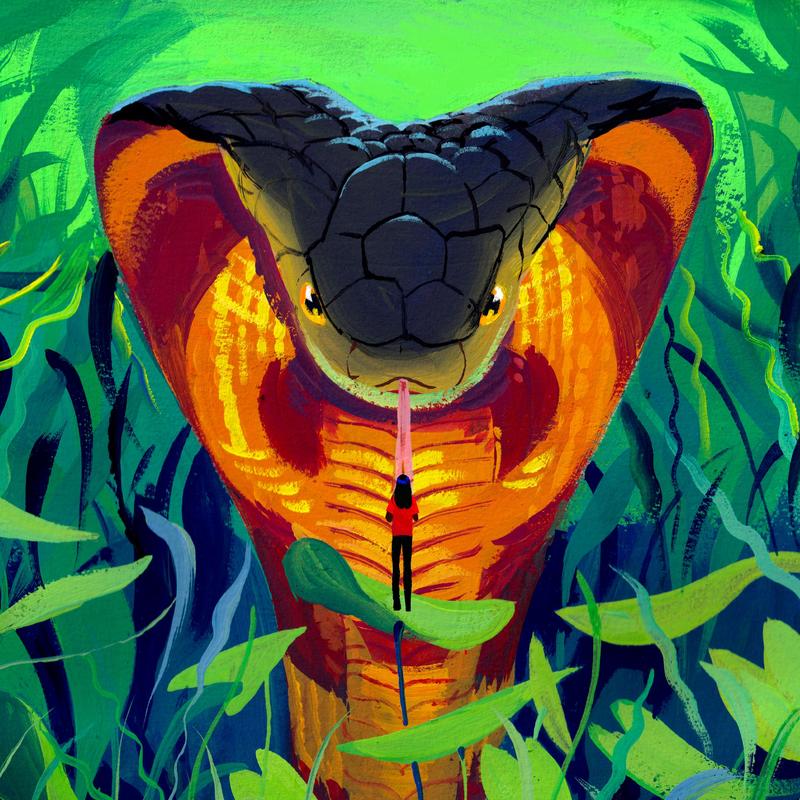
GOWRI SHANKAR: A king cobra, the longest venomous snake in the world.
LULU: Now is the part where we make you sing the theme song with us.
GOWRI SHANKAR: Okay.
LULU: [sings] "Terrestrials, terrestrials. We are not the worst, we are the ..."
GOWRI SHANKAR: Oh, you want me to fill up the blank?
LULU: Yeah.
GOWRI SHANKAR: Oh, we are the best.
LULU: Yeah, you got it!
LULU: Terrestrials is a show where we uncover the strangeness right here on Earth. I'm your host Lulu Miller, joined as always by my songbud ...
ALAN GOFFINSKI: [sings] Slithering with style ...
LULU: Alan.
ALAN: [sings] Like a radical legless reptile.
LULU: Okay. So people who are terrified of snakes, please stay tuned, because I, too, was like you. Truly. I mean, growing up, if a snake appeared on a movie screen, I would yelp and run out of the room. I actually broke my ankle while hiking—not once, but twice—trying to scramble away from what I thought was a snake, but in both cases just a tree root.
ALAN: Oh, Lulu!
LULU: To me, the fear felt automatic, instantaneous. It felt like my body was afraid before my brain even knew why. But then my oldest son was born.
JUDE: Hello!
LULU: And for some mysterious reason, by the age of two he loved snakes. He'd stare at them at the zoo, check out tons of books about them from the library.
JUDE: Because they slither!
LULU: [laughs] And over the years, watching him watch snakes, well, it's gotten me over my fear enough to at least be able to peek through my fingers at them and learn why his very favorite snake ...
JUDE: The king cobra ...
LULU: ... are, according to today's storyteller, less like monsters and more ...
GOWRI SHANKAR: Like puppies!
ALAN: Arf arf.
LULU: [laughs] So join us if you will—I'm dragging Alan along for courage.
ALAN: You got this, buddy.
LULU: As we sink our fangs into a wild adventure that will turn this rope of nope into a lasso of yasso!
ALAN: [laughs]
LULU: Along the way there will be laughs and learning, and only one snake bite—when you least expect it. So here we go!
LULU: Who are you, sir? Can you introduce yourself?
GOWRI SHANKAR: I am the king cobra guy, Gowri Shankar. I'm a herpetologist, meaning I study snakes or reptiles in general.
LULU: Herpetologist comes from the ancient Greek word herpetón, which means "creeping animal."
GOWRI SHANKAR: Yes.
ALAN: [sings] 'Cause I creep! Yeah.
LULU: [sings] Just creepin' on the down low. And these days Gowri tracks these creepy kings out in the wild, in the rainforests of India. But our story begins 35 years ago, in the city.
GOWRI SHANKAR: A beautiful garden city.
LULU: Of Bangalore, India, where Gowri grew up.
GOWRI SHANKAR: During heavy monsoon, these snakes come out of the burrows, and they would come into my house.
LULU: [gasps] I have had that very nightmare. And Gowri's mom? Well, when this one particular black and yellow snake slithered out of the darkness into their garden, she reacted in what I believe is the exact appropriate way—she released an ear-splitting scream.
GOWRI SHANKAR: Oh, she was very scared.
LULU: But Gowri calmly approached the snake.
GOWRI SHANKAR: I took a stick and pinned him down. I grabbed it. I got hold of his neck.
LULU: Oh! What did it feel like?
GOWRI SHANKAR: It was dry. It was like a leather shoe, right?
LULU: Huh!
GOWRI SHANKAR: A lot of people think snakes are slimy.
LULU: Yeah.
GOWRI SHANKAR: Snakes are not slimy.
LULU: Huh!
LULU: Now picking up this snake was a super dangerous thing to do. While it's very unlikely to be seriously hurt by a snake in the US, India is the snakebite capital of the world. Over 50,000 people die from snakebites there every year. Because see, there are wheat and rice farms all over India. And you know what else, besides humans, loves wheat?
GOWRI SHANKAR: Rodents.
LULU: Rats! Mice!
GOWRI SHANKAR: And these snakes feast on them.
LULU: Farmers in the fields can accidentally scare a snake and get bit. But luckily, the snake that Gowri caught in his garden was not one of the dangerous ones.
GOWRI SHANKAR: It's a striped keelback.
LULU: Okay.
GOWRI SHANKAR: Keelbacks are non-venomous.
LULU: So he took this stripey yellow and black, non-slimy snake ...
GOWRI SHANKAR: And gently walked out of the garden.
LULU: And let it go. It was a triumph! Young Gowri had been courageous and ushered an innocent creature to safety.
ALAN: Go, Gowri, go Gowri, go!
GOWRI SHANKAR: I felt very happy, and I felt very proud of myself.
LULU: But his mom ...
ALAN: No, Gowri, no, Gowri, no!
GOWRI SHANKAR: [laughs] She said, "No, you can't do that. That's really dangerous. These snakes can kill you!" The more she shouted at me, the more I got attracted towards these snakes.
LULU: [laughs]
ALAN: You little daredevil!
GOWRI SHANKAR: My elder brother was a very good kid. Whatever my mom, my dad would say, he would listen.
LULU: Okay.
GOWRI SHANKAR: I wouldn't listen.
LULU: So kid brother, rule breaker Gowri kept catching snakes!
GOWRI SHANKAR: Rat snakes and vine snakes.
LULU: Ugh!
GOWRI SHANKAR: Bronze back snakes.
LULU: Ugh!
LULU: And one day, a massive seven-foot-long rat snake slithered into his neighbor's house.
GOWRI SHANKAR: They make a mess. These snakes would have thrown all the kitchen utensils, their food, everything on the floor.
LULU: And they asked little Gowri to come try to catch it. So he lunges at the snake and then gets caught in this kind of one-on-one face-off.
GOWRI SHANKAR: He strike at you, and then retreats. He strike at you, and then he would retreat.
LULU: Oh, gosh!
GOWRI SHANKAR: Because they're scared of you.
ALAN: A seven-foot snake, is that, like, as thick as your arm?
GOWRI SHANKAR: Yes.
ALAN: And is it strong?
GOWRI SHANKAR: It's strong. Very strong. They're muscular, pure muscle. But I was—I was not a weak kid. I was a karate black belt guy, so ...
LULU: Oh, black belt in karate? That probably helps!
GOWRI SHANKAR: Yeah.
ALAN: Using your karate moves on the snakes.
GOWRI SHANKAR: Karate moves, yeah.
LULU: So Gowri dodges snake bites, roundhouse kicking over chairs, till he's able to ...
GOWRI SHANKAR: Grab them right on the middle of the body.
LULU: Yank him from his hiding spot, and ...
GOWRI SHANKAR: Bag him.
LULU: Right into a pillowcase.
GOWRI SHANKAR: By then, there would be, like, 50 or 100 people watching me capturing the snake.
LULU: Whoa!
ALAN: Go, Gowri, go Gowri, go!
LULU: And word started to spread about this snake-catching karate kid.
GOWRI SHANKAR: If someone comes to my house and knocks on the door, "There's a snake in my house. Is your son around?" And my mom opens the door: "No, he's not there!" So she would send them back.
LULU: [laughs]
LULU: But Gowri would push by her, pillowcase in hand.
GOWRI SHANKAR: I want to catch that snake, you know?
LULU: Wow!
ALAN: Do you have business cards or something?
LULU: Yeah, like with a snappy little slogan?
GOWRI SHANKAR: No.
LULU: Alan, can you right this wrong?
ALAN: Absolutely. Gowri's Snake Removal. We handle the hiss-teria. While you're screaming, I'm scheming. Karate chop makes the snake stop. You see cobra, we say no, bruh.
LULU: [laughs]
ALAN: Don't throw a hiss-y fit, we got it in the bag. Kiss your hiss goodbye. Snaking it easy. Venomber one snake removal. Your hiss-ness is our business. De-ess-cale-ating the situation. We never miss the hiss.
LULU: Okay, I gotta break in here or it might never stop—it's gonna be infinite, like an ouroboros, if you will, a snake eating its own tail, just around and around.
ALAN: Ouroboros—more like snake rescue for us.
LULU: I just turned off Alan's mic, because I need to get on with Gowri's incredible story. Because what made young Gowri different than the other snake catchers in town is that he did not kill the snakes he caught. He'd take them with him, hop on his motorcycle, and zip off.
GOWRI SHANKAR: Literally in the traffic through the city.
LULU: And sometimes he'd have to respond to a last-minute snake emergency call and he'd show up unprepared.
GOWRI SHANKAR: Didn't have a bag, and we carried it on the bike.
LULU: Just like what? Around your shoulders like a scarf?
GOWRI SHANKAR: Yeah, around the shoulders and the neck.
LULU: Picture it: a boy, motorcycling into the sunset, snake scarf flapping in the wind, heading to return it back into the wild. And only once, taking a detour.
GOWRI SHANKAR: I took the snake and we went to a movie theater. You know theater?
LULU: Oh, no!
GOWRI SHANKAR: And I released the snake in the theater just to have fun.
LULU: You monster!
ALAN: No!
LULU: Did people freak out?
GOWRI SHANKAR: Yeah, they freaked out. The entire movie was stopped, and I—like a hero, I jumped and then caught the snake and ...
LULU: Oh, you sneak!
ALAN: [laughs]
GOWRI SHANKAR: Yeah.
LULU: Wow.
GOWRI SHANKAR: And released the snake outside, and then said, "Guys, start the movie again."
LULU: What kind of snake was that one?
GOWRI SHANKAR: That was a non-venomous. I didn't want to kill people. I just wanted to have fun with people.
LULU: Okay. That was very thoughtful.
LULU: As you can tell, Gowri had gotten pretty used to snakes—that is, until he encountered his very first king cobra.
GOWRI SHANKAR: I was, like, stunned. Wow! I've never seen a snake of that size before.
LULU: This was at the zoo. By this point Gowri was in college, and he says he just felt transfixed by this nearly 18-foot-long creature. He let his eyes run along its black back, its sand-colored stripes.
GOWRI SHANKAR: I would notice each and every scale.
LULU: And up to its golden-rimmed eyes.
GOWRI SHANKAR: And he would look at me, stare at me.
LULU: And as he stared into its eyes, his head filled with questions.
GOWRI SHANKAR: Where do they sleep?
LULU: When they're in the wild. How do they pass their time?
GOWRI SHANKAR: How often they eat.
LULU: What do they eat? And after days, weeks of cutting class to go stare at king cobras all day ...
GOWRI SHANKAR: Just watch them climbing on the trees, the way they move, the way they slither.
LULU: ... the zoo's cobra keeper gave Gowri a very special invitation: to join him inside the snake pit.
GOWRI SHANKAR: And I was so thrilled to be that close. And no barrier, right? There is no fence.
LULU: So you're in the pit.
GOWRI SHANKAR: In the king cobra pit, yeah.
LULU: Are they in there too, or are they ...
GOWRI SHANKAR: They were in there, yes.
LULU: Oh, gosh!
GOWRI SHANKAR: So one of the king cobras just lifted his head up. This king cobra was looking at me. The king cobra knew there's a new person in the pit.
LULU: Okay, so it's noticing you. It's registering you're someone new. What would happen if it bites you?
GOWRI SHANKAR: Yeah. The king cobras have the largest quantity of venom compared with any other snakes. So the quantity kills the prey.
LULU: Okay, so it's like an extra-big dosage of venom?
GOWRI SHANKAR: Exactly, yeah. If a king cobra bites an elephant …
LULU: Yeah?
GOWRI SHANKAR: The elephant will die.
LULU: Whoa!
LULU: Gowri explains king cobras don't hunt elephants but, you know, if it was about to be stepped on by an elephant, the venom could take it down. Which means one king cobra has enough venom to kill ...
GOWRI SHANKAR: Maybe about eight people.
LULU: Okay, and you are standing right there?
GOWRI SHANKAR: Yes.
LULU: And the venom, how does it work?
GOWRI SHANKAR: They are neurotoxic.
LULU: Neurotoxic. Okay, meaning toxic to the brain.
GOWRI SHANKAR: To the nervous system, yeah.
LULU: Other animal venoms clog up the blood so your blood can't flow, or split the cells that make up the body. But king cobra venom interferes with the brain's ability to send signals to the body.
GOWRI SHANKAR: It's supposed to paralyze its own prey.
LULU: Meaning, in just a few minutes, its prey can't move, can't breathe.
LULU: What is its prey?
GOWRI SHANKAR: They feed only on other snakes.
LULU: Oh!
GOWRI SHANKAR: Yes! Yes!
LULU: Gosh, they just keep getting more and more hardcore! They're the biggest, the most venomous, and they eat other snakes!
GOWRI SHANKAR: Exactly.
LULU: Okay, so it paralyzes the snake, and then how does a snake eat a whole other snake?
GOWRI SHANKAR: The venom gets pumped into the prey. As it's killing the prey, it is also helping in digestion.
LULU: Hmm.
GOWRI SHANKAR: Meaning melting.
LULU: Oh, so where it bites ...
GOWRI SHANKAR: The tissues, the muscle, they become like a jelly.
LULU: Whoa!
GOWRI SHANKAR: And then it's a smooth ...
LULU: It's a smooth swallow?
GOWRI SHANKAR: Like a noodle. Yeah, it's a swallow. Huge noodle.
LULU: So to recap: You are inside a cobra pit. This massive king cobra has lifted its head, it's looking at you, its fangs are possibly pressure-loaded with venom that could practically melt you on the spot.
GOWRI SHANKAR: Yeah.
LULU: And we will find out what happens after this short break!
LULU: Oh, what's that?
BADGER: Excuse me, I have a question.
BADGER: Me too.
BADGER: Me three.
BADGER: Me four.
BADGER: Me five.
BADGER: Me six.
BADGER: Me seven.
BADGER: Me eight.
BADGER: Me nine.
LULU: If you listen to Terrestrials …
ALAN: And I hope you do!
LULU: ... you know that at the end of each episode, we invite listeners to ask the experts their badgering questions.
ALAN: The Badger!
LULU: It is one of my favorite parts of every episode when I get off the microphone, hand it over to you.
ALAN: All you listeners out there in listening land always seem to come up with the most brilliant and sometimes funniest questions that we never thought to ask.
CHILD: Do cobras have butts?
CHILD: Do buffaloes take baths?
CHILD: Are anglerfish allergic to anything?
LULU: [laughs] But your questions have been piling up!
ALAN: And up! And up!
LULU: And up!
ALAN: We can't get through them fast enough!
LULU: Yeah, which is why we are going to devote an entire episode to your badger questions.
ALAN: A badger-a-thon! A badger-ama!
LULU: A badger-palooza!
ALAN: But we need more! More questions for our experts!
LULU: It could be about any animal, any plant, any earthly—or even space phenomenon.
ALAN: So send them in! Parents, head over to Terrestrialspodcast.org/badgers where you can submit a video.
LULU: Or just audio. And get them in fast! We've only got two weeks to collect as many wild questions as we can, and then we'll put together a top-notch team of science experts to get you answers.
ALAN: Again, head over to Terrestrialspodcast.org/badgers.
LULU: That's terrestrialspodcast.org/badgers.
ALAN: By July 29 to submit your badgering questions for the experts.
LULU: And stay tuned to see if your question makes it on the show. Bye!
ALAN: Bye bye!
LULU: Terrestrials is back. And Gowri is standing in a pit of king cobras, one of the deadliest species of snakes on the planet, and one of them has just raised its head and is staring straight at him.
LULU: Truly, are you a little scared at this point?
GOWRI SHANKAR: No, no, no.
LULU: Do you—Gowri, is something wrong with you? Like ...
GOWRI SHANKAR: I think so, yeah.
LULU: Are you lacking a fear part of your brain?
GOWRI SHANKAR: Something wrong with me, yeah. When people ask me, "Are you—aren't you afraid?" the fear doesn't come into my system.
LULU: Weird!
ALAN: This is the sound of me clapping back on behalf of science!
LULU: Huh?
ALAN: Because it turns out that most, if not all, of us humans might actually come into the world just like Gowri—without fear of snakes in our systems. Even though it feels innate or automatic to you, study after study seems to show that snake fear likely needs to be taught—that if we don't see a movie, say, where people are running in terror from snakes, then we don't find snakes scary.
LULU: No!
ALAN: Oh yeah! There are videos of babies, both humans and monkeys, who were never taught to fear snakes, just chilling with the snakes like they are harmless little bunny rabbits.
LULU: In other words, what you and science are really saying, Alan, is that there is nothing wrong with Gowri at all, but 'tis I who has something wrong with her, whose brain hath been polluted, corrupted, by culture telling her what to fear. 'Tis I!
ALAN: Uh, Lulu? Lulu! Lulu!
LULU: Huh? Yeah?
ALAN: Can we please get back to the story? There's a king cobra, like, a few feet from Gowri's face.
LULU: Okay, sorry. Where was I? Cobra pit. So the king cobra has lifted his head. He's sizing Gowri up. And then Gowri takes a step back, and waits, until eventually the king cobra realizes Gowri is not a threat, and lowers his head.
GOWRI SHANKAR: I just fell in love with the king cobra at that point.
LULU: Flash forward: Gowri makes king cobras his whole life. He becomes a professional herpetologist and begins studying them.
GOWRI SHANKAR: We were the first researchers to track them in the wild.
LULU: And he began to find out some of their secrets. Like, where do they sleep?
GOWRI SHANKAR: They try to find a nice, fallen, huge log. They go deep into that and sleep.
LULU: Cozy!
GOWRI SHANKAR: Cozy, yes.
LULU: He'd watch them then emerge out of those logs and climb high into trees, and swim across streams to track prey from hundreds of feet away. And then, with full bellies, slither into sun spots to power up their digestion.
GOWRI SHANKAR: Reptiles need sunlight to digest their food.
LULU: Huh!
GOWRI SHANKAR: But sometimes I've seen them just lying right in the open, under the sky, where it's raining the whole day. I don't know what they're thinking.
LULU: Wait, just, like, enjoying the rain? Just like ...
GOWRI SHANKAR: Enjoying the rain. Yeah, yeah, yeah.
LULU: Another surprising thing he noticed is that they will sometimes growl—one of the only snakes to do so. And Gowri discovered they are the only snake that builds nests!
GOWRI SHANKAR: King cobra is the only species which builds a nest, out of 4,000 species of snakes found across the globe. Why? To protect their eggs from the temperature, humidity or from predators.
LULU: Wow!
LULU: And these cobra nests are incredible—they look almost like woven huts. They can be almost two feet tall and over four feet wide, so basically most of you could curl up in one. And they have different chambers to keep their eggs safe. And as Gowri watched these wild king cobras quietly assemble intricate nests, luxuriate in the rain, and watch him back, he realized ...
GOWRI SHANKAR: King cobras are very docile.
LULU: Out of the over 50,000 snakebite deaths in India each year, only five or six come from king cobras. Even though they're huge and venomous, they are, according to Gowri, way less aggressive than other snakes. It all comes down to ...
GOWRI SHANKAR: Boundaries.
LULU: If you respect theirs—don't get too close to their nests or bodies—they'll respect yours.
GOWRI SHANKAR: Yes, they are dangerous if you put them in that situation. But if you set the boundary, if you're not gonna cross that boundary, they're gonna be absolutely fine.
LULU: And learning that about them made Gowri realize he was ready to offer one new service in his snake-catching business.
ALAN: Dinga-ling, call to get rid of the king!
ALAN: Gowri got the powri to catch king cobras!
LULU: [laughs] That's right. He revived his childhood snake-catching business and would now even come catch king cobras!
GOWRI SHANKAR: People just kill them. I didn't like the idea of such a huge, beautiful snake getting killed for nothing.
LULU: Because Gowri says these scary-seeming king cobras actually do more good than bad for humans.
GOWRI SHANKAR: This guy is smarter than other snakes. So this guy is gonna eat your cobras, your rat snakes. You want me to remove this king cobra? He's keeping a check on other venomous snakes in and around your house.
LULU: Whoa, he's a snake catcher, just like you!
GOWRI SHANKAR: Yeah.
LULU: [laughs]
GOWRI SHANKAR: And king cobras are huge, like three meters. There's no way you will miss spotting him, right? It's easier to spot him than a cobra, which can quietly get into your house.
LULU: Sneaky.
GOWRI SHANKAR: Yeah, sneaky. So it's better to have a king cobra which is keeping your other snakes under check.
LULU: Wow.
LULU: So Gowri the snake catcher shows up to try to catch his first king cobra. It's inside someone's house.
GOWRI SHANKAR: I go into the house and see the situation.
LULU: Inspecting the surroundings, and using what he learned about them, knowing how much they love going into their cozy dark logs, Gowri brings his own fake log of sorts.
GOWRI SHANKAR: I put a pipe near a wall.
LULU: So that when Gowri shows up with his big hook ...
GOWRI SHANKAR: The king is gonna look, "Oh, someone is messing around with me. I'm not comfortable. I want to go settle down in a dark, nice, cozy place."
LULU: Yeah, like, run away and hide.
GOWRI SHANKAR: And then when I direct the snake towards the pipe, the pipe looks like a dark burrow, right?
LULU: Right, so you're, like, coaxing the snake toward what it thinks is a log.
GOWRI SHANKAR: Yes! Coax it into the pipe.
LULU: That then leads to a bag.
GOWRI SHANKAR: Exactly.
LULU: So smart!
LULU: So then Gowri ties that bag closed, and bingo—win, win, win. The villagers are safe! The king cobra is safe, and can be released back into the wild, where it can keep eating the way more dangerous snakes. And Gowri is a hero!
ALAN: Go, Gowri, go Gowri, go!
LULU: And on he goes, snagging and bagging kings and queens left and right, restoring balance between villagers and the forest. His sneaky pipe-and-bag technique working like a charm—until it doesn't. One morning, Gowri gets a call. And to his surprise, when he shows up ...
GOWRI SHANKAR: There were three king cobras in that place. I caught the one which was on the tree. I put him in a bag. I caught the one which was in the house. I put him in a bag.
LULU: Mm-hmm.
GOWRI SHANKAR: And the third one, I didn't have a proper bag, so I used a small bag, which I used to use for a cobra.
LULU: Not a king cobra, a smaller cobra. So a smaller bag.
GOWRI SHANKAR: So while I was bagging the snake, he bit me. He bit me through the bag.
LULU: Half-inch, deadly venomous fangs pushed right through the cotton bag into Gowri's left palm.
LULU: In the moment, do you think you're—do you think you're gonna die?
GOWRI SHANKAR: Ooh, yes. Yes, I was sure a hundred percent I'm gonna die, because there is no antivenom.
LULU: What did it feel like?
GOWRI SHANKAR: You know a drilling machine?
LULU: Yeah, a drill. Power drill.
GOWRI SHANKAR: What if someone switched on the drill on your palm ...
LULU: Oh!
GOWRI SHANKAR: There's a fire. There's a burning pain through the entire hand, and then it goes up to your forearms, and you're helpless. You don't know what to do.
LULU: Gowri's friend rushed him to the hospital, where doctors tried to slow the venom passing through his body, knowing there wasn't really much they could do.
GOWRI SHANKAR: I asked my friend to write down whatever was happening—where the pain is, what was my blood pressure ...
LULU: Wow!
GOWRI SHANKAR: My heartbeat. Everything was written down while I was dying.
LULU: You were, like, science-ing your own death.
GOWRI SHANKAR: Yes, yes.
LULU: So that others might be able to learn something, maybe about how the king cobra venom spreads, and maybe any clues to how to survive the snakebite.
GOWRI SHANKAR: Yes. I told my friend, "In case if I die, please write this paper."
LULU: Wow!
GOWRI SHANKAR: Yeah.
LULU: What—what is happening here? I mean, are parts of the inside of your arm starting to melt?
GOWRI SHANKAR: Exactly. Exactly. What the venom's supposed to do. Yeah.
LULU: Yeah?
GOWRI SHANKAR: It's killing all the blood cells, tissues. I start melting there, yeah.
LULU: As his hand continues to swell up, and then his arm, Gowri knows that most people don't survive past an hour, maybe two. And time was ticking. So his girlfriend Sharmila rushed to the hospital room to see him.
GOWRI SHANKAR: When I was about to die in the hospital, I proposed to her. I said, "Would—would you marry me?"
LULU: And she said yes.
GOWRI SHANKAR: Unfortunately, for her bad luck, I survived, and she got married to me. [laughs]
LULU: In case you haven't noticed, Gowri is still here today to tell the story. He did survive, and they did get married, and now they have two kids. And all these years later he's alive and well and happier than ever. And I guess the question on my mind, and probably on your mind is how? How did that deadly venom not kill him?
GOWRI SHANKAR: The bag.
LULU: The bag? The one the snake was in?
GOWRI SHANKAR: Yes, yes. The bag would have absorbed a lot of venom, and very little got into my blood cells.
ALAN: [sings] Thank you, bag. Thank you, bag. Oh, bag. I owe you my life. Thank you, bag. You are my protector. Thank you, bag.
LULU: Although he does believe that one other thing could have helped, that thing I made fun of him for being earlier, the fact that he remained totally fearless.
GOWRI SHANKAR: I was calm. I didn't panic. I didn't let my blood pressure go up, my heartbeat faster, so the venom reaches my brain and heart.
ALAN: So by staying calm and not freaking out ...
GOWRI SHANKAR: Yes.
ALAN: ... you think that actually kept the venom from spreading as rapidly, like, because you were able to breathe slow and keep your heart rate low?
GOWRI SHANKAR: It helps a lot. It helps a lot.
LULU: [sings] Thank you, calm.
LULU: After it almost killed you, did that make you a little more afraid of king cobras?
GOWRI SHANKAR: You know what I did? Immediately after the hospital, I went straight to rescue another king cobra.
ALAN: No!
GOWRI SHANKAR: Yeah.
LULU: Gowri!
GOWRI SHANKAR: Yeah.
LULU: No!
GOWRI SHANKAR: Yes. The king cobra was in their bedroom. I couldn't bag him because my left arm was swollen, so I got my hook, lifted the king cobra, brought him out, and took him for a walk towards the forest. And ...
LULU: Why? Why?
GOWRI SHANKAR: Anytime there's a snake in somebody's house, both people and snake is in danger, right?
LULU: Yeah.
GOWRI SHANKAR: I don't want anyone to kill the snake. I would not sleep peacefully that night if I heard there was a king cobra in someone's house and I didn't go there, and eventually they killed the king cobra. I wouldn't like to hear that.
LULU: Gowri has come to believe that fear itself can actually be a dangerous thing, not only because it prevents you from seeing a creature as it truly is, but because it can change the whole ecosystem around you. In his travels, Gowri has encountered cultures and places where people are taught to shoot or attack any king cobra they see on the spot. And there, he says, the cobras behave differently. They are far more aggressive.
GOWRI SHANKAR: They are very, very fast. They are really defensive.
LULU: Whereas ...
GOWRI SHANKAR: Here in our region, they worship them. And they also have nice beliefs, like if a king cobra passes through their crop, the plantation or the agricultural land, that year they're gonna get a really good bumper crop.
LULU: Hmm, really? So they're, like, good luck?
GOWRI SHANKAR: Good luck.
LULU: Yeah.
LULU: And according to Gowri, the king cobras where he lives ...
GOWRI SHANKAR: The king cobras are calm. They don't need to run away from this human who's not trying to kill them.
LULU: Gowri is not saying be reckless. There are many snakes, including the king cobra, including some in the US, that could kill you. But he is saying be reverent.
GOWRI SHANKAR: When you're nice to the snake, the snakes are gonna be nice.
LULU: Because although fear seems like something that exists inside, that is private and belongs to you, it can seep out and change the world around you.
ALAN: [sings] Freaky, freaky thing called fear. The freaky, freaky thing called fear. The freaky, freaky thing called fear. It slithers down, down, it slithers down. It makes your stomach queasy. Hypnotized by my fright. Ooh, creepy, creepy. How freak, freaking out! Ooh, what's so creepy, creepy? Giving me the heebie-jeebies. Hypnotize. The fear has got a hold of me. How do you forget about—hypnotize. Terrify me, eek! Hypnotize. Who would I be, what would I be without the freaky, freaky thing called fear? The freaky, freaky thing called fear. Now check it: fear can keep me safe, fear can be a friend to me. But if I let it get the best of me, I'm gonna be hypnotized. Terrify me. Eek! I'm squealing loud. Hypnotize. Who would I be, what would I be without the freaky, freaky thing called fear? The freaky, freaky thing called fear.
LULU: The one, the only, the freaky Alan Goffinski, with accompaniment by Jo Strogatz. And there's nothing else cool about to happen.
BADGER: Excuse me, I have a question.
BADGER: Me too.
BADGER: Me three.
BADGER: Me four.
LULU: The badgers! Listeners with badgering questions for the expert.
LULU: You ready?
GOWRI SHANKAR: Yeah!
EDIE: Hi, my name is Edie, and I'm seven years old. And my question is: what are cobras afraid of?
GOWRI SHANKAR: Huh! A bigger king cobra.
LULU: [laughs]
GOWRI SHANKAR: Right? King cobras are cannibalistic. So a five-meter king cobra can eat a two-meter king cobra.
ALAN: No way!
GOWRI SHANKAR: Yeah. So a king cobra should watch out for a bigger king cobra.
ALAN: [laughs]
LULU: Wow!
JUDE: Hi, my name is Jude, I am seven-and-three-quarters. Who would win, king cobra versus Komodo dragon?
GOWRI SHANKAR: Ah, that's quite interesting, Jude. But the thing is, Komodo dragons are on a different island, so they'll never meet each other. But the Komodo dragon would definitely eat a king cobra.
ALAN: It would eat it!
GOWRI SHANKAR: Eat it, yeah.
LULU: Yet another king slayed by a dragon.
HANNAH: Hi, my name is Hannah. I'm 35 years old, and I was wondering how long a king cobra could go without food?
GOWRI SHANKAR: I had a king cobra which I was taking care of. He didn't eat for almost four months.
LULU: Wow!
ALAN: I get cranky if I miss lunch.
LULU: Yeah.
GOWRI SHANKAR: Yeah.
SYLVIE: Hi. My name is Sylvie and I'm almost five years old. And my question is: how do rattlesnakes do their rattle?
GOWRI SHANKAR: Rattles are made out of keratin, like our nail materials.
LULU: Oh, like fingernails?
GOWRI SHANKAR: They create that sound so that they warn the predator: "Look, I'm here. This is my space. Don't come."
LULU: [laughs] So the sound I make when I'm impatient—clicking my nails together—is rattlesnake for, "Watch out! Death!"
GOWRI SHANKAR: Yeah.
NELLIE: Hi, my name is Nellie. What happens if you get bit by a rattlesnake?
GOWRI SHANKAR: Rattlers, unfortunately, they are venomous. They are dangerous. So in case if you get bitten, I would suggest just go to the hospital as early as possible. Fortunately, all the venomous snakes in the US, there are antivenom. Your doctors are good, your hospitals are good, they're gonna take care of it, so you don't need to be scared of that.
WILL: Hi, I'm Will. I'm 34 years old. I've heard about snake charming.
GOWRI SHANKAR: Yeah.
WILL: Is the snake actually being charmed or hypnotized by the person playing the musical pipe?
GOWRI SHANKAR: No. There's a huge person intimidating this particular snake. The snake is moving, and he's blowing a pipe which produces sound. So people think the snake is dancing to the music, but music is for the spectators, not for the snake.
LULU: Oh, wow!
LULU: And anyone who tells you different should pipe down. Heh!
LULU: Is there anything, Gowri, that you're really, really afraid of?
GOWRI SHANKAR: I think now that I have kids and family, I'm afraid of not—not to disappoint my children.
LULU: Hmm.
GOWRI SHANKAR: Not to hurt them, not to trouble them, not to make—I mean, I always want to be like a nice father, nice dad.
LULU: Yeah.
GOWRI SHANKAR: So I'm afraid I might disappoint them. So I'm always scared of being in that situation.
JUDE: He's not afraid of a king cobra?
GOWRI SHANKAR: Not scared of king cobras.
JUDE: He's not afraid of a Komodo dragon?
LULU: He's not afraid of Komodo dragons.
JUDE: He's not afraid of a monster?
LULU: Of a monster? No.
GOWRI SHANKAR: Not scared of forest and darkness. Nothing.
LULU: Just scared of not being a good enough parent?
GOWRI SHANKAR: Yes.
LULU: I get that.
JUDE: He's not afraid of his worst nightmare ever?
LULU: Well, I think his worst nightmare is not being a good enough daddy.
GOWRI SHANKAR: Yeah.
LULU: And again, I really relate to that. That's why I went on this whole cobra adventure in the first place, to try to better understand this thing that freaks me out but my son loves. So thank you, Gowri, for teaching us so much, not just about king cobras, but about fear itself.
GOWRI SHANKAR: My pleasure.
LULU: And thank you to my son, for encouraging me to push through my fear and learn about cobras. I had a truly fang—tastic time.
LULU: Get it? Fangtastic. Is it funny?Because, like, snakes have fangs?
JUDE: No.
LULU: Well, I think that's where we'll leave it, with me yet again failing to make my child laugh. And I won't tell you the last gross fact.
JUDE: I think they eat their family?
LULU: You think they eat their family?
JUDE: I thought that was true.
LULU: Maybe they do, I'll ask!
LULU: I asked Gowri, and it turns out my son is right—king cobras will indeed eat their family members! Siblings will eat siblings, mates will eat mates. But a mother has never been observed to eat her children. So there you go, just another parent trying not to disappoint her kids, by not, you know, eating them. Super thoughtful. Terrestrials was created by me, Lulu Miller, with WNYC Studios. This episode was produced by Alan Goffinski, with the sound design by Mira Burt-Wintonick. Our executive producer is Sarah Sandbach. Our team also includes Ana González, Tanya Chawla, Natalia Ramirez and Joe Plourde. Fact-checking by Sophie Samiee. And big special thanks this episode to not only my wife Grace but also to Alan's wife Alita for being the beautiful voices singing on the "thank you, bag" song. Thank you to the wives! We love you.
LULU: Support for Terrestrials comes from the Templeton Foundation, the Arthur Vining Davis Foundations and the Simons Foundations. Thank you!
LULU: Oh, and that sound means it is time to celebrate the July birthdays of our Explorers Club members! Are you ready to rattle off some of these names, Alan?
ALAN: I hope I pronounce them right—the snakes are high! I mean the stakes.
LULU: Here we go!
ALAN: Let's do this!
LULU: Agnes, Addie, Andrew, Amelia.
ALAN: Abigail Neiman.
LULU: Charlie.
ALAN: Clove, Cordelia.
LULU: Diego, Fred.
ALAN: Freya Roush and Freya Hegland.
LULU: Gillie, Ian, Isabel, Isla.
ALAN: And another Isla. And Sadie.
LULU: Jude—but not mine.
ALAN: Just another cool dude named Jude.
LULU: Khoi and Thao, Lucas, Sophie and James. Nora.
ALAN: Rhodes.
LULU: Olive.
ALAN: Quynh Anh, Ryan Salvador.
LULU: Sadie, Samantha, Timmy, Vivi, Warren.
ALAN: And Willa!
LULU: And a belated happy birthday to Avery.
ALAN: Shyah Rosalyn.
LULU: And Sheep! Yay! If you want to join Explorers Club, and not only experience mildly off-key singing from me and Alan but also as of now get our new magnifying glass necklace and see the world more closely, just head on over to Terrestrialspodcast.org/donate. That's Terrestrialspodcast.org/donate. Thank you so much for listening! See you in a couple spins of this dirty old planet of ours. Bye!
-30-
Copyright © 2026 New York Public Radio. All rights reserved. Visit our website terms of use at www.wnyc.org for further information.
New York Public Radio transcripts are created on a rush deadline, often by contractors. This text may not be in its final form and may be updated or revised in the future. Accuracy and availability may vary. The authoritative record of programming is the audio record.