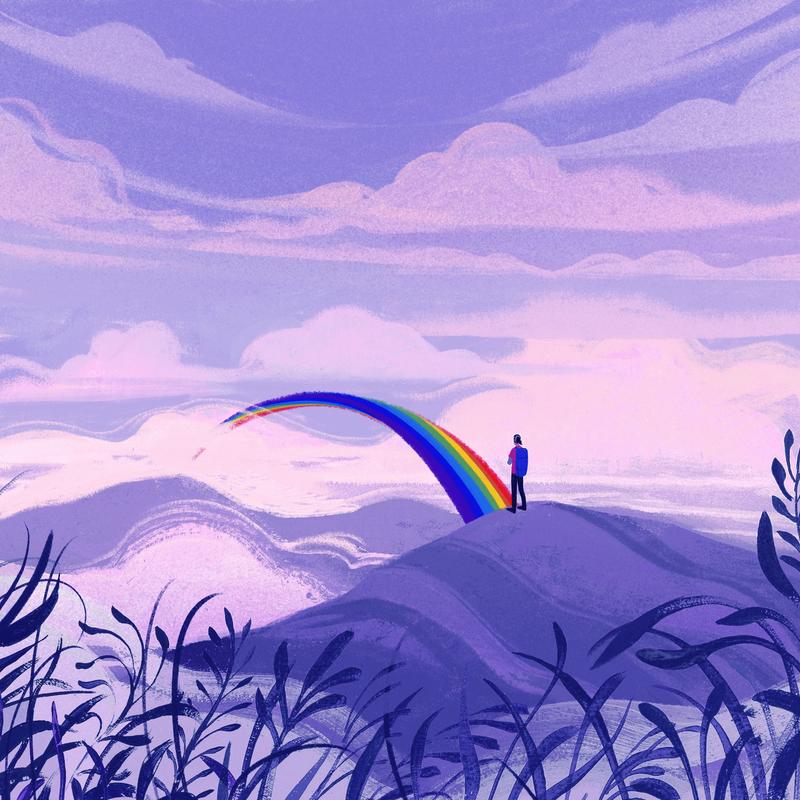
The Bridge: How Rainbows Connect Worlds
LULU: 3, 2, 1. Imagine… your body stretches into a huge curve over a mile long… and you begin turning...
CHORUS :
Red
Orange
Yellow
Green
Blue
Indigo
Violet
LULU: You live way up high in the clouds and when people try to paint or draw you they often include butterflies, unicorns, or leprechauns.
LEPRECHAUN: You'll never find my pot of gold! Tee hee!
LULU: You have become
ALAN + CHORUS: A Rainbow!
LULU: Woo! Now is the part where I make you sing the theme song with me
CHORUS: Terrestrials Terrestrials we are not the worst, we’re the
CHORUS: Sailors? Les bestrials
ALAN:Did someone say bestrials?
CHORUS: Bestrials!
LULU: Woo!
CHORUS: Yeah! *clapping*
LULU: Terrestrials is a show where we uncover the strangeness waiting right here on earth, I am your host Lulu Miller joined as always by my songbud.
ALAN: I see your true colors…
LULU: Alan
ALAN: Shinin’ through
LULU: Anddd..
CHORUS: YOUTH PRIDE CHORUS!!
LULU: The youth pride chorus of New York City
CHORUS: *warming up lip trills*
LULU: And since a RAINBOW is the literal flag of the pride movement… I figured they’d all be super excited to help me make sense of rainbows.
EVE: I personally actually don’t like rainbows.
LULU: OK, EVE (Soprano in the choir), tell me more.
EVE: Yeah, That’s just not my thing. Like it's just so tacky to me personally.
LULU: Haha tacky,
EVE: Yeah.
LULU: Kinda cheesy, without substance! I hear ya Eve that is how they are often depicted BUT
[MOODY MUSIC]
LULU: The story i have to tell about rainbows… is very serious business. Not cheesy at all. Because it turns out that rainbows, for thousands of years, have been carrying a powerful secret. One that - once discovered - would prolong human life and change the course of human society. But this tale begins not with humans, but with gods.
[THUNDER]
LULU: With myths. In legends from all over the planet, rainbows were seen as a kind of bridge that could connect gods, or spirits - to those of us on Earth. In Norse mythology, for example, a rainbow was seen as a LITERAL bridge… that a person could walk across to access the Gods (up in the clouds). The Tawala of New Guinea saw the rainbow as a sort of bridge for the dead, who could travel across it to the afterlife. In Greek myths, the rainbow was a bridge that carried messages and warnings from Gods down to mortals.
[RUMBLE]
LULU: Beware trouble on the horissssson…
DARKER MUSIC
LULU: And in many North and Central American traditions, people were told to never point at them, or else your finger would rot off. Now, as time ticked on, people kept looking up at rainbows, and wondering... what were they, like Were they… real? Like trees or clouds, you know concrete things out there? Or.. maybe rainbows were just a trick of the eye? More, like an optical illusion. Something we create from within our minds. And people… fought about this.
LULU + CHORUS: It’s out there!
ALAN + CHORUS : It’s in here!
LULU + CHORUS: It’s out there!
ALAN + CHORUS It’s in here!
LULU: Flash forward to around 350 BC, Ancient Greece, when a bearded philosopher named Aristotle weighed in:
ALAN + MALE CHORUS: Exō estín.
LULU: which is Greek for….
ALAN: IT’S OUT THERE!!!
LULU: After noticing that rainbows often appeared after a rain.. once the sun came out again, Aristotle guessed that what must be happening out there in the world..is that when a sunbeam, a clear white beam of light, passed through a patch of mist (left over from the rain).. all those little water droplets were TINTING the clear white sunbeam… almost like they were adding facepaints to the sun’s rays, or a colorful costume over that clear white beam of light! Meaning, to Aristotle when you looked up at a rainbow was evidence of the sun’s pure light being changed or..
ALAN: Disguised.
LULU: Time continued to move on. And rainbows - continued to appear. After storms. As omens. As mysteries. Kids in Ireland ran toward them, looking for pots of gold that they could never quite reach. Then came the year 1665.
[SCARY PLAGUE SOUND]
LULU: And a plague swept through much of England. People were told to stay indoors. Maybe you or your folks know a lil sumpin’ about that…
ALAN + CHORUS: HASHTAG LOCKDOWN
LULU: Some people baked sourdough bread. Some knitted sweaters. And one man named Isaac Newton - he watched sunbeams stream through his window.
ALAN: TRA LAAA LAA
LULU And sometimes wondered...
Philip: Well, what is light itself?
LULU: This is Dr. Philip Ball, a science writer who wrote a book about colors, called Bright Earth. He explained that Isaac Newton–who would later get really famous for working out the laws of a little something called
ALAN: Gravity!
LULU:.... Well back in 1665, he was just a young scientist hiding out the plague at his parents’ house in the English countryside.
ALAN: Awww what will I do today?
LULU: One day he was doodling around with a triangular chunk of glass, we call it a prism. And he held it up to the sun coming through his window, and
Philip: I'm sure lots of people have seen this-
LULU: All of a sudden…
MUSIC: Glimmer glimmer
PHILIP: it's like your own little rainbow forming on your wall.
LULU: And Isaac Newton wondered: Had that Greek philosopher bro Aristotle been right? Was that tiny rainbow appearing on his wall because the prism was changing the sun’s pure white light?
PHILIP: almost like it's tinting the light, like it's some kind of you know, coloured filter that is injecting colour into the light.
LULU: Or maybe… thought Newton, just maybe, a rainbow wasn’t disguising the light —
ALAN: AHH AH AHHHH
LULU: but was unmasking the truth of the light?
ALAN: AHHHHHH
LULU Meaning, what if all those bright colors of the rainbow were somehow the sunlight's...
ALAN AND CHORUS: INGREDIENTS!
LULU: Ingredients! If you mix together all the blues and purples and oranges of the rainbow you somehow got.... a clear white sunbeam!?
PHILIP: Well, that was the question.
LULU: To find out, Newton did a clever experiment
PHILIP: He said, well, if that's right, that ALL THE COLOURS were already in the light,
LULU: And the prism had somehow UNMIXED the ingredients, had somehow broken open a sunray and let us see the bright spectrum of colors that live inside
PHILIP: Then if I take that separated out spectrum of colours and use a second prism to bring them back together again, I should get white light back.
LULU: Ohhhhhh-hhhh that’s what he did!?.
PHILIP: And so that's what he did.
LULU: AND… did the second prism just add even more colors or change the rainbow of light even more?
ALAN: NOOOOPE!
PHILIP: He got the white light.
LULU: *Gasp!*
LULU: So before, a lotta people thought a prism was transforming..
LULU: The light, but he discovered no, it's revealing the light–
Philip: That's right. What rainbows are showing us is that all of those colors that we see are already in the sunlight.
MUSIC: Proliferate by Poddington bear
LULU: NOW THIS IS A MASSIVE MOMENT IN SCIENCE HISTORY, understanding this, that sunlight is actually comprised of a rainbow of colors - that would unlock huge technological and scientific breakthroughs and we will get there. OH WILL we get there. But first… Isaac Newton had one last very simple thing to do. Count how many colors are in the rainbow. Now, how many colors do you think are in the rainbow? I’ll wait… think about it. Count them. Now, say your guess out loud. OKAY. There is likely someone very famous in history who agrees with you. Because the NUMBER of colors in the rainbow… That TOO had been a huge area of debate over the centuries. Our bearded bro Aristotts back in Ancient Greece, he counted 3 - 3 colours in the rainbow. Red, Green, and Violet. In ancient China, some texts put the count to 5. The medieval Islamic philosopher Nasir al-Din al-Tusi..he guessed... infinity! Infinite colors, twirlin’ around in there. And Isaac Newton, sat there staring at the little rainbow on his wall, scratching his head, furrowing his brow, I imagine, counting once, then twice, and FINALLY settled on his number.
ALAN + CHORUS: Seven!
PHILIP: Red, orange, yellow, green, blue, indigo and violet.
LULU: Our friend, RoyGBiv.
PHILIP: That's the one.
ROY-G-BIV MUSIC STARTS
LULU: ROYGBIV! It’s the nifty trick for remembering those colours based on the first letter of each word:
ALAN: Red orange yellow green blue indigo violet!
ALAN: Red orange yellow green blue indigo violet!
LULU: And this little 7 pack of colors
ALAN: Red orange yellow blue indigo violet!
LULU: Got packaged, and pressed into textbooks as THE scientific truth about the distinct colors that make up the rainbow. And it stayed there for hundreds of years.
ALAN: Red orange yellow blue indigo violet!
LULU: I was taught it in school, maybe you were too? BUT Philip let me in on a little secret
PHILIP: Newton figured that there ought to be seven colours in the rainbow, not for a good scientific reason, but just because he thought maybe the rainbow is a little bit like a musical scale. And there are seven notes in the musical scale.
LULU: Oh the Do re Mi FA SO la ti do of the western classical scale, that’s 7!
PHILIP: Yeah.
LULU: wait, wait, wait, wait, wait. So he was just like, it wasn't that he had a microscope or I dunno a magnifying glass out and was like counting the colors. He just was like, there's a lot and seven is a pretty number, a musically pretty number?
PHILIP: And it was kind of like that.
LULU: hee hee!
ALAN + CHORUS: RED ORANGE YELLOW GREEN BLUE INDIGO VIOLET
PHILIP: He thought well, it stands to reason, you know, in nature, there were at that time, um.. seven planets.. Known.
LULU: Huh
CHORUS: The sun, the moon, Mercury, Venus, Mars, Jupiter, Saturn.
ALAN [with its pretty rings, rings rings….]
LULU: We would later discover more planets (like Neptune and Uranus) and realize the sun and moon are not planets, but BACK THEN, people thought there were
CHORUS: SEVEN.
PHILIP: And there were basically seven different metals known then.
LULU: Today there are over ninety, but back in Newton’s day..
ALAN: Gold. Silver. Mercury. Copper. Iron. Tin. Lead. CLUNK.
ALAN + CHORUS: SEVEN!
PHILIP: And so people thought, OK, that figures. are seven of these or seven of those. so people thought nature worked by these kind of correspondences like that. So there was a.
Lulu: Wow, like seven is just a mystical or not even, like a naturally divine number almost.
Philip Ball: Yeah, yeah, yes.
ALAN and LULU SONG:
Seven it’s just so pretty…
Seven it’s seems so TRUE…
Seven it’s nice and round, yet sharp
It’s a prime number, a holy number,
Seven continents on the planet
Seven days in the week
Seven were the steps that Buddha took
And Sinbad sailed the seven seas
The alchemists loved it and religions too
Seven sins!
The scientists loved and it stuck like glue
ROY-G-BIV!
Yes seven it’s just so pretty
Seven it seems so trueeee
But the beauty of seven blinded Newton to the truth of the rainbow that’s even more coooool
LULU: The TRUTH of the rainbow... plus LASERS.. Pew pew. After this short break!
[BREAK]
ALAN + CHORUS: (singing to the tune of “Doe a deer”)
Red - the color of a strawberry
Orange - the color of a firrrrre
Yellow - the color of the sun / or sunflower
Green - the color of grass - grass grass grass
Blue - the color of the sky / or ocean
Indigo - im not sure but i hear it’s pretty
Violet - the color of a grape/ or jellyfish stinger thing
That will bring us back to Red red red RED!
LULU: This is Terrestrials - that is the youth pride chorus in NYC who is music-ifying Isaac Newton’s scientific declaration that the rainbow contains - how many colors again?
ALAN + CHORUS: SEVEN
LULU: I learned these seven colors, I think, in fourth grade, and until about two months ago, I thought that was the end of the story. Isaac Newton had cracked it. Rainbows were real, out there things in the world.. Caused by raindrops, splitting apart sunbeams in such a way that revealed those seven ingredients inside. Science for the win! Cased closed.
LULU: But… it turns out… thanks to curious artists, poets and painters and kids around the world who kept staring at the rainbow, and drawing the rainbow, and wondering about the rainbow.. Case… not closed.
CREAKING UP
LULU: Poets, like John Keats, were angry at Newton and accused him of using science to QUOTE
ALAN: “unweave a rainbow”
[Paper tearing]
LULU: Tear out its magic. And painters, (like William Turner who was famous for painting skies)… thumbed their noses at Newton.
ALAN: ROY-G-BIV? MORE LIKE ROYGBIVmfmskdflhkwrtuhstiuerhpiasdhesiuh
LULU: By painting hundreds of colors into their rainbows…
ALAN: like magenta fuchsia lavender lime honey mint umber salmon, maroon, cyan..
LULU: And Philosophers and college kids and little kids could not let go of that age old question
ALAN: Wait bro how do we know my blue is the same as your BLUE?????
LULU: But seriously how would we know?
LULU: All of these people thinking deeply and reaching back… deeply into the centuries old debate of where rainbows REALLY existed.
CHORUS: It's out there, it's in here. It's out there, it's in here.
LULU: Adding their voices to team:
ALAN: It’s in heeeere!
LULU: And at last, along came… another bro. A big bro, a big… brother, literally, of TEN kids in a British family named Thomas Young! He was training to be a doctor, and one day, while dissecting the eyeball of an ox…
SFX: MOO
LULU: He began wondering more about how the eye focuses and processes … LIGHT. and he eventually devised an ingenious experiment - it’s called the double slit experiment, super complicated, gets into quantum physics, I barely understand it but you can go look it up if you dare - and he discovered that light was not made of seven rigid colors but… instead
WAVY MUSIC
LULU: Waves, A whole range of waves vibrating at different speeds. And because of how our eyes process these waves and send that information to the brain we perceive different wavelengths as different colors…So the long, slow waves – we see those as:
ALAN: (low pitch) REEEeeEEEeed
LULU: The medium ones, look to us more –
ALAN: (middle pace and pitch): GReeeeeen
LULU: The faster ones -ddddeee- we see them as
ALAN: faster and higher vibration [vvvvvviolet]
LULU: But the truth of the rainbow, of light itself, is that there are NOT hard lines between these colours, between the waves.. It’s much more like an ocean.
PHILIP: It's kind of a bit arbitrary where we say. You know, this color stops and this one starts, or how we divide it up.
LULU: And so a much more accurate count of colors in the rainbow, is not seven,but… INFINITE! Just like Medieval philosopher Nasir al-Din al-Tusi said, oh… 700 years ago. And where we draw the line between one color and the next, well that.. depends on us. And once we realized all this. That light was made of this continuum of wavelengths, from very slowwwWWWwww to veryfast, WELL THAT kicked off one of the biggest scientific revolutions of our time.
MUSIC FROM PODDINGTON BEAR: LIP GLOSS
LULU: Because different materials in our universe like particles in gases and rocks and stars… REFLECT and EMIT and ABSORB all those wavelengths of light in different ways. This new understanding of color… as wavelengths… It allowed us to discover all kinds of new elements:
ALAN: Helium! Cesium! Thallium! Gallium!
LULU: which helped us understand what our universe is literally made of
[knock knock]
LULU: And made us begin to wonder if there were wavelengths of light that we can’t see.
PHILIP: You know people have been looking at the stars for a long time. Astronomers have been looking at the stars for a long time. but for them too, it meant, OK, we're looking at all the visible light that's coming from stars. But what if we made radio telescopes to see if there are stars out there or other things in space that are emitting radio waves? And there are, loads of them. So it made us realise there's much more in the universe than we could see just by, you know, relying on our own vision.
LULU: Wow.
LULU: And in time, our understanding of wavelengths would allow us to invent all kinds of things that even use light we can’t see, like: infrared cameras that can detect heat in the dark and infrared lasers that HEAL OUR bodies and prolong our lives doing everything from removing moles, drilling DANGEROUS cavities, shrinking tumors, and even, restoring eyesight!
LULU AND ALAN: Meta.
LULU: And other wavelengths hidden in the rainbow allowed us to invent new ways of passing information (messages, music, internet) across huge distances–
PHILIP: And that's what radio waves are. Radio waves, a really long wave.
LULU: Wait. Rainbows gave us radios? Kind of?
PHILIP: You could say, understanding the light of the rainbow and the fact that they're-
LULU: Sorry, radio. I just need a moment for that. Like rainbows gave me my job. I love the radio. I've been doing radio for 20 years,
PHILIP: Yes!
LULU: All of this MAKES ME THINK BACK TO THE MYTHS FROM THOUSANDS OF YEARS AGO. All of these cultures from all around the world who independently, intuited, sensed that rainbows were some kind of bridge between worlds…
MUSIC
LULU: It seems to me, the current best science agrees. Rainbows are a bridge, between the inside world and the out.
PHILIP: Yeah, I think that probably is the best way to see it because, they do seem to sort of, you know, sit in this sort of weird place between... are they physically out there? Or are they something, you know, perception of the mind? And the truth is, they're a collaboration of both. And I think that's what gives them this kind of magical quality that just makes us keep coming back to them.
LULU: In other words
ALAN: IT’S OUT THERE,
LULU: anddddddd
ALAN ITS IN HERE.
[INFINITE COLORS SONG]
LULU: ALAN GOFFINSKI with backup club whispers from Me and Maria Paz Guiterriez! And that’s it there is nothing else cool about to-
BADGERS
ELEANOR: Hi my name is Eleanor and I am 6 years old. Why is pink not a color in the rainbow?
PHILIP: That's a great question. So there's something called saturation that tells you how sort of rich the colour is or how kind of diluted it is.
LULU: Like faint or almost see through..
PHILIP: Yeah. And so pink is actually you could think of it as like a weak red. So in a way pink sort of is there…
LULU: Aw….AND PHILIP EXPLAINS to see it - you might just need dimmer sunlight.
PHILIP: And if the light is weaker, you know it may be that the red bit will look a little bit pinky. And, and, and one of the weakest kinds of rainbows is made not with sunlight, but with moonlight.
LULU: Wait, wait, wait, wait, wait, wait, wait, wait, wait. Are you saying there are moon rainbows, moonbows?
Philip Ball: There are, yeah, yeah. If the moon is bright enough and you have sorta, rainy sky, you can get a moon bow.
ANA: SOMEWHERE OVER THE MOONBOW - aliens fly…..
KAI: I’m Kai, I'm 7 years old. Do rainbows only have the half that we see? Or do they have a half that we see and another half that makes a full rainbow around the Earth?
PHILIP: OH KAI! That's such a brilliant question. They do have another half.
LULU: They do? Where is it?
PHILIP: Yeah, they do. It's below the horizon. Because it's a whole circle and sometimes if you see a rainbow from the sky from an airplane you can see the whole circle.
LULU:: OhhhhhhH…. MG. (the o is the circle of the full rainbow. haha)
TANYA: I’m Tanya, I'm 23, Can you see rainbows underwater?
Philip Ball: I honestly don't know, but I suspect that it might be pretty hard. It would be very faint.
Lulu: Maybe that's an experiment we can put out to our listeners. If you can swim, Go try it and let us know.
PHILIP: ha ha yes
BADGER: Im Nora. Im 3 years old. Is there a snowbow?
LULU: A snowbow! Like a rainbow made from snowflakes?
PHILIP: Yes!
LULU: Cool! Literally.
EVE: I'm Eve. I'm 23
LULU: uhhhh, look who’s STILL with us. It is Rainbow hater Eve from the Youth Pride chorus
EVE: How did rainbows become the gay pride flag?
LULU: Huh. You know. As a gay person myself, I'm married to a woman. My kids have two mommies, I too realized I had no idea how the rainbow became associated with the movement that told us to be proud.. Of who we are… so I looked it up and found that : the man who designed the GAY pride flag, back in 1978, Gilbert Baker, was looking for something that expressed the full spectrum of all different types of love. He said “rainbow really fits that… we’re all the colors, and all the genders and all the races.”
PATTIEGONIA: My name is Pattiegonia. I am a drag queen and environmentalist. And I'm coming to you live from mile 73 of backpacking 100 miles. And my question is, are there rainbows on other planets?
PHILIP: There will definitely be rainbows on other planets.
LULU: Oh that's excellent.
PHILIP: I mean, you would need to have droplets of some liquid, but it wouldn't have to be water. If you had liquid methane, liquid.. ammonia If there were droplets of those in the atmosphere then you would see rainbows. On the planet Venus, there's little droplets of sulfuric acid, they make clouds. There are going to be rainbows, sulfuric acid rainbows on Venus!
LULU: WOW!
LULU: And i think THAT is a great place to leave it, and i won’t tell you that a rainbow produced by liquid ammonia would probably smell like pee, i won’t tell you that, bc i’m nice. (pot of gold, potty of gold). Also wont tell u bc im really nice.
LULU: OK before i do the credits is need to tell you some very exciting rainbow related news…
We have just created the first ever original Terrestrials puzzle. Yep, a classic jigsaw puzzle that you can put together with your loved ones that secretly arranges over a dozen of the terrestrial episodes we've ever done. So there's like a mule and a camel in the snow and an octopus and a big old rainbow. They're all arranged in this kind of incredible fantastical scene by the artist Arthur Jones. And it can be yours for the simple price of supporting terrestrials. We have just launched what we're calling the Explorers Club. It's a way for just $7 a month to support what we do. And in exchange, you get all kinds of perks like ad-free listening and extra Alan songs and all kinds of other stuff, including this really cool puzzle, which I've been wanting to make for about three years ever since we started Terrestrials. Anyway, you can go check out the puzzle and see if joining the Explorers Club is right for you by going to terrestrialspodcast.org slash donate. That's terrestrialspodcast.org/donate.
[ROYGBIV SONG]
LULU: Terrestrials was created by Lulu Miller with WNYC. This episode was produced by Tanya Chawla and Ana González, with technicolor sound design by Mira Burt-Wintonick. Sarah Sandbach is our Executive Producer. Our team also includes Alan Goffinski and Joe Plourde. Factchecking by Diane Kelly.
LULU: Special thanks this episode to Roy G Biv. JK, that’s not a real person, But you know who is? Nicholas Sienkiewicz, the director of the Youth Pride Chorus of New York City. Big thanks to him and Rashad Chambers - and all the singers for lending their beautiful voices to this episode and … to this world. If you are interested in seeing them perform, watching videos, or joining yourself, head on over to www.youthpridechorus.org. And that my friends will do it today, see u in a couple spins of this dirty old planet of ours. And if you are looking to fall asleep tonight, allow me to give a special shout out to my mother -in -law, Kate, who sang this song to her daughter, who is now my wife, and we now sing this to all three of our kids every single night. Here we go.
LULU: Red and yellow and pink and green, purple and orange and blue.
I can sing a rainbow, sing a rainbow, sing a rainbow to you.
LULU: Good night.