BIG CATS: Lions, Tigers & Roars (Oh My!)
[RADIOLAB FOR KIDS INTRO]
LULU MILLER: Three, two, one. Imagine ...
ALAN GOFFINSKI: You are the king.
ANA GONZÁLEZ: And the queen. Your nails shoot out of your toes and become ...
ALAN: Swords! You can smell fear and blood.
ANA: You're the strongest, the biggest.
ALAN: The loudest! The quietest.
ANA: With the sharpest of fangs! And you prowl the jungle ...
ALAN: ... the savannah ...
ANA: ... even snow-capped mountains!
ALAN: For your next meal.
LULU: You have become ...
ANA & ALAN: A big cat!
ALAN: Meow!
ANA: Yeah!
LULU: Now is the part where I make you sing the theme song with me. "Terrestrials. Terrestrials. We are not the worst. We are the ...
ANA & ALAN: [sings] Best-rials!
LULU: [laughs]
ALAN: Nailed it.
LULU: You got it!! Terrestrials is a show where we uncover the strangest waiting right here on Earth. I am your host, Lulu Miller, joined by two people who absolutely knew how that theme song went because they make the show! We've got our beloved producer bud ...
ANA: This episode is clawsome!
LULU: Ana! And songbud ...
ALAN: Totally jawsome!
LULU: Alan!
ANA & ALAN: [singing] It's a big cat, big cat, big cat episode! Woo!
LULU: All right guys, this has been our most requested episode, but I don't really wanna do it.
ANA: What do you got against these big cats?
LULU: Um, I think I'm a little intimidated by them. I mean, they're big, they're tough, they're kind of like the bullies of the animal world. I mean, they're almost too cool, you know?
ALAN: Wow. Big feelings about big cats.
ANA: Well, okay, we think you're wrong.
LULU: Hmm!
ANA: Because big cats are totally more complex than this stereotype you seem to have of them.
LULU: Oh yeah?
ANA: Uh-huh.
LULU: All right. Well then I hereby challenge you to make me fall in love with big cats.
ANA: Challenge accepted!
ALAN: We're roaring to go!
ANA: Yeah!
LULU: All right. I will get outta the way and let you do your thing.
ANA: Yeah, okay. This is really an interesting challenge. Where do you stand on big cats, Alan?
ALAN: I'm sort of genuinely more in the Lulu camp.
ANA: What?
ALAN: I get where she's coming from. They're just kind of the cool kids in the cafeteria with their pretty fur and everything like that. I get it.
ANA: Okay, so we're looking for what makes them more than just cool and more than just powerful.
ALAN: Right.
ANA: And more than just having great heads of hair, which some of them undeniably do.
ALAN: I'd be "lion" if I'd be denyin' that.
ANA: [laughs]
ALAN: Also, don't forget the roar.
ANA: I do want to know the difference between a roar and a meow.
ALAN: I just always assumed that the roar was a meow, like, cranked to 11.
ALAN: When you just scale it up, bigger vocal chords, bigger lungs, you get a deeper sound? I don't know.
ANA: I don't know either. We have to find out. But also, what exactly are we talking about when we talk about big cats?
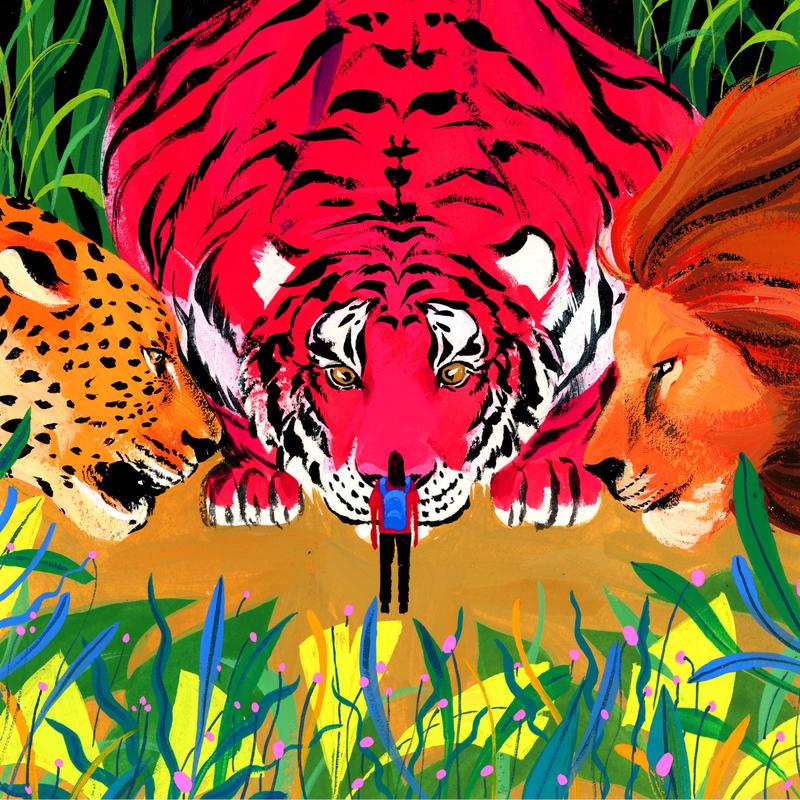
ALAN: Well Ana, I'm glad you asked! Introducing our top five big cats: Tigers, lions, jaguars, leopards and snow leopards.
ANA: Wait, you forgot cheetahs!
ALAN: Well, cheetahs are not big cats!
ANA: What?
ALAN: I mean, they're cats and they are pretty big, but capital B "Big Cats" are from a very specific evolutionary lineage called Panthera.
ANA: Wow. Okay, so these are the big five big cats! We can do this. First Up? Tiger!
ALAN: Let's hear its big cat stats!
ANA: Tigers hold the world record of the biggest big cat, with one in captivity growing to more than 900 pounds!
ALAN: Whoa! That's like five Alans! Five me's!
ANA: But on average, they're not much bigger than a lion, in the 400-pound range. And their iconic bright orange fur which stands out to us actually makes them almost invisible to creatures like deer and antelopes, because to those creatures, orange looks like green, which lets tigers blend into the green landscape as they prepare to pounce!
ALAN: Oh deer! Okay, so how can we get Lulu fall in love with tigers?
ANA: I know someone who can help!
LUKE HUNTER: Tigers, you know they're kind of power lifters of the cat world.
ANA: This is our friend Luke Hunter who is not a hunter like his name suggests. He actually runs the big cats program at the Wildlife Conservation Society based in the Bronx Zoo. His whole job is dedicated to understanding and protecting the big cats of the world. So you could say he's kind of the big dog of big cats.
LUKE HUNTER: We're at the Bronx Zoo and we're headed now to Tiger Mountain.
ANA: And while many people will never see a tiger in the wild, here at Tiger Mountain we're peering through a thick piece of glass and looking at a little forest with a pond and trees, hoping to catch a glimpse of one the zoo's seven tigers.
ANA: Great day for some—oh, there it is! Whoa!
ANA: Everyone around us oohs and ahhs.
ANA: That's a big animal.
LUKE HUNTER: See? How can you not love cats? Look at how many—look at—this is a popular exhibit. People love tigers. Rightly—rightly so in my view.
ANA: Watching this tiger strut through its enclosure, I can kind of see what Lulu means. Kids are chanting and screaming and people are whipping out their phones to take pictures like it's a celebrity. But it's also just undeniably majestic. Just its gaze could make you shake in your boots.
ALAN: [sings] It's the eye of the tiger.
ALAN: And what kind of tiger is this?
LUKE HUNTER: This is amur tiger. So this is the one also known as Siberian tiger.
ALAN: That is the largest kind of tiger. It lives mostly in China and Russia, but when it comes to all the kinds of tigers all around the world?
LUKE HUNTER: The tiger is the world's most endangered large cat. So there's only around, we think, maybe 4,500 wild tigers left on Earth.
ALAN: Less than 5,000 wild tigers left, when just a couple centuries ago there were hundreds of thousands. See, human beings have hunted tigers for a long time.
ANA: Because they're the biggest, most fearsome cat, killing one makes some people feel big and powerful. And because of that, some types of tigers have gone completely extinct.
ALAN: Tigers with extra thin stripes, and tigers with shaggier orange fur. And all these characteristics that are now gone.
LUKE HUNTER: The good news is we've figured out how to save tigers.
ANA: By working with local governments, wildlife conservation groups have helped make it illegal to hunt tigers all over the world—although some people still try to get away with it. Plus, big cats need big land to roam and find their food. So Luke and his colleagues? They help protect that, too.
LUKE HUNTER: So even though the numbers are still quite low, we're seeing them starting to recover.
ALAN: I do have one very important question. Do all cats hate all dogs?
LUKE HUNTER: They kind of do. Yeah.
ALAN: [laughs]
ANA: Even if some kittens and puppies can be adorable BFFs, tigers have been known to eat a stray dog or two if they're super hungry. Chomp! Even through the glass, you can feel how powerful this creature is.
LUKE HUNTER: They will fly into the water for prey. So that includes crocodiles, includes very, very large soft shell turtles.
ANA: Turtles and crocodiles?
ALAN: Yeah, I thought cats hated water, but apparently tigers can wrestle a croc and drag it onto land to eat.
ANA: But then we see this ferocious tiger in front of us do something maybe even more surprising.
ANA: So I see he's eating grass. Why is that cat eating grass?
LUKE HUNTER: They get fur balls from grooming. And one of the ways that they purge it is just cough it up, and so the grass helps as an emetic to help them just cough up this stuff. Every cat owner's dream when you get up early in the morning and step out of bed. And I don't know which is worse: warm furball vomit or a cold furball vomit. Because yeah, they've hawked up a fur ball.
LULU: [laughs] A tiger furball would be, like, giant and maybe striped a little?
ALAN: Yeah. How's that, Lulu? We got the biggest, most endangered big cat in the world who also coughs up furballs?
ANA: Yeah big popular cool-kid cats? They're just weirdos with tummy troubles just like us!
LULU: [laughs] Okay, great start! But I don't know. I need more. I mean, don't get me wrong, I like the image of a tiger eating grass like a housecat, but big cats are still feeling pretty much like what I expected, you know? Chomping dogs, being mean.
ALAN: All right, if barfing tigers isn't doing it for you, it's time for ...
ALAN: Okay, so exploring fascinating big cat vocal facts which we are calling The Voice! I mean, The Roar!
CHORUS: [sings] This is The Roar!
ANA: Yeah, it's The Roar.
CHORUS: Roar! Roar! Yeah!
ANA: It's the show called The Roar! Get ready for the big cat battle of the champions!
CHORUS: [sings] This is The Roar! Whoo!
ALAN: Welcome to The Roar, the world's only game show dedicated to finding the best roar of the big cats. I'm your host, Lion Seacrest. [laughs] Here today with my purr-fect co-host, Kitty Clarkson.
ANA: That's right, Lion. And of course, all of the contestants in The Roar are members of the Panthera family, which means unlike other cats, their voice box is deep down in their throat, a long way from their mouth.
ALAN: So when a big cat lets it rip, the sound is super loud and super low.
ANA: But there's trade-off.
LUKE HUNTER: the structures of the throat don't allow them to purr, so they can't purr and they can't meow.
ANA: So, if you rub a tiger's belly, it's not gonna purr.
[roars]
ANA: Me-ouch!
ALAN: And unfortunately, one of our supposedly big cats is disqualified from this show: the loud-meowthed snow leopard.
LUKE HUNTER: They don't roar.
ALAN: They don't roar very well.
ANA: Tough break, boys. But I don't make the rules, I just rate the roars. Let the showdown begin!
ALAN: Coming to us from the African savannah and also the hills of India, we have leopards!
LUKE HUNTER: I mean, leopards we call it "sawing." It's kind of like a wood saw going back and forth over a rough log.
ALAN: Wow, I love that steady beat, but it might need some autotune to really top the charts.
ANA: And now for something a little snarlier. From the jungles of South America, the jaguar!
LUKE HUNTER: Jaguars, it sounds more like a kind of grunting noise.
ALAN: They also make an even softer sound to communicate with their babies.
ANA: [gasps] That small voice almost sounds like a meow!
[gasps]
ALAN: Not even! It sounds like a duck! I don't know about you, Kitty, but I'm ready for something more metal!
ANA: Able to call across wintry forests, dry grasslands, and even muddy swamps, it's the icon!
ANA & ALAN: The tiger!
ALAN: A diva if I've ever heard one.
ANA: The cat's pajamas, if you will. Ba-dum-cha! But let's take things up a notch. Performing its signature, ground-shaking vocal performance ...
LUKE HUNTER: The lion.
ANA: Yes!
[roars]
ALAN: Wow! That bass!
ANA: That power!
ALAN: And now to announce the winner of this season of The Roar, Kitty, will you open the envelope please!
ANA: With a roar of up to 114 decibels, which is considered dangerously loud for humans to be close to for a long period of time, the winner of this season of The Roar is ...
ALAN & ANA: The lion! Whoo!
ALAN: Congratulations!
ANA: While all the big cats have their roars, there's only one with the power to traverse the African savannah and be understood for miles in every direction.
ALAN: Wow! Thank you to all of our ext-roar-dinary contestants. And join us next time on The Roar!
LULU: [laughs] Okay, I am really starting to enjoy this truly cat-ivating work. Which big cat is next?
ANA: Well no big cats purr-ade would be complete without the king of the jungle, the winner of The Roar, the kitty cat who is all that and a bag of meat chips, the lion!
LUKE HUNTER: If I had to name a favorite, they'd probably be my favorite cat. It's incredibly big, dangerous, aggressive.
ANA: That's after a break!
LULU: Terrestrials is back. We are here with Ana and Alan who are trying to convince me to love big cats even though they are big bullies.
ALAN: You think that they're big bullies, but big cats are more complicated than that.
ANA: Yeah, and some people love lions. Like Luke Hunter.
ALAN: Has anyone ever called you the Lion King?
LUKE HUNTER: No. Yeah. [laughs]
ALAN: Can I call you the Lion King?
LUKE HUNTER: Would you? I've been waiting my whole life, Alan.
ALAN: See, Luke has been fascinated by lions for most of his life.
LUKE HUNTER: Because of the pride structure.
ANA: Oh, prides meaning lion families.
LUKE HUNTER: Yeah. So the really cool thing about the pride, the core of the pride, I mean the absolute backbone of the pride is a group of related females. So it's sisters and moms and grandmothers and nieces and daughters. And so they're ...
ALAN: Just females.
LUKE HUNTER: Just females So that's the core. That's the nucleus of the pride.
ANA: Nucleus, meaning the center, the heart that makes the whole pride strong. Sisters, moms, aunties, cousins, grandmas and their sisters, they're all part of this big lion family compound.
ALAN: [sings] We are feline-amily!
ANA: And the only other cat to hang out in groups of cat buddies is the cheetah.
ALAN: Which again are not big cats, even though they are big and they are cats. But moving on, I didn't make the rules!
ANA: Okay, okay. So most other big cats, they live solitary lives. They hunt solo, they'll come together to mate and have babies, but then they split up again and go it alone. That's not true for lions, where the females of a single pride will remain together for life.
LUKE HUNTER: Because females have the pride structure, you get an 18-year-old, 19-year-old lioness, she's no longer reproducing. She's the great grandmother. But she'll be taken care of. You know, if she can stay with the pride, if she can move with them, just so long as she can keep up, you know, she's got this support system.
ALAN: The lion pride helps lions care for their family members at the end of their lives, and also at the very beginning.
LUKE HUNTER: What tends to happen is that females have cubs around the same time.
ANA: Oh!
LUKE HUNTER: And so you get these whole cohorts, and they help each other raise their cubs.
ALAN: All the cousins.
LUKE HUNTER: All the cousins. Right.
ANA: So cool!
LUKE HUNTER: Isn't it? And, you know, a cub can go to any lioness. They're protected by all the lionesses. They will suckle any cub. If a cub's suckling with that lioness, that could be anyone's. It could be a sister's, it could be a mother's cub.
ALAN: Like going over to your aunt's house for dinner.
LUKE HUNTER: Exactly.
ANA: Yeah.
ANA: And the lionesses aren't just feeding their babies, they're feeding themselves, because these mamas are all muscle, no mane, weighing in at more than 350 pounds of pure, grade-A lion.
LUKE HUNTER: You don't see fat lions lazing around in the bush.
ALAN: Lionesses hunt in teams, and they do it while teaching and protecting their cubs. Meanwhile, the males are circling around them.
LUKE HUNTER: The males are bodyguards.
ANA: And these are the ones you'll see on the roads and under trees in the African savannah, laying around, bellies full, big cat energy on full display.
LUKE HUNTER: Because males sort of have this reputation of just being lazy.
ALAN: But they're actually on the clock.
LUKE HUNTER: So what those males do, what the pride male lions do is they are constantly on patrol.
ANA: Using the lion's superior sense of smell and hearing to know where their females and cubs are and where the unfamiliar male lions are.
LUKE HUNTER: Because always at the edges of their territory, there's other male lines sniffing around.
ALAN: And the male lions out there bodyguarding the pride? They have a special name when they get together.
LUKE HUNTER: Coalitions.
ANA: Groups of up seven male lions who form, like, a super group of superhero level security for the females and babies.
LUKE HUNTER: It's just something to behold. You know, it's incredibly big, dangerous, aggressive.
ANA: And the "mane" way they patrol? Mane way? [laughs] Get it? Mane.
LUKE HUNTER: They're roaring.
[roars]
LUKE HUNTER: They have this very, very dramatic roar that covers, you know, large distances.
ANA: Up to five miles away, warning any other male lions that are not part of their coalition that if they try to come any closer, they'll feel the wrath of the biggest, baddest lions this side of the baobab trees.
ALAN: I'm picturing, like, this super cool, super tough hair metal band, like, strutting around, belting out their song.
ANA: But here in the Bronx Zoo, just down the hill from Tiger Mountain and over to some rocks, there are two male African lions just lounging.
ALAN: And they don't look like they think they're the kings of the savannah. They're being goofy!
ANA: Oh! He's pulling his butt. He bit his little tail!
LUKE HUNTER: This is really unusual. You don't see this in tigers. This is what you would see in the wild where these two remain together, a coalition of lions. Look, he's gonna flop on him. They're really, really closely bonded.
ALAN: He's standing on him!
LUKE HUNTER: I told you they were close.
ALAN: And it got me thinking about how heartwarming it is that these fearsome big cats are able to be so strong and powerful and legendary really, because they are part of a family, a pride.
ANA: And those famous roars aren't just to exert their manliness over the animal kingdom. No!
LUKE HUNTER: We know lions can recognize other individuals by their roars.
ANA: They use them to call out to their family members, to their partners, mothers, grandmothers, cousins and babies, and let them know they're out there protecting them.
LULU: Aww! Wow! I'm hearing the roar differently now.
ALAN: And guess what? We got to hear their roar up close and personal at the zoo.
LULU: What did it sound like?
ANA: It sounded like this ...
[roars]
ALAN: What did that mean?
ANA: [laughs]
LUKE HUNTER: He was saying, "This is my land. Don't mess with me." That's what it's all about.
ALAN: Really?
LUKE HUNTER: By the way, it's not just males. Lionesses have a formidable roar, and they'll all band in. So when a pride gets going, it is just incredible.
[roars]
LULU: Wow! I mean, sounds fearsome, but I guess you're telling me lions can also be pretty dear-some.
ALAN: [laughs]
LULU: I don't know. Wow, you guys, picturing this—this inner circle of muscle-y mamas sharing child care, and this outer ring of lions calling out communications, and tigers that can swim and—you are totally changing my mind about who big cats are, and made me see, wow, they do not need my shade. Like, they're endangered and they really need my love. So that's two of the five big cats. Who's next?
ANA: You know, Alan, I just realized that we spent all that time on lions and tigers and roars.
ALAN: Oh my!
ANA: That we don't have time to talk about jaguars and leopards, not to mention snow leopards!
ALAN: These cats are too big to fit into one episode!
ANA: Yeah, we might have to do a two-paw-ter. Get it? Like paw?
LULU: [laughs] Oh no, are you kidding me? More big cats?
ALAN: Hey, whatever it takes to get you on board with these kitties!
ANA: Yes! Next episode, in part two of this two purr-ter, we're gonna meet leopards in India coexisting with humans, jaguars down in South America who are sneakier than Catwoman.
LULU: Ooh!
ANA: And we'll learn how coexisting with big cats can actually make you smarter?
LULU: What?
ALAN: Cats out of the bag!
LULU: Meow!
ALAN: [sings] Oh wow, all you cats. I'm gonna need to hear you sound off one more time to start this song! Ooh, let me hear that tiger! Ooh, and was that jaguar? How 'bout that leopard sound? And do we have a snow leopard in the house? Oh, that's right. I forgot you are a quiet cat! And last but not least, I gotta hear that rock star roar, the lion!
[roars]
ALAN: [sings] Roarin' loud, roarin' loud across the savannah. Roarin' loud! Hear me shout at the top of my lungs. Have a little pride in your pride, get a little roar in your life. Roarin' loud! We're big cats, we're not kitten around this time. Roarin' loud! It's the cats of Panthera. Roarin' loud! Except for the snow leopard who barely roars at all. Get a little roar in your life, coughing up a furball this time. Gross!
ALAN: [sings] Roarin' loud! We're big cats, we're not kitten around this time. We're big cats, we're not kitten around this time.
LULU: Alan Growl-finski everyone, doing his best to channel David Lee Roar-th! And what's that? It's not The Badgers, we'll save those for next week. But a riddle? You ready?
ALAN: Okay.
ANA: Okay.
LULU: Why is it that no one likes to play cards in the savannah?
ALAN: I don't know, Lulu. Why?
LULU: 'Cause there's too many cheat-ahs!
ANA: [groans]
ALAN: Okay, I know they're not technically big cats and I know we're saving Badgers for next week, but I do have one cheetah question from a listener.
KAI: Hi, I'm Kai. I'm seven years old, and why do cheetahs have to run so fast?
ANA: Oh yeah, that's a good question. Luke?
LUKE HUNTER: The cheetah's method of hunting is this very, very high speed pursuit.
ANA: And Luke says a lot of that comes down to their toenails!
LULU: Their nails? How?
LUKE HUNTER: It's the only cat species that doesn't really have the protractile claws.
ALAN: Oh, like the claws shoot out from their little toe beans like a housecat?
LUKE HUNTER: Yeah. I have cats. I love little cats, and, you know, we have a lovely male, he's very chill. But if I mess with him, if I go too far, he uses his claws. He lets me know, you know? And you've all had that. They grab you and they kick, kick, kick. And so exactly the same thing with all the other big cats except for the cheetah.
ANA: Oh!
LUKE HUNTER: Their claws are more like a runner's spikes, they stay out all the time.
ANA: Their claws help them grip the ground, like an Olympic sprinter might have special sneakers.
LULU: It's cleats! They have cleats!
ALAN: Yeah.
LULU: Cleats. They're always out.
ANA: And their whole body is designed for speed.
LUKE HUNTER: Long body, long legs, super flexible spine, small head, you know, reduces weight at the front.
LULU: [laughs] Little head, long legs. It's like the ostrich of the cat world.
ALAN: [laughs] Totally!
LUKE HUNTER: And they have a really, really long tubular tail, which helps them balance themselves with these tight turns when they're sprinting, faster than a hundred kilometers an hour.
ALAN: That's over 60 miles an hour! Like a car on the highway!
LULU: Whoa! I mean, that is so fast.
ANA: Which is even more impressive when you realize that cheetahs weigh less than half of a lion.
ALAN: Gotta be light to run with the wind.
LULU: I think we'll leave it there for today. And I won't tell you that it's not just the lion's roar that is significantly louder, significantly bigger than the other cats, apparently their pee-pee, according to expert Luke Hunter, also is one thousand times smellier than domestic cat pee, which is already a pretty high bar. I won't tell you that because I'm nice.
LULU: Terrestrials was created by me, Lulu Miller, with WNYC Studios. This episode was produced by Ana González with Alan Goffinski. Sound design by Mira Burt-Wintonick. Sarah Sandbach is our executive producer. Our team also includes Tanya Chawla, Natalia Ramirez and Joe Plourde. Fact-checking by Diane Kelly. Support for Terrestrials is provided by the Simons Foundation, the Arthur Vining Davis Foundations and the Templeton Foundation. Thank you! Oh, and finally—beep beep beep—that sounds means two brand new Explorers Club members with May birthdays. We're gonna sneak in a happy birthday to them before the month is over. Happy birthday Loreen and Billy. Find out how you can join the club. There's a link in our show notes. And that's all. See you in a couple spins of this dirty—meaning like dirt—old planet of ours. Bye!
-30-
Copyright © 2026 New York Public Radio. All rights reserved. Visit our website terms of use at www.wnyc.org for further information.
New York Public Radio transcripts are created on a rush deadline, often by contractors. This text may not be in its final form and may be updated or revised in the future. Accuracy and availability may vary. The authoritative record of programming is the audio record.