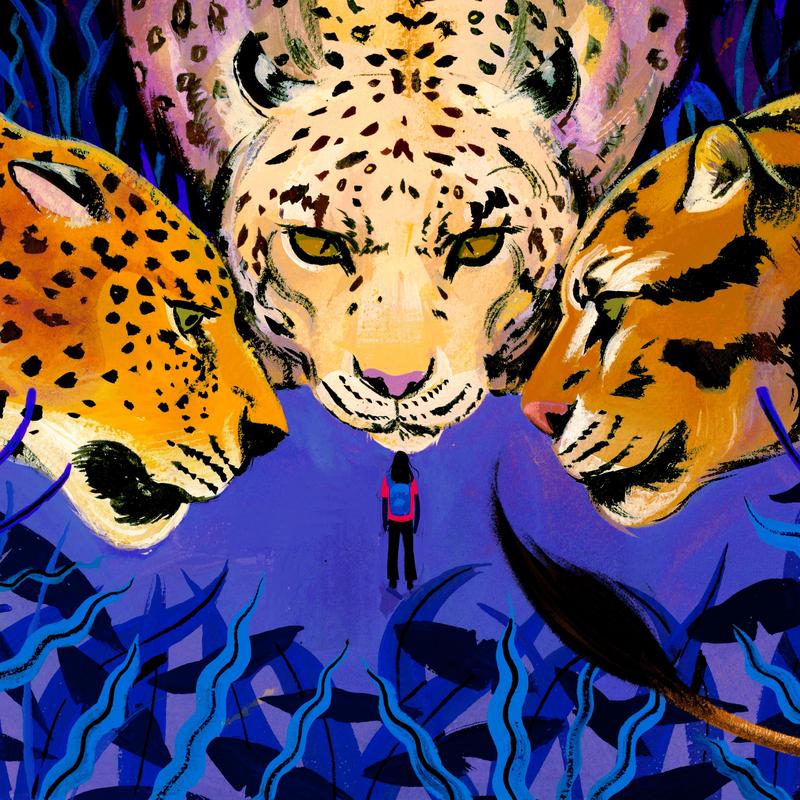
BIG CATS 2: Leopards & Jaguars (2 Fast, 2 FURious)
[RADIOLAB FOR KIDS INTRO]
LULU MILLER: Three, two, one. Imagine ...
ANA GONZÁLEZ: You had too many big cats in your last episode.
ALAN GOFFINSKI: And Lulu hates big cats, but you still have more stories to tell.
ANA: So you sneakily made the first big cats episode a little too long.
ALAN: And now you're literally talking into a microphone right now to make another episode all about big cats!
LULU: You have become ...
ALAN & ANA: The Terrestrials Big Cats episode PAW-t two!
LULU: [laughs] You're both ridiculous.
ANA: That is cat-egorically false, Lulu.
LULU: True. You two are fang-tastic. Nyah-ah! Now's the part where I make you sing the theme song with me. "Terrestrials, Terrestrials. We are not the worst. We are the ...
ANA & ALAN: [singing] Best-rials!
LULU: Woo-hoo! Hit it out of the park! Terrestrials is a show where we uncover the strangeness waiting right here on Earth. I'm your host, Lulu Miller, joined today by our beloved producerbud ...
ANA: Here, kitty kitty!
LULU: Ana. And our songbud ...
ALAN: Big kitty kitty kitty!
LULU: Alan! And thanks to you guys, I'm starting to come around big time on big cats! Especially the lions and tigers we met last episode—which by the way, if you haven't heard "Big Cats: Part One," you might wanna hit pause—with your paws and check that out first. But what's in store for today?
ANA: Today we have three incredible tales that will have you seeing big cats as little miracles. Isn't that right, Alan?
ALAN: Yeah! And to help us dive even deeper into big cats, we need to bring back our personal lion king from the Wildlife Conservation Society at the Bronx Zoo: Luke Hunter.
LUKE HUNTER: Sure, do my best, yeah!
ANA: Alright Luke, which big cat are we meeting first?
LUKE HUNTER: The supreme cat, the leopard.
ALAN: Let's hear the big cats stats for the leopard! Weighing in between 40 and almost 160 pounds, the leopard is like a giant dog that's actually a cat. It's a sleek, golden feline covered in distinct splotchy markings called "rosettes."
ANA: Found anywhere from Africa to Russia, leopards usually hang out by themselves, but a group of leopards is called a "leap!" Because leopards are known for their speed and climbing abilities.
LUKE HUNTER: They can fly up a tree like a monkey.
ALAN: Fun fact: that's how they can outsmart a pesky lion trying to steal their food!
LUKE HUNTER: So leopards haul when they kill. They haul it up in a tree. They'll put 'em out in these sort of very, very flimsy branches that, you know, a leopard can navigate and lions are trying to get there. Whoop! Slip, thump, hit the deck.
ANA: [laughs] Because leopards are a bit more slinky than lions, reaching speeds over 35 miles per hour. But only for short distances. Because another one of their superpowers? Patience. They like to wait in the dark of night and ambush their prey. Kinda like a giant house cat, which Luke calls ...
LUKE HUNTER: a mini leopard.
ALAN: And this story about leopards is all about that ability to slink, to lurk, and prowl among the hills and humans of India.
ANA: Ooh, sounds cats-scinating!
ALAN: To tell it, we're gonna need to call in another friend, someone who grew up watching leopards.
SHATRUNJAY PRATAP SINGH: Can you hear me loud and clear?
ALAN: Yeah, I can hear you pretty well.
SHATRUNJAY PRATAP SINGH: Good!
ALAN: This is Shatrunjay Pratap Singh. He's a conservationist and a leopard tracker. And on all of his holidays, he would travel to his family's farm on the northwest side of India in an area called Jawai.
SHATRUNJAY PRATAP SINGH: And Jawai is where leopards and humans live together without any problem.
ALAN: See, according to Shatrunjay, leopards are opportunistic carnivores, which means they'll eat anything made out of meat.
SHATRUNJAY PRATAP SINGH: Pigs, dogs, goats. I've seen them eat frogs also in monsoon.
ALAN: A leopard will eat a frog?
SHATRUNJAY PRATAP SINGH: Yes. Any type of protein is good for them.
ALAN: [sings] A leopard will eat a frog? A hog? A dog? Any meat at all! Any meat at all! Pretty much any meat at all!
ALAN: And yet one protein they generally avoid? Humans! Even though the dozens of leopards that live in Jawai roam freely through the villages.
SHATRUNJAY PRATAP SINGH: When we are driving around early morning, and it's almost dawn breaking. And there'll be small children, children as young as about six years, seven years, on foot, going to school. And leopards are there. There's no problem.
ALAN: And it's not just kids.
SHATRUNJAY PRATAP SINGH: You see, here leopards and shepherds have been living together for past hundreds of years.
ALAN: Shepherds—people who herd sheep and goats in Jawai. Shatrunjay tells me that they have a sort of pact with the leopards, one that has taken generations to figure out. See, Jawai's landscape ...
SHATRUNJAY PRATAP SINGH: It's basically a desert state with these boulders and hills.
ALAN: It's kind of hard to grow many vegetables, so people rely on sheep and cows for milk and meat. And so do the leopards. Farmers know this, and they kind of accept that leopards are gonna kill and eat some of their farm animals each year. It's part of the balance of the place. If shepherds help keep the leopards alive, tourists will come to see the leopards which brings money to the village. People like Shatrunjay work with the local hotels and companies to pool that money and buy new livestock for farmers when leopards inevitably eat a sheep or two.
SHATRUNJAY PRATAP SINGH: So the farmer is happy, the leopard is happy. So it's a win-win situation for all of us.
ALAN: [sings] We go together like shepherds and leopards. Doo wop do bee do.
ALAN: But there's also a deeper reason shepherds and leopards coexist in Jawai, and it has to do with the very mountains and hills of this area.
SHATRUNJAY PRATAP SINGH: Most of them have temples on top.
ALAN: Hindu temples where priests worship the god, Shiva.
SHATRUNJAY PRATAP SINGH: Shiva for us is the creator of the world, creator of the Earth, planets, solar system, everything.
ALAN: Including leopards.
SHATRUNJAY PRATAP SINGH: And Shiva wears a leopard skin. If you see Shiva pictures, he'll be either sitting on a tiger skin and wearing a leopard skin.
ALAN: Hmm.
ALAN: So a lot of people believe these big cats stalking the hills of Jawai are the most powerful Hindu god in the flesh. And Shatrunjay is also Hindu, and says there's a way to pray to Shiva that also calls to the leopard outside the temple walls.
SHATRUNJAY PRATAP SINGH: There's a most powerful chant, which is known as "om." Should I say it in my language? How do we do it?
ALAN: Oh yeah. Sure. If you don't mind, I would love to hear it.
SHATRUNJAY PRATAP SINGH: Yeah. So whenever we sit and meditate, we'll be concentrating on Shiva. We will be saying, "Ooooohm."
ANA: [sighs] What about that, Lulu?
LULU: Wow, I've always found the "om" beautiful, but now it holds this other meaning as maybe a symbol of connection with the leopard! What a story of co-existence and mutual respect. I mean, this is—this is pretty amazing, but it's gotta be an outlier, right? Like, these Indian leopards and their relationship with humans, like, there can't be other big cats that live so harmoniously with humans, can there?
ANA: Oh yes there can! Luke, take it away!
LUKE HUNTER: Coming next we're gonna talk all about jaguars.
ALAN: Jaguars big cat stats! Chunkier than the leopard, between 120 to 250 pounds, the jaguar is the NFL player of the jungle. It's the third biggest cat in the world, right after the tiger and lion, but it's the biggest cat in South America.
ANA: Though they look similar to leopards, with the same tan fur covered in rosettes, their heads are bigger, beefier and musclier. And there's another big difference: most human beings who live around jaguars will never see them.
LAURA RODRIGUEZ: I haven't seen a jaguar in the wild, never. [laughs]
ANA: Never?
LAURA RODRIGUEZ: Never.
ANA: How long have you been studying jaguars?
LAURA RODRIGUEZ: Thirteen years.
ANA: Thirteen years!
ANA: That's how long biologist Laura Lisbeth Jaimes Rodriguez has been studying jaguars around where she lives in Colombia.
LAURA RODRIGUEZ: I can travel just one hour from here and find jaguars.
ANA: Not with her eyes, though, with a series of cameras! Because she knows that jaguars will not come out if they even sense her presence, so she hikes out into the dense forests on foot, or sometimes ...
LAURA RODRIGUEZ: In a horse.
ANA: Trekking past snakes and wild pig-like creatures, and even a special type of alligator cousin.
LAURA RODRIGUEZ: Large caimans.
ANA: All to tack up night vision trail cameras that can hopefully catch a glimpse of this mysterious big cat. Like this one time after installing a camera ...
LAURA RODRIGUEZ: Like, two minutes after I leave, the jaguar crossed that same point. Yeah, I'm sure he was looking at me and waiting that I leave for him to pass.
ANA: Ha!
ANA: Because the truth is when people in Colombia think they've seen jaguar, it's usually actually an ocelot—a smaller spotted cat. Or they might see ...
LAURA RODRIGUEZ: A puma.
ANA: Pumas. Also known as cougars, also known as mountain lions and catamounts and panthers are all different names for the same cat!
ALAN: And none of which are official big cats, aka from the genetic classification Panthera. And speaking of panthers, when people talk about black panthers—not the movie, Wakanda forever!—they actually are talking about leopards and jaguars who have black fur. But when the sun hits them just right, you can see their rosettes. Meaning black panthers don't exist!
ANA: What?
ALAN: They're actually just dark coloured jaguars or leopards. Okay, back to jaguars versus pumas. Rawr!
ANA: And while jaguars never leave even a crumb of their meals behind, pumas don't care about being sneaky! They might walk right into a chicken coop and just chomp their way through, leaving a chaotic mess of feathers behind, sometimes without even eating what they kill!
ALAN: Puma? More like rude-a!
ANA: And when they bite into their prey, they'll often hold onto its throat until it suffocates very slowly. Not very fun, pumas!
LAURA RODRIGUEZ: Yeah, they suffer a bit more.
ANA: Jaguars, on the other hand, attack their prey with just one single [chomp]. That's because jaguars have the strongest jaw strength relative to their size, of any big cat. So they can just crunch through armored animals like turtles, caimans and crocodiles.
LAURA RODRIGUEZ: For jaguars, they are easy peasy. Yeah, como esos señores del gimnasio.
ANA: they're strong like men who go to the gym, she says. And these brawny beefcakes are surprisingly agile in the water.
LAURA RODRIGUEZ: They are great swimmers. They can expand their paws.
ANA: Like fins or like paddles?
LAURA RODRIGUEZ: Yeah.
ANA: While we think that most cats don't like water, jaguars have been known to swim for almost a mile. And they can literally hunt underwater. They turn into like a submarine, tucking their ears back, plugging their noses, bugging out their eyes so they can see their prey underwater. And eventually [chomp] attack and eat a fish without ever coming up for air.
LAURA RODRIGUEZ: Yeah.
ANA: And no one's quite sure how they do all this, because Jaguars are so mysterious!
LAURA RODRIGUEZ: They stay the whole time solitary.
ANA: They spend their nights stalking through the forests looking for food, which might take days. And as they search for their next meal, they're memorizing the paths of the forest, seeing where they can walk undetected, and where they might be able to take a nice, long 10-hour nap.
LAURA RODRIGUEZ: In the middle of a forest, if there is a lot of leaves and it's very soft, and then can just sleep a bit.
ALAN: Aww! What a cute widdle jaguar curled up in the sun!
ANA: It's how they conserve their energy to be ready ...
LAURA RODRIGUEZ: For a hunt.
ANA: Like their leopard relatives, jaguars are big on the sneak attack ambush. But that's over in an instant. The rest of the time, the jaguar is walking through the trees and paths of the forest, thinking. Strategizing.
LAURA RODRIGUEZ: Yeah.
ANA: And tapping into jaguar ...
LAURA RODRIGUEZ: Sabiduría
ANA: Oh, wisdom.
LAURA RODRIGUEZ: Wisdom. That wisdom for how to behave.
ANA: Many local indigenous communities believe jaguars know how to live in the forests better than almost any other creature. That's why human beings who live in and around the same forests refer to jaguars as ...
LAURA RODRIGUEZ: A guardian of the forest. The jaguar is seen as a spiritual being, something that moves between worlds.
ANA: Moves between worlds?
LAURA RODRIGUEZ: Yeah. Like for example, shamans.
ANA: Oh, a shaman. Like a healer or a spiritual leader?
LAURA RODRIGUEZ: Yeah, the person who can guide the community.
ANA: The carrier of a tribe's ancestors and history. The person who makes big decisions about the tribe.
LAURA RODRIGUEZ: And how to manage the land, for example, when to hunt.
ANA: Hmm.
LAURA RODRIGUEZ: Which tree to cut when. And that shaman can turn into jaguars to travel through the spirit world and protect their communities. Some of them say that they can turn into a physical jaguar, some of them says that it is just, like, in the mind.
ANA: Thinking like a jaguar is part of the reason that so many indigenous communities that remain living among these creatures have survived for centuries, because they looked to guidance from the guardians of the forests.
LULU: That's really beautiful. Congrats. I mean, I can't imagine a cooler big cat story than that.
ALAN: Well, hold your horses, Lulu!
ANA: Yeah, freeze your felines!
ALAN: Cool your cats!
LULU: Okay?
ANA: Because we've got the cherry on top, the final story in this big cat circus, that holds the most important lesson we can learn from big cats.
LULU: Ooh, I can't wait!
ANA: Well, you're gonna have to, because it's coming right after this short break.
LULU: Bah!
LULU: Vrrooop! Terrestrials is back and here putting the "rrrr" into Terrestrials with a second episode all about big cats is Ana and Alan.
ANA: Yeah yeah yeah yeah yeah!
ALAN: Roar!
LULU: Buds, where are you taking us next?
ANA: To help us close out this journey, we called up one more expert—who has an amazing ringtone, by the way.
[wolf howling]
NYEEMA HARRIS: So of course when this goes off in a meeting, people are like, "What is happening?"
ANA: Is that a lion?
NYEEMA HARRIS: No, it's a wolf.
ANA: It's a wolf. Yeah.
ANA: This is Dr. Nyeema Harris, a wildlife biologist, a bit of a comedian, and a professor at Yale University, who studies carnivores—including the one big cat we have not yet talked about.
NYEEMA HARRIS: Snow leopards.
ANA: Okay, lets get into it!
ALAN: Big cat stats for snow leopards!
ANA: Weighing in as the smallest big cat, the featherweight of the bunch, snow leopards are only about 100 pounds, smaller than most cheetahs and pumas—who are not official big cats even though they can be bigger than this supposed big cat. Make it make sense!
ALAN: And that's not the only quirky thing about these quote-unquote "leopards." They're actually much more closely related to tigers, but ...
NYEEMA HARRIS: They can't roar.
ANA: In that their "roar" sounds a lot like a meow. Which causes some people to think that they're not big cats at all. But they are in fact the official big cat cool kitty club aka the genus panthera. And to prove it, they rule their territories in the rocky mountains of Asia, where they leap and bound like mountain goats to ambush their prey.
ALAN: All right, snowy checklist time! Do they have giant meaty paws that act like snowshoes?
ANA: Check!
ALAN: Extra thick fur to stay cozy?
ANA: Check!
ALAN: Cute little ears that avoid heat-loss?
ANA: Check!
ALAN: Extra large nasal cavities that warm the cold air as they breathe before it gets to their lungs?
ANA: Check! Sometimes referred to as the "ghost cat," their thick pale fur matches the pale rocky landscape so well that trying to spot one in the wild is harder than a Where's Waldo!
NYEEMA HARRIS: Very hard to see. Very hard to find. I've tried. I've been climbing mountains for a couple years now, trying to find this fluffy spotted white cat, and I've never seen one.
ANA: What Nyeema is more likely to find?
NYEEMA HARRIS: Poop, scat, feces, whichever word we like to use.
ANA: That's right. In addition to cameras and tracks, one of the most effective tools Nyeema could use to study snow leopards is their doodoo.
NYEEMA HARRIS: The reason why I get so excited about finding poop is because there are stories within stories that get to be told from it.
ANA: Like where the cat lives, how healthy it is and also what it eats. And this is a really important thing to study, because all big cats have a very special relationship to the ecosystems that they're in. Every meal that they eat begins a sort of cascading effect down the food chain.
NYEEMA HARRIS: They get these special designations of being at the top of the food chain as an apex predator.
ALAN: Vocab alert: "Apex" means top. [sings] The top of the mountain, the best in the class, the crest of the waves before the waves crash, the head of the body, the tip of the tongue, the pyramid's point, the ladder's top rung, the spire of a birthday hat pointy and long, and this is the apex of the song!
NYEEMA HARRIS: The baddest kids on the block, essentially.
ANA: All big cats are the apex predator in their environment.
NYEEMA HARRIS: There's no other species that's above in terms of thinking about their impact on the environment. Their strength, their movement, their behavior, all has the power to change the entire ecosystem.
ANA: Huh! And Nyeema witnessed her first apex predator changing its ecosystem when she was 13 years old.
NYEEMA HARRIS: So let me tell you this amazing story.
ANA: She traveled to Kenya with a group of other students from Philadelphia. And they went to this beautiful nature preserve at night to see all of the animals that come out when the sun goes down.
NYEEMA HARRIS: We saw elephants, we saw gazelles, we saw lions. And then they started hunting.
ANA: A pride of lions spotted gazelles and began to stalk.
NYEEMA HARRIS: And I literally remember it as if it happened yesterday, because the adults were training and teaching the young, and so they were kind of letting them play with the gazelle and try to figure things out. And then eventually the adults were like, "Okay, enough playing. It's time to eat our food." So everyone else was Team Gazelle of, like, "Oh, the poor gazelle!" And, "Oh, it's a mom!" And, "Oh, there's a baby!" And I was team lion all the way. Bones are crushing, bloody mouths. I was ecstatic by what was happening, and so I was like, "Oh, I'm kind of different. Okay."
ANA: Nyeema says witnessing this moment, the apex predator dominating the food chain, it literally changed her life.
NYEEMA HARRIS: And I came back home telling my mom that I wanted to study death! [laughs]
ANA: And she kind of does. Because death is an important part of life—especially for apex predators. They eat other animals, and that shapes how many of those animals can be alive in a place. And it also goes beyond hunting the animals!
NYEEMA HARRIS: They can have an impact even without eating an animal.
ANA: Whoa!
NYEEMA HARRIS: So if you're a prey, if you're a gazelle, if you're a buffalo, you are always aware of where the bad guys are, right? You're aware of where the carnivores are. You are afraid that this could be your last day, this could be your last meal. And so because of that fear, these prey species, they start to change their behavior.
ANA: The presence of something like a lion or a tiger, jaguar, leopard, snow leopard, it makes its prey more alert. The very scent or particular way a tree rustles signals to its prey that it's time to move, this watering hole is not safe.
NYEEMA HARRIS: Because there's the fear of being eaten.
ANA: But it sounds like that fear is protecting them. Is there kind of like a good quality to fear in that way?
NYEEMA HARRIS: Oh my goodness. I don't view fear as a bad thing at all.
ANA: Really?
NYEEMA HARRIS: No, I think it is a—one, it's natural, right? There are conditions or circumstances where it's smart to be afraid, right? [laughs] Do you go outside at night without a flashlight, right? It's smart to be aware that there is risk and that you should be defining risky environments versus safe environments. And so fear also changes our mental capacity, right? It makes us think harder and think differently.
ANA: In humans, fear is based in memories of real dangers and pain that you've experienced: did that hot stove burn you? Did you fall off your bike when you went down that hill at top speed? All of those memories interact with your present day and make you use an oven mitt or pump the brakes on that bike.
ALAN: Fear also changes how your brain and body work. It causes more blood to pump into your muscles. And it helps your brain make decisions faster, because a part of the brain called the thalamus senses danger and sends signals to another part of the brain called the amygdala, which makes quick decisions on how to act. They tune out any non-essential information. And all of that keeps you safe.
ANA: And of course, we don't know exactly what's happening in the brain of a gazelle or an antelope or even a lion, but it's clear that big cats, as the apex predators, control their ecosystems as the first domino in a long food chain that keeps the planet in a certain type of balance.
ALAN: And that is why all our big cat experts are watching out for big cats all over the world.
ANA: Because being the apex, the very top, the first domino, the standout stars of the ecosystem also means you have the farthest to fall.
NYEEMA HARRIS: The big cats are really vulnerable. They reproduce very slowly. They require huge home ranges.
ANA: Travelling hundreds of miles sometimes just to catch a single gazelle.
NYEEMA HARRIS: Right? So they need a lot in order for them to be successful. I want to make sure that carnivores are thriving, that they are in healthy ecosystems, and so we absolutely need people to still root for them, to still cheer for them.
LULU: Wow! I am not just rooting and cheering, I am roaring for the big cats. Ana, Alan, bravo! This has been a truly transformational journey, and I am authentically an uproarious fan of big cats.
ANA: Yay!
LULU: Only one thing left to do!
[musical interlude]
ALAN: [sings] Hands Up! Everybody, paws! Everybody, paws! Are you a big cat? 'Cause I'm a little bit afraid of that/I'm terrified by the thought of your jaws/Coming at me with a sneak attack/Are you a big cat? Watch your back because we're coming for ya. I gotta stay alert. Stay smart.
ALAN: Hands up! Everybody pause for a minute/Lemme see your claws, get with it/Everybody paws for a minute/Lemme see your claws.
ALAN: Woo! Hands up! Everybody pause for a minute/Lemme see your claws, get with it/Everybody paws for a minute/Lemme see your claws.
ALAN: Woo! Hands up! Lemme see your claws. Hands up! Lemme see your claws.
ALAN: Are you a big cat? I really should be afraid a little bit/But every big cat needs a little love and respect and protection. Everybody pause for a minute/Lemme see your claws, get with it/Everybody paws for a minute/Lemme see your claws. Woo! Hands up! Hands up! Everybody pause for a minute/Lemme see your claws, get with it/Everybody paws for a minute/
ALAN: Round of applause! Woo! Hands up! Lemme see your claws. [applause]
LULU: Woo-hoo! Alan Goffinski with backup vocals by producers Ana González and Natalia Ramirez. My goodness this team is talented, and there's nothing else cool about to—what that?
BADGER: Excuse me, I have a question.
BADGER: Me too.
BADGER: Me three.
BADGER: Me four.
LULU: The Badgers! Listeners with badgering questions for our experts.
LULU: Luke, Nyeema, you ready?
NYEEMA HARRIS: Yeah.
LUKE HUNTER: Cool.
ALIA SHAKWAT: Hi my name is Alia Shawkat and I am an actor from Arrested Development and The Pee Wee Movie. I'm 36 years old. My favorite big cat is a tiger, and my question is: Can I keep one as a pet?
LUKE HUNTER: No, you should not. Yeah, you should not. I know you—I mean, legally in some states in the US you can, not here in New York, but Texas, you can. But it's a really bad idea. They're beautiful as cubs. This is why people buy them, but I mean, a tiger is the size of a lion. You know, they're very, very dangerous.
LULU: And if the whole they might kill you doesn't convince you?
LUKE HUNTER: Their pee really stinks. You know, it's got a purpose. It's sending a message, you know?
ANA: Pee with a purpose.
LUKE HUNTER: Right.
ANA: Yeah.
LUKE HUNTER: Just get domestic cats. They're like a mini tiger, and they're lovely, and you don't have any of those problems.
LULU: Pee with a purpose. Okay, this one is for Nyeema.
ALMA: Hi, my name is Alma and I'm nine years old. What do you think about the movie The Lion King?
NYEEMA HARRIS: Ooh, I love that question! Okay, so The Lion King, the original, that was such an important movie for me really growing up. I continued to watch it and identify flaws, For example, like the likelihood of lions eating worms, for example, very, very, very low. They are true carnivores. They're gonna eat the warthog. Sorry. Wrong, wrong, wrong.
LULU: Hakuna matata for now, poomba. Yum!
NYEEMA HARRIS: "Hakuna matata." It means "no worries."
LULU: [sings] For the rest of your days. And despite Nyema's beef with the Lion King's inaccuracy in Simba's diet, she says the music?
NYEEMA HARRIS: It's my jam.
LULU: And it still guides her when she is out in the field searching for lions and snow leopards.
NYEEMA HARRIS: There are definitely times where I feel very stressed in the field—something isn't working. And so that sentiment comes to mind of, like, take it easy. Don't worry. It'll work out.
LULU: Now that is what I call a problem-free philosophy!
KAI: Hi, I'm Kai. I'm seven years old. Do big cats ever fight with other species of big cats?
LUKE HUNTER: Yeah, Kai. That's a super question. They absolutely do. So lions are kind of the worst at this, because other big cats—leopards, cheetahs, and other carnivores for that matter, African wild dogs, spotted hyenas—they're a potential danger to the cubs. And they're also a competitor for the same food, so if a lion sees a cheetah or a leopard in the distance, they just go for it.
ANA: Is there any contest? Like, have you ever seen a cheetah or leopard win?
LUKE HUNTER: I've seen—I've seen cheetahs and leopards get away.
LULU: Run cheetah, run!
MONA: I am Mona, I am six years old, baby! Do wild cats also always land on their feet? Is that myth a real thing?
LUKE HUNTER: It's a real thing, yeah, yeah, yeah. It's a real thing. You know, they sort of twist the front of the body against the back of the body. It's kind of like a spring. It's an amazing thing when you see it in slow motion, and they're able to, you know, do it very, very quickly. Leopards are really, really good at that, because leopards spend so much time in trees. You know, they leap out of trees, sometimes on prey or very close to prey from huge heights. And occasionally they fall or they slip ,and they're pretty good at landing on their feet. Lions are really clumsy. You know, lion in a tree is sort of a comical thing. It's the only time I think lions are out of their element. And I've seen lions fall, and they hit the ground like a sack of potatoes. I mean, they just go thump! And, you know, they get up and they're fine. I mean, they're so—they're not the least bit hurt or maybe a little embarrassed.
ANA: I guess lions sometimes be lyin' on the ground.
LULU: [laughs] Okay, and that's where we're gonna leave it. And I won't tell you that leopards, another thing they do when they're up there in the trees is that they stash the prey that they've killed, like whole antelopes. And it's just kinda like up there rotting in the trees, so other creatures don't get it, but it's up there for so long sometimes maggots start coming out of them, and then when they come up they just start eating it maggots and all. Crunch! But I won't tell you because I'm nice.
LULU: Terrestrials was created by me, Lulu Miller, with WNYC Studios. This episode was produced by Paw-na—Ana González, with apex sound design by Mira Burt-Wintonick. Sarah Sandbach is our executive producer. Our team also includes Alan Goffinski, Joe Plourde, Tanya Chawla and Natalia Ramirez. Fact-checking by Diane Kelly. Support for Terrestrials is provided by the Simons Foundation, the Arthur Vining Davis Foundations, and the Templeton Foundation. Thank you!
LULU: Oh! That sound means it's time to celebrate our June birthdays for our Explorers Club. Alan, you ready?
ALAN: Let's go!
LULU: Happy birthday to ...
ALAN: Arlo, Andrew Valerio, Beau.
LULU: Blaise, Casey, Cora.
ALAN: Esme, Emmett, Fiona and Jack.
LULU: George, Jasper, Joanna, Joaquin.
ALAN: JoJo!
LULU: Joyce, Landon, Lior, Rowan.
ALAN: Spencer, Sydney, Tilda, Winifred.
LULU: And a special belated birthday to Ignacio, Luka & EB! I hope on your special day all you leopards are surrounded by all your shepherds—leopards and shepherds. By your friends, know what I'm saying? Rowr! If you would like to join our Explorers Club, check the link right here in the show notes. You can just click it, see if it's for you. Thank you so much for listening. See you in a couple spins of this dirty ol' planet of ours. Bye!
-30-
Copyright © 2026 New York Public Radio. All rights reserved. Visit our website terms of use at www.wnyc.org for further information.
New York Public Radio transcripts are created on a rush deadline, often by contractors. This text may not be in its final form and may be updated or revised in the future. Accuracy and availability may vary. The authoritative record of programming is the audio record.