
Who is Russel Vought?
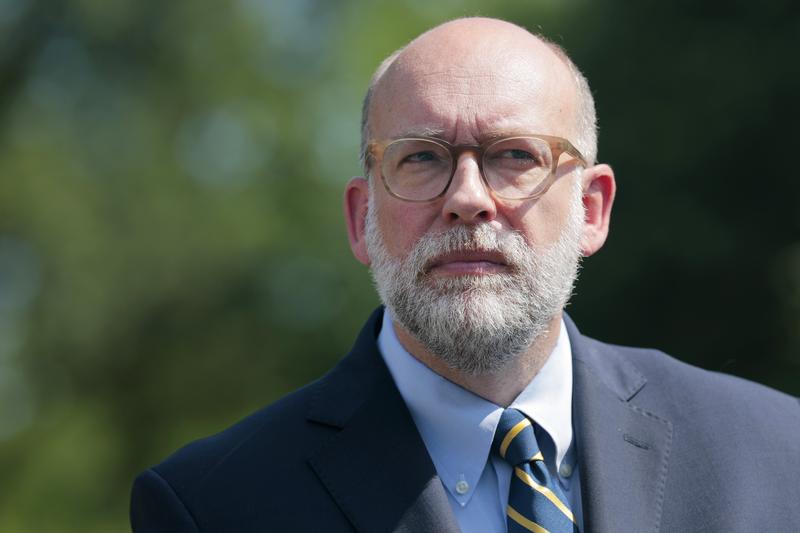
( Anna Moneymaker / Getty Images )
Brooke Gladstone: I'm Brooke Gladstone, and this is the On the Media midweek podcast. Last week, amid a dismal news cycle, a flicker of sunshine. Russell Vought, the Director of the Office of Management and Budget, the man behind the firing of thousands of federal workers from various agencies, the man who famously said he'd put federal workers in trauma, got a setback in his plan to kill the Consumer Financial Protection Bureau. Vought had called the bureau "woke and weaponized agency against disfavored industries and individuals."
He'd spent much of the last year firing its staff and choking off funding, but last Friday, he was ordered by a federal judge to request money from the Federal Reserve to keep the agency afloat. Senator Elizabeth Warren, who's credited with creating the agency after the 2008 financial collapse was in a celebratory mood. The CFPB, she said, is "an agency that has returned more than $21 billion directly to consumers, cheated by big banks and giant corporations, but today, Russ Vought was forced to request funding for the agency because we fought back in the courts."
Back in October, I spoke to ProPublica reporter Andy Kroll, who'd just written a profile about Vought. At that time, Vought was described by his boss as--
Donald Trump: Darth Vader. You know Darth Vader, right?
Brooke Gladstone: Donald Trump.
Donald Trump: They call him Darth Vader. I call him a fine man, but he's cutting Democrat priorities, and they're never going to get him back.
Brooke Gladstone: Whereupon Andy Croll one-upped Trump's casting of this particular bureaucrat by dubbing him shadow president.
Andy Kroll: The sources that I interviewed for this story work across the federal government and who deal with OMB in some cases on a day-to-day basis. That's how they described him to me.
Brooke Gladstone: Trump has kind of been plagued by what people regard as shadow presidents. Elon Musk was a shadow president. Trump's Homeland Security Advisor, Stephen Miller, still dubbed a shadow president, and they've had extraordinary influence, but Vought is the shadow of shadows.
Andy Kroll: OMB normally acts almost like a loving but diligent parent to the many agencies that make up the executive branch. It apportions, to use the technical term, money that Congress has already approved to these different agencies so that the federal government can run. That is what OMB looks like in normal times. What it looks like now is a place where Donald Trump's ideological agenda, in some cases his overtly political agenda, is being enacted. Russ Vought has found this place to basically put a kink in the hose of the federal government to exert the President's will.
Brooke Gladstone: Give me just an example or two.
Andy Kroll: The National Institutes of Health, earlier this summer, the Office of Management and Budget froze more than $10 billion that was going toward outside medical research, the kind of cutting-edge research that this country is known for, that saves lives, that develops new treatments. OMB froze that money, said that it was, "reviewing the money to ensure that it aligned with administration priorities in alignment with a MAGA agenda."
Brooke Gladstone: There is amazing amount of plain speaking in this administration about what its intentions are now. There's no dog whistling.
Andy Kroll: No, there's not. It's Russ Vought, I think, is a great example of that.
Brooke Gladstone: He's 49 years old, looks a little older, trim, graying beard. He gives off these tidy and meticulous vibes. That's the surface.
Andy Kroll: He originally hails from the Northeast. His father was a Marine who went on to be a union electrician. His mother was a public educator and then later founded a private Christian school. It's very clear that his family were very devout and that they believed in taking that faith into the public sphere. I think the mom's decision to help open the school and to really promote an idea of education steeped in things like creationism or the notion that if we aren't fundamentally a Christian country, we will descend into apathy and sin and sickness is a really key part of understanding him, because he really brings together today both the slash government at all costs mentality, but also a Christian nationalist worldview.
Brooke Gladstone: Vought attends a private Christian high school, goes to Illinois to study at Wheaton College, and he moves to D.C. right after college in 1999 and landed a mailroom job in the office of Texas Senator Phil Gramm. Combative, libertarian, or as some said, the most hated man in America.
Andy Kroll: Vought's job working for Phil Gramm was one of the first jobs he held on Capitol Hill. He was a kid learning how Congress worked, how bills actually get made and passed, versus the West Wing version or the Schoolhouse Rock version, however you want to put it. Phil Gramm is this iconoclastic, singular character in the Senate, someone for whom basically every program that required federal spending was an example of overreach or overspending, profligate behavior by the United States Congress, and he wanted to rein it in.
Vought went on to say that his time working for Gramm laid the conservative foundation for the rest of his career. Just to give you a flavor, people would come to Phil Gramm, and they would say, "You want to cut this program that helps the poor? You want to cut this program that helps new mothers. Don't you have a heart, Senator Gramm?" He would say in response, "Well, of course I do. I keep it in a jar on my desk." Russ Vought follows a really interesting trajectory when he arrives in Washington in the late '90s.
In the beginning, it looks like the quintessential college grad who's interested in politics, gets an internship and begins to slowly climb the ranks through Congress, working for different members. Eventually, he gets pretty darn close to the top of the political power structure in the Republican Party, but instead of sticking with it, he decides that the Republican Party is betraying its principles. It has drifted from what it was meant to be. He grows disillusioned and ultimately leaves a really influential job on Capitol Hill to work in activism.
Brooke Gladstone: He landed at Heritage Action, an offshoot of the Heritage Foundation, and it's kind of aggressive and spiky. Describe how he did there.
Andy Kroll: Heritage Action launched in 2010 in this very fraught moment in American politics. The Affordable Care Act has recently been passed. This Tea Party movement is brewing to push back on what conservatives see as this massive government overreach. Heritage Action becomes the brawling-- Spiky is a great way to put it. Affiliate of the Heritage Foundation, this long-standing think tank really known for putting out policy papers. Kind of a tweedy ivory tower kind of culture. Then it starts this pugilistic activist arm called Heritage Action.
Russ Vought goes there and basically becomes the chief antagonist, the most persistent tormentor of all of these members of Congress that he used to work for or work in support of when he was on the Hill. To take one example, in the 2010 elections, he designs this attack ad against a senior United States Senator, Bob Corker of Tennessee that puts Corker's face on a mailer next to three other people that a Republican doesn't want to be seen with. Barack Obama, Vladimir Putin, and the Iranian leader, Mahmoud Ahmadinejad. It's this kind of tactic that absolutely infuriates Republican leaders. Mitch McConnell, the majority leader, they are irate.
Russ Vought is loving it because he believes he has found a way to pressure Republicans to actually act, in his view, the way Republicans should.
Brooke Gladstone: Then he gets on Trump's radar.
Andy Kroll: Because there are so few people in Washington who won, expected a Trump victory in 2016, and two were willing to go into the new administration and try to make sense of what this president-elect Donald Trump actually wanted to do, but with Vought, there are a couple of key things here to understand. One is that when he was marinating in the teachings and the wisdom of Phil Gramm, he studied the Office of Management and Budget, the OMB, knew what that agency could do, and he dreamed of working there because he had come to see it as the kind of place where you could enact the massive spending cuts, that you could rein in government in a way that you couldn't from Capitol Hill.
Brooke Gladstone: That office isn't supposed to control the money constitutionally. It is appropriated by Congress. I mean, aren't there some suits about that?
Andy Kroll: There are some suits about that, and your analysis is in line with what the law says, what legal experts, conservatives, including the late Antonin Scalia, the late William Rehnquist, have said about the president's power or not to freeze funding that Congress has appropriated, but that is not what Russ Vought believes.
Brooke Gladstone: In the first term, he was frustrated because there were so many people in the way, career officials and people in the cabinet that refused to let it go off the rails, like John Kelly or Rex Tillerson, Secretary of State. Vought does have the substantial achievement you noted of being the cause of Trump's first impeachment.
Andy Kroll: That's right. The Ukraine funding freeze is the catalyst for Donald Trump's first impeachment trial. Remember, there was the funding freeze that the White House ordered and that Vought carried out, and he had been itching to use this tool. Impoundment is the wonky term. Also remember, at the same time, the White House is pressuring the Ukrainian president, Volodymyr Zelenskyy, to investigate then presidential candidate Joe Biden and Biden's son Hunter. That is where this possible quid pro quo, seemingly corrupt intent, comes into play.
These things all swirl together in 2019, and lead to that first impeachment, and Vought is not only in the middle of the action behind the scenes, he refuses to comply with a subpoena as part of the investigation into the Ukraine freeze and is actually named in the articles of impeachment.
Brooke Gladstone: He has this long history of frustration with his own party, but nothing compared to the downright horror with which he regards the Democrats. You quote him saying last year, "the stark reality in America is that we are in the late stages of a complete Marxist takeover of the country in which our adversaries already hold the weapons of government apparatus." That would be the deep state, and so in the second term, he took that apparatus over and used it to--
Andy Kroll: To shrink the government, fire employees en masse, freeze hundreds of billions of dollars, about 410 billion according to Democrats on the Appropriations Committee.
Brooke Gladstone: With the Supreme Court's help.
Andy Kroll: So far. The final rendering of how legal all of these machinations regarding federal funding remains to be seen. The court is about to take these questions up, and that's a really big issue going forward.
Brooke Gladstone: Let's stipulate that while we were distracted by flashier so-called shadow presidents, he was always the guy behind the curtain. For instance, when we were watching Chainsaw, Elon prance about and feed USAID into the wood chipper.
Andy Kroll: Musk was seen wielding the chainsaw is seen as the face of DOGE. Vought is very much a methodical, behind-the-scenes kind of operator. There was tension between those two personalities, and from what I gather, there were moments when Vought and his team at OMB were frustrated by what DOGE and Musk were doing, but also times when Vought and his folks saw DOGE as a useful tool.
Brooke Gladstone: I mean, who was the boss?
Andy Kroll: The final accounting of all this, I think, will show, and I think my reporting points toward this, that the boss was Vought, that Vought played a much more critical role pointing DOGE in certain directions to the Consumer Financial Protection Bureau, USAID, the US Institute of Peace, than we understood at the time.
Brooke Gladstone: You gotta wonder, Vought didn't agree to an interview with you, nor answer the questions you sent him. why is a guy who claims to have been raised on the idea of slashing spending, gleefully slashing jobs, such a big spender?
Speaker 3: The Department of Homeland Security announcing today that it's going to buy two Gulf Stream jets for more than $170 million. The department says the jets are required to provide official travel for Homeland Security Secretary Kristi Noem and other top officials.
Speaker 4: The Trump administration authorized a $20 billion financial lifeline for Argentina as it faces a deepening economic crisis. The justification of the deal has raised major questions and criticism about its merits.
Speaker 5: The president's so-called big beautiful bill aims to cut taxes by more than $3 trillion. The CBO said today that that tax cut would result in an increase of the deficit by $2.4 trillion. It would also leave nearly 11 million people without health insurance over the next decade. It comes as--
Brooke Gladstone: If Vought is really a budget hawk, how does he square those line items?
Andy Kroll: By fudging the math in the case of the one big beautiful bill, or in some cases just not remarking on new gilded ballrooms or private jets for the DHS secretary. He couches all of this discussion about cutting government, cutting jobs, cutting spending as trying to eliminate the "woke element in government," to rein in, "weaponized agencies."
Brooke Gladstone: Part of this is tactical on Vought's part, right? He gets to do what he wants to do if he doesn't complain about what Trump wants to do.
Andy Kroll: It's no accident that Vought is one of the very few people who served all four years of the first Trump administration, spent four years between the presidencies, working in service of the president and being very close in the inner circle. Then now he has come back. He knows what to say, what not to say, to have the trust of Donald Trump, which is a difficult thing to do. Vought also has a long-term view. This is a project of his that has been in the works for decades, long predating Donald Trump.
In 2023, Steve Bannon and Russ Vought are on stage together, and Bannon makes this comment that Trump is a very imperfect instrument, but he's an instrument of the Lord. Bannon and Vought they see Trump as someone to help them enable a larger vision. Trump is not the be-all and end-all. Then, in 2024, in a speech that we obtained that hadn't been reported, Vought goes even further. He says that Trump is this singular, historic figure, someone unlike any other president in American history, put on this earth to defeat the deep state, to end this supposedly corrupt government that we have found ourselves in, and that that is nothing more than a gift of God.
Brooke Gladstone: He believes that. You believe he believes that?
Andy Kroll: I absolutely believe that he believes that, yes. In one recording we obtained, Vought said that Republicans need to learn to love shutdowns because shutdowns are the way we save the country. That's the way he talks. He talks in terms of winning for the future of Western civilization. He views these kinds of fights, this shutdown that we're in right now, for instance, as existential battles for the survival of the United States of America. Then of course, that makes you think, what won't this person do in a position of power?
Brooke Gladstone: Here's another tape of Vought. It's in a private speech in 2023.
Russel Vought: We want the bureaucrats to be traumatically affected. When they wake up in the morning, we want them to not want to go to work because they are increasingly viewed as the villains. We want to put them in trauma.
Andy Kroll: As he put it in an interview with Tucker Carlson, the people who work in the bureaucracy, "hate the American people." Now, that's just such an inflammatory, unfair comment when you know the kinds of people who work for the federal government. They're not doing it to get rich. They're not doing it to be famous. These people are public servants who serve our country in mostly invisible ways, but keep our country strong and healthy and running.
Brooke Gladstone: What's the endgame here as we white knuckle ourselves through one of Vought's reported happy times. A government shutdown. It'll end. If he really is shadow president, what are his priorities for the next three years?
Andy Kroll: One of the big things to watch is what is the high court going to say about unilaterally dissolving government unions and mass-firing employees who supposedly have workplace protections? What is the Supreme Court going to say about the OMB unilaterally freezing hundreds of billions of dollars that Congress appropriated by law? Article 1, power of the purse and Vought has thrown a wrench, or as one person in our story put it, dropped a grenade into this system. That to me is the big, big question hanging over all of this right now.
I don't think it's a guarantee that this conservative supermajority marches in lockstep with the administration, but I certainly don't think it's a guarantee that they rule against Russ Vought in the White House either.
Brooke Gladstone: Like Stephen Miller, Vought wants a blanket opinion that makes the presidency more powerful than it's ever been. It seems short-sighted. It isn't always going to be their lot in power.
Andy Kroll: I have had the same thought many times. Where I come down is in two places. One is again Vought in these private speeches he gave that I obtained the recordings of. He talked about the 2024 election as akin to the 1860s, as akin to a civil war-like moment.
Brooke Gladstone: Not the only one who thinks that.
Andy Kroll: No, he's not. That's right. Those were the stakes as he saw them. Then I also think that talking to people in government, talking to smart folks who observe government, the Trump administration can do so much damage in these four years, can traumatize so many federal workers, can throw such chaos into the federal bureaucracy that even a supercharged presidency under a Democrat can't rebuild.
Brooke Gladstone: I think federal workers were traumatized, but there are many glimmerings of shaking off the funk and maybe uniting with each other and with other opposition forces. I don't know, maybe that's just wishful thinking.
Andy Kroll: No, I think that's absolutely right. I mean, I talked with probably getting north of 100 at this point, federal workers, current fired folks who are in job limbo. I think one, they believe that knowing explicitly what Vought has set out to do as it relates to them does give them some agency, because they see that this is explicitly what he's trying to do.
Brooke Gladstone: Not a byproduct.
Andy Kroll: Not a bug, a feature. Also, that there is solidarity among them, that they do have a voice, and that voice can be powerful when they find each other. People don't necessarily interact when you're at CFPB, and you're at CDC, they the Fed, you're at the EPA. People are finding each other now, and it's slow but I hear that more and more people comparing notes, people comparing strategies, and I would not be surprised to see from collectives of federal workers speaking out to defend their jobs, defend their colleagues, defend this idea that the civil service workforce serves the American taxpayer to try to make this country work better, make people healthier, make roads safer, and make this democracy function. That has been a heartening sign in this reporting.
Brooke Gladstone: Andy, thank you very much.
Andy Kroll: Thanks, Brooke.
Brooke Gladstone: Andy Kroll is a reporter at ProPublica covering justice and the rule of law. This interview first aired in October. See you Friday for the big show. I'm Brooke Gladstone.
Copyright © 2026 New York Public Radio. All rights reserved. Visit our website terms of use at www.wnyc.org for further information.
New York Public Radio transcripts are created on a rush deadline, often by contractors. This text may not be in its final form and may be updated or revised in the future. Accuracy and availability may vary. The authoritative record of New York Public Radio’s programming is the audio record.