
Trump's Justices Changed the Way We Vote Forever. Plus, Ep.3 of American Emergency
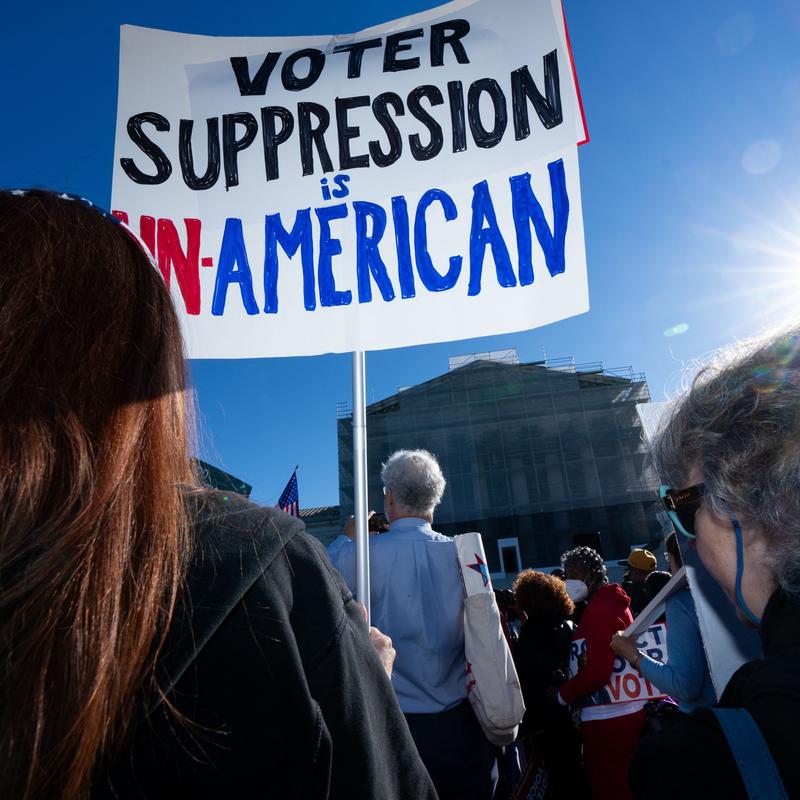
Title: Trump's Justices Changed the Way We Vote Forever. Plus, Ep.3 of American Emergency
[music]
News tape: In a 6-3 ruling, the court's conservative majority found that Louisiana's 6th District, which links Black communities across the state, relied too heavily on race in its design.
Brooke Gladstone: The Supreme Court's latest decision grants states nearly unrestricted power to gerrymander, but the court majority's logic was less than airtight.
- Elliott Morris: The Supreme Court is assuming party and race are independent influences on your vote. In fact, we've figured out that party ID is downstream, is part of your racial identity.
Brooke Gladstone: What does all this mean for our elections and our democracy? From WNYC in New York, this is On the Media. I'm Brooke Gladstone. Also this week, the storm of misinformation that came in the aftermath of Hurricane Helene.
News tape: The group called Hurricane Helene an act of war, claiming Hurricane Helene was caused by government-controlled weather weapons.
Brooke Gladstone: That's all coming up after this.
Micah Loewinger: From WNYC in New York, this is On the Media. I'm Micah Loewinger.
Brooke Gladstone: I'm Brooke Gladstone. Late last month, a massive ruling came down from the Supreme Court: Louisiana v. Callais.
News tape: In a 6-3 ruling, the court's conservative majority found that Louisiana's 6th District, which links Black communities across the state, relied too heavily on race in its design.
News tape: The decision could open the door to broader legal challenges over majority Black and Latino districts across the country.
Brooke Gladstone: Republicans across the South did not wait around for "they kicked that door clean off its hinges."
News tape: Tennessee Governor Bill Lee just signed a new congressional map into law, splitting up the state's only majority Black district.
News tape: The court's conservatives cleared the way for Alabama to move forward with a set of maps that would eliminate one of the two majority Black districts in the state ahead of the midterms.
Brooke Gladstone: Florida, before the Supreme Court had even said go, drew and approved new maps. Meanwhile, Georgia, South Carolina, and Mississippi's state legislatures now all have plans to meet in the coming weeks to potentially put red pen to paper. There's been plenty written about the legal mess the high court has left the American public in, but upon examining the majority's decision, it turns out that there's yet another problem, a statistical one.
- Elliott Morris: Brooke, if I can take you on a short little journey here.
Brooke Gladstone: G. Elliot Morris is a journalist, statistician, and author of the data-driven news website Strength In Numbers.
- Elliott Morris: I'd like you and your listeners to close your eyes and imagine a line going from left to right. On the left is a person, maybe you, with no preferences about who you vote for, and on the right is you have decided who to vote for. You are voting for a Democrat or a Republican, in this case, in your congressional district.
Along that journey, we know from our study of voters that you will attain a racial identity, either consciously or subconsciously, that will have an influence on who you vote for. It will also have an influence on another step on your journey, which is an attainment of a partisan identity, a party affiliation by virtue of your race and other factors of your identity. If you are a Democrat, 90% chance you will be voting for a Democratic candidate.
The court says in their Louisiana v. Callais decision, specifically Justice Alito writing for the majority, that the state is allowed to discriminate against you based on the effects of your partisan identity, but not on the effects of your race. They say that if we separate your racial and your partisan identity, the state can discriminate against you as much as it wants based on your party.
Brooke Gladstone: Alito is saying race and political party are separate things that happen to be related.
- Elliott Morris: Yes. The statistical error here is that the Supreme Court is assuming party and race are independent influences on your vote. In fact, along our journey, we have figured out that party ID is part of your racial identity, what we call a mediator. Party ID mediates the relationship between your race and your vote. It also mediates a lot of other things like your age and your ideology, et cetera. The court has said this one big meta super identity variable, your party identity, you can discriminate against someone as much as you want based on that, but not all the other things that are going into it.
Brooke Gladstone: Okay. If, let's say, this is a nice, compact Black voting district, and they vote Democratic, the state has the opportunity to break up that compact district and turn it into something that looks like a salamander, according to the court, but they're not allowed to do it because of race. The burden of proof is on the voters in that district to say they're doing this because we're Black and because we're going to vote Democratic.
- Elliott Morris: Yes. The court has taken what they call a race-neutral approach to this. They say you're no longer both Black and a Democrat. You are a Democrat first, and you can be discriminated against based on that.
Brooke Gladstone: They've made that decision arbitrarily. What's the basis for that?
- Elliott Morris: The court also decided in a case in 2024, Alexander v. South Carolina, that there's no ban on partisan gerrymandering. This is their attempt to reconcile that opinion that the mythical gerrymanderer listening to this can discriminate against someone as much as you want based on their partisan identity, but not on their race. If you're confused, Brooke, it is nonsensical.
The other thing that the court decided in Callais is that they added a criteria that a plaintiff must succeed at proving to strike down a racial or partisan gerrymander. The plaintiff must submit their own map that preserves all of the state's goals in partisan gerrymandering, in cracking up different communities, everything except for the racial gerrymandering. You, as the person being gerrymandered, have to submit a new map that still preserves that reality.
Brooke Gladstone: I don't understand. They have to submit a map that enables the state to, say, favor the GOP in this case, but what?
- Elliott Morris: The thing that most Americans don't realize is that there are no protections against partisan gerrymandering. There's no mention of party in the Constitution. Roberts and Alito and Thomas, the majority justices on the court, are saying there's no remedy for partisan gerrymandering because of that fact until Congress or some other body passes some standard for evaluating the districts based on their party.
If that is the case, then the court has decided in Louisiana v. Callais that, as the plaintiff of a voting rights case, the person being diluted based on your race, potentially, you are still allowed under the Constitution to be diluted based on your party. If this isn't making sense because it doesn't sound fair, that's right, it isn't fair.
Brooke Gladstone: Put this into context. How many Black districts, how many Democratic districts are there, and how does that relate to the percentage of Black voters in the state, or Democratic voters for that matter?
- Elliott Morris: Currently, Louisiana has six congressional districts. Two out of those six are represented by Black Democratic congresspeople, and those districts have a majority of Black residents inside of them. About a third of the districts are Black districts. Also, about a third, 32% roughly, of Louisiana's population is Black. There's rough fairness here. As a result of this new decision from the Supreme Court, Louisiana's state legislature will be allowed to dilute the votes of these Black Democrats by virtue of them being Democrats, and the new map in Louisiana will only have one Black majority district as well, rather than two. They could have drawn zero, but the legislature, in all of its generosity, drew one for the Democrats instead.
Brooke Gladstone: The original Voting Rights Act of 1965 was often said to have had both a sword and a shield. The shield was Section 5 of the VRA, which required states, counties, cities with a record of racial discrimination to get permission from the government before they could change their maps around election time. Now, that shield was removed in 2013 in a decision called Shelby County v. Holder. The Act's sword allows citizens or the Justice Department to challenge unfair maps. What the court has done now is seemingly blunting the edge of the sword to the point where it doesn't cut.
- Elliott Morris: We're really living in a democracy effectively without the Voting Rights Act because the preclearance has been ruled unconstitutional. That's Shelby County.
Brooke Gladstone: Yes, getting permission.
- Elliott Morris: Getting permission. The remedies are now effectively impossible to attain after you have been discriminated against.
Brooke Gladstone: What's your assessment of where our elections are now?
- Elliott Morris: We're really staring down the barrel of a future of safe districts pretty much everywhere. No one ever leaving Congress because they never get defeated, and to maximize the bias of these maps against the minority in every state in the country. That is particularly pernicious in the South, where partisan gerrymandering, as we have discussed here, is also racial gerrymandering. Partisan gerrymandering is, in and of itself, a violation of many democratic principles.
Brooke Gladstone: You've noted that two of our last four presidents were elected without winning the popular vote, and those two presidents appointed five of the nine justices currently on the Supreme Court. Meanwhile, the Senate is by definition undemocratic insofar as it overrepresents less densely populated states.
- Elliott Morris: The House was one of our last bastions of numerical majority rule, a check on the numerical minority. Even though in 2012 the winner of the popular vote, the Democrats, still lost the House, this tended to happen less often in the House. We are now entering a democracy in which the numerical minority will be able to control all four chambers of the federal government.
Brooke Gladstone: You've written about how the House of Representatives has systematically become less representative. Can you give us the numbers on that?
- Elliott Morris: Yes. One problem with all this gerrymandering is bias or the tilting of the chamber away from Democrats in the South. Along with that, mapmakers are also drawing fewer and fewer competitive districts. Combining these post-Callais redistricting maps, these are the maps in Louisiana, Alabama, Tennessee, and to some extent Florida, with the other gerrymanders that happened in 2015 in Texas, California, Missouri, North Carolina, and Ohio, not to list every state in the country here, we have erased nine competitive congressional districts in the House of Representatives.
In our modeling of the 2026 midterms, we expect there to be 15 true toss-up seats, true seats that could go either way, 15 out of 435. 96% of these seats essentially are going to one party over the other without a shadow of the doubt.
Brooke Gladstone: Did you say that in '76 we had 101 competitive congressional districts?
- Elliott Morris: Yes, basically a fourth of the House of Representatives regularly changed parties by virtue of gerrymandering and partisan polarization, people separating themselves effectively geographically, and therefore easy to carve up. That number fell to 42 in 2024, already near an all-time low. Now, accounting for all this redistricting in 2025 and these new racial gerrymanders in 2026, that number should fall to 33 competitive House districts, overall competitive, but those true number of districts that are really razor-thin, the toss-up districts, that's only 15 seats.
Brooke Gladstone: Can you tell me how this plays out on the ground?
- Elliott Morris: Whereas redistricting is supposed to be the principle that translates our will of the majority into seats in the House and representation, voters now want redistricting battles to confer upon them a partisan advantage. In Indiana's primaries, two weeks ago, eight members of the state Senate who had voted against redistricting, Donald Trump's redistricting there, seven out of eight of those lost. That to me is evidence that those primary voters would not tolerate deviation from their party leader, in this case, Donald Trump, or really just the party's strategy.
Brooke Gladstone: The senators who lost weren't punished for being insufficiently conservative.
- Elliott Morris: They were punished for being insufficiently partisan in their approach to redistricting.
Brooke Gladstone: You've used the phrase "doom loop" to describe the state of gerrymandering in the country. What do we do to get out of it, or at least stave off doom during this election year?
- Elliott Morris: The doom loop is an idea that comes from the political scientist Lee Drutman, but it describes this cycle by which voters and donors and party leaders all abandon their commitment to democracy and representation in search of partisan advantage in redistricting. There will be more steps along this doom loop as partisans, actual at the voter level, also abandon their commitments to democratic principle, which is a function of two-party systems, of a zero-sum thinking, of a punishing of the opposition party. If you want me to say two minutes on a remedy here or maybe one minute on a remedy here.
Brooke Gladstone: No, take your time.
- Elliott Morris: Unfortunately, I think there's no way out of this. The general political science conclusion is that a system of representation that is based on districts where those voters that are being districted are polarized, sorted based on their geography and their race, as long as politicians are allowed to draw those districts, they will sort the people into gerrymandered seats. The Supreme Court has said that that is permissible, and really the only way out is to ditch the districting system altogether and enact some system of proportional representation where you don't have districts at all.
Brooke Gladstone: I wonder whether a subsequent court could just cancel out this decision the way that they canceled out Dred Scott.
- Elliott Morris: Supreme Court precedent is constantly being rewritten. You can imagine a packed court might try to rewrite this new case law, but unfortunately, the state-level constitutions also can allow partisan gerrymandering of state legislatures. If there's no protections for racial minorities in state legislatures, you have a whole nother problem in all 50 states as well. This is, unfortunately, a bell that cannot be unrung.
Brooke Gladstone: Thanks very much, Elliott.
- Elliott Morris: Sorry, Brooke. Thanks for having me, though.
Brooke Gladstone: G. Elliott Morris is a journalist, statistician, and author of the data-driven news website Strength In Numbers. This is On the Media.
[music]
Micah Loewinger: This is On the Media. I'm Micah Loewinger.
Brooke Gladstone: I'm Brooke Gladstone. This week, the president nominated his pick to lead the Federal Emergency Management Agency.
CBS: President Trump has nominated Cameron Hamilton to lead the agency a year after he was removed from that very same position.
Brooke Gladstone: Hamilton was acting administrator of FEMA for about four months back in 2025, and a few months prior to that, he was sharing conspiracy theories on X about the agency's response to Hurricane Helene. The storm killed hundreds of people across the Southeast and triggered an avalanche of misinformation online. This week on American Emergency: The Movement to Kill FEMA, Micah and senior producer Eloise Blondiau take us back to Hurricane Helene and the political fallout that came in its wake.
News tape: Hurricane Helene, a catastrophic Category 4 showing no mercy, destroying property, flooding hotel lobbies, businesses, and homes, and submerging vehicles in oceans of water.
Helene survivor: This is terrible.
News tape: Hardest hit, North Carolina, where every single county has been impacted.
News tape: The worst flooding ever on record for the state. One emergency official calls it biblical devastation.
BBC: A short while ago, we got an update on the response from Jaclyn Rothenberg, the FEMA Public Affairs director.
Micah Loewinger: On September 30th, 2024, FEMA's Jaclyn Rothenberg looked wearily into a camera as she spoke with the BBC.
Jaclyn Rothenberg: Hurricane Helene was a multi-state event, and we currently have 3,500 federal personnel and 1,000 FEMA personnel that are spread across all of these states to help people recover.
Micah Loewinger: The immediate days after Hurricane Helene were a blur for Jaclyn. She traveled to see relief efforts in Florida before returning to headquarters in DC, where she took back-to-back calls from reporters. A few times a day, Jaclyn would throw on a FEMA-branded jacket, run to the bathroom to put on some makeup, and then sit under the fluorescent office lights for an on-camera TV spot. She also managed a team of 40 spokespeople and PR workers who fielded hundreds of requests from journalists morning to night.
Jaclyn Rothenberg: This local outlet in North Carolina wants to talk to an official, this one in Georgia, this one in Florida. We would have people on TV at 6:00 AM, 7:00 AM, 8:00 AM. It was such an intense couple of weeks.
Micah Loewinger: When they weren't speaking with the press, they were discussing how to speak to the press, frantically scurrying around FEMA's National Response Coordination Center, the beating heart of the agency's public relations system.
Jaclyn Rothenberg: It looks like a war room. You have people that are writing on whiteboards, writing talking points for officials to do interviews. There's social media monitoring going on. There's screens of every single television network so you can watch the interviews as they're happening live, but also pick up on local press conferences and coverage.
Micah Loewinger: Much of this work was fairly routine, but as viral rumors and misinformation about the storm and the government's response started to take over social media, it began to dawn on the agency's leaders that they were dealing with a new kind of emergency.
Jaclyn Rothenberg: I don't think any of us knew the magnitude of what this storm would mean in FEMA's history, and that I didn't know at the time.
Micah Loewinger: The exact moment it became clear was a couple weeks after landfall.
Jaclyn Rothenberg: I remember being in FEMA's National Response Coordination Center doing my job. A colleague pulled me aside in a small little room, and they said, "There's been some threats against you. We think it's unsafe."
Micah Loewinger: On X, a conservative influencer named Liz Churchill had posted a picture of Jaclyn's face with the words, "Make this TRAITOR famous." That was reposted by former Infowars host Alex Jones, who's long claimed that the agency operates secret prisons, so-called "FEMA Camps." He added his own message above Jaclyn's photo: "They are literally at war with the American people." Trolls began posting her phone number and home address along with antisemitic messages.
Jaclyn Rothenberg: There was an individual in Alabama who threatened to shoot me, so a state that actually was not impacted by the disaster at all. I got scared. I got really scared, and ultimately, we made the decision to have me pause on doing media interviews and to try to lay low. I remember calling my husband before I left, and I said, "We need to leave the house."
[music]
Micah Loewinger: On this week's episode of American Emergency: The Movement to Kill FEMA, Hurricane Helene, a storm that brought unprecedented destruction to western North Carolina and put the agency squarely in MAGA's crosshairs. While President Trump claimed FEMA was a failure, its response to the storm demonstrated how much FEMA had evolved since Hurricane Katrina. This time around, the agency was better staffed and better trained. It was also far more proactive.
Before Helene made landfall, FEMA had positioned 1,500 federal workers to the region, nearly 1,000 of whom would help coordinate search and rescue operations. It pre-staged 2.7 million meals, over 100,000 gallons of gasoline and 10,000 beds for survivors. For FEMA, Helene was really two storms: one that poured 40 trillion gallons of water across the Southeast, and another that appeared on phones and computer screens. That one, it completely overwhelmed the agency.
Donald Trump: People are dying in North Carolina. They're dying all over those five, six states. They're dying, and they're getting no help from our federal government.
Micah Loewinger: Days after landfall, just a month before the 2024 presidential election, then-candidate Donald Trump held a rally in Michigan. At the time, he was polling neck and neck with Kamala Harris in North Carolina.
Donald Trump: How would you like to be a veteran? You've been sleeping opposite the entrance to a luxury hotel, and illegal migrants come in, and they're going up and occupying the hotel. That's what's happening. They stole the FEMA money just like they stole it from a bank so they could give it to their illegal immigrants that they want to have vote for them this season.
Micah Loewinger: This was a lie. Customs and Border Protection operated the migrant housing program. The funds flowed through FEMA, but it came from a totally separate pot of money. Just one of many false narratives spreading on the right-wing internet.
News tape: Former President Donald Trump is falsely accusing the Biden administration of going out of their way to restrict aid to Republican-leaning communities impacted by the storm.
Jaclyn Rothenberg: That's absolutely not true. We help people in every community where there's a federally declared disaster.
Micah Loewinger: In media interviews, Jaclyn and her public affairs team tried to push back on each and every false narrative coming from the Trump campaign.
Donald Trump: What's happened there is very bad. They're offering them $750 to people whose homes have been washed away.
Micah Loewinger: This was also a lie. Jaclyn's team posted on social media that the $750 is just a bit of quick cash for survivors who can also apply for heftier home assistance, up to $42,000 in a single year, and sometimes more.
Jaclyn Rothenberg: It's really unfortunate that there's misinformation because that discourages people from applying for assistance.
Micah Loewinger: Part of the misinformation was rooted in a misunderstanding of how the agency functions. People often imagine that workers in FEMA gear are pulling people out of flooded homes, but FEMA primarily coordinates with other local agencies, who do the lifesaving work, providing supplies, manpower, and funding to support them. Responding to all these false claims became an endless game of whack-a-mole for FEMA, especially on X, now under the ownership of Elon Musk, who had a vested interest in seeing Trump reelected.
Jaclyn Rothenberg: I remember Elon Musk tweeting that he was trying to send Starlinks down to North Carolina and that FEMA was hampering the efforts to set up Starlink internet devices.
Laura Ingraham on FOX: Musk says he received a note from a SpaceX engineer that said that the big issue is that FEMA is actively blocking shipments and seizing goods and services locally.
Jaclyn Rothenberg: Which was fundamentally false. I was putting out tweets constantly that we were, in fact, not blocking the shipments of Starlinks.
Micah Loewinger: Several state and local officials also tried to dispel rumors that FEMA was blocking or confiscating third-party donations, but there was simply too much noise online.
Will Oremus: The reality is that our information environment isn't well designed for debunkings.
Micah Loewinger: I spoke with Will Oremus, a technology reporter at The Washington Post, as these rumors were spreading in 2024.
Will Oremus: We worked with researchers from a nonprofit called the Institute for Strategic Dialogue, who did a report on this, how many people were reached by 33 of the most viral falsehoods around Hurricane Helene. Then we just, as a back-of-the-envelope analysis, looked at, well, what about FEMA's own tweets? How many people are they reaching? FEMA's most popular tweets since Hurricane Helene have reached 50 times fewer people than the false rumors.
Micah Loewinger: The false rumors, the tweets about Jaclyn being a "traitor," reached a fever pitch about two weeks after Helene made landfall, culminating in that death threat and her decision to start laying low. Jaclyn wasn't the only person from FEMA who was targeted. Trolls tried to 'swat' Deanne Criswell, the agency's leader. They made a hoax phone call to 911, attempting to send police to her rental property. Her deputy chief of staff received a similar threat, and Criswell's chief of staff was doxxed, too.
Brianna Sacks: The threat level against workers was pretty unprecedented.
Micah Loewinger: This is Brianna Sacks, a Washington Post reporter who's been writing about FEMA for years.
Brianna Sacks: Sorry, I need to respond to my boss really quickly.
Micah Loewinger: Go for it.
Brianna Sacks: One second. Okay, thanks.
Micah Loewinger: She was in the middle of breaking a story about the agency when we spoke in December. In 2024, she spent a month in western North Carolina reporting on how these viral lies and rumors about FEMA were playing out on the ground.
Brianna Sacks: There were about a dozen or so we tracked of these militia extremist right-wing groups who had come into the area offering support and supplies and tagging themselves as doing what the federal government wasn't doing.
Micah Loewinger: She followed one of these groups, a notorious border militia called Veterans on Patrol, to Lake Lure, a mountain town about 35 miles outside Asheville.
News tape: The group called Hurricane Helene an act of war, reportedly issuing threats against the US military, claiming Hurricane Helene was caused by government-controlled weather weapons.
Micah Loewinger: One day, Brianna was driving around speaking with survivors when her phone lit up with a tip. A government source had forwarded her an email saying that FEMA and other relief workers in North Carolina were planning to pause their work due to threats from a militia.
Brianna Sacks: I pulled over in the middle of nowhere and was able to reach the man who wrote the email, who confirmed that they had heard there were credible threats about men with guns driving around the area threatening FEMA.
Micah Loewinger: On October 13th, she broke the story in The Washington Post. It was immediately picked up by other national outlets.
NBC: National Guard troops had come across trucks of armed militia saying they were out hunting FEMA. NBC News has not seen the email cited by The Post, and it's unclear whether the threat mentioned was seen as credible.
Micah Loewinger: Officials told the press that FEMA would evacuate Rutherford County, North Carolina, while they investigated, but within a day, the gunmen story was largely debunked.
Brianna Sacks: As local authorities got involved and figured out what happened, it was confirmed that there were never truckloads of men. It was the lone individual who they ended up arresting.
News tape: 44-year-old William Parsons, arrested Saturday for allegedly making threatening comments aimed at FEMA workers while in a gas station, where authorities say he was armed with an assault rifle and handgun.
News tape: Parsons says he was so upset and went to Lake Lure to respond to what he says were social media reports that FEMA was withholding supplies.
Brianna Sacks: It's not clear how the report referring to men in trucks started, and it made its way to the federal government.
Micah Loewinger: This story spread quite a bit, in part because of your piece.
Brianna Sacks: Yes.
Micah Loewinger: Do you regret reporting it in the way that you did?
Brianna Sacks: It's funny you asked that because I called my editor and I was like, "Did we make a mistake? Am I at fault here for something?" He was like, "Absolutely not. We got an email, a federal document. This is what it said, and this was the situation that FEMA was in." This was not the only incident of threats against FEMA during this time. I think it just goes to show where everyone was at in terms of thinking, "What is going to happen? Is someone going to shoot a federal worker? Are they safe?"
[music]
Micah Loewinger: There were, in fact, other cases of harassment levied against federal workers on the ground, but the fact that this militia story was exaggerated undermined that reality. FEMA's decision to stop operations for a day fed into Trump's narrative that the agency was failing the people of North Carolina. The confusion and misinformation had also made some survivors wary of seeking support from FEMA.
Brianna Sacks: Shawna Gilmore was a woman I connected with who lived outside of Swannanoa.
Micah Loewinger: A town that saw significant flooding during Helene.
Brianna Sacks: She grew up in a rural southeast Missouri town.
Shawna Gilmore: I've been through lots of floods because I lived on the Mississippi River.
Brianna Sacks: Oh, wow.
Micah Loewinger: This audio is from Brianna's interview with Shawna Gilmore.
Shawna Gilmore: The water seeps up and rises, and it goes down. It doesn't come rolling down mountains. [laughs]
Brianna Sacks: In her telling, when her home would flood, her family was the ones who would pick themselves back up. There was no federal aid that came in.
Shawna Gilmore: Maybe I just have trouble trusting the federal government as an authority.
Brianna Sacks: You're far from alone there.
Micah Loewinger: Fortunately, Shawna's home was largely spared from the flooding in Swannanoa. Hurricane Helene caused some big trees to fall on her property, about $5,000 of damage that FEMA might be able to pay for, but Shawna wasn't sure that she wanted to apply for aid. She was suspicious of federal workers after seeing rumors on social media about the agency trying to steal land, misinformation based on FEMA's voluntary buyout program, where it purchases flood-prone properties at market rate. She was also concerned about a so-called "FEMA camp" that had come to her area.
Shawna Gilmore: A gal had made a video of the trucks coming in and had watched from an aerial of the operation getting set up.
Micah Loewinger: Shawna did not respond to my request for an interview, but based on her descriptions, I believe she had seen a viral video from right-wing content creator Ann Vandersteel.
Ann Vandersteel: Stick with us. We're going to figure out what's going on.
Micah Loewinger: Ann Vandersteel livestreamed this video outside of the so-called "FEMA camp," which was really just a fenced-in area on the side of a highway, a lot with a bunch of trailers and prefab buildings.
Ann Vandersteel: It's got armed guards, and it is a massive installation that literally, according to the residents that live around here, they said it's FEMA camp, and it popped up in a matter of days.
Micah Loewinger: Not much happens in this video. Vandersteel doesn't really allege anything specific, but the guards, her snooping around, it does suggest something is going on, enough to make Shawna wonder what FEMA might be up to.
Shawna Gilmore: I don't know what it is, but there's something really stirring and triggering for me about it.
Micah Loewinger: As she told Brianna Sacks, The Washington Post reporter, Shawna's friends were begging her to apply for FEMA assistance, that $750 and a bigger reimbursement for the damage on her property. She ended up speaking with a FEMA worker and asked him about the FEMA camp.
Brianna Sacks: She learned that they were setting up there because people needed somewhere to sleep. They didn't want to take up all the hotels, so she decided to sign up. Then she texted me, I think the next day, freaking out, saying, "I actually don't want to do this. I want to rescind my application." There was a lot of turmoil, I think, within herself and fear of giving her information to the Federal Emergency Management Agency.
Micah Loewinger: I believe I read in your piece that in December, several months after Helene, only about 15% of households in the affected region had applied to the agency for individual and household assistance.
Brianna Sacks: Correct. I had an official within FEMA flag this to me, saying, "Hey, this is pretty startling. We're not seeing people sign up for aid. I have a feeling it's the misinformation." I went there to find out why people weren't signing up for aid. I think the misinformation was an undercurrent, but there were other major factors that were hindering people's desire and ability to sign up for federal assistance.
[music]
Micah Loewinger: Coming up on American Emergency, those other major factors.
Gloria Sundquist: They're just a bureaucratic organization that required your lungs for whatever they wanted to give you.
Micah Loewinger: This is On the Media.
[music]
Micah Loewinger: This is On the Media. I'm Micah Loewinger. We just heard about how FEMA workers and some Helene survivors came to fear one another, the result of conspiracy theories, new and old, supercharged by a noxious presidential election and Elon Musk's X, all of which may have discouraged some flood victims from seeking help from the federal government. According to local reporters, online misinformation was more visible to people outside of North Carolina. Many survivors didn't have power or access to the internet for weeks. For others in western North Carolina, applying for financial assistance from FEMA clashed with an Appalachian culture of self-reliance.
Kim Bellofatto: That's a great way to define it. People didn't sit at home and think, "I need the government to come help me." People helped their neighbors.
Micah Loewinger: This is Kim Bellofatto, a journalist-turned-librarian who oversees several branches in Madison County, North Carolina, part of the mountain region that was engulfed by freak floods.
Kim Bellofatto: Trees down in your yard, everybody shows up with their chainsaws, and they've cut it and pushed it out of the way.
Micah Loewinger: She didn't recall hearing any specific conspiracy theories about FEMA during Helene or its aftermath, but she winced at the thought of federal workers wandering up long mountain roads, walking up to houses to explain FEMA's various assistance programs, which was its common practice after a disaster.
Kim Bellofatto: This is a rural community. Nobody just rolls up to your front door and knocks on it. That's not expected. I know that there was a worry among the FEMA teams as far as going out into the communities, like how isolated were they going to be, and was it safe to go into those spaces?
Micah Loewinger: She invited the agency's staff to set up inside the Marshall Public Library, a modern, sunny building on a wooded hillside.
Kim Bellofatto: We're a trusted resource, and I felt like whatever people thought or heard or believed about FEMA, the fact that it was here would improve its trustworthiness.
Micah Loewinger: Remember, much of FEMA's job after a disaster like Helene is really about processing paperwork and then getting money to survivors and local governments so that they can rebuild. Kim had federal workers spread out in a meeting room where locals could come and ask questions and file their applications for aid in person. The agency brought its own security.
Kim Bellofatto: Suddenly, there's two armed guards at the library who are asking questions before you go in. "Are you here for FEMA, or are you here for the library? Can I take a quick look in your bag?"
Micah Loewinger: The dissonance of a little library safe haven amidst the social media mayhem just felt so On the Media-y. I flew down to North Carolina with my series collaborator, OTM senior producer Eloise Blondiau, to visit.
Gloria Sundquist: Hello, Eloise.
Micah Loewinger: I'm Micah. Nice to meet you.
Gloria Sundquist: Hi, Micah. Nice to meet you.
Micah Loewinger: It was here that we met Gloria Sundquist, one of the circulation assistants at the library. We found her scanning books behind the counter, greeting the regular patrons who strolled in, all while some kids played tag among the stacks. Gloria hardly knew anything about FEMA before Helene rocked her hometown of Hot Springs.
Gloria Sundquist: I know I'm knowledgeable about a lot of things, but FEMA, the whole name is scary.
Micah Loewinger: Gloria got to know the FEMA workers stationed at the library, which was convenient because she needed assistance herself. Helene nearly killed her. When the storm hit western North Carolina, Gloria sheltered at her home on the banks of the French Broad River, where she'd lived for nearly 30 years. She figured she was safe since she was up in the mountains, and she didn't want to leave any of her pets behind.
Gloria Sundquist: I had six cats and a dog.
Micah Loewinger: What are your cats' names?
Gloria Sundquist: Oh my gosh. Geez. We've got Purr, she's a shelter cat, Pounce, he's a cat that was rescued in a field, PJ, he's Pounce Jr, Sharpie, he's black, Bunny Ann, Mugsy, who sounded the alarm.
Micah Loewinger: Mugsy sounded the alarm?
Gloria Sundquist: Mugsy, my little buffy orange, he looked outside and the water's up to the windowsill, and he started crying.
Micah Loewinger: The morning after landfall, the sun was shining as the waters began to swallow Gloria's white wooden home.
Gloria Sundquist: I said, "All right, Mugs." I pulled down the attic ladder, and I threw him upstairs. One by one, I was throwing them upstairs because of the water. It was crazy. It was like looking through a porthole. You'd see water coming up just like you were looking out a ship's window.
Micah Loewinger: While the cats hid in the eaves, her 100-plus-pound dog, Marble, clung to the attic ladder. In the chaos of the moment, Gloria had decided to change her pants, but, stunned by the sight of the rising water, stood with the clothes in her hands, soaking wet.
Gloria Sundquist: Things were floating. It was surreal, like the Titanic. The refrigerator floated, and it came into the other room, and then I heard my name being called.
Micah Loewinger: A group of guys on a raft appeared at her window and beckoned for Gloria to come through it.
Gloria Sundquist: I put my dog out the window, and Big Chris reached out and pulled him into the raft. Then I went out the window, and the water was orange. It was just orange.
Micah Loewinger: Later, when she got to town, her savior, Big Chris, handed her something he'd seen floating behind her as she boarded the raft.
Gloria Sundquist: He said, "This followed you out." He said, "I want to give it back to you." I had a candle on my windowsill, and it was the hand of God and a little girl in the hand of God. It was just a testimony to me, yes, I was in God's hands. He took care of me. It wasn't my time. That's all you can say.
Micah Loewinger: When Gloria returned to her house a few days later, nearly all of her belongings were destroyed. The water had mostly drained away, leaving several feet of sludge. The cats were all safe, though. All but one had climbed down from the attic, muddy paw prints marking their path out. Though Gloria felt blessed to have survived, it would be a long time before she gathered back together the pieces of her life.
In order to receive FEMA assistance towards somewhere to stay and to rebuild her home, Gloria was told to download an app to start her forms, but she didn't have electricity, Wi-Fi, or a smartphone. Later, once she got herself a new phone and started the application, it was painful to relive her near-death experience over and over.
Gloria Sundquist: In the midst of all that trauma, how do people sort through that?
Micah Loewinger: The process was really confusing, so Gloria enlisted a pro bono lawyer to help her.
Gloria Sundquist: The paperwork is very, very upsetting to see. I'll be honest with you, it's very, very hard to decipher their paperwork, and I'm not stupid.
Eloise Blondiau: You work at the library.
Micah Loewinger: Eloise Blondiau, OTM's senior producer.
Eloise Blondiau: Even though you were at the library and around FEMA representatives all the time, it was still hard for you.
Gloria Sundquist: It was very hard, yes. They were all very nice. It's just that they couldn't really answer your questions about what's pending, what kind of assistance is available.
Micah Loewinger: At first, FEMA offered Gloria hotel vouchers, but the hotels were two hours from her home, her pets, and her job at the library.
Gloria Sundquist: I said, "You're not equipped to deal with rural people." I said, "I do not need a hotel voucher. I need rental assistance." I had a cabin up above me that people wanted $1,000 a month for a one-room cabin.
Micah Loewinger: When the rent money didn't arrive in time, a charity gave Gloria a camper to live in, which she put on her property next to her wrecked home.
Gloria Sundquist: It was the volunteers, it was the churches. It wasn't FEMA.
Micah Loewinger: FEMA came through months later with a check to contribute to Gloria's home repairs, but she was emotional when she recounted the experience even a year and a half later, and she told us she wasn't sure the money was worth all the trouble. The fact that she'd seen way more volunteers than FEMA workers made her wonder what exactly the federal government was doing to help her community.
Gloria Sundquist: FEMA, I don't know what they're for. What are they for?
Samantha Montano: It is absolutely the case that not everyone's needs were met during the response to Helene. Certainly, now in the recovery, there are many people and communities who are struggling to recover.
Micah Loewinger: This is Samantha Montano, a professor of emergency management at Massachusetts Maritime Academy and the author of Disasterology: Dispatches from the Frontlines of the Climate Crisis. She was doing Helene recovery volunteer work with her students. I interviewed her while I was reporting in North Carolina.
Samantha Montano: FEMA, for the most part, responded to Helene in a way that demonstrated the changes that had been made post-Katrina. You had a competent FEMA administrator.
Micah Loewinger: Deanne Criswell, Biden's appointee.
Samantha Montano: You have a staff at FEMA who was better trained, and you have a mobilization of the entire federal government. You run into this situation where you're asking the public to imagine a horrible situation being even worse. Death tolls could have been significantly higher. Power could have been out for even longer. Water supplies could have been out for even longer.
Micah Loewinger: What would you say to somebody who's hearing you and they're like, "It just sounds like this person, she's such a FEMA supporter."
Samantha Montano: [laughs] No, no. I am one of FEMA's biggest critics. I wrote an entire book about how FEMA needs to be more effective, efficient, and equitable. What is important to understand here is that just because there is reform that is needed to an agency or to a system does not mean that that agency needs to be completely destroyed.
Micah Loewinger: "Trump's threats to kill FEMA," says Samantha Montano, "were rooted in the narratives that captivated MAGA during Helene. His claims that the agency was biased against his supporters took on a new fervor later in October 2024."
News tape: It feels like déjà vu, loading up and heading out towards another hurricane just two weeks after Hurricane Helene hit.
News tape: This is Hurricane Milton's path of destruction. The damage along Florida's already battered Gulf Coast, extensive.
Micah Loewinger: The trouble for FEMA began when its teams deployed to Florida. Some officials and rank-and-file workers experienced harassment and threats online and on the ground. One team leader took matters into her own hands.
Marni Washington: There is what we call a community trend, and unfortunately, it just so happened that the political hostility that was encountered by my team, they just so happened to have the Trump campaign signage.
Micah Loewinger: This is Marni Washington, a FEMA supervisor who was deployed to Florida in the wake of Hurricane Milton, speaking on a podcast after she was fired from the agency. She had texted her team, who were canvassing with info on FEMA's programs, that they could skip homes featuring Trump campaign signs to avoid more harassment. Those texts were leaked to the right-wing media, and they quickly took on a life of their own. Soon, pundits were pointing to Washington's texts as evidence of the agency's anti-conservative bias.
News Nation: The Daily Wire broke it, reporting that at least 20 homes with Trump signs or flags were skipped from the end of October and into November due to the guidance.
Opinions Vary: She's saying this was a widespread practice. I don't believe for a second that this was the only time this happened, and I don't think it was the only place that it happened.
Deanne Criswell: The actions of this employee are unacceptable, and it is not indicative of the culture of FEMA, and I do not believe that there is a widespread cultural problem.
Micah Loewinger: This is Biden's FEMA administrator, Deanne Criswell, testifying before Congress a couple days after the story broke.
Deanne Criswell: I have directed ongoing investigations, and if we find any other acts of similar behavior, we will take appropriate disciplinary measures.
Micah Loewinger: One investigation eventually found only 15 instances in which FEMA employees even mentioned Trump or MAGA signs among tens of thousands of recorded home visits over Biden's term. By then, the story of an agency biased against Trump and his supporters had served its purpose. Like a boomerang, the president had thrown out this lie and then plucked it back out of the air months later when his chaos had manifested as proof.
When President Trump called for a review to determine FEMA's future, his executive order referenced Marni Washington. While Trump exaggerated FEMA's failures on the campaign trail and then promised better aid when he reentered office last January--
Donald Trump: You are not forgotten any longer. You were treated very badly by the previous administration.
Micah Loewinger: His FEMA delayed and withheld assistance to North Carolina. Looking back, it's clear that the events surrounding Hurricane Helene were the culmination of narratives that had begun simmering decades earlier. Those Cold War-era conspiracy theories, the distrust in the wake of Katrina, and all of FEMA's frustrating bureaucracy.
What Helene illustrates so well is that even with all the progress FEMA had made, the agency couldn't insulate itself from the destructive force of MAGA, a movement that, on its path to power, looked to exploit any and every crack in the old American order. When Trump finally came back to Washington in 2025, he brought with him the anger that had been directed at FEMA from the right-wing fringes, and then put those same conspiracy-minded, anti-government forces in charge of the agency's fate.
Micah Loewinger: Next week on the fourth and final episode of American Emergency, my conversation with Trump's new nominee to lead FEMA, a MAGA warrior who stood up for the agency against former DHS Secretary Kristi Noem and her special assistant Corey Lewandowski.
Cameron Hamilton: I wanted to choke somebody, and that's exactly what came to my mind, [laughs] doing some very un-Christian things to a certain person.
Micah Loewinger: That certain person being Mr. Lewandowski?
Cameron Hamilton: Yes, I think you can read between the lines on that statement.
Micah Loewinger: That's it for this week's show. This series is reported and hosted by me, Micah Loewinger, with additional writing and reporting from--
Eloise Blondiau: Me, Eloise Blondiau, On the Media's senior producer. Jared Bartman designed the artwork for this series. Our fact-checker is Tom Colligan. Original music and mixing from Jared Paul. American Emergency was edited by executive producer Katya Rogers.
Micah Loewinger: Special thanks to Leah Varjacques at Extreme Weather Survivors, Alex Webber, Brianna Sacks, Laura Hackett, and Blue Ridge Public Radio. See you next week. I'm Micah Loewinger.
[music]
Copyright © 2026 New York Public Radio. All rights reserved. Visit our website terms of use at www.wnyc.org for further information.
New York Public Radio transcripts are created on a rush deadline, often by contractors. This text may not be in its final form and may be updated or revised in the future. Accuracy and availability may vary. The authoritative record of New York Public Radio’s programming is the audio record.