
Trump's Glitzy Library Grift
Title: Trump's Glitzy Library Grift
Brooke Gladstone: This is On the Media's Midweek podcast. I'm Brooke Gladstone. Last month, amid the rush of news from the Justice Department, another troubling bulletin.
Reporter: In a new legal opinion, the Department's Office of Legal Counsel ruled the Presidential Records Act goes too far, saying Congress cannot force the President to preserve and turn over records to the National Archives. The law has been in place since the 1970s, requiring presidents to treat official records as government property, not personal.
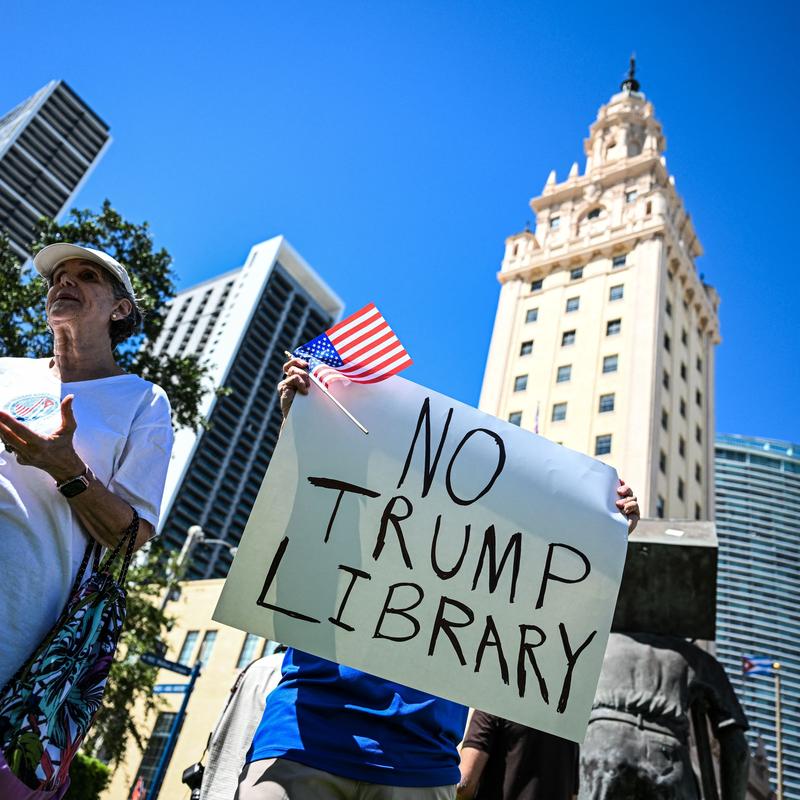
Brooke Gladstone: Given the administration's proclivity for obscuring information, the fact that it challenged the act wasn't a shock. Presidential records are the backbone of presidential libraries, and our president has long shown keen interest in memorializing his time in office. His library, according to renderings released in March, will be extravagantly-Trumpificent.
President Donald Trump: It's going to be most likely a hotel. This concept could be office, but it's most likely going to be a hotel with a beautiful building underneath and a 747 Air Force One in the lobby, which is going to be a trick.
Brooke Gladstone: Even before architectural renderings were released, his multipurpose facility was already serving a purpose, presidential piggy bank. When the Qatari royal family gave Trump a Boeing 747 to become Air Force One, it wasn't a bribe, but a future exhibit in the library. When Trump sought damages from ABC News, Paramount, Meta, and X, their settlements, about 63 million in all, weren't Trump profiting off the office, but money for the library, which raises an inevitable question, which I posed last year to historian Tim Naftali. Why does the president need so much money for a library?
Tim Naftali: That's a product of our beautiful constitutional system. The Article I branch, which is Congress, is not thrilled about building shrines to the Article II branch, which is the presidency or the executive branch. The way the system works, the president would build this facility, deed it to the American people, and then Congress would pay to curate the museum, preserve and make accessible the documents, and make sure that the roof got fixed. Congress gets stingier and stingier, decrees that anyone elected to the presidency after 2002, who's going to get a library, has to raise the money to build it and has to raise an additional 60% of the cost for maintaining the building. You need to raise a lot of money.
Brooke Gladstone: I'm remembering that season of Veep when the character Selina Meyer is spending almost all of her time trying to get money for her library.
Selina Meyer: I need a monument to Selina Meyer.
Andrew Meyer: An institution.
Selina Meyer: Selina Meyer belongs in an institution.
Brooke Gladstone: Bill Clinton famously pardoned Marc Rich after Rich's wife promised $500,000 to Clinton's library. A Republican lobbyist was caught on camera, allegedly arranging meetings between top Republican officials and foreign entities in exchange for donations to George W. Bush's library. Why are these libraries such ripe vehicles for this kind of deal-making? I assume part of it is that you can donate anonymously. It's actually impossible for us to know how much money Trump has already amassed.
Tim Naftali: Your assumption is one of the reasons why it matters that President Trump has started to raise money so early in his second term. The opportunity for outside interests and foreign governments to make him happy is huge, and making him happy might lead to a change in his interpretation of our national security interests. Presidents understand it is easier to raise money while they still have power. Just as their power begins to diminish as they become more and more lame ducks, so too does their ability to raise funds. Outside interests see that fact as a vulnerability in the system, and they take advantage of it. We are now living in an era which is more permissive of official corruption than we've seen since the 19th century.
Brooke Gladstone: Let's just go back to 1940, when Franklin Delano Roosevelt was the first to set up a presidential library. I've been to it. You can listen to his Fireside Chats in a 1930s-style kitchen or living room. He deeded his papers to the American people, but he didn't have to, and he put restrictions on what was available.
Tim Naftali: George Washington created the norm that presidents own their papers. The reason why presidential papers for the 19th century are scattershot is that presidential families owned them, and if they wanted to destroy them, they could. Franklin Roosevelt and the presidents that followed him deeded their papers to the American people, but they did set some restrictions on access. Because of Watergate, the Congress decided that presidents shouldn't own their papers anymore because they were untrustworthy custodians of their papers.
There was reason to be concerned that Richard Nixon, if he controlled his papers and his tapes, would destroy some of them. Congress mandated in the Presidential Records Act of 1978 that the next president, their papers would be, from day one, owned by the American people, and those records would be at a National Archives facility. It was assumed they would be at the presidential library with the president's name over the front door.
Brooke Gladstone: Now, your experience was with Nixon's library, you were director of it.
Tim Naftali: Because of Watergate, Richard Nixon could not send his records to California, where he wanted a library. The records stayed in Washington, D.C. Nixon's family and the president, he was still alive, wanted a library anyway, and they built one in his hometown of Yorba Linda. It was a private presidential library, and it didn't have any of his presidential papers. The family then decided in the early 2000s to join the existing presidential library system. The federal government would take it over.
The presidential papers would be sent out to California, but they would be under the control of the National Archives, and the Museum Library, which was infamous for its view of Watergate, would also come under federal control and would have to meet federal standards. I was recruited to be the first federal director, and that meant, in this case, that I would redo the Watergate exhibit.
Brooke Gladstone: What did you find that you changed?
Tim Naftali: The museum exhibit argued that Watergate was an attempt by the Democrats to overturn the results of the 1972 election, did not discuss the Plumbers, the spying on Daniel Ellsberg, did not discuss in detail the role played by Republicans in deciding that the President had to leave office.
Brooke Gladstone: It accused The Washington Post reporters Bob Woodward and Carl Bernstein of bribing sources. Nixon's enemies list was portrayed as the product of a rogue presidential staffer. That was John Dean, Nixon's White House Counsel. Nixon was presented as not having done anything his predecessors hadn't done except get caught.
Tim Naftali: The docents who had been there, fine people, but they had a list of books they could read, and they were discouraged from reading other books, were encouraged to say to people, "Yes, President Nixon did things that were wrong, but he did nothing that no other president had done, so it's okay." Rather than saying, "Presidents shouldn't do this." We had a whole section on other presidents who had done secret taping, Kennedy and Johnson, and actually Eisenhower and Truman, and even FDR had taping systems. That's all there too. It's not up to the federal government to tell you what to think.
It wasn't up to me to tell people what to think about Watergate. I had an obligation to make sure the evidence that was relevant to making your own mind up about Watergate had to be accessible.
Brooke Gladstone: You have said that the door to what Trump is doing in the creation of his library now was actually opened by Barack Obama.
Tim Naftali: I was very disappointed when President Obama decided to privatize his library project, that his museum would be run by the Obama Foundation, because I believe it's very important for us to be capable of nonpartisan public history. Even though presidential libraries are tilted absolutely towards the president in their first iteration, over time, their museums get closer and closer to a nonpartisan view. These libraries are a litmus test of our ability as Americans to be honest to ourselves about the most powerful people in our society.
Brooke Gladstone: What does Trump seem to be intending to do?
Tim Naftali: If President Trump's approach to his library is like his approach to everything else, his library will be a Trumpland with an alternative narrative about practically everything that happened in his first term and now in his second term. President Trump has an open door to privatizing his museum.
Brooke Gladstone: What does it mean for the future of our cultural memory?
Tim Naftali: I'm really concerned about Trumpian predilections. He doesn't like to document what he does. In the first term, he had to be stopped from tearing up documents. He almost went on trial for having kept documents that belonged to the American people because of the Presidential Records Act, which meant that he doesn't have respect for the protection of our materials. Given that he penalizes people who do not parrot his version of reality, I am concerned about the kinds of records his lieutenants are keeping, and I worry about our ability later to get good oral histories, such important supplements to documents.
The archivists of the National Archives, it's an understaffed team, but they're very professional. I think they can protect the documents that are already there, but I worry about them being able to ensure good archival practice during the life of this administration. If a president knows that ultimately the people of this country, or at least their children, will know about their crimes and their abuse of power, it might be a check on their behavior when they're in office. President Trump's ability to now manipulate his own record because of this permissive climate is yet more license for misdeeds.
Brooke Gladstone: You wrote in The Atlantic back in 2022 that you went to the George W. Bush Museum and you found no mention of waterboarding, Guantanamo Bay, military tribunals, the digital surveillance of Americans.
Tim Naftali: The National Archives was going to allow them to privatize that museum so there would be no National Archives involvement whatsoever. I pointed out weaknesses in the existing displays, and I thought that was a bad idea.
Brooke Gladstone: Why did they do that?
Tim Naftali: To save money. The Bush Foundation runs that museum now, but I'd learned that the Nixon Foundation wanted to take over the Nixon Museum. The National Archives promised Congress in 2022 that that wouldn't happen, but it's possible that the leadership team at the National Archives will allow foundations to privatize their museums, so the attempt to present a nonpartisan approach to Watergate may be short-lived.
Brooke Gladstone: We already see the president's efforts to whitewash the entire history of the United States by almost any means necessary. For instance, his executive order instructing national parks employees to flag displays that "disparage Americans," his ongoing effort to rewrite the January 6th insurrection. Really, how much do presidential libraries, which only a small percentage of us will ever visit, matter when it comes to keeping the truth front and center?
Tim Naftali: If the only access a person had with a presidential library was a physical access, absolutely. Presidential libraries have the capacity through the web to interact with many more people. People in this country and around the world access the digitized, declassified records that presidential libraries put online and is done by civil servants every day.
Brooke Gladstone: Let's follow the money for the moment. Senator Elizabeth Warren has introduced the Presidential Library Anti-Corruption Act to put some guardrails around presidential library donations.
Senator Elizabeth Warren: Nations, people seeking presidential pardons, and companies doing business with the federal government can dump tens of millions of dollars into these library slush funds while the president still sits in the Oval Office making decisions about their future. That is wrong, and my new bill will put a stop to it.
Brooke Gladstone: In the exceedingly unlikely case that this bill is passed and signed, would it help address some of the problems we've been talking about?
Tim Naftali: I do think it would be healthy if the public knew who was contributing to the building of a library. That's a check on the most overt forms of lobbying. The best way to eliminate this opportunity for corruption is for Congress to pay for these big buildings, but I don't think that's likely. Some people with deep pockets will be doing this because they believe in public history or they believe in their man, and someday their woman, but others will have an ulterior motive. I think the only way to be realistic about those motives is for people who give money to be public.
Brooke Gladstone: In Trump's case, one of the two nonprofits set up to get library donations is called the Donald J. Trump Presidential Library Foundation, and it lists his son Eric and his daughter Tiffany's husband, Michael Boulos.
Tim Naftali: It's not new for members of a presidential family to participate in a library foundation. What I think is new today is this enabling culture of official corruption. The president ran promising vengeance. He is using this opportunity to squeeze money from his enemies, and that money is being directed to his library. The president in this term isn't even trying to create the impression of a line between his personal and his financial interests. The problem is much bigger than just a library foundation. The problem is the climate we are living in, and the fact that the American people don't seem to care about a president who's enriching himself while in office.
Brooke Gladstone: Tim, thank you very much.
Tim Naftali: My pleasure, Brooke.
Brooke Gladstone: Timothy Naftali is a senior research scholar at Columbia University's School of International and Public Affairs. This interview was first aired last July. Thanks for listening to the Midweek Podcast. Join us Friday for the big show. It posts around dinnertime. I'm Brooke Gladstone.
[MUSIC - On the Media's Theme song]
Copyright © 2026 New York Public Radio. All rights reserved. Visit our website terms of use at www.wnyc.org for further information.
New York Public Radio transcripts are created on a rush deadline, often by contractors. This text may not be in its final form and may be updated or revised in the future. Accuracy and availability may vary. The authoritative record of New York Public Radio’s programming is the audio record.