
Trump Sued Himself … and ‘Settled’ for a $1.8 Billion Fund
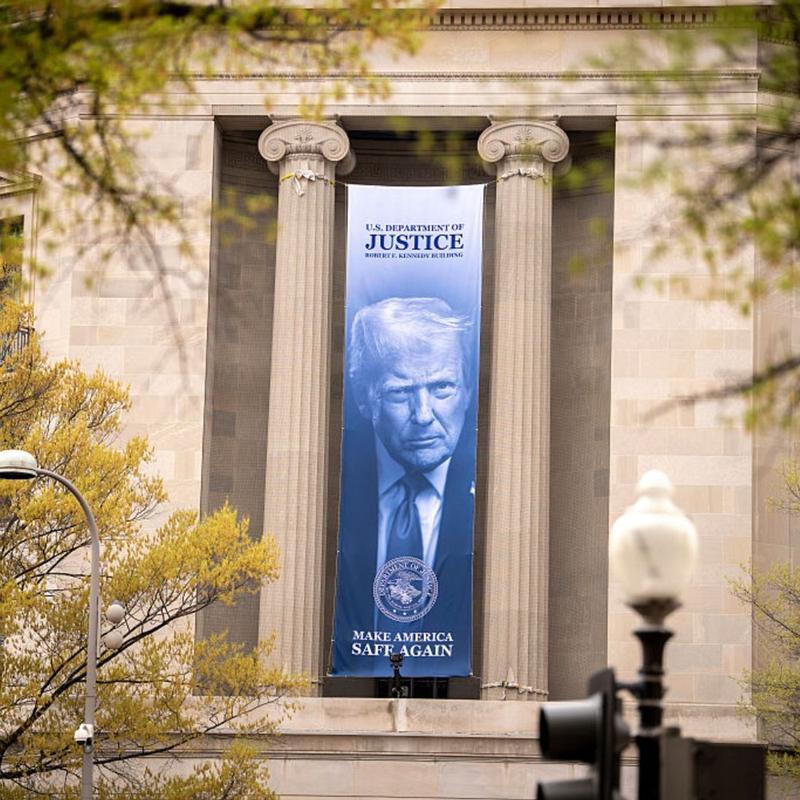
[music]
Senator Chris Van Hollen: Will individuals who assaulted Capitol Hill police officers be eligible for this fund?
Attorney General Todd Blanche: Anybody in this country is eligible to apply.
Brooke Gladstone: President Trump's attempt to create a $1.8 billion fund for those "targeted" by the Biden administration is raising eyebrows of friends and foes alike.
Anna Bower: People can see the obvious self-dealing.
Brooke Gladstone: From WNYC in New York, this is On the Media, I'm Brooke Gladstone.
Micah Loewinger: I'm Micah Loewinger. Also on this week's show, CBS News Radio is no more. While obits for the network celebrate nearly a century of broadcasting, back in 1928, the launch was less than promising.
- Brad Schwartz: CBS is this upstart company formed by a stock promoter and a talents agent. The early reviews of the first performances don't make you want to tune in again.
Micah Loewinger: It's all coming up after this.
Brooke Gladstone: From WNYC in New York, this is On the Media. I'm Brooke Gladstone.
Micah Loewinger: I'm Micah Loewinger. Last week, President Donald Trump and his own Justice Department reached a settlement on the president's $10 billion lawsuit against the IRS with the creation of a so-called anti-weaponization fund.
News clip: The DOJ says the $1.8 billion fund will support those who claim they were a victim of lawfare at the hands of the Biden administration.
Micah Loewinger: On Friday, a federal judge temporarily froze the slush fund ahead of a June 12 court date. There were already other efforts to kill it, including a challenge from two officers who defended the Capitol on January 6th.
Reporter: Capitol Police Officer Harry Dunn and Metropolitan Police Officer Daniel Hodges are bringing the lawsuit because the fund could be used to compensate the Capitol rioters who attacked them and put their lives at risk. In this tape, you hear Officer Hodges as he's pinned against a door by the mob.
Senator Chris Van Hollen: Will individuals who assaulted Capitol Hill police officers be eligible for this fund?
Micah Loewinger: Democratic Senator Chris Van Hollen questioning Acting Attorney General Todd Blanche.
Senator Chris Van Hollen: Why not make that a rule?
Attorney General Todd Blanche: I expect that the-- Because I'm not one of the commissioners setting up the rules, I expect--
Micah Loewinger: That doesn't sound like a no. The fund has divided the GOP with some Senate Republicans refusing to vote on a spending bill over concerns that taxpayer dollars could go to insurrectionists.
News clip: Former Senate Majority Leader Mitch McConnell said it would be "utterly stupid, morally wrong to award money to pardon January 6 rioters."
Micah Loewinger: Unsurprisingly, the MAGA faithful have fallen in line.
JD Vance: This is about compensating Americans for the lawfare that we saw under the last administration.
Micah Loewinger: JD Vance, at a press briefing last week.
Kaitlan Collins: You previously told me that anyone who assaulted a police officer on January 6th should go to prison. Why not rule out giving them taxpayer-funded money?
JD Vance: Kaitlan, what I said is we're going to look at everything case by case.
Kaitlan Collins: Why not rule it out?
JD Vance: Because, Kaitlyn, there are people who I don't know their individual circumstances.
Micah Loewinger: The origins of this contentious slush fund go back to an even more contentious lawsuit.
Anna Bower: The story of the president who sued himself really begins, actually, in 2019.
Micah Loewinger: Anna Bower is a senior editor at Lawfare. She recently wrote about how in 2019, an IRS contractor named Charles Littlejohn leaked tax returns for a number of wealthy Americans. Those leaks were later published by the New York Times and ProPublica. Trump sued the IRS for the leak earlier this year, which Bower says makes sense. He was legitimately wronged. There were a couple of things that should have turned his case into a nothingburger.
Anna Bower: Chief among them is that Trump filed this suit well after the two-year statute of limitations.
Micah Loewinger: His workaround of the statute of limitations is that he didn't know that his information had been leaked, and therefore, he was basically filing within two years of his learning.
Anna Bower: Yes. His claim is that he didn't know until he received a letter in January of 2024 from the IRS saying Littlejohn leaked your tax return information.
Micah Loewinger: Before that, his lawyer was speaking about harm done to him in court.
Anna Bower: Yes. A year before that, his lawyer, Alina Habba, had gone to federal court on the record and spoke on his behalf at a public hearing about Littlejohn leaking his tax returns. Then there's also this separate issue of whether the government would have been liable because Littlejohn was a contractor, not an employee. There's different rules of liability around what the government can actually be held culpable for when it's a contractor versus an employee.
In other cases, the government had raised this issue as a defense, including the Trump administration itself this year, filing briefs to that effect. Then if you look at the one case that was also related to Littlejohn's conduct, that was a case brought by the billionaire Ken Griffin, whose tax return information was also leaked. That case, the Justice Department did enter a settlement, but that only resulted in a public apology.
Micah Loewinger: No money, no $10 billion.
Anna Bower: No money. Yes. Point is just there's no reason in Trump's case to believe that this would have resulted in anything substantial, much less settlement, to the tune of $1.776 billion.
Micah Loewinger: Trump seems to be getting some preferential treatment here. Does that have anything to do with the fact that he effectively controls both sides of the courtroom?
Anna Bower: That's the other thing that is completely unusual and unprecedented about this case. He controls the government that he is suing, and he controls the lawyers who are litigating on the other side of the case. Keep in mind, under Trump's theory of executive control of the Justice Department, he has been very clear that whatever he says goes.
Micah Loewinger: To point out the obvious, the Justice Department is not supposed to be the President's personal lawyer or act in any way like that. In fact, the judge for this case, Kathleen Williams of the US District Court for the Southern District of Florida, said that she thought this all smelled pretty funny.
Anna Bower: It raised the question for her as to whether or not she actually even had jurisdiction to oversee the case. The reason why has to do with a constitutional issue, because federal courts are only allowed to oversee cases where there's a real, genuine dispute. We call it adverseness or adversity. She wanted to hear from the parties on this because if there's no real dispute, she could dismiss the case. We never got around to hearing what Trump and the Justice Department thought about all this, because before the judge could ever even hold a hearing on the matter, there was this announcement that a settlement had been reached.
Micah Loewinger: Trump's settlement with himself was for a cool $1.7 billion, $1.776 billion to be exact. He said that this money would go to charity, but actually, that money is set to go to a newly minted anti-weaponization fund to compensate people who "suffered weaponization and lawfare." Where exactly is that money coming from, and where do we think it's going?
Anna Bower: The $1.776 billion for this anti-weaponization fund is coming from a permanent appropriation called the Judgment Fund that was of appropriation that Congress set up because it didn't want to basically have to do a new appropriation every time that the Justice Department settles a case. The assumption up until now has been that the Justice Department will pay out settlements in a responsible way. What happened here is that there's really no normal type of congressional oversight that you would have if you, as the executive, just wanted to create this fund outside the context of litigation. Through the guise of a settlement that they could go through the judgment fund that acted, essentially, like a blank check.
Micah Loewinger: This anti-weaponization fund, which it's painful to even read those words because it feels like it's obvious that a weaponization of the Justice Department is what is creating this fund. It does seem like some of this money is intended to go to January 6th rioters and other political allies who attempted to interfere with the 2020 election.
Anna Bower: Trump has long talked about compensation for the January Sixers, and we've already seen reports of Jan Sixers who are applying for compensation from the fund.
Micah Loewinger: The Trump administration has dismissed multiple cases for members of the Oath Keepers and the Proud Boys with prejudice. Meaning they can't be tried again. They've taken press releases of their convictions off government websites. It really feels like they're just setting the table here.
Anna Bower: The seditious conspiracy cases that you just mentioned that the Justice Department sought to dismiss, those are people who were adjudicated guilty and sentenced to decades in prison for their conduct. I actually, in the Oath Keeper's case, I covered some of that trial. Stewart Rhodes, the evidence at trial involved stockpiling weapons to bring to Virginia to be able to ferry them across the river on January 6. It involved recorded statements that he made in which he said that his only regret was that people who were at the Capitol that day didn't bring rifles because they could have fixed it right then and there.
Micah Loewinger: The Oath Keepers trial hits close to home because I was actually a federal witness in that trial.
Anna Bower: Oh, wow.
Micah Loewinger: The government used some of my reporting into the Zello walkie-talkie app as evidence. I authenticated the evidence. I was pretty ambivalent about it at the time. I felt like I didn't really have a choice. I was subpoenaed. It was complicated. Now, just like-- I don't know.
Anna Bower: What was it like seeing that news about the Oath Keepers case and this anti-- Sorry to turn the tables on you. Become the interviewer, but I'm just curious.
Micah Loewinger: I mean, honestly, I find it really upsetting because it just feels like such an obvious subversion of justice. You don't have to have sat in that courtroom to take offense to this. I mean, we all watched January 6th unfold on TV. There's a lifetime of footage on the Internet. The idea that we shouldn't believe our lying eyes and that the obvious thing that happened that day didn't happen that day, it just feels like a profound eff you to all of us.
Anna Bower: Right. I am so in the details on these things that I agree with you. What I wonder is, does the average not really tuned-in news consumer feel the same way? I don't know the answer to that.
Micah Loewinger: I'm not sure I know the answer to that either. I was going to ask you that. I do fear that the idea that the Biden administration weaponized its DOJ against innocent MAGA supporters, this framing has become just a basic fact in right-wing media, and that that's what is allowing this charade to take place.
Anna Bower: I'm from rural Georgia, and I hear that sentiment from people a lot. I also think that when I've talked to people back home about this settlement fund in particular, people can see the obvious self-dealing that's happening in a way that maybe they can't when it's just in the context of government dismissing some of these January 6th cases or rewriting history and deleting press releases and that kind of thing.
Micah Loewinger: Do you think that the press, the coverage that you're reading and watching, hearing, is making it clear how upside down all of this, how baldly corrupt it all seems?
Anna Bower: I always just wonder, is it that the media is not expressing these things in a concrete way, or is it just that general audiences don't have the attention span or the desire to really get into the legal weeds on some of this stuff?
Micah Loewinger: I appreciate that, but I also feel like we can't blame laypeople for not understanding the maneuvers taking place here. Like, isn't it our job to make this clear and make people care? Maybe we do need the headlines to be "Trump Administration attempts to steal money from the Federal Government to pay out to political allies."
Anna Bower: Is that your view, or is that just a suggestion?
Micah Loewinger: Is it my view that that language should be used-
Anna Bower: Yes.
Micah Loewinger: -by mainstream outlets? I don't know. It's easy for me to preach this because I don't work in a newsroom and I don't have to deal with standards editors at the New York Times and this kind of stuff. I'm just afraid that journalists, in their effort to not seem biased, will hide their own analysis behind explanations of boring mechanisms. It's like the stakes are a little bit too high for this stuff. I think if there's any chance people won't understand what's happening, it's our job to translate it for them.
Anna Bower: Yes. I also wonder, too, how much coverage are you giving to the IRS settlement fund? Like, are you doing multiple stories, like wall-to-wall coverage of it, because it's really terrible and seems like people should know about it, or are you doing one story and then moving on? Because things just don't break through.
Micah Loewinger: Yes, no, exactly. This has been great. I'm going to try to bring the conversation--
Anna Bower: Yes, I'm sorry. I feel like we got derailed on me asking you questions.
Micah Loewinger: Yes, absolutely. No, thank you. Thanks for your curiosity. There have been some reports that at least some Republicans are skeptical of this slush fund. Is there any hope that Congress will intervene here?
Anna Bower: I have given up on thinking that Congress will exercise its oversight powers in the way that it ought to, or at least the way that I think it ought to. Keep in mind there's the midterms. We could very well see some changes there depending on the outcome of the election. If you have a change of party in the House of Representatives, you may very well see an effort in House to bring litigation to challenge this. That could actually be one avenue in which standing might be successful. It's unclear because the case law on that issue is a little bit unclear.
Micah Loewinger: Okay, I guess we'll cross that bridge if we get there.
Anna Bower: Yes, we will see. There's a lot of just unprecedented things going on with this settlement. Unfortunately, a lot of my answers to you are, "It's unclear."
Micah Loewinger: I'll take whatever hope I can get. Anna, thank you very much.
Anna Bower: Thank you. Thanks for having me.
Micah Loewinger: Anna Bower is a senior editor at Lawfare and co-author of the recent article, "The President Who Sued Himself."
Brooke Gladstone: Coming up, the true story of the glorious launch and legacy of CBS News began in a prison fire.
Micah Loewinger: This is On the Media.
[music]
Micah Loewinger: This is On the Media. I'm Micah Loewinger.
Brooke Gladstone: I'm Brooke Gladstone. Big shakeup, said CBS's 60 Minutes this week. On Thursday, CBS News editor-in-chief Bari Weiss named Nick Bilton, a former New York Times opinion columnist and documentarian who's never worked in traditional TV news, to run what is, for now, TV's most-watched news magazine. Also, this week, another bombshell. The network did not renew the contract of veteran 60 Minutes correspondent Sharyn Alfonsi after 22 years on the job. Last December, she had prepared a report on the notorious prison in El Salvador where the president was deporting people. The night before the segment was slated to air, Bari Weiss pulled the story.
News clip: Weiss told show leadership to pull the segment in part because there was no interview with the Trump administration. Angry with the decision, correspondent Sharyn Alfonsi emailed her fellow 60 Minutes colleagues--
News clip: Saying the story is factually correct and accusing CBS News editor-in-chief Bari Weiss of pulling it for political reasons.
Brooke Gladstone: She's not the first 60 Minutes lifer to rebel against Weiss. In April 2025, longtime executive producer Bill Owens resigned, saying it was no longer possible to run the show with journalistic independence. Last week, CBS's star anchor Anderson Cooper quit the network, ending his final broadcast with a subtle jab.
Anderson Cooper: I think the independence of 60 Minutes has been critical, and I think the trust it has with viewers is critical to the success of 60 Minutes. Yes, for the last time, I'm Anderson Cooper.
Brooke Gladstone: Something else happened, far less covered, but no less important.
Micah Loewinger: May 22 marks the end of CBS on the radio. Over its nearly 100 years, CBS has helped define the sound of America.
Edward Murrow: This is Edward Murrow speaking from Vienna. It's now nearly 2:30 in the morning, and Herr Hitler has not yet arrived.
Brooke Gladstone: CBS Radio launched the career of the legendary news anchor Edward R. Murrow and helped shape the format of broadcast news. In late March, Bari Weiss and President Tom Zebrowski issued a memo declaring that CBS Radio would be tossed into history's dustbin.
News clip: CBS News says the change is coming as the world moves on to digital sources and podcasts.
Brooke Gladstone: Weiss and Zebrowski wrote that, "CBS News radio served as the foundation for everything we have built since 1927." If true, it was an accident. Writing in the Columbia Journalism Review, historian A. Brad Schwartz, author of Broadcast Hysteria and a forthcoming biography of Edward R. Murrow, recounts the remarkable tale of history's first on-the-spot breaking news broadcast that entirely changed the trajectory of CBS News and yet is largely lost to memory. Brad, welcome to the show.
- Brad Schwartz: Thank you for having me.
Brooke Gladstone: What's the real story?
- Brad Schwartz: For one thing, the company that we now know as CBS, the Columbia Broadcasting System, didn't have anything like a news division or a news organization when it started broadcasting in 1927. It goes on the air about a year after the national broadcasting company, NBC.
Brooke Gladstone: Its archrival. It's the unreachable star.
- Brad Schwartz: Absolutely, because it has the backing of the Radio Corporation of America. It has the blessing of the US Government. It is intended to be essentially the American version of the BBC, structured differently, but starts in a very similar way. Whereas CBS is this upstart company. It's formed by a stock promoter and a talent agent, concert manager who are really trying to compete with NBC in terms of entertainment. You see, that's what they're promoting from 1927, and struggling early reviews of the first performances don't make you want to tune in again.
Brooke Gladstone: You quote one reviewer in your piece saying that its three-hour premiere declined in quality with astounding speed and that no one not paid to listen could have survived it.
- Brad Schwartz: That's right. I left out the fact that they were, I believe, at least 15 minutes late getting on the air in the first place because there were storms and there were technical difficulties, and they were in a studio that didn't have clocks. Back in those days, broadcast journalism, as we think about it today, certainly didn't exist. You would have people reading bulletins off the news wire, or literally just they'd buy a newspaper and read the text on the air.
Brooke Gladstone: In fact, CBS executes a great leap ahead of NBC. What happened was there was a prison fire in 1930 in Columbus, Ohio. The prison had a broadcasting facility right near where the cells were burning.
- Brad Schwartz: This prison, by the time of the prison fire in 1930, is almost 100 years old. It had held Confederate prisoners of war during the Civil War. It's a very old facility near downtown Columbus. During what appears to have been an escape attempt, a couple of inmates would later confess to setting an incendiary device in a cell block that was unoccupied, but was next to an occupied and overcrowded cell block.
Brooke Gladstone: Just to be clear, these prisoners who were trying to escape, they set up this incendiary device in this abandoned building in order to create a distraction, right?
- Brad Schwartz: Correct.
Brooke Gladstone: They got the timing wrong. They set it so that everyone would be at dinner, but it didn't actually catch fire until they were all back in their cells, locked individually. There wasn't any automatic unlock.
- Brad Schwartz: Exactly. These cells, which would contain probably three or four inmates, are individually locked. Yes, these inmates hoping to create a diversion so they can escape during dinner. By the time the fire catches, everybody's locked up.
Brooke Gladstone: The untold story here, perhaps even more than the first time a live unplanned event was broadcast, was the broadcaster Otto Gardner, a prisoner who fellow inmates knew as the Deacon. Tell me about him.
- Brad Schwartz: Otto Gardner was originally from Virginia. He's African American, and he comes north to Ohio at some point. This is, of course, the period of the great Migration. He's living in Youngstown in 1917 when he murders his wife and her sister-in-law, shoots them both on a crowded streetcar in front of a lot of witnesses. He's convicted of first-degree murder, pleads guilty, is sent to the Ohio Penitentiary in 1918. It appears that he experiences a religious conversion within the prison. He, at some point, obtained a degree from the Moody Bible Institute, I'm fairly certain by correspondence, because they even in the '20s had radio correspondence courses.
Moody had its own radio station, and a lot of prisoners in the Ohio Penitentiary had radio sets in their cells like crystal receivers. By 1929, 1930, he is known within the prison as the Deacon because of his religious degree, but also because he is working as the secretary of the Protestant chapel in the prison, which is in a building that's located right next to the cell blocks that are going to burn in April 1930. One of his duties in the Protestant Chapel is managing a radio station that WAIU, the CBS affiliate in Columbus, installed there to broadcast musical performances by the prisoners. This was a regular program that began in early 1929, was quite popular regionally, apparently.
Brooke Gladstone: People all over were tuning in to hear these prisoner performers.
- Brad Schwartz: One duo in particular. There was an inmate, Harry Dawson, I believe, who wrote a song, I'm Just a Black Sheep, and it became a regional hit.
Brooke Gladstone: We can't find it.
- Brad Schwartz: Neither could I. I'm sorry. He and his partner were known as the Black Sheep. People would write mail to the prison. You look at the newspaper coverage, you see indications of like, "If you like this performance, write to the governor." These were popular broadcasts, and it appears that because Gardner was the secretary of the Protestant Chapel, he was responsible for managing what they referred to as the radio station, and he almost certainly did some broadcasting as well.
He was acting as an announcer in some capacity on at least a few of these programs. When the fire breaks out, not only do they have broadcasting facilities, but they have prisoners, and one in particular who have microphone experience, which makes a big difference when you're covering an event like this.
Brooke Gladstone: You said that he knew the difference between addressing an in-person audience and addressing a radio audience.
- Brad Schwartz: Yes, that's a big factor that I think is going to make this broadcast as impactful as it was, because the craft of broadcasting that is developing in the 1930s, particularly politicians, are still orating, they're still talking as if to a full lecture hall. You see people like FDR, you see people like Edward R. Murrow, they're the ones who understand this is a conversation. You are addressing a singular imagined spectator, not a theater full of people.
Brooke Gladstone: This is before Murrow's big moment and Roosevelt's. This was April 21st, 1930. The fire breaks out. Describe what transpired after it started.
- Brad Schwartz: It's iron bars and stone walls, so it's essentially like being inside a brick oven. When they eventually were able to clear the burned building, they found men with their heads in the toilet trying to get away from the heat, but it's the heat in the smoke that overcome you before the fire. Once people smell the smoke and the cry of fire goes out, the first concern of the prison officials, and the warden in particular, is to avoid a prison break. They show much less concern for the lives of the people inside the burned building.
While the warden and most of the guards are trying to secure the complex and bring the National Guard in, a few prison guards, but mainly other prisoners, are unlocking the cells, are breaking the locks off with hammers, are doing whatever they can to get each individual door open and get their fellow prisoners out. There was some saving done by the prison officials, but certainly the inmates who survived this and left accounts, like Chester Himes, who became the famous novelist and wrote a story and later a novel about this. He marvels at how the people who are considered to be the worst of the worst, convicted of murder and every crime in the book, are risking their own lives to save their fellow prisoners.
Brooke Gladstone: How did WAIU, that local CBS Columbus radio station, get the eyewitness account of the fires? Technically, how did they pull it off?
- Brad Schwartz: Because WAIU is located on an upper floor of the only skyscraper at that time in Columbus, what is now the LeVeque Tower, they can see the smoke coming up from the prison, which is right near downtown. They actually break the news locally while they send someone over, their station manager, Fred Palmer, to the prison. Within an hour or two of the breaking of the news, they have Palmer reporting in by telephone. He can tell an announcer on the other end of the line what he's seeing, and then the announcer can repeat what he's saying over the air, which is, again, about as close as you could get given the technical constraints.
Once Palmer is able to get inside the prison, about a couple hours after the fire has started, and he gets to the chapel, and he sees that the radio facilities have survived and are in working order, they are able to patch in, certainly using a phone line with the WAIU transmitter. Now they're broadcasting locally direct from the scene of the disaster. Meanwhile, the WAIU officials are getting on the phone with CBS in New York, saying, "We have something. Can you clear your schedule?" This requires getting long-distance phone lines.
The fire breaks out around 5:00, 5:30 PM. By 11:15, the Columbia Broadcasting System in New York is ready to take this local broadcast from Columbus and send it out to 72 affiliates nationally, who, if you're listening to your radio at that hour, you have no idea what you're about to hear. Certainly, in the local Columbus coverage area, there are reports that people thought this might be some drama. They thought it might be a skit, because this is just such a new type of reporting that people didn't quite know how to take it.
Brooke Gladstone: Fred Palmer has this set up now. Who does he put on the air to speak to the nation?
- Brad Schwartz: Deacon Gardner. He's not identified by name in the broadcast. He's identified by number, convict X46812. That's what is in all the newspapers the next day. It's difficult to know exactly why Palmer did this. The accounts get very sketchy in that period between the fire and when they actually go on air. They seem to have wanted a prisoner's perspective. Of course, we know Gardner was very eloquent. We know he was experienced with the microphone. We don't have a recording. The newspaper accounts conflict in some details. I think it's likely Palmer came on as the announcer and then handed it over to convict X46812. What is very clear from all the accounts is that the voice everybody remembered was Gardner's.
Brooke Gladstone: 322 prisoners died in the fire, the deadliest prison disaster in US history. Deacon Gardner was at the microphone delivering the first breaking news report in CBS history. Tell me what we know about Gardner's use of the mic.
- Brad Schwartz: What's remarkable when you look at the press accounts is that the structure of what he's saying is so similar to a report that you would hear later from Murrow in World War II during the London Blitz, for example.
Edward R. Murrow: I'm standing on a rooftop looking out over London. At the moment, everything is quiet.
- Brad Schwartz: Gardner starts by describing what he's seeing, because he's in the chapel building, which has windows. It's right next to the scene of the fire. He starts with the objective information, when the fire started, how it spread, what the estimated death toll was at that time, where the main loss of life was on the top floors, paints this word picture of what the prison looks like. Again, I'm reminded of Murrow, particularly when he's reporting from Vienna after the Nazi's march in 1938.
Edward R. Murrow: It's now nearly 2:30 in the morning, and Herr Hitler has not yet arrived. No one seems to know just when he will get here, but most people expect him sometime after ten o'clock tomorrow morning. It's, of course, obvious after one glance at Vienna that a tremendous reception is being prepared.
- Brad Schwartz: Like all the radio reporters who were operating from Nazi-occupied countries at that time, he has to pick his words carefully because the Nazi's control the microphone. He can speak more frankly from Britain than he can from Germany. There are things he doesn't say in that moment that he says later. The same thing is going on here, whereas Gardner knows he is on the air at the pleasure of the prison officials. We know from other sources that there is a great deal of unrest in the prison, apparently, attempts at escape or rumblings of what might become a riot. This would proceed over the succeeding days.
In the moment, Gardner is emphasizing that nobody's trying to escape, everybody's well behaved, the nurses don't feel that they're in danger. The press accounts, there's some conflict in who said what. The one thing, all the newspaper accounts that reported on this, from the New York Times to papers in Canada, what they agree on is that more than once Gardner referred to his fellow prisoners as brothers, specifically in the context of talking about how they saved each other. He makes this comment. "After seeing the things they did and the bravery of them, I am glad and proud to call them brothers." Because it shows up in all these news reports, you can tell that's the thing that really landed with the audience.
Brooke Gladstone: Yes. The Kansas City Star declared that, "Radio for the first time in history gave millions of listeners eyewitness accounts of a catastrophe at the time of its happening." The Kentucky Post called Gardner a radio hero for his intensely dramatic account. The Chicago Defender reported that Gardner startled America, thanks to his vivid and amazing description.
- Brad Schwartz: I can't help comparing it to Murrow's reports during the Blitz, specifically because so much of the content of those reports is about the character of the people that he's seeing. In this case, the British.
Edward R. Murrow: I saw many flags flying from stars. No one ordered these people to put out the flags. They simply feel like flying the Union Jack above their roofs. No one told them to do it, and no flag up there was white.
- Brad Schwartz: It's making an argument to American listeners that they can take what a lot of people outside of Great Britain thought they couldn't, the Blitz. Gardner is doing the same thing. He is looking at these prisoners seen as the worst of the worst. The castoffs from society. He's commenting on the brotherhood, the sense of solidarity that they demonstrated in risking their lives to save each other. That's really remarkable.
Brooke Gladstone: Coming up, we delve deeper into the evolution of CBS News after the fire, and the Deacon set the stage for Edward R. Murrow and peek through the embers of network news today.
Micah Loewinger: This is On the Media.
[music]
Micah Loewinger: This is On the Media. I'm Micah Loewinger.
Brooke Gladstone: I'm Brooke Gladstone. Continuing with historian A. Brad Schwartz, we shift our focus from the stunning impact of a horrific prison fire on broadcast news to the internal workings at CBS. Apparently, owner William Paley was known for taking credit when, in fact, credit was not due.
- Brad Schwartz: Yes. His memoir that came out in the 1970s. The title is As It Happened, but the joke was it should be As It Didn't Happen. At the time of the prison fire in April 1930, he's 28 years old. He had acquired control of the CBS network about a year-and-a-half earlier, right around the time he turns 27. He didn't found the network, even though he identified himself as the founder in later years. He had bought this failing company that had never turned a profit.
He comes in from a family business in Philadelphia, successful cigar company founded and run by his father and uncle. He's in charge of the advertising for that concern, and sees in the mid to late '20s what an amazing advertising medium, this new thing called radio is, how great it is at selling. In the moment, he's very conservative in the sense that he doesn't want to risk what he has. He's slow to see the promise in television, even though he would claim differently, and the same is true with news. Even when he has this minor phenomenon on his hands with this prison fire broadcast, he's still reluctant to capitalize on it, as best we can tell.
Brooke Gladstone: Although, ultimately, Paley sends Gardner a $500 check and a thank-you note, presumably to allow CBS to take credit for what the local station had done.
- Brad Schwartz: Yes, exactly. This is really one of the only reasons we know Gardner's name, because he's only identified on air and in the initial news coverage as convict X46812. Then within a day it goes out on the Associated Press and the other news wires that the president of CBS, William S. Paley, is sending Otto U. Gardner a check and a thank-you note commending him for this historic broadcast that he's made. Paley, one of his first actions when he took over CBS around about 1929, retained the services of Edward Bernays, who was the inventor of public relations, who was a propagandist during the First World War.
Brooke Gladstone: Incidentally, the nephew of Sigmund Freud, who really wasn't crazy about his nephew.
- Brad Schwartz: Yes, but Bernays was a big believer in what he called created news. There's other examples of him in this '29, '30 period, ginning up stories that turn out not to be true. The whole idea that if you can get the press to report on your company, that's better than buying advertising because it's cheaper. People regard that with less skepticism because it's not an advertisement, it's a news story. The idea of sending Gardner a $500 check gets CBS in newspapers around the country and keeps the story alive, literally for weeks.
Brooke Gladstone: It demonstrates specifically that the public really wants up-to-the-minute news.
- Brad Schwartz: Somebody who works at the public relations firm of Edward Bernays, who used to work at the New York Times, whose name was Edward Kloberg, he had an editor at The Times, someone who really internalized and believed in the principles of journalism, specifically as practiced at The Times. Now he's working in public relations, and he's making an argument to Paley that this broadcast demonstrates that there is a public demand for news delivered in this way over the air that will be filled by someone. Paley is reluctant.
Newspapers at this time are still the dominant news medium in the United States. Broadcasting depends on them not just for news content because newspapers are doing the reporting, but radio also depends on the press for advertising because radio listings in the newspapers, that's the only way people are going to know what's on the air. Paley fears, as would turn out to be the case in later years, that the more radio becomes a competitor to newspapers in terms of delivering original reporting, there's going to be friction between radio and the press that would break out in the '33, '34, what they call the press radio war.
In this moment, Ed Kloberg is urging Paley to move forward. Within four months of this broadcast, Paley has hired Ed Kloberg to be an executive vice president, basically putting him in charge of news. By the end of that year, Kloberg has hired Paul White, who is a wire service man from way back. The two of really start to build the news division, what we now know as CBS News. It's not its own journalistic organization. For a few more years, they referred to it as public affairs and special events.
In 1935, when Ed Kloberg hires a young man in his mid to late 20s, claiming to be in his early 30s, named Edward R. Murrow, he joins this special events division not as a journalist. He has no reporting background. He's never worked on a newspaper. He is booking speakers for the CBS network in this organization, where he's surrounded by all of these news people. He then credits Ed Kloberg above everyone else for establishing the ethic, the integrity, the standards of CBS News.
Brooke Gladstone: Getting back to the fire, CBS had started promoting itself as the news network. As you wrote, Gardner became a footnote, misremembered, if remembered at all. Paley's memoirs falsely describe an inmate who seized the microphone and began broadcasting the roar of the flames and the screams of the dying. What happened to Gardner?
- Brad Schwartz: He's transferred to the less secure Prison Farm facility, as a lot of prisoners were, to relieve overcrowding because of the reforms, I think, that take place in the years after the fire. Even though he has a life sentence, he's paroled in 1947.
Brooke Gladstone: He stays in prison for 17 more years after the fire, though, right?
- Brad Schwartz: Correct. Then once he gets out, by now, he is an ordained minister, so he continues to do this ministry to the incarcerated. One of the Black newspapers in Ohio, the Ohio State News, catches up with him two years after his release. This would be now in '49. It's the only news source that I've been able to find in the years after the fire recognizing him as this-- He's referred to in the headline as the hero of the Ohio penfire, talking about the broadcasting that he did, and then interviewing him and saying that he's turned his life around.
Again, he doesn't talk much, if at all, about his own experience in the fire. He's putting the focus back on ministry toward the incarcerated and doing what he can to improve the lives of his brothers, as he called them, still behind bars. At the time of his death in 1967, he's buried in the same cemetery in Columbus where the unclaimed bodies were interred after the 1930 fire.
Brooke Gladstone: You say that the early years of CBS is just a black hole because CBS either doesn't care to preserve its history, or maybe it wants to make sure that some people don't see parts of its history. With CBS News Radio being shut down and the entire team being laid off, are you worried about the archives that will just lose more of this history? Or how much history is there left to lose?
- Brad Schwartz: The paper history of CBS's early years, as far as anybody has been able to determine, was destroyed probably sometime in the 1980s. The Library of Congress is specifically concerned with preserving the audio history, because radio, one of the things that makes scholarship about broadcasting so important, is that, especially in the 20th century, radio was the soundtrack of American life. So much went on the air without being recorded. We're talking about the national network level. If you get down to local radio, college radio, so much is gone.
You do have, if you're talking about a network like CBS, interviews with newsmakers of all kinds, just the work of all these journalists, for decades, by this point. CBS never cooperated, as far as I'm aware, with making the archived audio available at a facility like the Library of Congress. I do know that there is a great deal of concern about what will happen to the record of all of that work. For scholarship and just for the interest of the general public in what the 20th and early 21st century sounded like, that would be an irreparable and immeasurable loss.
Brooke Gladstone: You say that CBS's new leaders invoke Murrow's legacy without seeming to understand what created it. What do you mean?
- Brad Schwartz: There is, especially at CBS, throughout broadcasting writ large, a tendency to look back to those days, to refer to Murrow with words like integrity and standards and all of those things that are true but become cliched and lose their meaning the more times we use them. From having lived vicariously through much of his career, by this point, I'm struck by how, in those early days, when he and CBS are first breaking through in the late 1930s.
With these broadcasts from Europe, the Anschluss in 1938, the Munich crisis later that year, leading up to the start of World War II. One of the things that audiences and critics are responding to is that they know that even if the text of the reports that Murrow is giving are objective, the way he is communicating information, the details he is focusing on, communicates an editorial comment on what he's witnessing.
He is perceived as being opposed to the Nazi government at a time when NBC, because it was older, because it had long-standing relationships with European governments, including Germany before the Nazis, there was a perception that their commentators were moderating what they were saying--
Brooke Gladstone: Pulling their punches?
- Brad Schwartz: Exactly, in order to maintain access. Murrow and CBS, because of who Murrow was and what his beliefs were, but also because this is the young upstart company can be seen as more critical, there is a reservoir of trust that's built up, and particularly going through the war years because people are, in the United States, experiencing World War II on the home front through the radio, primarily through CBS in large part. They know that Murrow was in Vienna in 1938.
Edward R. Murrow: They lift the right arm a little higher here than in Berlin. The Herr Hitler is said a little more loudly.
- Brad Schwartz: They know he was in London in 1940. As the bombs were coming down.
Edward R. Murrow: Far away in the distance, I can see just that faint red angry snap of anti-aircraft bursts against the steel blue sky.
- Brad Schwartz: That he is at Buchenwald in 1945, bringing one of the first word pictures people have of the conditions in the Nazi concentration camps.
Edward R. Murrow: Men crowded around, tried to lift me to their shoulders. They were too weak. Many of them could not get out of bed. I was told that this building had once stabled 80 horses. There were 1,200 men in it, 5 to a bunk. The stink was beyond all description.
- Brad Schwartz: People know him. They know what his values are. They know that he is always first and foremost concerned with the preservation and promotion of democracy around the world, but especially in the United States. He wrangles with CBS leadership throughout the war about how much he is able to communicate those beliefs, how directly he is able to say what he really feels.
Brooke Gladstone: We all know he ran into problems in his coverage of McCarthy in the '50s. I want to know about your observation that CBS's new leaders invoke his legacy without seeming to understand what created it. What is it you're seeing at CBS today?
- Brad Schwartz: Murrow's viewpoint was no one can escape their background, their experience, their reading, their education. All you can do is be upfront about where you're coming from, tell the audience what you've seen, and let them take it or leave it. I see increasingly, especially at CBS, but I would say throughout broadcast journalism, this invocation of Murrow as the patron saint of broadcast journalism in the United States, without recognizing that he came from a values-based position where he was an advocate for democratic values as he understood them.
Brooke Gladstone: Brad, thank you very much.
- Brad Schwartz: Thank you.
Brooke Gladstone: A. Brad Schwartz is a historian currently working on a biography of Edward R. Murrow.
[music]
Micah Loewinger: That's it for this week's show. On the Media is produced by Molly Rosen, Rebecca Clark-Callender, and Candice Wang. Travis Mannon is our video producer.
Brooke Gladstone: Our technical director is Jennifer Munson, with engineering from Jared Paul. Eloise Blondiau is our senior producer, and our executive producer is Katya Rogers. On the Media is produced by WNYC. I'm Brooke Gladstone.
Micah Loewinger: I'm Micah Loewinger.
[music]
Copyright © 2026 New York Public Radio. All rights reserved. Visit our website terms of use at www.wnyc.org for further information.
New York Public Radio transcripts are created on a rush deadline, often by contractors. This text may not be in its final form and may be updated or revised in the future. Accuracy and availability may vary. The authoritative record of New York Public Radio’s programming is the audio record.