
Trans People are Facing a 'Dual State' in Trump's America
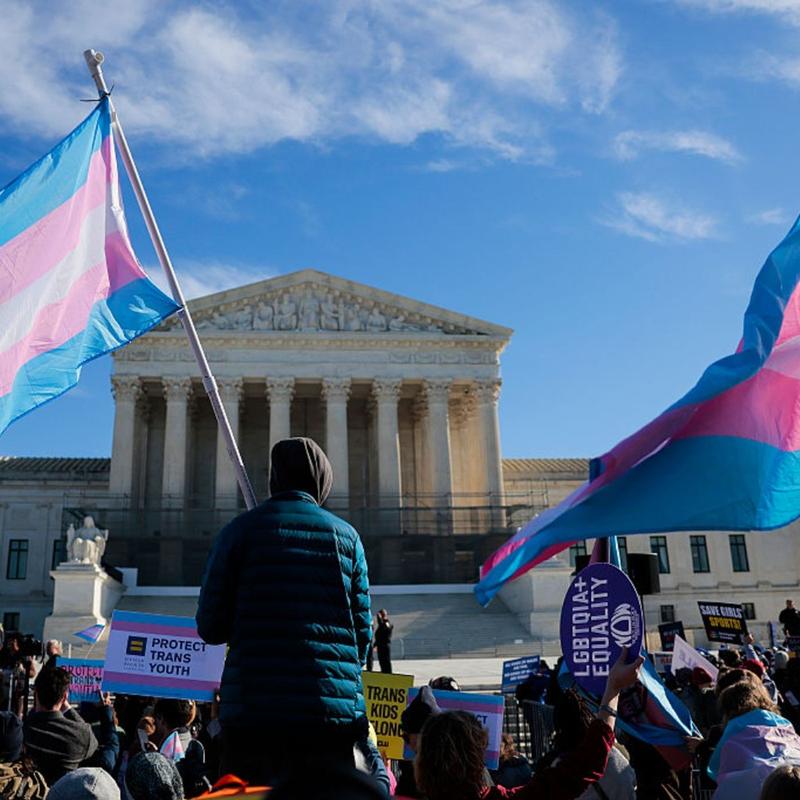
Micah Loewinger: Hey, you're listening to the On the Media Midweek Podcast. I'm Micah Loewinger. This week, the Idaho Senate is considering a bill that would block transgender people from using public bathrooms that conform with their gender identity. A first offense could land someone in prison for a year. This bill is the latest in a cascade of legal actions stripping away trans rights in Kansas.
News clip: Around 1,700 people in Kansas are about to have their driver's licenses declared invalid. Why? Because they're transgender.
News clip: A new Kansas law takes effect, requiring transgender people to use public building bathrooms corresponding with their sex at birth.
News clip: It lets any citizens sue someone they think is trans for $1,000 if they violate that rule.
Micah Loewinger: In Tennessee--
News clip: House Bill 754 would require clinics who perform gender transition surgeries to also perform detransition procedures. It would also require clinics and insurance companies to report the occurrence of these procedures to the Tennessee Department of Health who would then record various statistics into a database.
Micah Loewinger: In West Virginia--
News clip: The 4th Circuit Court of Appeals has reversed a lower court ruling, meaning that the state's Medicaid policy excluding coverage for gender affirming surgeries will be upheld.
Micah Loewinger: That last ruling was based on a Supreme Court decision from June in a case called US v. Skrmetti. The high court upheld a Tennessee law banning puberty blockers and gender affirming care for minors. In order to better understand these legal setbacks, Civil Rights Attorney Alejandra Caraballo has looked to legal scholar Ernst Fraenkel.
Alejandra Caraballo: He created what was called the dual state.
Micah Loewinger: Brooke spoke to Alejandra earlier this month.
Alejandra Caraballo: He divided into two categories, the normative state and the prerogative state. The normative state is basically everything that you run into every day. You go and pay your taxes, you go to court. The state is pretty much acting as normal. Then there's the prerogative state, which acts with an arbitrary violence against a targeted minority group. That group cannot expect any fair or consistent treatment by the state.
Brooke Gladstone: My understanding is that Fraenkel saw this play out. He was a Jewish lawyer in housing.
Alejandra Caraballo: Jews were being stripped of their homes, property rights, legal rights to own businesses. Nothing in the Weimar Constitution, which was still operative, allowed for that, but none of that mattered because they were part of the prerogative state. You do have a six-year period before you get to the camps and whatnot, this period where Jews are increasingly being targeted, and also not just them, gays, lesbians, trans people in Nazi Germany were also targeted. You have this useful framework for how authoritarian states target particular minority communities and how the legal systems contort themselves to enable that persecution of that minority group. I don't necessarily mean to compare directly to the Holocaust.
Brooke Gladstone: Always dangerous. [chuckles]
Alejandra Caraballo: Yes. The reason why that resonates is that that's essentially what we're starting to see here in the United States with the ways that courts and the legal system are starting to abrogate the rights of trans people.
Brooke Gladstone: They can't go to the courts because the laws have changed. They live in what seems to be a fetal or maybe adolescent prerogative state.
Alejandra Caraballo: Essentially, yes.
Brooke Gladstone: You say there's a dual state approach when it comes to medical care, the way the HHS treats trans people's health care versus other kinds of healthcare.
Alejandra Caraballo: Exactly. They're deregulating how drugs are approved, these kinds of supplements are being sold, RFK Jr. hawking all kinds of snake oil all the time. Meanwhile, they are cracking down on gender affirming care for trans youth and launching investigations against providers of gender affirming care. They claim on one hand, especially with the right around vaccines, "We want to ensure that parents have the rights to choose medical treatments for their children, and they do that in the instance of vaccines." When it comes to gender affirming care, they say, "Well, parents don't have that right anymore."
Brooke Gladstone: Parents have the right to withhold the care. They just don't have the right to provide the care.
Alejandra Caraballo: Yes.
Brooke Gladstone: In the Skrmetti case, when presented with a petition about parental rights to choose youth transmedical care, the Supreme Court didn't weigh in, but in an earlier decision, it did to deny it.
Alejandra Caraballo: They punted. They didn't even bring up the parental rights question in Skrmetti about whether or not parents have the right to choose the medical treatment for their child and not be barred by the state from seeking it. Ultimately, the Supreme Court punted on that. Then there was a case out of California where the schools banned forced outing so that school officials could not forcefully out a trans youth to their parents, which could potentially result in harm to that youth from being kicked out, being disowned.
In an emergency shadow docket posture, they re-enabled an injunction against that law because they believed that it was against the parental rights of those parents of those students. You have the Supreme Court going above and beyond to protect the rights of one set of parents and then completely ignoring the rights of another set of parents when presented with that question in a formal cert petition.
Brooke Gladstone: Let's go to Kansas, shall we? Governor Laura Kelly vetoed the bathroom bounty bill, which contained two provisions the immediate invalidation of the driver's licenses of trans people if their gender marker doesn't match their gender assigned at birth. The second provision, the so-called bathroom bounty, allows anyone to sue anybody they suspect of being transgender if they walk into the wrong "restroom" in a government facility.
Now, the governor vetoed it, calling it poorly drafted with overreaching consequences that would cost millions of taxpayer dollars to comply with when that money is already really tight in Kansas. Then the state legislature overturned her veto. Two trans residents in Kansas are suing. Now, this strikes me as textbook dual state stuff. They seem to be persecuted for simply existing.
Alejandra Caraballo: Exactly. They went without any committee hearings. They did what was called a cut and go, where they essentially took another bill, completely cut out the text, put in this new bill that had the bathroom bounty bill and the revocation of licenses and birth certificates. Then Kansas legislature rushed this through, and in less than three weeks, it went from basically no one knowing that this bill existed to being enacted, and people were losing their driver's licenses. That's how quickly it went.
Brooke Gladstone: Let's explain why these two things are a big deal, driver's licenses and bathrooms. Why we could go slowly, padding up to the dual state structure of the Nazis with these relatively minor things like driver's licenses and bathrooms?
Alejandra Caraballo: If you can't use the bathroom, you can't participate in society. A lot of people will just say, "Well, you could just use the bathroom of your sex assigned at birth." If you're a trans person, you often don't look anything like your sex assigned at birth anymore. For trans women, if you go and use the men's restroom, that puts you at extreme risk of sexual assault, harassment, even violent assault. This is not a theoretical, this has happened. Trans men are really in a bind because oftentimes they have deep voices, beards. They look just like any other man, and they're being told they have to use the women's bathroom.
What's going to happen if somebody who comes in with a very deep voice, burly, with a beard, walks into the women's restroom? Everyone is going to freak out about it. That's exactly what this law requires. Ultimately, what that means for trans people is they can't participate in society because you can only hold going to the bathroom for so long. If you're at work for 8 hours or 10 hours a day, you'll start getting bladder infections. Then there's the driver's license aspect.
Brooke Gladstone: Right. The driver's licenses of trans people in Kansas, there was no warning, they were suddenly invalid. That was it. They couldn't drive.
Alejandra Caraballo: They could risk arrest for driving with a suspended license. Just go to the DMV and get a new license. That puts people at immense risk. They have to ask friends or family to be able to drive them. They have to miss work. It's incredibly disruptive. Some people say, "Well, you just have your driver's license that says your sex assigned at birth," and for trans people, that's oftentimes incredibly dangerous. Just even buying a six pack of beer the way you look is not going to match the sex listed on the driver's license, which could out you, subject you to harassment and violence.
Brooke Gladstone: You might say, "Well, why don't you just go and get your driver's license in a state other than Kansas?" Even that's not so easy.
Alejandra Caraballo: Let's just say you were like, "I'm done with this. I'm leaving Kansas. The state is hostile to trans people." If you were to move to New York or California and try to activate a license in those states, you would not be able to until you lifted the suspension on your Kansas license. You can't even leave the state without the indignity of going to the DMV, getting a new license issued with a gender marker that does not align with your gender identity.
Brooke Gladstone: Last December, the Texas newsroom obtained internal documents through records requests that showed that the Texas Department of Public Safety had compiled a list of 110 trans people who tried to update their license information between August 2024 and August 2025. When pressed, the Department of Public Safety in Texas didn't say why. Texas isn't alone here. Indiana, you've said, may also be compiling a similar list. Connect this to the dual state framework. Governments compiling lists of minority groups is never a great sign.
Alejandra Caraballo: We don't know why they're compiling these lists. Kansas ultimately had a list of trans people that had changed their gender markers, and immediately they were able to suspend their licenses. Texas, Indiana, or these other states, if they're able to compile them, they could do similar things. We've heard the Governor of Texas, Greg Abbott, saying that trans people should not be teachers in public schools in Texas.
They could create a list of people who are not eligible for teaching licenses within the State of Texas, if they're transgender, any number of permutations that they could use these kinds of lists to target trans people and ensure that they cannot have any meaningful contribution to society. They can't work, they can't get driver's licenses, they can't get identification documents, and ultimately, with this push around voter IDs even be able to vote. Pretty much every aspect of this is trying to strip any semblance of normality from a trans person's life.
Brooke Gladstone: I think there was one instance where someone who never changed their gender marker but changed their name still had their license invalidated.
Alejandra Caraballo: Yes. That happened in Kansas as part of this, and they were unsure as to exactly how that happened. Kansas said that it was an error, but something still triggered them being added to that list. That's intensely scary. Idaho right now they just passed through the House, and it's going through their state Senate a bill that would enact a five-year felony charge for using the bathroom that aligns with your gender identity. This is where we're at now.
Brooke Gladstone: You've noted that unless these lists are used in a discriminatory manner, they're legal. If they say, "Hey, we have this list of people we identified as trans, and now they're barred from being teachers," that's unconstitutional, no matter what the Governor of Texas says. Your worry with regard to the law is that the Supreme Court is hinting that they don't view trans status as something that is immutable, something that just can't be changed with the wind.
Alejandra Caraballo: You could see this in Justice Barrett's questioning and her concurrence in Skrmetti. They view being trans essentially as a choice and something that can just be easily changed. As a result of that, they don't believe that it meets the requirements for protected class status. I do believe being trans is immutable, like it's not subject to external change. Even if it wasn't, we do protect other classes that don't have immutable status, and that includes religion.
You can change your religion, and that is still protected under the Constitution. That's a frustrating double standard. Regardless, that is worrying because if they don't believe that it's something that is immutable and can be changed, they can then endorse methods to try and force that change. We're seeing that with the potential decision in Chiles v. Salazar, which may invalidate bans on conversion therapy in over 21 states.
Brooke Gladstone: Let's hop back quickly to medical care. In Tennessee, the Attorney General was able to access and identify incredibly intimate medical records of trans people held by Vanderbilt Medical Center that included therapy notes, photos, pre op, and post op. No one knows why.
Alejandra Caraballo: The Tennessee Attorney General used the pretext of investigation for fraud against Vanderbilt University and issued subpoenas asking them for all of their medical records related to gender affirming care, not just for trans youth, but for all their transgender patients.
Brooke Gladstone: That is a very familiar Trump administration pretext to intrude into places.
Alejandra Caraballo: This is exactly where the Trump administration got its playbook from. Tennessee, Missouri, and Texas had been doing this for years, where they were attempting to get at the medical records of trans people. Tennessee was the most successful, and Vanderbilt did not even fight those subpoenas. There was a lawsuit filed arguing that they violated the patient privacy rights of their patients, and that's still pending.
Brooke Gladstone: The Ninth Court of Appeals heard a case involving queer doc, a telehealth gender affirming care practice that the DOJ subpoenaed in July. It was seeking more than a dozen types of records dating back to 2020, demanding names, birth dates, addresses, Social Security numbers of patients. DOJ said it needed this data to investigate whether queer doc was engaging in fraudulent insurance billing. What's going on there?
Alejandra Caraballo: This is part of the intimidation tactic by the Justice Department to try and force providers to stop providing gender affirming care, particularly to trans youth. The Justice Department sent out roughly over 20 different subpoenas to 20 different medical providers to some of the top children's hospitals around the country, alleging that they were engaged in fraudulent billing practices with insurance. They're claiming that using alternative billing codes in billing practice, which is utilized widely, but using any other billing code other than ones that are directly tied to gender dysphoria, is somehow fraudulent.
For instance, when they're prescribing hormones, they'll say, endocrine disorder unspecified, and that just may be how the insurance companies prefer that to be billed. A single provider can have to bill potentially 20 different insurance companies at any given time, Medicaid, Medicare, and each one of those may have a different practice for how they accept the billing code. What they're saying is that you use something like endocrine disorder unspecified, rather than treatment for gender dysphoria. It's fraudulent.
There's not intent to deceive or defraud insurance companies here. They're using that mismatch and abusing it again, tying to the framework of the dual state. That's just everyday billing practices, but when it comes to trans people, suddenly that becomes fraud. As a result of that, they are using that pretext to issue these subpoenas and claim broad authority to access not only medical records, but internal employee communications, external emails, all kinds of things. That is just basically a giant fishing expedition.
Queer doc fought the subpoena, and they won, and the Trump administration is essentially appealing that. They want the threat of the subpoenas to get people to stop provision of care voluntarily. That's what we've seen with so many different providers who have voluntarily withdrawn providing this care just out of pre-compliance and fear.
Brooke Gladstone: This also connects back to the dual state in terms of isolating these disfavored members of society. Trans people would be less likely to seek medical care or be honest or truthful with their own providers.
Alejandra Caraballo: Exactly. If you're a trans person and you're worried that your provider will be subpoenaed by the federal government and all your medical records will be handed over to some DOJ flack, you're going to be less willing to be upfront with your medical providers. If you have to go to the hospital, you may not disclose that you're transgender because you're concerned that that may be used against you.
Brooke Gladstone: In a piece for the dissident last September, you wrote that these structural attacks against trans people are the prerogative state in action. You called it a raw and undisguised exercise of power to eliminate a disfavored minority from the public sphere. Eliminate.
Alejandra Caraballo: [chuckles] This is straight up from Speaker Michael Knowles, who was at CPAC now three years ago.
Brooke Gladstone: That's the conservative gathering that happens every year that sets the template for where the far right will move.
Alejandra Caraballo: Exactly. He said to a giant audience, "We must eradicate transgenderism from society." He's repeated that multiple times. Chris Rufo has recently retweeted that exact statement.
Brooke Gladstone: Another philosopher activist of the far right.
Alejandra Caraballo: Exactly. They use this disingenuous trolling where they say, "We aren't saying we want to eradicate trans people. We just want to eradicate transgenderism." I don't know how you do one without doing the other, because you can't coerce people into not being trans, and you can't kill ideologies. You can't kill ideas. Ideas exist outside of people. The only thing you can do is kill people. There's an old study that said that about 41% of trans people attempt suicide at some point in their life, which is a pretty stark number and is orders of magnitude higher than the rest of the population. There's people online that go around making memes about it, saying, "We've got to raise that 41% to 100%."
Brooke Gladstone: How common is this? Is this just a couple of cranks?
Alejandra Caraballo: It's pretty widespread on Twitter. There was a young girl, a trans girl who's 17, who took a picture of a bridge and said, "It's so pretty from up here." The next day, it was found that she had taken her own life and jumped from the bridge. That image that she posted on Twitter went viral. Over 100 million views, the vast majority of the replies were celebrating it, celebrating that she took her own life, and making jokes about it.
Now, the picture that she took, trolls are taking that and putting it in the replies of trans people and making a meme out of that picture. It's very clear they want to drive the factors that cause trans people to be suicidal. They don't have to do it themselves. They could just make everything so bad that they hope that trans people do it themselves.
Brooke Gladstone: What do we learn from other historical moments when the dual state framework has come into play? If you go back to the civil rights movement, you'll see white people at the time, some of them saying, "These Black activists are too aggressive. They're scary. They need to play by the rules. Stop agitating so hard, stop offending people."
Alejandra Caraballo: Civil rights movements are almost never popular in the moments when they are able to succeed and push through. What's unique about trans people is that we're actually on the other side of this. A lot of the things that are happening to us were policy wins that we already won years or decades ago. The ability to change our gender markers, that was through quiet advocacy for over years. In many states, you've been able to do that for decades.
You're able to change the gender marker on your passport since 1992. That's 33 years that you were able to do that, and then that got taken away. Iowa became the first state ever to remove duly enacted civil rights protections for a group based on any protected class. Just yesterday, they enacted another bill that prevents cities from even enacting their own protections for trans people. This is far beyond just backlash. This is now a regression, wiping out decades of what trans advocacy has been able to accomplish. I struggle to find parallels. There was obviously backlash to the civil rights movement and the feminist wave of the '70s.
Brooke Gladstone: This is more like what happened after Reconstruction.
Alejandra Caraballo: Reconstruction is probably the closest I can think of where a group who had previously been able to secure substantial civil rights protections is systematically having them erased. That's the closest parallel, because even the backlash of the '80s to the civil rights movements, none of them were able to strip the kinds of rights that they're doing now.
Brooke Gladstone: Elon Musk and other groups on the far right are pushing an idea that empathy is weakness. They call it suicidal empathy. How does that relate to this?
Alejandra Caraballo: What they really mean by that is if you're concerned about immigrants, if you're concerned about trans people, if you're concerned about Muslims, you are contributing to the downfall of Western civilization, and if anything, it's the opposite. It's the lack of empathy, it's the lack of compassion for our fellow humans that is causing so much of the problems in our world.
Brooke Gladstone: Alejandra, thank you very much.
Alejandra Caraballo: Of course, thanks for having me.
Brooke Gladstone: Alejandra Caraballo is a civil rights attorney and a clinical instructor at Harvard Law Cyber Law Clinic.
[music]
Micah Loewinger: That's it for the midweek podcast. Don't forget to catch the big show on Friday. While I have you, if you haven't already, go ahead and follow us on Instagram and TikTok. We also have OTM subreddit where you can see some of the videos we've been making recently, Brooke and I talking about some of our favorite moments from the show. We'd love to hear what you think. I'm Micah Loewinger.
Copyright © 2026 New York Public Radio. All rights reserved. Visit our website terms of use at www.wnyc.org for further information.
New York Public Radio transcripts are created on a rush deadline, often by contractors. This text may not be in its final form and may be updated or revised in the future. Accuracy and availability may vary. The authoritative record of New York Public Radio’s programming is the audio record.