
The UK’s Violent Riots Were Stoked by Elon Musk and a Global Far-Right Network
Micah Loewinger: Hey, it's Micah. It's been a minute since our FEMA series came out. I want our New York listeners to know that we're having an in-person event in a couple of weeks. I'll be joined by former FEMA official MaryAnn Tierney. We'll talk about the history of the agency, how it's being reshaped now under the Trump administration, and some other fun stuff we couldn't fit in the show. Join us in person at WNYC, 7:00 PM on June 7th. You can get tickets at wnyc.org/events. It's a great opportunity to meet other OTM listeners. We'd love to see you there.
[music]
News clip: In a capital city in the British Isles, people are forced to flee their homes by a mob.
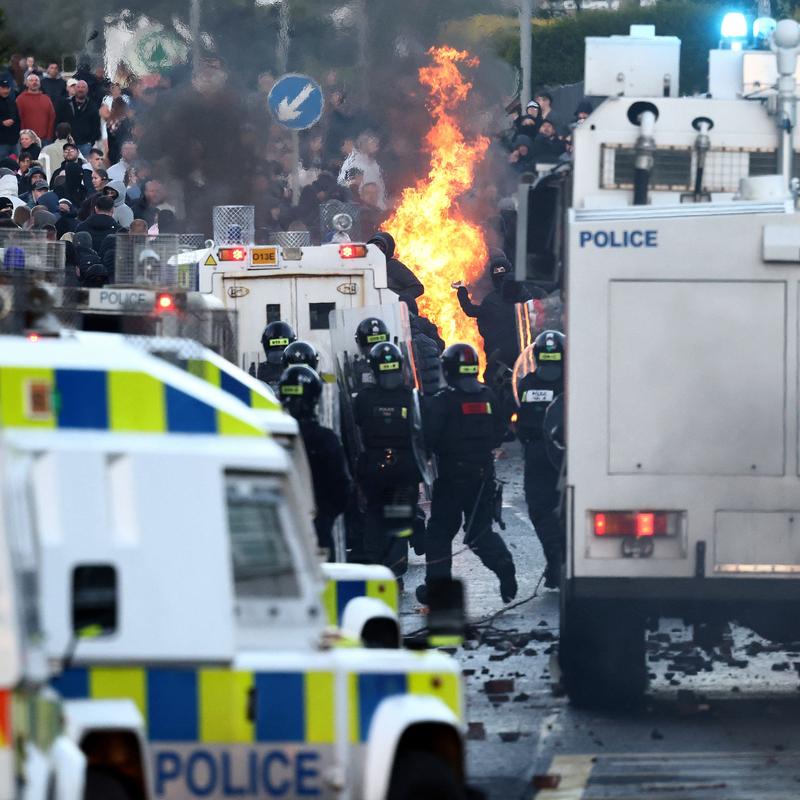
Micah Loewinger: Anti-immigrant violence erupted in Belfast this week, in part stoked by the world's first trillionaire, Elon Musk.
News clip: Elon Musk writing on X this week, "Only by protesting REPEATEDLY and LOUDLY will there be any change!!"
Micah Loewinger: From WNYC New York, this is On the Media. I'm Micah Loewinger. Also on this week's show, two of network TV's biggest news shows made news. The president stormed out of an interview with NBC.
President Trump: Let's call it quits, because I've had enough.
Micah Loewinger: Fired 60 Minutes correspondent Scott Pelley had words for CBS's new management.
Scott Pelley: There was a thumb on the scale for the president's version of events that was a level of political influence that I had never seen in 37 years at CBS News.
Micah Loewinger: Go behind the headlines with us after this.
[music]
Brooke Gladstone: This is On the Media. I'm Brooke Gladstone.
Micah Loewinger: I'm Micah Loewinger. This week, Elon Musk took his company SpaceX public in an IPO billed as the largest in history.
News clip: SpaceX is on track to become the most valuable company ever to go public and make its founder, Elon Musk, the first trillionaire.
Micah Loewinger: You'd think he'd have his hands full with that, but apparently Musk has also had time to write many, many, many racist posts on X, some of which helped spark violent riots in the UK over the last couple of weeks. The events this week began on Monday when a Sudanese man was arrested and charged with attempted murder for stabbing a white man in Northern Ireland.
News clip: The attack comes amid escalating tension over immigration across Europe.
Micah Loewinger: A video of the gruesome incident immediately appeared on social media, and then--
News clip: Elon Musk writing on X this week, "Only by protesting REPEATEDLY and LOUDLY will there be any change!!"
Micah Loewinger: The next day, masked vigilantes stormed immigrant homes and businesses in Belfast.
News clip: In a capital city in the British Isles, people are forced to flee their homes by a mob which was intent on causing havoc and setting fires. It is a shocking reality and a terrifying experience for those who had to grab what they could and run for their lives.
Micah Loewinger: The week before, in the streets of Southampton, England, anger over another knife attack drew anti-migration protesters, some of whom turned violent.
News clip: Some more footage here of riot police clashing with protesters.
Micah Loewinger: In that case, a British Sikh man stabbed and killed a young white man last December. When police arrived at the scene, they mistook the victim, Henry Nowak, for the perpetrator and handcuffed him. In body cam footage, you can hear Nowak say he's been stabbed and can't breathe, to which a police officer says.
Police Officer: You've been stabbed? Whereabouts? I don't think you have, mate.
Micah Loewinger: The murderer was sentenced to life in prison, but it was the release of the police body cam footage that set off the most recent chain of events, spurred in part by posts from a notorious conspiracy theorist.
David Gilbert: Tommy Robinson is the most prominent far-right activist in the UK.
Micah Loewinger: David Gilbert is a reporter at WIRED covering disinformation in online extremism. He says things really heated up after Elon Musk reposted one of Robinson's videos.
David Gilbert: He has a huge amount of followers online, but what he's really expert at is inciting anger, stoking tensions, and making it seem as if the UK is under attack from minorities.
Micah Loewinger: What effect did that video that Elon Musk reposted, what effect did that video have?
David Gilbert: When he put out a call for people to show up at the police station that night, hundreds of protesters showed up, and he showed up with them, and he was able to speak to the crowd.
Tommy Robinson: Henry's murder is-- I've spoke about this for 20 years. I said you'll be a victim of a race gang, i.e., Pakistani Muslims will be beating up a white kid. The police will turn up, they jump on the white kids every time. I've seen it my whole life. They jump on the white kids.
Micah Loewinger: Then barely a week later, at 10:30 PM on Monday night on a Belfast street, bystanders captured video of the moment a Sudanese man, Hadi Alodid, pinned another man, Stephen Ogilvie, to the ground, attacking him with a knife. Ogilvie is now in a coma after losing one eye and suffering wounds to his neck and face. Give me the roadmap of how we went from a bystander video to violence in the streets of Belfast in just 24 hours.
David Gilbert: As you said, it was 10:30 at night in Belfast. Someone videoed it, we don't know who. They posted it online. Exactly one hour later, Tommy Robinson posted the video. That video got 6 million views. A few hours later, Elon Musk responded to Tommy Robinson and then spent the next 24 hours posting consistently about this case. Many major US accounts on X started amplifying the video.
When people woke up in the UK on Tuesday morning after the incident, by 7:00 AM, people were posting about having protests in Belfast and other cities in Northern Ireland. Far-right groups on Facebook started organizing. Then Elon Musk posted about the protest and said that this is enough, we have to take a stance, people have to push back against this. By 7:00 PM that evening, there were masked men on the street who were kicking in doors of migrants, setting fire to vehicles, terrorizing migrant communities across Belfast.
There's very few people who are orchestrating this. While much of it is happening on major platforms like X and Facebook, the real hardcore organization is actually happening on other platforms, in Telegram chats where they are talking about OPSEC. They are talking about covering tattoos, wearing nondescript clothes, covering their face, making sure that no one is videoing what they're doing, that they are not wearing smartwatches, that they're not wearing anything identifiable, no digital devices.
Micah Loewinger: This call for retribution and protest, which quickly turned into a violent attack on immigrant communities in Belfast, was effectively the narrative cover for a network of people who, in a sort of carefully planned way, sprung into action as if they were training for this sort of moment.
David Gilbert: That is exactly what happened. One of the groups is part of the wider Active Club Network, which is a white supremacist network based in the US which has a footprint that's growing across the globe. The group that was involved heavily in the planning of these incidents is an offshoot of the Active Club movement for teenagers. The idea of this movement is that it's based on fitness and male bonding, but what it's actually doing is facilitating the radicalization of young white males into these white supremacist and often neo-Nazi ideologies.
Micah Loewinger: Elon Musk wrote, "Murderous migrants beheading innocent people in their hometown is what's making people angry, not social media." He reposted messages claiming that British Prime Minister Keir Starmer "hates white people." This is just like white supremacist great replacement theory, right?
David Gilbert: It has been repackaged recently under a term called "remigration," which is something that has been bubbling up in Europe for a few years and has been embraced by the Trump administration recently. It's this idea that white people are under attack, and so therefore we need to kick everyone else out that doesn't look like us.
Micah Loewinger: Last month, you traveled to Porto, Portugal, to cover the Remigration Conference, which featured some key far-right American figures, including the ex-commander of Border Patrol, Greg Bovino. You wrote about the increasing collaboration between American and European far-right remigration believers. How does this international movement fit into the story of what's happened in Belfast and Southampton?
David Gilbert: I was amazed at the number of Americans who had traveled to Porto. Figures like Bovino, you had members of the New York Young Republicans Club, Jared Taylor, who's a very prominent white supremacist from the US. You had members of Patriot Front. We can link it to what's happening in Belfast because the Patriot Front and active clubs in the US have a very, very close relationship. What we see in the North of Ireland at the moment is these Active Club Networks who have become very involved in what's happening there.
They see it as a huge success. They are now holding up this as an example of what other groups across the globe, in the US and Europe, can do when it comes to fighting back against this claim that they're being replaced. These networks are getting stronger. They are communicating more easily, and I think that's what we saw in Belfast, is that it spread across X so quickly, and they started posting about it, saying, "This is evidence of why we need to have this extremely racist policy of remigration."
Micah Loewinger: The term "remigration" is a very benign term to describe a very, very violent policy agenda. What are these people imagining would happen?
David Gilbert: They have a 30-year plan that would happen in 3 phases. The first phase would see the worst of the worst, what we're seeing in the US at the moment, where they're trying to deport people who are threats to society, have criminal records, and are there illegally. The second phase would see people who are in the country legally but are not citizens and who have not assimilated and are not white, and they should be sent back to their countries as well.
What the third phase shows is what these people really want. They would look at citizens who do not assimilate to the Western cultures, traditions, and religions. For example, if they are still practicing religions other than Christianity, if they are cooking foods that are not traditional foods in Germany or France or the UK or America, then they would be kicked out.
Micah Loewinger: Who gets to decide what assimilation looks like?
David Gilbert: When I asked Martin Sellner, who was called the godfather of remigration at the conference in Portugal, who exactly decides this, he couldn't really give me an answer. Ultimately, it comes down to whoever's in power will decide. This movement is still relatively fringe. In that conference in Porto, there were elected officials, a number of them from Germany, some from Spain, speaking at the conference, listening. Five years ago, no one had heard about this policy. Now you have dozens of Americans traveling thousands of miles to go to a conference to listen to it.
Micah Loewinger: This was not the first time that Elon Musk has been accused of inciting violence in the UK and the rest of Europe. Why is he so fixated on these crimes and European politics? What does he want out of this?
David Gilbert: I ask myself that question a lot. The only thing I can think of is that, as a result of his posts, things happen in the UK. People love him here. People talk this week about how if it hadn't been for X and Elon Musk, we'd never heard about this attack on Stephen Ogilvie in Belfast, which is patently untrue, obviously. They believe that he is this truth teller, and he is giving them the power to speak.
Micah Loewinger: I think he believes the things that he's saying. Intentionally or not, it seems like his ability to whip up violence in the streets, it likely gives him leverage with, I would imagine, European regulators who oversee his companies. For a month now, the UK government has been discussing a potential ban of X, which allows users to use Grok AI to create pornographic images of women and minors. Keir Starmer has recently said that he wants to amend a law to require social media companies to take down inflammatory posts in the middle of such riots. If I were a lawmaker, I would be thinking this is exactly the kind of thing we can expect if we try to meddle with Elon Musk's X, right?
David Gilbert: Yes. He knows the power that he has. His repeated attacks on Keir Starmer kind of show it. He clearly does not fear lawmakers or authorities in the UK or the EU. I think for years, lawmakers in the EU have been seen as the ones who have been actually holding big tech in the US to account, but ultimately, they fine them hundreds of millions of dollars. So what? The big tech companies don't care. They'll tie everything up in court for years, and if they do have to pay it in the end, that's fine. They can pay it. They've made enough money.
Micah Loewinger: I have to ask you, you have been covering disinformation, political extremism for a long time, and a lot of what you write about are figures in the United States, but you're an Irish writer, you live in Ireland. What does it feel like to watch figures like Elon Musk export some of these political movements to where you live?
David Gilbert: It's terrifying, really. For years, when I've been covering this stuff, it didn't really touch me personally because I wouldn't interact one-to-one with people in the real world who believe much of the stuff that I was covering.
Micah Loewinger: Like QAnon and Pizzagate and that kind of thing.
David Gilbert: Exactly. COVID changed that overnight. People went down rabbit holes. WhatsApp groups were set up across the country. People got paranoid, and they started to believe everything. That group of people who started off believing that COVID was a hoax and not wanting to take the vaccine, they've stayed in those groups, but those groups have morphed to become anti-immigrant, racist groups. I suppose for a long time I felt insulated to an extent by being so far away from a lot of the people I cover before, but now I'm actually interacting with them on a daily basis, so it's a big change.
Micah Loewinger: It's frightening to see what's just happened in Belfast boomerang back to the United States. Brian Kilmeade of Fox & Friends, this week, said this to Department of Homeland Security Secretary Markwayne Mullin on air.
Brian Kilmeade: They're standing up because their leaders have let them down in their own streets, trying to take their country back. They want to label them as racist. All they want to be is Irish. They want Ireland back. I see a lot of the same fights here.
David Gilbert: Brian Kilmeade is completely wrong. A lot of people in the North are incredibly angry about this because this exemplifies a lot of the content that's been posted online about how this is Irish people, nationalists and loyalists, uniting to fight back against the minorities. There's been memes going around about how loyalists and nationalists in the North, this is the thing that they're going to unite over. That is not true.
The groups that we see on the streets of Belfast are loyalist groups that want to stay loyal to the British Crown. They do not want Ireland to be a united country. They want to be British, and that's a very key point that is being missed in a lot of the conversations that are happening about what's happening in Belfast this week.
Micah Loewinger: What should listeners look out for when they're reading coverage of these riots?
David Gilbert: People need to realize why people like Elon Musk and Tommy Robinson are saying the things they're saying. What they're saying in simple terms is that there is a massive global conspiracy taking place where white people are being replaced in their own countries by minorities. In the coverage of this story, that has not been really explicitly called out. It's incredibly important to call out what they are trying to do.
They don't care about Stephen Ogilvie or Henry Nowak. Both the victims' families explicitly said, "We do not want our family members' death or injuries to be exploited." Tommy Robinson and Elon Musk do not care. They just see an opportunity to exploit this suffering to push home this narrative. That's something that needs to be more explicitly called out in media coverage when these incidents happen.
Micah Loewinger: David, thank you for doing this work.
David Gilbert: Thanks for having me, and thanks for talking about this. It's important.
Micah Loewinger: David Gilbert is a reporter at WIRED covering disinformation and online extremism.
[music]
Brooke Gladstone: Coming up, firings, testy meetings, tears, and recriminations. It's just another day at CBS News.
Micah Loewinger: This is On the Media.
[music]
Brooke Gladstone: This is On the Media. I'm Brooke Gladstone.
Micah Loewinger: I'm Micah Loewinger. As social media spread disinfo is helping to foment unrest an ocean away, a stalwart of the old media, 60 Minutes, one of the few trusted gatekeepers still standing, is being rocked from within. It all started a couple weeks ago when CBS News editor-in-chief, Bari Weiss, fired a bunch of staffers from the team at 60 Minutes. Among them, executive producer Tanya Simon and correspondents Sharyn Alfonsi and Cecilia Vega. On the same day, Weiss installed a new executive producer at the program. Like herself, he's a former New York Times columnist with no prior TV news experience.
Oliver Darcy: All hell broke loose at 60 Minutes.
Micah Loewinger: Oliver Darcy is the founder of the newsletter Status and a former media reporter at CNN.
Oliver Darcy: I can't imagine that CBS management thought this was going to go over well, but I don't believe they anticipated it going this far off the rails.
Micah Loewinger: When newly minted executive producer Nick Bilton met his 60 Minutes team a few days after the mass firings, Darcy was leaked an audio recording of the encounter.
Oliver Darcy: Scott Pelley, the longtime CBS News journalist and the longtime 60 Minutes correspondent, he was the only correspondent in the room, and he just goes off on Nick Bilton, says he's not basically qualified for his role, says that Bari Weiss is not qualified for her role, says that David Ellison, he doesn't use David Ellison's name, but it's pretty obvious who he's talking about, that David Ellison brought Bari Weiss into CBS News to kill 60 Minutes, and that that's exactly what she's doing. I listened to the audio, and it was a really extraordinary, very tense meeting.
Micah Loewinger: What have you learned about the new leader of 60 Minutes, Nick Bilton?
Oliver Darcy: Nick came in a little hot, if you will. He did a bunch of interviews and sounded pretty condescending, to be totally frank. In one of the interviews with Semafor, they ask him, "What do you think about not having any television experience? Does that intimidate you?" He says, "No. Basically, if I need someone to push the button to go live on the air, there are people that I can have push the button for me." Very much diminished the role of the people who work at 60 Minutes and what it takes to go on air with a story.
If he had not engendered a lot of goodwill just in the rollout, he was, at one point, telling Scott Pelley, "You don't intimidate me, man. I'm not going to be intimidated by this role." It sounded very adversarial, and that was not really a great way to come in, given the trauma the 60 Minutes team had just experienced. If you think about it, these are people who have worked together for decades. Then they just watched the new boss at CBS News, Bari Weiss, come in and fire them without any explanation.
Micah Loewinger: After their altercation in that meeting, Scott Pelley is summoned by Bari Weiss and some other bigwigs at CBS, and he's fired soon after that. He gave a big interview to The New York Times about his side of things, his shock and confusion about the whole ordeal.
Lulu Garcia-Navarro: You were just fired from the news organization which you were at the heart of for 37 years.
Scott Pelley: I can't believe I'm hearing those words.
Micah Loewinger: Which went viral.
Scott Pelley: There was a thumb on the scale for the president's version of events that I felt was a level of political influence that I had never seen in 37 years at CBS News.
Oliver Darcy: We learned this week that David Ellison called Lesley Stahl, the 60 Minutes correspondent, and apologized to her for how this had all gone down, suggested or said that this was his top priority and he wanted to make things right. That's something you wouldn't say if you thought things were okay. The fact that David Ellison, who is busy trying to convince regulators around the world to approve a $110 billion deal to purchase Warner Bros. Discovery, is now taking time out of his day to clean up Bari Weiss's mess does not seem to bode well for her.
Whether this means he will ultimately relieve her of her duties, I think, is the open question. I would not expect anything to happen on that front until Ellison closes his merger because he's not going to want to rock the boat with the Trump administration, which very much seems to like the direction that Bari Weiss is pushing CBS.
Micah Loewinger: You reported that since this all went down, Bari Weiss has pretty much left the newsroom at CBS. She's kind of MIA.
Oliver Darcy: My understanding is she has this office suite on the 6th floor of CBS News' headquarters in New York, and that suite is where her lieutenants, her top deputies are, and that's where she is. To even get in the suite, it's locked. You have to have a key card that has special access. It's hard to stress that is very abnormal for a news executive.
Typically, editors, the editor-in-chief, they are in the newsroom. They're of the people. They are working on stories with the reporters and producers. The only parallel that I can think of is Chris Licht, who was the ill-fated CNN boss, and Chris did the same thing. It signals, at the very least, that she's distant from staff, and I think part of it is that she's not trusting anyone around her.
Micah Loewinger: You mentioned that David Ellison called Lesley Stahl, which I think we can interpret as an appeal to her, Bill Whitaker, and John Wertheim, the three remaining correspondents at 60 Minutes, to stay put and not walk out. What's the status of the show right now?
Oliver Darcy: I think they're trying the best to recover and move forward. They have a fall season to produce and they're supposed to be working on that right now. These are 60 Minutes stories. These aren't stories that are turned around in a few hours or a day, like you might see on cable news. These are well-researched, they're well fact-checked, and they often require flying the correspondents to all different corners of the world.
They're down four correspondents right now. They don't know who's coming in the door next, so it's a mess. Some people have speculated inside 60 Minutes that they're going to have some trouble getting on the air, maybe not for the first one or two episodes, but after that, they won't have many stories in the bank that they can pull from.
Micah Loewinger: Obviously, the state of TV news is not great, but 60 Minutes was enjoying some real success. Paramount itself noted that viewership increased by 9% for the most recent season, and Scott Pelley told The New York Times that the show's digital reach increased by over 100% last year. Yet Weiss believed the show needed to be overhauled.
Oliver Darcy: It doesn't make any sense. If you judge 60 Minutes on any metric, they were exceeding all the metrics. It's a critically acclaimed show. They had just won two Emmys. There were no major journalistic disasters that she could point to and say, "Look, this wasn't really great. We had this really big black eye this season." Nothing there. They were producing solid journalism. As you mentioned, they were averaging 9.1 million viewers this season, which was a 9% increase year over year, which is, again, in the era of declining linear television reach, that's great. The show's not staying flat. It's going up. It's crazy. They've been enjoying massive success on digital.
In fact, the numbers that Scott Pelley, you said, were referring to were actually in a press release that Paramount itself put out on May 21st. They said that total video views across social platforms were up 185%. They said that total engagement with their content on social was up 137%. TikTok numbers up 85%. Instagram numbers up 65%. They say in here that there were 2.5 billion views on social media. It seems to me that either Paramount was not telling the truth on May 21st when they hailed how well 60 Minutes was doing on digital, or they're not really telling us the truth now as they're trying to find an excuse for blowing up the show.
Micah Loewinger: This leads to the question that everyone is asking and arguing about: why did they so aggressively target this show? On MS NOW and other liberal media spaces, we've heard that the goal here was to purposefully ruin 60 Minutes and CBS.
Scott Pelley: The goal here is to destroy the brand because that's what's happened. You have not only 60 Minutes basically gutted like a dead tree from the inside, but you also have this tremendous anxiety over CBS News.
Micah Loewinger: Do you think we're witnessing a grand plan to incapacitate an outlet critical of this administration, or is this just incompetence?
Oliver Darcy: It could be a mixture of both. It's not just liberal talking heads saying this. It's Scott Pelley. It's Steve Kroft, the longtime 60 Minutes correspondent, who told me that he never thought he would see that 60 Minutes would be "executed" by the president of the United States. Honestly, even if it's not a direct result, if 60 Minutes were not getting under Donald Trump's skin, it's hard for me to imagine they would blow up the show because, again, by every other metric, it's doing really well.
The only thing that makes sense, really, is that David Ellison, who is doing everything he can to ingratiate himself with the president of the United States, decided that something needed to be done about 60 Minutes. Now, maybe he didn't say destroy the program. Maybe it was relayed to Bari Weiss that it needs to be more fair or open-minded to the rest of America, some version of that, and maybe she's just an incompetent manager and just executed this entire thing really poorly.
We don't know what happened, but I think we'd all be fools not to believe that Donald Trump ranting about 60 Minutes in public is not also communicating that to them in private. Whatever the Ellisons are telling Donald Trump, it's music to his ears because the entire administration is saying, " We can't wait for you to get CNN next."
Micah Loewinger: Tom Ley at Defector had this hypothesis. I'm going to read from his piece. "Weiss is failing at this because she's not actually a propagandist. She's a culture warrior who sees every step of her career as part of a process in which she is bringing her enemies to heel." Does that analysis hold water for you?
Oliver Darcy: I'm not sure. I think that Bari Weiss likes to be a disruptor, and I think that's worked well for her on Substack, or at least on the internet in general. She seems to be someone who generates controversy, which becomes attention, which grows her numbers and builds her following to be bigger. I think that works, to some extent, on the internet, but television news is a lot different. CBS News has never been in the public discourse more than it is today, and their ratings are still really, really bad.
I believe that in May, CBS Mornings, their flagship morning show with Gayle King, it had its worst-rated May on record ever, ever. Her big thing that she's done prior to this was the Evening News with Tony Dokoupil, who is her handpicked anchor, and that show has suffered the worst ratings of the 21st century under her watch. It's hard to get in her mind, but it just seems to me like she doesn't understand who the CBS News audience is, and she doesn't understand that attention on CBS News does not translate into ratings the same way it might on the internet.
Micah Loewinger: Let's zoom out a bit. In 2024, CBS reported The Late Show with Stephen Colbert captured $70.2 million in advertising, while 60 Minutes caught $79.7 million. As Variety's Brian Steinberg reported, advertisers are moving away from both of those formats towards sports, streaming, and live entertainment. Even though 60 Minutes was still making money, is there something to the idea that its future success was not something that CBS could count on, that there was legitimate reason to start shaking up the show?
Oliver Darcy: Yes, there's definitely legitimate reason to be planning for a post-linear television future. If you're not planning for that future right now, I think it'd be irresponsible. I think the question is, how do you do it? I can't imagine that anyone thinks that Bari Weiss is doing a good job here. Do you fire the people who are posting really good digital numbers, or do you say, "Hey, you guys are doing really good on digital? I saw that we had a record year across social media. How do we do better there?"
Micah Loewinger: This whole situation is kind of a win-win for MAGA. If Weiss succeeds in turning CBS News into this engine of anti-woke content, that's good for the White House. If it burns the place down and liberal viewers get up and leave, like they did with The Washington Post, that's just one more critical news organization gone. It seems like this political movement wants a news environment where there are no legacy outlets left to do decent journalism, where it's all just partisan content, and the best at getting attention wins.
Oliver Darcy: That's a really good way of looking at it. I think that's why Donald Trump is so happy with the Ellisons. He sings their praises every time he's asked about them. I think that's why he's so excited and the rest of the administration is excited for David Ellison to be in control of CNN, because 60 Minutes is one thing, but Donald Trump, let's be honest, he has been obsessed with CNN since he ascended in politics more than a decade ago. That's because authoritarians don't like there being a shared set of facts.
They want information chaos where they can plant narratives and not face resistance. If CNN is no longer fact-checking Donald Trump and holding him to account and just is even softer on him, that is the entire point of all this stuff. The people losing here are the people who believe in a news landscape where organizations are tethered to the facts and are able to be profitable by telling the truth, and the people who are winning here are the ones that want to destroy our sense of shared reality.
Micah Loewinger: Oliver, thanks for staying on top of this story, and thanks for joining us.
Oliver Darcy: Thank you so much for having me.
Micah Loewinger: Oliver Darcy hosts the media criticism podcast, Power Lines. We reached out to CBS for comment, but didn't hear back by time of publishing.
[music]
Brooke Gladstone: Coming up, a new guidebook offers a lexicon for navigating life in an autocracy.
Micah Loewinger: This is On the Media.
[music]
Micah Loewinger: This is On the Media. I'm Micah Loewinger.
Brooke Gladstone: I'm Brooke Gladstone. As Oliver Darcy said, the Trump administration and the MAGA movement would love nothing more than a complicit, or at least compliant, media. In lieu of that, the strategy appears to be to pollute our current information ecosystem with nonstop, often contradictory verbiage. A good example presented itself on Meet the Press.
Kristen Welker: They're urging the votes to be counted quickly. That's how they vote in California.
President Trump: They're crooked, just like you're crooked. Your press is crooked, and Meet the Press is crooked.
Kristen Welker: To be fair, I'm not crooked, but-
President Trump: Really? You play right into their hands.
Kristen Welker: -let's continue.
President Trump: You're either crooked or you're stupid. You play right into their hands--
Brooke Gladstone: It was a heated back-and-forth that ended with the president pulling off his mic.
President Trump: Let's call it quits because I've had enough.
Brooke Gladstone: What prompted that? Host Kristen Welker had been unusually pushy on Trump's war of choice with Iran.
Kristen Welker: What changed? Because you insisted "no new wars."
President Trump: First of all, I didn't guarantee no war.
Jon Stewart: All of us who lived through his campaign know that he made that kind of a centerpiece. He said this:
President Trump: Under Trump, we will have no more wars.
Brooke Gladstone: The Daily Show's Jon Stewart.
Jon Stewart: He also said this:
President Trump: I'm not going to start a war. I'm going to stop wars.
Jon Stewart: Of course, he also said this:
President Trump: I'll keep you out of wars.
Jon Stewart: No wars again?
President Trump: We won't have wars again.
Jon Stewart: See what I mean?
Brooke Gladstone: Sometimes it can be hard to find the words to describe exactly what's going on since Trump's obfuscations, misdirections, brazen lying are unprecedented in our democracy. The frequent frantic declamations of authoritarianism, unbridled corruption, and would-be king. They just don't capture it. It's happening so fast and frenetically. We haven't had the time to coin words with the specificity required to describe how the wheels are turning.
That's why Maria Kuznetsova and Dan Storyev decided to write a guidebook of sorts. It's called How to Survive Authoritarianism: A Russian's Phrasebook for Everyday Life in America, and it'll be out in the fall. Maria and Dan worked as activists and human rights defenders in Russia for about a decade before Putin's crackdowns made it too dangerous to stay. They now live abroad in exile. I asked them to start by describing a couple of terms which describe the way that the citizens have to operate under these leaders.
Dan Storyev: "Putinovaya upravlenie," the manual control, it's a newer term. It comes from Putin-era Russia, whereas "chelobitnaya" goes back to the times of Ivan the Terrible. "Chelobitnaya" literally means you are bowing so hard that you strike your head on the floor. In Russia, you see it all the time where people who need something as basic as having their road paved in their city, they essentially have to record these teary messages to Vladimir Putin asking him to intervene and do something about this.
Maria Kuznetsova: I want to add to that that a huge and important part of "chelobitnaya" is humiliation, and humiliation in this process is on purpose.
Dan Storyev: There is an example here. The showdown in the Oval back with Zelensky, when Zelensky was attacked by JD Vance and then by Donald Trump.
Brooke Gladstone: How can you dress like that?
Dan Storyev: Yes, how can you dress like that? Do you own a suit?
Brooke Gladstone: You never once said thank you.
Dan Storyev: Exactly.
Brooke Gladstone: There's another one of these terms that I think show the dangers of authoritarianism, at least as a mode of government. The phrase is, and you can say it in Russian, "effective manager."
Dan Storyev: "krepky khozyaystvennik." They denoted these technocrats within the Soviet systems who would run cities, they would run collective farms, they would run gulags in some cases. It is a successful yet ruthless technocrat, and it became especially popular in post-Soviet Russia, but then it became really popular within the Putin elite, Vladimir Putin and the rest of them being extremely impressed with the Chinese model, with the Singaporean model, where you have pretty much zero political life, you have pretty much zero democratic freedoms and liberties, but at the same time you have economic growth, the trains run on time, and the streets are immaculately clean.
This is exactly what we see the contemporary right in America, people like Curtis Yarvin, for example, allegedly JD Vance's favorite philosopher, people like Peter Thiel, this is exactly what they advocate. They advocate for something they call a corporate monarchy. The argument that these people give is that we need to delegate all our power to the single executive. This concentration will make sure that the trains run on time, the streets are clean, you can walk alone at night, and so on and so forth. Just give up your freedom of speech.
Brooke Gladstone: Right. Why the hell then would they be throwing their support behind a clear incompetent where the economy is in free fall, the streets are not clean, there is civil unrest, and the whole thing? I don't know how to answer that question, but maybe it can lead us to the idea we haven't talked about yet, which is manual control. That word.
Maria Kuznetsova: "Ruchnoye upravleniye." What we see right now in America, what we see now in Russia, is quite different from what we saw in dictatorships of the 20th century. Now the regimes are very personalistic, and basically, you find a person who is charismatic enough to lead the movement, and then you deal with all of the problems that arise with that. Manual control basically means that all of the bureaucrats are afraid to make any decisions, and every time they have to make one, every decision is just kicked off upstairs till it reaches the most powerful person in the country, or at least the minister.
The problem with such system is that it stops reacting to routine tasks, every task becomes political, and also problems are not resolved on time. Local authorities, for example, just didn't even want to react to emergencies because they didn't know if the federal government would approve of that. A lot of things about authoritarian regimes are in tension with each other, and it's kind of contradicting tendencies.
On one hand, we have effective managers who are ruthless and who just try to run Gulag efficiently. On the other hand, authoritarianism is often quite chaotic because it doesn't prevent problems in time. It's actually, in that way, a fragile system that hurts a lot of people. It also makes a lot of things that should not be political, it makes them political. Again, fixing the road, stuff like that.
Brooke Gladstone: There are a couple of Russian phrases that both relate to leaders staying in power longer than legally allowed, and the words are in English, "castling" and "zeroing."
Dan Storyev: Castling is "rokirovka" in Russian, the chess move, where you shield your king with your rook. Putin, at one point, when he needed to leave the presidency so that he wouldn't be breaking the law, what he did is he created out of thin air a replacement for himself. That replacement's name was Dmitry Medvedev, who indeed ended up continuing the exact same policies that were going on under Vladimir Putin. In fact, it was under Medvedev that Russia invaded Georgia in 2008.
Brooke Gladstone: Something you've pointed out, a lot of nations, China, Venezuela, they just changed the constitution to allow them to stay forever.
Dan Storyev: This is what zeroing is. Zeroing or "obnuleniye," it's just basically canceling your term limits. Masha, maybe you could explain it better than I can.
Maria Kuznetsova: Yes, right. What Putin did basically was-- Officially, we still have term limits in Russian Constitution. Putin just proposed that because we are changing Constitution substantially in 2020 and we had this pseudo-referendum that ran for seven days all over Russia to do that, we reset the term limits. Basically, the exception of not having two presidential terms only applies to Putin, and it will apply again to everyone after him.
Brooke Gladstone: Right. The clock stopped for Putin.
Maria Kuznetsova: Yes, basically.
Brooke Gladstone: You wrote about "politekhnologii" or political technologists. These are people who exist to maintain the illusion that an undemocratic system is working democratically. Some call that illiberal democracy. Can you tell me about some of the more creative ways Putin's political technologists managed to pull this off?
Dan Storyev: The term that we use in the book is "electoral activities." They are not really elections. They are a performance, and everything within this performance isn't about the real policies of the candidates as much as it is about the various trickery that political technologists use. For instance, in Russia, we have something called the dead souls. Now, the Dead Souls, of course, it's the title of the amazing novel by Russian imperial writer Nikolai Gogol.
Brooke Gladstone: It's a hilarious book.
Dan Storyev: Yes. Anyway, we actually have many cases in Russia where, during the elections or electoral activities, you have people "voting," and these people, they might have died years and years ago, or they may never have existed in the first place. Coincidentally, they always tend to vote for Vladimir Putin or for his favorite party, the United Russia.
Brooke Gladstone: There's a Russian phrase, "svoim vsyo, chuzhim zakon," which means everything for our own, for others, the law. Another phrase, "byl by chelovek."
Dan Storyev: "Byl by chelovek, a statya najdyotsya."
Brooke Gladstone: Yes, give me the man, and I'll find the crime. All of these involve what in English is called undesirables, also a Russian term.
Maria Kuznetsova: Basically, authoritarians start to use law just for their own purposes while still pretending that having some law implemented is a thing of democracy. They also start to use law selectively, and that's what phrases like "find me a man and I will find you a crime" refers to. We actually have such a prominent example right now in the United States. It's what's going on with James Comey and the fact that they're trying now to prosecute him based on an Instagram post that had 100 likes. That gives me vibes of late Putin's regime, actually. You just decide who you don't like, you decide who you want to prosecute, and then you find anything on them.
What people in America don't understand right now is that sometimes this kind of political prosecution, its goal is not to put a person into jail. The goal is to threaten you with the process, and it doesn't matter how this process ends. It basically deters a lot of people in power from even attempting to say something against the wannabe dictator.
Brooke Gladstone: Let's turn to "infopomoyka," basically an information dumpster, and it's a phrase that depicts how tyranny can corrupt our perception of reality.
Maria Kuznetsova: Basically, what Putin's regime decided to do is to create as many versions of reality as possible to confuse people and to encourage people to disengage. In Russian, we use a phrase, "We will never know the whole truth," which means that there are so many contradictory versions out there that it's impossible to find what really happened.
What Russian propaganda does is creating a lot of content of low quality. That's what we call info dumpster, but it's everywhere, hundreds of channels on all social media, it's on television, it's in newspapers, it's maybe even in the comments, and Russians use a lot of troll farms to engage in that way with people. You create so many things that people get confused, and when people get confused and overwhelmed, they just disengage.
The idea here, because I think people misunderstand that modern dictators, they want you to believe what they do, or they want to put you in prison. No, they're actually much better off if you just don't do anything, you stay at home, or you emigrate. That's where the concept of inner emigration comes in. Inner emigration is when a person who understands the political reality, who understands that democracy is under assault, anyway chooses to disengage and only spend time doing their personal things, and basically shut themselves from politics.
Dan Storyev: To add to inner emigration and to how important apathy is for modern dictatorships, another Russian saying is "moya khata s krayu, nichego ne znayu." It basically means "my house is at the edge of the village, and so I don't care what happens with the rest of township." It rhymes in Russian, and it doesn't really rhyme in English, but that's the idea. You disengage as much as possible.
Brooke Gladstone: You've said that one of the key principles of this book is that language matters. What was your intention in assembling this phrasebook of Russian words?
Maria Kuznetsova: I moved to the United States a couple of years ago, and when Trump came back to power, I started to see a lot of similarities with what I knew from Russia. I also started to have my American friends ask me for advice on how to live in such circumstances. Very early on, people started to understand that the dynamics has changed.
Brooke Gladstone: They lacked a language that they could apply to the consequences and the techniques of the people who oppose democracy?
Dan Storyev: That's the thing. Russia existed for so long, for literal centuries, under the boot of authoritarian regimes. Russians have developed this special language, which allows us to talk about authoritarian developments and which also allows us to talk about them in the open without actually being thrown in jail. That's a very important component of this.
I remember watching in 2025 the detention of Rümeysa Öztürk, who was a PhD student at Tufts University. She was detained for her pro-Palestinian stance. She was kidnapped by masked, plainclothed agents out in the open, just snatched up and dragged away. When you grow up in Russia, these kind of images, they immediately resonate with you, just instantly. We have the exact vocabulary to describe these plainclothes officers. We call them "siloviki" or "eshniki." We have this vocabulary to describe a dictatorship, and Americans just don't. This is exactly why we wanted to write this book, so we could help our American friends name the things happening around them, because naming something is the first step towards resisting it.
Brooke Gladstone: Thank you both very much.
Maria Kuznetsova: Thank you.
Dan Storyev: Thanks for having us on.
Brooke Gladstone: Maria Kuznetsova and Dan Storyev are authors of the upcoming book, How to Survive Authoritarianism: A Russian Phrasebook for Everyday Life in America. It comes out in the fall.
Micah Loewinger: That's it for this week's show. On the Media is produced by Molly Rosen, Rebecca Clark-Callender, and Candice Wang, with help from Ella Walsh. Travis Manion is our video producer.
Brooke Gladstone: Our technical director is Jennifer Munson, with engineering help from Jared Paul. Eloise Blondiau is our senior producer, and our executive producer is Katya Rogers. On the Media is produced by WNYC. I'm Brooke Gladstone.
Micah Loewinger: I'm Micah Loewinger.
Copyright © 2026 New York Public Radio. All rights reserved. Visit our website terms of use at www.wnyc.org for further information.
New York Public Radio transcripts are created on a rush deadline, often by contractors. This text may not be in its final form and may be updated or revised in the future. Accuracy and availability may vary. The authoritative record of New York Public Radio’s programming is the audio record.