
The Red Scare, but Dumber
House Speaker Mike Johnson: The barbarians are in the gate. 35 years ago, Republicans and Democrats in Congress who were fighting communism on a distant shore. Now it's here.
Brooke Gladstone: The GOP is pushing the C word hard. From WNYC in New York, this is On The Media. I'm Brooke Gladstone.
Micah Loewinger: I'm Micah Loewinger. Speaking of communists, a new State Department report blames Cuba for fomenting an anti-American left, but--
Michael J. Bustamante: If it's true that Cuba was this bastion of the global left in the 1960s, it's really difficult to make a comparable case today.
Brooke Gladstone: Also on this week's show, a former flight attendant and current independent journalist is doggedly covering deportation flights.
Gillian Brockell: I do see myself as having a moral obligation to say something about how unsafe all of these flights are. Every single one of them was dangerous because the people were shackled. You can't evacuate within 90 seconds with shackled people.
Micah Loewinger: It's all coming up after this. From WNYC in New York, this is On The Media. I'm Micah Loewinger.
Brooke Gladstone: I'm Brooke Gladstone. Amid national anxiety over, well, you name it, the economy, the war, the weather, democracy, the president's current focus seems to be on the war, making money off of his social media posts, the so-called theft of the 2020 election still, and ensuring by any means necessary that his side doesn't lose the next election. He's going all in on that thing where only he can save us from a cinematically blood-curdling foe.
Reporter: The US is once again declaring Cuba as a threat to the United States in a new report released by the State Department.
Brooke Gladstone: Sometimes a word or phrase will suddenly bubble up in the media at specific moments for particular reasons. This one is a golden oldie, the veritable Betty White of buzzwords for you. Of course, Betty never really lost her zing, whereas sometime back in the '90s, this once mighty word, this politically expedient conjurer of existential dread, most certainly did until now.
President Donald Trump: Communism is a mortal threat to American liberty. It is the greatest threat to our country, including World War I, World War II, Pearl Harbor, or even 9/11.
House Speaker Mike Johnson: The barbarians are in the gate. Look, 35 years ago, Republicans and Democrats in Congress were fighting communism on a distant shore. Now it's here.
Rep. Steve Scalise: The Bolshevik takeover of the Democrat Party is in full swing, and Communism is on the ballot this November against freedom. Make no mistake about that.
President Donald Trump: The radical left is actively trying to destroy our children's future with the disaster known as communism. This isn't a social Democrat. These are communists by another name.
Brooke Gladstone: In fact, in the two weeks following the June 23rd primary contests in New York, where a raft of candidates who are Democratic socialists or were endorsed by them won primaries across the state. The president, according to Reuters, invoked communism 81 times, calling some of the winners hardcore godless communists.
Gil Duran: Suddenly, he can't say the word communist enough, and this is really an attempt to frame his political opponents as a dangerous enemy that he alone can defeat.
Brooke Gladstone: Gil Duran is an author and founder of the Nerd Reich, a newsletter about extremist tech politics.
Gil Duran: This new fixation on the word communist is an effort to save himself in the midterms by creating an emergency where basically he's trying to revive the old red scare tactics of the 1950s. That's part of the problem with his strategy, is that these seem to be talking points designed to speak to people in their 70s rather than to speak to the majority of people in the country today. It's not clear that it'll work, but they're certainly trying. Essentially what Trump is doing is trying to say that the Democratic Party is a national security threat and that it's because of some communist infiltration that he's completely making up out of thin air. Except it doesn't come out of thin air. It comes out of a particular book that has become the talking points for the Republican Party.
Brooke Gladstone: That book is called Unhumans: The Secret History of Communist Revolutions and How to Crush Them, written by ghostwriter and hypnotist Joshua Lisec and notorious alt-right provocateur Jack Posobiec. In 2024, after Donald Trump was convicted on all 34 charges of falsifying records in his hush money trial, Posobiec asked far-right fans on Real America's Voice, a small news network--
Jack Posobiec: Are you the hunter or the prey?
Brooke Gladstone: He said the barrage of guilty verdicts against Trump wasn't merely a miscarriage of justice, it was an act of war perpetrated by the unhumans.
Jack Posobiec: The unhumans want you dead. They want your way of life dead. They want to see your children lobotomized and converted to their mindless, lawless, and godless ways. These unhumans want you working your fingers to the bone, paying a life tax so that they can frolic in a fake multicultural utopia laced with government subsidies as you and your family die on the job. No chance of joy, no chance of freedom.
Brooke Gladstone: Here is what conservatives still fail to grasp, wrote the man who brought us Pizzagate, a fable about a Democratic Party pedophile sex ring hidden under a D.C. pizza joint that resulted in gunfire. "Unhumans still support communism after it killed 100 million people in the 20th century. They are not bothered that communism killed 100 million people. In fact, they think 100 million deaths is just a good start. On a base level, unhumans seek the death of the successful and the desecration of the beautiful."
JD Vance blurbed Unhumans with this sobering take. "In the past, Communists marched in the streets wearing red flags. Today they march through HR, college campuses, and courtrooms to wage lawfare against good, honest people."
Gil Duran: Curtis Yarvin, who's the main political guru of Peter Thiel, goes on X and says that it's important to use communism this way as a slur-
Brooke Gladstone: Journalist Gil Duran.
Gil Duran: -and that basically it should be a rhetorical punch in the mouth. One thing Yarvin's really good at is saying too much, is revealing the strategy--
Brooke Gladstone: Yarvin, admired by Thiel and also by Vance, has often stated that Americans would be better served by a dictatorship and the sooner the better.
Gil Duran: I read the entire book in one sitting on a plane when it came out, and here's what the thesis of the book is. That Democrats and liberals essentially are actually communists and that communists are actually unhumans, that liberals and progressives don't deserve rights, that they're not human, and that if we don't treat them with exact reciprocity, meaning do unto them what we say they're going to do unto us, then we're in grave danger. When Trump talks about communists, when Rubio and Miller talk about leftists as the national enemy, as a threat, they are using the strategy that was laid out in Unhumans.
Brooke Gladstone: Of course, Trump is a past master of dehumanizing rhetoric. His recent coinage "Democrats" is well below his usual standard. His better efforts include human garbage, sleaze bags, traitors, the enemy within, evil, and the party of Satan. Every progressive and liberal, every Democrat, a communist demon, a deadly corruption that must be wiped clean. That's new. Meanwhile, this week, the locus of evil deep within the rumbling bowels of the communist menace, where the unhumans pull the strings of the devil's minions, was revealed. It's all there in a hundred-page State Department report titled Cuba, the Capital of 21st Century Communism. That's coming up next.
Micah Loewinger: This is On The Media. This is On The Media. I'm Micah Loewinger.
Brooke Gladstone: I'm Brooke Gladstone. On Monday, the State Department dropped a report titled Cuba, the Capital of 21st Century Communism, which argues over a hundred pages that the Cuban government is waging nothing short of "a revolution against Western civilization itself." That it has infiltrated the highest reaches of the US Government, recruited and cultivated generations of American activists, and backed an unprecedented wave of left-wing terrorism on American soil.
Reporter: It calls Black Lives Matter a far-left organization and suggests they were alone responsible for the violence during the period of George Floyd protests. It claims Los Angeles Mayor Karen Bass is part of a national effort to make Cuban communism go "mainstream". It calls out the 23-year-old daughter of Congresswoman Ilhan Omar, calling her a "progressive activist spreading Cuban propaganda."
Brooke Gladstone: Others named in the report are progressive Twitch streamer Hasan Piker, New York City Mayor Zohran Mamdani, the presidents of the National Lawyers Guild and the Democratic Socialists of America, and journalist Amy Goodman.
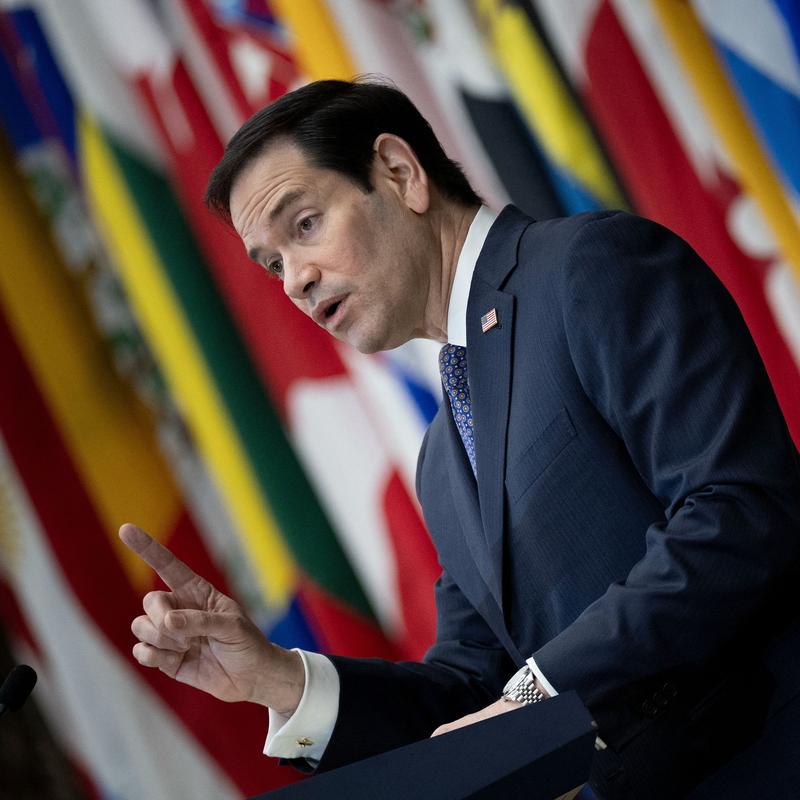
Secretary of State Marco Rubio: The Cuban regime's sprawling intelligence and ideological network helped to build the far left in our country and in our hemisphere. It remains inextricably linked to the far left groups and movements across and beyond the West.
Brooke Gladstone: That's Secretary of State Marco Rubio speaking last week at a political terrorism conference he hosted in D.C., but at the same time, he and the President have been going on and on and on about how Cuba is on the brink of collapse.
Secretary of State Marco Rubio: At the end of the day, they got to make a decision. Their system doesn't work, right? Their economic system does not work. It's broken, and you can't fix it with the current political system that's in place. They just don't comprehend how to do it. It's a failed state.
President Donald Trump: We just want them to be a nicely run country that can feed its people. Look, it's a failed nation. The country is starving, and it's got no energy, it's got no oil, it's got no money, it's got nothing. It's got a beautiful piece of land. You could have beautiful resorts, doesn't have oil. It's collapsed.
Michael J. Bustamante: If it's true that Cuba was this bastion of the global left in the 1960s, it's really difficult to make a comparable case today.
Brooke Gladstone: Michael J. Bustamante is an associate professor of Cuban and Cuban-American history at the University of Miami.
Michael J. Bustamante: Cuba today still purports to be a symbol for a certain left, a left that I think is actually quite marginal in most places. A symbol of resistance to the United States, not a symbol of a model that is seeking to implant itself elsewhere. Look at Latin America right now. Latin America has undergone in the last few years a pretty significant shift to the right politically. The idea that Cuba is still plotting this overtaking of the region just dramatically contradicts the real correlation of forces that exist today.
The Cuban government is just doing its best to keep the lights on. Now that doesn't mean that the Cuban government doesn't have an interest in developing ties with groups outside of Cuba, including the United States, that share its criticisms of US policy. There's insinuations in the report that the Cuban government may coordinate things like anti-embargo activism in the United States with certain groups that might cross a certain legal line. That's not substantiated in the report.
Brooke Gladstone: Here's a quote from the conclusion of the report. "Today, Cuban agents and operatives maintain a foothold in hundreds of front groups, activist organizations, solidarity centers and ideological NGO and nonprofit networks. These groups collectively represent one of the single largest, most sophisticated and dangerous vectors for hostile foreign influence in modern American history. Many of the most significant upheavals in recent American political history, from the George Floyd riots to the rise of antifa, to the explosion of pro terrorist activism on American college campuses, can be linked in some way, shape, or form to Cuban influence."
Michael J. Bustamante: I think the keywords in that passage you just read are "in some way, shape, or form". Being most generous in my interpretation of the report. There's a long history of the Cuban government seizing on evidence of American political discord dating back to the 1960s as a way to indict the American model and prop up the Cuban model. To lay at the feet of the Cuban government in the vague way that that passage you read does something like a contemporary racial justice movement, it's atrocious.
It denies that there was anything animating the George Floyd protest that would be organic or real. Even if you assume that Cuban agents somehow infiltrated in these groups, which the report doesn't provide proof of that at all, you still can't deny that the circumstances that prompted that protest were not created in a lab somewhere underground in Havana.
Brooke Gladstone: You wrote in a thread on X that the report was filled with selective, infuriating history, including the part about Cuba's relationship to Black radicalism in the United States.
Michael J. Bustamante: This is a great example of the way in which revolutionary Cuba would seize on discontent in the United States as a way to cultivate support for what they were doing as a different model. Revolutionary Cuban officials, Cuban state media in the 1960s, they covered closely the civil rights struggle. There's a famous film done in Cuba in the mid-60s that uses the famous track called Now by Lena Horne, the civil rights anthem of its era, and uses that as a soundtrack to a montage of civil rights protests, as a way to show its own citizens that the United States is a place of oppression. Its own citizens, by the way, who significant numbers of them are Black.
Cuba, also, out of that, establishes ties to certain Black radical groups. Angela Davis, Stokely Carmichael, these are things that are mentioned in the report. There are campaigns in Cuba to support Angela Davis when she's in jail. There are Black radicals who go into exile in revolutionary Cuba. That part is true. What I think the report is partial in describing is many of those actors own later complicated relationships to revolutionary Cuba.
A great example is the case of Robert Williams. Robert Williams is cited in the report. One of the people who's associated with creating the idea of Black nationalism in the 1960s goes into exile in Havana in the early to mid-'60s. From Havana, the Cuban government helps him broadcast what was called Radio Free Dixie into the Jim Crow South.
Radio Free Dixie: From Havana, Cuba, free territory of the Americas. Radio Free Dixie invites you to listen to the free voice of the South. Stay with us for music, news, and commentary by Robert F. Williams.
Michael J. Bustamante: That is evidence of the Cuban government supporting Black radicals in this way. Again, segregation was a real thing.
Brooke Gladstone: Yes. In order to attribute Black radicalism in the US to Cuba, you have to completely leave out the context that gave rise to Black radicalism. A lot of that context persists today.
Michael J. Bustamante: Precisely. Not only that, you also leave out where Robert Williams ended. After spending a few years in Cuba based on his own papers, he got really frustrated because he felt that Cuba, similar to the United States, a society that was shaped by slavery, slavery that was shaped by inequality and racial segregation, that revolutionary Cuba, despite coming to power with this goal of bending racial discrimination in Cuban society, simply declared that racism had been solved as a function of class in 1961, '62, and thereafter, it really became taboo in Cuba to talk about continued evidence of racial disparity. Robert F. Williams butts up against that, and he becomes disillusioned with socialist Cuba, and he leaves. He's not the only one. There are Black Panthers who go into Cuba.
Brooke Gladstone: Eldridge Cleaver, one of the founders.
Michael J. Bustamante: Exactly, who then leaves Cuba and writes an exposé of the racism that he had felt in socialist Cuba itself. These are just broader parts of the historical context that I think matter from our overall assessment of the role that Cuba played in its relationship to Black nationalism. If there is evidence that Cuba lends support to Black nationalist actors, to leave open the idea that somehow Havana is pulling the strings entirely of these movements utterly ignores the context domestically in the United States to which those actors were responding. Again, whether or not you agree with the solutions that they were proposing for the time.
Brooke Gladstone: You've noted that while those on the list are unlikely to be foreign agents acting on Cuba's behalf, many of these groups do have simplistic views about Cuba and have allowed the "Cuban government to use them in their own script of victimization." Just wondering what you mean and who you're talking about here.
Michael J. Bustamante: I think DSA is a good example.
Brooke Gladstone: The Democratic Socialists of America.
Michael J. Bustamante: Where I have a problem with an organization like DSA is in attributing the entirety of Cuba's crisis today to the impact of US sanctions. Talk to Cuba's best economists, and they would say that that's an overly simplistic read. The situation in Cuba is a result of a composite of factors that are in fact embedded with one another. US sanctions policy over many, many years intensified over the last seven months, but also economic mismanagement internally and its unwillingness to embrace even moderate market reform.
One can have a political argument with DSA about why their views on Cuba are simplistic. Why it's unfortunate that when they've traveled to Cuba to draw attention to US sanctions, they seem to echo a reading of the Cuban situation that is very much the Cuban government's, in which the Cuban government has zero responsibility. It's quite another thing to insinuate that they are agents of influence for the Cuban government itself, because that is not just a political argument about disagreement on the terrain of free speech. It's an argument about disloyalty.
I go back to this "in some way, shape, or form" business. What is the difference between an actual agent of Cuban intelligence versus somebody who just happens to have an opinion that's in line with the Cuban government? The report flirts with the vague line between all those things and puts it into one broad package to create this picture of an overwhelming threat.
Brooke Gladstone: You've noted that this report is a rhetorical mirror to how the Cuban government treats its own dissenters?
Michael J. Bustamante: Friends of mine who have been on the ground in Cuba over a number of years, trying to organize independently of the government, which is illegal, particularly when you're organizing around political issues. Folks who have tried to advocate for reform politically and economically, human rights activists. The most frequent way with which the Cuban government seeks to delegitimize those groups through state media is to paint them as simply agents of US Empire.
There are US Government programs for democracy promotion that some of these groups are plugged into and benefit from. The Cuban government will say, these groups, because they're getting US funding, they're incapable of thinking of their own ideas. They're part of a foreign plot. That basic tactic of saying that dissent can't be organic.
Brooke Gladstone: This is exactly what Putin is doing. People are being forced to register as foreign agents all the time, even if they have virtually no contact with any foreigners.
Michael J. Bustamante: Right. This report from the State Department inverts that logic, that any contact-- You've gone to Cuba to bring aid or on a solidarity mission. There was this humanitarian aid flotilla that happened earlier in the spring. That you're an agent of Cuban government propaganda. That was an incident in which I felt the architects of that flotilla, its leaders, were articulating overly simplistic visions of Cuban reality, were articulating overt sympathy for the Cuban government itself in a way that I disagree with profoundly. Again, the notion that they have no agency in their thought, whether it's good, bad, stupid, or smart, is, I think, the problem in this report.
Brooke Gladstone: What is the point of this? What is the goal in the end?
Michael J. Bustamante: There is all this rhetoric in there that seems geared toward domestic politics. This raising of the specter of the progressive caucus of the Democratic Party is communist on the march, and the way that's being used as a scare tactic. The other piece of this is an argument about Cuba as a national security threat to the United States, which, again, I agree with you. It's certainly overkill. This is not the only piece of that argument that the administration has been teeing up over months. They would point to some reports, disputed, that the Chinese and the Russians maintain listening and espionage posts in Cuba that allow them to eavesdrop on US government communications.
They would point to evidence of Cuban troops showing up on the fronts in Ukraine, fighting for the Russian army. It's debated to what extent the Cuban government is complicit with Cuban troops showing up in Russia, but they are.
Brooke Gladstone: Russia is paying a lot of money at this point for foreigners to fight instead of Russian soldiers that they're running out of.
Michael J. Bustamante: This is really sketchy recruitment, to put it mildly. There's a lot of reports that some of these Cuban soldiers are never seeing the money that they're promised, and they're being brought there under false pretenses. "You're going to come in and work construction." Suddenly, within 24 hours, you're on the front line.
Brooke Gladstone: I see.
Michael J. Bustamante: All of these things are like a drip, drip, drip, to make an argument that Cuba, this country that is basically falling apart, is not just a political problem for the United States or an economic problem for the United States, but some national security threat that has to be dealt with. If there is an existential threat, is the threat of the blowback that comes from a society that is completely unraveling. How is it? I think we should be asking that Cuba can both be on the verge of falling, as the president has said repeatedly, and this existential threat to the United States, That's a fundamental tension that this report does not address or resolve.
Brooke Gladstone: Any thoughts on the constant invocation of communism by Rubio and so many others in the administration as a way to target political enemies? Do you think it is a useful tactic now? I mean, who's he going to point at? Not even China's really communist anymore.
Michael J. Bustamante: A couple days ago, questions that the Secretary of State was answering at a press conference in the Philippines, where he's traveling for the ASEAN summit. He was asked about the seeming inconsistency between the administration and Rubia himself working to tee up another successful meeting between Trump and his Chinese counterpart. Then the allegations that Cuba is a den of communist infiltration. Asking the question, wasn't China like a way more powerful place, and haven't we been concerned about their influence? Why isn't there a report on that?
Journalist: Don't you think it's inconsistent in that you haven't addressed the same issues of China? They're the largest Communist party in the world, 100 million.
Secretary of State Marco Rubio: Yes, but our issue is with communist interference inside of our country. That report was about what these different elements do to interfere in our country and to undermine our foreign policy. Your question was about Communist influence. Yes, the United States doesn't want to be a communist country.
Michael J. Bustamante: The comparison is also about geopolitics. Cuba is a small country that has backed up against the wall to US power 90 miles away. The Chinese government is a global superpower that the United States is going to have to contend with one way or another. One of the saddest things about the whole media cycle around this report is that it is distracting attention for whatever this week or two weeks that this cycle lasts from just how grave the situation is for Cuban citizens and how desperate and deserving they are of a solution from both of their governments.
Brooke Gladstone: Earlier this month, Cuba suffered its third national blackout in six months amid Trump's oil blockade. Many residents have said that, "Living like this is agony. What have you heard from friends and family in Cuba?
Michael J. Bustamante: My father's first cousin worked as a pharmacist, the Cuban State Pharmacy for 25 years or something or more. She retired with a pension that's worth somewhere between 2,000 to 3,000 Cuban pesos a month. To put that into context, a liter of cooking oil is going for 1,500 to 2,000. Unless you have a foot in Cuba's still incipient but interesting private sector, unless you're working in tourism and can get foreign tips, but, oh, there's no tourists really showing up anymore, unless you've got family on the outside who can send you money and support. I don't understand how people are getting by. Signs are that they're not.
The humanitarian crisis is not a future thing. It is here. At what point that breaks, I don't know. It's an open question whether the calculus of the administration is to bring about such humanitarian hardship that it creates the circumstances for a forceful toppling of the Cuban government from within. I think when people are focused so much on the day-to-day of just getting by, I don't think it's a given that the outcome of that is mass mobilization in an organized way.
We are seeing increased protests, but we're also seeing Cubans continue to leave even though the US border is now closed in the last year, again after the closure of the US-Mexico border. During 2025, the island lost more than 200,000 people in migration, which is way more than the Mariel boatlift of 1980, which at the time was seen as a total watershed. What I'm hearing is that people are at their wits' end and real concern about the social unraveling.
Brooke Gladstone: Thank you so much, Michael.
Michael J. Bustamante: Thank you for having me.
Brooke Gladstone: Michael J. Bustamante is an associate professor of Cuban and Cuban-American history at the University of Miami and author of the book Cuban Memory Wars: Retrospective Politics in Revolution and Exile. In the run-up to the release of the State Department's Cuba report, Miguel Diaz-Canel, Cuba's president, said that the US had fallen to a new and more dangerous version of McCarthyism.
Mr. Arens: Are you now a member of the Communist Party?
Mr. Robeson: Oh please, please, please.
Mr. Scherer: Please answer, will you, Mr. Robeson?
Brooke Gladstone: Paul Robeson, actor, singer, activist, athlete, and much more before the House Committee on Un-American Activities, June 12, 1956.
Mr. Robeson: To whom am I talking?
Chairman Francis E. Walters: You are speaking to the Chairman of the Committee.
Mr. Robeson: Mr. Walter?
Chairman Francis E. Walters: Yes.
Mr. Robeson: The Pennsylvania Walter?
Chairman Francis E. Walters: That is right.
Mr. Robeson: Representative of the steelworkers?
Brooke Gladstone: Seems Robeson knew him all too well.
Mr. Robeson: You are the author of the bills that are going to keep all kinds of decent people out of the country.
Chairman Francis E. Walters: No, only your kind.
Mr. Robeson: Colored people like myself, and you would let in the Teutonic Anglo-Saxon stock.
Chairman Francis E. Walters: We are trying to make it easier to get rid of your kind, too.
Mr. Robeson: You do not want any colored people to come in?
Brooke Gladstone: Chairman Francis E. Walters' unabashed candor was met by Robeson's own.
Mr. Robeson: The reason that I am here today, from the mouth of the State Department itself, is, I should not be allowed to travel because I have struggled for the independence of the colonial peoples of Africa. The other reason that I am here today, again from the State Department is that when I am abroad I speak out against injustices against the Negro people in this land. That is why I am here. I am not being tried for whether I am a Communist, I am being tried for fighting for the rights of my people, who are still second-class citizens in this United States of America.
My mother was born in your state, and my mother was a Quaker. My ancestors in the time of Washington baked bread for George Washington’s troops when they crossed the Delaware. My father was a slave. I stand here struggling for the rights of my people to be full citizens in this country, and they are not. They are not in Mississippi, they are not in Montgomery, Alabama. They are not in Washington. They are nowhere, and that is why I am here today. You want to shut up every Negro who has the courage to stand up and fight for the rights of his people, for the rights of workers, and I have been on many a picket line for the steelworkers too, and that is why I am here today.
Mr. Arens: Would you tell us whether or not--
Gil Duran: There were people on the left who went to Cuba in the 1970s, but we should be a little more focused on the people who went to Epstein Island?
Brooke Gladstone: Journalist Gil Duran.
Gil Duran: This is like the weapons of mass destruction that never existed in Iraq. You just create some fake supposed evidence to justify and lend seriousness to your claims. Part of the reason they're doing that is that you need to keep finding ways to repeat the accusation. Keep an eye out for the Trump administration to continue to find imaginary Communists hiding under every rock, because this is essential to their strategy now.
Part of what's interesting about this strategy they've embarked upon is that there's a tactic in propaganda known as accusation in a mirror. It's when you accuse your opponents of doing the thing that you're actually doing in order to create confusion and make it hard for people to discern what's actually happening. The threat is coming from inside of the White House, not from Cuba, not from anywhere else. They are the people creating the danger. It would be better to de-escalate this rhetoric and for them to figure out how they're going to somehow make good on all the promises they've made that they can't keep.
Brooke Gladstone: Gil Duran of the Nerd Reich newsletter. This is Lena Horne.
[music]
Micah Loewinger: Coming up, a former flight attendant turned journalist can't look away from the abuses on ICE deportation flights.
Brooke Gladstone: This is On The Media. This is On The Media. I'm Brooke Gladstone.
Micah Loewinger: I'm Micah Loewinger. This week, a rare glimpse of accountability for recent violence outside of an ICE facility in Colorado.
Reporter: Police say a woman was shot outside the Aurora ICE processing center by a man who works for the GEO Group, that's the company that owns the facility.
Reporter: Today, Brandon Booth, charged with assault in the first degree. Booth admitted he intentionally pulled the trigger during the July 16 shooting, but told police he was trying to scare two protesters and never intended to hit anyone.
Micah Loewinger: Meanwhile, still no word on the officers responsible for the two deadly shootings earlier this month.
Reporter: Breaking news out of Texas, where authorities are investigating after a man was shot and killed by an ICE officer during a traffic stop. The Department of Homeland Security says immigration agents were trying to detain Lorenzo Salgado Araujo in Houston early yesterday morning when he allegedly attempted to evade arrest.
Reporter: This morning, a person reportedly shot and killed during an incident involving an ICE officer in Biddeford. That's about 25 minutes outside of Portland, Maine.
Reporter: The man has been identified as Joan Sebastian Guerrero, the father of a three-year-old daughter.
Micah Loewinger: The killings reignited outrage over ICE and its aggressive tactics. According to reporting by The Intercept, helped push the agency to require its field agents to begin wearing actual uniforms. There was also a brief pause on ICE traffic stops, which President Donald Trump quickly reversed.
Tom Homan: President said he wanted to continue, so that's why they're continuing. The vehicle stops are back on.
Micah Loewinger: White House border czar Tom Homan this week speaking with News Nation.
Tom Homan: In June we had the highest numbers of arrests in the history of the agency of ICE, and July's tracking to even beat that. We're hitting on all cylinders now. We're deportation maxing.
Micah Loewinger: To date, the Administration says it's deported around 600,000 people, though the true number has been difficult for the press and think tanks to corroborate. Around 19,000 members of that count have been subjected to a new nightmare cooked up by Trump 2.0, third-country removals, where people are sent to countries that they're not from. Gillian Brockell has worked as a flight attendant and a journalist at the Washington Post and other mainstream outlets. Nowadays she's an independent reporter who's made it her business to scan the flights that ICE is using to move detainees around.
Twice a week, Brockell publishes a tracker on her website, GillianBrackel.com, to monitor all of these third-country removal flights and the people who are on them. Her diligence has paid off, and she's had some big scoops. This work comes with a price. Gillian, welcome to the show.
Gillian Brockell: Thank you for having me.
Micah Loewinger: How did you first start working on this beat?
Gillian Brockell: I mean, it was completely random. It was May 20th of 2025. I was a staff writer at the Washington Post. I took the first buyout at the end of 2023. I wrote about history. I was working on a book about the history of resistance to slavery. I used to be a flight attendant, and I'm still an aviation geek. There were all these breaking news reports about lawyers saying that they'd been told that their clients had been put on a plane and sent to South Sudan, a country that they were not from, and that it was against the judge's specific orders.
I just thought, "I wonder if I can figure out what plane they're on." The lawyers were saying the plane was still in the air. It took me a couple of hours. I did eventually figure out the plane. The New York Times later confirmed that was, in fact, the plane, and it landed actually to refuel in Shannon Airport in Ireland. At that point, I wasn't covering this. I was just watching it like everyone else was. I called the Shannon Airport police. I thought that there might be a chance to get these people off the plane.
Micah Loewinger: What did you say to the police?
Gillian Brockell: I said, "There's this plane with this tail number on this part of your airport that has just landed. It came from here. I believe that there are people on board who have been illegally removed from the United States. You may have human trafficking laws that apply here. They're being sent to South Sudan, a place that they are not from. Please check the plane." The plane was there for about two hours, and then it took off. Still don't know to this day if it was searched. That was like my introduction to ICE flights.
Micah Loewinger: What happened to the people on that plane headed for South Sudan?
Gillian Brockell: Eventually it landed in Djibouti at Camp Lemonnier, which is a US air base. The people there stayed in a shipping container, imprisoned there for six weeks before the Supreme Court cleared the way for their removal. Military flight flew them to South Sudan on July 4th, 2025. Three of them have been released. Five of them are still detained there.
Micah Loewinger: Can you talk about the experience these people being removed go through?
Gillian Brockell: They're shackled at the wrists and ankles, attached to a waist chain. They have to remain seated the entire time. There are prison guards and ICE agents on board. The flight attendants really just arm and disarm the doors. The GEO Group guards do most of the work.
Micah Loewinger: GEO Group is a private prison contractor.
Gillian Brockell: Yes. Much of the experience depends on the mood of the guards on board. I've heard from passengers that some guards just won't let you get up. When you have to use the restroom, you soil yourself in your seat. I've heard from former flight attendants on these ICE flights that that's a pretty regular occurrence. People are threatened. The guards use racial slurs. They wrap people in this thing called the wrap, which is a full-body straight jacket. The food is disgusting, and there's not enough of it. Most ICE flights are domestic, but the removal flights to Africa and Asia already lasted a long time. They're getting longer, and they're getting worse. They're doing multiple stops.
Micah Loewinger: Multiple stops, as in you might end up visiting multiple countries before the country that you're removed to.
Gillian Brockell: If you're being deported to Vietnam, you could visit four to seven countries before you arrive. The longest I've recorded with flight data and with confirmation from passengers for a shackling is 82 hours.
Gil Duran: Wow.
Gillian Brockell: I've recorded 75 hours, 68 hours, 51 hours. It's really awful. For a Mother Jones story I did, I talked to a medical doctor. She just said prolonged shackling like this, besides causing excruciating pain, can cause permanent nerve damage, cuts and bruising, and the risk of blood clots is insane. One woman I spoke to, Melissa Tran, when she was being deported to Vietnam, she said that every country that they stopped in, the guards allowed them to stand up for one minute.
Micah Loewinger: One minute?
Gillian Brockell: One minute. You can't even stretch that much with the waist chain because you can't raise your wrists above your shoulders. You can't reach your oxygen mask if you can't raise your arms. You can't tie the strap to the life vest around your waist if you have a waist chain.
Micah Loewinger: That's just the flight. Many of these people are being taken to countries with dangerous political situations. They may not even speak the language. Let's talk about one example. Adriana Zapata.
Gillian Brockell: Adriana Zapata was a legal asylum seeker from Colombia. She was a victim of sexual torture from the national police there. She and two dozen other South Americans, all asylum seekers, were put on an ICE flight to the Democratic Republic of Congo. She has diabetes. She has really complex medical conditions. Once she got to DRC, within a couple of days, the government there told the Trump administration, we don't have the medical facilities to care for her. You have to take her back. The Trump administration just ignored them. Then a federal judge ordered her return. At that point, DOJ said, "Sorry, we can't take her back. There's an Ebola outbreak there, wouldn't be safe." She's now stuck there until Ebola is done.
Micah Loewinger: She's a Colombian woman in her 50s.
Gillian Brockell: Yes.
Micah Loewinger: Why was she sent to the Congo?
Gillian Brockell: It's just this legal loophole. Before the second Trump administration, there was this concept of a safe third country. It was a rarely used thing where someone could be deported to another country where they would be safe and where they would be resettled. The Trump administration is just increasingly claiming that a lot of unsafe places are safe. Then the other thing is that they're not being offered resettlement. The Democratic Republic of Congo, as soon as these people arrived, they put them in a hotel near the airport and said, "Okay, you have to leave. You can't stay here."
This is happening in 11 countries now in Africa. In most of them, the host country is just saying, "All right, you have to go. It's either to your country of origin, and we're going to force you there soon, or you got a couple of days to figure out somewhere else to go." Most people are returning to their countries of origin, which is something that federal judges specifically barred for the vast majority of these people.
At least one Russian dissident who was sent back via Egypt, he immediately was taken into Russian custody and has disappeared. It is against US and international law to deport someone to a country that's just going to deport them to a place where they won't be safe. It's called chain refoulement. So far, the Trump administration has said, well, these countries said that they weren't going to force them back to their home countries. Then they're just pretending that they don't know what's actually happening. That is moving through the courts very slowly.
Micah Loewinger: There's huge money to be made here. For a recent piece in Mother Jones, you talked about some of the people profiting off of these flights.
Gillian Brockell: The Mother Jones story was about this private equity firm called Stonepeak. Stonepeak bought Omni Air International, which is a longtime ICE flight charter that does all of the Africa and Asia large jet removals, has for years. The sale went through in April 2025, and since Stonepeak purchased them, their ICE flights have quadrupled. We know in 2019 they charged $34,000 per flight hour. For a similar removal to Asia, it was about 1.8 million total for that trip. We don't know what their current price is. All ICE flights go through CSI Aviation, which is ICE's flight broker. Right now they're getting into the last few months of a contract worth up to $1.5 billion.
Micah Loewinger: That's our tax dollars.
Gillian Brockell: Yes, that's our tax dollars.
Micah Loewinger: Your most well-known story was your report on Liam Ramos, who listeners may remember as the five-year-old boy captured in a photo wearing a bunny hat. He was taken by ICE in Minneapolis.
Gillian Brockell: There was an activist in Minneapolis who, like me, is an airplane geek. His name's Nick Benson. He, for months, had been filming the loading of every ICE flight leaving Minneapolis. He noticed that there were never any kids being loaded onto the planes. Then the Liam Ramos story happened. The story of his capture was national news within hours. Nick knew he'd definitely never seen Liam being loaded. He looked and saw that the only nonstop flights between Minneapolis and San Antonio that day were operated by Delta.
Nick FOIAed the footage from the airport to get evidence of this. He took it to a major news outlet. The major news outlet didn't seem particularly interested. They were dragging their heels. He gave it to me. I reported it out in a couple of days, posted the story, and turns out that people really did care that Delta was doing this.
Micah Loewinger: Why did you want to hold Delta's feet to the fire here?
Gillian Brockell: In Trump's first term, the family separation policy, they were flying kids who'd been separated from their parents across the country to different detention centers on a bunch of airlines. The way that that ended was a flight attendant did one of these flights, was disgusted and ranted about it on Facebook. It became national news. All of the airlines that are unionized, so not Delta, got together released a statement saying, "We're not having unaccompanied minors in ICE custody on our planes anymore." By the end of the day, the Trump administration announced that it was ending the family separation policy.
Micah Loewinger: In all of the reporting that you've done, which stories have stuck with you?
Gillian Brockell: I think about this woman, Rabiatu Kuyateh, all the time. I live in Prince George's County, Maryland. She lived just down the road from me. Her son might have gone to the same school that my kid goes to now. She is from Sierra Leone. She was in the US for 30 years. She had protections from removal to Sierra Leone. She had no criminal record. She had not done anything wrong. ICE scooped her up last summer, and then last fall put her on a plane to Ghana, a country she'd never been to. She said that on the plane, a man who had asked for his medication was put in the wrap in this full-body straitjacket and put upside down on the floor for the entire 16-hour trip.
I talked to a flight attendant who quit soon after that trip, and they said that the man was screaming, "I'm already a dead man. I'm already a dead man." She was imprisoned in a hotel for a couple of weeks and then forced to return to Sierra Leone. There's really awful video that went viral in Africa of her being forced onto this bus that took her back. As soon as she got back to Sierra Leone, she fled again. She's been in hiding for the last eight months. She's a registered nurse. She was a productive member of my community. She owns a home down the road from me that she can't go home to. She's so stuck. I just think about her all the time, how unfair it is.
Micah Loewinger: I want to ask you about your origin story on this beat. May 20th, 2025, when you called the Irish airport and, to use your word, you interfered--
Gillian Brockell: I tried to interfere. I was not successful. I wish I had been.
Micah Loewinger: A traditional reporter might say, "My job is just to let readers know that this is happening." Why did you cross that line and try to stop it while the story was still unfolding?
Gillian Brockell: I mean, the short answer is just that I felt a moral obligation. I knew that the plane was only going to be there for a short period. I tried to call friends in Ireland. It was two in the morning. They were asleep. I didn't think that I was going to be able to figure out, "Should I call the transportation minister or the foreign minister?" Is there a human rights person? Who do I call? I don't know. It was two in the morning.
I wasn't covering it when I did that call. As a former flight attendant, I do see myself as having a moral obligation to say something about how unsafe all of these flights are. Not just the third country removals. Every single ICE flight. There were 78 ICE flights yesterday. Every single one of them was dangerous because the people were shackled. You can't evacuate within 90 seconds with shackled people.
When I talk to my friends who aren't in journalism about, "Well, I did this thing, and so now a lot of places will never hire me," they don't get it. They're like, "You mean you acted like a human? You did a human thing?" They don't see the big deal. I know that there are probably some of my former colleagues listening who are going, "Nope, you crossed the line. You're done." I just think that these traditional ideas that we've had about journalism are not cut out for the times that we're in.
Micah Loewinger: Since it's become harder for you to pitch these stories to mainstream outlets, how has that affected your ability to do the reporting?
Gillian Brockell: I have my own ghost newsletter now, and I publish my stories there. I keep my third-country removal tracker there. People can pay to subscribe. I'm making more now than I was freelancing. I'm able to publish more frequently than when I was having to pitch stories, but I'm not making enough to live on. I've pulled from my retirement twice. I don't want to have to do it again. I'm probably going to have to soon.
I'm looking for a place to take my work in-house. I wish I had an editor. I wish I had an entire team to be filing FOIAs and working contacts in host countries. I'm drowning in stories and not making enough. Times are hard for everybody right now, myself included. To be honest, I do worry that I have screwed up my career. I think I've done the right thing, but I don't know where I go from here.
Micah Loewinger: Do you regret making that call?
Gillian Brockell: No. I wish it had worked.
Micah Loewinger: Gillian, thank you so much for doing what you do.
Gillian Brockell: Thank you for having me.
Micah Loewinger: Gillian Brockell is an independent journalist covering ICE flights and third-country deportations. You can follow her work at GillianBrockell.com.
[music]
Micah Loewinger: That's it for this week's show. On The Media is produced by Molly Rosen, Rebecca Clark-Callender, and Candice Wang, with help from Ella Walsh. Travis Mannon is our video producer.
Brooke Gladstone: Our technical director is Jennifer Munson, with engineering from Jared Paul. Eloise Blondiau is our senior producer, and our executive producer is Katya Rogers. On The Media is produced by WNYC. I'm Brooke Gladstone.
Micah Loewinger: I'm Micah Loewinger.
Copyright © 2026 New York Public Radio. All rights reserved. Visit our website terms of use at www.wnyc.org for further information.
New York Public Radio transcripts are created on a rush deadline, often by contractors. This text may not be in its final form and may be updated or revised in the future. Accuracy and availability may vary. The authoritative record of New York Public Radio’s programming is the audio record.