
The Rapid Rise of Bari Weiss
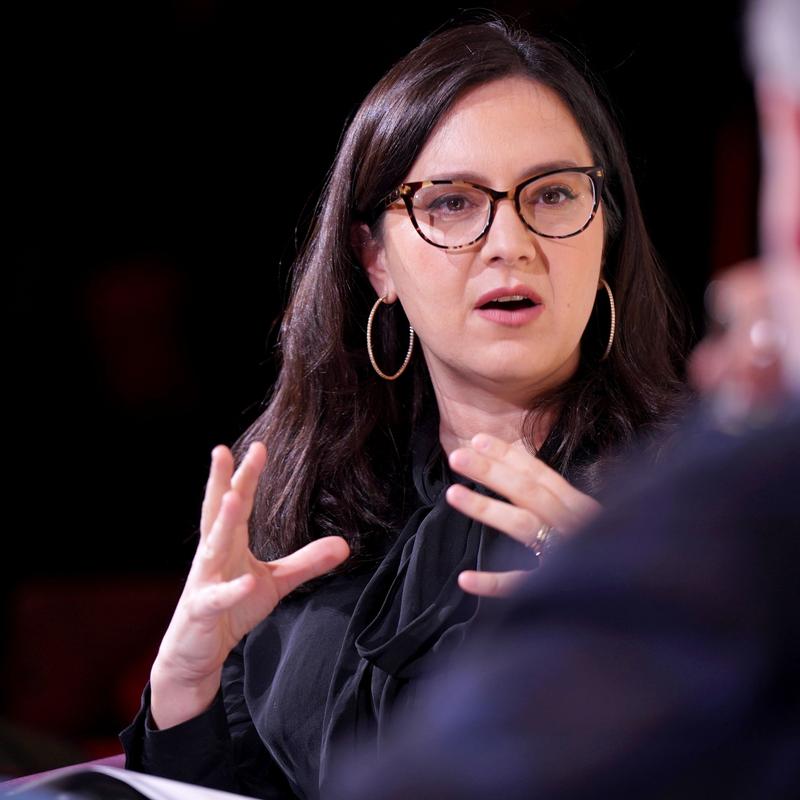
Micah Loewinger: Hey, you're listening to the On The Media midweek podcast. I'm Micah Loewinger. This year, former New York Times opinion editor, Bari Weiss became the editor-in-chief of CBS News. The network's new owner, Paramount Skydance, also acquired Weiss's online publication, The Free Press, for an estimated $150 million. Unconventionally, for a news executive, Weiss appeared in front of the camera in December when she hosted a town hall with Erika Kirk.
Bari Weiss: I want to thank Erika Kirk so much for joining me tonight, and I also want to thank our audience for participating in this town hall. CBS News is going to have many more conversations like this in the weeks and months ahead, so stay tuned. More town halls, more debates, more talking about the things that matter. I'm Bari Weiss here in New York. Good night.
Micah Loewinger: Back in September, I spoke with Peter Shamshiri, co-host of the podcast If Books Could Kill, who's been tracking Bari Weiss's rapid rise. The story starts in 2004, when Weiss was still an undergraduate at Columbia University. That year, she helped start a campus group called Colombians for Academic Freedom, and got herself ensnared in a controversy involving a group of professors teaching Middle Eastern and Arab studies, most notably Joseph Massad, a vocal anti Zionist.
Peter Shamshiri: There was one incident where a student asked Joseph Massad whether it was true that Israel gave advance notice to Palestinians in potential danger from incoming airstrikes. Massad apparently lashed out and basically said, "If you're going to defend Israel, get out of my class." Unclear whether that happened. There were investigations that led nowhere. It's very Bari Weiss in that the group that she was part of is branded as one promoting academic freedom, but the entire mission appears to be to get academics disciplined for their views, for the way that they acted in class. Presenting yourself as having lofty principles that are very directly undermined by your actions, that, to my mind, is just straight down the middle, Bari Weiss.
Micah Loewinger: After she graduated from Columbia, she did a stint at Tablet, the Jewish culture magazine. She then landed a gig at The Wall Street Journal in 2013. It's there that she writes what you and your co-host, Michael Hobbes, call the canonical Bari Weiss column. This is right after the Obergefell ruling in 2015 that legalized gay marriage. Weiss is a gay woman, but her take in the column was less celebration and more finger-wagging.
Peter Shamshiri: Yes, she cites a bunch of incidents of terrorism targeting LGBT folks across the globe and basically says, we are so focused on the opponents of gay marriage in America, but our real enemies are Muslim terrorists. She says, "The barbarians are at our gates." It's a very classically Bari column because there's this very quick, almost tacit acknowledgement that she agrees with liberals on the issue, but then the entire column is dedicated to criticizing them. This little move is sort of the basis for her whole career. I'm a liberal, but it's very purposefully designed as a way to give the reader permission to agree without feeling like they're being a conservative. There is a thread that you'll see running through a lot of her work, being relatively anti-Muslim and very concerned with Islamic terrorism.
Micah Loewinger: The New York Times brought her in as an Op-Ed editor and writer on culture and politics. Weiss was often criticized for taking maybe upsetting to liberals' positions. There was one piece titled Meet the Renegades of the Intellectual Dark Web, which focused on Joe Rogan and Jordan Peterson, Sam Harris, Eric Weinstein, up-and-coming mostly conservative thinkers and writers. Then, a piece titled "When Progressives Embrace Hate," which focused on objectionable statements made by four organizers of the Women's March. Break that one down for us a little bit.
Peter Shamshiri: It starts off applauding the principles of the Women's March, but then is primarily a criticism directed at several organizers, primarily Linda Sarsour, who's anti Zionist, very explicitly has tweeted in support of Assata Shakur, a Black radical who allegedly killed a cop back in the 70s. There is another organizer who was pictured once with Louis Farrakhan. I think you had this really mainstream protest movement in the Women's March that was very correctly identifying the threat from the right wing to women's rights in particular. They were vindicated just a few years later with the overturning of Roe v. Wade. Rather than focus on that, Bari nitpicks her little issues with Linda Sarsour's tweets. I mean, it's just silly.
Micah Loewinger: What the column does is it focuses on Linda Sarsour's tweets as an example of her radical beliefs, stretches those politics onto a large and fairly diverse protest movement, and then compares it to other scary kinds of extremism. She wrote, "We just saw what happens to legitimate political parties when they fall prey to movements that are at base anti-American."
Peter Shamshiri: Bari is very interested in characterizing the left by its fringe elements. There are not a ton of people on the broad left in the broad big tent of the Democratic Party who support Assata Shakur, or who know who she is, for that matter.
Micah Loewinger: The online criticism of her columns, some arguments that were allegedly taking place between her and her colleagues behind the scenes. All of that culminated in 2020 when she made a loud exit from The New York Times in the aftermath of her boss, James Bennet, being fired over the publication of Senator Tom Cotton's now notorious Op-Ed, which urged the government to send federal troops to crack down on Black Lives Matter protests, again in the summer of 2020.
She wrote a lengthy resignation letter which described, "My own forays into wrongthink have made me the subject of constant bullying by my colleagues who disagree with my views. They have called me a Nazi and a racist." She wrote that letter just mere weeks after she took to Twitter to call some of her co-workers, "Mostly young wokes." [chuckles] What do we know about her exit from the Times, and how do you think it set her up for the next phase of her career?
Peter Shamshiri: I think about her exit from the Times as a performance by Bari Weiss. I think she saw an opportunity and took it. What I mean by that is James Bennet is forced to resign after the Tom Cotton Op-Ed. The reason for that is not just the substance of the Op-Ed, but the fact that Bennet openly states that he did not review the piece before it was sent to publication, which is presumably part of his job.
Bari gets to utilize this moment to portray The New York Times as beholden to, as you said, young wokes, not very interested in free inquiry, free speech. At this point, I think it's very clear in my mind that she's announcing herself to the broader conservative media ecosystem as a free agent. What makes her unique is that she didn't just go become a talking head on Fox News or whatever. She launches her own Substack and tries to create her own media empire.
Micah Loewinger: You've argued that this time, 2020/2021, was this important era, especially when you look at where the conservative movement was.
Peter Shamshiri: It felt like a moment when conservatism needed a rebrand. It seemed like Donald Trump was fading. It felt like the perfect moment to carve out a new space on the right, and that's what The Free Press seemed to be. It captured two audiences at once. One is moderate liberals who were maybe a little bit irritated by the rise of the social justice left in 2020. Two, is the adrift conservatives who were not necessarily comfortable with Trump, who thought that he was gauche and impolite and had crossed the line on January 6th. Bari filled that space very effectively and very quickly.
Micah Loewinger: In the mission statement for The Free Press, here's a quote. "The Free Press is a media company built on the ideals that were once the bedrock of great American journalism. Honesty, doggedness, and fierce independence." It goes on to say, "We don't allow ideology to stand in the way of searching for the truth."
Peter Shamshiri: Anyone who has read as much of The Free Press as I have will naturally recoil at that statement. It's outrageous to think that it is an ideology-free publication. It is very much just a conservative publication. The primary theme of The Free Press's output, in my view, is aggressive criticism of the left and a remarkable credulousness toward the right. There are a ton of examples of this. You can go to the website's free speech section.
There's almost nothing dedicated to the Trump administration's suppression of free speech. In an era where protesters are being targeted, where the administration is targeting universities they don't like, where troops are being deployed to blue cities, The Free Press does not really cover that stuff. There are other things. There is zero criticism of Israel at The Free Press. Something I noticed very consistently is that they will often bury their criticism of Trump in debate pieces. They feature a lot of experts weigh in pieces where they will compile the opinions of different experts on something.
Micah Loewinger: I read one of these. It's titled Is Donald Trump Breaking the Law? Seven Experts Weigh In.
Peter Shamshiri: That's right. That piece came out when there was discussion of whether Trump was disobeying court orders. They spoke to seven, I think predominantly law professors. None of them said that Donald Trump was not breaking the law. Several of them said, yes, he definitely is. Several of them dodged the question and said, well, he's being careless. Bottom line, they found no one willing to say, no, he's not violating the law. Yet, that gets packaged in this experts hash-it-out style piece that makes it look as if there is room for disagreement. If the headline would be bad for Trump, the story gets packaged as a debate piece.
Micah Loewinger: Can you give another example of that?
Peter Shamshiri: Mahmoud Khalil, the pro-Palestinian protester who was targeted by the administration for deportation. The pieces are Fight Club: Should Mahmoud Khalil be Deported? Both Left and Right Are Wrong About Mahmoud Khalil. There's a piece titled Deporting 'Pro-Jihadist' Students: Censorship or Good Governance? If their concern is free inquiry and competing ideas, then surely you would just allow someone to write a piece criticizing the administration very clearly.
Micah Loewinger: The Free Press has been, by any kind of honest summary, it's been wildly successful. It's grown at an incredibly fast clip. It now has 1.5 million free and paid subscribers as of July. Bari Weiss has also raised $15 million from investors, which include Marc Andreessen and David Sacks. What exactly accounts for this massive valuation on this newsletter?
Peter Shamshiri: She's got the Liz Holmes. She can whisper to these rich guys and get their money, get them believing in her cause. She immediately invested in expansion in 2021, 2022, hired staff, raised capital from Silicon Valley types. She expanded into video and documentaries. Their paid subscribership is well over 150,000 at $10 a month. You're talking about an operation that is generating a good amount over a million dollars a month. Yet, like you mentioned again, did a round of fundraising last year and got $15 million, meaning they're burning through cash at a pretty astounding rate.
Micah Loewinger: She's been quite outspoken in wanting to see DEI destroyed and rooted out from American public institutions. That's something that we've heard Marc Andreessen beat his drum about quite a bit. Same with Christopher Rufo, who's a big supporter of The Free Press. In an interview with The New York Times, he called the site "A beautiful off-ramp for center-left readers," who he hopes to corral into his form of conservatism. Is The Free Press flipping readers, as he describes it?
Peter Shamshiri: One of, I think, the big question marks about the future of The Free Press is how appealing is this style in the new Trump era. It's very easy when Joe Biden's in power to pitch yourself as critiquing the left because the left is in power. That feels like good journalism. Part of the appeal to a lot of people was there is a monolithic liberal culture in this country, and we need to pierce that, but that's not what things feel like now. Now, with Trump in power, a lot of The Free Press's output is just going to read like it's consent manufacturing. I don't know that there's a ton of appetite for that.
Micah Loewinger: What I've observed is a kind of an anti-woke lens applied to even critique of the Trump administration or this right-wing radicalization. I listened to the most recent episode of Bari Weiss's podcast, Honestly, which she makes for The Free Press. It's an interview with Rod Dreher, an American conservative writer living in Hungary. The interview is about the rising threat of what he and Weiss called the woke right, this hyper online, misogynistic, anti-Semitic corner of the Internet that is red pilling men and boys. She basically says that the woke right is a creation or a response to the woke left.
Bari Weiss: When the woke left says trans disabled people of color are the most oppressed class in America and therefore deserve the most privileges, the woke right says, no, no, no, white Christian men have actually been treated like they're at the bottom of the totem pole and they deserve the most accommodations, in effect creating a new form of identity politics, this time in right wing language. It's a fascinating and alarming dynamic, sort of the same phenomenon on each side of the political spectrum.
Peter Shamshiri: It's a framework for continuing to blame the left for what's happening on the right. It's how they perpetuate their style of analysis because they don't have a ton of interest in understanding the right. They view everything that the right wing does as the organic, reflexive response to the left.
Micah Loewinger: In the interview, Dreher repeatedly talks about how he supports what Donald Trump is doing to universities and the government. In the same breath as calling out this censoriousness from woke culture, he's also cheering on how conservatives should be targeting what he perceives as liberal institutions, which he and Bari seem to agree still hold the most power in the United States. At one point, he cautions against making a false equivalency between the woke right and the woke left, because he's concerned about making the woke right seem as powerful as the woke left.
Peter Shamshiri: It's very interesting where they think the danger comes from. This is an opinion that you see across the right, that the right is besieged, and that view tends to justify their reaction. It's something that you'll see, for example, defenders of the Trump administration cite when you ask about the excesses of that administration. Basically, this is what needs to be done to combat the extent to which the American government has been poisoned by liberalism over the course of decades. That viewpoint is very important to their mission because it is how they allow themselves to believe that they are the truth tellers, that they are the objective ones.
Micah Loewinger: When I was speaking with a friend of mine, a liberal person who subscribes to The Free Press and enjoys it, the sentiment that I picked up on was that this reader felt like there's not enough of skewering of the left and honest talk about wokeism in the legacy media, and that here was something that The Free Press was offering and they enjoyed that kind of cultural criticism.
Peter Shamshiri: I've heard that basic argument before, too, and I guess I'm just curious about what legacy media those folks are reading. Because criticism of the left is really common in these spaces. Not just that, but the exact style of criticism that Bari Weiss offers is very common. If you're looking for Op-Ed writers who are ostensibly liberal but criticize the excesses of the left, especially focusing on cancel culture, you have Jonathan Chait, Thomas Chatterton Williams, Conor Friedersdorf. You have conservatives like Bret Stephens, David Brooks.
I don't really understand the argument that we need more of this. I think there's a ton of it. What's remarkable about Bari Weiss is that she was able to take the style of column that everyone was writing and turn it into a media empire. I think that's what's impressive about her.
Micah Loewinger: Peter, thanks for coming on the show.
Peter Shamshiri: It's been an absolute pleasure. Thanks.
Micah Loewinger: Peter Shamshiri is the co-host of the podcast If Books Could Kill and 5-4. Bari Weiss did not respond to our request for an interview. Thanks for listening to the OTM midweek podcast. If you'd like to support the show, consider dropping us a review on your podcast app of choice. Oh, and by the way, in the new year, we're going to be posting a lot more to Instagram and TikTok, so follow us if you don't already. Happy New Year, everyone. I'm Micah Loewinger.
Copyright © 2026 New York Public Radio. All rights reserved. Visit our website terms of use at www.wnyc.org for further information.
New York Public Radio transcripts are created on a rush deadline, often by contractors. This text may not be in its final form and may be updated or revised in the future. Accuracy and availability may vary. The authoritative record of New York Public Radio’s programming is the audio record.