
The Psychology of Sticking Your Head in the Sand. Plus, Ep. 2 of American Emergency.
Title: The Psychology of Sticking Your Head in the Sand. Plus, Ep. 2 of American Emergency.
[music]
News clip: The Nasdaq Composite with a huge gain.
Brooke Gladstone: The stock market is hitting all-time highs despite the ongoing economic turbulence caused by the Iran war. Cognitive dissonance, anyone?
Bryan Walsh: People are screaming that we are going to be running out of the supply we have. We're seeing airline companies cancel flights en masse. We're seeing energy rationing happening throughout parts of Asia.
Brooke Gladstone: The psychology of sticking your head in the sand. From WNYC in New York, this is On the Media. I'm Brooke Gladstone.
Micah Loewinger: I'm Micah Loewinger. Also on this week's show, one disaster did more to erode the reputation of FEMA than any other, but when Hurricane Katrina hit, the agency's only employee in New Orleans was a PR guy.
Marty Bahamonde: I responded, "OH MY GOD!!!!!!!! Tell her that I just ate an MRE and crapped in the hallway of the Superdome along with 30,000 other close friends."
Brooke Gladstone: It's all coming up after this.
Micah Loewinger: From WNYC in New York, this is On the Media. I'm Micah Loewinger.
Brooke Gladstone: I'm Brooke Gladstone. It's been over nine weeks since Iran essentially closed off the Strait of Hormuz, the world's most crucial oil chokepoint. As of earlier this week, just 534 ships are believed to have made it through the Strait intact, a piddling few compared to the 100 ships that sailed through daily prior to the war. Some of us are already keenly feeling the squeeze and there's more to come.
News clip: Diesel is inching closer to $6 a gallon nationally. That hurts. It really matters because farmers, of course, they use the diesel. They use it for the tractors, for irrigation and hauling. Every single pass across the field is costing them more.
News clip: We've seen 12,000 flights being canceled. That's 2 million seats. In terms of jet fuel exports on a global basis, we see about 2 million barrels a day being exported normally. Last month, we saw 1.3 million barrels a day.
News clip: The inventories number coming out of the US, the ones we got last night, I've never seen anything like that before. The analogy I think is like that movie Jaws, when the mayor declares "The beaches are open," you can see the fins swimming around there. The fins are these inventory numbers.
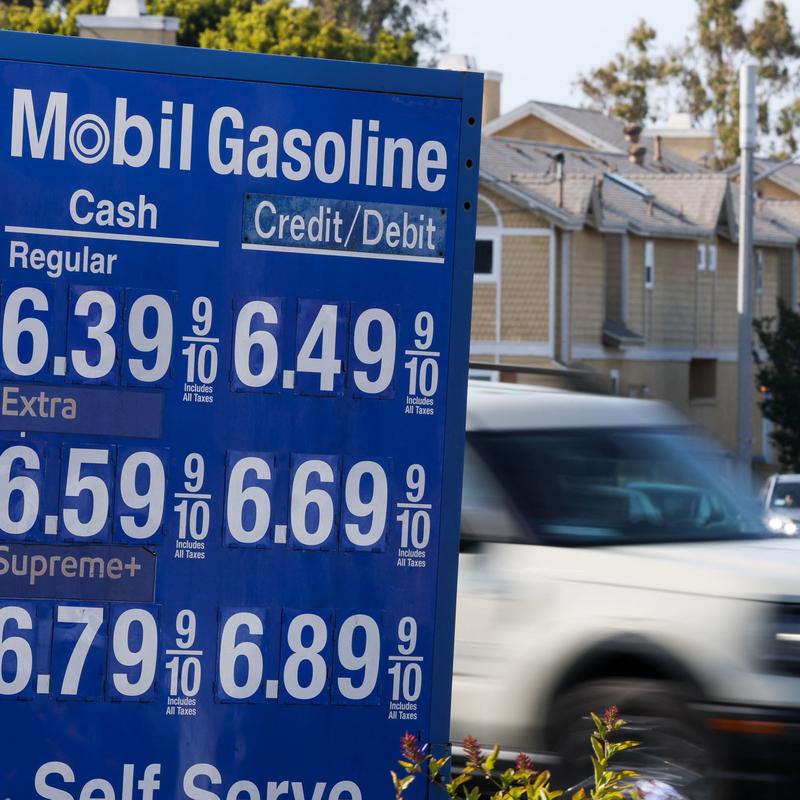
News clip: Gas prices remain around $4.50 a gallon as a national average, with experts warning even if the conflict were to end soon, it may take months for more normal prices to return.
Brooke Gladstone: Curious. Interestingly, very little of this is being registered on Wall Street.
News clip: The Nasdaq Composite with a huge gain on top of a market that's continuing to see just honestly jaw-dropping strength at this point.
News clip: Everything looking good for Trump on the markets and economy point of view.
News clip: It feels like we're just at the point where we're looking beyond the conflict with Iran.
Brooke Gladstone: Bryan Walsh, a senior editorial director at Vox and editor of its Future Perfect section, calls this phenomenon "economic blindness," the jarring mismatch between economic reality and the market's reaction. He recalled a similar blindness of his own in February of 2020 while reporting on the beginnings of the coronavirus pandemic.
Bryan Walsh: I had written about the first SARS in Hong Kong. I'd written about bird flu. I'd written about H1N1, the one we all forgot in 2009. I'd even written this cover story for Time Magazine just a few years before the pandemic started, that literally warns how we are not ready for the next pandemic in big, very scary letters on the cover. Yet even going into February, well after Wuhan had already been locked down, well after it was pretty clear, I think in retrospect, that this was not just an outbreak, that this could be something much more global, I remember telling people even, "Well, it'll probably go away."
Brooke Gladstone: Why did you say that?
Bryan Walsh: I had seen and covered so many other situations that petered out, because that is ultimately what generally happens. An event like that is incredibly rare. There was almost a fear I had of not wanting to seem alarmist, which is strange because I would often spend much of my time as a reporter outside this crisis trying to actually raise the alarm, trying to get people to understand this would be a real threat. We would not be ready.
Yet when the moment came, what I found myself doing was trying to not come off alarmist. I'm not sure whether I was trying not to scare people or whether I myself just, when presented with what ultimately was exactly what I've been warning people about, I couldn't make myself believe it. It didn't feel real to me.
Brooke Gladstone: Right now, we're talking about economic blindness. Talk about how the markets behaved during COVID.
Bryan Walsh: The markets really weren't recognizing COVID as a serious threat. On February 19th, 2020, the S&P hits an all-time high. You have to remember at that point, China was doing things that were unprecedented with Wuhan and the shutdown there, and yet it hadn't really reached American shores. It took another several weeks for that to really kick in, and then you had what was the sharpest market correction in history. I think the market dropped 34% in just a few weeks, and that was after Italy had shut down. There was that famous day in March when Tom Hanks revealed that he had been infected with COVID, the NBA shuts down.
Brooke Gladstone: Schools close.
Bryan Walsh: Exactly. At that point, the reality is impossible to avoid and it gets priced into the market, but well after the information was there.
Brooke Gladstone: Right. You say this economic blindness is afflicting us again. The reality of the oil crisis is not matching up with the markets. This week, the S&P 500 and Nasdaq Composite set all-time highs. Last week, a Reddit user posted on Reddit Money, "Can someone explain how the stock market keeps hitting all-time highs while everything feels so bad?"
Bryan Walsh: There's something called the ostrich paradox, and this is from Robert Meyer and Howard Kunreuther at Wharton. They identify six biases that tend to afflict people in these times. One is myopia, the inability to see what's in front of you. That's an inability of the market to fully recognize what's happening on the ground. There's amnesia, simply forgetting the fact that we've had past crises, including COVID, that can suddenly lead to a sudden correction. You have optimism, which is, "Ah, everything's going to work out."
In that case, you're looking to what markets have seen with Trump and tariffs, where when the market looks like it'll react, he always backs down. That'll happen this time. There's inertia, which is today will be like yesterday, the world more or less keeps on going. There's simplification, which is just refusing to see the complexity of something like oil supply. Then there's herding, which is when you see other traders continuing to price the market up and up, it is not a comfortable thing to be the person saying, "Maybe not." That's what's happening here.
Even though people who deal with the physical reality of oil itself are screaming that we are going to be running out of the supply we have, airline companies cancel flights en masse, energy rationing happening throughout parts of Asia, and yet the market continues to go up. Even the oil price doesn't really change hugely. It goes up and down, but not to the degree that it should if it was reflecting the physical reality on the ground.
Brooke Gladstone: All of this research that you've done is grounded in the study of our reaction to natural disasters and more broadly, climate change.
Bryan Walsh: Climate change is where a lot of this research comes out of because you have long-term change happening slow enough that we're not really catching up to it.
Brooke Gladstone: Yet, with climate change, devastating fires, devastating floods, devastating heat waves all over the world and here in the United States, what's it going to take?
Bryan Walsh: What did it take with COVID here in the United States? We can't have NBA games anymore. Oh, celebrities have it. Oh wait, our schools have to close now. At that point, it becomes unavoidable. With Hormuz, if you really started to see, say, a major US airline canceling tens of thousands of flights the way that European airlines already have, suddenly mass numbers of people's summer vacations are canceled, something like that, then you react to it all at once, I think. With climate change, it's always going to be difficult because it's simply too massive, too global, too slow-moving to ever have the COVID moment, or maybe the moment we'll have with Iran. I don't know what the thing is for that.
Brooke Gladstone: Harvard psychologist Daniel Gilbert argues that gradual threats fail to trip the brain's alarm, leaving us soundly asleep in a burning bed, that this is evolutionary.
Bryan Walsh: If you weren't able to respond very quickly to the immediate threat in front of you, you probably weren't going to last very long. The saber-toothed tiger, whatever, a great alarm system for that. What I don't have is for something where it's a drip, drip, drip. Climate change is that for sure. Even with what's happening around Iran, you hear about Lufthansa canceling all these flights. You hear about these rationing activities that have been taken in Asia, countries in Africa that are running out of fuel altogether. They're all presented as somewhat discrete events. You don't hear that one story that says all this is connected.
Brooke Gladstone: The question of when reality tends to hit the markets, you suggest that it might take armed conflict for the market to react definitively?
Bryan Walsh: If you see the US once again launching attacks on Iran, that would really drive home the fact that this thing is not opening up anytime soon. That would lead to significant market reaction. I think that's one reason, frankly, that the president seems to have been very reluctant to renew attacks. That's clearly one example of what would do it.
If we see real impacts on airlines here in the US, again, not just Spirit, nothing wrong with Spirit, but one of the major ones, that would do it. Gas prices are clearly having the biggest impact right now, and they are up a startlingly high level. This is clearly having an impact that's being felt, and yet it hasn't really impacted the market yet.
Brooke Gladstone: One thing that you said to my producer, Candice, is that now we have fewer clear and present threats in our lives. This is screwing with our psychology.
Bryan Walsh: We are not likely to be hunted down and killed by a predator animal. Many of the threats we now face do tend to take the form of these longer-term, slower-moving threats like AI. We hear about the threats of AI, how transformative it could be. We really struggle with that, one, because that's not just potentially massive, it also could be one that doesn't ultimately materialize. That is a real struggle for us, especially with the response to it would be something that would require some kind of global coordinated action. There's nothing about our brains that is wired to deal with that.
Brooke Gladstone: Right. You mentioned AI as a looming crisis. As a futurist, how do you deal with AI?
Bryan Walsh: It's so difficult. I'm thinking again about COVID because AI is another subject that Future Perfect, where I work, we've written about a lot in the past. One thing I found strange is that we used to write a lot about existential AI risk. That was almost easier for me to really imagine and believe before you started to see things like ChatGPT, before you started to see AI become a part of everyday life.
Brooke Gladstone: That they would become conscious and destroy the world à la Terminator?
Bryan Walsh: Exactly, the really out-there sort of science fiction worries. I could actually take those more seriously before I saw AI in front of me all the time. I don't know whether that's because I have a better familiarity with what it can and cannot do.
Brooke Gladstone: Ah, but you mentioned COVID. Is it because it's closer now and there's a herd fear?
Bryan Walsh: Yes. The moment is here, potentially. A big thing we've been focusing on AI over the last month or so has been this new Anthropic model, Mythos. What can it do to cyber defense, cyber offense? Suddenly, even the Trump administration is talking about regulating models for their release. That's meaningfully different. Yet I find myself a little bit like I'm feeling as February 2020, to really pull the trigger on, "Oh, the thing that we were worried about is upon us." I weirdly find myself reluctant, I think for the same reasons, that herding, that fear of being seen as alarmist, that fear of being proven wrong.
Brooke Gladstone: You suggest that a straightforward headline, "The Strait is Closed," would register more powerfully. I wonder, is that the key? Did we tell the story of COVID-19 wrong? Are we telling the story of this oil crisis wrong? How do we tell it right?
Bryan Walsh: I do think we told the story of COVID wrong. We failed to put the pieces together and really make audiences understand that something was happening in China in January. Looking back, I can't believe I didn't appreciate it more. Definitely failed to put it in the kind of binary terms that maybe would have broken through. Doing a binary headline demands putting something on the line, saying something declaratively. Again, with the Strait of Hormuz, you can't trust what the president's saying. It often seems as if information is being released in a deliberate attempt to time the markets--
Brooke Gladstone: And to push the markets.
Bryan Walsh: Absolutely. Then you look at the Strait itself. Is it open? Is it closed? Every day it seems uncertain. When we actually look at the facts, are ships going through the Strait? The number is much, much, much lower. That's closed. Yet there's just enough uncertainty that we don't feel comfortable as the media simply saying that.
[music]
Brooke Gladstone: Bryan, thank you so much.
Bryan Walsh: Thank you very much.
Brooke Gladstone: Bryan Walsh is a senior editorial director at Vox.
Micah Loewinger: Coming up, revisiting Hurricane Katrina and its aftermath as a public relations disaster for FEMA.
Brooke Gladstone: This is On the Media.
[music]
Micah Loewinger: This is On the Media. I'm Micah Loewinger.
Brooke Gladstone: I'm Brooke Gladstone. On Thursday, a Trump-appointed panel released its long-awaited recommendations to overhaul the Federal Emergency Management Agency. The panel suggested that FEMA should respond to fewer disasters, putting more of a burden on states. What happens when the next big disaster strikes and FEMA can't or won't be there for the people who need help?
This is just the latest chapter in the agency's troubled relationship with the people it's supposed to serve, a story that Micah has been delving into in a new series we're calling American Emergency: The Movement to Kill FEMA. Episode 1 aired last week, and if you haven't heard it yet, you can go back and listen to the OTM podcast feed. In this week's episode, Micah revisits the disaster that probably did the most to erode FEMA's already dismal reputation. A quick note: there is a brief mention of suicide later in the hour. Micah, take it away.
Micah Loewinger: Hours after Hurricane Katrina had passed through Louisiana, a man named Marty Bahamonde stepped off of a Coast Guard helicopter. He had short gray hair, a FEMA lanyard around his neck, and a look of deep worry on his face. He had just surveyed the hurricane's damage to New Orleans from the sky and was ready to deliver the worst news of his career to a group waiting in the city's emergency operations center.
Marty Bahamonde: There were probably about 15 people around that table: Mayor Nagin, the Homeland Security director, and all of their staff. I asked them to spread out a map of New Orleans. I went methodically where that helicopter had flown, and what I had seen and what the damage--
Micah Loewinger: Marty had been sent to Louisiana to arrange an upcoming press conference for the leader of FEMA, not to facilitate disaster relief. On paper, he was not the right person to be doing this job.
Marty Bahamonde: I was an external affairs guy. I was somebody who just talked to the media, and so I think some people didn't think I was qualified to make that type of an assessment.
Micah Loewinger: In that moment, he was the only FEMA official in the city, the only representative from an agency that had predicted years ago that a storm would one day swamp New Orleans.
Marty Bahamonde: This was the worst-case scenario, and I spelled it out to them. There were people that started to cry at that meeting, and I think the sense in that room was that our lives have changed forever. What do we do now?
[music]
Micah Loewinger: This is episode 2 of our 4-part series, American Emergency: The Movement to Kill FEMA. The Trump administration's modern-day assault on FEMA is the culmination of countless negative narratives about the agency, some exaggerated or outright conspiratorial, some real and deserved. This week, we're looking at the true catastrophe that was Hurricane Katrina, a storm that took nearly 1,400 lives, washed away countless homes, and left a scar on the city and everyone who survived it.
While FEMA's not a first responder, the agency had promised to pre-stage supplies and personnel and then woefully underdelivered. The historic failures forever marred public perceptions of the agency. As one former senior FEMA official put it to me, the memory of Katrina was a "monkey on our backs." It intensified the suspicion that FEMA was doing more harm than good.
Archival news tape: FEMA's a dirty word, so it's just a four-letter word. I'd just say FEMA now instead of the other nasty words.
CBS: Criticism of the federal government response to the disaster mounts.
Archival news tape: FEMA's a disaster.
CBS: Where's FEMA? Where's the mayor?
Micah Loewinger: The aftermath of Katrina did usher in sweeping reforms, but last year, whistleblowers at the agency warned that Kristi Noem's Department of Homeland Security had left FEMA vulnerable once again.
News tape: In a new letter to Congress, FEMA employees warned that the Trump administration is undoing two decades of progress since Katrina.
News tape: It's called the Katrina Declaration and signed by 36 employees, while dozens more chose to remain anonymous.
Former Rep. John Yarmuth: They're very concerned that we could see the next Katrina-level disaster based on the stripping away of FEMA that we have seen.
Micah Loewinger: To understand what went wrong in 2005 and what could go wrong again today, we need to take a closer look at the agency before the storm hit.
Marty Bahamonde: FEMA was well aware of what the risks were to New Orleans, and just the year prior, did a major exercise called Hurricane Pam to play out that scenario of a major levee failure in New Orleans because of a hurricane.
Peter Standring: They're talking perhaps as many as 50,000 dead, up to 1 million homeless, and a city underwater.
Micah Loewinger: This is PBS correspondent Peter Standring, who spoke with researchers about the fictional Hurricane Pam exercise in 2004 for a segment that more or less predicted the events that occurred a year later. Just as the Pam exercise anticipated, Katrina would overwhelm levees and flood walls that were built to protect New Orleans from the bodies of water that surround the city: Lake Pontchartrain and the Mississippi River.
Peter Standring: In this doomsday scenario, levees intended to keep water out trap it inside New Orleans.
Micah Loewinger: Even though a Katrina-like storm was on FEMA's radar, natural disasters were falling behind on the list of national priorities. Following 9/11, Washington, DC had been swept up in an all-consuming frenzy. Just as Ronald Reagan had let Cold War paranoia subsume FEMA, the War on Terror had caused it to shapeshift once again.
President George W. Bush: The Homeland Security Act of 2002 takes the next critical steps in defending our country. Dozens of agencies charged with homeland security will now be located within one cabinet department.
Micah Loewinger: FEMA, with its dual focus on natural disasters and civil defense, was hoovered up by the Department of Homeland Security.
Marty Bahamonde: FEMA was now buried beneath several layers of other leadership within DHS.
Micah Loewinger: FEMA's top leaders from the '90s, who had shown that the agency could respond to natural disasters quickly and efficiently, were replaced when President George W. Bush came into office. Even his new political appointees would find themselves outmuscled by their new bosses at DHS.
James Lee Witt: Let FEMA coordinate all of the catastrophic natural disaster events the way it has been doing it. It does not need to be fixed. It's working really well.
Micah Loewinger: Former FEMA administrator James Lee Witt, that Clinton appointee we heard about in episode 1, sounded the alarm about the new bureaucracy at a DNC hearing in 2004, a year before Hurricane Katrina. Witt said he'd been hearing from staffers who were frightened by all the abrupt changes at the agency.
James Lee Witt: When we left in 2001, FEMA was ranked one of the top agencies in the federal government to work for. Just recently, The Washington Post ranked it dead last, 28th.
Micah Loewinger: Similar to what's happening today under Trump, the agency's true blues were jumping ship.
Marty Bahamonde: Our workforce had dwindled by almost half. We were probably at our weakest state when Hurricane Katrina hit.
Archival news tape: Monster of a hurricane, a Category 5 storm with winds of 160, 165 miles an hour. A storm on track to be the biggest hurricane ever to hit the United States.
Micah Loewinger: By Sunday, the morning before landfall, Marty Bahamonde had arrived in New Orleans. As a seasoned PR guy, he'd made these sorts of trips many times before.
Marty Bahamonde: About 300 days out of the year, I was working a disaster, all sizes: little floods, large hurricanes, and I did that for 8 years.
Micah Loewinger: This time around, his assignment was to prepare a post-storm press conference for his boss, Michael Brown, Bush's director of FEMA, who was in DC watching the storm approach the Gulf.
Archival news tape: Is FEMA ready for this? Because you guys have been pretty taxed lately with all the hurricanes of last year and this year's busy hurricane season?
Michael Brown: Well, we are ready. We're going to respond, and we're going to do exactly what we did in Florida.
Micah Loewinger: Before coming to FEMA, Michael Brown had no prior emergency management experience. The press didn't pay much attention to him until after the storm, when they began to scrutinize his resume, which included a failed congressional bid and a rocky stint leading the International Arabian Horse Association.
Judd Legum: To give you an idea of what he did there--
Micah Loewinger: Investigative journalist Judd Legum on Democracy Now! back in 2005.
Judd Legum: He spent a year investigating whether a breeder performed liposuction on a horse's rear end. I think that 11 years he spent there probably didn't serve him too well when he transferred over to FEMA.
Micah Loewinger: Brown was not qualified to lead the agency on a good day, and certainly not through the crisis that was about to unfold.
Marty Bahamonde: The seminal moment was four o'clock in the morning prior to landfall.
Micah Loewinger: Marty Bahamonde.
Marty Bahamonde: I got a bang on my hotel door, and somebody was outside saying, "We are evacuating the hotel. Everybody must get out."
Micah Loewinger: Marty scrambled to find somewhere to wait out the storm. The highways were clogged as thousands of people fled the city. None of Marty's contacts in New Orleans would even pick up the phone. He finally got a hold of a local official who invited him to crash at City Hall, which is how he ended up across the street from the Superdome, the stadium where the Saints play.
Marty Bahamonde: The Superdome was identified in previous planning that that would be a shelter of last resort, that they would put people in the Superdome because it had been rated to be able to withstand high winds from a hurricane.
Micah Loewinger: The afternoon before the hurricane hit, Marty watched the first wave of people lining up at the stadium, almost entirely Black residents. Some brought suitcases, coolers of food, and pillows. For Americans around the country who were watching the crisis unfold on TV, the stadium would become maybe the clearest symbol of failure and neglect from city officials and FEMA. It became a hell on earth for evacuees like Chavon Allen.
Chavon Allen: I tried to forget New Orleans and bury what I went through. It is not something that I'm comfortable talking about or something I'm proud to talk about.
Micah Loewinger: In 2005, the year of Katrina, when Chavon was 18, her family moved to a new house in New Orleans' 8th Ward after her mom won a housing lottery.
Chavon Allen: She had received a Section 8 voucher. That was our first time living in a huge house, coming from the project.
Micah Loewinger: I know this is many years back now, but when do you first remember hearing that a big hurricane was coming to New Orleans?
Chavon Allen: When did I hear about Katrina?
Micah Loewinger: Yes, the first time.
Chavon Allen: My grandma was talking about this major hurricane coming. It's supposed to be bad. We watched when Ray Nagin say, "Everybody needs to evacuate."
Ray Nagin: I am this morning declaring that we will be doing a mandatory evacuation.
Chavon Allen: We like, "Where are we going to go at? Where are we going to go?"
Micah Loewinger: Chavon's family were among the 100,000-plus who didn't leave the city. The Hurricane Pam report had correctly predicted that elderly, disabled, and poor residents, especially people without cars, were most likely to stay. Others just didn't believe the storm would be that bad. A year prior, some 600,000 New Orleanians had left the city ahead of Hurricane Ivan, a storm that pummeled the Caribbean and several states. New Orleans was largely spared, which to some made the mayor's warnings before Katrina seem like another false alarm. Chavon wanted to stay. She and her twin brother had been planning a party for their 19th birthday on Sunday, the night before the storm was supposed to hit.
Chavon Allen: It started getting dark, it started getting late, and that's when all our friends started arriving. It was like a huge block party. We was listening to bounce music, the biggity, biggity, biggity, biggity bounce music.
[music]
Micah Loewinger: You had a nice birthday then?
Chavon Allen: I had a nice birthday, and it was a lot of drinking on that day. That was the last time I seen anybody I grew up with from New Orleans.
Archival news tape: Category 5 Hurricane Katrina makes its way towards the city of New Orleans, expected landfall about 5:00 to 8:00 AM tomorrow morning.
[music]
Marty Bahamonde: I specifically remember at seven o'clock in the morning on Monday, the day of landfall-
Micah Loewinger: Marty Bahamonde.
Marty Bahamonde: -the early speculation was that New Orleans had dodged a bullet.
Archival news tape: By late this evening, onlookers were back in the French Quarter. In the words of one, the fact that the damage wasn't worse was pure New Orleans luck.
CNN: I would say there's nothing like the flooding that we might have anticipated. This was clearly a horrific storm. Clearly it is going to be a mess to clean up, but Wolf, they were expecting Armageddon here. Armageddon it wasn't.
Marty Bahamonde: The media was down in the French Quarter where all the hotels were, and the French Quarter had fared pretty well. We didn't really discover what the true impacts were until about eleven o'clock in the morning. I was in the radio center at City Hall, and we got a report that the 17th Street Canal levee had broken and that water was pouring into the city. I said, "Wow, we need to go and see this."
Micah Loewinger: This is how Marty ended up on that helicopter flight. When he first approached a Coast Guard pilot to ask him to fly him over the city, the man said no, probably thinking, "Why is this public affairs guy trying to hog a precious helicopter?"
Marty Bahamonde: I told them a little white lie that I was there because the White House was counting on me to give them situational awareness following the hurricane.
It worked.
Marty Bahamonde: About 30 seconds into the flight, I saw water for as far as the eye could see.
Micah Loewinger: He later estimated correctly that 80% of the city was submerged. The biggest gut punch was the sight of the people standing on their roofs waiting to be saved. Many buildings had been pushed off their foundations and were jumbled together. He said they looked like someone had taken a bunch of dice and thrown them around.
Marty Bahamonde: I kept thinking to myself, "I just need to let people know so that we can start to help people." I called Mike Brown directly.
Micah Loewinger: The director of FEMA.
Marty Bahamonde: I told him what I had seen, what the damages were, and he said, "Thank you. I'm going to let the White House know." We subsequently got on a conference call with FEMA leadership in headquarters and FEMA leadership that was over in Baton Rouge. I explained to them what I had seen, and their response was, "Thanks for the information. We'll try to get you out of New Orleans as soon as possible." That was it. No questions asked, no delving into what I had seen.
Micah Loewinger: No questions, no delving. Why was there so little curiosity among FEMA's leadership about a crisis that the agency had predicted years ago? How had it been left to a PR guy to sound the alarm? All while, with every passing hour, the situation seemed to be getting worse.
Archival news tape: It's almost like being in a war zone. If a home's not destroyed, it's full of water and lives just torn apart here. You can see these rooftops just barely sticking out of the water. Look at that. Those are homes. Those are homes.
Micah Loewinger: Coming up on American Emergency:
CNN: I told you earlier today I didn't think this had turned out to be Armageddon. I was wrong.
[music]
Micah Loewinger: This is On the Media.
[music]
Micah Loewinger: This is On the Media. I'm Micah Loewinger. While FEMA's only guy on the ground was trying to alert the agency's leaders about the breach at the 17th Street Canal levee, Chavon Allen had just celebrated her 19th birthday with a raucous block party in the 8th Ward. She slept through most of the storm and woke up with a head-splitting hangover when her dog, sopping wet, jumped on her bed.
The first floor of their home was quickly filling with water. Her family was lucky to have a two-story house. Most of her neighbors didn't. Her mom, grandmother, and siblings waited on their balcony. They burned sheets to try to get the attention of helicopters buzzing above them. Eventually, some guys from the neighborhood showed up in a little boat and offered them a ride to the Superdome.
Chavon Allen: My grandmother and my mom were like, "No, we're not getting on the boats. We're going to stay here." I remember looking at my mom and saying, "I cannot die on my birthday. I can't die here." My mom and my grandmother stayed back, and I just remember telling them I love them and whatever happen happens.
I remember I was real scared on the boat, and we saw a dead body. That's when I knew Katrina, it was real. I'll never get the picture of this man out of my head for the rest of my life. I remember it was a Black guy, he had on a white shirt, he had on some black pants, and he was just face down in the water. I just remember screaming on the boat, just screaming and screaming and screaming and screaming all the way to the Superdome.
Micah Loewinger: Not long after she arrived, Chavon was faced with more death.
Chavon Allen: It was a guy that took his life. He lost his whole family in a hurricane. He jumped and landed at the bottom of the Superdome.
Micah Loewinger: Oh, that's so awful.
Chavon Allen: Everybody was just shocked, everybody trying to talk to the National Guard, begging the National Guard to help, and the National Guard was just like, they didn't care about us at all.
Micah Loewinger: Within a day, Chavon discovered that her family had made it to the Superdome safely. Her grandmother reassured them that the floodwater would recede and they'd be able to leave in a day, but that's not what happened.
Archival news tape: Thousands of evacuees sought refuge in that shelter of last resort, only to be subjected to an unspeakable breakdown of law and order.
Micah Loewinger: As the crowds at the Superdome grew, so did the wild rumors.
Archival news tape: There was a lot of looting going on. There was a shootout today as well. There were rumors of rapes, murders.
Archival news tape: Violence erupted, and there wasn't enough security to stop it.
Micah Loewinger: Tales of armed gangs, babies raped and killed at the Superdome. Mayor Nagin and law enforcement officials repeated some of these claims, as did CBS and Fox, though investigators failed to find proof or firsthand witnesses. The reports about looting were true, sort of. It wasn't as if swarms of people were seizing on the moment to get free swag or flat-screen TVs. They were hungry. Chavon says she saw people trying to break into vending machines to get something to eat. FEMA had promised to deliver 15 trucks of water and 360,000 MREs, ready-to-eat meals. Only a fraction arrived: 5 trucks of water and 40,000 meals.
Marty Bahamonde: This is now becoming a disaster into its own right because of the conditions that were developing.
Micah Loewinger: After wading back and forth through the flooded streets to visit the Superdome, Marty decided he'd be of more use just staying there 24 hours a day, sleeping on the concrete while he relayed dispatches to FEMA headquarters.
Marty Bahamonde: The Superdome had become a toilet bowl.
Chavon Allen: The bathrooms was disgusting. They didn't have any running water. I saw a guy taking a poop by the concession stand, just out in the open.
Marty Bahamonde: The smell and the toxicity inside was unbearable.
Chavon Allen: People were peeing in their seats in the Superdome. It was not safe and healthy for anybody to live in.
Micah Loewinger: Like so many survivors, Chavon had brought no supplies with her to the Superdome.
Chavon Allen: I left my house with the skirt I had on, the maxi pad that I had on.
Micah Loewinger: There was no toilet paper, let alone any sanitary products.
Chavon Allen: I walked around every day with a bloody skirt on. I was covered in my own blood.
Micah Loewinger: It was hot and humid. With little drinking water and no power for air conditioning, people were fainting. FEMA's medical staff, which was supposed to arrive before Katrina, came late and were quickly overwhelmed. Chavon's grandmother had a stroke.
Chavon Allen: We didn't even know if she was going to live, if she was going to die. She had no medical attention. It was a lot. It was a lot.
Micah Loewinger: Chavon says her grandmother pulled through, but in that moment, her family decided that whenever they could leave the Superdome, they were done with New Orleans. On Wednesday, the third day after the storm hit, Marty pulled out his BlackBerry and sent an email to his boss.
Marty Bahamonde: I sent this email to Mike Brown, and it said, "Sir, I know that you know the situation is past critical. Here are some things you might not know. Hotels are kicking people out. Thousands are gathering in the streets with no food or water. Hundreds are still being rescued from homes. We are out of food and running out of water at the dome. Plans are in works to address the critical need. Phone connectivity is impossible. More later."
Micah Loewinger: Brown was staying 80 miles away in Baton Rouge, preparing for a TV hit on MSNBC that night. He never replied, but a few hours later, Marty received an email about the FEMA director's activity. His press secretary was concerned that Brown's schedule was too packed and that his dinner would be rushed, especially considering the wait times at Baton Rouge restaurants. Another FEMA colleague forwarded the email chain to Marty as if to say, "Get a load of this."
Marty Bahamonde: Now, this is Wednesday afternoon at 2:44, so we were well into our third day at the Superdome. I responded, "OH MY GOD!!!!!!!! Just tell her that I just ate an MRE and crapped in the hallway of the Superdome along with 30,000 other close friends, so I understand her concern about busy restaurants. Maybe tonight I will have time to move the pebbles on the parking garage floor so they don't stab me in the back while I try to sleep, but instead I will hope her wait at Ruth's Chris is short." You can tell the sarcasm-
Micah Loewinger: Oh my God.
Marty Bahamonde: -in my response. Those kinds of emails that were going around told me they really do not understand the human crisis that we're dealing with here.
Micah Loewinger: There were other signs. Some Katrina survivors had been directed to a different impromptu shelter a mile away at the city's convention center. Just like at the Superdome, thousands of mostly Black residents awaited rescue there without access to basic supplies. The day after Marty sent that email, CNN's Paula Zahn asked Director Mike Brown about the lack of preparations.
Michael Brown: We just learned about that today, and so I have directed that we have all available resources to get to that convention center to make certain that they have the food and water.
Paula Zahn: Sir, you're not telling me you just learned that the folks at the convention center didn't have food and water until today, are you?
Michael Brown: Paula, the federal government did not even know about the convention center people until today.
[music]
Micah Loewinger: Outside the convention center, one man held up a tiny baby to the news cameras.
CBS: We got a baby out here, they don't have no formula, no water, and they want us to survive out here. Where's FEMA? Where's the mayor?
George W. Bush: Right now, the immediate concern is to save lives and get food and medicine to people so we can stabilize the situation.
Micah Loewinger: Later that week, President Bush did a now iconic presser with his beleaguered FEMA director.
George W. Bush: Brownie, you're doing a heck of a job. The FEMA director's working 24 hours-- [fades out]
Micah Loewinger: On Friday, DHS Secretary Michael Chertoff removed Brown from Louisiana.
Michael Chertoff: Mike Brown has done everything he possibly could to coordinate the federal response to this unprecedented challenge. I appreciate his work, as does everybody here.
CNN: That's how it sounds when you get fired in Washington. As for what Mr. Brown may think of it all, we do not know. He wasn't allowed to answer questions.
Micah Loewinger: His side of the story came out in the following months when he appeared in a series of televised congressional hearings about FEMA's Katrina response.
Michael Brown: My biggest mistake was not recognizing by Saturday that Louisiana was dysfunctional.
Micah Loewinger: In his testimony, Brown said the blame should lie with the state and local officials who waited too long to order a mandatory evacuation. That FEMA's slow response during the storm could be explained in part by the fact that DHS officials had sat on reports about the levee breaches, including the calls from Marty Bahamonde after his helicopter ride.
Michael Brown: It's my belief that had there been a report come out from Marty Bahamonde that said that a terrorist has blown up the 17th Street Canal levee, then everybody would have jumped all over that, but because this was a natural disaster, that has become the stepchild within the Department of Homeland Security.
Micah Loewinger: He argued that the focus on terrorism before Katrina had hampered its ability to prepare.
Michael Brown: We asked for money to follow on Hurricane Pam to do the implementation of those plans.
Lawmaker: Who did you ask it from?
Michael Brown: We asked the Department of Homeland Security for it, sir, and we did not get that money.
Lawmaker: Who denied you that?
Michael Brown: Well, you have to ask DHS the process they go-- [fades out]
Micah Loewinger: There was some truth to what Brown alleged. Katrina was a catastrophic breakdown of government at all levels. There was plenty of blame to go around. When asked why he didn't act sooner on Marty's warnings, he deflected by calling Marty an exaggerator. Looking back, Marty's assessments were accurate. Perhaps it was easier for Brown to blame the messenger than take responsibility for the horror that unfolded.
Lawmaker: How many total FEMA people were pre-positioned, approximately, at the Superdome?
Michael Brown: Counting the team, which I will count as FEMA people, a dozen.
Micah Loewinger: When asked the same question by lawmakers, Marty contradicted his former boss.
Lawmaker: Was there anyone else from FEMA in New Orleans on that Sunday?
Marty Bahamonde: No.
Lawmaker: Monday?
Marty Bahamonde: No.
Lawmaker: You took on the enormous responsibility, and it goes beyond public affairs. You were the chief lifeguard.
Micah Loewinger: This is the reason I wanted to speak with Marty Bahamonde in the first place. To me, his story symbolized the complexity of the agency's failures during the storm, that beneath the dysfunction among its leaders, there were still FEMA workers who would do anything to help people, even if it meant sleeping on cement floors at the Superdome or testifying against his boss in Congress.
Marty Bahamonde: I was honest. I wasn't trying to protect myself or protect anybody else. I was an emergency manager, and what I saw in Katrina infuriated me, and we needed to do better.
Micah Loewinger: After the hearings, lawmakers took the lessons they had learned and passed the Post-Katrina Emergency Management Reform Act, or PKEMRA. The law requires that FEMA's top leader must have professional emergency management experience. FEMA remained part of the Department of Homeland Security, but the act gave the agency more freedom to spend money and mobilize aid before and during disasters. It also shielded FEMA from funding cuts by the Secretary of Homeland Security, or at least it was supposed to.
Last year, whistleblowers at FEMA signed the Katrina Declaration, the letter that was shared with Congress, claiming that the current administration has violated PKEMRA left and right, leaving the agency vulnerable once more. Trump has yet to nominate a permanent FEMA director for Senate confirmation, and insiders I've spoken to say his rumored pick, Cameron Hamilton, does not have the required experience to lead the country through the coming hurricane season.
The whistleblowers also pointed to DHS Secretary Kristi Noem's vendetta against FEMA, how she bullied workers at the agency, calling them names while withholding funds and attempting to slash preparedness programs. All this was too much for Marty. Last year, he decided to retire after three decades at FEMA.
Marty Bahamonde: When my leadership tells me that I'm worthless and that I'm part of a conspiracy to do wrong in this country, that's a hard thing to swallow. You say, "I don't know that I see a future here."
Micah Loewinger: FEMA, as you know, is sometimes a kind of a punchline. There was a Gallup poll from October of 2025 that found that it was the third least popular agency in the federal government. How much of that do you think is the product of FEMA's own failures? How much of that is the product of conspiracy theories and baseless allegations?
Marty Bahamonde: I think it's a product of human nature. When there's a disaster and you're impacted, you're angry, you're hopeless, you're mad, your life's changed. All that you want is to be back to normal the next day, and that can't happen. No FEMA can make that happen. We don't take it personally when you hear these ratings and everything, but I can tell you, to this day, whenever there's a disaster, the first thing people say is, "Where's FEMA? Where's FEMA?" Because they know that we're going to be there to help, and they want us. They need us.
Micah Loewinger: After leaving the Superdome, Chavon Allen got on a bus to Texas and ended up in Houston, where she still lives today. For 16 years, she refused to celebrate her birthday.
Chavon Allen: I just felt like it was a lot of lives lost on my birthday, and it wasn't worth celebrating. My mom told me that I can't keep living my life in the past, that I have to move on. I finally celebrated my birthday on my 35th birthday. I rented out a park, and I gave myself a big, huge party. Even right now to this day, I feel like when I celebrate my birthday, I'm celebrating the people that was lost in New Orleans.
Micah Loewinger: Last year, on the 20th anniversary of Katrina, her 39th birthday, Chavon worked up the courage to do something she'd never done before. She watched a documentary about the storm, a new Hulu series titled Hurricane Katrina: Race Against Time.
Chavon Allen: I sat in my bed on my birthday, and I actually cried. I said, "This is what we actually went through during Katrina."
Micah Loewinger: She was moved in particular by the film's media criticism, its analysis of the exaggerated news coverage of violence and looting.
Chavon Allen: I have three younger brothers that was in middle school going into high school, and they caught the hate from the kids in the Houston schools. They used to get jumped on all the time just from being from New Orleans. The kids used to say, "All y'all do is kill, steal, and rob people," and that's not their personalities.
Micah Loewinger: After watching the documentary, Chavon decided to tell her story in her own words for the very first time on TikTok.
Chavon Allen: I'm going to talk about my stay in the Superdome for Katrina and how horrible it was to relive that trauma all over again.
Micah Loewinger: At time of this recording, her video has been viewed nearly 90,000 times.
Chavon Allen: I guess it started hitting the algorithm of people from New Orleans, everybody started commenting on the video and started sharing my video. I was just like, "I can finally let the past be the past and not be afraid to talk about it."
[music]
Micah Loewinger: In the years since the storm, FEMA and climate change experts have begun to tackle one of its most salient lessons: natural hazards hit poor communities and people of color the hardest. Studies show that marginalized groups are less likely to trust government officials during big disasters, more likely to live in flood-prone neighborhoods, and less likely to receive adequate aid during the recovery process. These are basic facts, and yet, under orders from Trump's DHS, references to these disparities are being scrubbed from FEMA literature as part of a larger censorship campaign against language related to so-called DEI and climate science.
For most of my life, when I heard the word "FEMA," images from the TV coverage of Katrina, pictures I'd seen on TV flashed into my mind, and I don't think I'm alone. The agency may never succeed in decoupling itself from its greatest failure, but even as it tried to build on lessons from Katrina, there were new challenges and new threats.
[music]
Micah Loewinger: Next week on American Emergency:
News Anchor: An anti-government militia group known as Veterans on Patrol is claiming Hurricane Helene was caused by government-controlled weather weapons. The group called Hurricane Helene an act of war.
Micah Loewinger: In the aftermath of Hurricane Helene in 2024, FEMA was hit by a tidal wave of disinformation.
Jaclyn Rothenberg: I don't think any of us knew the magnitude of what this storm would mean in FEMA's history, and that I didn't know at the time.
Micah Loewinger: That's it for this week's show. This series is reported and hosted by me, Micah Loewinger, with additional writing and reporting from--
Eloise Blondiau: Me, Eloise Blondiau, On the Media's senior producer. Jared Bartman designed the artwork for this series. Our fact-checker is Tom Colligan. Original music and mixing from Jared Paul. American Emergency was edited by executive producer Katya Rogers.
Micah Loewinger: Special thanks to Brenda Valdivia and Justin Knighten. On the Media is produced by WNYC. See you next week.
[music]
Copyright © 2026 New York Public Radio. All rights reserved. Visit our website terms of use at www.wnyc.org for further information.
New York Public Radio transcripts are created on a rush deadline, often by contractors. This text may not be in its final form and may be updated or revised in the future. Accuracy and availability may vary. The authoritative record of New York Public Radio’s programming is the audio record.