
The FCC’s Pressure Campaign to Reshape Broadcast TV
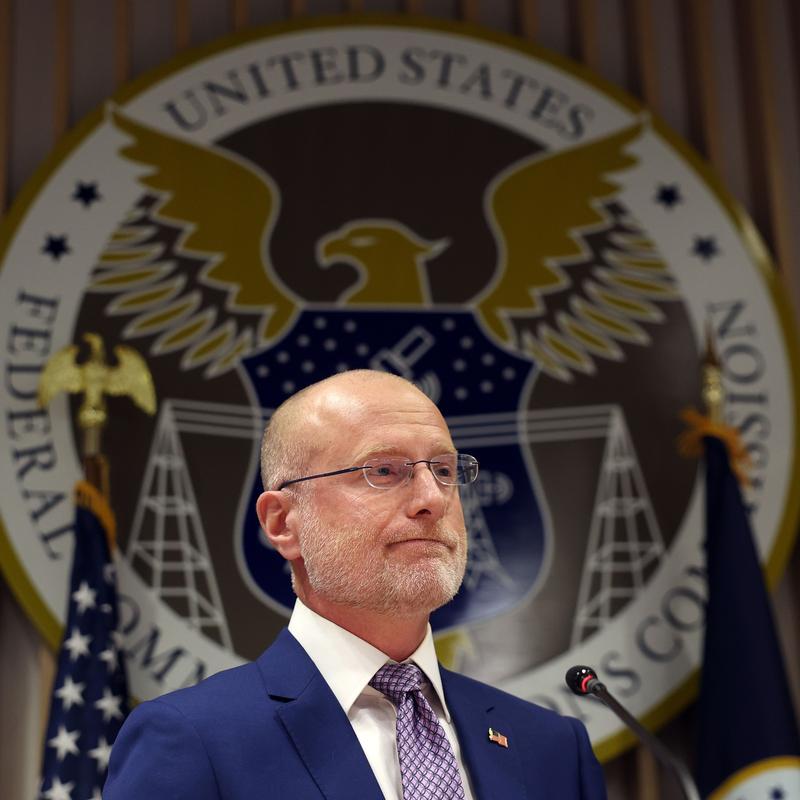
Title: The FCC's Pressure Campaign to Reshape Broadcast TV
[music]
Jim Rutenberg: Brendan Carr was using the old standards that his party has really not wanted anything to do with for our entire lives to now say we're going to punish these broadcasters who don't follow these old rules that everyone forgot about.
Brooke Gladstone: FCC chair Brendan Carr is changing the way business is done at his agency. From WNYC in New York, this is On the Media. I'm Brooke Gladstone. Earlier this year, CBS pulled an interview from The Late Show with Stephen Colbert for fear of triggering the FCC's rarely used equal-time rule.
[clip begins]
Stephen Colbert: We were told in no uncertain terms by our network's lawyers, who called us directly, that we could not have him on the broadcast.
[clip ends]
Brooke Gladstone: Driving this crusade to crush the liberal media is a lawyer on a letter-writing mission.
Daniel Suhr: One of the things that I find frustrating is that apparently we have people who think they are entitled to treat their shows like they're private property rather than being responsive to their corporate management.
Brooke Gladstone: It's all coming up after this.
[music]
Brooke Gladstone: From WNYC in New York, this is On the Media. Micah Loewinger is out this week. I'm Brooke Gladstone. In late June, ABC began running some unusual ads. They were a call to action, and they sounded like this.
[clip begins]
Announcer: The View has welcomed your favorite guests and covered the issues you care about for nearly 30 years. Now the FCC wants to control who is allowed to appear on the show. Viewers, use your voice, scan this QR code. You have until July 6th.
[clip ends]
Brooke Gladstone: And this.
[clip begins]
Announcer: Channel 7 has proudly served you for more than 75 years. Every day we commit to inform, entertain, and serve you. Now the FCC is questioning our commitment to the community. Show your support for WABC-TV--
[clip ends]
Brooke Gladstone: The FCC has reportedly been inundated with tens of thousands of comments as a result of these ads from audiences who don't want the government meddling in their favorite shows. Where Paramount capitulated when it felt the heat, ABC is doubling down against the multiple investigations launched at it by the FCC. One is the probe into Disney ABC's policies around diversity, equity, and inclusion.
Another is about which shows get exempt from an old FCC rule called the equal-time rule. That one was invoked when Stephen Colbert had Texas Democrat James Talarico on his show. At the time, Talarico was in a competitive primary race, and CBS pulled the episode off the air reportedly in fear of the equal-time rule being invoked. According to the traditional interpretation of the rule, candidates running for office would not have to appear in the same hour and they themselves would have to request it, but again, the rule hasn't been applied to late-night talk shows for decades. Anyway, this is all academic.
It's not about the law per se. It's about entertainment shows getting their politics wrong, fueled by the President's primal scream against the skeptics and the jokesters and the losers. It's a power play executed by the FCC and a few deeply motivated conservative lawyers. You'll hear a conversation with one later in the hour who claimed that late-night shows like Jimmy Kimmel Live! and daytime shows like The View are not serving the public interest, they are too one-sided, too liberal, and that's got to be fixed. Not through the courts, where they would confront the First Amendment, but by the FCC enforcing the equal-time rule and the public interest standard in ways not applied in decades.
It's kind of working because the FCC can threaten to yank the licenses of broadcast stations, and that's bad for business. These days, few have the stomach for a fight, even if they could win. You remember when Charlie Kirk was assassinated in September, late-night host Jimmy Kimmel said:
[clip begins]
Jimmy Kimmel: We hit some new lows over the weekend with the MAGA gang desperately trying to characterize this kid, who murdered Charlie Kirk, as anything other than one of them and doing everything they can to score political points from it. In between the finger-pointing--
[clip ends]
Brooke Gladstone: The comment was clipped and posted on X by a right-leaning media watchdog group, and online outrage ensued. Then FCC chairman Brendan Carr on a right-wing podcast aired his determination to crush Kimmel.
[clip begins]
Brendan Carr: Frankly, when you see stuff like this, I mean, look, we can do this the easy way or the hard way. These companies can find ways to change conduct, to take action, frankly, on Kimmel, or there's going to be additional work for the FCC ahead.
[clip ends]
Brooke Gladstone: The easy way or the hard way. ABC chose the first option, pulling Kimmel off the air indefinitely, but it wasn't so easy after all. After public outcry, even street protests, Kimmel's suspension ultimately only lasted about a week. In February, I spoke to New York Times writer-at-large Jim Rutenberg, who's working on a book about the ideological battle over our airwaves. I asked, "Is this a long game? Is it an all-out war? And if so, against TV or all media?"
Jim Rutenberg: Well, I would say yes, it's a long war. It happens to have been going on for decades now. It has a lot ahead of it still, so yes to all, but yes, TV. Why? Because TV and your medium, radio, unlike my medium, whatever we call the New York Times these days, is regulated by the federal government under the FCC. The FCC has some power to punish broadcasters, to hold them to certain old-fashioned standards known as the public interest standards, to be balanced and fair. Brendan Carr was using the old standards that his party has really not wanted anything to do with for our entire lives to now say we're going to punish these broadcasters who don't follow these old rules that everyone forgot about.
Brooke Gladstone: Right, they haven't been enforced. Exactly which rule is he trying to revive?
Jim Rutenberg: It's questionable whether he's properly reviving anything that exists quite the way he says it does, but the public interest standard dates back-- I'm sorry to do this to you and your listeners, but we got to go back to the 1920s.
Brooke Gladstone: Love that period.
Jim Rutenberg: I do too. Nerd alert. In that period, the country was grappling with this powerful new form of media, radio. It was like nothing that had come before because it could reach so many millions of people. It had this power to influence that the printed word really couldn't match. They decided, "We're going to give you licenses to use your frequencies, but in return, you have this incredible new power. It needs to be used responsibly."
The industry wanted that because it was chaos. Anyone with a setup from the hardware store could get onto radio, so it was a mess. Then over the decades, very, very specific stipulations rose up for what it meant to be serving the public interest, "Are you offering certain kinds of news program? Are all sides getting their point of view across on your airwaves? Are you offering children's program, et cetera, et cetera?" It moves on to TV.
It's in the Reagan era where the Republicans say, "We really don't like this stuff." They get rid of some of the more powerful parts of this. Then, after the Reagan era, no FCC commissioner made a habit, certainly not a habit, of enforcing these standards.
Brooke Gladstone: Now, it was FCC Commissioner Mark Fowler that got rid of the fairness doctrine, which is different from "equal time." We often get them confused. That opened up the way for Rush Limbaugh to breathe new life into moribund AM radio, start an enormous new industry, and led ultimately to Fox.
Jim Rutenberg: It really enabled the entire conservative infrastructure to blossom. Podcasts would have never fallen under those old standards, but a template was set. You mentioned the equal-time rule, which Brendan Carr brings up a lot. There, even to this day, is a rule that if you are a broadcaster, your local station in your town, radio or TV, and you have an entertainment program, not a news program, and you invite the local candidate on who's registered for office and you're not news, by the way, I'm going to stress entertainment, you have to give the opponent the same amount of time with similar prominence on your station. That's still around.
Brooke Gladstone: Even though that law is still around, it's only around election time that you can even invoke it.
Jim Rutenberg: There is indeed a window. There are broader versions of it that get a little bit outside of elections. He's trying to apply here, but they have different restrictions that make it hard. He's tried to conflate some of this with news distortion. Another public interest provision that you can't stage news. You can't fake news. A very hard case to make. You have to prove that a conspiracy goes all the way up to the top of the network and the station. He's tried to bring that in.
Some of these things, you're right, they're really circumscribed. The prescriptions are tighter than he lets on, but he's expanding them to the common sense, what you'd think if you heard it on the street. Well, they're supposed to be fair. That's not fair. It's that kind of way of addressing a much more complicated issue.
Brooke Gladstone: Let's get back to this war against the media or against television here. Trump watches a lot of TV. He's tried all sorts of ways to bring mainstream journalism in general to its knees, but the use of government power is a new twist. You've observed that Nixon tried it, but couldn't pull it off because too many people saw the danger there. Trump picked Brendan Carr to use the FCC to apply power where they can, right?
Jim Rutenberg: You would see Trump in his first term say, "Take their license away. Take their license away." Like Nixon before him, he had public servants who weren't willing to do it the way he wanted to because they didn't see a legal path to really do it legitimately, including Trump's own FCC chair, Ajit Pai. Now, Brendan Carr was at the FCC then, worked closely with Pai before he became a commissioner himself as a lawyer, but Brendan Carr is not going after the networks.
NBC doesn't have a license, but its stations do. If you start threatening to pull a license from NBC in a market that's important to it, in a market where it may own the station, that hurts the whole network's revenues. It's disastrous. Whether he can legally really do it, that's one thing, but the threat itself carried a lot of power.
Brooke Gladstone: You spoke with Daniel Suhr, the president of a small legal group called the Center for American Rights, or CAR like Brendan Carr, only he has an extra R. You laid out how the Center for American Rights has been creating the legal logic for Trump's ferocious new FCC since before the 2024 election. A core tenet is simply the media is biased, full stop.
Jim Rutenberg: Yes. Interestingly, Daniel Suhr says, "Hey, I'm a conservative. I've always thought the media is biased." Here comes Trump in the election, and the thing that really caught his ear was there was a debate on ABC News, the only presidential debate between Trump and Harris. The ABC fact-checkers interrupted Trump a few times. He made some pretty wild allegations and statements.
[clip begins]
Donald Trump: In Springfield, they're eating the dogs. The people that came in, they're eating the cats. They're eating the pets of the people that live there.
[clip ends]
Jim Rutenberg: Harris was not fact-checked the same way. Trump said afterward, "This is three against one, the two moderators and my opponent against me."
[clip begins]
Donald Trump: When you looked at the fact that they were correcting everything and not correcting with her. They're a news organization. They have to be licensed to do it. They ought to take away their license for the way they did that.
[clip ends]
Jim Rutenberg: "Someone take their license away." Daniel Suhr looks at these old cases, and he says, "Okay, I see how this could work. A lot of these rules are still on the books. The fairness doctrine may be gone, but there are all sorts of other provisions that we could try to apply here to bring a complaint." It was very eye-popping because-- I've been writing a book for years about this long fight. The minute I saw those complaints get filed, I said, "Wow, this is out of the blue. No one has done this in a really long time in this concerted of a way." What Daniel Suhr did was he filed a bunch of complaints right off the bat in the fall against every major network.
Brooke Gladstone: Like what?
Jim Rutenberg: When 60 Minutes interviewed Kamala Harris very close to the end of the campaign--
Brooke Gladstone: And Trump complained about the editing. There was an investigation. It turned out there was nothing wrong with the editing. Paramount, the owner of CBS, gave him $16 million anyway.
Jim Rutenberg: That's important. As this was all happening, Paramount was trying to sell itself to Skydance. While they're pursuing this deal, this complaint against 60 Minutes, that doesn't go away with Trump's settlement of that lawsuit, is dangling out there, and Brendan Carr says, "While that complaint has not been adjudicated, I can take it into account, because guess what? I, Brendan Carr, have a say about whether this deal can go through, because Paramount owns television stations. Paramount, I'm going to want some things."
Then Daniel Suhr gets involved in this process as an outside group, makes filings, declaring, "We want a news ombudsman who will judge the network for bias." You get a deal but with these provisions, the new Paramount, the new owners, the Ellisons, agree to all of them. That is basically unheard of.
Brooke Gladstone: Suhr filed this complaint on the basis that anyone with a broadcast license has to serve "the public interest in convenience and necessity," but as you've said, this prescription has never been applied to news or debates before.
Jim Rutenberg: The way that this provision works is, "Government, we don't want to be involved in news." We have a presumption of good faith. This has been kind of codified through legal decisions, but the upshot is we have faith that journalists, when they do the news, they do their jobs responsibly. It might not be perfect, but we as the government really can't get involved here. What Daniel Suhr says is they should not be exempt from these rules that apply to entertainment shows, they do not deserve that presumption of good faith.
Brooke Gladstone: Biden's FCC dismissed complaints against ABC, CBS, and NBC that were filed by Suhr?
Jim Rutenberg: Yes.
Brooke Gladstone: There was also a complaint against Fox. The FCC dismissed them as having no merit. Brendan Carr un-dismissed them, except, of course, the one against Fox. What have legal experts told you about the strength of Daniel Suhr's legal arguments?
Jim Rutenberg: Other than Daniel and Chairman Carr, I've yet to find a legal expert who said, "This is a really good case here." Mind you, because these things have not been litigated in this way in so long, you're talking to people who haven't even thought about this stuff in decades. Anyway, regardless, you don't find many people giving Daniel Suhr a ringing endorsement outside of the FCC chair and like-minded individuals
Brooke Gladstone: Coming up, the legal basis for all this may be weak, but for now, one determined lawyer glides from victory to victory on a magic carpet of complaints. This is On the Media.
[music]
Brooke Gladstone: This is On the Media. I'm Brooke Gladstone. We're listening to the interview I did with The New York Times' Jim Rutenberg earlier this year. In the course of his reporting, he spoke to Mark Fowler, Ronald Reagan's fairness doctrine destroying FCC chairman and a Trump supporter. His reaction to what's going on now was surprising.
Jim Rutenberg: Yes, Fowler was basically beside himself. Anyone who paid attention at the time or has gone back and studied that period would be shocked at this in general, because the Republican Party made such a point of abandoning the fairness doctrine. When it came to media, it was one of the most foundational things in Republican orthodoxy. Mark Fowler is the avatar of that.
Though the fairness doctrine is still gone, these public interest provisions are being used in the ways that he always opposed. I said to him, actually, "Well, what about these public interest provisions? Why didn't you get rid of them?" His point was twofold. He said, "For one thing, the public interest provisions are in the actual law." The fairness doctrine was an FCC policy. He had power there, but he also said he didn't think that someone would try to use the surviving provisions quite in this way.
Brooke Gladstone: Fowler told you that in Carr's hands, the public interest rules had been transformed into a "made-to-order jawboning instrument." That's a term of art that implies government pressure on media?
Jim Rutenberg: Yes, it came up a lot in the Biden years when conservatives complained that the Biden administration was pressuring the social media platforms, which can do whatever they want with content, but was pressuring them to censor conservative speech, especially when it came to COVID or election denialism. The government cannot force the platforms to censor speech, it's not allowed because of the First Amendment, but jawboning coerces the platforms into censoring so that the government gets what it wants regardless, where it couldn't legally really ask for it.
When Ted Cruz, who's been talking about jawboning and working up legislation dealing with social media, sees the Jimmy Kimmel imbroglio unfold, he's really bothered by it. He likened Chairman Carr, the "easy way or hard way" line, Cruz likened it to a mobster in the movie Goodfellas.
[clip begins]
Ted Cruz: A mafioso coming into a bar, going, "Nice bar you have here. It'd be a shame if something happened to it." It's fine to say what Jimmy Kimmel said was deplorable, it was disgraceful, and he should be off air, but we shouldn't be threatening government power to force him off air. That's a real mistake.
[clip ends]
Jim Rutenberg: What he was doing there is really defining this, too, as jawboning. This legislation he had been working up against the platforms, which was very much in keeping with a unified MAGA theory of the case on speech. Now, it was applying as well to the Trump administration.
Brooke Gladstone: Other people within the GOP stand with him?
Jim Rutenberg: Rand Paul, maybe. That should be no surprise. Very libertarian-leaning Republican senator. John Thune, the leader of the Senate Republicans, was there with him, not nearly as outspoken. Then you even had some podcasters, Ben Shapiro, Joe Rogan, he's kind of his own thing.
Brooke Gladstone: Yes.
Jim Rutenberg: He didn't like it. Part of the argument went, "You do this now to a Kimmel, and when a Democratic administration's in, they're going to do it to us."
Brooke Gladstone: But it hasn't dissuaded Carr or Trump or Suhr?
Jim Rutenberg: Not in the slightest. As we speak, the FCC has told the show The View that runs on ABC, "We're watching you for violations of the equal-time rules you have candidates on." They are full steam ahead on this.
Brooke Gladstone: Brendan Carr explained to you that part of this is a broader symptom of a realignment. Republicans, who are close to being what he called fundamentalist libertarian, were in the past, and the future was about government power in the public interest. That's how he put it. Suhr said something very similar, right?
Jim Rutenberg: Daniel Suhr put it this way, which was, "Hey, as conservatives, we love the free market, but when it comes to television, the free market is not helping us. It's all become liberally biased, which is not fair."
Brooke Gladstone: The free market was supposed to give the people what they want.
Jim Rutenberg: Now the argument is, "The free market is not, so we are going to use the power of the administrative state." They don't say that, but that's what this is, to correct this imbalance that the market has allowed.
Brooke Gladstone: We did a whole series about Leonard Leo, a leader of the Federalist Society. He was deeply involved in Trump's picks for judges and especially high court justices. Now Leo is deep into a campaign to take back what he considers the liberal capture of American culture. Does he figure into this?
Jim Rutenberg: Daniel Suhr had worked at the Federalist Society. When I asked Daniel about these adjacencies with Leo and Leo's new work on culture, what he said was, "Yes, absolutely. I am fully supportive, and I'd like to think that my effort helps his." Because what Leonard Leo wants to do ultimately is bring more family-friendly, patriotic, and faith-based programming to television. In this definition of the public interest, that kind of programming would fit it where Jimmy Kimmel wouldn't. What Daniel's very open about is I hope that this clears the path for more of that kind of content on TV.
Brooke Gladstone: You wrote that Trump, since his earliest days running for president, has demanded that the FCC punish the networks for his perceived mistreatment by stripping them of their licenses. Is this a realistic threat?
Jim Rutenberg: So much has to happen to take away a license. Even if you look back in history, look at the times when licenses were taken away, and politics had anything to do with it. Whatever the political charge was of bias or what have you, it was mixed in with serious charges of corruption, lying to the FCC about things, part of a whole kit and caboodle.
Brooke Gladstone: What serves endgame?
Jim Rutenberg: He's very open about his endgame. It has to do with media consolidation. We have to go back to the Kimmel situation. If you'll recall, Jimmy Kimmel says his thing. Brendan Carr says his thing, "Easy way or the hard way." The first suspensions of Kimmel come from two major television station groups. One is called Nexstar. They own a lot of stations.
Brooke Gladstone: Let me guess, the other is Sinclair.
Jim Rutenberg: The other is Sinclair. Now, not only are both led by conservatives who are perceived as Trump-friendly, but both are also in the market to buy many, many more television stations. Brendan Carr will be in charge of that, so they want to keep him happy. Their purchase of those television stations, new twist, would require a change in regulation. Because of those old rules about what television could do, both of those companies have caps on how many Americans they're allowed to reach of 39%. The idea is you don't want them owning too many stations. They'll have too much power.
Now, it's very old-fashioned now in the internet era, but it exists still. They want that cap lifted. Brendan Carr wants to do it. Daniel Suhr wants it to happen. Why is that? Because if those stations that have shown that they will play along with Brendan Carr and the Trump administration on things like Kimmel, if they're bigger, they can bring more pressure to bear on the big networks to not show Jimmy Kimmel, or to let them suspend more programming that gets them in trouble with the FCC. Maybe it's David Muir's 6:30 newscast. By the way, a very highly watched program in this country.
Brooke Gladstone: It wouldn't be a big stretch for them because they're conservative to begin with. They'd be doing precisely what they want to do. Moreover, we've seen lots of waivers given. There was one given to Rupert Murdoch. A lot of times they can just skirt these laws.
Jim Rutenberg: That's absolutely, objectively true, but it gets more complicated than that with the way that their relationships work with ABC. They like their ABC affiliation. They like their network affiliations in general. Why, most of all? Believe it or not, football. Football is the driver of all things - television. Every station that has football makes a lot of money. Sinclair can't afford right now football on its own. It needs the network for it.
Brooke Gladstone: Nexstar can't either?
Jim Rutenberg: Nobody can, except for the networks and the streamers. What the networks can say to a Nexstar or a Sinclair is, "Hey, you want football? Well, then you can't preempt these shows, because if you preempt too many of these shows, we're losing money on those shows in your market. Now, we can't afford football. You don't get football. We all go down the tubes." That's the argument.
While all of this can happen without the FCC, the FCC is inserting itself now in these negotiations. They give Sinclair and Nexstar a little more heft, "Hey, the FCC is going to make us do this now. We got to do what the FCC wants." Again, Brendan Carr, he'll say, "We think there's an imbalance in these negotiations between the networks and their station groups. We want the station groups. Our people," doesn't quite say that, but sometimes he does in different ways.
"We want our people to have more heft in these negotiations, do what we want them to do." As you can see, so much rides on this. Daniel Suhr said to me about this, "I'd love a day when maybe Sinclair and Nexstar, they're their own mini-networks." They show the Leonard Leo family-friendly, patriotic programming that I think red state America is deprived of by these networks.
Brooke Gladstone: What's at stake here?
Jim Rutenberg: I think a lot's at stake, because if you think that broadcast television still has some sway in this country, and I think it does, then you have a government effort to change that for ideological reasons, and that could change the business. I don't know if Brendan Carr gets what he wants at the end of the day. I don't know that Daniel Suhr gets his Leonard Leo-looking television at the end of the day. What the networks say is that all of this could break their business models. It's just a very precarious time for still one of the most important forms of media in this country.
Brooke Gladstone: What does it mean for the viewers and listeners?
Jim Rutenberg: It might mean that their favorite hosts or their most-hated hosts could end up not being on the air, but for reasons that have to do with what the government wants.
Brooke Gladstone: Thanks very much, Jim.
Jim Rutenberg: Thank you so much for having me.
Brooke Gladstone: Jim Rutenberg is writer-at-large for The New York Times. Coming up, Daniel Suhr in his own words. This is On the Media.
[music]
Brooke Gladstone: This is On the Media. I'm Brooke Gladstone. As we heard, Daniel Suhr, the president of the Center for American Rights, has been a driving force behind bringing to account broadcasters who failed to serve what he sees as the public interest. When I spoke to him in February, it was around the time that CBS had undergone major changes on air and in its leadership.
Daniel Suhr: Thrilled about that fact over here, by the way. [chuckles]
Brooke Gladstone: In fact, it's largely because of you. You helped craft the decisions that have changed CBS, so congratulations to you. You've been extremely influential.
Daniel Suhr: [laughs] Thanks. You're welcome to say that on air. Don't edit that part out.
Brooke Gladstone: If, as you say, half the country feels insulted by late-night TV, in fact, you say it's why their ratings are in the tank. Anyone insulted by late-night TV can find a vast number of alternatives. Even those watching the Super Bowl could find an alternative halftime show. There's no discussion currently of extending regulation to cable or digital. I know that. Those are media dominated by the far right. If this is really about fairness, maybe you should be lobbying to have the government imposing rules there too. That is how you would best achieve your aim of fairness and balance. Go in and meddle in all the platforms.
Daniel Suhr: I do think that broadcast news and broadcast entertainment continue to play incredibly important roles in our culture. In fact, that, I think, reflects two things. One is the decline of newspapers that has created a vacuum that has made broadcast and visual media more important. Then, secondly, I think as our culture has evolved over time more and more into a visually driven and video-driven culture, that has increased the importance of video-based news, which is what we see on broadcast TV.
Brooke Gladstone: Network news is not dominating the national discussion these days. That is happening far more on cable and even more in the digital realm. Podcasts, which have audiences frequently far greater than network news, the top people there too tend to be far right. You've mentioned what a great audience Greg Gutfeld has over at Fox.
You say, Why is it that this guy has such a big audience? It's because people are turned off by the network news. Well, in that case, the network news will die of its own stodgy set of standards that it's lived by all this time. Late-night TV, as you've said yourself, don't have great ratings either, so why can't you let the market work as was the Republican ideal in the past?
Daniel Suhr: The importance of the newsroom is, I think, essential to answering that question. If you look at cable and podcasts and streaming, it's all commentary on the news. Frankly, even the AM radio band is largely commentary on the news. The hard reporting, journalists on the beat in Capitol Hill, in local communities, in state capitals, it is broadcast television that has the newsroom resources to have full-time, professional-trained journalists out on the ground reporting the news.
Then the rest of our media ecosystem, whether that's social media or podcasts and streaming and even, to some extent, cable, is really commenting on the hard news. The hard news is mostly starting with what we see on broadcast. I think that's why it's so important.
Brooke Gladstone: Back in 2019, Brendan Carr posted on X, "Should the government censor speech it doesn't like? Of course not. The FCC does not have a roving mandate to police speech in the name of the 'public interest.'" Then by November 2024, he's posting, "Broadcast licenses are not sacred cows. These media companies are required by law to operate in the public interest. If they don't, they're going to be held accountable as the Communications Act requires." Then there was his statement about Jimmy Kimmel, "We can do this the easy way or the hard way." Would you call this jawboning?
Daniel Suhr: No, I would not call it jawboning. I think what Chairman Carr has said is very similar to what many previous FCC chairs have said from both parties. FCC chairs have always felt a responsibility to talk to the regulated community, here, broadcasters, about what their responsibilities are under the law and the policy goals and views that the administration has. The best example of that is Newton Minow, who was JFK's chair, gave a famous address where he said, "TV is a vast wasteland, and you guys have to do better. You can't treat your broadcast licenses like sacred cows." Almost word-for-word what Chairman Carr has said.
Brooke Gladstone: You sort of have to go back to the '60s to hear the last time that that was said. He said back in 2019, "The FCC does not have a roving mandate to police speech in the name of public interest." Policing speech seems to be what is going on right now.
Daniel Suhr: Respectfully disagree. Obviously, I've been one who's filed some of the complaints that Chairman Carr has acted on in this regard. What he's done on "equal time," I see as enforcing the law. You could look to the '90s and many of the things that FCC chairs said at the time about indecency on TV, right? There was a real concern at the time about violence and sex on television. Frankly, that was bipartisan. Tipper Gore, right, out there?
Brooke Gladstone: Right. We're talking about politics now, though. I feel like you are changing the subject.
Daniel Suhr: [laughs]
Brooke Gladstone: Let's stick with politics because that's why people fear the government messing with the media.
Daniel Suhr: Yes. Don't get me wrong. I'm a conservative. I fear the government too.
Brooke Gladstone: Not in this case, though.
Daniel Suhr: [laughs] Well, what I have seen is Democrats, when they have been at the FCC, using the powers of the agency to achieve their goals. Now we have a Republican chair.
Brooke Gladstone: Give me an example of that.
Daniel Suhr: Sure. Under the Biden FCC, under Chairwoman Rosenworcel, there was a complaint filed against a Fox affiliate in Philadelphia based on Fox News's coverage of the 2020 post-election integrity stuff. The chair kept that complaint open for well over a year and had public comment on it, which is the exact same thing that Chairman Carr has done with my complaint on CBS in 60 Minutes, to the extent that one says my complaint and his response to it is jawboning, the former chair did the exact same thing to Fox, even though it dealt with material that was broadcast on cable, and then they were trying to back-end through Fox's common ownership of a TV station.
Brooke Gladstone: That was about promoting lies about the 2020 election, and it was ultimately dismissed. I'm just wondering about what seems to be a real changing stance in the philosophy of your group. Just a couple of years ago, Republicans claimed the mantle of being the party of free speech. This just feels like a total divergence from the long-term Republican opposition to the administrative state. Are you going to go toe-to-toe with the more libertarian Republicans who disagree with you?
Daniel Suhr: Yes, I do so in my Twitter comments every day. [laughs] I don't agree with many of my libertarian friends on this. I agree with them on lots of other issues. I think it's important to remember that there are lots of components to the public interest. One of them is localism. What some might characterize as speech police, I would say is reinvigorating the viewpoint diversity component of the public interest, which has always been there. It's not that we're censoring any individual speech. It's that we're saying, across the board, we need to ensure that companies and networks and programs are giving lots of views a fair airing. That's not been happening of late.
Brooke Gladstone: Not on AM radio. [chuckles]
Daniel Suhr: [laughs]Yes, and we'll have to respectfully disagree on how we think of AM radio.
Brooke Gladstone: The free market is great, except when it isn't, right?
Daniel Suhr: Well, the free market is great, except when there's a breakdown in the market. That's what we have in broadcasting.
Brooke Gladstone: The free market is great in virtually every area, but the one in which it seems conservative interests are not being well-served.
Daniel Suhr: Yes, in the case of broadcast, the market is limited by the amount of spectrum that's available.
Brooke Gladstone: That used to be the only way people communicated. Now it's just one in enormous kaleidoscope of ways people talk to each other one-on-one, one-to-many, many-to-one.
Daniel Suhr: Great use of the word "kaleidoscope."
Brooke Gladstone: Yes, the FCC was created to deal with the responsible use of a limited resource. Our airwaves are still a limited resource, but they are far from being the sole resource that Americans have access to.
Daniel Suhr: Yes, don't disagree. In fact, in many ways, that's why I think we need to address the national TV ownership cap, is because broadcasters are competing with streaming and digital for advertising dollars. Though streaming and digital platforms don't have artificial limits that restrict how many households they can reach when they sell their advertising, broadcasters do.
Brooke Gladstone: You're supportive of lifting national television ownership caps and allowing local broadcast ownership to grow?
Daniel Suhr: I am.
Brooke Gladstone: Why?
Daniel Suhr: I look at the media landscape right now, and I see NBC, ABC, CBS, and I would include PBS as really dominating over their affiliates.
Especially with the big three corporate national networks, the affiliates are not given a lot of discretion about the program they can carry. They are contractually bound and punished when they preempt programming that they feel like is not in the interests of their community. Really, all the power to determine what goes on the airwaves is at the national network level. The locals are really limited to a couple of high school sports games and the local news.
Brooke Gladstone: Local news is much more influential than national news-
Daniel Suhr: 100% agree.
Brooke Gladstone: -and more highly viewed.
Daniel Suhr: Absolutely.
Brooke Gladstone: If you're talking about Sinclair and Nexstar, the biggest owners of broadcast stations, they're both conservative. What you're really proposing is the creation of networks that are closer to your own political perspective.
Daniel Suhr: Yes, I'd be thrilled with that outcome.
Brooke Gladstone: That seems to be counter to what you've been saying, though, about fairness and balance in a non-ideological way.
Daniel Suhr: It's exactly what you said, Brooke. Network news has relatively low trust ratings. Local news has very high trust ratings among the American people.
Brooke Gladstone: The networks, they don't mess with those, so what's the problem?
Daniel Suhr: I don't think it is a problem. That's why I want more local news stations that are being run effectively by these companies. I think these companies are doing it right.
Brooke Gladstone: These national affiliates ultimately will own more stations than the networks have affiliates.
Daniel Suhr: Yes, I think they're doing a great job. Companies that do a great job should grow.
Brooke Gladstone: They would be going into neighborhoods that don't necessarily reflect the political or cultural predilections of the owners, and then you're back where you started. Only this time, the leaning would be conservative as opposed to liberal.
Daniel Suhr: Yes. In that world, I think it would look a lot more like the AM radio band.
Brooke Gladstone: God forbid.
[laughter]
Brooke Gladstone: The AM radio band is not diverse.
Daniel Suhr: I think it's a lot more diverse than network news.
Brooke Gladstone: You say that Sinclair would produce programming that is more reflective of many Americans' values than the networks currently provide. Sinclair has certainly been called out for imposing on their own affiliates changes in their news broadcasts. That's happened again and again.
Daniel Suhr: Yes, I think that's a legitimate point. One of the things that I find frustrating about Colbert is that apparently we have people who think they are entitled to treat their shows like they're private property rather than being responsive to their corporate management. I would say, in general, we see these companies producing content that people want and that they have solid trust of the American people. Companies that achieve that, I think we should reward and allow to grow.
Brooke Gladstone: Sinclair and Nexstar are always changing places over which is the nation's top broadcaster. Back in 2018, it was Sinclair who was number one. It was forcing its anchors to read a promotional script that warned viewers about "fake news" on other stations and media.
[clip begins]
Jessica Headley (News Anchor): I am Fox San Antonio's Jessica Headley.
Ryan Wolf (News Anchor): And I'm Ryan Wolf.
News Anchor: Our greatest responsibility is to serve our-
News Anchor: -Treasure Valley communities.
News Anchor: The El Paso, Las Cruces communities.
News Anchor: Eastern Iowa communities.
News Anchor: Mid-Michigan communities.
News Anchor: We are extremely proud of the quality, balanced journalism that CBS4 News produces.
News Anchor: But-
News Anchors: -we are concerned about the troubling trend of irresponsible, one-sided news stories plaguing our country.
News Anchor: Plaguing our country.
News Anchor: The sharing of biased and false news has become all too common on social media.
News Anchor: The sharing of biased and false news-
News Anchors: -has become all too common on social media.
News Anchor: This is extremely dangerous to our democracy.
News Anchor: This is extremely dangerous to our democracy.
News Anchor: This is extremely--
[clip ends]
Brooke Gladstone: Sinclair has often meddled in the news of its own affiliates, trying to serve their own local communities, and that's okay with you?
Daniel Suhr: I don't see that as being particularly different from the way a lot of networks run right now. I would point out that when that last happened in a way that drew national attention, it was Senate Democrats attacking Sinclair for news distortion, which is the same doctrine that I used with CBS, and everybody said was antiquated and outdated and unconstitutional when I did it, but everybody seemed okay when Senate Democrats did it to Sinclair.
Brooke Gladstone: You think it's okay when Sinclair does it, but not when NBC does it?
Daniel Suhr: I think you have to take each case on its facts.
Brooke Gladstone: [laughs] What is your endgame, Daniel? Is it to entirely remake television according to a particular definition of fairness?
Daniel Suhr: Yes. My hope is to get back to an actual fair and unbiased presentation of information. I think our democracy gets distorted when news is consistently slanted in one direction, when one party's candidates enjoy overwhelmingly, lopsidedly an advantage on entertainment programming. I think our democracy is in danger when most Americans don't trust the national news.
The question is, how do we move back to a society where we see that kind of trust restored? One option I think that you laid out is we don't. We just see the networks go the way of the dodo. I don't think that's the way it's going to have to be. With different management, different leadership, the networks could move back to fact-based, unbiased news and a diversity of entertainment programming that appeals to all Americans. If they did that, we would actually restore the American people's trust in the news and the networks. It's just a choice the networks have to make. There are certain tools that we have as advocates to push them in the right direction to make that choice.
Brooke Gladstone: I think we just have a fundamental disagreement on what fact-based means,-
Daniel Suhr: Yes.
Brooke Gladstone: -and what is the responsibility of journalists to ensure that they aren't engaged in allowing the public to be lied to?
Daniel Suhr: I think the reason, though, that we have so little trust in media is because many of what I will call my people, many conservative or Republican or red state people, for millions of Americans, they look at the national news media's failure to cover President Biden's cognitive decline. They look at the Hunter Biden laptop. They look at COVID-19, and they feel lied to.
Brooke Gladstone: COVID-19?
Daniel Suhr: Yes, I know, yes, I know it's going to sound crazy to you, but they look at how the social media companies and the White House were suppressing their views about the efficacy of masks or about returning children to school at a particular time. They look at that experience, and they feel lied to. Maybe they're wrong, but they do. They see a pattern where each of what they perceive to be a time that the media lied to them, they always help one political party. That's why the trust is gone.
Brooke Gladstone: What's next on your list? The View, Seth Meyers. The attack on Jimmy Kimmel kind of fizzled.
Daniel Suhr: In credit to Seth Meyers, he made an intentional choice not to feature politicians as guests. I will credit him with that. In terms of what's next, one, I think our country needs to figure out what the future of NPR and PBS look like after congressional defunding. I think congressional defunding was a statement on the part of the American people's elected representatives that they feel like things are broken at NPR and PBS. I don't get the sense that the leadership at NPR and PBS have received that message and are taking it seriously.
Brooke Gladstone: Will you be bringing complaints against them?
Daniel Suhr: Potentially, yes. I think one thing that's very true of public broadcasting is that it is often awash in DEI.
Brooke Gladstone: What does DEI mean in this context?
Daniel Suhr: Hiring practices.
Brooke Gladstone: Oh, hiring people to reflect the community.
Daniel Suhr: If you're using a quota, yes.
Brooke Gladstone: If there's no quota, if you want to have programs on that reflect what you think people want more of, maybe more religious programming, more patriotic programming, then why wouldn't a minority community have a right to have more correspondence reflect their views?
Daniel Suhr: Yes, no, I'm totally okay with that.
Brooke Gladstone: That's DEI in a nutshell.
Daniel Suhr: The kind of DEI that I'm concerned about is illegal DEI, which includes having either quotas in hiring, having race-based internships or fellowships or management track programs, mentoring programs, things like that.
Brooke Gladstone: What is wrong with giving people who have been kept out of a system an opportunity to enter it?
Daniel Suhr: I don't think anything's wrong with that. I think it's whether or not you do so based on membership in a class, race, or whether you do so by looking at people's individuals.
Brooke Gladstone: You're talking about classes of programming that reflect the interests of individuals. Who makes those programs? Who makes the evangelical programs, but evangelicals? Who makes the programs that you feel are not being produced now, but people who reflect or embrace those identities?
Daniel Suhr: Yes, fair point. I think if we lived in a world in which all of that happened, I'd feel much more comfortable.
Brooke Gladstone: That's what DEI is for.
Daniel Suhr: If DEI meant that evangelical people of faith or people from rural communities were getting special treatment for broadcasting on public radio, maybe we'd all feel differently about it.
Brooke Gladstone: You would feel differently about it, leaving quotas aside, if it were people other than the ones that have, in the past, been encouraged to enter a system from which they were excluded, that weren't evangelical or rural?
Daniel Suhr: I'm against treating people differently based on race. If, over the course of an interview with an individual, you find that they bring unique experiences, then go ahead and hire them, but don't hire them based on a box they check on a form.
Brooke Gladstone: When the government goes after DEI hires, they're not interested in the individual. They're just interested in their race. We've seen highly qualified Black and female people in the military just get summarily fired for no reason whatsoever, just because the assumption was they were hired because of DEI.
Daniel Suhr: I'm not a national security guy, so I don't feel qualified to comment on that. I would say, though, the US Supreme Court spoke pretty clearly in the Students for Fair Admissions case versus Harvard. You can agree or disagree with the decision, but it's the law now. That's really what the administration has been trying to apply.
Brooke Gladstone: We went off on a little bit of a detour, but--
Daniel Suhr: It's okay. It was a good detour.
Brooke Gladstone: Just getting back to the question of who's next on the list.
Daniel Suhr: We're going to be in an election year, right? Questions around "equal time" and around disclosure of conflicts of interest regarding candidates, those are all going to be coming to the fore. They already have, obviously, with both Colbert and The View. The other thing that we'll be really active on is monitoring stations' compliance with their legal obligations in an election year.
Brooke Gladstone: Well, we'll see.
Daniel Suhr: We will. It's going to be interesting.
Brooke Gladstone: Thanks for the conversation.
Daniel Suhr: Thanks so much.
Brooke Gladstone: Daniel Suhr is president of the Center for American Rights. That's the show. On the Media is produced by Molly Rosen, Rebecca Clark-Callender, and Candice Wang. Travis Mannon is our video producer. Our technical director is Jennifer Munson with engineering from Jared Paul. Eloise Blondiau is our senior producer. Our executive producer is Katya Rogers. On the Media is produced by WNYC. Micah Loewinger will be back next week. I'm Brooke Gladstone.
[music]
Copyright © 2026 New York Public Radio. All rights reserved. Visit our website terms of use at www.wnyc.org for further information.
New York Public Radio transcripts are created on a rush deadline, often by contractors. This text may not be in its final form and may be updated or revised in the future. Accuracy and availability may vary. The authoritative record of New York Public Radio’s programming is the audio record.