
The Battle for the Future of the Democratic Party
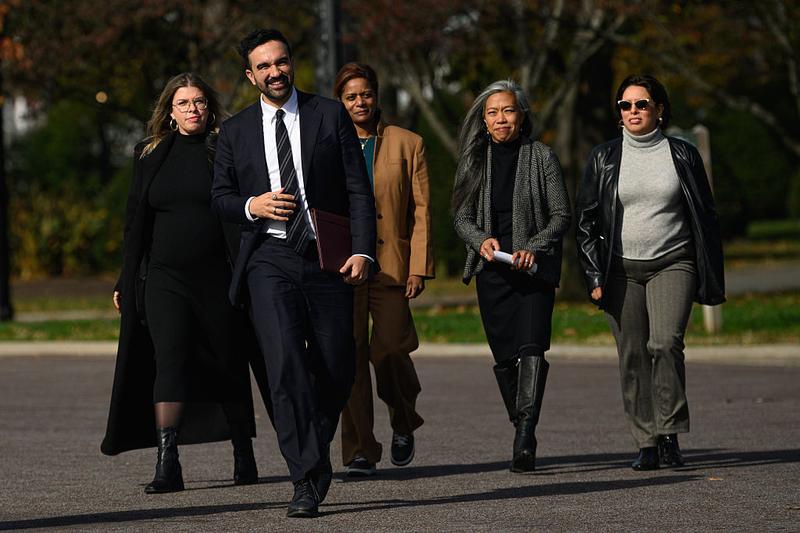
( Adam Gray/Bloomberg / Getty Images )
Title: The Battle for the Future of the Democratic Party
Brooke Gladstone: The Democrats are divided. Should the progressives or the moderates define what it means to be the party of the left-ish?
Matt Bennett: To be clear, we do not believe that language is the thing that has driven Democrats into the hole that we were in, but a lot of Democrats talk in ways that are deeply alienating to regular voters.
Analise Ortiz: This is why the Democratic Party loses, because they're stuck in a boardroom somewhere yelling at each other over this.
- Elliott Morris: There's a campaign being waged by elite strategists in the Democratic Party to move the party to the right based off of their belief that issue positions can save the Democratic Party.
Analise Ortiz: Too often, the moderate stance is the status quo, and people are so angry with the status quo. They are tired of feeling like politicians are doing nothing.
Brooke Gladstone: Wither. The big D Democrats. It's all coming up after this. From WNYC in New York. This is On The Media. Micah's out this week. I'm Brooke Gladstone. What a fall. By which I mean autumn, but in fact, there was a fall after a rise for the Democratic Party. On October 1st, the Dems shut the government down.
Chuck Schumer: Democrats have three words for this. No fucking way. We will not let Republicans blow up our health care system.
Brooke Gladstone: Oh, Chuck Schumer, so saucy, but polls showed that we the people held the GOP responsible for the shutdown and rising prices. For a bright and shining moment, Democrats had a narrative edge and a compelling rallying cry, affordability, and it seemed to pay off on November 4th.
News clip: Good morning. It was a big night for Democrats as the party swept key races across the country. In the race for governor of Virginia, Democrat Abigail Spanberger defeated Republican Winsome Earle-Sears.
News clip: In New Jersey, Democratic Congressman Mikie Sherrill has won the governor's race, and in New York City, Zohran Mamdani has won the closely watched mayoral race, defeating Independent--
News clip: Mississippi Senate Democrats celebrated their efforts to gain two more seats.
News clip: Georgia Democrats, they are celebrating their first statewide election win in nearly five years, hoping it's a sign of--
Jon Stewart: Yes, it was amazing.
Brooke Gladstone: On his podcast, Jon Stewart was looking ahead.
Jon Stewart: I guess the question next was, how will they squander it? How?
Brooke Gladstone: A week later, he got his answer.
Jon Stewart: Tonight's show will be brought to you by I can't believe fucking it.
[laughter]
News clip: Overnight, five new Senate Democrats joined three others voting to no longer block the reopening of the government in exchange for a concession that Senate Republicans had been offering for weeks, to hold a vote on extending Obamacare subsidies. Now, many progressive Democrats are accusing their Democratic colleagues of caving by not getting Republicans to agree to more.
Brooke Gladstone: The already long-brewing battle between the Democratic Party's moderate and progressive wings boiled over. Bernie Sanders called it a disaster, and AOC called it cowardice. We won't know for a couple of months which political calculation was right, but we do know that the defectors who reopened the government had nothing much to lose. A few had voted against the shutdown pretty much from the start. Two are retiring, and the rest aren't up for reelection until either 2028 or 2030.
They all said, more or less, that their constituents were being made to needlessly suffer, and polls were starting to show Democrats getting more of the blame. Besides, they'll have another chance to shut down the government in January. Then, if they still can't budge the Republicans, millions will lose their health care, and they'll all know exactly who to blame.
Meanwhile, the party had an urgent navigational question, which way to tack, left or center? It's an old debate, but the current iteration in the shadow of Trump 2.0 has come to seem increasingly existential. Late last month, the New York Times weighed in with an editorial that looked at the Democratic House candidates who won in districts that also went for Donald Trump, and it concluded, "Democrats closer to the political center from both parties continue to fare better in most elections than those further to the right or to the left." The Democrats who win tough races work hard to signal to voters that they're less progressive than their party.
Statistician, G. Elliott Morris, along with data scientist Mark Reich, came out with a model that analyzed the same data cited by the New York Times editorial board, comparing how Democratic congressional candidates fared in their districts to how their party's average member did in 2024. They found that moderation wasn't the silver bullet Democratic strategists seem to be looking for. We asked Elliot to lay it out.
- Elliott Morris: We say that the moderation bonus is about a point, maybe a point and a half if you really stretch it. This 1 percentage point advantage is smaller than a lot of the other factors that predict elections; incumbency, fundraising experience, general vibe of district fit. Therefore, pushing the Democratic Party to adopt the policy that should only nominate moderates is picking out one thing that you can explain the election with and say, "This explains all of elections."
Brooke Gladstone: This idea that capturing a moderate majority of Americans will win elections goes back to Richard Nixon's so-called silent majority, a term that he used in a speech back in 1969. It once was conventional wisdom that a decisive slice of the electorate is moderate, and if you could just pull them in, you can win. That's not true anymore. You found that, "The premium that voters place on ideological moderation has declined by 80% since the 2000 election."
- Elliott Morris: Yes. The thing that has really changed about politics since 1969 is the rise of partisan sorting and a polarized public. There are a lot of moderates out there, but they are not as willing to be swing voters to change the side of the aisle that they typically vote on because of the identity that they have with a political party. You are a Republican or a Democrat first before you are a moderate.
Brooke Gladstone: I've read that in some polls, you are a Republican or a Democrat before you're a man, a woman, a Christian, that this is a much more potent personal identifier than you would imagine.
- Elliott Morris: In every case where political scientists empirically have looked at the value of issue positions versus your group attachment or your identity at predicting how people would vote, they have come to the conclusion that group attachments and your identity matter orders of magnitude more now. A good 2018 paper by Michael Barber and Jeremy Pope found that you could take conservative Trump voters, tell them that Trump supported a liberal policy, and they would become 20 points likelier to support that liberal policy. What matters here is not issue positions and what people want their government to do. It's essentially who they want to control their government.
Brooke Gladstone: There was a paper by Andy Hall at Stanford that had previously come to the conclusion that moderates do do better. Then that changed?
- Elliott Morris: Andrew Hall and Daniel Thompson, two political scientists in California, had previously analyzed whether or not more ideologically extreme House primary candidates performed better than ideologically moderate candidates for the House. They looked at this on the Democratic and Republican side, and their analysis previously had found a large advantage, about 6 to 12 percentage points for the moderates. In March this year, they published a retraction in which they say that their original case is "far weaker" than they previously thought, and that the earlier analysis "should not be relied on."
Brooke Gladstone: Okay. About a week after that New York Times editorial, there was a center-left group, the WelcomePAC, which published a big report called Deciding to Win. It looked at a lot of polling data. Then, like the times, concluded that the Democrats can win by going more moderate, noting that 70% of voters think that the Democratic Party is out of touch. Thoughts?
- Elliott Morris: Well, first off, many voters also think the Republican Party is out of touch.
Brooke Gladstone: How many Republicans think that the Republican Party is out of touch?
- Elliott Morris: A comparative number from The Associated Press NORC, found, in their polling, 58% of the public says they view the Democratic Party unfavorably, and 51% of the public says they view the Republican Party unfavorably. We're talking about two parties that people are deeply unhappy with.
Brooke Gladstone: With regard to the deciding-to-win conclusions, you had two critiques.
- Elliott Morris: Yes. First, I think they present a pretty biased list of policies. Just for an example, expanding drug price negotiation. That is a Democratic policy, and it's very popular, according to the WelcomePAC deciding to win research effort, something Joe Biden pushed in Congress. We can say that's a Democratic policy, but the unpopular policies that they ascribe to Democrats are things like abolishing the police, abolishing prisons, lowering the voting age to 16, or getting rid of AP courses in public schools, what's called tracking. These are actually not Democratic policies. They appear nowhere in the Democratic Party's manifesto in 2024, and these were not things that Kamala Harris was running on.
Again, the data that these people are presenting does not actually speak to reality and yields itself to conclusions that are nonsensical, because the advice would be, Kamala Harris shouldn't have said abolish the police. Well, she didn't say that on the 2024 campaign, so what are we actually talking about here when we're talking about moderating our issue positions? When you start really digging into it, the advice isn't very actionable.
Brooke Gladstone: They say, though, that voters perceive the Democrats to be further on the left perhaps than they are. You coined a term called the strategist's fallacy to illustrate what's really going on here.
- Elliott Morris: This fallacy refers to the thinking among elites or strategists in the Democratic Party that voters make decisions about voting the same way they do to sort of match up the ideological issue preferences of themselves and the candidates and pick a candidate that is closest to them on all of their issues. If you just take all of the positions that the average person has, then they'll vote for you. I think this is a fallacy, as issue positions are not the only thing that contribute to voting behavior.
In fact, as I've pointed out, the predominant factor is your social ties, how your family and your friends feel towards the candidates, and what sort of identity groups you are a member of, and how you feel the parties are standing up for those identity groups.
Brooke Gladstone: You found that only about 20% of voters can reasonably define the parties as liberal or conservative, or tell us what policy issues are liberal or conservative.
- Elliott Morris: In 1964, Philip Converse found that about 10% of the public could place policy positions into a ideologically liberal or conservative bucket and describe what those things meant when you asked them. This has been updated, a 2017-- this great book by Donald Kinder and Nathan Kalmoe called Neither Liberal nor Conservative finds the same thing, that people just don't think about politics in the same ideological terms the strategists do, and that if you're sort of mapping that ideological thinking on the American public, you're sort of leading yourself down a rabbit hole, I guess that they won't follow you, to bastardize that metaphor.
Brooke Gladstone: The Republicans don't have this debate about moderation, do they?
- Elliott Morris: After the 2012 defeat of Mitt Romney, there was an autopsy of the campaign, and its conclusions were not about moderation versus conservatism. They were all about group appeal. In the 12 years since then, the Republican party has increased its vote share with minorities, non-college-educated white people, and with low-income earners, not by taking moderate issue positions, but by increasing their group appeal towards those voting blocs, by painting the Democrats as out-of-touch elitists who are sort of out to run transgender kids in every single sports league or whatever.
The point is that they've waged a war in politics that's predicated on group voting, not on issue positions, and that has paid dividends for them. I don't think Democrats will see dividends trying the other strategy.
Brooke Gladstone: Let's talk about the 2025 election results. You said what we saw recently was a directional shift.
- Elliott Morris: Yes, Brooke, there's this long-term historical trend, right, where after a new president takes office in the subsequent election that the other party gains a lot. In this case, the shift was actually larger than most pollsters expected and larger than the historical pattern. To put some numbers on this, Abigail Spanberger, the Democrat in Virginia who won, she won by about 15 points. That is about a 10 percentage point swing to the left since the last election, since 2024. Usually, this swing is about half that large, so this indicates a pretty big victory for the Democrats, and they are moderate.
To our bigger question here, do moderates do better in election? Well, this, from the surface, would seem to suggest they do, right? That you run Abigail Spanberger, you run Mikie Sherrill in New Jersey, two moderate candidates, they do really well. Zohran Mamdani in New York, he also does really well. There are two candidates in Georgia who win by 20 points. There's three judges in Pennsylvania that also win by 10 or 20 points. None of those candidates run on the moderate message.
Brooke Gladstone: That suggests, big surprise, that politics is actually local.
- Elliott Morris: Yes. The first thing I learned from the 2025 elections is that the best way for Democrats to maximize their chance of winning is to campaign on the things that the voters care about. In this case, it's affordability. The three Democratic candidates run campaigns relentlessly focused on economics and the cost of living, and prices, and they don't distance themselves from the left. They really spend no time at all on the ideological battles within the Democratic Party. If you look at the exit polls in Virginia, about 50% of voters said that the economy was their number one issue. In Contrast, it's like 11% for immigration and much lower for every other issue.
Among those voters, the economy-focused voters, Democrats win 65% of the vote. They win by 30 points. So Republicans win about 35% of those voters. In contrast, Trump won those voters by 60 points in 2024, so there's a complete inversion. There's a 90 percentage point shift here among the economy-focused voters. This is my original argument from the start that there's so much more ground to be gained if you unlock yourself from the sort of ideological prison of American politics and just think about this in terms of what voters care about.
Brooke Gladstone: You've said that the Democrats have to distance themselves from the national party brand to win the Senate. How?
- Elliott Morris: The problem here isn't necessarily that the Democratic brand is left-leaning. The problem is that there's a national brand at all. The historical arc here is that 60 or 70 years ago, Democrat had a different meaning in different parts of the country. There were more regional and local party labels. The pictures in their head were different when they thought about Democrat in Iowa versus New York. Over the last 60 years. Nationalization of media, decline of local media, ubiquity of cable news has increased the proportion of the national party brand in people's mind. It's decreased the amount of local and regional party brands for both the left and the right.
Brooke Gladstone: Getting back to what you call the strategist's fallacy that people are just not that ideological. They don't look at the world or even politics in those terms. It's like a sport, like for me in football, where I don't understand the rules and I don't care. That would explain why one voter might vote for Obama, and then vote for Trump, and then vote for Zohran Mamdani. It's inexplicable, maybe, to operatives who simply dismiss these voters as disruptors who want to bring the system down.
- Elliott Morris: We are used to thinking of voters as left, right, or center. I think the data suggests in the 2025 elections, affirm, that actually there's left-leaning voters, there's right-leaning voters. There might be a very small minority of coherently moderate voters that really do want something from both parties, but there's a large group of voters, maybe 40% or 50% of the public, according to these exit polls, that aren't ideological at all. They just want a party to fight for their general well-being.
Brooke Gladstone: Do you have any broader thoughts about the communication strategies of the Democrats drawn from what you've observed and what seems to succeed?
- Elliott Morris: It seems to me that there's a campaign being waged by elite strategists in the Democratic Party to move the party to the right based off of their belief that issue positions can save their Democratic Party. Then there's some of us saying, "Actually, your obsession with issue positions, empirically, is unfounded. There's only very small returns, and is also built on a fallacy." I keep coming back to this old H.L. Mencken quote. "In this whole debate, there's always a well-known solution to every problem, neat, plausible, and wrong." It seems to me that these people are pushing a very neat solution to the deep, deep problems of the Democratic Party.
Brooke Gladstone: You are from a small town in Texas, right? It had 1,500 permanent residents, and your parents live in Hill Country now in Texas, with about 3,000 residents. If you had like $40 million, how would you use it to win voters in places like where you grew up?
- Elliott Morris: You can get really creative here. I'm not sure how plausible this is, but pro-Democratic groups could just go out and start buying up third spaces, your rundown coffee shop. Where I'm from, where my parents live now, there's a perpetually dying and reviving movie theater that would be a good pick, that's pretty cheap compared to a television ad in New York City.
Another pitch here might be to have regional party conventions where you just get the most prominent local officials from four or five states in the Midwest, maybe like Iowa, Kansas, Nebraska, the Dakotas, they get their own party conventions. Maybe it's not associated with the nominating process at all, but then there's a lot of local news coverage about that regional party convention that's really focused on the issues of that region and highlighting the voices of the best politicians for that region rather than for the country as a whole.
Brooke Gladstone: Wow. What an idea. Diverting money from political advertising to actual on-the-ground benefits.
- Elliott Morris: Yes. You wouldn't have thought about that in America, would you?
Brooke Gladstone: Thank you very much.
- Elliott Morris: Thanks, Brooke.
Brooke Gladstone: Elliott Morris is a journalist, statistician, and he writes the newsletter, Strength in Numbers. Coming up, a moderate with a long history has his say. This is On The Media. This is On The Media. I'm Brooke Gladstone. We're grappling with the question that's plaguing the Democratic Party now and since, at least, the late '80s. Do you have to embrace moderate policies to win? Matt Bennett is the co-founder of Third Way, a center-left think tank that promotes moderate policies, and he says that Zohran Mamdani's win in New York City poses a serious political problem for the Democrats.
Matt Bennett: Mamdani ran a brilliant campaign, young and attractive and dynamic and really great at social media, and kept his focus on affordability in ways that were simple for voters and sticky.
Brooke Gladstone: What's the problem?
Matt Bennett: Here's the problem. He is still very much connected to the Democratic Socialists of America, and the DSA calls for closing all prisons and freeing all incarcerated persons, and nationalizing most industries. This is a very radical organization, and many of the staff come from there. The problem is that Republicans are going to weaponize that against Democrats in places far from New York the way they did with Defund the Police back in 2022.
Brooke Gladstone: What are they doing?
Matt Bennett: Well, the campaign arm for the Republicans put on a memo laying out what the DSA believes and imputing that first to Mamdani and then saying, "This is what name your candidate in a contested House race believes as well."
Brooke Gladstone: Can you name some candidates?
Matt Bennett: Rebecca Cooke, running in Wisconsin 3. The Republicans have said she believes what Mamdani believes. She doesn't. Rebecca grew up on a dairy farm in Wisconsin. That is not her view. She's a moderate. You are certain to see campaign ads run against Rebecca in a very competitive race, and you're going to see it all over the country. What happened in 2020 when Democrats won the White House but lost a net of 14 House seats, what we found is that, in many races, Democrats lost because Defund the Police was used against them. None of the candidates who lost wanted to defund the police.
Brooke Gladstone: You fight back. You don't say Mamdani really needs to tamp it down because he might hurt other candidates.
Matt Bennett: What we're simply saying is Democrats shouldn't follow his lead. This stuff doesn't work in places that aren't deep blue.
Brooke Gladstone: How do you define a moderate?
Matt Bennett: Being reasonable on a whole range of things in ways that voters in purple and red places comport with their values and what they are interested in their elected officials doing.
Brooke Gladstone: What does reasonable mean?
Matt Bennett: For example? It means that when you're talking about immigration, you're clear that we need a secure border, that we need internal enforcement. Now, it shouldn't look anything like the barbaric enforcement that's going on right now, but failing to enforce the law doesn't make sense. Somehow, we lost what we call the battle of reasonableness to Donald Trump.
Brooke Gladstone: Kamala Harris was an incredibly moderate candidate. She was, however, a Black woman.
Matt Bennett: No question, racism and misogyny played a huge role, but so did other things. One of the most devastating television ads of all time was the ad that started, "She's for they/them, and he's for you." That ad went on to talk about how what she was doing with transgender criminals, which was all BS, of course, but the campaign failed to respond to that ad. What they should have said was, "Look, here is our position when it comes to transgender issues for children, for criminals," and they just never did it. If you look at the polling after the election, when people were asked what was Harris's view of transgender issues, voters said she wants to give gender reassignment surgery to prisoners.
Brooke Gladstone: Third Way suggests that the biggest reasons behind the Democrats string of recent losses beyond Biden's age, chaos at the border, inflation. The problem might be language. In August, it put out a memo called Was it Something I said, which listed 45 phrases that Democrats should avoid using in public, and that includes pregnant people, incarcerated people, Latinx, allyship, and intersectionality.
Matt Bennett: To be clear, we do not believe that language is the thing that has driven Democrats into the hole that we were in, but the way that we talk matters. A lot of Democrats and our allies, the people in the Democratic ecosystem, talk in ways that are deeply alienating to regular voters.
Brooke Gladstone: Candidates generally do not.
Matt Bennett: There's a ton of candidates and elected officials that would never use these words, but our message wasn't just to them. It was to the people around them. NGOs like mine and philanthropies, and advocacy groups, all of us contribute to the brand of people running on the left. We're talking to everybody saying, "When you speak this way, you are alienating them." If you're in the grocery store and you're talking to somebody, you wouldn't say, "A justice-involved individual." You would say, "Somebody in jail."
Brooke Gladstone: Does it matter so much, though, Matt? Isn't this just a distraction, just a reflexive, defensive crouch?
Matt Bennett: No, I think it is just good politics. We have got to recognize that voters have told us over and over and over that our coalition is strange in certain fundamental ways. Not all of this language is completely benign. A lot of it is used to suggest to voters who are not bigoted that they are, to suggest to the voters who are not stupid that they are.
Brooke Gladstone: I agree to stipulate that many people were turned off by the weirdness of Democrats. If you can give me an example of any of them using this language.
Matt Bennett: The day after we put this out, there was a meeting of the DNC, and the meeting opened with a land acknowledgement. Now, land acknowledgments are done in good faith. The idea that land was stolen from one of the Native American tribes. Of course, we understand why people do land acknowledgments, but let me tell you, that is just not how most people think. They don't think about Los Angeles as land stolen from the Chugach. It may not be coming off the lips of major Democratic candidates all the time, but it's in our ecosystem, and it's real. This is one step that we can take, a relatively minor one, but the way that we talk actually matters.
Brooke Gladstone: Statistician G. Elliot Morris looked at every study that measured the value of issues versus group attachment in politics and found that issue positions matter much less and group attachment much more when it comes to predicting how someone's going to vote. Therefore, when voters see candidates seemingly espousing positions that are poll-tested rather than really embraced, just makes them seem inauthentic. Take Chuck Schumer, one of the country's least popular politicians. It seems like everything he says is processed through the polls.
Matt Bennett: You will be surprised to hear that I agree with you on all of that. We use polling to convince moderate candidates to trust their gut because they're right. The problem we are trying to address with our polling is that Democratic candidates are pressured to move to the left by a lot of things. They're fundraising consultants. They are pressuring them to take positions that are, in many cases, more extreme than they're comfortable with because that's what generates online dollars. All of them have to fill out questionnaires from advocacy groups. They need their money, their volunteers, and they won't get it unless they fill out these questionnaires, in many cases demanding that they take positions that are far to the left of where they're comfortable being.
Another pressure comments on X, or Bluesky, or Instagram tend to be from politically active people farther to the left. If you're running as a moderate in a swing district, stick with your gut.
Brooke Gladstone: Third Way put out a memo that debunked myths about the Democratic Party, citing Elliot Morris's model, which found that the average moderate Democrat outperforms a generic Democratic candidate by one to one and a half points. His big claim was that the existing empirical models overstate the value of moderation and that the one or so percentage point advantage is far less important than a whole lot of other factors that predict elections, like incumbency, fundraising, experience, general vibe, district fit, and therefore pushing the party towards moderation is missing the forest for the trees.
Matt Bennett: I'm sorry, I just don't accept that criticism. Well, of course, we agree with the fact that incumbency is the most important factor in an election. What we're saying is we are losing elections in swing districts, some of these elections, by very close margins. Becca Cooke lost last time by three points. We are not arguing that the most important factor is whether they're taking these moderate positions. We're arguing that it can be the decisive factor in a close race.
Brooke Gladstone: Let's say that moderate platforms do a point better than progressive ones. I'm still stuck on whether that's significant enough for Democrats to make moving towards the center their principal strategy in getting voters back. A lot of swing voters aren't looking for moderation. They're looking for disruption. They move from Obama, who they think will be a disruptor, to Trump or to Mamdani. They are voting against the status quo. The middle, they're looking for something big.
Matt Bennett: I do not agree that they're voting against the middle. Both Mikie and Abigail put up massively bigger margins than Mamdani. The very first line of Spanberger's victory speech on election night was, "Tonight, Virginia chose pragmatism over partisanship." There is no doubt the pendulum swings quickly back and forth. Voters vote against the status quo almost every time. Our view is that, in swing places, it is much better if the Democratic brand is pragmatic and moderate.
Brooke Gladstone: How do you balance appealing to the center without completely alienating the progressives that can just stay home?
Matt Bennett: Barack Obama and Bill Clinton are the two most successful Democratic politicians of my lifetime, and both of them ran as moderates. Believe me, they generated excitement.
Brooke Gladstone: You worked in both Clinton presidential campaigns. You worked alongside the Democratic Leadership Council, a group that was responsible for shaping his moderate new Democrat platform and ushering in the first Democratic president after a long string of defeats. Some Democratic strategists are looking to that era for lessons we can apply today. I suppose you agree with that approach.
Matt Bennett: I do. Look, in 1989, we had lost four of the last five presidential elections, three in a row by landslide margins. Their view was that Democrats had been bleeding support among working-class voters. The people at the DLC recognized they needed new leadership, and so they got as their chair this brilliant, relatively little-known governor of a small state. And he, Clinton, gave a series of speeches in 1991 called the New Covenant Speeches, where he laid out a vision for what it meant to be a new kind of Democrat. This is very applicable today. We're very deep in the wilderness now. We have to do some of the things that they did back in the late '80s.
Brooke Gladstone: In a recent article with the New York Times, an original DLC leader, Elaine Kamarck, said, "Bill Clinton's most frequently run commercial was--"
Bill Clinton: I have a plan to end welfare as we know it, to break the cycle of welfare--
Brooke Gladstone: It was a bumper sticker, and it did two things simultaneously. It spoke to the people in the country and said, "Yes, we heard you. We got it. This welfare system rewards people for staying home, rewards people for having more children when they don't have any support for the children," but then he said, "As we know it." In other words, he wasn't doing a Reagan imitation, throwing the whole thing out. He was saying, "Let's change it." "That was such a brilliant combination," said Kamarck, and I think we need that again. Do you think that?
Matt Bennett: Well, it's hard to argue with the success of that as a political strategy.
Brooke Gladstone: I could argue with its impact. We all know what happened. He created a program that cut the amount of money that went directly to people, but it did offer support in finding work and childcare. The Republicans stripped that stuff out. He signed it anyway, and the Republicans also made it so that states could just give it to private businesses or just hoard the money, never releasing it, which happened in Ohio. It was a disaster because he ended up capitulating.
Matt Bennett: He lost control of Congress to Newt Gingrich, who--
Brooke Gladstone: Then don't sign it.
Matt Bennett: It was a lot more complicated than that. Clinton created 20 million jobs. On the day that he was impeached, his approval rating was 63%. We can quibble over the details of what he ended up doing or what the Republicans forced him to do--
Brooke Gladstone: Matt, you really think that's a quibble?
Matt Bennett: No. We could argue over that, but life got better for most people in this country in the 1990s, in part, because of the leadership of Clinton. To your point, the Republicans were able to add a degree of cruelty to our low-income support systems that continue today, and we didn't do enough to shield middle-class people from the effects of globalization and technology, but he got a lot right.
Brooke Gladstone: Getting back to the future of the Democratic Party, the moderates say take a middle course. The progressives say we need bold actions. Your advice is for people to be reasonable and stay away from a list of restricted words?
Matt Bennett: Among many other things, like generally [crosstalk]
Brooke Gladstone: I want to be persuaded, but--
Matt Bennett: I hear that it's not happening. Let me be clear. Language is only a minor piece of this. What is most important is that Democratic candidates have genuinely held views that are consonant with the values of the places where they're running.
Brooke Gladstone: Neither duck from them, or equivocate when they are misrepresented by right-wing media.
Matt Bennett: 100%, yes.
Brooke Gladstone: Do not cower, do not crouch.
Matt Bennett: Don't cower, not only from the right-wing distorting them, but don't cower from being attacked by the left. Harris didn't go on Joe Rogan because she was worried about going on a show for three hours and saying things that might anger her base. I don't blame her necessarily. That was a failure of the whole system from the president on down, and we can't do that anymore.
Brooke Gladstone: Matt, thank you very much.
Matt Bennett: My pleasure. It's fun.
Brooke Gladstone: Matt Bennett is a co-founder of Third Way, a center-left think tank for moderate Democrats. Coming up, a state representative from the Southwest says, "Take your eye off the Beltway and focus on the local. This is On The Media. This is On The Media. I'm Brooke Gladstone. As Matt Bennett asserts, it's crucial for the Democrats not to cower, to never let a smear, misrepresentation, or accusation, no matter where from, go unanswered. Now we turn to a progressive politician who is fighting back in a very online way.
Analise Ortiz: I am not afraid of these motherfuckers, especially because I did nothing wrong.
Brooke Gladstone: That's a TikTok video of Analise Ortiz ventilating some well-placed defiance. She represents the 24th district in the Arizona Senate, and in August, she reposted an Instagram story warning of the presence of ICE at a nearby elementary school.
News clip: Arizona lawmaker Annelise Ortiz facing an ethics investigation and calls for expulsion from the state Senate after she shared a post that included the location of an ICE operation.
Analise Ortiz: I will continue alerting my community that ICE is out there, especially since--
Brooke Gladstone: While the ethics investigation is still ongoing, Ortiz, who used to work as a TV journalist, continues to actively post TikToks about the ins and outs of her job in the state Senate for her nearly 63,000 followers.
Analise Ortiz: When I started using social media on the campaign trail, I was knocking on people's doors, and they were opening the door because they recognized me on TikTok.
Brooke Gladstone: In late September, she launched a TikTok series in response to a national Week Without Driving challenge.
Analise Ortiz: And I said, "Let me document this because I need to experience what it's like to go around Phoenix without a car because so many, many of my constituents don't have any other option."
Brooke Gladstone: Your district's about a 30-minute drive from downtown Phoenix?
Analise Ortiz: That's right. It is the district with the largest Latino population in the entire state, a large working-class population, many young families, people who rely on public transit.
Brooke Gladstone: I just wonder, what did it teach you?
Analise Ortiz: Oh, my gosh, I learned so much. There are way too many delays in our public transit system. People are missing doctor's appointments, coming in late to work. I met a man with a visual impairment who cannot drive, who works as a security guard late at night. The buses don't run by the time he gets off work, so his only choice is to spend gobs of money on Ubers and Lyfts.
Brooke Gladstone: You've talked about how the Democratic Party feels elitist. How does social media give you the opportunity to counter that elitism?
Analise Ortiz: On the Week Without Driving series, I had so many people comment saying, "This is exactly what we want elected officials to do. We want them to put themselves in our shoes.
Brooke Gladstone: Nobody thought it was a gimmick?
Analise Ortiz: No, no. I am a working-class person. I live in Maryvale. I go to the same Food City that my constituents go to. You have to be authentic. That's what people are craving right now. There are so many politicians terrified of letting their walls down and just being real with people. "The cost of groceries sucks right now. The cost of rent is horrible. I'm pissed off at my landlord." Those are just normal, everyday things that I am experiencing and my constituents are experiencing, but they don't feel as though the vast majority of the Democratic Party itself is experiencing that.
Brooke Gladstone: You say that when you see Democrats taking private jets to D.C., you feel disconnected from people in the National Congress. You suggest that perhaps voters should focus on their local officials.
Analise Ortiz: Absolutely. I was just at a picnic this weekend with the Teamsters local union. There was a man eating lunch. I sat down to eat lunch with him. He was a monolingual Spanish speaker named Sergio. He asked me, "What party are you?" I told him I'm a Democrat. Immediately, he starts railing in on Nancy Pelosi, very angry, saying, "Why are the Democrats not doing more about Trump?" The word he kept using was demoralizada, "I'm demoralized by the Democratic Party."
I tried to make this case to him of we're in the minority and this is why things are the way they are, but I told him I have been very unhappy with Nancy Pelosi in the past as well. We had a really great conversation. I told him to call me if he ever needed anything. I hope I left Sergio thinking maybe there is hope in the Democratic Party because Sergio is not ever going to get a chance to sit at a park and have lunch with Nancy Pelosi, but he can have lunch with Senator Ortiz, and building that trust is an extension of building the trust with the party. I take that duty very, very seriously.
Brooke Gladstone: You have that opportunity because you do live in that community. You're not spending most of your time in Washington. If you get elected to national office, then you won't.
Analise Ortiz: Some members of Congress also do a really good job of being home in their districts. Our Representative Yassamin Ansari, when she is not here in Phoenix, her staff is consistently showing up at community resource fairs, at food drives. I do see this drive amongst the younger wing of the Democratic Party to be more on the ground with their constituents. I think that's going to pay off astronomically.
Brooke Gladstone: There's a debate raging within the Democratic Party right now over its future. The progressive faction argues that bold transformative policies are the key to energizing voters and defining what the party actually stands for, and the so-called moderate faction urges candidates to espouse moderate positions to win back swing voters. Obviously, every district is different, has different interests and different orientations.
Analise Ortiz: We need to go back to the man I talked about, Sergio, who said he was demoralized by the Democratic Party. Sergio is not going to be impressed by a moderate position on health care. Somebody like Sergio could dramatically benefit from bold changes like the ones Mamdani ran on; rent control, free public transit, health care for all. It doesn't matter whether you are Republican or Democrat. These are popular policies to help working people get ahead in this country. That is the messaging Democrats need to be hyper-focused on, and they need to deliver actual wins.
Here in Arizona, two of our swing legislative districts are represented by some of the most progressive members of the State House, Lorena Austin and Mariana Sandoval. They win crossover Trump voters in their purple districts because they are authentic and committed wholeheartedly to lowering costs and affordability.
Brooke Gladstone: It seems intuitively obvious that a vast number of people have felt very frustrated, and many of those voted for Trump and now, given how disappointing that's proved, they are available to be persuaded. Will that work for everyone? Maybe this is where pragmatism and ethics, or people who scoff may call it moral purity, come into conflict, because each congressional district is distinct, right? They can range widely among the Democrats from leftish to rightish.
Analise Ortiz: We need to remember that for every voter that is going to abandon the Democratic Party because of an ideological stance, there are hundreds of disregarded, disengaged voters who aren't voting at all. If Democrats are terrified to answer a debate question about immigration or transgender rights honestly and authentically, then they are going to lose the support of Latino families or families who have a trans or LGBTQ loved one.
I just don't buy that we need to sell out one particular demographic to win elections. That has proven to be untrue in my election, and where it is a purple district, people can be strong in their values and win over more conservative-leaning voters by talking first and foremost about affordability and being honest about where they stand.
Brooke Gladstone: You definitely wouldn't agree with Matt Bennett, who we spoke to, co-founder of Third Way, which describes itself as a center-left Democratic think tank. He argued that Zohran Mamdani's victory in New York poses a serious political problem for the party because Mamdani's politics couldn't work in purple or swing districts. He said that Mamdani will be weaponized by the GOP to tar the reputations of every Democratic candidate. He cited Abigail Spanberger and Mikie Sherrill's massive wins in Virginia and New Jersey as evidence that moderates running in purple districts is the solution.
Analise Ortiz: I would be interested to know if he talked to working-class Virginians or people who sat out of the race because they felt like the policies were not strong enough for them. If people are not feeling the positive impacts to their lives, they are not going to come back and elect the moderate Democrat the second time or the third time. We have to prove that we are capable of driving down the cost of rent, bringing good-paying jobs to our neighborhoods. Too often, the moderate stance is the status quo, and people are so angry with the status quo. They are tired of feeling like politicians are doing nothing.
Brooke Gladstone: Matt Bennett also said that voters see Democrats as elitist, completely out of touch with the actual concerns of the working class, but he suggests it's certain words that can set off cascades of eye rolling among working people. His think tank produced a list of 45 phrases politicians should avoid, like allyship and pregnant people, Latinx. He says these kinds of locutions are needlessly alienating for some.
Analise Ortiz: I think this arguing over semantics amongst the consultant class is already so far removed from where people are. This is why the Democratic Party loses, because they're stuck in a boardroom somewhere yelling at each other over this instead of being out having real conversations, not Latinx or Latino. What do you like most? I just think that that is bogus. Democratic messaging needs to focus on talking to people in language that they understand, but I do not think pointing fingers at one Democrat or another because they said pregnant person or Latinx is a productive use of our time.
Brooke Gladstone: Maybe this whole argument over moderate versus progressive is also a distraction. We're talking about something quite different. You could be a moderate candidate and still make a difference in your community, or you could be a progressive one with bold ideas and still make a difference in your community, or you could be either of those and make no difference at all.
Analise Ortiz: That's right. I see it as community-centered candidates versus corporate-centered candidates. When I talk to voters, that is what they identify as a tension point for them. They feel as though corporations and businesses have too much power over elected officials. They don't necessarily feel as though elected officials are fighting for them. They think they're fighting for the corporate wealthy elite class. We need to have community-centered candidates showing that their duties are to the people, not to any sort of special interest. That is a message that is going to resonate across party lines.
Brooke Gladstone: It needs to be consistent because it's a classic trope of political demoralization that the Democrats will show up every two or four years.
Analise Ortiz: Yes, I got that so much when I ran my first time. I knocked on a door of a man named Samir, and he didn't answer the first time, so I left a handwritten note on his door, and I later left him a voicemail. A few months later, I came back to his door. This time, he answered. He said, "Thank you. I was about to give up on the electoral process. I was not going to vote this year, but you came to my house and you left me a voicemail, and that tells me that you care." I challenge my elected colleagues to be that entry point for someone who is demoralized by the party. Don't stop knocking on the door. Eventually, you can get them to a point where they believe in the party again. I think that's what it's going to take.
Brooke Gladstone: Thank you so much.
Analise Ortiz: Thank you, Brooke. I'm really appreciative for the opportunity.
Brooke Gladstone: Analise Ortiz is a member of the Arizona State Senate, representing the 24th district. She's up for reelection in 2026. That's the show. On The Media is produced by Molly Rosen, Rebecca Clark-Callender, and Candice Wang. Travis Mannon is our video producer. Our technical director is Jennifer Munson, with engineering from Jared Paul and Sam Baer. Eloise Blondiau is our senior producer, and our executive producer is Katya Rogers. On The Media is produced by WNYC. Micah Loewinger will be back next week. I'm Brooke Gladstone.
Copyright © 2025 New York Public Radio. All rights reserved. Visit our website terms of use at www.wnyc.org for further information.
New York Public Radio transcripts are created on a rush deadline, often by contractors. This text may not be in its final form and may be updated or revised in the future. Accuracy and availability may vary. The authoritative record of New York Public Radio’s programming is the audio record.