
Stars and Stripes in Peril
( ullstein bild / Getty Images )
Brooke Gladstone: This is the On the Media Midweek podcast. I'm Brooke Gladstone. Stars and Stripes, the venerated, independent, award-winning newspaper that has served the armed services for roughly a century, may be getting an uninvited makeover courtesy of Pete Hegseth's Defense Department. In a statement posted on X earlier this month, Pentagon spokesperson Sean Parnell said that Stars and Stripes would no longer be carrying wire reports from studiously impartial AP and that it would steer away from all that is woke or might sap morale.
Parnell said the Defense Department would be bringing the newspaper "into the 21st century." It may happen. So far, there have only been the posts and one anonymous report, but as someone who's been hosting this show for that entire century, I can only testify that it hasn't been the best for journalism.
Eric Slavin: This was a complete surprise to us.
Brooke Gladstone: Eric Slavin is the editor in chief of Stars and Stripes.
Eric Slavin: To this point, we still have not spoken directly with the Pentagon, although we would certainly welcome a chance to sit down and discuss what we do.
Brooke Gladstone: Parnell wrote, "Stars and Stripes will be custom-tailored to our warfighters. It will focus on weapons systems, fitness, lethality, survivability. No more repurposed DC gossip columns. No more Associated Press reprints." How do you envision that change?
Eric Slavin: It's difficult to say exactly what they're referring to. No other news organization that I'm aware of is on the ground in a lot of remote bases throughout Europe and the Pacific, providing really granular military news. We have used wire stories to round that coverage out because we can't be everywhere at once, and we think that, for example, a soldier who's out in a very remote area in the desert might want to know what happened with the NFL. The wire service does that, and also with a number of stories that we don't have the bandwidth to produce. In terms of our overall military coverage, it is very, very focused on the military community, on families.
Brooke Gladstone: There was a story in the Daily Wire in which anonymous War Department officials said that Stars and Stripes stories would be written by active duty service members and "50% of the website's content would be composed of War Department-generated materials." Now, to me, that sounds like PR. What does it sound like to you?
Eric Slavin: We've had civilian staff since the '40s. We do have primarily civilian reporters, but we also do take on military reporters, somewhat like interns. Those civilian reporters take them under their wing and show them how to be journalists. As for the rest of that Daily Wire story, if you were to mingle PR with independent journalism where it is indistinguishable, then that erodes credibility and fundamental mission of providing service members with independent news.
Brooke Gladstone: Which brings me to Parnell's statement targeting "woke distractions that siphon morale." Now, a vital part, as you said, of Stars and Stripes' mission is covering things like the high cost of off-base housing or the plight of military families who need food stamps, or struggling with schoolbook removals or investigations into sexual assault cases within the military. That's the stuff you cover in a granular way your readers are not going to find anywhere else. What does woke distractions that siphon morale mean to you?
Eric Slavin: I think you have a deeper morale when what you are printing, what you are posting, corresponds with the lived experiences of your readers. If they are looking around and seeing issues that need to be resolved, and you report on them, that feels like their issues and what they're thinking about has been acknowledged, and I think that improves morale rather than just attempting to cheerlead. There may be a place for that, but we think we can do more in reading the comments of service members who come to us and thank us for what we do. I think that's validated.
Brooke Gladstone: You have had something called the Code of Federal Regulations, which states that reporters must produce work that is "objective, credible, and editorially independent of the military chain of command and military public affairs activities." That has recently been removed by the Defense Department on the basis that it is "unnecessary," which leaves the paper operating, I guess, under an older Department of Defense directive from back in 1994. Why would they remove the Code of Federal Regulations?
Eric Slavin: This Code of Federal Regulations was being modernized last year. There was public comment. They were overwhelmingly supportive of the independent mission, and actually, many of them called for the expansion of that mission.
Brooke Gladstone: Being more independent, you mean? In what way or how?
Eric Slavin: The Defense Department has attempted to deny us the right to file under the Freedom of Information Act, which just about anyone on earth can do, but they have said that we are a federal organization and cannot do that. We have argued against that. We have found alternate ways to make those FOIAs in some places, but oftentimes they flat out have rejected that. At the moment, there is a Department of Defense regulation still in effect which says that Stars and Stripes cannot be subject to news management or censorship by military or government officials. That is still in place.
Brooke Gladstone: Then they can't be supplying 50% of its content directly from the Pentagon.
Eric Slavin: That is true, but that is also a Department of Defense regulation, and the Department of Defense can change its own regulations. That Code of Federal Regulations was a greater backstop to support the independence of the organization that was rescinded without any notification.
Brooke Gladstone: A little history. In the midst of the Civil War, Stars and Stripes was started by some Union soldiers who'd captured an area that included a printing press. They went ahead and made their own paper. This, of course, during a war, is so fraught that the Lincoln administration suppressed some 300 newspapers critical of the war. Then, after the war, Stars and Stripes went dark for a while, I think. Can you pick it up from there?
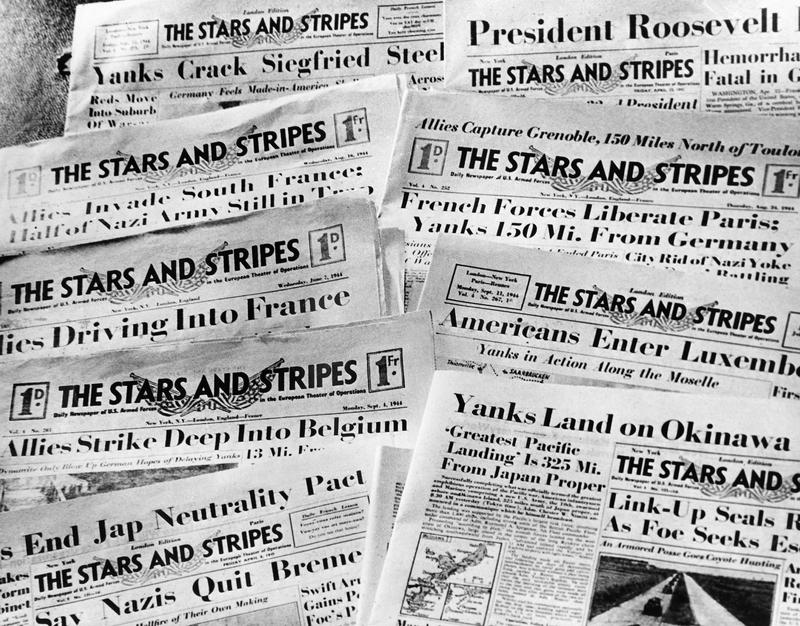
Eric Slavin: Sure. It reappeared in World War I. The first copy that I've seen from World War I had a big picture of Pershing. It was under President Wilson. Then it went dark again, as you said, but it has been continuously printed since 1942 in Europe, again from multiple locations as Allied forces gained ground, and printed in 1945, beginning in Asia. From there, it's been printed continuously in multiple countries throughout the world. It has always had some measure of independence.
There have been trouble at various times, and attempts to impose censorship, but General Eisenhower was very forthright during World War II, said, "This is the soldiers' paper, and it should not be censored."
Brooke Gladstone: The focus is on the soldiers and their families.
Eric Slavin: We looked at the number of families that were on food stamps overseas, and then we found at least 7,000. We looked at the obstacles to spouse hiring. Military spouses are, on balance, overeducated and underemployed if they're able to find a job. There are structural impediments to that. A lot of the rules were written in 1951. There were service members who were being double-taxed. A small part of Germany decided that if they thought that US service members and other DoD employees were planning on staying in Germany, they subjected them to income tax, even if they had paid US income tax.
In some cases, they imposed penalties of $100,000 to $200,000. We wrote about that. Germany stopped doing that. We cover the schools overseas. We will cover even the sports overseas. I don't know too many publications that are interested in covering a girls' basketball team between two schools who have about 150 people, but we will do that. We have a blog-like function called K-Town Now for about 50,000 people who live in Germany, where we will tell them even the smallest details about trash pickup in town. We speak German, so they don't have to.
As far as the bigger stories, there was one where there are thousands of people who work for the Defense Department in Japan. They weren't always getting the health care that they needed, and we reported on that, and that got some attention. I think service members understand that if there is an issue overseas that no one else is well placed to report upon, we're there. That, I think, is a boon to their morale.
Brooke Gladstone: You say that this came as a complete surprise, but did you get any pushback this past year with the Defense Department under Pete Hegseth? Surely, given the coverage you've done, we cited your coverage of service people being harried by ICE and even detained. You didn't hear anything?
Eric Slavin: No. It is not a new thing for Stars and Stripes to come under fire. That happened in 2020. The Secretary of Defense announced that they were going to cease funding for Stars and Stripes.
Brooke Gladstone: Why?
Eric Slavin: The answer they gave in a press conference is that it did not fit their conception of putting out their message, which is not what Stars and Stripes is for anyway. A number of people in Congress had a problem with that. A number of people among the general public, some former generals and admirals, came out and said that they didn't necessarily agree with everything we ran, but thought that we were important to have.
Ultimately, between Congress and even the President, who tweeted out, "We are going to keep Stars and Stripes," we continued to survive. The idea that someone would decide to make changes or otherwise target our independence, it's not a new idea, but again, we were not anticipating this.
Brooke Gladstone: We talked about some of the examples of the paper's noteworthy work, but I wonder if you could just pick out, past and present, some stories that really stand out for you.
Eric Slavin: Dee Spearman is somebody that I will always remember. He was a very young sailor who was aboard the USS Arleigh Burke, 2022, I believe, and he fell overboard, and he died. At the time, there was a very short release regarding his death. Our reporter stuck with this for two years. She continued to ask for documentation, even when documentation wasn't coming very quickly. She did the interviews. She talked to the family members.
Ultimately, what we found in some of the Navy's reports and from accounts from people aboard the ship was that Dee had fainted at least four times aboard the ship, twice when he was helming the ship, but he was sent to work alone on the top deck of the ship. There were improper lifelines, just a number of issues related to that that really made you question, "Okay, was proper procedure followed? Did he have to die?" From that reporting, I would hope that the Navy may have learned something about how to handle these types of situations. I think the family gained at least a little bit of closure knowing that their son's story was told.
Brooke Gladstone: Is there another investigative piece you'd want to point to?
Eric Slavin: We found out that service members, if they were questioned for a felony, it was being recorded in an FBI database as being convicted of a felony. That was being forwarded to the FBI, and it ended up being recorded as if they had actually committed crimes. Service members, when they got out, and they were looking for jobs, suddenly someone would tell them, you have a criminal record.
Brooke Gladstone: How did that happen?
Eric Slavin: Under the UCMJ, which is the Uniform Code of Military Justice, you would have investigators who would document that they had spoken to these people and that was getting forwarded to the FBI, appearing as if they had been convicted of something, when in effect, they had never even been arrested.
Brooke Gladstone: They're getting their records expunged?
Eric Slavin: They're trying.
Brooke Gladstone: You've said that you've sent reporters into harm's way and that this isn't a regular journalism job. You've lived through it yourself. You were a reporter for the publication for many years, covering the military from Iraq, Japan, South Korea. What makes this job unique now?
Eric Slavin: Now, they are not doing the push-ups. They're not going through a lot of the stresses that active duty service members are, and we would never claim to do that, but moving every few years, issues at finance, moving to a new country, figuring out the paperwork that needs to be done on the Defense Department side, the reporters really live a lifestyle which is very similar to that of their readers.
Brooke Gladstone: What do they say about your reporting? What are they usually getting in touch with you about?
Eric Slavin: Their questions, I think, are more granular. They expect you to know what they're talking about and speak in very professional terms. If you're wrong, they will call you out on it very quickly. It really behooves us to have our stuff straight. You do also have a lot of people reach out when they feel like the bureaucracy is failing them. We will talk to them. We'll ask, "Have you gone through your chain of command? What have you tried to do about a particular problem?"
Sometimes we will make that phone call and ask a command and say, "Hey, what's going on here? Why does this sailor have mold in his room?" Before you even have the chance to write the story, sometimes it gets cleared up just after we've made a phone call.
Brooke Gladstone: If you're not allowed to report on anything that saps morale, as you say, people would rather be seen than to be fed a line of what they know is BS. The world that they live in should be reflected to some degree in the paper that they read. Is that something the Pentagon doesn't seem to understand?
Eric Slavin: We have published stories of people doing very heroic things as well. The other day, we had a story about some Marines in a ramen shop in Okinawa who saved somebody from choking, but sometimes things are not perfect, and service members are aware of that. We report it when it's news.
Brooke Gladstone: Over the last year, we've seen the Pentagon bearing down pretty hard on the press. Hegseth demanded that reporters sign a pledge promising to never divulge or gather information that the Pentagon hasn't authorized for release. That includes unclassified information, or else they would have to turn in their badges. The Pentagon press corps, pretty much as a body, did just that. They walked out, and they were replaced by lackeys, funders like My Pillow Man, right-wing influencers like Laura Loomer.
X, of course, is there in full force. Is reining in Stars and Stripes just another attempt to control the narrative, most particularly for people into the armed services? What do you think they're trying to do?
Eric Slavin: I would love to know what they're trying to do. I really would, Brooke. I would love to sit down with them and have a discussion about what it is they want. I'm happy to talk about our mission, talk about the things that we do for our readers and for the military community.
Brooke Gladstone: I know, but I just think that the people making these decisions, what they think of the audience, that they want to tailor the Stars and Stripes to, tailor-made, as they said.
Eric Slavin: I guess that tweet enumerates some of the things that they consider important. A lot of those things are subjects that we do cover. We just cover more than that. I don't know what we are doing that they disagree with because they haven't told us, but everything we do is for the service member. We try to give them well-rounded news so that they can participate as citizens in a democracy, while also explaining to them what the US Armed Forces are doing and why they are where they are. That's what we do, and that's what we're going to keep trying to do as long as we possibly can.
Brooke Gladstone: Aside from this tweet and subsequent tweets, there haven't been any instructions that have come down to you. Do you have something to respond to, or are you just going to keep on keeping on?
Eric Slavin: We are going to keep on keeping on because we have no real alternative. There's no message that has come to us beyond a social media post.
Brooke Gladstone: That's it.
Eric Slavin: That's it.
Brooke Gladstone: What happens if they do come through with some instructions?
Eric Slavin: Obviously, we're concerned about what might come, given what we've seen, but we will attempt to explain what it is we do and why we do it. Hopefully, we can sit down and have a conversation that is not on social media, and we can work out whatever differences we might have, and we can preserve Stars and Stripes as an independent news organization.
Brooke Gladstone: This could just be something they ran up the flagpole. It might not even be real.
Eric Slavin: The post was real. We know that. As to what they want to do beyond that post, I don't know how much credence to give what I've read in other news sources by anonymous sources, and I don't have any real details as to what it is they want to accomplish.
Brooke Gladstone: Eric, thank you very much.
Eric Slavin: Thank you.
Brooke Gladstone: Eric Slavin is the editor in chief of Stars and Stripes. Thanks for listening to the midweek podcast, the Big show show posts as it usually does on Friday, roughly around dinner time. See you then, I hope.
Copyright © 2026 New York Public Radio. All rights reserved. Visit our website terms of use at www.wnyc.org for further information.
New York Public Radio transcripts are created on a rush deadline, often by contractors. This text may not be in its final form and may be updated or revised in the future. Accuracy and availability may vary. The authoritative record of New York Public Radio’s programming is the audio record.