
Predicting the News
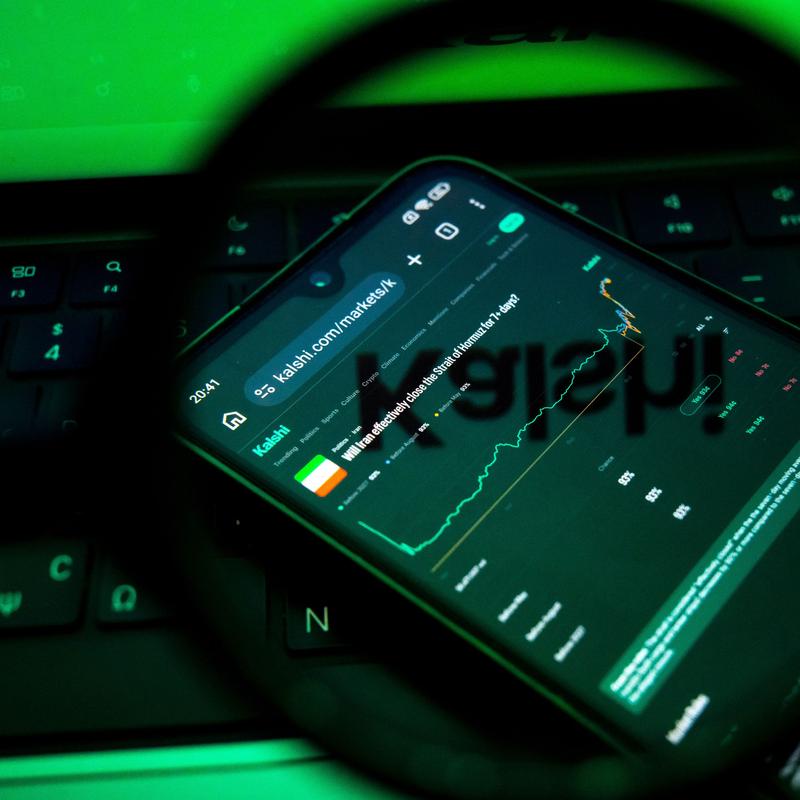
Micah Loewinger: Hey. You're listening to the On the Media midweek podcast. I'm Micah Loewinger. There's been a flurry of activity surrounding the business of prediction markets, specifically Kalshi and Polymarket, sites that claim to be more like the stock market than traditional betting since you're wagering against other people rather than the house. Recent headlines have been filled with stories of people betting on when the Iran war would end, where the bombs would drop, and when that US airman would be rescued, with some suspiciously well-timed bets making some users a ton of cash.
All of which has lawmakers clutching their pearls. Last week, at a congressional hearing on the subject, Michael Selig, the current chair of the CFTC, the Commodities Future Trading Commission, tried to reassure members of both parties that his agency was investigating allegations of insider trading. As John Oliver reported on his show this weekend--
John Oliver: While Selig's recently made noises about stronger enforcement, it is hard to take him at his word, given that during his confirmation hearings, he told Congress he'd let courts decide whether these companies constitute gambling, but in office, he's done the exact opposite of that. In fact, more than a dozen states are currently suing prediction markets. Rather than let that play out in the courts like he promised, Selig posted this video.
Michael Selig: To those who seek to challenge our authority in this space, let me be clear. We will see you in court.
John Oliver: What a weasel.
Micah Loewinger: Not for nothing, Selig is the only sitting member on a panel that should have five. Meanwhile, a bipartisan group of lawmakers have proposed a bill that would bar federal employees from using non-public information to make bets on prediction markets, one of several bipartisan moves in Congress to regulate the sites. Sports betting exploded in the United states after a 2018 Supreme Court decision legalized online gambling. Polymarket and Kalshi sprung up in the aftermath, and recently both companies have made partnership deals with news organizations.
Earlier this year, I spoke about prediction markets with Judd Legum, author of Popular Information, an independent newsletter dedicated to accountability journalism. After tuning into this brave new world of news gambling, he told me that the Kalshi ticker has become a strangely normal part of CNN coverage.
Judd Legum: You could have a discussion on any range of issues, whether it's, is there a genocide occurring in Gaza, or the state of government funding, or whether or not the Democrats will retake the House in 2026. In addition to whatever discussion is going on, you will see something at the bottom of the screen saying, what is the current state of the market on Kalshi? What is the price of, yes, the Democrats will take control of the House? Is it $0.50? Is it $0.60? Is it $0.75? Integrated into the discussion, they'll talk about the movements in these prices and what the Kalshi market is predicting.
Micah Loewinger: Harry Enten, who [chuckles] was a kind of polling whiz kid in his former life at 538, now will pull up Kalshi odds and report on them as if they have explanatory power when talking about serious news events. Here he is in January talking about Trump's attempts to strong arm control of Greenland.
John Berman: What about the prediction markets?
Harry Enten: Yes. Are people in the public taking it seriously, the people who are putting their money where their mouth is? They're absolutely taking it seriously. I mean, take a look here. The chance that Trump buys any of Greenland by the end of his term, on Friday, it was just 12%. Whoa, way up there now to 36%. A tripling in less than a [crosstalk]--
Micah Loewinger: They are promoting gambling on the seizure of a sovereign nation in this case, right. Not only is that just trivializing what should be treated as an absolutely insane news story, but journalistically speaking, why would a news organization privilege the opinions of a group of random people who are effectively guessing what a highly unpredictable man will do?
Judd Legum: I think that this is part and parcel to the orientation, especially in Trump's second term, of news organizations to at all times avoid accusations of bias. If you were to talk about, well, what are the implications of either invading or strong arming Denmark to give up some of Greenland, how would that impact the world? You might be seen as biased because there might be some negative implications of that. If you're simply discussing the numbers, just the data, you can insulate yourself from that.
Micah Loewinger: Of course, CNN is not alone. The Wall Street Journal, CNBC, Yahoo Finance, Sports Illustrated, and Time, they have all inked deals with sites like Polymarket and Kalshi. Even the Golden Globes recently played Polymarket predictions on their broadcast.
News clip: Let's check out the top three predictions on Polymarket.
News clip: Based on the top three Polymarket predictions--
News clip: And looking at the top three predictions on Polymarket--
News clip: Is leading the top predictions on Polymarket.
News clip: Pulling ahead on the polymarket predictions--
Micah Loewinger: Looking at the news organizations in particular, what is in it for them to push a gambling addiction onto their viewers?
Judd Legum: Well, why have the sports leagues adopted this so enthusiastically? Because I think they understand that if you have even $20 wagered on a game, you are more likely to tune in. If you bet on a lot of games, you're likely to tune in to a lot of games. I think news organizations that have seen their readership or viewership decline see this as a way of creating more loyal viewers or readers.
Micah Loewinger: You quote Kalshi CEO Tarek Mansour, who said, "Kalshi is replacing debate, subjectivity, and talk with markets, accuracy, and truth." In effect, you write, Kalshi's betting market being treated as news is based on the efficient market hypothesis. What do you mean by that?
Judd Legum: There is a school of thought, something that has been adopted by Peter Thiel and some of the funders of these betting markets, that in fact, it is the marketplace that is the clearest path to discovering what truth is.
Micah Loewinger: But, as you write in your piece, a lot of these markets, although they may appear to carry a hefty tag, we're talking about market caps of millions of dollars, they're nothing close to, say, the size of the stock market.
Judd Legum: That's right. Probably the presidential market, who's going to win in 2028? That's going to be a fairly large market. As you go down to a congressional race, or as you go down to some of these more obscure news events, or even things like, will the announcer during this sporting competition say a particular word, these are going to be very small markets. What the price of a certain outcome is really has no relationship to truth or even probability. It just relates to how much a handful of individuals who have access to wealth have decided to put down in this market.
Micah Loewinger: Okay, but if we had Kalshi's CEO sitting with us here, he may say something like, well, look at our track record. Prediction markets picked Trump to win the 2024 presidential race. They supported Zohran Mamdani for the New York City mayoral race in 2025. Is there not some predictive power on display here, or are you skeptical of the examples and data that have been cited thus far?
Judd Legum: I don't think that there is nearly enough data. These sites are so new that you can draw any conclusions about their accuracy. Look, they deal with binary questions. They're either right or wrong. They're either predicting an outcome or not. They're going to be right some of the time. Does that mean they're better at predicting something than some other methodology, maybe traditional polling or other things? That I don't think we could possibly know. I think the larger question, especially when it comes to news, is why do we need to predict these things in the first place?
Micah Loewinger: Because we have to know. [chuckles]
Judd Legum: Why is it necessary to have a prediction market on, will the government be funded by next week? Next week will come and we will know. Isn't it more important to spend that time talking about what are the issues that people are talking about that need to be resolved before the government can be funded?
Micah Loewinger: You argue that these betting markets are still small enough to be disrupted by individuals. How so?
Judd Legum: Right. If you look at Kalshi, there's $50 billion in annual volume. That's about $135 million per day. If you break that down further, this is spread across thousands of different markets. Once you look at, for example, a market about a special election in Tennessee, it's just going to be a few million dollars at most, probably less than that in many cases. Therefore, anyone who's interested in changing the narrative, which is something many people are interested in.in the context of a congressional election or a presidential election or elections on any level, this can be done now on Kalshi for tens of thousands, even thousands of dollars.
Micah Loewinger: Our producer Becca actually observed this example while looking at Kalshi before one of Fed Chair Jerome Powell's press conferences in January. There was a mention market, so betting on what words he would use during his remarks and the following Q and A. A commenter in Kalshi's chat posted few minutes before the conference went live that there was a script out and that Powell was going to utter the phrase national debt and that fellow betters should hammer it. Needless to say, Powell didn't end up uttering those words, but perhaps someone made a killing betting against that he would say it.
In small ways, it's not hard to see how easy it is to make a profit by manipulating people you're betting against.
Judd Legum: Yes, and that example illustrates the problem where you have markets where there is a small, or in some cases, not so small number of people who know exactly what the outcome will be in advance. Although Kalshi has rules against insider trading, it's far from clear that they have any way to enforce those rules.
Micah Loewinger: Yes. Recently, MS NOW host Chris Hayes posted a video to social media talking about the betting market that emerged around what topics he would bring up in his interview on Stephen Colbert's show. NPR's Bobby Allyn alerted him.
Chris Hayes: And that market, which when Bobby first sent it to me was like at $22,000, goes to this, 800,000, almost $900,000, like close to $1 million market.
Micah Loewinger: As Hayes discussed in his video, the interview with Stephen Colbert was prerecorded, meaning Chris Hayes, someone in the studio audience, a producer working on the CBS segment, anyone with inside knowledge could have made a killing in this market by just betting before the interview aired.
Judd Legum: It's a huge flaw in these kind of markets. There was even an instance where Bill Ackman, a billionaire investor who wanted Mayor Adams to drop out of the election in New York City for mayor because he was supporting Andrew Cuomo at that time. He actually publicly suggested, well, what Adam should do is place a bet on himself dropping out and then drop out in order to reap the financial advantage from dropping out.
Micah Loewinger: Oh my God.
Judd Legum: You can just see how this is really just the Wild West.
Micah Loewinger: Yes. Just another example of potential insider trading. An anonymous better--
News clip: Bet $32,000 that the Venezuelan president would be out of power by January 31st. The following morning at 4:21 AM Eastern, the President announced Maduro was in custody, and that user cashed out, making more than $400,000.
Micah Loewinger: Another user made over a million dollars betting on what the top Google searches would be in 2025, which raised suspicions that [chuckles] this was an internal Google employee with prior knowledge of the data. Aren't there mechanisms and a regulatory system aimed at combating this exact kind of fraud?
Judd Legum: Well, that's right. There is a mechanism by the SEC that is aimed at preventing insider trading. Unfortunately, the SEC is not involved in regulating these markets at all. It's the CFTC which regulates commodities and futures markets, and they have no history of regulating insider trading. In fact, those markets traditionally are used by insiders to hedge their risk in the future, and it's completely acceptable.
Micah Loewinger: It's legal and even normal to act on inside information?
Judd Legum: Yes, let's say that I'm Frito-Lay and I'm going to be coming up with a new, what I suspect might be very popular version of Doritos, which is going to require a lot of corn, and I know I'm going to need to buy an immense amount of corn six months from now to make these new Doritos. I can then use the corn futures market to lock in the current price to hedge against any disruption that my own purchases might make, and that's seen as a legitimate and prudent use of the futures markets.
It's a totally different mindset than the SEC where using that kind of insider information, trading your own stock because you know of some new initiative that your company's to do that you think is going to be very profitable, is prohibited.
Micah Loewinger: Because Kalshi and Polymarket are regulated by the Commodity Futures Trading Commission and not the SEC, there isn't really a mechanism for [chuckles] enforcing insider trading?
Judd Legum: Well, there's still prohibitions against fraud, right? You could argue that you're committing fraud against the other people in the market by using insider information because you're participating as if you are on the same level ground as everyone else. The real issue becomes the fact that the CFTC has no experience, no staff, no ability to really enforce those kinds of laws, unlike the SEC, which has been doing this for decades and decades and decades.
Micah Loewinger: Of the three big issues with this industry, you list manipulation, insider trading, and trivialization, this feeling that betting on very serious current events kind of flattens the news. I agree with you that there's something a little sick on [chuckles] making money on these events, but hasn't that ship already sailed?
Judd Legum: I think there's always been two aspects to news. There's certainly always been the entertainment and voyeurism aspect. We're curious people, we're nosy people. We want to know where celebrities are vacationing, we want to know gossip, we want to know about affairs, and that's not a new thing. That's been going on for hundreds of years, probably since the invention of news. The question is, is there a place anymore for another kind of news?
'Cause certainly there's another tradition where news is an essential part of people's ability to inform themselves as citizens, to decide who they might want to vote for, who they might want to donate to, what they might want to protest, how they might want to live their lives in light of what's going on around them. The question is, are there areas where people can go to get that kind of news?
What you have with Kalshi is it is essentially invading those spaces and turning the news into this game to essentially de-emphasize the part of news that is probably the most important, which is that it's about informing yourself as a citizen.
[music]
Micah Loewinger: Judd, thanks so much.
Judd Legum: Thanks for having me.
Micah Loewinger: Judd Legum runs the newsletter Popular Information, a publication dedicated to accountability journalism. This interview first aired in February. Thanks for listening to the latest On the Media midweek podcast. Don't forget to listen to the big show this weekend. See you Friday. I'm Micah Loewinger.
Copyright © 2026 New York Public Radio. All rights reserved. Visit our website terms of use at www.wnyc.org for further information.
New York Public Radio transcripts are created on a rush deadline, often by contractors. This text may not be in its final form and may be updated or revised in the future. Accuracy and availability may vary. The authoritative record of New York Public Radio’s programming is the audio record.