
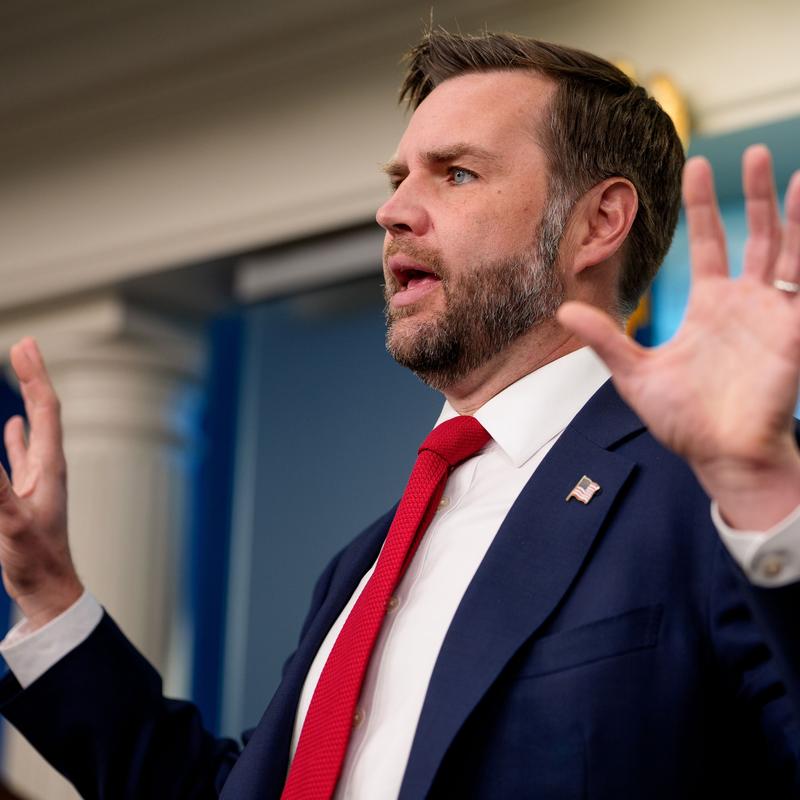
J.D. Vance: Iran Deal Fall Guy
Micah Loewinger: Hey, it's Micah. It's been a minute since our FEMA series came out, and I want our New York listeners to know that we're having an in-person event in a couple of weeks. I'll be joined by former FEMA official MaryAnn E. Tierney. We'll talk about the history of the agency, how it's being reshaped now under the Trump Administration, and some other fun stuff we couldn't fit in the show.
Join us in person at WNYC, 7:00 PM on June 24. You can get tickets at wnyc.org/events. It's a great opportunity to meet other OTM listeners. We'd love to see you there.
[music]
President Donald Trump: This way, if it works out, I'm going to take the credit. If it doesn't work out, I'm blaming J.D. You better be careful, J.D.
Joe Perticone: It happens all the time with Trump. He can never fail; he is only failed by others.
Brooke Gladstone: It was the MoU heard round the world. From WNYC in New York, this is On the Media. I'm Brooke Gladstone.
Micah Loewinger: I'm Micah Loewinger. Also on this week's show, Israeli media tries to thread the needle on the Israeli PM's Iran policy.
Oren Persico: Netanyahu said that the goals are to eliminate the threat of nuclear weapons and topple the regime, and now people realize that it's not what they were sold.
Brooke Gladstone: Plus, the ideological and theological rifts tearing MAGA apart.
Matthew D. Taylor: The Christian Zionist crowd want violence directed at America's enemies abroad and at Israel's enemies, and the America First crowd wants the violence directed at America's internal enemies: migrants.
Micah Loewinger: It's all coming up after this. From WNYC in New York, this is On the Media. I'm Micah Loewinger.
Brooke Gladstone: I'm Brooke Gladstone. This week saw the long-awaited sort of framework of a deal to halt the Iran war and reopen the Strait of Hormuz.
News clip: A US official tells CBS News President Trump signed the 14-point Memorandum of Understanding with Iran today in Versailles, France, and it's now in effect.
Brooke Gladstone: What's in this MoU, as they refer to it? Well--
Kevin Liptak: It is vague in a lot of its terms, particularly when it comes to Iran's nuclear program. The final agreement will confirm the provisions of this article, and so it is what we expected. It's punting the really thorny issues about enrichment, around the fate of Iran's nuclear stockpile, to these future technical negotiations.
Brooke Gladstone: The deal's financial terms are also raising eyebrows.
Kevin Liptak: It does specify, for example, that Iran will be able to gain access to a $300 billion development fund. American officials have been explicit that the US will not provide the funding for that, but that $300 billion figure is included in this document.
Senator Bill Cassidy: The details that I've seen so far look awful.
Brooke Gladstone: Republican Senator Bill Cassidy, unshackled now after his primary loss.
Senator Bill Cassidy: This will go down as a tremendous foreign policy blunder. Iran ends up stronger, our allies in the region are weaker, and Iran has learned that if they're willing to grab that Strait of Hormuz and choke it off, they can get the Western world to dance to their tune.
Brooke Gladstone: And Republican Senator Ted Cruz.
Senator Ted Cruz: History teaches that giving billions of dollars to theocratic lunatics who want to murder us is a really, really bad idea.
Brooke Gladstone: Now, most conservative critics shrewdly stop short of blaming the president for the MoU's deficiencies, but they do drop another name.
Brian Kilmeade: The Vice President was here, did a wonderful job on every outlet, but this is his deal. It's not the President's deal.
Brooke Gladstone: Brian Kilmeade, co-host of what's said to be Donald Trump's favorite show, Fox & Friends.
Brian Kilmeade: He can't do everything himself. I just hope they didn't let him down.
Brooke Gladstone: And here's prominent far-right pundit Ben Shapiro.
Ben Shapiro: This MoU appears to be, just from the text, a disaster that doesn't achieve any of the actual signaled goals that were set by the administration at the beginning. The Vice President of the United States, the chief negotiator on this particular project, has not well-served the President.
Brooke Gladstone: Joe Perticone, a national political reporter at The Bulwark, says it's clear that in selling this deal to the American public, J.D. Vance is being set up as the Iran deal fall guy. Welcome to the show.
Joe Perticone: Thanks for having me.
Brooke Gladstone: Tell me about the line in The Dark Knight Rises that this US-Iran tentative, non-binding memorandum of understanding reminded you of.
Joe Perticone: I thought of the opening scene in which the villains take over a plane while flying another plane above it, and before they let it fall to the ground, all of the henchmen are linking them up to the cables to escape. Bane puts his hand on the shoulder of one of them and says, "No."
Bane: No, they expect one of us in the wreckage, brother.
Joe Perticone: "They expect one of us in the wreckage, brother," and he just nods and falls down with the plane. This is what's happening here. It happens all the time with Trump, is that he can never fail; he is only failed by others. Somebody either willingly becomes the fall guy-- Steve Bannon and Peter Navarro literally went to prison for Donald Trump-- or they become the fall guy because they accidentally walked into it, and then they find themselves with no way out.
It was very apparent, early on this week, when details of the deal started leaking. You could tell senators, most of whom are longtime Iran hawks who probably wanted this war to continue despite the economic pain, that they didn't like it. I started noticing, very quickly, Lindsey Graham, who's chief among these Iran hawks, said, "Well, the architect, J.D. Vance and others." That struck me as odd because no one thinks of the Vice President being the architect of this major deal. You would think, if it's anyone other than the president, it'd be the Secretary of State.
Brooke Gladstone: You also have observed that when these narratives come out clearing the President of any blame for what he himself set in motion, it generally begins on Fox or on one of the far-right-wing podcasts or something, and then it gets picked up, but you say that this particular narrative pinning this whole thing on Vance actually did begin with Graham in the Senate, picked up by others in the Senate, and then traveled onto the media outlets.
Joe Perticone: Yes, we've seen it a million times over. When Trump decides he no longer likes someone in his inner circle, it originates on Fox, most of the time on Fox & Friends, the morning show which he watches religiously. This case, it was senators quickly moving to describe this as J.D. Vance's baby, and if we recall, in March, J.D. Vance was being reported as the lone skeptic of this military engagement.
Brooke Gladstone: Yes, very consistent with his own America First policy.
Joe Perticone: Yes, exactly. This whole thing came together really quickly, and it happened at the same time that J.D. Vance is out plugging his book. J.D. Vance is making the rounds everywhere on all these different TV interviews, but because this is happening at the same time, every interview ends up being about this deal.
Brooke Gladstone: What did Vance have to do with this MoU? Did Vance have any input into this document at all?
Joe Perticone: Oh, he absolutely did. I just don't think it would be at all accurate or fair to describe the Vice President as the architect of this deal, the way the senators have. This is a team effort. Ultimately, the buck stops at the President, but when Donald Trump is President and Republicans control Congress, the buck doesn't stop with him. It stops with whoever they decide it stopped with.
Brooke Gladstone: Trump has been dropping Vance's name a lot when asked about who is responsible. Even when Trump was asked if he would be at the signing, which ultimately he was this week, Trump said--
President Donald Trump: Well, it depends. J.D.'s coming in for it. He was originally going to do it. I'll probably be gone by then. We're having dinner.
Brooke Gladstone: And this isn't going to fit the requirements that previously senators like Graham and John Cornyn said would be necessary to stop the war, right?
Joe Perticone: Yes. Before this war was started, the strait was open, and now we're looking at the possibility of Iran receiving passage fees or whatever Ticketmaster-esque language they come up for tolls of whatever they want. I spoke to John Cornyn at the beginning of this war, and he said, "Yes, gas prices are bad, but we need to make the case thoroughly to the American people that a little pain is worth it if it means eliminating the prospect of a nuclear Iran, if it means removing their ballistic missile capabilities."
Now we're seeing, as a result of this MoU, okay, they've to eliminate their currently enriched stockpile, but it doesn't necessarily impose strict enforcement of future enrichment of uranium. It doesn't necessarily address their ambitions for a civilian nuclear program. It just ends the current hostilities.
Brooke Gladstone: For 60 days.
Joe Perticone: Yes.
Brooke Gladstone: Maybe extend it to 90.
Joe Perticone: They can keep extending it as long as they want, technically. It's just a public relations band-aid for this thing.
Brooke Gladstone: Are the senators who have loudly said, "Iran needs to do this, Iran can't be allowed to do that, Iran can't get any money,"-- are they going to be able to maintain that position without condemning the President?
Joe Perticone: I spoke to Lindsey Graham before we saw the text of this deal, and he said, "I sort of like what I've heard so far," while he was pinning it on J.D, but then he said, very clear, "If they can enrich nuclear material, it's not a good deal." Reporters were given the text by the administration prior to Congress. The details leaked out, which they said was fake, and then when they finally gave the official details, it was word-for-word the exact same.
We've seen that, actually, this possibility that they can enrich nuclear material in the future, so these hawks now have to deal with, "Well, do we review this?" And part of that component of it is the language of it. A "Memorandum of Understanding" is a very particular wording to avoid requiring congressional advice and consent.
Brooke Gladstone: You suggest there's nothing that Congress would like more than not having to weigh in. You've said there's nothing legislators, at least in this Congress, hate more than actually legislating.
Joe Perticone: Oh, it's their least favorite thing. They like confirming nominees. They like renaming post offices. Sometimes, they like doing tax cuts through reconciliation, but beyond that, it's difficult to get them to really do things, especially this close to the midterm elections. Anything they do can be turned into an advertisement. A lot of the senators I spoke to said, "Well, yes, ideally, you would want Congress to review this." By law, the Iran Nuclear Agreement Review Act of 2015 forces them to. That's if it's an agreement.
In the MoU, we see, oh, there's a relief of sanctions. It's not clear that the administration can just unilaterally issue sanctions relief. That might also fall under Congress. Democrats have said this is an illegal war. Nothing is illegal if Congress isn't willing to enforce the laws to begin with.
Brooke Gladstone: It's really important for Trump to make sure that the world believes that Obama's nuclear agreement was terrible. Just this week at the G7 summit, he was railing against that terrible deal.
President Donald Trump: What Obama did was he loaded up a plane with $1,700,000,000 in green cash from banks all over Washington, Maryland, and Virginia. They were stripped of all their cash. They had no cash to do payrolls. It all went into a Boeing 757, a wonderful plane, and they flew it to Iran. I made it very tough for them when I terminated the Barack Hussein Obama catastrophe, JCPOA, one of the worst deals.
Joe Perticone: Trump does this thing where he just replays many of the things he criticized Obama for. He regularly said that Obama's golfing too much. Trump has golfed more times in his first year back in office than I think all the presidents combined since Eisenhower.
Now, with this, he's embarking on this deal, which the JCPOA was about 150 pages, took years, had serious enforcement mechanisms, though not as much as, at the time, Republicans said they would have liked, and this is just more of a public relations document to end this war quickly because it's becoming a massive problem, both financially for the United States in terms of how expensive it's, but also in how it's affected the global economy and gas prices, and you name it.
The JCPOA was an economic and nuclear agreement and a de-escalation. This is an "end this war and stop the bleeding in the President's approval numbers."
Brooke Gladstone: And J.D. is just the guy who gets to be in the wreckage.
Joe Perticone: [chuckles] Yes, wrong place at the wrong time.
Brooke Gladstone: Many have observed that it didn't help Kamala's presidential run that she was mislabeled "the immigration czar" when she was actually just charged with trying to find out what the roots of the problem were. Selina Meyer on Veep, she's told that she's going to be dealing with a very special thing for the president.
Jonah Ryan: POTUS would like you to head up a program that is very important and very dear to his heart.
Selina Meyer: No, no no no no. You do not do this to me. Do not say that it is obesity. Do not say that to me.
Jonah Ryan: It's obesity.
Selina Meyer: No.
Jonah Ryan: I'm sorry, ma'am, but you have drawn the fat straw.
Brooke Gladstone: What do you think the consequences for Vance are of becoming the accidental architect?
Joe Perticone: Being the face of anything that is this monumental and horribly unpopular can be deadly for a career. We can just look at Marco Rubio, the Secretary of State. He became the face of the 2013 Gang of Eight Immigration initiative that failed. It was a major point in the 2016 presidential campaign, which Trump and others used against him. He spent the past decade in political rehab to make his image better again, and it's working.
Vance getting slapped with the label of 'architect' here can really hurt his political chances in a Republican primary.
President Donald Trump: If it works out, I'm going to take the credit. If it doesn't work out, I'm blaming J.D. You better be careful, J.D.
Joe Perticone: These things usually originate as jokes, and then they turn into, "Oh, we've got to get this person out." We saw it with Pam Bondi.
Brooke Gladstone: Oh, yes.
Joe Perticone: She was very quickly gone. You can't really cut a vice president loose like you can a cabinet official, but you can relegate them to the obscurity of being vice president.
Brooke Gladstone: He certainly did that last time around.
Joe Perticone: I think Vance is still in a much better position than Mike Pence.
Brooke Gladstone: [chuckles] We've been talking about GOP legislators. What about the Democrats?
Joe Perticone: I spoke to Tim Kaine earlier in the week.
Brooke Gladstone: The junior Senator from Virginia.
Joe Perticone: He said, "Look, this has gotten so out of hand." This is not a direct quotation, but he did say they're happy there's an off-ramp. The first thing they're going to do is, he said, "We're going to compare this to the deal that Trump just tore up," which is the JCPOA, but also, they are very optimistic about the prospect of bringing an end to hostilities as soon as possible. He also made a darkly hilarious comment where he said the Democratic Caucus is extremely unified, with the exception of Senator Fetterman-
Brooke Gladstone: [laughs] That's right.
Joe Perticone: -that this is an illegal war. Yesterday I spoke with Bernie Sanders, and he said, "Look, it's been my longstanding position that this war is unconstitutional, it's illegal. I'm happy that we can end this in any possible way." I also asked, "If you codify an end to this war, does that negate the claims that it is an illegal war?" And he said, "I don't know about that."
Brooke Gladstone: One can say that almost every conflict in the last half-century has been illegal in the sense that Congress has ducked having to authorize it. It's a "military operation," it's a "brief incursion," whatever you want to call what looks and smells and quacks like a war. That certainly does not originate with Trump.
Joe Perticone: Yes, and there's the 60-day limit of military force to which the administration responded, "Well, it's not 60 total days because some of the days, we weren't dropping bombs." They constantly find these loopholes, and it keeps getting allowed because of the permission structure that Congress has created. You can trace this back to Vietnam, but if you look at, since the Iraq and Afghanistan wars, where declarations of Congress became authorizations for the use of military force, and now, it's the President just kidnaps the head of state in Venezuela, and it's just like, "Well, actually, that was a DOJ operation." A DOJ operation not on US soil? Okay.
The constant, "Well, let us see how this plays out," creates a new precedent every time they do it, and each new precedent rolls back their Article 1 powers and grants more to the President, which the other party is never going to like when the opposite is in the White House, but it keeps happening.
[music]
Brooke Gladstone: Joe, thank you very much.
Joe Perticone: Thank you for having me on.
Brooke Gladstone: Joe Perticone is a national political reporter at The Bulwark.
Micah Loewinger: Coming up, we look at how the Israeli media are covering the deal.
Brooke Gladstone: This is On the Media.
[music]
Brooke Gladstone: This is On the Media. I'm Brooke Gladstone.
Micah Loewinger: I'm Micah Loewinger. As we just heard, the Vice President is being forced into the role of spokesperson for the Iran deal. On his recent media tour, he tried to put an America First spin on it.
J.D. Vance: Now, I think it's important to say that while I do believe that this deal will be good for the entire world, fundamentally we're worried about what's in the best interest of the American people.
Micah Loewinger: Vance, here on a New York Times podcast this week, responding to criticism from Israeli officials.
J.D. Vance: You've seen people in their system, Ben-Gvir and Smotrich, who've attacked the deal, and I guess my response to them would be, what is your exact proposal? You're a country of 9 million people. You can't just kill your way out of solving every single national security problem that you have.
Micah Loewinger: The deal and this new tone have shaken Israelis and Benjamin Netanyahu's government, which has seen its relationship with Donald Trump deteriorate over the past few months.
President Donald Trump: We've had an amazing partnership; he's been an amazing prime minister. We have a little dispute over Lebanon.
Micah Loewinger: The President at the G7 summit in France this week.
President Donald Trump: I say, "You can do a little softer touch, Bibi. You don't have to knock down a building every time somebody walks into it that's from Hezbollah."
Micah Loewinger: The MoU calls for an end to Israel's combat in Southern Lebanon, which is still occupied by Israeli troops. It also doesn't lay out a plan for regime change in Tehran or stymie its use of ballistic missiles and proxy militias, a far cry from the "total victory over Iran" that Netanyahu promised earlier this year.
Oren Persico: By and large, there's a disappointment.
Micah Loewinger: Oren Persico is a staff writer for The Seventh Eye, an independent website devoted to journalism and freedom of the press in Israel. He has been tracking the Israeli media's response to Trump's rhetoric and the Iran deal and what all this tells us about Netanyahu's political future.
Oren Persico: The pro-Netanyahu media and the anti-Netanyahu media were convinced and portrayed to the public that we actually won on the first day, it's going to change the Middle East, we will remove all the threats from Iran, Lebanon, and Gaza. And now that Trump has pushed for this deal, people realize that it's not what they were sold. All the horrible times that Israelis suffered for the past year were for nothing.
Micah Loewinger: It's hard to spin this as a success for Netanyahu and his followers.
Oren Persico: Right.
Micah Loewinger: Over the last few weeks, President Trump has visibly been souring on Israeli Prime Minister Netanyahu. This week at the G7 summit in France, Trump said--
President Donald Trump: Israel has fighting Hezbollah too long, and too many people are being killed. You don't have to knock down an apartment house every time you're looking for somebody, because there are a lot of people in those apartment houses, and they're not all Hezbollah. That I can tell you. I suggested to Israel to let Syria take care of Hezbollah, because, to be honest with you, I think they do a better job of doing it.
Micah Loewinger: Earlier this month, when Iran threatened to abandon negotiations with the US over Israel's actions in Lebanon, Trump lashed out at Netanyahu over a call and reportedly said, "You're [beep] crazy. You'd be in prison if it weren't for me. I'm saving your ass," referring to his ongoing corruption trial. "Everyone hates you now. Everyone hates Israel because of this. What the [beep] are you doing?"
Oren Persico: I attend, usually, the Netanyahu trial. For the past year-and-a-half, he's being interrogated. Usually, there's a pro-Netanyahu crowd that, when the court adjourns, take advantage of the situation and shout to him, "We love you. Everybody loves you." Last week, I shouted to him, "Trump says everybody hates you." [chuckles]
Micah Loewinger: Wow. What was the reaction to that?
Oren Persico: They were just stunned, and he left, like always. It does shatter the image of Netanyahu that he's this leader of international stature. Previous elections, they had banners of him and Trump holding hands as a sign to the voters that if Netanyahu wins, we'll have the biggest ally possible. That is just not the case anymore.
Micah Loewinger: I want to talk about Channel 14, a pro-Netanyahu propaganda broadcaster. According to a recent piece in The New York Times, the leading figures of Channel 14 have been ardent admirers of Trump, but lately, they've dramatically shifted their tack and have started openly criticizing Trump in ways they never have before. For example, Yaakov Bardugo, a political commentator who's known to be close to Netanyahu, described Trump and Vance on air as "modern Chamberlains," a reference to Neville Chamberlain, the former British Prime Minister who was known for appeasing Hitler. Another leading star on the channel, Shimon Riklin, wrote that Trump represents total surrender to the Ayatollahs in Iran.
Tell me a little bit more about this sudden shift and what you think it reveals about the changing relationship more broadly between the US and Israel.
Oren Persico: You have Yinon Magal, he's the biggest star of Channel 14, and he called Kushner and Witkoff "Jew boys." That's a really offensive, anti-Semitic word, and he called J.D. Vance a scumbag. There's a Chief Diplomatic Correspondent for Israel Hayom, the Miriam Adelson free newspaper, and his profile picture on Twitter, X, used to be a picture of himself with Trump. On the morning of the agreement on Sunday, it was Trump's birthday, and he published a double spread in the newspaper celebrating Trump, stating that Trump has really put America back on track, and later that day, when Trump announced the deal, he made a 180-degree flip.
He took down his profile picture with Trump, even took the effort to tweet again, "I changed my profile picture. Enough is enough." If you look at another editor who edits an ultra-Orthodox magazine, he published on Twitter, X, an AI caricature of Trump accepting bags of money from Emirati-looking people and turning his back to the poor Israeli Jew sitting in the ruins of his house. They're really portraying Trump as a villain now. He's either so stupid that he was duped by his advisors or that he is really a corrupt villain, and we were mistaken about him. What they don't do is blame Netanyahu. They don't think that Netanyahu was wrong to gamble, really, the strategic future of the State of Israel and its geopolitical standing on this president.
Micah Loewinger: Vice President J.D. Vance said this about the anti-Trump turn in Israeli politics.
J.D. Vance: To some of these cabinet members in Israel who are attacking the President of the United States, the other thing that I would say is that over the last 3 months, 2/3rds of the defensive weapons that have protected your homeland have been built by American hands and paid for by American tax dollars. The problem for Israel isn't Donald J. Trump, and anybody in Israel who thinks their biggest problem is the President of the United States needs to wake up.
Oren Persico: If you look at the next president, it doesn't look like there will be anyone like Biden, like Trump, in the White House in the context of supporting Israel, and that might be even a good thing for Israelis in the long run. They might force Israelis to deal with the core problem, which is not Iran. It's the Palestinians. We might have to reconcile the Israeli-Palestinian conflict without the blind support of the US, and that might force Israeli governments to do things that they're not willing to do right now, and were not willing to do for the past generations.
Micah Loewinger: You mean making meaningful concessions to the Palestinian people?
Oren Persico: Yes. It sounds out of touch of current Israeli government plans and actions, but we might just not have a choice.
Micah Loewinger: When we spoke to you in January 2024 for the first time, you talked about how the Israeli mainstream media barely mentioned any of the devastation and carnage in Gaza. Now, nearly two-and-a-half years later, I know there's a ceasefire. There continues to be bombings and violence; many more Palestinians have died since. What does that look like in Israeli media?
Oren Persico: The Gaza Strip is still a non-story in Israeli media. It's very difficult to even get basic information about what's going on there. This indifference to human lives has replicated itself, also, in Lebanon. When the IDF entered Lebanon, and about a million Lebanese civilians had to flee their homes in Southern Lebanon, Israeli media didn't cover it at all, even though it was nothing like the relationship with Gaza. These people from Lebanon didn't go into Israeli communities and massacre people just because they were Israeli.
There were plenty of international journalists in Lebanon that Israeli media could rely on for good, unbiased reporting, and still, it was a non-story. A million of them suffered greatly from the invasion of Israeli soldiers and had no empathy in Israeli media or the Israeli public.
Micah Loewinger: You're talking about the 1 million Lebanese who have been displaced since Israel's bombing campaign began, including 3,400 people who've been killed in southern Lebanon.
Oren Persico: Yes. If you look at what's going on in Gaza, Israel is supposed to be in control of 60% or 70% of the area. You have a couple of million people who are very--
Micah Loewinger: Who are crammed into a very, very small part of the Strip.
Oren Persico: Thank you. They were crammed to the Strip when it was all under their control because it's not a large area, and now, they have to suffice with 30% of what they had. Of course, there's no infrastructure, no housing, no education, no medical facilities. If I'm just looking at the Israeli TV channels and the Israeli websites, if it's not Haaretz, I wouldn't know anything about what's going on there, and because Israeli soldiers have stopped dying in Gaza, the coverage has become zero.
Micah Loewinger: Let's talk a little bit about Netanyahu's political future. On Monday, he announced that he'd be running for Prime Minister again in the upcoming November election, but in a recent piece in the Financial Times, a columnist wrote, "Trump's Iran deal is likely to be a political death sentence for Netanyahu. He thus has every incentive to reignite the Third Gulf War. He has bet his own and Israel's future on getting Trump to bring about regime change in Iran. That bet has exploded in his face. Rarely has a geopolitical roll of the dice gone so rapidly wrong."
Do you agree that it could be a turning point for Netanyahu, who's managed to wriggle his way out of almost every political bind he's found himself in to this point?
Oren Persico: Yes, I agree, but I have to add that he has to win in order to get out of jail. If he wins the next election, he'll be able to fire the Attorney General and get a dismissal on his indictment. The thing is, he is a great politician. The days after October 7th, 2023, his closest advisors and allies thought that he will have to quit; he wouldn't be able to survive this horrible catastrophe. Yet, more than two-and-a-half years later, he did. I wouldn't put it past him that he would be able to win this election.
If he does win, it looks like what remains of Israeli democracy would be destroyed because that's the only way for him to survive politically.
Micah Loewinger: According to the Financial Times, Netanyahu's opposition has taken advantage of this moment to publicly scold him. Naftali Bennett, the right-wing former Prime Minister who's one of Netanyahu's biggest rivals in the election, said that he was "losing control over Israeli sovereignty." Avigdor Lieberman, the former Defense Minister, called him Trump's puppet. Former Prime Minister Ehud Barak said in an interview with Israel's public broadcaster this week, "Israel is paying the price of Netanyahu's hubris and blindness and the price of the manipulations that he tried to pull on Trump. Iran emerged stronger; Israel emerged weaker. That is Netanyahu's strategic responsibility. He failed."
Who are some of these opposition figures, and how seriously are you taking them and their chances in this election?
Oren Persico: Most chances is either Naftali Bennett or Gadi Eisenkot, the former Chief of Staff, will be the next prime minister, but they are not very different from Netanyahu vis-a-vis the Palestinian issue or Iran. They have been critical of the Iran war because it didn't succeed, not because it was started to begin with.
Micah Loewinger: When it comes to a post-Netanyahu Israel, you don't see significant changes for the government?
Oren Persico: There is one significant change. Netanyahu is a populist autocrat who's trying to destroy any checks and balances that might diminish his power. Naftali Bennett, when he was prime minister, didn't act the same way. Gadi Eisenkot doesn't seem like an autocrat so far. It looks like they might be willing to reverse the course of Netanyahu, bring back some more independence to the judiciary, the Supreme Court. Stop inciting against the press. In that sense, there might be a change, and that is an important step towards maybe changes that might come later.
If you do have a vibrant press, an independent Supreme Court and judiciary, a free academia, those are the pillars that you need for even further democratic ideas to flourish. That might be a step in the right direction.
Micah Loewinger: We'll be following along. Thanks for your work and thanks for joining us, Oren.
Oren Persico: Thank you, Micah.
Micah Loewinger: Oren Persico is a staff writer for The Seventh Eye, an independent Israeli website devoted to journalism and freedom of the press. As of this recording, the next round of talks about the peace process have been postponed after Israel and Hezbollah traded strikes on Friday.
Brooke Gladstone: Coming up, the ideological and theological rifts tearing MAGA apart.
Micah Loewinger: This is On the Media.
[music]
Micah Loewinger: This is On the Media. I'm Micah Loewinger.
Brooke Gladstone: I'm Brooke Gladstone. Earlier, we heard about how conservatives dissatisfied with the Iran deal are channeling their discontent toward J.D. Vance, but there's another group of far-right-wingers who have been critical of US support for Israel and the war in Iran from the beginning, and they're more than happy to dunk on President Trump. Take Megyn Kelly.
Megyn Kelly: Even when we launched this war, people like me said Benjamin Netanyahu talked Trump into it, but Trump had agency. Trump made the call.
Tucker Carlson: He's overselling this-
Brooke Gladstone: Former Fox News host, Tucker Carlson.
Tucker Carlson: -like it's an all-you-can-eat buffet in Atlantic City. "Oh, it's going to be the best."
Brooke Gladstone: Tthen there's content creator Candace Owens, who often leans in on anti-Semitic tropes.
Candace Owens: Donald Trump is treacherous. He is engaged in treachery with a Zionist cabal.
Brooke Gladstone: This group of Trump critics prefer to label themselves "America First" to distinguish themselves from the Christian-Zionist MAGA cohort, but this current conflict, according to Matthew D. Taylor, a visiting scholar at Georgetown University's Center on Faith and Justice, has ancient theological roots which are deeply revealing. Welcome back to OTM, Matt.
Matthew D. Taylor: It's great to be back, Brooke.
Brooke Gladstone: You saw the assassination of Charlie Kirk as an accelerating factor in this rift because he was a bridging figure among these camps.
Matthew D. Taylor: He was really respected by both of these factions, actually. He was very pro-Israel, would take meetings with Netanyahu, but he was also friends with Tucker Carlson. Candace Owens was actually the Communications Director for Turning Point USA and a very close friend of Charlie Kirk's until she got in trouble for some anti-Semitic comments and had to leave, but they remained friends even after that. Charlie Kirk was also very opposed to Nick Fuentes, and Nick Fuentes, who is Catholic and is an outright Nazi. I don't know any other way to talk about Nick Fuentes, and that was the barrier, the line that had been drawn in the sand of what was respectable within the MAGA coalition.
Brooke Gladstone: Then Tucker Carlson brought Nick Fuentes on his podcast.
Tucker Carlson: Nick Fuentes, thank you for doing this.
Nick Fuentes: Yes, thank you for having me.
Tucker Carlson: Oh, I've wanted to meet you. I've heard about you.
Nick Fuentes: Mm, I've heard about you.
Tucker Carlson: [chuckles] Thank you.
Matthew D. Taylor: One America-First anti-Semitic influencer invites another America-First anti-Semitic influencer on his podcast, News at 11:00, right? Who cares, right? But actually, in far-right circles, this was a huge deal because, again, Charlie Kirk had drawn this line to say that Tucker was inside the MAGA coalition and Fuentes was outside, and Tucker, even though he was close friends with Charlie Kirk up until his death, violated the Kirk line, moving the Overton window of what was acceptable to talk about in public.
Brooke Gladstone: I've also wondered how the Heritage Foundation fits in with some of these factions.
Matthew D. Taylor: I view the Heritage Foundation and some of these other institutions less as players in this civil war, and more as the battlefield in the civil war. Fascinating backstory: Heritage actually convened this task force to combat antisemitism, organized by Christian nationalists and Christian Zionists, and they produced this report called Project Esther. It's the little sibling to Project 2025.
It was published a year after the October 7th attacks, right before the 2024 election. Project Esther outlines a plan. It says, "Jews haven't really done a very good job of eradicating anti-Semitism, so we're going to fix this for them, and we're going to get rid of all this anti-Semitism on the left." It outlines a plan that describes how we need to label anyone who is critical of Israel as part of the Hamas support network, this mythical network.
Brooke Gladstone: That's a huge problem. Criticism of Israel is not the same as antisemitism.
Matthew D. Taylor: I totally agree, and yet Project Esther was this force in American politics that became policy in the second Trump Administration. Some of the planning team of Project Esther have said, "We talked quite a bit about whether we should confront Tucker Carlson and Candace Owens, these anti-Semitic voices within our political camp, and we decided not to do that. We wanted to focus on antisemitism on the left," and in the process, they label any criticism of Israel as antisemitism. They muddy the waters on what anti-Semitism is, and in the end, the Antisemitism Task Force that created Project Esther has to separate itself from the Heritage Foundation, because the Heritage Foundation is run by Kevin Roberts.
Kevin Roberts decides that he's not going to give up his friendship with Tucker Carlson, and they're worried that antisemitism is making its way into the Heritage Foundation. Then all these staffers start leaving the Heritage Foundation over concerns that it has become anti-Semitic. That is the terrain of this battle, where these institutions that have been part of this coalitional mindset of holding together the different factions of MAGA and the war in Gaza, the Charlie Kirk assassination, the war in Iran have just driven the wedge deeper and deeper into the very base of Trump's support.
Brooke Gladstone: You say that the path that led us here is long and starts with the birth of Christianity?
Matthew D. Taylor: Yes, you could start with the birth of Jesus if you wanted, right? Jesus was born a Jewish man in the 1st century. Almost all of his early followers were immersed within Jewish cultural and religious life. They go to synagogue. They follow kosher. The major argument in the New Testament is, "Are we still Jewish? Do we need to adhere to all the trappings of Jewish religious life, especially around Torah?" This becomes, then, over time, and it takes a couple of centuries, the fracture between Judaism and Christianity, what we often would call the "parting of the ways." A lot changes when the Emperor, Constantine, converts to Christianity.
Suddenly, Christianity goes from being this persecuted minority religion in the pagan empire into becoming the Imperial religion. Over the course of the 4th century, Christians are in the position of power, and the elements of Christianity that really love Judaism, that want to attach to Judaism, they are given an amount of power over Jews that they can exert coercive control, and the elements of the Christian community that have deep antipathy and resentment towards Jews, well, they're also given more power and control. This develops over time into these two trajectories, both of them, I would argue, quite toxic in Christian-Jewish relations, this trajectory of hatred and resentment, ultimately, we come to talk about as anti-Semitism.
Brooke Gladstone: You say that this group that comes to hate and fear Jews develop a formulation that Christianity has inherited God's covenants with the Jews. Therefore, the Jews are unnecessary, and the ongoing existence of Jews, you wrote, was a threat to this supremacist vision.
Matthew D. Taylor: Yes, the formal theological term is "supersessionism." It's an idea of replacement that Christianity takes over all the promises that God had made to the Jewish people. Jews become perceived, within the late Roman Empire and then into the medieval period in Europe, as an enemy within, and that's not really to be trusted. This refrain, this accusation, "Well, the Jews killed Jesus. He was their Messiah," and this charge of deicide then spirals out into all of this Christian animosity and fear towards Jews.
The other psychological fixation that early Christianity has about Judaism, part of it is this fear, this animosity, but part of it is also this attraction to Judaism, right? Because Judaism is still the religion of Jesus, right? These are the practices we see Jesus participating in. The stories of the Hebrew Bible are infused with the sense of Jewish identity, of Jewish practices, and of Jewish sensibilities, and so that's all also baked into early Christianity.
There's this other trajectory that emerges from that era of fracture between Judaism and Christianity that we ultimately come to call "philosemitism," a seeming love and embrace of Jews, but again, because Christians are in the position of power, it becomes a desire to control or direct Jews, and it often, throughout Christian history, has manifested in elaborate efforts by Christians to convert Jews. To try to win over some of the chosen people, and then to hold them up as trophies and say, "See, we got one. We got one of Jesus' own people. So that legitimates all of our claims and makes Christianity clearly superior and supreme," and the major manifestation of that in the modern world is what we call Christian Zionism.
Brooke Gladstone: Those are the people who are closest to Trump now?
Matthew D. Taylor: Yes, this is the new breed of Christian Zionism that has really grown up in the last 30 years or so. The major person that we have to talk about would be Paula White-Cain, Donald Trump's closest religious advisor, an independent charismatic televangelist and megachurch pastor. There's an infamous video of Paula White-Cain on her televangelism show having a messianic rabbi, a rabbi who identifies as Jewish but is also a Christian, wrapping Paula White-Cain in a giant Torah scroll.
Ralph Messer: This scroll that we wrap around you is symbolic, how God has, right now, protected your life. You are hidden in the Word of God. You are hidden in the Torah, God's teaching and instruction. There is absolutely nothing, Paula, in your life that will ever, ever, ever touch you.
Matthew D. Taylor: [chuckles] Whenever I show this to my Jewish friends, they're just horrified.
Brooke Gladstone: Wow. You're convinced that it's largely because of this extreme group of Christian Zionist advisors that Trump has been arguably the most pro-Israel president in US history, if you say we define pro-Israel as giving Netanyahu everything he wants until recently.
Matthew D. Taylor: Because of the position that Paula White-Cain has been in as Trump's foremost religious adviser, as the gatekeeper of the White House Faith Office, she has stacked Donald Trump's evangelical advisors with people that-- I don't know another way to describe them other than to call them Christian Zionist extremists in the sense that they're far outside the standard distribution even of Christian Zionism in American evangelicalism.
Brooke Gladstone: How does this relate to this other faction, the hardline Calvinists? That's Pete Hegseth and his ilk. They also support the war in Iran. What's their theological reason for that?
Matthew D. Taylor: I would not call Pete Hegseth a Christian Zionist. What Pete Hegseth lacks in theological love for the State of Israel, he more than makes up in theological hatred for Muslims. Hegseth embraces more of this idea of Christian power and Christian warfare, the idea of crusades. He wrote an entire book titled American Crusade. I don't think that he's invested in the State of Israel per se, because that's not the strand of theology he comes from.
Brooke Gladstone: What about the reactionary Catholics? You wrote that a remarkable number of prominent America First figures associated with anti-Semitic content are Catholic, who have been major drivers of this rift within the Trump coalition, right?
Matthew D. Taylor: Steve Bannon, Candace Owens, Nick Fuentes, Megyn Kelly are Catholic. American Catholics make up 20% of the population. It's a diverse spectrum, but within that, there is this faction that has these more traditionalist sensibilities that often accompanies indulging in anti-Semitism. Christian Zionism is basically a Protestant fixation. Certainly, there are Catholics like Joe Biden who are Zionists who support Israel for geopolitical, personal, or friendship reasons, but it's not theological. In the teachings of the Catholic Church, there just isn't really a role for Israel to play.
There was this real moment of reckoning in the Catholic church in the 1960s, in the aftermath of the Holocaust, to try to grapple with the role of the Catholic Church, that Catholic theology had played in fostering anti-Semitism. This all happens at the Second Vatican Council. One of the documents that comes out of the Second Vatican Council is called Nostra aetate, and it's really a re-envisioning of Catholic-Jewish relations. There are elements of even repentance. It made a huge impact in mainstream global Catholicism.
The challenge is a lot of these reactionary Catholics, that are more affiliated with Opus Dei or the America First influencer crowd, don't really like this set of modernizing reforms in the 1960s. They're hoping to push the church back into more of a pre-Vatican II mode.
Brooke Gladstone: "Bring back Latin." [chuckles]
Matthew D. Taylor: Yes, there's a Latin Mass, and so it's not coincidental, I think. They are not Christian Zionists. That is not their theological orientation, and so they're not going to go extreme on pro-Israel. They're going to go extreme on anti-Israel and lean harder into anti-antisemitism.
Brooke Gladstone: What does all of this infighting signal to you about the future of MAGA?
Matthew D. Taylor: A lot of the America First crowd, they don't even identify with MAGA anymore. That has become the pro-Israel form of Trump support. I think it's wrong to think about this as though, oh, America First is the far right and the MAGA establishment is the mainstream right. It's all far right. When we talk about the American far-right, it's not a question of who endorses the use of violence and who doesn't. It's a question of where they want to direct the violence. For the Christian Zionist crowd that surrounds Donald Trump, they want the violence directed at America's enemies abroad and at Israel's enemies. The America First crowd wants the violence directed at America's internal enemies as they understand them: migrants and LGBTQ folks and the enemies within.
It's more of a blood-and-soil nativism, where a more Christian Zionist crowd, they're really moving out of the conventional space of Christian nationalism more into a space of Christian imperialism, a model of American dominance in the world and of Christian dominance over the world.
Brooke Gladstone: What do you think the GOP's platform on Israel will be in 2028?
Matthew D. Taylor: That is the question that this civil war is over. We see this in a number of surveys, both the right wing, the left wing, the center is really moving against Israel. I think you're going to see a lot more anti-Israel sentiment in public, including among some Republican politicians. Tucker Carlson has disavowed Trump. Nick Fuentes has encouraged his followers, if they vote in 2026, to vote Democrat to send a message to Trump. The anger, this hostility within Trump's coalition, is very powerful.
I will note, Trump has moved us away, moved his coalition very far away from the mindset of liberal democracy, more into the mindset of authoritarianism. Of a central leader, a central party, a one-party state that grabs hold of the levers of power, maybe through a legitimate election, but then refuses to let go. We already saw this in 2020 with the attempt to overthrow the election. I really do think it's worth all of us paying attention to the factional concerns within Trump's coalition because that may very well be the future governing coalition that is imposed upon us.
[music]
Brooke Gladstone: Matt, thanks so much.
Matthew D. Taylor: Thank you, Brooke.
Brooke Gladstone: Matthew D. Taylor is the author of the forthcoming book Defying Tyrants: Following Jesus in a World of Christian Antichrists.
[music]
Micah Loewinger: That's it for this week's show. On the Media is produced by Molly Rosen, Rebecca Clark-Callender, and Candice Wang, with help from Ella Walsh. Travis Mannon is our video producer.
Brooke Gladstone: Our Technical Director is Jennifer Munson, with engineering from Jared Paul. Eloise Blondiau is our Senior Producer, and our Executive Producer is Katya Rogers. On the Media is produced by WNYC. I'm Brooke Gladstone.
Micah Loewinger: I'm Micah Loewinger.
Copyright © 2026 New York Public Radio. All rights reserved. Visit our website terms of use at www.wnyc.org for further information.
New York Public Radio transcripts are created on a rush deadline, often by contractors. This text may not be in its final form and may be updated or revised in the future. Accuracy and availability may vary. The authoritative record of New York Public Radio’s programming is the audio record.