
ICE's Summer Spending Spree
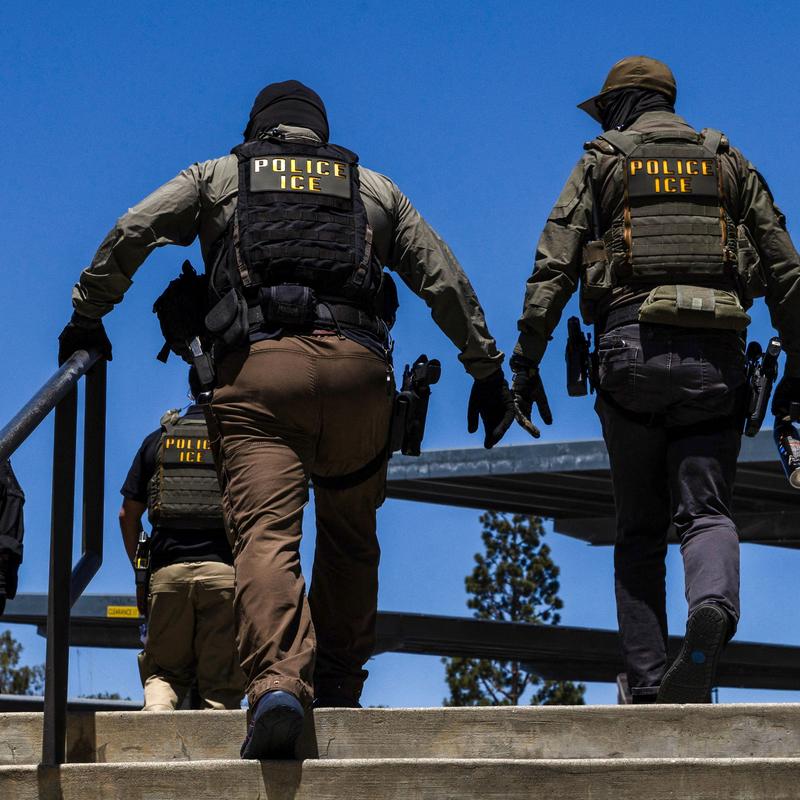
Micah Loewinger: Hey, you're listening to the On the Media midweek podcast. I'm Micah Loewinger. At the start of 2026, US Immigration and Customs Enforcement, or ICE, was top of mind for many Americans, in large part due to what the agency called Operation Metro Surge. The order sent nearly 3,000 agents to the Twin Cities in Minnesota, resulting in thousands of arrests and two US citizens shot dead by ICE agents. There were nationwide protests, congressional hearings, and plenty of headlines. As the weeks went on, ICE faded a bit from the spotlight. The agency was still arresting and deporting thousands, and ICE shot even more people.
News clip: Two fatal shootings this month involving Immigration and Customs Enforcement officers have reignited protests and renewed questions about tactics, training, and recruitment at the agency. Two men were killed in these latest stops. In Houston, Texas, it was 52-year-old Lorenzo Salgado Araujo, originally from Mexico. In Biddeford, Maine, it was 26-year-old Joan Sebastián Durán Guerrero, originally from Colombia. None of the agents involved were wearing body cameras, and neither of the victims were the intended targets of the operation.
Micah Loewinger: The violence and another uptick in arrests have renewed scrutiny of the agency at the heart of Trump's anti-immigration efforts. In January, I spoke with Joseph Cox, investigative reporter and co-founder of 404 Media, to talk about the array of tactics and technology ICE was using, and I decided to call him back to ask about the new tools and strategies it's added since then.
Joseph Cox: ICE continues to spend money on all sorts of data and surveillance technology. There is location data harvested from smartphones, there is access to license plate information. There is personal information that ICE is buying from Thomson Reuters and a bunch of other companies as well. Of course, listeners will know Thomson Reuters for running the Reuters news agency. The company is also a massive data broker, and they sell all sorts of private information to the government and to private clients.
Just recently, funnily enough, a day after President Trump went on an unhinged press conference about voter security and election fraud, we reported that ICE is going to pay Thomson Reuters another $125 million for a bunch of personal data to investigate not just immigration fraud, but what they describe as voters fraud. If anything, and I'm reading the tea leaves here, you go through these documents, and you can see what the President is saying publicly about voter fraud, alleged voter fraud, and election security. It's then being reflected in the US procurement documents as well. They are absolutely echoing one another.
Micah Loewinger: You may not know the answer to this, but ICE, voter fraud? How does this body even have jurisdiction to be investigating these allegations?
Joseph Cox: How it fits into ICE's mandate is that technically the data is likely to end up, according to the records, with HSI, Homeland Security Investigations. This is a division of ICE that has traditionally been focused on cybercrime, money laundering, child abuse imagery, real legitimate criminal investigations. As we know from data that was published by the Cato Institute, something like 90% of HSI officials were actually redirected to ICE's main mission, which is finding people to deport, obviously. That's not dried up, obviously, because there's still a lot of people being detained.
Fraud, even if it's baseless claim to voter fraud, would probably technically fall under HSI's remit as well, because it has that fraud word in it. This is still like early days. I am reading between the lines of these procurement records, but they say in black and white there they want to use this data to investigate voter fraud.
Micah Loewinger: Talk a little bit about Thomson Reuters product CLEAR. This is not the same CLEAR that travelers might encounter in some airports. What exactly is this service? What is ICE getting out of this contract?
Joseph Cox: The CLEAR Investigative database sold by Thomson Reuters collects all sorts of public and private data. When I say public, that can be like stuff from court records, it could be property information, corporate ownership, all of the stuff that is technically public. If you were to investigate an entity or a business, you'd have to go and dig around potentially a little bit to go do it.
Then it has more private stuff such as credit header information. Not to get too technical, but this is the bit at the top of your credit report. It's not how much credit you have or anything like that, but it's your name, it's your address, your email address, maybe a phone number, that sort of thing. Thomson Reuters in this CLEAR product isn't just about the data, it's that it's a single dashboard to link all of these pieces of information together. I can type in a name or Social Security number or some identifier, and I can then zoom in on that person.
Micah Loewinger: Yes, let's just linger on that for a second because I think when most of us sign up for a credit card, say we're chasing rewards through our bank. We don't think or know that this personal information might find its way to ICE or some other law enforcement. I mean, how is that legal?
Joseph Cox: This is America. [laughs] I don't think you get away with this in Europe. Data collected by a company for one purpose is so often leveraged and sold and repurposed for another. The credit header stuff has actually been going on for years and years and years. I've reported how bounty hunters are able to access the information. Private investigators as well, they use it literally all the time. Repo men as well.
Now, when ICE is obsessed with getting people's addresses, I thought it was worth digging specifically into how ICE is getting the information, which most people, as you say, when they go and open a credit card with any bank or financial institution, I don't think people think it's even going to leave the bank. It does leave the bank, and it goes to credit bureaus, and then it leaves them, and then it ends up in the hands of a law enforcement agency, and specifically ICE, who can query it, they can search it, they can analyze it all without a warrant, just because this is how privacy works in the United States. There is no federal privacy law that would block this thing.
The last thing I would just say on that is that towards the end of the Biden administration, the Consumer Financial Protection Bureau, they were very explicitly investigating the sale and the transfer of credit header information. They were going to propose a new rule that would maybe not outright ban it, but put some limitations on it. The second Trump administration comes in, not only do they get rid of that rule, they essentially kill the entire agency.
Micah Loewinger: ICE is the beneficiary of there being no guardrails in this data broker industry. Where else are they getting this information?
Joseph Cox: A lot of other places. The location data from your smartphone, that similarly has very few protections. I've also reported that ICE has been purchasing or somehow accessing insurance claims data as well, related to car accidents or to medical claims. I could go on and on and on, and we would be here for a very, very long time, frankly. I almost feel like I can't remember all off the top of my head. The point is that they want to get every information, essentially, that is going to be beneficial to them for locating somebody, a person of interest, an entity of interest.
I think I feel comfortable saying that because I spoke to some people who attended a recent Border Security Expo, and there was a senior ICE official there, Matthew Elliston, I believe. He was talking about how we're open for business, essentially, that if you have an interesting product or an interesting data set that you would like to sell to ICE or DHS, come talk to me. The people who were at that conference told me that after this senior ICE official spoke, there was a very long line of people who wanted to talk to him.
Micah Loewinger: Wow. This is like the panopticon. They're just building it. It's disturbing, too, that they are seeking information that had once been walled off to them. They're attempting to use tax information that immigrants had given to federal agencies because they were led to believe it would not be used for this purpose.
Joseph Cox: Yes, the idea was that if you're an undocumented person, you would still pay your taxes and provide that information to the IRS and obviously pay the money that you were required to do so. In exchange, the IRS promised, "Well, we're not going to then use this for immigration enforcement." Now that firewall has been completely shattered. There is a back and forth in the courts where IRS has provided some information to ICE. They've used it. A judge says, "You can't do that."
Micah Loewinger: The original deal between the IRS and ICE made in early 2025 was that the IRS would give ICE taxpayer identification numbers and last known addresses for over 1 million people. US District Judge Colleen Kollar-Kotelly temporarily blocked the IRS from sharing data in November 2025. Judge Indira Talwani of the US District Court for the District of Massachusetts also ruled against data sharing in February of this year. Yet the battles keep going and going.
Joseph Cox: There's all of that IRS stuff happening in the courts. In the meantime, I came across a very interesting $10 million purchase in the US government procurement records. It said that ICE was trying to buy ITINs. I-T-I-N. That is the tax identifier given to undocumented people. When I showed that to Senator Ron Wyden, he gave me a statement and said, "It sure looks like ICE is trying to buy the data that they technically weren't allowed to get from the IRS." I do think that signifies something in that when ICE can't get a certain data set or type of information in one way, they might just try to purchase it another way or get it from another provider entirely.
Micah Loewinger: Can you put into perspective the amount of information ICE and Customs and Border Patrol are buying right now?
Joseph Cox: A lot of law enforcement agencies like the FBI or the DEA or ATF or whoever, they usually will buy data from a provider like LexisNexis or Thomson Reuters, something like that, on a case-by-case basis, obviously. The difference with ICE, at least from the contracting records I've read, that they're even prepared to pay basically twice for the same data if it means they can get it even quicker. When I was going through this Thomson Reuters $125 million procurement record, they hint at, in the contract itself, "We actually already get some of this data from another contractor that feeds this information through to us. We want it quicker, and we want it in bulk. We're going to pay for this again, even though this is going to cost ICE more money."
Micah Loewinger: The last time we spoke, we talked about some of these data purchases, but also how ICE was expanding its use of tech on the ground. You've written a lot about an in-house facial recognition app called Mobile Fortify. Is that still in use?
Joseph Cox: Mobile Fortify is absolutely still in use. Picture the facial recognition system that you have to go through if you enter the United States and potentially exit United States as well. This is run by Customs and Border Protection. What ICE's Mobile Fortify app does is take that system, which traditionally was housed at the border, and turns it inwards, and puts it onto ICE officials' mobile phones. They can then go up to somebody on the street, point their smartphone camera at them, scan their face, and the app will then query, I think, an unprecedented number of government databases, at least for an app being used inside the country. That's DHS stuff, that's FBI databases, some other ones as well. It will bring up the person's alleged name, date of birth, and most importantly for ICE, whether they've been given a final order of deportation or not.
We really saw it take off during Minneapolis and Minnesota. We saw it in action there. Then later on, I was relayed these talking points from a senior ICE official at a border security expo. He said that the app has been used something like 200,000 times in the field. He claims that this app does not make mistakes. I don't think he reads our website because we've reported this technology is not foolproof. It can make mistakes, and it is being deployed en masse inside the United States, especially during these big surge operations that we've seen.
Micah Loewinger: As you wrote earlier this year, ICE told lawmakers that Mobile Fortify "provides a definitive determination of someone's immigration status and should be trusted over a birth certificate." Of course, facial recognition technology is not 100% reliable. It's been known to misidentify people, especially Black and brown people.
Joseph Cox: Yes, that birth certificate line is still shocking to me, even though I was the one that reported it. The idea that a piece of technology as faulty as facial recognition or even just an app in general can override somebody's birth certificate is still crazy.
Micah Loewinger: According to a lawsuit filed by the ACLU, a 56-year-old ICE watcher in Minnesota was approached by an ICE officer who the woman says already knew her name because he had used facial recognition technology. Now a similar app is being offered to local police. This is something you've reported on as well.
Joseph Cox: ICE and Customs and Border Protection. There are some moving parts here, but they plan to offer a stripped-down equivalent of Mobile Fortify to local police departments called Mobile Identify. I found this on the Google Play Store. I contacted Google for comment. I contacted ICE for comment. The app then disappeared for some reason, which is still not entirely clear to me. I did obtain an internal DHS document where they laid out, "We want to give this to law enforcement agencies that are part of the 287(g) program."
For those who aren't familiar, this allows local and state law enforcement agencies who they're not part of ICE, they're not part of DHS, they are local cops, but it gives them certain immigration related enforcement powers. They can detain somebody in the process of a traffic stop if they suspect they are an undocumented person. The idea is that this app will help them do that. They will again scan somebody's face, and it would tell them, "Hey, contact ICE about this person, here's your confirmation code, provide that to ICE, and then somebody will come assist you."
ICE not only wants to streamline the immigration detention process with technology, but also by essentially outsourcing it to 287(g) agencies as well. I don't think that's fully taken off yet, but I can imagine it being a next phase in immigration enforcement.
Micah Loewinger: Across social media, I've seen a real awakening around Flock Safety. This is the tech company that installs cameras around small towns and cities, which allow local police to track cars through Flock's automatic license plate readers. On its website, Flock says it doesn't work with ICE, but last year, 404 reported that ICE agents were getting access to Flock's data with help from local law enforcement. How much is that still going on?
Joseph Cox: Yes, so we reported that in May 2025, and that triggered a national conversation about Flock, which is still ongoing. There are other components of it. We also found that a woman who self-administered an abortion was tracked via Flock. Including--
Micah Loewinger: What?
Joseph Cox: Yes, including a Texas police official search cameras all over the country for this person. That's the key thing about Flock is that when a police officer searches it, either for their own agency or maybe for Immigration and Customs Enforcement, they are not necessarily searching just cameras in their own town or city, or state. This is obviously of great concern when it comes to immigration, because certain states are going to have a different stance on immigration and undocumented people than other states as well.
We report that in May 2025, it starts this national conversation. There are a bunch of changes, like Flock introduces new guardrails inside its products. Californian agencies remove themselves from the national network so they can't be searched by officials in other states. I think it happens in Illinois as well. There are still pockets of it happening, though. Querying this dataset doesn't require a warrant. There's no like, "Hey, here's our case, here's our probable cause. You're a judge, please sign it. Now we'll search the Flock system."
You log in with a username and password and maybe a two-factor authentication token, and then you can search whatever you want. That's because technically these are cameras in public places taking images mostly of public spaces. Under the American understanding of privacy, and in a legal sense, you do not need a warrant to query or obtain that information. That is being challenged by some civil rights groups. That is why there is so much room for abuse with this technology.
Micah Loewinger: It did seem like the intensity of the backlash against ICE earlier this year started to abate, at least until the two fatal shootings this month. How do we as reporters and news consumers keep this stuff front of mind and not just let it fade into the background again?
Joseph Cox: It's a really, really hard problem. There are issues of the attention economy, people's own appetite for this sort of thing, their fatigue when it comes to this. I think based on the pattern that we've seen from ICE and DHS, this is the norm now. I don't think there's going to be a constant baseline of activity, at least visibly. We're going to have these surges. I am concerned that both readers and listeners and viewers on one side and journalists will, frankly, get tired of it, and just feel like, "Oh, this is normal now."
I feel it's really important to keep reporting on this and what is actually happening, even if it's not, in a journalistic sense, like a scoop every single time. It's just it's important to document what is happening so individual communities can decide what they want to do. Whether it comes to Flock cameras or ICE raids or the data broker economy, or whatever. It happened to Minneapolis. In six months, it's going to happen somewhere else. Those people deserve coverage just as much as Minnesota did, of course.
Micah Loewinger: Joseph, thank you for doing this work. Thanks for coming on the show.
Joseph Cox: Absolutely. Thank you so much.
Micah Loewinger: Joseph Cox is an investigative reporter and co-founder at 404 Media. Thanks for listening to the midweek podcast. Don't forget to listen to the big show this weekend. In the meantime, you should check us out on Instagram, TikTok, and Reddit. Just search On the Media. I'm Micah Loewinger.
Copyright © 2026 New York Public Radio. All rights reserved. Visit our website terms of use at www.wnyc.org for further information.
New York Public Radio transcripts are created on a rush deadline, often by contractors. This text may not be in its final form and may be updated or revised in the future. Accuracy and availability may vary. The authoritative record of New York Public Radio’s programming is the audio record.