
How to Live Forever (or Die Trying)
Correction issued 10/23/26 to clarify Saul Newman's role as a demographer and research fellow at The Oxford institute of Population Aging.
Micah Loewinger: On this week's On the Media, some tech titans want us to think they can turn back the clock and end aging as we know it.
Walter Cronkite: We have here among the VIPs, one very unusual man. He's at least 130 years old. His name is Charles--
Speaker 1: Here's a question to think about. It's about longevity. What if aging gracefully is something you can actually control? Yes, please.
Naomi Klein: This is a very important idea for Peter Thiel, who defines himself as a libertarian. One of the things he is trying to free himself from is the tyranny of mortality and the idea that our bodies do die.
Astra Taylor: The tagline of this conference was, "Maybe if you're not trying to destroy the world, you're not trying hard enough."
Saul Newman: If I took Jeff Bezos and shook him by the collar and said, "You are going to fund plant science," he could fund it for 1,000 years for what he's put into this vanity project of not dying.
Micah Loewinger: Is the future world they're planning for the kind worth surviving for? It's all coming up after this.
[music]
Micah Loewinger: From WNYC in New York, this is On the Media. Brooke Gladstone is out this week. I'm Micah Loewinger.
[music]
Micah Loewinger: In late September, the second annual MAHA, Make America Healthy Again, summit took place in Washington, DC, featuring panels with Health and Human Services Secretary RFK Jr., administrator of the US Centers for Medicare & Medicaid Services Dr. Oz, and Vice President JD Vance. About five hours in, this man took the stage.
Bryan Johnson: Hi, you guys. I'm going to use my time to give you guys a biological age test, so everyone stand up.
Micah Loewinger: Tech founder Bryan Johnson, who reportedly spends $2 million a year trying to crack the code for immortality. Among other things, he's known for injecting himself with the blood of his teenage son and taking hundreds of pills a week. During his panel, he told the audience to stand on one foot and stay upright for as long as possible.
Bryan Johnson: If you got between 0 and 7 seconds, your biological age for this test is 60 to 80. 7 to 15 seconds is 40 to 60. Beyond 15 seconds to 30 seconds is age 20 to 40.
Micah Loewinger: After the audience, one by one, lost their footing, Johnson continued on.
Bryan Johnson: Why can't the United States of America lead the world in healthspan? Why can't we be Monaco, which is 86.7 years? We're at 79. Why can't the US be number one? Why can't we be the longest-lived citizens in the entire world?
Micah Loewinger: Bryan Johnson is one of the most recognizable faces of a burgeoning longevity industry that has captivated MAHA, wellness TikTok, and the healthcare sector. There are now over 80 longevity startups, some of which are backed by billionaires like Sam Altman, Jeff Bezos, and Peter Thiel. It's big business. Right now, the concept of longevity is everywhere.
Speaker 1: Here's a question to think about. It's about longevity. What if aging gracefully is something you can actually control? Yes, please.
Speaker 2: There are people walking alive today that are going to live to 140-plus.
Speaker 3: Really?
Speaker 2: No question.
Speaker 4: Anti-aging hacks mainstream medicine doesn't want you to know about. Number one, supercharge your longevity molecule. NAD+ is the master molecule of aging. Two, destroy zombie cells. Three, utilize peptides.
Micah Loewinger: This hack in particular, self-injecting untested peptides that some influencers claim can extend your life, treat insomnia, heal injuries, grow muscle, tan your skin without UV exposure, and more, has become a social media darling.
Robert F. Kennedy Jr.: Yes, I'm a big fan of peptides. I've used them myself-
Micah Loewinger: Health Secretary RFK Jr. on The Joe Rogan Experience in February.
Robert F. Kennedy Jr.: -and used them with really good effect with a couple of injuries.
[music]
Micah Loewinger: With the erosion of our regulatory and public health systems, the opportunities for harmful hype and grift are growing. This week, we're devoting the full hour to the allure of living longer by changing our bodies or even changing society itself. We'll start with a new book out this week titled Morbid: Debunking Modern Longevity Science. After reading reviews in The Guardian, The New Yorker, and The Wall Street Journal, I thought this would be a wonky but conventional exploration of a niche topic.
When I got a hold of it, I was surprised by the book's irreverent and, at times, antagonistic tone. Its author, Saul Newman, is not a traditional demographer, the type of scientist who is commonly engaged in this kind of work. Nowadays, he's a research fellow at the Oxford Institute of Population Ageing. Around a decade ago, when he started critiquing the field, he was studying plant genetics for the Australian government.
Saul Newman: It was almost against my will that I got drawn into this. I had this reaction like seeing a car crash on the freeway, and I got sucked in.
Micah Loewinger: He was drawn in by a bitter feud in the field of longevity, a debate over how aging affects us as we grow older.
Saul Newman: The way we measure that is very simple. We measure the rate at which you die. The rate at which you die doubles every roughly seven or eight years. They keep doubling until I die. That's the single best measure of aging that we have.
Micah Loewinger: There's two camps, as I understand it, in the field of longevity science. Break it down. Who are these two sides, and what exactly are they arguing?
Saul Newman: There's one camp that says there is a single limit to human life. There's just one number that you can't live past. We don't know what that is. There's this big argument about what the value is. That's camp one. Camp two is this group that thinks aging stops in old age. Things don't get better, but they don't get any worse. Your lifespan is not limited here. You can get a long run of lucky cards at the table, if you like. Sooner or later, you're going to lose, and you'll die. These two camps have been fighting it out for decades.
Micah Loewinger: Rather than picking a side, Newman found faults with both.
Kerry Howley: He had come across two papers in the field of old-age longevity, litigating this very old debate about the potential limit to human lifespan.
Micah Loewinger: Kerry Howley is a staff writer at New York Magazine who profiled Saul Newman and his quest to blow up the field of longevity science.
Kerry Howley: Saul, being a very meticulous data scientist, found both of these papers egregious in the way they were using data.
Saul Newman: It was a disaster. You saw these massive problems in the top-level journals in science.
Kerry Howley: He had come to this field very much from the outside. He's not a demographer, and so take that for what you will.
Micah Loewinger: Because of his lack of traditional training in the field, many leading demographers didn't think he had standing to be making such aggressive attacks. Later, when Kerry Howley began asking longevity scientists about Newman's critiques, they said they were "totally inappropriate, just plain offensive, misleading, and potentially libelous." The pushback didn't deter him one bit.
Kerry Howley: Right from the beginning, he was primed to find fault with this entire field. I think he went looking for further evidence of malfeasance and poor statistical practice, and he absolutely found it.
Micah Loewinger: In his book Morbid, Newman dives into story after story of famous centenarians, 100-year-olds, and supercentenarians, even older people, who turned out to be frauds because, he argues, some government records, including birth records, are incomplete or unreliable.
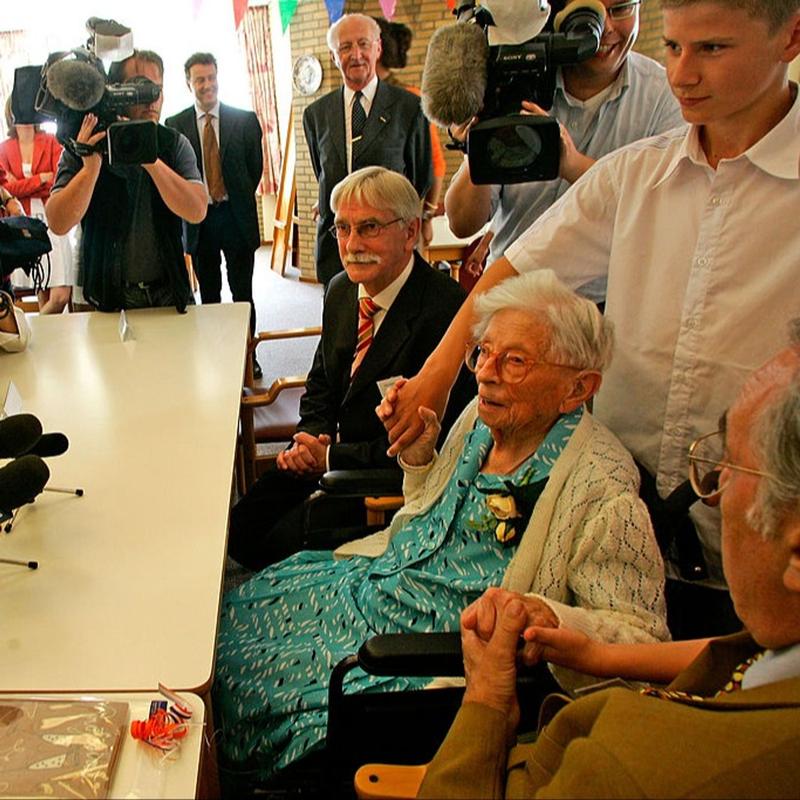
Saul Newman: I'll give you a colorful example, if you like. Charlie Smith was the oldest man in America, but the way he became the oldest man in America was that he was working in a field picking fruit, and his boss said, "Charlie, you've got to get some paperwork." The Social Security Administration finds him some paperwork that says he's 113, and promptly loses the paperwork. Charlie just goes with it. [laughs]
Micah Loewinger: In 1979, the Guinness Book of World Records deemed him the oldest man to have ever lived, at the age of 137 when he died. As you detail in your book, the press back then loved this story.
Walter Cronkite: We have here among the VIPs, one very unusual man. He's at least 130 years old. His name is Charles Smith.
Micah Loewinger: CBS invited him to attend the launch of Apollo 17. You can still watch this interview of him on Walter Cronkite's program, telling Neil Armstrong and company that there's no way that they're going to go to the moon, that it's just not possible.
Charlie Smith: What's going to hold that plane up in the air? What's going to hold it up there? The moon ain't going to hold it.
Micah Loewinger: After his death in 1979, researchers discovered a marriage certificate that would date him to about 105 years old, not 137, which is Newman's point: It's just not that hard to fake this stuff.
Saul Newman: World War II, Congress passed a law saying that only people who were Americans could work in wartime industries. Now, this presented a problem because almost half of the working population did not have any paperwork whatsoever. The US government simply decided to give birth certificates to whoever turned up to the post office based on whatever age they swore they were. They just stamped them out at rates of 30,000 birth certificates a month to people who were already fully grown. The capacity for error in that is enormous.
Micah Loewinger: Then there are the errors that stem from authentic paperwork being misused. Take Sogen Kato, who was once considered to be the oldest man in Japan.
Saul Newman: Japan has a National Appreciation for the Aged Day. To celebrate this in Tokyo, they went around to find Tokyo's oldest man and congratulate him. His granddaughter comes to the door when they come looking for Mr. Kato, and she said, "Bugger off," effectively. The police become more and more concerned because every time they go around, she tells them to get lost. The police are like, "Well, better go have a look at this." He's been in his room for 30 years because he's dead. He's a mummified corpse, and his family have been collecting the pension the entire time. That's how he's reached 111. When the government of Japan go looking, they find 82% of the 100-year-olds in the country are dead.
Micah Loewinger: Newman fired off a lot more anecdotes like this: a corpse kept in a freezer in Italy, huge rates of pension fraud in Greece, which, to Newman, is evidence that, essentially, all of demography is built on suspect data.
Kerry Howley: Saul is saying it's impossible to do rigorous scientific study in this field with what's available.
Micah Loewinger: New York Magazine's Kerry Howley.
Kerry Howley: Last I spoke to Saul, his position was basically, "You can't trust paper records," but paper records are all that we have. There's no biological test for aging. I can't give you a blood test and figure out how old you are. I think most people within the demographic field would say, "No, there's good data and bad data." Someone who I found was universally associated with good data is this Belgian demographer named Michel Poulain.
Michel Poulain: You need a lot of documents, and the information that you'll pick in these documents should be fully consistent.
Micah Loewinger: I called up Michel Poulain. He's an emeritus professor at UCLouvain in Belgium. You might be aware of some of his research, a term he coined with his collaborator Gianni Pes called "Blue Zones."
Kerry Howley: Places that seem to have clusters of people who are living longer than usual. Starting in the year 2000, he had done research into a rural village in Sardinia.
Micah Loewinger: The Mediterranean island where, he had heard, people in the mountains were living to 100 or older at rates much higher than the average population.
Kerry Howley: He visited this village 50 times. There were good birth records. There were good death records.
Michel Poulain: At the end, about three months after I started, I was convinced that these people were really centenarians.
Micah Loewinger: He and his collaborator Gianni Pes called this cluster of villages a Blue Zone because they had marked the municipalities on a map with a blue pen.
Michel Poulain: I like the blue color, nothing else.
Kerry Howley: After the work in Sardinia, Michel was contacted by an American entrepreneur and journalist named Dan Buettner. Buettner had a large grant from National Geographic, and he said to Poulain, "Hey, let's go find some other Blue Zones. We have the money to do this." This is someone with the kind of vision and energy to create a movement out of what might have been a more obscure academic concept.
Micah Loewinger: After roping in some other researchers, Buettner published a cover story in the November 2005 issue of National Geographic, which he later expanded into a book, detailing five Blue Zones: Sardinia, Italy; Okinawa, Japan; Nicoya, Costa Rica; Ikaria, Greece; and Loma Linda, California, US.
Michel Poulain: When I discuss with Dan Buettner, he admit that he has to introduce this Loma Linda because National Geographic wanted to have a US taste in the system.
Kerry Howley: The publisher just wanted there to be an American Blue Zone.
Micah Loewinger: After multiple requests, Buettner did not agree to a sit-down interview. In a written statement, he said he based this particular Blue Zone on a study of the Seventh-day Adventist community in Loma Linda, which was found to have longer lifespans.
Michel Poulain: Up to now, we have no proof that Loma Linda is a Blue Zone.
Micah Loewinger: Buettner says there was not a formal definition of Blue Zones at the time, and that he and other researchers are working to develop one now. Nevertheless, for the better part of two decades, Buettner has built a booming business on the idea that people in a city in California, and in these exotic, far-flung places, had maybe unlocked the secrets of longevity. He's authored several cookbooks, like one titled The Blue Zones Kitchen: 100 Recipes to Live to 100. The Blue Zones company has offered consultations on how to improve health outcomes for towns and cities around the country for a hefty price. In 2023, Buettner hosted a four-part Netflix documentary.
Dan Buettner: I have found that most of what people think lead to a long, healthy life is misguided or just plain wrong.
Micah Loewinger: In the series, Buettner traveled to each of the so-called Blue Zones to observe the oldest of the old and "reverse-engineer" a formula for longevity.
Dan Buettner: What is the secret to living a long time?
Speaker 5: Community. If you're depressed, you're not going to live very long.
Dan Buettner: Everybody, even people into their 100s, have a garden. People in Ikaria have been drinking the same wine for over 100 generations, and they're living the longest. There's this concept in Okinawa called ikigai. I believe it's one of the most powerful factors contributing to their longevity.
Speaker 6: Ikigai is a kind of mission.
Dan Buettner: This is a Blue Zone right in an American suburb, an Adventist community where followers are defying the longevity odds.
Micah Loewinger: In 2020, Dan Buettner sold his company Blue Zones LLC to Adventist Health, a nonprofit affiliated with the Seventh-day Adventist Church, for a reported $78 million.
Kerry Howley: The Blue Zones brand is everywhere.
Micah Loewinger: Kerry Howley.
Kerry Howley: There's frozen food. There's canned soup. That is something that Poulain has never been comfortable with. One of the starkest examples of the division between them, Poulain says that Buettner went ahead and trademarked the term "Blue Zones," the term Poulain had originated, without his permission, without his even knowing.
Michel Poulain: Because in my way of working as a scientist, we are not very familiar with the concept of trademark.
Micah Loewinger: Poulain and Buettner ended up having a schism after one product in particular was marketed using the Blue Zones name.
Kerry Howley: Yes, I think that was the Chanel Blue Serum.
Commercial Narrator: Chanel has created Blue Serum, a skincare inspired by Blue Zones, regions of the world where people live better and longer, fueled with three antioxidant and revitalizing ingredients native to Blue Zones. Blue Serum--
Kerry Howley: Buettner had not been consulted, no royalties were being paid to Blue Zones, and so he wanted to sue. He asked Poulain to testify on behalf of the Blue Zones brand. At that point, I think Poulain was like, "This is too much. I'm being pulled into this legal quagmire to defend something I don't even believe in, essentially."
Micah Loewinger: In a written statement, Buettner told us that Michel Poulain did not come up with the name Blue Zones; his collaborator Gianni Pes did, and that Gianni Pes gave his blessing to use the Blue Zone term for his business. In an email, Pes told us he had no objection to Buettner's use of the term, but that he shares the credit for the Blue Zones name and concept with Michel Poulain.
[music]
Micah Loewinger: Enter Saul Newman, who takes issue with all of this: the early Blue Zones academic research and Buettner's Blue Zones brand. That's coming up after the break. This is On the Media.
[music]
Micah Loewinger: This is On the Media. I'm Micah Loewinger. We just heard about the origin story of Blue Zones, the early academic research from Michel Poulain and Gianni Pes, and the booming business built by Dan Buettner. Saul Newman says he's not buying any of it.
Saul Newman: I just thought it was funny that everybody took this so seriously. The central claim was that people in these regions live to remarkable ages, which is not true.
Micah Loewinger: In 2019, he published a viral critique of Blue Zones and other research drawing on old-age data. He estimates that 80% of people thought to be 110 and over are likely younger or dead. Seven years later, that paper has still not passed peer review, a fact that his critics often wield to say his attacks on the field lack merit, but Newman's narrative that there is something seriously wrong with the field of longevity science has started to stick.
[applause]
Announcer: The Demography Prize. The winner is Saul Justin Newman.
Micah Loewinger: In 2024, he was awarded an Ig Nobel Prize, a satirical science award for achievements that, "First, make people laugh, and then make them think."
Saul Newman: The Blue Zones are poor, the records no more, the 100-year-olds are all crooks.
[laughter]
Micah Loewinger: He delivered his acceptance speech in verse.
Saul Newman: The secret, it seems, to live out your dreams, and make sure you keep living, not dying, is to move where birth certificates are rare, teach your kids pension fraud, and start lying.
[laughter]
Micah Loewinger: As Newman explained in our interview, it's not just that he thinks the data in Blue Zone countries is bunk. He thinks that the lifestyle lessons that Buettner has drawn are not supported by the data.
Saul Newman: I'll give you an example: the idea of move naturally. I'll read you the quote from Mr. Buettner: "The world's longest-lived people don't pump iron and run marathons or join gyms. Instead, they live in environments that constantly nudge them into moving without thinking about it. They grow gardens." That's the quote. What's the reality? Well, the reality is, of the 47 prefectures of Japan, Okinawa has always had the worst body mass index, and that includes people who are aged over 75.
Even this claim that people grow gardens in Okinawa, well, the government of Japan measure the percentage of the population that grow gardens. They are third-last in Japan after Tokyo and Osaka, where nobody has a garden. This extends to this idea that there's lots of vegetarianism. The government of Japan measure the diets of people in Okinawa. They are last for the consumption of root vegetables, last for the consumption of leafy vegetables, last for the consumption of pickled vegetables. Now, in the Netflix documentary, there's a beautiful purple sweet potato on the cover image. Okinawa eats less sweet potato than every other prefecture in Japan, by this massive margin.
Dan Harris: What's your pushback on that?
Dan Buettner: You're probably referring to a plant scientist by the name of Saul Newman, who wrote one paper which actually wasn't accepted by an academic journal.
Micah Loewinger: Dan Buettner on the 10% Happier podcast in 2024.
Dan Buettner: He correctly cites Okinawa's high rates of obesity, but what he doesn't do is go back 25 years when I started my work to discover that actually then, they were producing the longest-lived people in the world, and it has deteriorated in the last 25 years. Nothing I can do about that. It's something I readily acknowledge in my writings and in Netflix.
Micah Loewinger: To Buettner's point, a recent peer-reviewed paper, which revisited the research methods of Michel Poulain and other demographers, found that the data and methodology behind the original Blue Zones holds up. There was no reference to Loma Linda, but the authors found that Okinawa was a "Blue Zone at the time," but likely wouldn't qualify today. When I asked Poulain about this new defense of his work, he shrugged it off and said he didn't think it needed to be vindicated. More broadly, he cautioned against drawing too many conclusions from, say, the habits of the centenarians he studied in those Sardinian villages.
Michel Poulain: The genetics is probably important, but we have no possibility to prove it. What we look is mostly the lifestyle, how these people are living. What are they eating? What are they doing in terms of exercise?
Micah Loewinger: Is this a case of correlation but not causation?
Michel Poulain: It's exactly the case. It is association.
Kerry Howley: I talked to someone named Nir Barzilai, who is at the Albert Einstein Center for Medicine and who studies centenarians. He said, "I think it's genetics. Maybe some people reach 100 just by being good." The centenarians he studied, he said, "are actually not good." That's his quote. He's like, "They're smoking. They're obese. Only 50% of them are even doing moderate exercise."
Micah Loewinger: Ah, that's so annoying.
Kerry Howley: [laughs] Yet, they get to be 100, so it's really not clear what you can take from the Blue Zones, but I don't know that you'll see much acknowledgment of that within the larger Buettner-branded Blue Zones empire.
Micah Loewinger: While Buettner's cookbook title would have you believe that eating his recipes will help you live to 100, in interviews, he often refers to the lifestyle habits of Blue Zone centenarians as common denominators or correlates of longevity, an apparent nod to the associations that Poulain discussed. He also points to the famous Danish Twin Study from 1996 to argue that only about 20% to 25% of how long a person lives is dictated by genes, suggesting the rest is up to our choices.
A 2026 paper published in Science argues that prior estimates were too low and that genetics likely account for over 50% of a person's lifespan. For a better sense of what's really in our control and not just written into our DNA, Saul Newman says we're better off ignoring Blue Zones and the claims about extreme old age, and instead looking at countries with high-average lifespans.
Saul Newman: It's rich, boring places with good health care, like Switzerland, Norway, the rich, boring parts of Japan. That's where people live the longest. Anywhere with free universal healthcare and high incomes is where people live a long time.
Micah Loewinger: I'm quite curious to see the impact of Saul Newman's new book. On one hand, I've become convinced that this field would benefit from a serious refresh. On the other, there's a way that Newman talks and writes about this stuff that can make it sound like no one has thought to question any of it before, which just isn't true.
Michel Poulain: Among my colleagues, we are talking a lot about the validity of age. We are trying all the time to improve our investigation in this case.
Micah Loewinger: Michel Poulain told me he's grown tired of what he calls the "noise" around Blue Zones. He says he's happy to debate any of this, but just wish more of it happened in person rather than in media coverage, like the piece you're listening to right now.
Michel Poulain: The best thing for Saul Newman is to come within such a group and to discuss. It may be that we have not the same opinion, but please, let's sit on the same table.
Micah Loewinger: You're basically saying, "Come and say it to my face, Saul."
Michel Poulain: Yes, why not? [chuckles]
Micah Loewinger: To read Dan Buettner's full statement, go to onthemedia.org.
[music]
Micah Loewinger: There was something that came up in my conversation with Saul Newman that didn't make it into the piece you just heard. We were discussing what really feels like a new era of Wild West snake oils: the explosion in peptides, influencer-endorsed supplements, and shady biotech startups. According to Newman, much of this is a function of class.
Saul Newman: These promised solutions ebbed when American science was on the rise. The reason we're seeing this massive resurgence in longevity treatments, especially in America, is that if you cannot afford the real medicine, you buy the fake stuff. That is not going to get any better in the current environment.
Micah Loewinger: Then there are the people who can definitely afford the real medicine, but still indulge in the unregulated treatments. People like Bryan Johnson, the venture capitalist who spent millions experimenting on his own body. I asked Newman what he thought of the Silicon Valley tech titans chasing these new-age cure-alls.
Saul Newman: They're extremely rich, and they've bought everything else. They're afraid of dying, so they are, in a sense, a millennial opportunity for grifters. These people are being sold this idea that, "Give us a huge amount of money, and you won't die." Nobody's logging on from the grave to give you zero stars. There's no repercussions. When I think about Bryan Johnson, I think of the man as part-perpetrator, part-victim. He could survive for 1,000 years, and he wouldn't have lived a day of it. The man is scared of candy bars. His life appears to be miserable. It's just the process of selling fake cures to rich people.
Micah Loewinger: It's worth noting that he's recently been diagnosed with an autoimmune disease. In July, he tweeted, "Been thinking things over and wonder if I've taken this whole longevity thing too far."
Saul Newman: I think his reaction to getting an autoimmune disease was extremely telling because he said initially that the reason he got it was he ate too much sugar in his 20s. Clearly, he views disease as a personal failing, and I think that really pulls apart the problematic thinking at the heart of this. The billionaires who are investing in longevity are not doing it for someone else. They're not thinking about the people who will be living when they're gone. They're thinking about me, me, me.
Micah Loewinger: Near the end of your book, you bring up the example of scientists from the Philippines and China engineering a type of rice that can regrow itself eight times. Rice usually dies within months and has to be replanted and re-fertilized every single season. It's possible now to engineer plants away from their usual death schedules. That's a very exciting achievement, but why did you want to end your book on this example?
Saul Newman: Partly because I think it's beautiful. Largely, women are rice farmers. They're almost always poor, and they skip school to do it. To have your rice just come back out of the paddy eight times is a beautiful achievement. The contrast I wanted to make is between the scientists who did this, who are driven by curiosity, and the people who are driven by profit motives.
In my desk drawer in Australia, I had two wheat plants that differed in lifespan by 50%. They had a single gene that differed between the two. The only way we got to that level of understanding was funding basic fundamental science, not some guy who's promising, "I'm going to make you biologically younger next week," like real, fundamental science. I wanted to contrast the extraordinary nature of those breakthroughs, which are being quietly achieved on absolutely zero money, with the nonsense that is getting funded by billionaires who are scared to die.
If I took Jeff Bezos and shook him by the collar and said, "You are going to fund plant science," he could fund it for 1,000 years for what he's put into this vanity project of not dying, and he could do something that benefits every single poor person on Earth. I want what's good in the world, right? I want a wheat that you plant once and keeps growing for 10 years.
[music]
Micah Loewinger: Billionaires are pouring money into longevity startups to try to live forever, which raises the question: Is the future world they're planning for the kind worth surviving for? Nowhere was that question more relevant than Peter Thiel's secret apocalypse ball, hosted in a beachside Miami hotel just days before the 2024 election. The dress code: black tie or dystopia.
Naomi Klein: People were encouraged to wear very risqué costumes. Somebody dressed as a "Haitian chef," and he was apparently cooking cats and dogs.
Micah Loewinger: The party was the lavish ender to Hereticon, an exclusive three-day conference for "thought crime."
Astra Taylor: The tagline of this conference was, "Maybe if you're not trying to destroy the world, you're not trying hard enough."
Micah Loewinger: Naomi Klein and Astra Taylor are co-authors of a new book, End Times Fascism: And the Fight for the Living World, which traces the emergence of a distinctly 21st-century flavor of fascism.
Astra Taylor: They were talking about colonizing Mars and seasteading, which is the idea of starting free-market countries on maybe abandoned oil rigs or cruise ships.
Naomi Klein: Bryan Johnson was there, and he presented on how to live forever. This is a very important idea for Peter Thiel, who defines himself as a libertarian. One of the things he is trying to free himself from, in addition to taxes and regulations, is the tyranny of mortality and the idea that our bodies do die.
Astra Taylor: Peter Thiel's top protégé is JD Vance. We're very struck by this gathering because a few days later, their friends were in power in the White House, so they were no longer heretics, but rather some of the most powerful people on Earth.
[music]
Micah Loewinger: Coming up in the rest of my conversation with Astra Taylor and Naomi Klein, we cover data centers, med spas, space tourism, and more. This is On the Media.
[music]
Micah Loewinger: This is On the Media. I'm Micah Loewinger, returning with more of my conversation with Naomi Klein and Astra Taylor, the authors of the new book End Times Fascism. That's the term they came up with to describe this emerging ideology that's taken hold, not just in Silicon Valley, but in the White House. I asked Naomi to define the term and explain how it's distinct from the fascism that we think about from the 20th century.
Naomi Klein: We live in the era where we uniquely understand that we actually have the power to destroy our own species, and that has changed our imagination, our dreams, our streaming shows, our video games, our movies, but it's also changed the fascism that we are facing. We quote in the book Umberto Eco trying to define what he called "Ur-Fascism," what binds together the different iterations of fascism. He said fascism always has an Armageddon complex.
We're arguing that that Armageddon complex has really swallowed the whole project in that there is not a horizon for a future that is in our world. The fascists of the '20s and '30s in Europe were promising their base a future in their countries. They were promising a nice farm stolen from the Slavs, a home stolen from the Jews. When you listen to MAGA media or you pay attention to Elon Musk, the future is in the bunker, whether it is the bunkered nation protecting itself against invading hordes, or what we see from tech is super-intelligence uploading your consciousness to the cloud, rocket ships to Mars.
All of this bears a more-than-passing resemblance to the story of the end times in the Book of Revelation, that there are fires and floods and pandemics. All of this is to be welcomed, and indeed accelerated, because it is about to usher in the next stage of human evolution, utopia, a paradise in a gated city in the sky. We're looking at how that religious story is being embraced by people of faith, but also people who are not religious at all, but place their faith in technology, or in their own wealth, or in their supremacist nation-state.
Micah Loewinger: When we hear far-right figures speak in apocalyptic terms about the future of our country, are they not using this apocalyptic language as a kind of scare tactic?
Naomi Klein: In some cases, that's what's going on. I think it's important to understand that fascism always arises during moments of genuine crisis. We're not arguing that we don't live in a time of real crisis. The question is, how is the fear, the sense of scarcity and precarity, and rage that emerges when systems are failing people, how is that going to be channeled? What fascism does is it changes the topic.
Rather than having the topic be oligarchy, increased inequality, climate breakdown, pandemics, and the systems that have made us all so precarious, the emergency is other people. It pits us against each other. It's the oldest trick in the book. They're using the apocalyptic language as a rationale, but I think we are seeing people who are religious people who really do believe that every one of these disasters are felicitous signs that the end is nigh.
The problem with these prophecies is that they switch the signal from bad to good, right? We should be taking these as signals that we need to act. We need to get at the root causes of crisis. We need real solutions that are going to save the most people. Instead, it's like, "Okay, great, it's go time. Things are falling apart, and that means the chosen few are going to be saved."
Micah Loewinger: Let's talk about how that template, that model, has been used by tech titans here in the United States. You've called AI an inherently fascist technology. What do you mean by that?
Naomi Klein: Fascists want to control truth. Ideas that they disagree with are done away with, famously burned in the bonfires after Kristallnacht. In our era, you don't need to have a bonfire to banish ideas. You can program your AI to just never give certain answers. We look at AI holistically with a war that is being waged on universities, on the media. Any other sources of expertise are seen as a threat to the ability to spew out the correct answer from the truth machine.
Micah Loewinger: Musk has said that he wants to summon a digital god that can help solve hunger, disease, and poverty, that will bring about an age of abundance.
Astra Taylor: It's very striking how these tech executives speak about their inventions in these messianic terms. Musk is talking about AI as a demon, or maybe it's a god. We see this in all the headlines over the last couple of weeks, that perhaps AI is going to cause the extinction of humanity, or maybe it will cure cancer and unlock the secrets of the universe. We have to understand the rush towards artificial intelligence in the context of Silicon Valley's trajectory.
Silicon Valley was looking for their next big bet. Social media had saturated everything. Crypto was making some people very rich, but wasn't eating the entire economy. They see in AI the promise of a technology that can really dominate everything. It is that drive to control as much wealth as possible that is causing them to align with the far-right because they understood that people don't want this. Ordinary people aren't clamoring for a job-eating robot. By partnering with the Trump administration, they were able to get what they really wanted, which is to unleash this sector without regulations. That material drive is what's fueling the messianic framing, which echoes this end-times narrative.
Naomi Klein: Our book is not primarily about billionaires building bunkers. We are interested in how AI itself is a vision of heaven. We quote a really powerful environmental justice organizer in Memphis, Tennessee, who is taking on Elon Musk's data centers, KeShaun Pearson, head of Memphis Community Against Pollution. He describes AI as an energy vampire.
Micah Loewinger: Yes, you're referring to the chapter in your book about a neighborhood near Memphis called Boxtown, where Elon Musk has chosen to build his supercomputer that he's dubbed Colossus. It's a primarily Black and low-income area where his data center, called xAI, was using enough methane turbines to power 280,000 Memphis homes and spewed unprecedented amounts of nitrogen oxide and formaldehyde into the air. The leader of a local environmental justice organization called Boxtown a sacrifice zone.
Astra Taylor: People there are calling attention to the fact that AI does not have to be super-intelligent to cause massive harms. Elon Musk has said that the future of humanity is in space, which is essentially saying in the future, everywhere will be a sacrifice zone. When we look at Memphis, we see the future that's in store for the majority of humans on this planet. Their fight is our fight, and it is a fight for the living world.
Naomi Klein: There's a detail in that chapter that I think about a lot. We quote a Chicago-based organizer and writer, Kelly Hayes, who says every fascism has its subhumans. For the techno-fascists, humans are the subhumans because the goal is to merge with the machines.
Micah Loewinger: Let's talk about the backlash to these data centers. You brought up in the book how the classic deal with a factory, for example, a Ford factory built in Michigan, was, sure, you have to deal with the pollution and noise in your backyard if you live nearby, but there are opportunities. There's jobs, potentially economic revival for your community, but the data center doesn't offer anything of that sort.
Naomi Klein: That's really striking because one of the details about why Musk chose Memphis to build Colossus, to build his supercomputer, was that he was in such a rush because he needed to catch up to OpenAI, because of his famous battle with his old friend Sam Altman. He was looking for somewhere where he could find an empty building, so he wouldn't have to build the data center from scratch.
The reason he chose Memphis was because the Memphis Chamber of Commerce told him about this abandoned factory. It was an Electrolux factory that had moved to Memphis a few years ago and had gotten all kinds of tax incentives and tax breaks on the promise that they would get lots of well-paying factory jobs, ended up getting about 700 jobs, and then closed that factory.
Then the building is offered to Musk, who turns it into a data center. We call it a ghost factory because it looks like a factory, sounds like a factory, but there are almost no workers there. Indeed, even the security guard jobs, which are some of the only jobs that are being created, there's a company that is marketing robot dogs. They say that they never get sick, they never go on leave, and they're much more reliable than humans.
Micah Loewinger: In theory. If you've seen a video of a robot dog, they don't inspire that much confidence. They fall over, and they can't get back up.
Naomi Klein: They've seen the same movies as us and taken the wrong lessons, clearly.
[laughter]
Naomi Klein: To me, the fact that Musk moves into an abandoned factory that originally had hundreds of jobs is really a symbol of this race to the bottom and how little communities are being offered in exchange for all of these costs. This has a great deal to do with why data centers have become choke points for the larger societal questions that we all have about this technology and what it's going to be doing.
Micah Loewinger: Joe Allen, the tech correspondent on Steve Bannon's War Room podcast, has called AI "the greater replacement," basically acknowledging that AI is a bigger threat than the immigrants that his boss constantly talks about deporting. Steve Bannon and Bernie Sanders have recently teamed up at an event in DC, campaigning to rein in AI. Astra, how do you feel about this man who, in many ways, has helped infuse our politics with this xenophobic, conspiratorial, fascist language, now teaming up with Sanders to fight this technology?
Astra Taylor: Our view is that Bannon is actually trying to get ahead of his base. He understands that many of his listeners are skeptical of Big Tech. They don't want their jobs to be taken. We should be very skeptical of Steve Bannon. At that summit, he also gave remarks that were very telling. He talked about needing to build a moat around US technology, in other words, protecting the Big Tech companies.
He talked about needing to have a war with China to not let China win. As usual, taking the anxiety, totally legitimate fear that people are feeling, and redirecting that away from the economic and political elites towards outsiders. We have to be very wary of figures like Steve Bannon, while also understanding that he's speaking to real concerns. He said over a year ago that there's more loathing in the MAGA base for the tech executives than for the left.
Micah Loewinger: In the book, you write about the subgenre of dystopian film and television that depicts the future of our broken world. One example you point to was the 2013 dystopian thriller Elysium, starring Jodie Foster, in which the wealthy live in a luxurious space station just outside of Earth's atmosphere, while Earth has been reduced to an impoverished, dry hellscape policed by drones. Everyone dreams about ascending to the space station.
Computer Voice: Three undocumented ships are approaching Elysium airspace.
Jodie Foster: Shoot them down.
Naomi Klein: It does seem like this space tourism that is starting to emerge with celebrities going on short trips into the upper atmosphere is the more realistic vision, and that is what Elysium predicts: a world that has been turned into a giant favela, just absolutely desiccated, and this floating space station/med spa paradise for the rich floating just above the Earth.
What people most want to get to Elysium for is health care. Coming back to Hereticon and this idea that if you have enough money, you can live a lot longer than people who don't have any health care whatsoever. The director, Neill Blomkamp, is from South Africa. His imagination was shaped by growing up in an apartheid state. What we are describing in this book is really an apartheid world. The director did say at the time that he didn't consider it science fiction.
Micah Loewinger: You mentioned this emerging space tourism that people like Jeff Bezos have begun to realize. You made reference to the time when actor William Shatner, who, of course, played Star Trek's Captain Kirk, was invited on one of these trips in 2021. He said of the experience, "The contrast between the vicious coldness of space and the warm nurturing of Earth below filled me with overwhelming sadness. I discovered that beauty isn't out there. It's down here with all of us."
William Shatner: From there, I saw the vulnerability. I saw how tiny a speck of dust, we're less than a speck of dust in the universe, and how vulnerable our planet is, just to know how magical the Earth is, and how intertwined it is, how sad it is that it's in decline. That just makes me weep.
Astra Taylor: Jeff Bezos says that Blue Origin will bring about a future where there are trillions of people in the cold depths of space, and the Earth will be zoned light industry. He wants to save us from a future of civilizational stagnation, which is a way of saying humans living within the carrying capacity of the planet. Elon Musk is always promising dreams of space colonization, but he seems incapable of appreciating the wondrous beauty of our multi-species planet and all its diversity.
Part of our political proposal is connecting with that sense of wonder, reminding ourselves that this is a pretty great place to be, tapping into that feeling William Shatner spoke to. We don't have to go on a spaceship to feel that way. Go outside. Look at the sky. Look at the stars. Remember that this is a place worth fighting for. The paradise is actually on Earth.
Micah Loewinger: The Australian philosopher Glenn Albrecht coined the term "solastalgia" two decades ago, describing the psychological distress of seeing familiar landscapes that we love and identify with changing so drastically before our eyes. He called it "the homesickness you have when you're still at home." This is the feeling that many of us are contending with as climate change ravages our landscapes, as horrible political transformations happen in front of our very eyes. It's also the thing that fascists are so effective at harnessing and weaponizing through our emotions. How can other political groups grapple earnestly with these feelings? What kinds of stories do we need to fight back against end-times fascism?
Naomi Klein: We talk in the book about Hurricane Helene and the kind of heroism you see when people will get into a kayak and paddle to save strangers, and then go back and save their dogs. Those are the types of real-world-based stories, not fantasies, that we believe we need to bring into our politics because fascism is full of myths. It is all speaking in the language of grandeur and final battles. These data centers are all named Prometheus and Colossus. We're in favor of bringing back the language of myth into left politics as well. It can't only be material because the stakes are so high that they really are grand in a moment such as this.
Astra Taylor: We profile a lot of organizers and activists in the US and abroad. One person we profile is Aurora Gómez in Spain, and she's the leader of an anti-data center organization called Your Cloud Is Drying My River. She's also a psychologist, and she works with many patients who have suffered eco-trauma. One of her tactics for helping people see a path forward is actually to watch some of these science-fiction movies that we've been describing in community, and then to talk about alternative endings. We just thought that was a beautiful example of taking on these stories really directly.
[music]
Astra Taylor: We've seen this narrative. We see it every day. We see it in the movies and video games, this variation of the Armageddon myth, the most dangerous story ever told. Again, the template that goes back to the Book of Revelation. It's a reminder that these stories are collective stories. It's not like we can rewrite them on our own.
Micah Loewinger: Naomi Klein is an author, journalist, social activist, and a University of British Columbia professor of climate justice. Astra Taylor is a writer, documentarian, and co-founder of the Debt Collective, a union of debtors. They recently co-authored End Times Fascism: And the Fight for the Living World. Naomi, Astra, thank you very much.
Astra Taylor: Thanks for having us.
Naomi Klein: Thank you.
[music]
Micah Loewinger: That's it for this week's show. This episode was produced by Candice Wang and edited by our executive producer, Katya Rogers. Our technical director is Jennifer Munson, with engineering from Greg Rippin. On the Media is produced by WNYC. Brooke Gladstone will be back next week, for real. I'm Micah Loewinger.
Copyright © 2026 New York Public Radio. All rights reserved. Visit our website terms of use at www.wnyc.org for further information.
New York Public Radio transcripts are created on a rush deadline, often by contractors. This text may not be in its final form and may be updated or revised in the future. Accuracy and availability may vary. The authoritative record of New York Public Radio’s programming is the audio record.