
Grab Your Tin Foil Hat for The Onion's Takeover of Infowars
Brooke Gladstone: President Trump posted an AI image of himself in a manner that finally offended some of his biggest boosters.
News clip: Trump looking like Jesus healing some Jeffrey Epstein-looking dude sitting there on the bottom. It's blasphemy.
Brooke Gladstone: Trump's journey from the hand of God to the Antichrist. From WNYC in New York, this is On the Media. I'm Brooke Gladstone.
Micah Loewinger: I'm Micah Loewinger. Also on this week's show, the satirical newspaper The Onion is taking over Infowars and replacing the hate with comedy. Why?
Tim Heidecker: People need to hear other people like me remind the world that this is insane and try to do it in an entertaining way. Otherwise, people feel like they're going crazy and that they're alone.
Brooke Gladstone: Plus, Amy Goodman has been sounding the alarm on corporate media for 30 years.
Amy Goodman: People were saying, "Give us a break," but now they're saying, "Oh, please, yell louder. Yell louder."
Brooke Gladstone: It's all coming up after this.
Micah Loewinger: From WNYC in New York, this is On the Media. I'm Micah Loewinger.
Brooke Gladstone: I'm Brooke Gladstone. On Easter Sunday of all days, among President Trump's usual flurry of posts on Truth Social, one definitely stood out.
News clip: If your children are watching, be warned, the president did not use polite language. "Open the [bleep] straight, you crazy bastards, or you'll be living in hell. Just watch."
Brooke Gladstone: Then, a week later, with a vital assist from AI.
News clip: Donald Trump posted this edited image depicting himself as a Jesus-like figure healing the sick with miraculous light beams coming from his hands.
Donald Trump: I did post it, and I thought it was me as a doctor and had to do with Red Cross, as a Red Cross worker there, which we support.
Brooke Gladstone: David Gilbert, who covers disinformation in online extremism for Wired, has found these posts have pushed some former MAGA supporters over the edge. David, welcome to the show.
David Gilbert: Thanks for having me, Brooke.
Brooke Gladstone: Let's review some of the major former Trump supporters who got pushed over the edge.
David Gilbert: One of the people leading the charge was Marjorie Taylor Greene. She posted after the AI image went up that it's more than blasphemy, it's an Antichrist spirit. Then we saw Pastor Joel Webbon, who's pretty prominent in the MAGA world.
Pastor Joel Webbon: Do I think that Donald J. Trump is Antichrist? No. Do I think that he is an Antichrist? Many Antichrists have gone out into the world. Maybe.
David Gilbert: It is really, truly incredible that figures like Webbon are talking like this. They were willing to indulge Trump when he was this divinely anointed person by God to bring America back to its Former glory, but when he steps over that line, and I don't think Trump fully understands what he did because he really isn't a man of faith, he isn't really a practicing Christian, and posting himself as Jesus, it instantly turns people against him.
Brooke Gladstone: He really doesn't get them, does he?
David Gilbert: He gets their votes, and it's been like that for a long time. They've played a game to an extent, because lots of policies that they wanted to enact, they saw Trump as their best opportunity. He wasn't the person who went to church every Sunday. He wasn't the person who was able to quote a single Bible verse. He was once asked, "What's your favorite passage from the Bible?"
Donald Trump: I don't want to get into specifics.
Mark Halperin: Even to cite a verse.
Donald Trump: No, I don't want to do that.
John Heilemann: Are you an Old Testament guy or New Testament guy?
Donald Trump: Probably equal. I think the whole Bible is an incredible-- I joke very much so. They always hold up The Art of the Deal. I say my second favorite book of
all time.
David Gilbert: That was a long time ago. He's constantly portraying himself as this figure of faith, and it's very obvious that he has none, and yet the evangelical right are willing to support him through all of this up until the point that he said he was Jesus.
Brooke Gladstone: There's this guy, Clint Russell. He's the host of the right-wing Liberty Lockdown podcast. Is he an important guy?
David Gilbert: Again, he's another figure who, if you had said six months ago that he would be saying that there's a decent chance Trump is the Antichrist, which he said on X, I wouldn't have believed you because he has been staunchly pro-Trump throughout Trump's presidency. It just is another example of how he is losing figures who have never wavered in their support for him.
Brooke Gladstone: What about the Knights Templar Order? Sounds like something out of The Da Vinci Code.
David Gilbert: Out of Indiana Jones, even. They're a Christian organization. They came from this medieval military order, and once again, they would have never broken with Trump, but they said that they had no other choice but to condemn it.
Brooke Gladstone: Wholeheartedly.
David Gilbert: A year ago, he posted a picture of himself as the Pope. There was none of this type of condemnation. It really is a tipping point where these supporters feel they have to speak out against this.
Brooke Gladstone: You mentioned the Pope. Trump called Pope Leo weak on crime, terrible for foreign policy. Leo called the war in Iran atrocious, that the leaders responsible have hands full of blood. How much does his squabbling with the Pope figure into this? Obviously, MAGA didn't have any trouble with Trump fighting with Pope Francis. They didn't like him very much. They seem to really like Pope Leo.
David Gilbert: The difference between him and his predecessors is that Pope Leo's an American. He speaks in English. His statements are not translated, and he is speaking directly about compassion, empathy for other humans, condemning war, very basic Christian, Catholic viewpoints, but his speaking out directly against the war in Iran has clearly angered Trump and gotten under his skin.
Brooke Gladstone: As you've noted, the assassination attempt on Trump in the summer of 2024, Trump and a lot of his supporters, including Tucker Carlson, said that his survival was an act of divine intervention, but in recent weeks, you've written about this new conspiracy theory that's taken hold, that the entire assassination attempt was staged.
David Gilbert: It's not a new conspiracy because the minute the assassination attempt happened in Butler, Pennsylvania, in July 2024, a huge section of people on the left were screaming that Trump had set it all up and did it to reinvigorate his campaign.
Brooke Gladstone: It wasn't just people on the left, though. It mostly was. Didn't Joe Rogan and Elon Musk weigh in?
David Gilbert: That was in 2025. They were saying that the CNN coverage of it was weird because CNN didn't typically cover Trump rallies, but they covered this one live. They were insinuating that CNN were somehow in on it or knew that it was going to happen.
Brooke Gladstone: Because Trump and CNN are such great pals.
David Gilbert: Exactly.
Brooke Gladstone: Especially back then.
David Gilbert: People like Marjorie Taylor Greene at the time were condemning people on the left for suggesting it was staged. Fast forward 20 months later, now she is among the cadre of MAGA or former MAGA people, including Tucker Carlson, including Candace Owens, Alex Jones, who are suggesting that the entire thing was staged by Trump? It's a remarkable reversal, and it speaks to how a lot of people have lost faith in what Trump is doing. Now, because of that, they're willing to indulge in these wild conspiracy theories.
Brooke Gladstone: Do you want to talk about Tucker Carlson's big monologue about the war in Iran, where he says.
Tucker Carlson: Many religious people of different religions have been killed over the past 2,000 years, but there's been only one sustained effort to exterminate a faith, and that's the Christian faith. Could that be part of it? Is it possible that the President sees this not just in geostrategic terms, in military terms, in economic terms, "Got to open the strait." Is it possible the President sees this in bigger terms, sees this as the fulfillment of something, or the elevation to some higher office beyond President of the United States? We've ignored that this could actually be real. There's something going on here.
Brooke Gladstone: What the hell is he talking about?
David Gilbert: He's circling around the fact that he thinks Trump is the Antichrist. He's speaking about this at the same time as the Easter Sunday post that Trump put out, insinuating it, but not openly, explicitly saying it, because he knows exactly who he's speaking to in his audience, and they will get it. If you look at the reaction to that monologue, Alex Jones called it out straight away on X. He said that Tucker Carlson is calling Trump the Antichrist.
If you went into any online forums, they were claiming the exact same thing. Carlson was sowing the seeds for what would become this push to label Trump as the Antichrist, giving himself plausible deniability at the same time of saying, "Oh no, I was just asking questions."
Brooke Gladstone: That's right.
David Gilbert: That monologue kicked off this month-long push by Carlson to go from questioning Trump's policies and if he's anti-Christian to now being openly apologizing about supporting Trump in the first place.
Brooke Gladstone: Which brings us to the assassination attempt again and the charge that it was staged, you say, got a big airing on Tucker Carlson's show when Joe Kent, former director of the United States National Counterterrorism Center, resigned. He went on Carlson's podcast, and he intimated that there was a cover-up.
Joe Kent: Butler happens, and Crooks, according to the official narrative, anyways, is an enigma. We don't know anything about him. We can't get into his devices. If we did get into his devices, maybe there's nothing there. No more questions are allowed to be asked about Thomas Crooks. The DHS IG is currently being blocked from investigating Butler as well. That's out in the media. That's all well known. Your investigative journalists found that Crooks did indeed have an online persona.
Tucker Carlson: Quite an extensive one.
Joe Kent: An online footprint. He was talking to people. It's like, why aren't we investigating this?
David Gilbert: Again, it's a lot of just asking questions, but what they're doing is they're setting the scene for people to go, "Oh my God, there's something more here. Joe Kent had the highest national security clearance level. He will know something, but he probably can't say it. This has to be a cover-up." That's exactly what happened. The minute that this podcast went out, you could see online people started posting more and more on X primarily, but on Truth Social, even on other more fringe platforms, about the Butler conspiracy, which hadn't really been discussed at all in that world ever, that it was staged.
Slowly, we saw more and more people talking about it. Over the course of the last week, I guess, it's really exploded as we've had former GOP national delegates talking about it in viral posts, how they were at the RNC a couple of days later, and how that had raised red flags immediately, but it took them this long to come around to the fact that they now fully believe that it was staged. It's very interesting to see how once one person with a high profile is willing to engage in this conspiratorial thinking out loud on his podcast, all the others are willing to follow along very quickly afterwards.
You had Tucker Carlson first with Joe Kent, you had Alex Jones, you have Candace Owens, you have Marjorie Taylor Greene, all willing to now publicly voice their questions about the assassination attempt and how they believe it's a cover-up.
Brooke Gladstone: We've been very careful on the show not to generalize about Christians. Obviously, Trump's feud with the Vatican will be difficult for many Catholics, but those who are bound up with charismatic preachers, they likely won't turn against Trump. The liberal Christians have always been appalled by him, but some in this group of disaffected are former Trump supporters, once we get past the bold-faced names. How about the Southern Baptists? That's a huge denomination.
David Gilbert: The term evangelical is problematic to an extent because it's used for a lot of Christians in the US, and it is now viewed by many, especially outside the US, as a derogatory term because they feel evangelical Christians are willing to overlook all of Trump's misdeeds and support him no matter what. I don't think that's accurate. While there are some who will never break with Trump, there are a lot who are willing to put up with a lot, but not everything.
We've seen with the AI post that people just know in their bones that that's not right. If you look at the pro-Trump communities that I would monitor on Facebook, these aren't extremist groups. These are just generalized pro-Trump groups.
Brooke Gladstone: Didn't you observe that in the past in a lot of those online communities, criticism of Trump has been more than discouraged, seen as treasonous.
David Gilbert: Only in the last year has it changed, but up until then, you criticized Trump by name rather than his policies or his administration, then you were going to be piled on. You may even be thrown out of that group because you're viewed as a traitor. That has now changed. It's not that these pro-Trump groups are suddenly anti-Trump, but perception has shifted. I think as Trump continues to barrel through his second presidency and have little care for what anyone else thinks, whether it's his own administration officials and certainly not his base, I think we're going to see more and more of his supporters or former supporters criticize him.
It's going to be interesting to see if that has a big effect on the GOP in the midterm elections or if it really won't, because his core base is still going to support him rather than voting for a Democrat.
Brooke Gladstone: It wasn't his core base that elected him. It was the core base, and all those other people who didn't want their taxes raised.
David Gilbert: That's very true. If you look at some of the polling, it suggests that he has lost a lot of young people who listen to Theo Von or Joe Rogan. Theo Von and Joe Rogan are now criticizing Trump openly. If it is to be believed that Joe Rogan and Theo Von won the election for Trump, then it should also stand that they will have a big effect on the midterms in 2026. I personally think that belief is a little bit overblown, but let's see. Trump knows it because he had Joe Rogan at the White House last week, shaking his hand, giving him an executive order in relation to psychedelics that he'd been pushing for.
Brooke Gladstone: David, thank you so much.
David Gilbert: No problem. It was great to chat.
Brooke Gladstone: David Gilbert is a reporter at Wired, covering disinformation and online extremism.
[music]
Micah Loewinger: Coming up, hang on to your tinfoil hat. A conspiracist bunker in Texas may be the next wellspring of Internet comedy.
Brooke Gladstone: This is On the Media.
[music]
Brooke Gladstone: This is On the Media. I'm Brooke Gladstone.
Micah Loewinger: I'm Micah Loewinger.
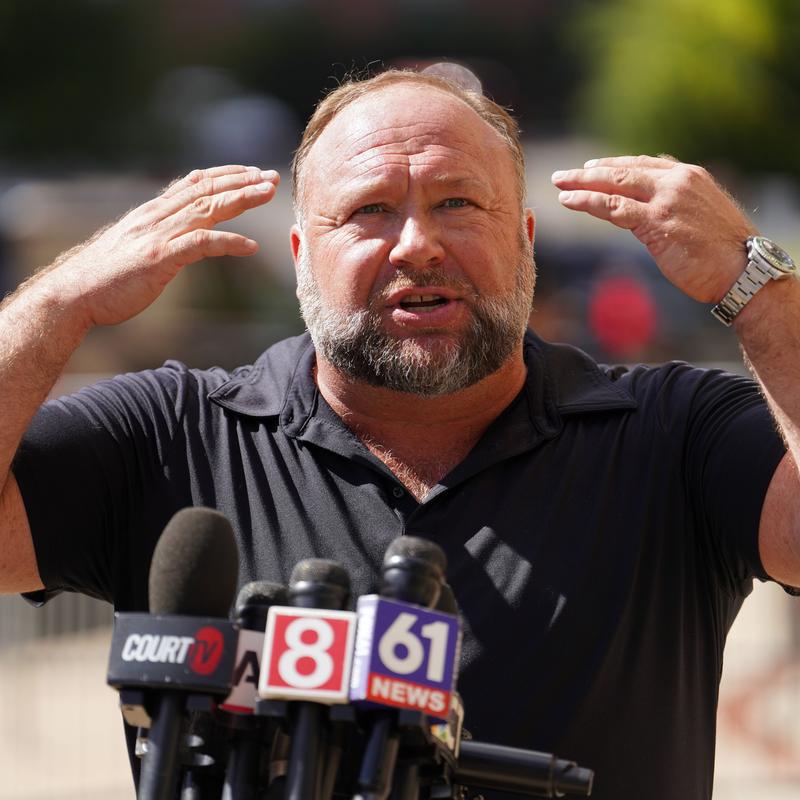
News clip: They're known for joking around, but now The Onion is getting downright serious. The legendary satirical newspaper has a new plan to take over Infowars, the right-wing platform founded by conspiracy theorist Alex Jones.
Micah Loewinger: A little backstory. Jones launched a crusade of lies in 2013 against the victims of the Sandy Hook Elementary School shooting, calling the whole thing a hoax, a false flag. It was ugly, demeaning, and persistent. Eventually, in 2018, multiple families of the children killed in the mass shooting sued Jones for defamation. When called to the stand in 2022 and asked about spreading this lie, Jones sounded contrite.
Lawyer: Do you understand now that it was absolutely irresponsible if you do that?
Alex Jones: It was especially since I met the parents, and it's 100% real.
Micah Loewinger: Jones largely didn't show up for court, so the judge handed down a default judgment finding him liable for $1.4 billion in damages. His contriteness was short-lived.
Alex Jones: In a default, even though we gave them all the discoveries, they had no case. She found me guilty, wouldn't let us put on a case, and then for five weeks had people up there cry about their kids that died. I'm very sad about it. I didn't kill their kids. It's like O.J. Simpson was found civilly guilty of murdering two people. He paid $33.5 million. I didn't murder anybody. I just questioned a public event. If they think they're going to get $900-plus million, they're gravely mistaken. Here's more news.
Micah Loewinger: Despite filing for bankruptcy shortly after the judgment, Jones stayed on air and didn't give the families a dime. That's where The Onion comes in. In 2024, CEO Ben Collins saw an opportunity to buy Infowars at auction. The idea was to take over the brand while providing some money to the Sandy Hook plaintiffs still awaiting payment, but it turned out to be a bit more complicated. There was a ton of legal back and forth throughout 2025, and in early 2026, Collins was waffling.
Ben Collins: I had real reservations at the turn of the year about continuing to do this, because at that point, it had been 13 months, which seems too long for me to keep going with something where I don't know what the ending is going to be. Then, on January 5th, Renee Good was shot. I don't remember being as incandescently angry at a news event in my entire life. I turned on Infowars afterwards, and he had Kyle Rittenhouse on. Kyle Rittenhouse was saying that Renee Good was putting cigarettes out on her kids, and that's why she had her kids taken away.
Micah Loewinger: Oh, my God.
Ben Collins: This was within hours of her death, and that he had read it on X, so it had to be true, of course. I just thought, "These [bleep] are going to do this for the rest of our lives without any punishment. They are just going to keep getting away with it." That's when I thought, "I'm not giving up. We're going to get this thing done, and we're going to replace it with something beautiful."
Micah Loewinger: Collins and The Onion kept waiting.
Ben Collins: For months, we were just in this holding pattern. Then something happened last month, and it was a very ridiculous way for this to come to a head.
Micah Loewinger: You're about to say that you saw a clip of him on Tim Pool's podcast.
Ben Collins: That's correct, yes. Alex went on Tim Pool's podcast, and he was not the picture of sobriety.
Alex Jones: We're getting shut down. We beat so many attacks, but finally, we're shutting down the middle of next month. It's going to be insane when it happens…the fake auctions. All of it's happening right now.
Tim Pool: What are you going to do? You're launching a new thing, or what are you doing?
Alex Jones: We'll be fine.
Ben Collins: He said that all the time. Almost every month during this stay, they were going to shut him down. I called our bankruptcy lawyer, and I said, "Buddy, I'm sorry to ask you this once again, but he's saying they're going to shut them down next month. Can you just check in on it? Call the receiver." The receiver was like, "Yes, they're out of money. The estate's out of money, so we can't keep operating Infowars."
We went to them, and we said, "Well, this thing has considerably less value to us as a dead asset. How about this? We will pay the exorbitant rent that Alex Jones pays to his landlord to keep his gigantic sprawling studio with all of his stuff in it. We will pay that to take over the IP, and we will keep the lights on in the studio so things don't melt. By the time we can buy it, it will remain in one piece." By the way, I just want to stress this. I didn't know about bankruptcy court before this. I didn't know anything at all.
I literally thought we were headed into a Storage Wars-style auction, but I've had to learn all this stuff. The state receiver has two duties. One, it's to keep the value of the estate alive, to keep the assets going, and to do what's best for the creditors. The creditors in this case are the Sandy Hook families. That met both thresholds. He said yes. On Monday of this week, he filed with the court that we had come to an agreement. We hope by a week from now, we'll be fully and formally taking over Infowars.com.
Micah Loewinger: It appears that The Onion might really, at long last, do this, so long as the judge approves, but in all that news, one particular announcement caught my eye. The Onion named a creative director for their incoming media asset, comedian Tim Heidecker, someone Collins is really excited about.
Ben Collins: He is probably the best alt-comic in the world. He's very much a comics comic, and he was the heart and soul of Adult Swim back in the day.
Micah Loewinger: He's half of the comedy duo Tim and Eric, and he's known to do a very particular impression.
Tim Heidecker: It's looking very likely that the Global Tetrahedron will seize control of Infowars in the coming days. The folks at Global Tetrahedon have asked me to step in to run the show over there and become part of the--
Micah Loewinger: Tim, welcome to the show.
Tim Heidecker: Thanks. Thanks for having me, Micah.
Micah Loewinger: You've been named the new creative director of Infowars. Why would you want this job?
Tim Heidecker: Why not? Overall, there's two big thoughts. One, it would be fun to goof on Infowars for a period of time once we commandeered it and parody that world, but then that would run its course and not be funny anymore, and there would be this big media brand that we could do whatever we want with. What I have been craving and wanting in the world is a home for what I consider good, individual, voice-led comedy.
Micah Loewinger: You're still waiting on a judge to approve the relaunch of the site, but The Onion already has the rights to sell Infowars-branded merch on theonion.info. That site also advertises "sold out products" like Demon guard patches that offer 24-hour protection from dark entities and Pure O oxygen supplements that promise optimal absorption and mind maximization. Those are fake, or are they? Have you tried them?
Tim Heidecker: I've tried the Pure O, and it's a trip. It's more oxygen than you get in a 24-hour period all at once. I've had several terminal illnesses that have been immediately cured after one dose. I'm a big, big fan of that product.
Micah Loewinger: When did you start watching Alex Jones? Do you have a memory of your first Infowars moment?
Tim Heidecker: I would think it would be in the 2015 era, pre-Trump, leading up to Trump. I'm sure I was aware of him as an Internet oddity, a coast-to-coast conspiracy theory fella, harmless, benign, amusing clown. We goofed on him at the Republican convention in Cleveland, followed him around, and I think when he became an actual-- It was like Trump's going on his show and validating some of his crazy stuff, it felt like this guy's actually influencing, in a way, my life because I live here. It's a weird time because he's now at odds with Trump.
Micah Loewinger: He recently said he thought that Trump was possessed by a demon or something like that.
Tim Heidecker: We are confirming that. We did some medical blood tests, and there is demonic blood running through his veins. I'm going to slip into that every once in a while if you don't mind.
Micah Loewinger: No, I love it. In fact, this Alex Jones impression, you have done it to the man himself.
Tim Heidecker: I did.
Micah Loewinger: Back in 2017, you somehow crashed an Infowars livestream outside the RNC. Can you help me set this up?
Tim Heidecker: One of my comedy partners, Vic Berger, we were shooting a special for him, walking around the convention, doing the thing, interviewing people. Vic has a great interview because Vic loves Chubby Checker. We were shooting this in Cleveland, and Vic was asking everybody why Chubby Checker isn't in the Rock and Roll Hall of Fame. His question for Alex Jones was, "What do you think about Chubby Checker not being in the Rock and Roll Hall of Fame?" "I don't know. I don't get involved in all that stuff." I think that's literally what he said.
Micah Loewinger: That's incredible.
Tim Heidecker: He really got taken off guard there, but then later the next day or something, I was just walking around causing trouble, and there they were live broadcasting and just launched into it.
Micah Loewinger: There's a reporter who you accost with your impression.
News clip: Voting for Trump?
Tim Heidecker: Live right now.
News clip: This guy here is doing a great impression of him. I'm going to step away because he's quite distracting.
Alex Jones: Let's let this distractor get in here. Let's see what this dumbo's doing.
Tim Heidecker: Ladies and gentlemen, Roger Stone is going to be my guest any second now. Stay tuned and join us here at the Republican National Convention, because we are going to take our party back, ladies and gentlemen.
Alex Jones: We've been trolled or whatever. I think it's funny.
Tim Heidecker: He's an attention whore. Like any narcissist, there's a certain love of getting the attention of people, knowing who you are and how to sound like you, and stuff. He was probably just amused by it, as I would be, I think, as anybody would be, if you're so distinctive that somebody can do an impression of you. Unlike Bill Maher, by the way, who apparently hates when people do impressions of him. That's another sickness that doesn't make sense to me.
Micah Loewinger: Back then, Jones was a good sport about it, but flash forward to today, I don't think he's been such a good sport about it.
Tim Heidecker: No. He said I'm a skinwalker.
Alex Jones: Just because you're wearing my shirt don't mean you're me. Let's be 100% clear about that. This is what the left do. They try to silence you, then they misrepresent who you are. They're body snatchers, they're skin walkers. They literally take your skin. This is going to backfire big time, folks.
Micah Loewinger: How did it feel to watch him melt down at the mere thought of you parodying him?
Tim Heidecker: It's a trip. It's surreal. I'm really living an out-of-body experience right now, out of my skin, into somebody else's skin experience. The people here, the legal team here, and Ben Collins and the owner of The Onion, everybody has been so supportive and great and careful about this. The reaction has been just so overwhelmingly positive by your average people out there, who have definitely outweighed his ranting and shirtless raving on his little TV show that he won't have anymore pretty soon.
Micah Loewinger: I want to ask you a comedy philosophy question.
Tim Heidecker: Yes, let's get into it.
Micah Loewinger: Conan O'Brien, earlier this year, was doing an interview with David Remnick on the New Yorker Radio Hour about why he doesn't find parodying Trump funny anymore.
Conan O'Brien: Years ago, when I was at Harvard and working on The Lampoon, we would try and think of magazines we could do a parody of. There was one magazine we always knew we couldn't parody, which was the National Enquirer. If a magazine has as its cover, "Elvis still alive marries alien, and they have a baby that's a three-speed blender," that's what the real magazine's coming out with, you can't do a comedic take on that. It's very difficult, or I think, impossible to do. I think Trump, if he were a magazine, it's the National Enquirer.
Micah Loewinger: Do you agree with him that Trump parodies aren't funny? If so, do you think a similar logic could apply to parodying Alex Jones?
Tim Heidecker: First of all, I don't find Conan mugging and doing promos for the Oscars in his gold suit very funny either. I don't necessarily think he's the expert on what's funny all the time, with all due respect. I think Trump continues to be hilarious, insane. For me, it's an endlessly insane and amusing thing that we're actually living through. As it applies to Alex Jones, I think people need to hear other people like me remind the world that this is insane and try to do it in an entertaining way.
Otherwise, people feel like they're going crazy and that they're alone, and that when you call this stuff out and try to do it in an amusing way, it hopefully provides some comfort and relief to your average Joe who's just trying to get through their damn day.
Micah Loewinger: To be clear, I believe that Alex Jones is extremely ripe for comedy. All that said, I don't think Alex Jones is going away just because you're going to mock him from his own studio. Right?
Tim Heidecker: Right. No, I don't think so. He's welcome to stand on the side of the road in Austin, Texas, with a cardboard sign and a tinfoil hat and tell the passerbyers driving by what he thinks about whatever, Bigfoot, or the Loch Ness Monster, or whatever.
Micah Loewinger: He still has 4.5 million followers on X.
Tim Heidecker: Yes, but I think first of all, those numbers are full of bots and full of people that are like me, who's just amused by it, but I don't really know what his support structure is and can't really worry about it. Eventually, we're going to move past this moment into a place where we try to change the meaning of the word Infowars in everyone's head. You go, "Dude, did you see that great movie on Infowars last night?" Then, three years from now, you're like, "What was Infowars again? Oh, that was that crazy website." Maybe that seems like a fool's errand, but for whatever reason, for me, that feels like an exciting journey to go on in my old age.
Micah Loewinger: Tim, thank you very much.
Tim Heidecker: You're welcome, Micah.
Micah Loewinger: Tim Heidecker is a writer, actor, director, and half of the comedic duo Tim and Eric. He was recently named the creative director of Infowars.
[music]
Brooke Gladstone: Coming up, an icon of independent media on how to stay the course after 30-plus years on the air.
Micah Loewinger: This is On the Media.
Brooke Gladstone: This is On the Media. I'm Brooke Gladstone.
Micah Loewinger: I'm Micah Loewinger. On Thursday, Paramount Skydance took another step forward in its bid to massively expand its media holdings.
News clip: An $81 billion Warner Paramount mega merger has now received shareholder stamp of approval, propelling a deal that could vastly reshape Hollywood and the wider media landscape closer to the finish line.
News clip: This is one of the last remaining hurdles for Paramount before it can actually take over WBDM and bring together brands like CNN, CBS News, HBO Max, and Paramount Plus.
Micah Loewinger: This sort of consolidation is no surprise to a cohort of scholars and journalists who've spent decades sounding the alarm on media deregulation. Among them, Amy Goodman, co-host and co-founder of Democracy Now, a fiercely independent daily broadcast and online show. For 30 years, Goodman has grown a loyal audience built on her famously persistent brand of investigative journalism.
Amy Goodman: Can you explain why you won't answer any questions on the issue of climate change or why the US is here?
Micah Loewinger: Her foregrounding of people otherwise ignored by the mainstream media.
Amy Goodman: We turn to a growing protest in North Dakota, where hundreds of indigenous activists have shut down construction on the $3.8 billion Dakota Access Pipeline. The oil pipeline threatens to contaminate the Missouri River, which provides water not only for thousands of residents on the reservation, but also for millions living downstream.
Micah Loewinger: Her unapologetic editorial choices over the years have led to some pointed criticism of her perceived biases. Here's Stephen Colbert in 2009, when he was still in his old right-wing persona, making the point.
Stephen Colbert: You're a communist, right? You're super liberal lefty. They don't get any more liberal lefty outside agitator than you, do they?
Amy Goodman: I don't know. I think that conservative and liberal lines are breaking down right now.
Stephen Colbert: Yes, to right and wrong.
Micah Loewinger: Now, Amy Goodman is the subject of a new documentary, Steal This Story, Please!, which takes us through her decades-long career. Last week, we sat down in a WNYC studio to talk about the film and the 30th anniversary of her show on what turned out to be a rather auspicious day.
Amy Goodman: I'm very honored to be doing this on my birthday.
Micah Loewinger: Happy birthday. Are you serious?
Amy Goodman: Thank you. Yes.
Micah Loewinger: Oh, my God.
Amy Goodman: I never, ever tell anyone my birthday, but it's just so hilarious that I'm looking at April 13. 13, everyone else, it makes them very nervous, the number, but I've always liked that number. Ithought it was fun.
Micah Loewinger: Incredible.
Amy Goodman: That just means be nice to me.
Micah Loewinger: I will be very nice to you. I started our conversation by asking Goodman where her reporting ethos and her urge to stay independent came from.
Amy Goodman: I come out of Pacifica Radio, which was founded in 1949 in Berkeley. A war resistor named Lou Hill came out of the detention camps and said, "There's got to be a media outlet that's not run by corporations that profit from war, but run by journalists and artists. Pacifica was born. Five stations. KPFK in Los Angeles, our station WBAI in New York, WPFW in Washington, Jazz and Justice radio, and KPF in 1970 in Houston. That station went on the air, and a few weeks later, it was blown up by the Ku Klux Klan.
They strapped dynamite to the base of the transmitter. They get back on the air a few weeks later, they rebuild the transmitter. The Klan strapped 15 times the dynamite to the transmitter and blew it to smithereens. The Klan leader said it was his proudest act because he understood how dangerous independent media is, dangerous because it allows people to speak for themselves. When you hear someone speaking for themselves, it makes it much less likely that you'll want to destroy him.
Micah Loewinger: I want to talk about an example of how you tried to use your reporting as a force for peace. In 1991, when you were working at WBAI, you learned about a story that had been missing from mainstream coverage. Indonesia's invasion of East Timor in 1975 and its systematic killing of a third of the Timorese population. 90% of the weapons used by the Indonesian army were supplied by our government. Talk about why you wanted to travel there and what you discovered through your reporting.
Amy Goodman: I went there with my colleague Allan Nairn, and I decided to do a documentary on East Timor. We went in '90, and then again in '91. In '91, the occupation of East Timor had been going on for 17 years. For the first time, a UN delegation was going to go to investigate the human rights situation. Huge deal for the people of Timor. They were dropping out of their workplaces, out of schools, to take refuge in churches that they be able to speak to the delegation. We learned that a young man had just been killed on the steps of the church.
Micah Loewinger: By the Indonesian army.
Amy Goodman: By the Indonesian military. Two weeks later, in total desperation, they decided to hold a procession from the main church to the cemetery. [chants] The Timorese then held up banners drawn on bedsheets. They had been prepared-- We followed this human procession to the cemetery. Then we saw hundreds of Indonesian soldiers with their USM 16s at the ready position. We had walked to the front of the crowd. We took our equipment out. I held up my microphone like a flag. Allan put the camera above his head. They swept past us, and without warning, hesitation, they just opened fire on the crowd.
Allan Nairn: Temorese in an instant were down, just torn apart by the bullets. The street was covered with bodies, covered with blood.
Amy Goodman: The first to go down was a little boy behind me, just exploded from the gunfire, and they just kept killing. They came at us. They beat me to the ground. Allan threw himself on top of me to protect me. They used their USM 16s like baseball bats and slammed them against his skull until they fractured it. They ultimately had lined up in firing squad fashion with the guns to our heads, but pulled those guns away because we believe they thought that they would have to pay a price for killing us that they had never paid for killing the Timorese. We were from the same country their weapons were from.
Micah Loewinger: Witnessing this massacre taught you how critical it was to expose what is done in our name as Americans.
Amy Goodman: That's right. After we got back, we held a news conference, explained that the weapons used against the Timorese that killed over 270 of them were from the United States. A nationwide movement grew up to fight for the people of East Timor and their independence. In 1999, the UN held a referendum, and in 2002, it became one of the newest nations in the world. I understood clearly, if people knew what was happening, they would do something about it. It's our job as journalists to go to where the silence is.
Micah Loewinger: The documentary features a clip of you at a press briefing after your reporting in East Timor, questioning a government official about why President Clinton was restoring military aid to Indonesia. You said to the government spokesperson.
Amy Goodman: Now, that was cut off after the massacre of November 1991, which I witnessed and survived. Why is President Clinton considering restoring that military training aid?
Micah Loewinger: How do you toe this line between asking tough questions like that and then perhaps jeopardizing future access?
Amy Goodman: You trade truth for access. It's not worth it. Politicians need us more than we need them. They need to be able to explain themselves to the public. Let's be clear, freedom of the press is about the public's right to know. That's why I was questioning Mike McCurry, President Clinton's spokesperson. Yes, the journalist laughed when he wanted to shut it down, but we can't give in to that peer pressure. Lives are at stake.
Micah Loewinger: What did it feel like being in that room and having your colleagues in the mainstream press laugh at your expense?
Amy Goodman: They were asking about golf clubs and what President Clinton would be doing. I think it was their anniversary, President Clinton and Hillary Clinton. I survived this massacre. It's not about me. It's about the third of the population who had been killed. I was just more determined than ever to expose what is done in our name.
Micah Loewinger: The show has been really successful. You have also experienced a Lot of criticism. In your rise in the industry, you've been called an activist rather than a journalist. How do you make sense of that label, that distinction? Do you see activism and journalism in tension? Is that the wrong way to think about it?
Amy Goodman: First of all, I don't think to be called an activist for people who are out there on the streets is in any way a way to denigrate someone, but if your view does not represent the status quo, you are then called an activist, but you're just representing a point of view that's not shared by the establishment. I think about the great journalist and publisher Ida B. Wells, who campaigned, crusaded against slavery. Her press was burned down. She was forced out of communities. She didn't think lynching was good. The corporate media has shut down voices or tried to.
Micah Loewinger: Did you ever worry that by not presenting as more neutral, you were inviting people to tune out your reporting? That you were potentially resigning yourself to just reach an audience that already--
Amy Goodman: To be fair and accurate is exactly the tenets of good journalism. What Nermeen Shaikh says, co-host on Democracy Now, is expand the frame. Bring the people who are left out or on the fringes of the frame to the middle. It's not just hear them occasionally. It's centering those voices. I really do think those voices, those who care about war and peace, those who care about the climate, those who care about inequality, racial and economic equality, those who care about LGBTQ issues, are not a fringe minority, not even a silent majority, but the silenced majority, silenced by the corporate media.
Micah Loewinger: What would you like to see more of your colleagues in the press right now do, in their coverage of our war in Iran?
Amy Goodman: Bring in the voices of Iranians in the same case as in Palestine and Israel. Not a lot of young people watch TV, but I do because I want to look at how the narrative is framed so we can deconstruct it. Just the lack of Palestinian voices, it is astounding. It isn't that hard to do this. These networks have much more resources than we do. You just make a phone call, you say, "What's happening on the ground?" In the same way, Israeli peace activists, they are not monolithic. We don't hear their voices either.
In Iran, we're talking regularly to Iranian professors, to activists, to diplomats, to artists. Hear them frame their own situation. We've spoken to professors here who were on death row in Evin Prison in Tehran. They do not support what the US and Israel are doing to Iran. You would think they'd say, "Get rid of the regime," but they say, "This actually serves the opposite purpose. It will harden the regime, make it much more far-right. This does not accomplish our ends."
I think we, as reporters, know no borders. To bring out the voices of people all over is our responsibility. The way the rest of the world learns about us and how we learn about the rest of the world should be through something other than a corporate lens.
Micah Loewinger: That corporate lens, though, seems to be losing ground. A lot of these outlets that I think you have viewed as your foil, they're not as powerful as they once were. Young people aren't watching MS Now and CNN, and the like. That model feels like it's dying, but there are new independent outlets that are rising up like Drop Site, Zetao, and 404 Media. These are fiercely adversarial, but also openly progressive outlets. They tend to have smaller, at least right now, but very loyal audiences. Do you see any of Democracy Now's DNA in these new upstarts?
Amy Goodman: Absolutely. I think Steal This Story, Please! does a great job of showing all the people who come out of Democracy Now, like Jeremy Scahill, one of the founders of Intercept, and then Drop Site News, it is so important that there be a potpourri of independent media, small and large. I've been sounding the alarm on corporate media for 30 years, and at the beginning, people were saying, "Give us a break," but now they're saying, "Oh, please, yell louder, yell louder," because we have these vast corporate mergers who own so much, and newsrooms don't make them the kind of money that their other companies do, especially under President Trump.
It is an enormous problem because the media is essential to the functioning of a democratic society. As the media is increasingly targeted, as Pentagon reporters are told they have to sign an oath that they will not release classified information unless approved by the Pentagon, journalists, actually interestingly, across the political spectrum saying no. Now, a judge has again and again said, "No, that is not constitutional."
Micah Loewinger: You've been very critical of our government since the beginning of your journalism career, even as other mainstream journalists have cheered on wars and looked the other way at American-led atrocities. Throughout this administration, as Trump has escalated the war on Iran, especially after he posted, "A whole civilization will die tonight," I've seen people online sharing this meme from a British sketch comedy show called The Mitchell and Webb Look. In the sketch that the meme is pulled from, we see a Nazi officer in an SS uniform asking his compatriot.
Clip: Have you noticed that our caps have actually got little pictures of skulls on them?
Clip: I don't.
Clip: Are we the baddies?
Micah Loewinger: I think that meme, "Are we the baddies?" captures this realization that a lot of Americans are sitting with right now, that this American exceptionalism that has infused the way we think about our country is dying. Where do you see our place in the world right now? Are we the baddies?
Amy Goodman: The United States is the most powerful country on earth, but there is a force more powerful, and that is everyone who stands up and says, "This does not represent what America can be." This isn't theoretical, and I think it's really important to show the images of war. I learned from Mamie Till-Mobley who lost her son Emmett Till in 1955. Emmett was a 14-year-old boy from Chicago. She wanted him out of the city for the summer, sent him to his family in Money, Mississippi.
He ends up being lynched by a white mob and ends up in the bottom of the Tallahatchie River. When his body was sent back, Mamie Till-Mobley said, "I want the casket open for the funeral and the wake," where you could see his distended, mutilated head. Then Jet magazine and other Black publications took photographs of his mutilated head, and they were actually published, and they were seared into the history and consciousness of this country.
Mamie Till had something very important to teach the press of today. Show the pictures, show the images. Could you imagine for one week if we saw the images of those girls in Minab at their primary school blown up? I really do think vast changes would happen, and that's our job in the media.
Micah Loewinger: Do you have any regrets about positions you've taken on your show or the way that you've approached stories in your career?
Amy Goodman: I look ahead. What further do we have to do? That's always been my approach. I come out of a family tradition where we were steeped in the past. In that case, it was the Holocaust. We came out of people who had escaped the pogroms, some were able to flee the Holocaust, others weren't, and just moving forward, lived with the belief that we have to ensure that this never happens again to anyone, anywhere. That's what I think about every day.
Micah Loewinger: You really think about that every day when you're on air.
Amy Goodman: That is what motivates me. That is one of the principles of my life. I work with a wonderful group of people, deeply committed to independent media that will make things better.
Micah Loewinger: Do you talk about Democracy Now after you leave the show?
Amy Goodman: We just celebrated our 30th anniversary at Riverside Church. Bruce Springsteen sang Streets of Minneapolis, and Patti Smith. They all stood on the stage and sang Patti's song, that iconic song, People Have the Power. That's what I want to see happen is media where people have the power. Democracy Now is just beginning.
Micah Loewinger: Amy, thank you very much.
Amy Goodman: Thank you, Micah.
[MUSIC - Patti Smith: People Have the Power]
Brooke Gladstone: Amy Goodman is the host of Democracy Now. The documentary Steal This Story, Please! is in select theaters now.
Micah Loewinger: That's it for this week's show. On the Media is produced by Molly Rosen, Rebecca Clark-Callender, and Candice Wang. Travis Manning is our video producer.
Brooke Gladstone: Our technical director is Jennifer Munson, with engineering from Jared Paul. Eloise Blondiau is our senior producer, and our executive producer is Katya Rogers. On the Media is produced by WNYC. I'm Brooke Gladstone.
Micah Loewinger: I'm Micah Loewinger.
Copyright © 2026 New York Public Radio. All rights reserved. Visit our website terms of use at www.wnyc.org for further information.
New York Public Radio transcripts are created on a rush deadline, often by contractors. This text may not be in its final form and may be updated or revised in the future. Accuracy and availability may vary. The authoritative record of New York Public Radio’s programming is the audio record.