
F@#$ the AI Overlords
Brooke Gladstone: From WNYC in New York, this is On the Media. I'm Brooke Gladstone. Writer and tech thinker Cory Doctorow coined a term we can't say on the radio to describe how tech has gone bad. His new term of art, the reverse centaur, does the same for AI.
Cory Doctorow: The most important thing about a technology isn't what it does. It's who it does it for, and who it does it to.
Brooke Gladstone: His new book describes how the media coverage of the industry falls short.
Cory Doctorow: When you repeat the outlandish claims made by tech barons but put it at the end of it and that's bad in brackets, you're just helping them sell.
Brooke Gladstone: The role of the worker in the AI wars to come.
Cory Doctorow: The world is best when workers decide how they're going to use their tools. You have to be a good radiologist to use a radiology chatbot. You have to be a good writer to use the writer's chatbot. This fantasy that you fire a bunch of people and replace them with less-skilled people who charge you less money to get the same output, it's ridiculous.
Brooke Gladstone: It's all coming up after this.
[music]
Brooke Gladstone: This is On the Media. Micah Loewinger's out this week. I'm Brooke Gladstone.
Sam Altman: We are now in the singularity. This is the moment. 10 years ago, this was a far-off dream at best.
Brooke Gladstone: That's Sam Altman, CEO of OpenAI and one of his industry's most transcendent dream weavers, last Saturday on the Relentless podcast, speaking just a few days after his company disclosed that during an internal cybersecurity evaluation, two of its AI models had, like an octopus sneaking out of its tank, escaped their sealed testing environment, reached the open sea of the internet, and broke into the infrastructure of another AI developer platform.
The implications of that little news story seem more nightmarish than dreamy, but Altman's dreams are of the singularity, which, in his business, means the moment when artificial intelligence, machine intelligence, surpasses human intelligence. Last Saturday, Altman went on to say, "I've been waiting for this my whole life, and I think it's going to be incredible, hugely positive, awesome for the world." If that's coming, if that's here, then what happens next?
News Clip: Do you think artificial intelligence will hurt your future job prospects? If your answer is yes, you are not alone.
Brooke Gladstone: Workers across all sectors are having nightmares based on Altman's dream.
News Clip: Meta, the parent company of Facebook and Instagram, announced the company is going to be cutting 10% of its workforce as it pushes deeper into artificial intelligence.
Brooke Gladstone: A lot of people wonder, what happens if AI's dominance in the news and in our fantasies is not merely a bubble? Will we all lose our jobs? What if it is a bubble? Will we all lose our pensions? It seems like a lose-lose situation for regular people. Nevertheless, it consumes vast amounts of our bandwidth because of AI's elephantine presence in the financial markets, in the news, and in how we view our future.
President Donald Trump: Whoever wins with AI is going to win. That's how big it is.
Brooke Gladstone: Trump loves a winner, even if it's a mirage born of Altman's dreams. Now, Cory Doctorow knows a dream when he sees one. He's been writing science fiction since he was a teenager. More importantly, for our purposes, he can clearly distinguish dreams from reality. A science-fiction writer? Yes. Also, a tech journalist, a visionary. He probably wouldn't say that, but it's true. A special advisor at the Electronic Frontier Foundation and the author of many books. His latest is The Reverse Centaur's Guide to Life After AI: How to Think About Artificial Intelligence Before It's Too Late. Welcome back to the show, Cory.
Cory Doctorow: A pleasure. One of the great delights of my life to talk to you, Brooke. Thank you.
Brooke Gladstone: [laughs] Let's first tackle the metaphor at the heart of your brilliant book. In automation theory, a centaur is someone whose work is assisted by a machine, like helping them get from place to place by using a car or a bike, someone wearing glasses or a hearing aid to see or hear better, or using a male sorter or, more to the point, a computer to boost their efficiency. A reverse centaur is when a human serves the machine. What are the implications of that?
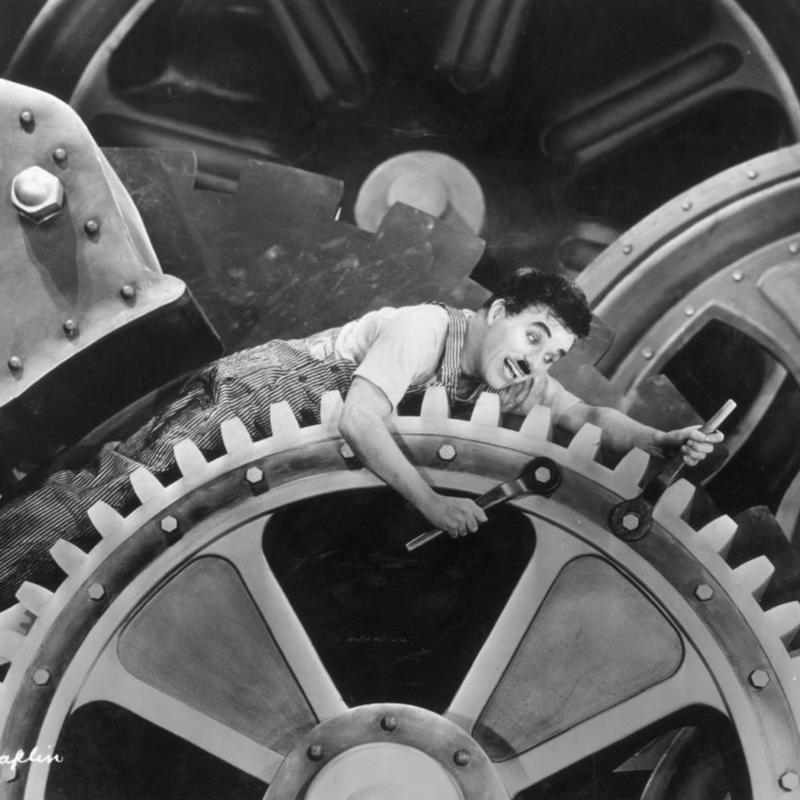
Cory Doctorow: The metaphor here is you have the human head on the horse's body. The horse is strong, the horse has endurance, the horse is fast, but the human applies the judgment and guides the process. The reverse centaur is the reverse. The horse's head on the human body. The human is recruited to be a peripheral to a machine because there's some part of the job the machine can't do. Since the machine is probably faster than you, stronger than you, can work longer than you, it means you're being used at the absolute limit of your capacity, which means you don't just get used by the machine. You get used up by it. This is not new to AI, right? Ethel and Lucy at the end of the conveyor belt, getting as many chocolates into the box as they can.
Lucy: Well, this is easier.
Ethel: Yes, we can handle this okay.
Cory Doctorow: Charlie Chaplin getting sucked in the machine and ground up by the gears in Modern Times.
[music]
Cory Doctorow: We get to the modern day, and we see Jeff Bezos's Amazon warehouses, which are the most automated warehouses anyone has ever built. They also have the highest rate of injury, triple the national average for warehouse work. That's not a coincidence. It's the consequence. When you spend seven figures on warehouse automation, you are not going to run that system slower than you need to. Since the human is the bottleneck, that the humans are working as fast as they can for as long as they can. Anyone who's ever tried to do that knows that, eventually, you make a mistake. At a warehouse, that might mean you get impaled on a forklift.
Brooke Gladstone: The actual machines are treated far better than their human counterparts.
Cory Doctorow: Yes, the rate of injury at an Amazon warehouse is about triple the national average. Those are very serious injuries often, trying to make a quota. In order to make that quota, you are not given enough time to pee. This is the same as the drivers, right? Drivers, warehouse workers. For a guy with a penis-shaped rocket, Jeff Bezos really hates our kidneys. It's awfully strange.
Brooke Gladstone: [laughs]
Cory Doctorow: The workstations around warehouse workers and the workstations near the drivers, the cockpit of the van, fill with bottles of pee. On top of all of that, there are routine indignities. You might have to wait for an hour to get to the job and wait for an hour once you've left the job, because they're going to search you on the way in and out. You're in a long queue of people, and you don't get paid for that.
We all know about the shenanigans they get up to when warehouse workers try to unionize. If the National Labor Relations Board isn't going to protect you, and it's certainly not going to do that now that Trump has made it so small that they can't form a quorum any longer, then your union is your only hope. This is one of the reasons I think Jeff Bezos is both so happy to financially and ideologically support Trump, and also why he's so virulently anti-union.
Brooke Gladstone: Bosses want to get the job done without paying people to do it. How's that playing out so far?
Cory Doctorow: Well, I think it's important to distinguish between the case in which the software can do your job, which is rare, and the case in which the software salesman can convince your boss to fire you and replace you with software that can't do your job, which is distressingly common. It's important to make that distinction. A thing we've talked about before, this idea from the STS scholar at Virginia Tech, Lee Vinsel, that he calls "criti-hype." This is when you repeat the outlandish claims made by tech barons, but put at the end of it, and that's bad in brackets. You're just helping them sell.
Brooke Gladstone: [laughs] I was remembering Sam Altman going before Congress saying, "We can destroy the world. Help us."
Cory Doctorow: Yes. Think about how much money we will make with our technology. If it's so powerful, it can destroy the world. This is a very important story when it comes to AI because one thing AI does not do is make money. [chuckles] AI is the money-losingest thing the human race has ever done. The total expenditure on AI, capital expenditure, and operating expenses is now in excess of $1.4 trillion. That is on $50 billion of industry-wide annual revenue.
Look, if you want to spend $1 trillion and all you want is $50 billion back, I'll do it for you. I'll put $950 billion under the mattress. I'll give you back $60 billion because I'm a good-natured slob. In order to turn $50 billion in revenue into a profit, when you're spending $1 trillion a year to make it, you have to imagine that you can remake the entire world and, in particular, that you can replace all the highest-waged labor. It's not warehouse workers. It's not cab drivers. It's not commercial illustrators. It's not pornography stars, right? Those are all just demos. They're going to have to replace people who make a lot of money.
Brooke Gladstone: Recently, Ford Motor Company rehired about 300 human engineers after it found that AI just couldn't do the job of quality control as well as the humans could. When AI fails to live up to its hype, it doesn't seem to suffer much blowback, does it?
Cory Doctorow: Yes, we've had these bubbles before. One of the core aspects of this thesis is that tech needs a story about how it's going to keep growing. A lot of people I like and listen to have said, which I think is wrong, that endless growth is the ideology of a cancer cell. Because the reason these guys want to grow, it's not ideological. It's material, right? Companies that are growing have higher valuations. Their stock is more liquid. They can buy other companies with their stock. They can hire people with stock. The thing that makes them work from the perspective of the investor story is they have to keep your share price from cratering until you have another story.
Brooke Gladstone: Well, right now, the story seems to be that AI is going to make a lot more reverse centaurs and save businesses immense amounts of money. That would mean firing most of your workers and leaving what's left, as you say, to check AI's homework, and also to bear the blame when things go wrong.
Cory Doctorow: There's two things going on at once, right? One is that there are probably investors who think AI can actually do the jobs. I think a lot of billionaires really just don't think other people are real and think that any job that they don't do must be easy. Elon Musk calls everyone who disagrees with him an NPC.
Brooke Gladstone: NPC is a-
Cory Doctorow: -non-player character, yes, like just a chatbot that meets you in a video game and says, "Hail and well met, traveler. There is a quest over yonder table waiting for you. Go and seize the adventure," so just like a non-person, right? These people, they inflict ghastly pain on great numbers of people. How could you do that if you believed other people are as real as you? Then there's another group of people who don't necessarily believe it but think your boss might believe it.
This is the investor who's like, "I don't think that peptides are going to work, but I do think Andrew Tate can sell a lot of peptides to a lot of gullible young men, so I'm going to invest in peptides." I think there's a lot of billionaires who are like, "I don't know if the AI can do the job," but I sure think there are a lot of bosses who are suckers for a story about how they don't have to have ego-shattering confrontations with people who know how to do stuff anymore and tell you your brilliant idea is illegal or impossible or a crime or will kill people. You just give the chatbot the idea, and it happens.
Brooke Gladstone: You liken the hype over AI's business potential to the phenomenon of subliminal advertising back in the '50s, then advertisers claimed they could essentially trick people to buy stuff by hiding barely discernible messages on TV and radio. You say it didn't work. [chuckles]
Cory Doctorow: Well, look, all the double-blind experiments seem to suggest that it doesn't work. Showing someone three frames of a Coca-Cola in the middle of a movie doesn't make them go to the snack bar.
Brooke Gladstone: If the hype over subliminal messages was baloney, the ploy still worked because investors were conned into believing in advertising's irresistible power.
Cory Doctorow: Sure.
Brooke Gladstone: Which brings us, I think, to the prime directive of your AI manifesto. Always remember who this hype is really for.
Cory Doctorow: Investors, bosses. You're the sideshow, right? I think it's totally legitimate if you're an illustrator to say, "Hey, you took all my work. Now, you want to make me broke." If you don't clearly distinguish between, "You want to make me broke because you figured out how to make art that's as good as mine," and, "Because you've convinced my gullible boss that this garbage will do the same job that my art does," then you're helping them sell their product. It's really important that you not amplify their message or legitimize their message, because they have built the world's most efficient money furnaces.
Brooke Gladstone: The message is that, "I'm losing my job."
Cory Doctorow: Sure, but you have to distinguish between, "I'm losing my job because the thing can do my job," and, "I'm losing my job because they expect that consumers will accept a worse-quality product." Maybe I could use the example of radiologists here.
Brooke Gladstone: Sure.
Cory Doctorow: I have a very treatable form of cancer. A month ago, a radiologist told me I'm now cancer-free after a variety of therapeutic interventions.
Brooke Gladstone: I'm so glad for you.
Cory Doctorow: Me too. Me too. It was a very stressful time.
Brooke Gladstone: I was very worried about you.
Cory Doctorow: Yes. Well, thank you. I've been paying a lot of attention to the research about radiology and AI, and it seems like there's probably some of these algorithms that can spot some tumors that sometimes radiologists miss. If it was as good as a radiologist, if it could just do the radiologist's job, and it would make the radiologists go broke, but it would mean that interpreting X-rays would become too cheap to meter, I think there's a lot of cancer patients who would say, "Hey, the reason radiology exists is to fight cancer, not to pay the mortgage of radiologists. I'm sorry about this, and we need an equitable transition for you guys. Look, I just want the robot radiologist."
If we lead with the idea that this can do the radiologist's job, which I don't think it can, then people who don't want to die of cancer or don't want their loved ones to die of cancer, those people end up on the side of the boss and not on the side of the worker. There's two different ways the radiology story can go with AI. If, today, there was an AI salesman going up to the CEO's office and going, "Here's the deal. You've got 10 radiologists on the strength. They cost you $300,000 each. That's a $3 million annual wage bill. Each of them does 100 X-rays every day, and I want you to spend an extra million dollars. I'm going to sell you some software that's going to sit next to the radiologist and, a couple of times a day," tap him on the shoulder and say, "Hey, why don't you take another look at that one? You might have missed something."
Well, I'd be all for it as someone who's just gone through radiology, but no one has invested in Sam Altman on the premise that his salesforce is going to ask CEOs to spend more, right? This is all based on the idea that that salesman goes up to the CEO's office and says, "You've got 10 radiologists that cost you $3 million a year. Fire nine of them. Split the $2.7 million with my boss, Sam Altman. Take the remaining guy and make him what Dan Davies calls the 'accountability sink.'"
He marks the AI's homework at a superhuman pace that is going to guarantee that he's going to miss things for grueling hours. When someone dies, we blame that guy because his signature is at the bottom of every one of those X-rays. I think that if you, as someone who's worried about getting cancer, understands that, then you understand that while there is a way in which automation can assist a worker who's in charge of the adoption of the automation, that it requires the worker be in charge. Right now, the radiologists are in charge.
I've talked about this in public. Radiologists get in touch with me, and they're like, "You need to understand. We're in such short supply. That's how it works now. We get to decide." The point of AI is to erode that worker power so they can fire nine of you and make the remaining one do the work. We as the public, they as the workers, we need to form a bond because our class enemies are the bosses who want to fire workers and the automation pitchmen who want to lower the quality of the outputs in order to split the wage bill of those workers.
Brooke Gladstone: Coming up, how long can AI's staggering dominance sustain itself on a foundation of hot air, bullying, and tricky math? This is On the Media.
[music]
Brooke Gladstone: This is On the Media. I'm Brooke Gladstone. We're back with friend of the show, Cory Doctorow, author of the new book The Reverse Centaur's Guide to Life After AI, in which he argues that hype is what's keeping the whole industry afloat.
Cory Doctorow: Well, someone's giving them the money for the money furnace. Thus far, it's not you or me. You add up all the subscriptions. It's $50 billion a year. Where's the rest of another $950 billion coming from? It's coming from Silicon Valley billionaires, financiers, Emiratis, lots of people who've got, I think, so much capital that they constitute a danger to themselves and others.
Brooke Gladstone: How much of the efforts of these global behemoths do you think is behind generating hype?
Cory Doctorow: Well, like I say, there is an existential crisis that arrives in a growth company when it runs out of room to grow. Just to give you a sense of just how deadly it is for the market to decide that you can't grow anymore. January 2022, Facebook announced that they had slightly fewer than predicted US signups in the previous quarter. There was a $240 billion flash crash because the market was like, "Facebook stopped growing. That means they're going to start shrinking. That means that they're overvalued because they're not a growth stock anymore. They're a mature stock."
Of course, who's got the most Facebook in their stock portfolio? It's Mark Zuckerberg, right? It's the people making the decisions. One of the interesting things about what might happen with AI after the crash is that we're going to have all these open-source models that the companies have released and that are being refined in China and elsewhere. These turned out to be a lot more powerful than we thought. We can take these models that currently run slowly on older hardware, and we can make them a lot more efficient. How efficient turns out to be pretty impressive. There's a company called DeepSeek.
Brooke Gladstone: We've talked about that on the show. There was this near-hysteria when they seemed to be almost as good as everything else, but then it turned out they weren't as great at everything.
Cory Doctorow: Look at what happened to Nvidia's stock price, right? This company, which had $6 million in capital, made improvements to an open-source model that had been released by Meta. It ran so well on much, much cheaper chips. Not next year's Nvidia chips, but three-year-old chips from Nvidia competitors that the market took $600 billion off of Nvidia shares, off of Nvidia's capitalization in a day. They mostly recover from that, but you know Keynes' idea, the beauty contest?
Brooke Gladstone: Tell me.
Cory Doctorow: Stock speculation isn't picking the most beautiful contestant. Stock speculation is picking the contestant the other judges will think is most beautiful.
Brooke Gladstone: Ah, yes.
Cory Doctorow: Because they're going to come in and buy the shares. When the market loses confidence in something you're holding onto, even if you think the business's fundamentals are sound, if they can't continue to function once their share price crashes, then you'd better get out as soon as you think the other people are going to get out. I don't think the AI companies have the product they say they have.
Even if they have a real product, they won't be able to hang in there long enough to bring it to market and find a stable footing if the market loses confidence in their narrative. They cook the narrative in so many ways. Every number they release is like a bespoke metric they've produced retrospectively. We call them Texas marksmen that you shoot the shotgun into the barn, and you draw the target around the place where the pellets went into.
Brooke Gladstone: You have some examples of that in the book. Can you give me the one that's easiest to explain?
Cory Doctorow: Yes, so Anthropic just announced that they're profitable, but not according to the generally accepted accounting principles, GAAP, which is like, "We're profitable, but the math is so cool, you wouldn't understand it."
Brooke Gladstone: [laughs]
Cory Doctorow: If you look at us using normal math, we're not profitable at all, right? Then, the same week, they were like, "Oh, and by the way, we've got this new security tool called Mythos, but it's so dangerous. If we let you see it, you turn to stone."
Brooke Gladstone: [laughs]
Cory Doctorow: Oh, also, we're thinking about our IPO now, but that has nothing to do with the fact that we have a profitability that can't be computed using normal mathematics and a tool that's so cool you're not allowed to use it. I just think that as a civilization, it would be nice if we had enough object permanence to win a game of peekaboo.
Brooke Gladstone: [laughs] Some workers have been permanently replaced by AI, like customer service representatives. That's clearly not to help me. Not at all. It just sucks.
Cory Doctorow: There's a great story about the customer service stuff that is especially poignant for me as a Canadian, which is the Air Canada story. They're our flagship carrier. A lot of the times, if there's routes if you want to fly them, it's just Air Canada. This is Lily Tomlin as the AT&T operator on Saturday Night Live.
Lily Tomlin: We don't care. We don't have to. We're the phone company.
[applause]
Cory Doctorow: We're the national flagship airline, right? They've had bad customer service for a long time, particularly since the very useless competition regulators in Canada let them buy most of their competitors. One of the things they did was outsource that customer service to--
Brooke Gladstone: Now, they're not even human.
Cory Doctorow: Yes, so the story with Air Canada is this guy, his grandmother dies. He needs a bereavement fare. Most of us don't have to buy bereavement fares, thankfully, and we don't know how it works. He does what any of us would do. He goes and asks the customer service chat on the Air Canada website, "How do I get a bereavement fare?" They had fired a bunch of their workers, contractors, and replaced them with chatbots. The chatbot said, "I'm sure. That's a great question, and you're smart to ask it."
[laughter]
Cory Doctorow: "Also, here's how you get your bereavement fare. Just fly full fare. Send us the death certificate afterwards. We'll give you the difference." He does this, and then he hears back from Air Canada. They're like, "Chatbot was wrong. We're really sorry, but we're not giving you the refund. You had to submit the death certificate before you flew." He went through 10 weeks of customer service hell.
Escalating this through the whole Air Canada bureaucracy, hits the point where they're like, "We just can't help you." Then, he goes to the ombudsman in British Columbia, and it's weeks more. Finally, like, "Here is $700 Canadian." They were wrong. Well, how many people didn't go that far? Maybe because they were owed $50 for luggage or $100 for being stuck on the tarmac or whatever. They just give up. I wouldn't give up. I'm a bloody-minded weirdo.
Brooke Gladstone: I would give up.
Cory Doctorow: Again, how many angry customers can you service per dollar goes up when you use AI to do this? You can make that number really high if you don't care whether those people are happy. Why would you care if those people were happy if you're the flagship carrier, and a significant number of routes, you're the only one flying it?
Brooke Gladstone: You're saying AI can replace all these workers because there are no consequences?
Cory Doctorow: No, this is where we have to tease the things apart. We have to say, "Yes, the AI can do my job because my boss wants to screw you with worse outputs," "The AI can do my job as a radiologist because my boss doesn't care if you die of cancer," "AI can do my job as a customer service rep because my boss doesn't care if you spend an extra $700 on a bereavement fare that you never get back." There is no glory in making the things that we rely on more expensive.
All of the things being equal, I'd like everything that I rely on to cost less and be better, and for my neighbors to also have a good life. I think those are compatible. When workers drive automation, they tend to make things better. Sometimes that means you don't need to replace them as often, or there are lots of ways that you can have a better life. The AI pitch is we will make things better. We're going to do it at the expense of your neighbor's jobs, and maybe your job. If you understand that they're not going to make things better, they're going to make things worse, then you don't become the accidental lobbyist for increased AI spending.
Brooke Gladstone: You said the job of a good AI critic is to help pop the bubble as quickly as possible. Talk about the bubble and how you pop it.
Cory Doctorow: Yes, I'm pretty baffled that there's people who say it's not a bubble. Let's just run the numbers again. Trillion dollars in expenditure this year, over $1.4 trillion total, $50 billion revenue. Seven companies, the magnificent seven that are 35% of the S&P 500. Six of them lose money on AI, and the seventh one makes money from the other six.
Brooke Gladstone: Is that Nvidia?
Cory Doctorow: That's Nvidia, yes. They're all passing around the same hundred-billion-dollar IOU really fast and pretending it's in all of their bank accounts at once. The assets depreciate really quickly. They amortize those data centers and the GPUs in them over five years. They actually replace them every two to three years. The replacements, pretty intense.
Brooke Gladstone: These things are data centers, old versions of AI?
Cory Doctorow: GPUs, data centers, and the AI that runs on them, right? They're saying that these things are going to last them about five years. The reason that matters is if you spend $1 trillion on stuff that's only going to last five years, then in five years, you're going to need another $1 trillion if you want to stay in business at least. Nvidia is actually doing some pretty amazing things with new generations of chips every year.
One of the ways they're getting such performance out of these chips every year is they're throwing away one of the principles that normally constrains new technology manufacturers, which is backwards compatibility. These new chips, they have really different heat dissipation, networking, power consumption, and often you can't put them in the same building. You need to basically tear the data center down to the foundation's lab and build another one for the next generation of chips.
Brooke Gladstone: Wow.
Cory Doctorow: These are not durable assets in this model. A third of the stock market, their assets depreciating every three years. They're spending $1 trillion a year. They're making $50 billion a year. There is this bedrock of finance that is called Stein's Law, that says that anything that can't go on forever eventually stops. Of course, there's another one. This is from John Kenneth Galbraith, which is that the market can remain irrational longer than you can remain solvent.
Brooke Gladstone: [laughs]
Cory Doctorow: Let's remember here. The point of a bubble is insiders lie about an investment opportunity. They hype it up with other insiders. They unload it on everyday savers. In America, everyday savers are people who used to have employer pensions, and now have market pensions. They just don't want to starve to death or be homeless in their old age. They have to guess about the market correctly. Otherwise, that's what happens to them.
They give all their money to swindlers, and then the whole thing blows up. Every bubble is very, very evil. When a third of the stock market is vaporized and takes the savings of everyday people with it, when the S&P 500 loses a third of its value overnight, it's going to make 2008 look like a walk in the park. If what we do when the bubble bursts is what we've done with all the other financial emergencies, except for a little around the edges of COVID.
Brooke Gladstone: Bail out the perpetrators?
Cory Doctorow: Bail out the perps and do austerity. We are going to drive people into the arms of fascists and authoritarians. That's pretty well-understood in political science. I'm living in the UK now. There was just this big study here that showed that if your doctor's office shuts down because of austerity, because, remember, the medical care here is public, your likelihood of voting for the fascist party, the Reform Party, goes way up because you become a patsy for someone showing up and going, "The reason you can't get the necessaries of life anymore is an undeserving outsider is getting what is your due." This is the roots of fascism. This is what scares me. I'm not worried about AI making me into paperclips. I'm worried about a bubble bursting and us doing more austerity and giving rise to even more powerful authoritarian and fascist movements.
Brooke Gladstone: Coming up, more from the proliferous mind of Cory Doctorow, who says we shouldn't succumb to the idea that world domination by AI is a foregone conclusion. This is On the Media.
[music]
Brooke Gladstone: This is On the Media. I'm Brooke Gladstone. Now, the final part of my discussion with Cory Doctorow about his exhilarating book, The Reverse Centaur's Guide to Life After AI, wherein he dissects the prevailing notion that AI's impending domination of everything is inexorable, inescapable, and, therefore, inevitable.
Cory Doctorow: Yes, look, Margaret Thatcher, her favorite saying was, "There is no alternative." They actually called her TINA Thatcher, "There Is No Alternative." Really, this is like an imagination-extinguishing motto, right? What she means is not, "There is no alternative to what I've delivered." It's, "Don't you dare try and think of an alternative." Look, I'm a science-fiction writer. My job is to come up with six alternatives before breakfast.
Tech CEOs always practice vulgar Thatcherism. Mark Zuckerberg wants you to think that there's no way you can talk to your friends without him listening in. Tim Cook wants you to think there's no way you can have a reliable phone unless he controls which software you install and takes $0.30 out of every dollar you spend. Google wants you to think that there's no way for you to search the web, unless they're spying on you, right? These are separable activities. There's no reason to do both.
Brooke Gladstone: You call them "cheap bullies' tricks."
Cory Doctorow: Yes, look, it's the "stop punching yourself" trick, right? Well, if you don't want to be spied on, why are you searching the internet? If you don't want Mark Zuckerberg listening in, why do you have friends? This is just as true about AI because, look, AI, pretty cool. Here's basically the AI story from a computer science perspective. 10 years ago, some researchers took existing machine learning techniques and tried a minor variation on them.
Normally, if you vary a technique by little, you get a small change in the output. Actually, they got a big change. It got much better. This was a piece of low-hanging fruit, and it turned out it was in a low-hanging fruit orchard. They could do the same thing over and over again. The output got better and better. Now, eventually, it tapered off. We're now in an era of diminishing returns. This is like, it's very exciting to see machine learning improving.
Machine learning, we can talk about whether that's a good term or a bad term, but making statistical inferences is useful. Knowing about what happened and trying to guess from knowing what happened, what's going to happen next lets us have weather predictions and cancer research and the International Panel on Climate Change. Statistical prediction is good, and we are getting better at it.
I could easily imagine a world in which we didn't have the bubble, in which maybe, like the IPCC and Sandia National Labs, took $100 billion for a moonshot supercomputer that did really good work refining the way we calculate climate emergency predictions. That spun out a bunch of interesting little chatbots and image generators and other things, then people made plugins out of them.
My first word processor was a program that came in a magazine I bought at the corner store and typed into my Apple II Plus when I was 10 years old. It's been 45 years. My word processors have gotten a whole bunch of new features. Now, my word processor is a feature that generates plausible word salad. Like most of those features, it's not one I have much use for. I think a lot of people, when they use it, it makes their writing worse.
I've never had a word processor feature that was so exciting. I was like, "Well, I guess we should bet the world economy on it. Also, maybe this word processor feature is so good, all the writers should be put in a wood chipper." We just have AI as a normal technology. The idea that we couldn't have AI without that, it's a dumb Jedi mind trick. There is no alternative.
Brooke Gladstone: Can you give me some examples of workers who've resisted being reverse centaurs? What's their leverage?
Cory Doctorow: There's one group of workers who succeeded really well, and it's the Hollywood writers. Their leverage is not just that they're in a union, although that helps. They are in a union that is not like any other union in America, except for the other Hollywood guilds. In 1947, the Taft-Hartley Act was passed. It was one of the first major reversals of the New Deal. Under Taft-Hartley, we banned what's called "sectoral bargaining." That's when all the workers in a sector bargain with all the bosses in the sector.
If you had sectoral bargaining, every cab driver, every Uber driver, every other driver for hire could be in one union. They could bargain with everyone who supplied service to them. It wouldn't matter if they were 1099 or W-2, a contractor or an employee. They would be bargaining for the same contract. The Hollywood guilds were carved out. That meant that all the writers were able to be in one union that bargained against all the employers, and they won.
Brooke Gladstone: They weren't competing against each other. Divide and conquer doesn't work in Hollywood.
Cory Doctorow: That's right. The fact that a bunch of them were freelancers didn't matter because, remember, one of the things that AI lets you do is convert employees who have rights into contractors who don't. It doesn't matter if you have sectoral bargaining. The writers who write for Warner's aren't Warner's employees. They got a 1099 like an Uber driver, right? They're in a union that Warner has to respect.
Here's an amazing thing, because a lot of creative workers-- and that's my gig, too. I've been a fiction writer since I was 17 years old. I've written more than 30 books. A lot of my colleagues, they think the way that we resolve this is by creating a new copyright that bans scraping the internet, making mathematical models of the things that you recover from it, and then publishing those models as software.
I look at this, and I'm baffled for two reasons, right? One is that those are super beneficial activities. Scraping the internet and then interrogating the database that you find, you've just described a search engine and also the Internet Archive. Also, speaking as someone who's just had a word included in the Oxford English Dictionary, it's pretty close to what the OED does.
Brooke Gladstone: Is that enshittification?
Cory Doctorow: Enshittification.
Brooke Gladstone: [laughs]
Cory Doctorow: They're looking at all the words, and they're a for-profit entity. They're doing without permission. It's fine, but here's the kicker, is that the Hollywood writers' strike was not a strike against Sam Altman or Dario Amodei, right? Who were they fighting? David Zaslav, the guy who runs Warner's. He's the one who wants to fire the writers. Every time there's a new entertainment industry lawsuit against AI, these copyright lawsuits that a lot of creative workers support, they drop press releases where they say, "We're really angry because the AI companies took the works and trained the models without paying us." Okay, how does that help me again? David Zaltzlav is the one who wants to fire me and replace me with a chatbot.
Brooke Gladstone: David Zaslav is being mind-controlled by the AI people who want his money.
Cory Doctorow: Yes, yes, yes. Well, that's true. Also, he thinks that he can produce inferior outputs, and it won't matter. This is the guy who deleted a bunch of movies that people liked because they were worth more as tax credits. He definitionally is the guy who's like, "You pigs will accept what other slop I give you and come back for seconds." Imagine you're behind the veil of ignorance, and you don't know the particulars of these two policy possibilities. Sectoral bargaining versus more copyright.
All you know is on this side, the copyright side, that's the side where you want a right that no other worker in America gives a damn about, but your bosses are really adamant that they need. On this side, the sectoral bargaining side, that's the right that every worker in America would really benefit from. Your boss would be furious if you got it. Which one of those is the one you should want? If we're going to make a new policy, let's make it the ones our bosses hate and other workers love.
Brooke Gladstone: You've observed that we have the highest support for unions for generations. The highest support for people to be in unions. You say the unions don't spend enough organizing their workers.
Cory Doctorow: Hardly anything.
Brooke Gladstone: I'm just wondering about the sectors where it might be harder for workers to unionize, like retail because of the high turnover or freelance digital workers.
Cory Doctorow: You're describing Hollywood workers. That's why they have sectoral bargaining, right? Because that's the only kind of union that works for them. There's a joke from eastern Canada whose punchline is, "If you wanted to get there, I wouldn't start from here."
Brooke Gladstone: [laughs]
Cory Doctorow: It would have been better if the unions hadn't become sclerotic and hadn't sold out their workers. God, the UAW, for a generation, had these crazy things like these two-tier contracts where workers who predated the Reaganomics era got all the benefits. Workers who came in after afterwards had to pay all the dues but didn't get any of the benefits. They're turning around. They're like, "Well, why do these people not want to be members of the union where they pay for benefits, but don't get them?"
It would have been great if before the unions capitulated to the neoliberal revolution, they had taken a stand. It's bad that they're here. As you say, we have more people who want to be in unions than at any time in living memory. The unions have more cash than they've had in living memory. There are more members of the public who support unions than in any time living memory.
If you wanted to get there, I wouldn't start from here, right? The people who organized unions when unions were illegal did something much more difficult than what we're proposing to do now, right? They operated in an environment of deadly violence. Trump thinks that when you fire so many members of the National Labor Relations Board that they can no longer form a quorum and enforce unfair labor practice actions, that that's it.
You fire the referees, so the game is over. That's not how it works. When you fire the referees, the rule book goes out the window. The National Labor Relations Act, which was the law that created the labor piece, half of it concerns itself with things your boss isn't allowed to do to you. The other half is about all the things you're not allowed to do with your boss. One guess which half of that has received the most enforcement through the decades of the National Labor Relations Board. All bets are off.
We are living in a world where, without labor power, there are a lot of things that are off the table. With labor power, a lot of things become more possible. Sectoral bargaining is the demand we should be making in the legal realm, in the policy realm. Raw worker power. Sit-down strikes, wildcat strikes, general strikes. That's what we should be doing outside of the policy realm. Just like with the last labor revolution, the desire to end the uncontrolled labor action will bring in the willingness to consider the things that labor needs in the rule book.
Brooke Gladstone: This is a really important point.
Cory Doctorow: Yes.
Brooke Gladstone: You've authored over 30 books. What's your personal relationship to AI? Do you ever incorporate it into your own creative process?
Cory Doctorow: I don't have any real creative use for AI. I just have never lacked for creative ideas for my books, right? Ideas are easy. Execution is hard. I do use AI in lots of ways. I use a chatbot to check my stuff for typos. I publish this newsletter every day. Because I don't want to get locked in by the platforms, I have to have a hybrid strategy. It's called POSSE; Post Own Site, Share Everywhere. I publish it, and I run it through these scripts, and then I turn it into a thread on Bluesky and a thread on Mastodon, and I publish it on Tumblr because I'm the last Tumblr user.
Brooke Gladstone: If there's a typo, it's on every single one of those.
Cory Doctorow: All of them. Boy, are my readers invested in letting me know about my typos. Until I fix it, I'm answering emails about it. Each one takes 15 minutes. If I can just fix the typo before I publish, it's great. People are always like, "What's your typo-finding prompt?" My typo-finding prompt is, "Find typos."
Brooke Gladstone: [laughs]
Cory Doctorow: Look, I've been telling my spell checker to go to hell for 35 years. A lot of those typos aren't typos. That's not new. As a worker choosing my automation, I can improve my quality. If you were to take every suggestion the AI gave you-- Oh, God, I have a collaborator that wants to write with me. We sometimes work on things using Office 365. Microsoft has got this chatbot that makes prose suggestions. These are the worst prose suggestions I've ever seen. If you clicked Yes on 10% of them, it would be like you'd had a catastrophic brain injury.
Brooke Gladstone: [laughs]
Cory Doctorow: It's just terrible. You have to be a good writer to use it. That's my point. You have to be a good radiologist to use a radiology chatbot. You have to be a good writer to use the writer's chatbot. This fantasy that you fire a bunch of people and replace them with less skilled people who charge you less money to get the same output, it's ridiculous.
Brooke Gladstone: In an ideal scenario, what role should AI play in the life of a creative aside from catching typos?
Cory Doctorow: I think broadly that the world is best when workers decide how they're going to use their tools. I have met people who use their writing tools in ways that I think makes them a worse writer. I've taught students lots of different ways to write. I once co-taught a workshop with Lynda Barry. She taught the week before me. You know the cartoonist?
Brooke Gladstone: Yes.
Cory Doctorow: It was for prose writers. She taught them how to write by drawing, a thing I'd never have imagined of doing. It made them really good writers. Teaching the next week was a delight.
Brooke Gladstone: I have to tell you, when I wrote my comic book, my writing for radio got way better.
Cory Doctorow: Oh, I believe you. Cross-training. It's awesome. Just like every other technique, there are going to be artists who use this stuff in ways that I think is going to make them worse. There's going to be artists who use it in ways that I think make them better. It's going to be as distinctive as the creative process of every artist. I think that AI-generated prose sucks.
I'm also willing to believe that in 10 years, I'll look back at some work of AI-generated prose and go, "Oh, that's pretty interesting," because the writer will have figured out a way to generate it. Probably one that's as labor-intensive as anything else we do that is producing something new. People are going to have to invent new ways of using it, but that's always been the case. One of the things I collect are gazetteers, so collections of Punch magazines.
Brooke Gladstone: Really? The British humor magazine.
Cory Doctorow: Yes, the little items at the beginning. One of my favorites is an American gentleman has invented a typewriting machine that will allow you to record your thoughts faster than you can think them.
Brooke Gladstone: [laughs]
Cory Doctorow: No longer will we have to endure the indignity of bad tavern nibs.
[laughter]
Cory Doctorow: I've been thinking about that a lot because my friend, Neal Stephenson, just wrote this essay about writing with a fountain pen, and about why writing with a fountain pen made him a better writer. He's got a whole neurological theory in there. You read that thing about the typewriters, and it's like, "Oh, yes, maybe being able to write faster than you can think causes some part of your writing to get worse." It makes other parts of your writing better, I'm sure.
I am willing to say that someone out there today, tomorrow, and in years to come will find ways to use statistical inference tools to make art that is good. It won't be by writing a Marc Andreessen-style prompt, "You are a famous novelist. Write me a great novel. Make no mistakes," right? It's going to be through having a lot of creative discernment, having a lot of iteration, having produced a lot of bad stuff on your way to becoming good. That's how everyone who's ever made good art made it. It will be no different with AI or any other tool.
Brooke Gladstone: You're against taking up either a pro-AI or anti-AI stance. AI, you say, isn't a monolith. It's not all powerful like the tech companies might want you to think, so we should stand in the middle on AI?
Cory Doctorow: No, we should stand in favor of workers and the environment, high-quality services and outputs. We should say that we want our health care to be good and our education to be good. Remember what I was saying before about discernment. You can't evaluate an AI's output unless you're already an expert in its subject. That's useful if you're asking to spell-check. Giving a kid AI to teach the kid something the kid doesn't understand. If the kid doesn't understand it, how is it going to know when the AI is making a mistake?
We should demand high-quality products and services. We should demand high-quality working environments. We should condemn unequivocally running roughshod over environmental planning, over the wishes of communities, using force majeure to build data centers. All of those things are compatible with continuing to have some form of statistical inference tools that use these new techniques.
It's just not compatible with betting the world economy on it. One of the reasons it doesn't make any sense to be pro-AI or anti-AI is that AI doesn't mean anything. The industry just points at anything they think will make money and say, "Hey, that's AI." Last year, they called it machine learning. Next year, they'll call it something else. Also, because being opposed to statistical inference is weird. It's just weird. Statistical inference is fine when you're using it well.
When you're using statistical inference to figure out who to stop and frisk, it's stupid and terrible. That doesn't make statistical inference bad. It just makes it not appropriate for all uses. It means that you have to stop thinking about this stuff as the all-powerful panacea or the all-powerful threat. We just have to think of it as a normal technology and apply discernment and proportionality in how we fund it and where we use it and what societal compromises and sacrifices we make in service to it.
Brooke Gladstone: The last question, a positive one, places where AI is being used for good, for what we want and need.
Cory Doctorow: Yes, so one of the paradoxes of AI is that you meet programmers who are very skilled who tell you AI is making their work better than it's ever been. You meet workers that are very skilled, and they say AI is making their code so bad. "I work in avionics. No one should ever get on a plane again." The answer to this paradox is not that one person's right, and the other is wrong. One of them is a centaur, and one of them is a reverse centaur.
One of the most interesting centaurs I know is one of the best programmers I know. One of the most nice guys I know, a guy called Patrick Ball, founded an organization called the Human Rights Data Analysis Group, HRDAG, hrdag.org. What they do is rigorous statistical extrapolation of the full scope of crimes during civil wars and genocides and war crimes that are then brought to the Hague, to Truth and Reconciliation, to the International Criminal Court as part of the way that we hold to account people who committed crimes during these horrible confrontations.
Patrick, like I say, is one of the greatest programmers I've ever met. He's found all kinds of ways, along with his colleagues, to use AI in the justice work they do. For example, they partner with Innocence Project New Orleans. They have looked at the successful exonerations they've done. They take the arrest reports, and they extract the linguistic correlates of an arrest that is likely to give rise to an exoneration.
Then they take all of the arrest reports, and they figure out which ones share those correlates, and they start there. No one is robo-lawyering these things. Look, they're not fools. They understand that there might be a kind of exoneration they've never done before. They're going to miss this way. It's not the only way they approach it, but it is a way that they're getting more bang for their buck. Here, bang for buck is someone who is innocent and in prison in Louisiana goes free, so that's a great use.
Brooke Gladstone: It seems like translation is getting better, thanks to AI.
Cory Doctorow: Yes, I would never use it for interpretation. I never use it to translate a book. I never use it in place of someone at a negotiation. I have these very funny Zoom calls with my family in the former Soviet Union. I'm the youngest person in my family who speaks any Yiddish. Anyone younger than me may speak some English, the ones in Russia, but otherwise just speak Russian. The ones who are older than me, they just speak Russian and Yiddish.
We're all on this Zoom call, and all the old ones are speaking either Russian or Yiddish. Their grandkids are shouting at them in either English or Russian or Yiddish. None of us speak Yiddish very well. There's lots of malapropisms. People misunderstand. Then, we translate a block of text and paste it into the chat. It's really funny, and it's a form of communication that we wouldn't have had without this.
There is a warmth in a communication that happens because of the intersection of the fact that we can see each other, and that we can translate some of these concepts using machine translation. It makes it really nice. It is a bond of love across generations that is possible because of technology, and where we use technology to forge and maintain bonds of love and solidarity. That's why I fell in love with computers.
That's what I've worked at the Electronic Frontier Foundation for 25 years for. It's the most important thing we do as a species. Computers can really help us with it. They can also really screw us up. That's why I insist that there is an alternative, and that you can have friends without Mark Zuckerberg being part of the conversation. You can search the web without Google spying on you. You can have a phone that works even if Apple doesn't take $0.30 at every dollar you spend.
Brooke Gladstone: AI isn't a genie that can't be put back into a bottle.
Cory Doctorow: It's not a genie at all. The most important thing about a technology isn't what it does. It's who it does it for and who it does it to.
Brooke Gladstone: Cory, thank you so much.
Cory Doctorow: Oh, thank you, Brooke.
Brooke Gladstone: Cory Doctorow is the author of The Reverse Centaur's Guide to Life After AI: How to Think About Artificial Intelligence Before It's Too Late. That's our show. On the Media is produced by Molly Rosen, Rebecca Clark-Callender, and Candice Wang, with help from Ella Walsh. Travis Mannon is our video producer. Our technical director is Jennifer Munson, with engineering from Jared Paul. Eloise Blondiau is our senior producer, and our executive producer is Katya Rogers. On the Media is produced by WNYC. Micah Loewinger will be back next week. I'm Brooke Gladstone.
[music]
Copyright © 2026 New York Public Radio. All rights reserved. Visit our website terms of use at www.wnyc.org for further information.
New York Public Radio transcripts are created on a rush deadline, often by contractors. This text may not be in its final form and may be updated or revised in the future. Accuracy and availability may vary. The authoritative record of New York Public Radio’s programming is the audio record.