
Behind the Scenes of 'American Emergency'
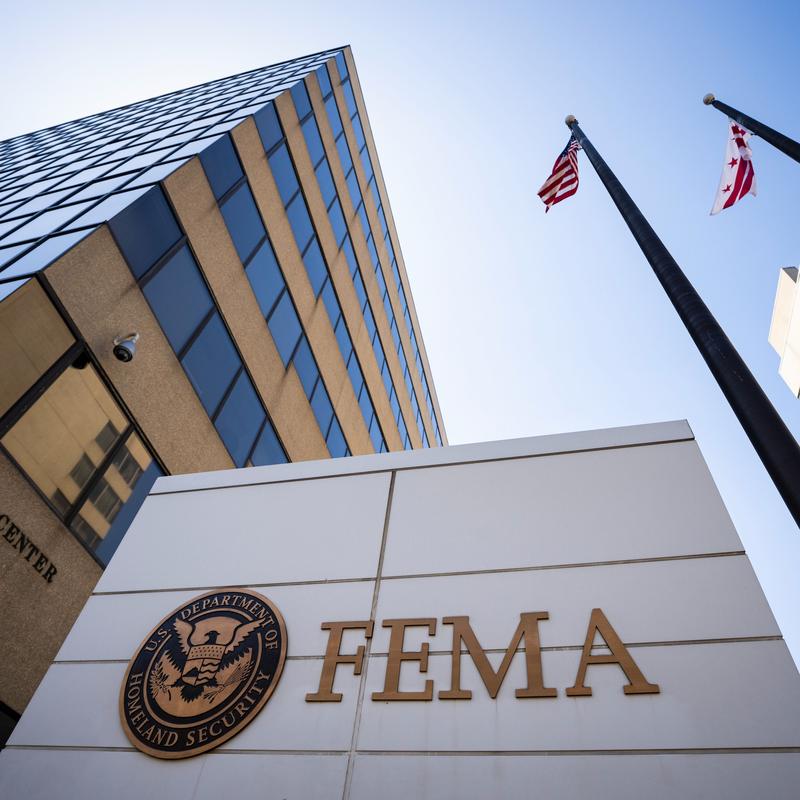
Micah Loewinger: Hey, you're listening to the On the Media midweek podcast. I'm Micah Loewinger. Over the weekend we reshared the first installment of American Emergency, our four part series all about FEMA, the Federal Emergency Management Agency. OTM senior producer Eloise Blondiau and I spent nearly a year researching and reporting those episodes. Earlier in the summer, we put on a live event at WNYC where we gave a behind-the-scenes look at our process making the show and why we wanted to tell a story about FEMA in the first place.
The conversation was recorded live at the Green Space in New York and moderated by legendary New Jersey beat reporter Nancy Solomon. We were also joined by one of our sources, former top FEMA staffer MaryAnn Tierney, who now leads the control center for SEPTA, the Southeastern Pennsylvania Transportation Authority. MaryAnn shared her expertise on how FEMA really works, as well as her experience working with Trump's latest pick to lead the agency, Cameron Hamilton. Here's Nancy Solomon.
[applause]
Nancy Solomon: Tonight, what we're going to do is we're going to talk about the making of the podcast. Why would a show about the media make a series about the Federal Emergency Management Agency? Why should we care? We'll also pull back the curtain and find out about the reporting challenges and how the team dealt with them. Let's start with you, Micah. Why FEMA? Take us to the beginning of this idea that you wanted to make this series.
Micah Loewinger: A number of the high-profile people who were convicted for the insurrection had started a militia after a natural disaster, had used a natural disaster to recruit, or had used it to raise money. I started to see this connection between the growing problems with extreme weather and climate change in far-right movements. Why FEMA? The militias hated FEMA. They were sometimes butting heads with FEMA people on the ground, and they told wild stories about FEMA.
The big one that we talk about in the series, and my way into this was the FEMA camps conspiracy theory, this belief that FEMA was going to round up political dissidents and put them in concentration camps, take their guns away, use FEMA as the vehicle for some kind of global authoritarian plot. I was like, "That FEMA? The Katrina FEMA." As we started digging into it and as we started hearing more about the Trump administration's efforts to abolish FEMA last year, I was like, "There's something here. There's some kind of continuity. There's something below the surface."
Nancy Solomon: Can you unpack that a little bit? What is it about FEMA that draws so much misinformation, disinformation, conspiracy theories?
Micah Loewinger: There are a lot of reasons why the right and the left hate FEMA, which we can get into. These conspiracy theories about the FEMA camps, they harken back to an era where FEMA was really hiding a lot from the public. One of the things that FEMA actually did in the '80s is they were charged by the Reagan administration with developing doomsday scenario plans. A big thing during the Cold War was this question of, "What would we do if the majority of Americans died after a nuclear attack?"
It sounds like a silly sci-fi movie, but there was a lot of actual planning that went into this question. Ronald Reagan actually asks his head of FEMA to draw up plans for declaring martial law and suspending the Constitution so that FEMA could get the country back on track, get leadership back in place, take nuclear survivors, put them in refugee camps. These plans, as they started to come out, and they were plans never realized, but they were actually plans, once they started to trickle into the public consciousness, they were picked up by conspiracy theories, right-wing and left-wing conspiracy theorists.
I'm calling them conspiracy theorists, but suspicious citizens who were like, "What is our government doing?" Alex Jones made many documentaries about the FEMA camps. It lived on as this theory, very divorced from the real history, but one that animated militia groups that were ostensibly interested in protecting their civil liberties.
Nancy Solomon: One of the fascinating stories that you guys tell is about Mount Weather in the first episode, which is the roots of some of this paranoia and conspiracy theory that's an actual real thing. Eloise, tell us about digging into the historical archives of FEMA and how you found this. First, tell us what was Mount Weather?
Eloise Blondiau: Oh, Mount Weather. Mount Weather still exists. It's an underground city in Virginia. It has a broadcasting studio. I think it has a hospital. It has pretty much anything you could possibly need to keep a big group of people alive. The reason it was created was to preserve continuity of government. The idea was, "Hey, let's say a nuke hits. How do we make sure everything doesn't fall apart? Let's send our most important people to this bunker to survive."
We came across Mount Weather in particular because me and Micah were talking about, "How do we tell this history of FEMA where it really was defending against nuclear war?" It was always doing the natural disaster work too, but there was a time when nuclear disaster was its priority. We found this book by Garrett Graff. He's a historian. It's called Raven Rock. I think I'm paraphrasing, but the subhead is something like, "How the most powerful people in America made plans to save themselves while the rest of us die."
[laughter]
That's the thesis of his book. Mount Weather is one of many of these secret bunkers. We were particularly interested in Mount Weather because it had an interesting introduction into the public imagination. In the '70s, there was a very tragic plane crash that happened very close by to Mount Weather, and people only realized that something weird was going on because the federal agents were immediately on the scene. That's how the public found out about Mount Weather. Obviously, as Micah said, this discovery sparked a lot more questions about what the hell is the government up to?
Nancy Solomon: Let's talk about Katrina, which is the subject of episode 2. One of the main people we hear from is Siobhan. Tell us how you found her.
Eloise Blondiau: This episode, we're telling the story of what happened at the Superdome, which was where a lot of residents in New Orleans were sent to ride out the aftermath of the storm. Micah had found this amazing former FEMA worker who was one of the only FEMA workers on the ground, and he was at the Superdome. We wanted to also tell the story from the perspective of a survivor. People feel like they know what happened during Katrina.
Our challenge was, how do we tell a story that maybe people haven't heard before? How can we introduce them to a person they may not have heard from before? We really wanted to make sure that we weren't just picking up someone who'd done a ton of press before. How do you do that not being in New Orleans? First thing, I reached out to some oral history projects in New Orleans to see if they might want to connect. Then I obviously scoured the Internet, and there were a lot of people on the 20th anniversary of the anniversary of Katrina who were sharing their experience.
Nancy Solomon: On TikTok.
Eloise Blondiau: On TikTok.
Nancy Solomon: Which we have.
Eloise Blondiau: I saw so many videos, but this one in particular stuck out to me.
Nancy Solomon: We're not going to play the whole thing, but it gives you a taste.
Siobhan: I'm going to talk about my stay in the Superdome for Katrina and how horrible it was to relive that trauma all over again. We was in the Superdome for six days. When I arrived the first day I went to the Superdome the day of Katrina after the levees broke and the city was submerged underwater.
Nancy Solomon: It wasn't easy to get Siobhan to talk with you, though, as you have told me. Tell us about that.
Eloise Blondiau: Yes. There are a lot of people who have similar videos. The thing I loved about Siobhan's video is immediately when you watch it, you feel like you know her. It was the first time she had told that story. She was very detailed, which is a reporter's dream, because you can verify things. It was 20 years ago, so it has to be someone who can recall things in a vivid way. It was the first time she'd ever shared her story about what she'd been through in Katrina.
She had watched the documentary and felt that it was time. It's hard when you talk to someone who's gone through something traumatic because you don't want to retraumatize them. You want them to want to talk to you about what happened to them. She actually wasn't too hard to convince. I didn't want to convince her, to be honest. I just sent her some messages on TikTok, and we had a little phone call beforehand, but actually, what was meaningful to me about us choosing Siobhan to tell this story was that it was meaningful to her.
She was finally ready to talk about it, which I think is really special. I think it makes the story-- it gives it more weight when you hear it. She also had these crazy narrative details, which are also a reporter's dream.
Micah Loewinger: The storm hit on her 19th birthday. She and her block were having a big party just hours before the city was completely submerged. Then she hadn't celebrated her birthday for a decade and a half. She refused to celebrate her birthday because she felt like, "How could I celebrate when all these people died on my birthday?"
Eloise Blondiau: She made that TikTok, I think, the day after her birthday because she'd been thinking about it.
Nancy Solomon: Katrina really represents this pivotal moment in the history of FEMA because it's widely recognized that the guy that was running it, Brownie, as George Bush called him, he did not have the necessary expertise. Actually, Congress does something about that and says, "No, you have to have somebody who has experience." Am I missing something? Tell me more, Micah.
Micah Loewinger: We had focused on these weird, strange, fringe reasons why people hate and don't trust FEMA. We felt like, "Well, we have to talk about Katrina," because it's a legitimate moment where hundreds of thousands of people were actually failed by government dysfunction. I'd be curious to hear from you, MaryAnn, about what you saw change at FEMA after Katrina or what you witnessed in the world of emergency management, like how it metabolized the mistakes of Katrina and vowed to do better.
MaryAnn Tierney: One of them was the passage of the post-Katrina Emergency Management Reform Act, which included the stipulations that the FEMA administrator have a certain level of emergency management experience.
It also required the same thing of FEMA regional administrators, the idea of professionalizing these very key positions within the agency. There was also, I think, a lot of introspection in emergency management around how do we prepare for people that are the most vulnerable, people that are marginalized every day, that live on the edge of society, and that a disaster either prevents them from acting because they lack the resources or the wherewithal to take action, or afterwards are pushed over the edge. I've seen that many times in disasters, whether it was in New York City or when I was in Philadelphia or at FEMA.
I think there was also a big move towards thinking about how do we plan for those groups of people, not just have them off to the side, but how do we integrate them into our thinking and response operations. Also, I think a big look at ingesting lessons learned. There were a lot of things before Katrina that were known about a significant hurricane impacting New Orleans. There was an exercise very close to Hurricane Katrina called Hurricane Pam, where many of the things that happened in Katrina played out in that exercise, but a lot of the lessons learned from that exercise were not acted upon in a timely manner.
Thinking about, as a profession, as a set of public agencies, how do we learn from our exercises? How do we learn from real world events and not just learn it and put it on a shelf, but learn it and ingest it back into how we do business. I think that was another key takeaway. I think the last thing was being more survivor focused. How do we ensure that our programs, our processes, everything that we do is oriented on how are we helping survivors move through response to recovery.
Nancy Solomon: We, the audience, meet you in episode 4, which is largely about the post-Trump world of FEMA. I want to get to that in a moment, but I thought it would be really interesting to hear about your experience in New York as part of emergency management here in the city, because from what I understand, you were working in emergency management on our city's worst day.
MaryAnn Tierney: Yes. I was with New York City Emergency management from 1999 to 2006 was my first emergency management job. OEM, that's what we called it. OEM was a very small agency when I started, and we were located in 7 World Trade Center, which in hindsight, was probably not the best place to put an emergency management agency. Actually, when I interviewed, I asked them about that because the World Trade Center had been bombed in 1993. I had asked, "Hey, what's the plan here?"
[laughter]
MaryAnn Tierney: I was assured it was good. We were Good. Then 9/11 happened, obviously. It was an extremely traumatic event for the entire city, for city government. We lost 343 firefighters, 23 police officers, 30 members of the Port Authority Police Department, and countless others were killed on that day and continue to die as a result of illnesses born from the toxic stew that was around Lower Manhattan in 9/11. Regularly, I know colleagues that are dying from cancer.
That really changed how New York City responded to disasters and grew emergency management. From 9/11, many things, even at the federal level, the creation of the Department of Homeland Security, the grant programs that support countless state and local governments to prepare for disasters, to prepare for Homeland Security events, all came from 9/11. Like Katrina, it was a watershed moment in American history in the profession of emergency management. Things were never the same after that.
Nancy Solomon: I was hoping you might tell us the story of what you were doing on that day.
MaryAnn Tierney: Oh, what I was doing? I was working. [laughs] If you were alive in 2001, it was a Primary Day, so we were voting. I was on my way to work, and I got a call. I was late for work because I was voting. I thought the person calling me was upset that I was late because we were actually having an exercise the next day. A bioterrorism exercise was planned for the next day. I thought I was in trouble [laughs], but it was to tell me that something had happened at the World Trade Center. I went to 7 World Trade Center and went up in the Emergency Operations Center, which was located in 7 World Trade Center.
Micah Loewinger: It had already been hit.
MaryAnn Tierney: Yes, the first plane had already struck. I believe it was the North Tower. Then we were in the Emergency Operations Center when the second plane hit the South Tower. Then we evacuated, and we walked down the 23 flights of stairs. There was a small group of us. A small group of city agencies were coming and arriving. We were in the lobby of 7 World Trade Center when the first tower fell into 7 World Trade Center, which was a very unfortunate situation to be in. Do not recommend.
We had moved into the garage area and then popped out on the backside on Vesey Street. The OEM command post was there. We got on the command post, and then a bunch of other people also got on the command post because they were evacuating. Then we were on a pier, and FEMA was on the pier right next to us. We were working for months to help the city recover, to clear the debris, find people, help identify them. It was a several-months-long effort to do all of that.
Nancy Solomon: It must be just nuts to devote your life to this kind of work and then have there be this large segment of our population that is so against the agency. I can't even really imagine that.
MaryAnn Tierney: In every profession or job there's people that don't think that what you do is of value. FEMA, the work that we did is extraordinarily important. Just because somebody doesn't think that it's true doesn't mean it's what they think is real. I think you have to think about: are you doing the best thing that you can do every day to help people and working on improving that. If there's naysayers then I think our job is to convert them to yea-sayers.
The militia is a really good example. I was deployed to Asheville for Hurricane Helene. I spent about a month there, and there were militia-like organizations that I engaged in order to help survivors. I think part of the challenge in government is that when you see groups like that, the immediate reaction is to say, "Oh no, I don't want to work with them." My thinking was, "Here's this group of people, and they're rough, they got guns, they're militarized, but they want to do the same thing I want to do.
"I want to help people. Our interests are aligned in the fact that we both want to help this community. How do we align our interests in a way where we can both help each other do that?" I think that in doing that, I built some really great relationships with some of those individuals. In fact, I still stay in touch with some of them. [crosstalk] You can't be afraid of people just because they're different from you or because they have a different set of thinking. I think that's a big problem in this country is that we don't take time to figure out how we can align our interests. I found that that was very successful in North Carolina, and I would absolutely do that again.
Nancy Solomon: You end up in a very difficult position where after President Trump takes office, you have to work with the new director, Cameron Hamilton, to basically come up with a plan to dismantle the whole agency. This is, of course, during the whole DOGE going through the whole federal government and cutting things. What was that experience like, and how did you navigate those waters?
MaryAnn Tierney: Obviously, that was very unpleasant. Imagine if somebody showed up at your job and said, "No, we don't want that anymore." That did happen. [crosstalk]
Micah Loewinger: It happened.
[laughter]
MaryAnn Tierney: It did happen. Yes, it did. You can empathize. It's very jarring. My job at the time when that happened, I was the senior career official at FEMA. Here we have this workforce of several thousand people who know these things are happening to us. I think part of our job was to provide stability and to be a buffer so that our workforce could continue to do its important work. I know that Cameron Hamilton felt the same way. Again, our interests were aligned in that the agency provided and still provides a very important service to Americans on their worst day
No government agency is perfect. A lot of them are very dysfunctional. FEMA has a lot of dysfunction that needs to be improved, but the people that work at FEMA, just like most government agencies, show up at work every day to try to help people. They want to do their job, and the systems and processes get in the way. That doesn't mean that the agency should be put through the shredder. It means we should sit down and have a thoughtful conversation about what can we improve and what should we fix, and how can the people who work here every day and understand the pain points contribute to that fix.
Getting direction to write a memo to abolish the agency was very upsetting. We were asked to do it, and we did it. Ultimately, it was not acted upon. The agency is still there and is now going to go through some major reforms.
Nancy Solomon: I can't remember the exact words of what you said, but I remember one of the clips of tape of you in the episode where you talk about how you understand that this is a political process. You're working for a political appointee who's going to do the bidding of his boss, the president. You had a certain acceptance that even though it wasn't what you wanted, that's what your job entailed.
MaryAnn Tierney: Yes. I think your job as a senior executive, especially in the federal government it's a very institutionalized process. Your job as a senior executive is to support political leadership, and your job is to provide advice. The department directed us to write a memo to abolish FEMA, which obviously I did not agree with, but we did that. In doing that, we provided advice about the challenges and obstacles that would play out if that was, in fact, done.
I think that that was successful because ultimately it was not acted upon. My job was to provide advice, and then it was their job to figure out what they wanted to do with that advice. Once they figured that out, my job was to do the thing they asked me to do as long it was legal. I was never directed to do anything illegal. I was asked a lot of questions, and I would give advice about whether that made sense, but I did ultimately leave because a lot of the things that were being done made me uncomfortable, which is different than not being legal.
Nancy Solomon: Let's play a cut of tape from the series. This is disinformation and conspiracy theories that lead to death threats. We're going to hear from Jaclyn Rothenberg, who worked in FEMA public relations. It was during the North Carolina hurricane.
Micah Loewinger: Yes, Hurricane Helene.
Jaclyn Rothenberg: I remember being in FEMA's National Response Coordination Center doing my job, and a colleague pulled me aside in a small little room, and they said, "There have been some threats against you. We think it's unsafe." There was an individual in Alabama who threatened to shoot me, a state that actually was not impacted by the disaster at all. Sorry. I got scared. I got really scared. I remember calling my husband before I left, and I said, "We need to leave the house."
Nancy Solomon: Micah, do you want to jump in here?
Micah Loewinger: Sure. We were interested in telling the story of Hurricane Helene because it's a very important recent storm that helps explain why the Trump administration targeted FEMA and threatened to abolish it. It's also interesting because after Hurricane Katrina, FEMA improved and evolved in many significant ways. Even though the agency, according, at least, to the experts that we spoke to, did a decent job, a pretty good job of anticipating the challenges of the storm and then responding to them, that was not what the story about Helene was online.
The story online was that FEMA did a terrible job, completely abandoned the people of Asheville and Buncombe County, and under Biden, because, remember, this is fall of 2024, the storm hits just a month before the election, the story becomes Biden's FEMA doesn't want to help Trump supporters so that they will not vote for him. FEMA has all these other motives to interfere with the election. In this stew of misinformation and outright lies about the government's efforts, high-up FEMA employees start to receive insane death threats. There were doxxing attempts.
Some people were swatted. If you don't know that term, it means you call in a fake police report hoping that a SWAT team will bust down the door. It's very dangerous. This is the level of vitriol and violence that's being directed at the people who are trying to respond to the storm. Jaclyn Rothenberg was the head of public affairs. She gets this death threat. We were interested in telling her story because we felt it captured the fear of FEMA, but also the fear that FEMA felt of the people that it was trying to serve. This is that tension that interfered with an earnest effort to help people on their worst day.
Eloise Blondiau: Just to add, Helene was a storm that saw unprecedented conspiracy theories. MaryAnn, you probably know better than I do, but I think there were more conspiracy theories about Helene than any other disaster before that storm. It was particularly hard for Jaclyn to do her job because she was going out on TV debunking these conspiracy theories and then going home and coming back into work, and they're telling her that actually now she's the subject of the conspiracy theories. It's pretty devastating for her.
Nancy Solomon: One of the things you came up with that you reported on was that there were much lower-than-expected applications for help and aid from that storm, but it turned out to be not an easy-- It wasn't a direct line like, "Oh, people think that FEMA is bad and ineffective, so they're not applying for the funds." It was actually a much more nuanced, complicated story. You want to explain that?
Eloise Blondiau: Because Micah's original entry point into this story was the militias and the conspiracy theories, I think that we did imagine that there would be a super clear through line in a situation like this between, "Okay, lots of conspiracy theories, that's the primary driver of distrust in FEMA." It was definitely more complicated than that. A lot of people didn't actually know what FEMA was doing?
MaryAnn Tierney: FEMA did a lot. We paid for all of the emergency response efforts, the debris removal, most of it, within the parameters of our program. We provided consumable supplies in Asheville and Buncombe County. We set up, in partnership with the county and the state, stations where people could go and wash their clothes and take a shower. I think one of the challenges with FEMA is that FEMA is not very good at telling its story and explaining to people what FEMA does and what FEMA does not do.
I also think that the public has unrealistic expectations about what FEMA can do in the constraints of the law. For example, FEMA is not going to make you whole after a disaster. When you have a disaster, FEMA will talk about the maximum amount of money you can get is $42,000. It adjusts every year, but right now it's about $42,000. What does everybody think? Everybody thinks they're going to get $42,000 grant from FEMA, but they don't. When they call FEMA, and they think they're getting $42,000 because that's what we put in our press release, and then they only end up with the average payout, which is less than $5,000, of course they are upset.
Nancy Solomon: Let's talk about the librarian in Asheville. It's Asheville, or somewhere in North Carolina?
Eloise Blondiau: Nearby. It's in Marshall.
Nancy Solomon: This is Gloria Sundquist. Tell us about finding her.
Eloise Blondiau: We came across this amazing library in Marshall, North Carolina. The head librarian there invited FEMA actually to set up inside the library because she was seeing so many conspiracy theories and hearing about the distress. She wanted a trusted place for people to interact with FEMA workers. By becoming acquainted with the library, we met Gloria, who is a circulation assistant who had a pretty dramatic survival story during Hurricane Helene, where she was rescued by boat from her home as it was filling up with water. We wanted to talk to her about her experience applying for aid from FEMA.
Nancy Solomon: Let's play that tape.
Gloria Sundquist: They said, "You're not equipped to deal with rural people." I said, "I do not need a hotel voucher, I need rental assistance." I had a cabin up above me that people wanted $1,000 a month for a one-room cabin. They're just a bureaucratic organization that wasn't going to give you much for anything, really. They required your lungs for whatever they wanted to give you. In the midst of all that trauma, how do people sort through that?
Nancy Solomon: MaryAnn, is it difficult for FEMA to differentiate between, say, what it takes to get into housing in a rural area versus in a city? That's one of the things she's saying there.
MaryAnn Tierney: I think let's start with the FEMA Individual Assistance Program, which is the program that provides all the financial assistance to individual and their families after a disaster, is broken and needs real reform. Some of that FEMA can do on its own; some of it Congress needs to act, because some of it has to do with how our statute is written. There's that. Layered on that, government agencies love Rube Goldberg machines. If it can take five steps, a lot of times we figure out how to make it take 10 steps. That is very frustrating for people. It's frustrating for people that work at FEMA.
We need to decomplex those programs. They need real reform. I think that's one thing. When I hear her story, it breaks my heart because there are probably things that we could have done to help her if we had a better set of programs that were better integrated, if we had a better registration process. Then the last thing I'll say is that one of the programs that's most complicated and most difficult is disaster housing, which FEMA is the lead for. I believe that that is misplaced. FEMA is not a housing agency.
There is an agency in the federal government who is responsible for housing. I think that they should be taking more ownership of that post-disaster. When a disaster happens to a community, and it destroys the housing stock, that is happening at a time where there's already an affordability crisis with housing across the country. We can't build enough houses in this country to meet the demand without a disaster. When a disaster rolls through and destroys all of the affordable housing stock in a community, it is a very complicated thing to rebuild.
The federal government is one piece of that, but lots of other things come into play, and a lot of it is local politics about how you're going to rebuild and where that housing is going to end up. What do we do for folks after a disaster who have lost their housing? FEMA has programs to provide temporary housing. I have seen in communities when FEMA has tried to do that, they have been met with significant resistance in putting that housing in place because the people who have housing left don't want that in their neighborhood. FEMA is put in the middle of that, and no one walks away happy. Everybody walks away unhappy with FEMA.
Nancy Solomon: Micah, you had this extraordinary reporting windfall in that Cameron Hamilton was fired from his job heading FEMA. He's out of a job, and he's willing to talk to you, but he then comes back. Tell us about that.
Micah Loewinger: That's right. I'll be careful what I say, because MaryAnn lived through everything. Cameron Hamilton was chosen to be the acting administrator at the beginning of the Trump administration. He was a head scratcher because he did not have a traditional emergency management background. He hadn't worked at FEMA for a decade, like some of his predecessors, but in reviewing the things that he was saying during the transition process and in the lead-up to the Trump administration, he sounded like a MAGA warrior.
He said things like, "We need to root out the bureaucratic rot in Washington. He said that if he was elected as a congressman, he lost his primary, that he would dismantle the administrative state. He is saying all this inflammatory stuff. He does not have the traditional qualifications. Then Trump says that he wants to abolish FEMA, and he's the guy at the helm. He ultimately stands up for the agency. He says he doesn't want to abolish it. He and MaryAnn are really put in the pressure cooker.
Corey Lewandowski and Kristi Noem, they seem to think that abolishing FEMA is their MO, and that's what they have to do. Cameron Hamilton is polygraphed at one point under orders from the Department of Homeland Security. They accuse him of leaking things to the press. I'm just trying to illustrate just how chaotic this time was, 2025. He ends up testifying that he doesn't want to abolish FEMA. He's fired.
When we call him up in December, I just thought, "Let's have him tell this incredibly juicy, revealing story about where the agency is, the dysfunction in the Trump administration, the hell that they're putting the leaders through." The man just talked, and we had a really interesting, fairly candid conversation about his time in government. Now, when we were writing the episodes, putting them together, trying to figure out the twists and turns, we learn that he has just been nominated to come back and run the agency officially again.
Eloise Blondiau: Major plot twist.
Micah Loewinger: Huge plot twist. We could never have seen this coming. As far as I know, he's the only Trump nominee to have had this comeback story. It ends up looking like we're the only journalists that have had a sit-down interview with him about his time in office. Eloise actually got a call from him before the last episode was about to come out, and he asked us to not run the episode. He asked us to delay the release of the episode because he was worried it would interfere with his confirmation hearing.
We said no. We said, "We're going to run the episode." Journalism ethics, very, very important, but just practically speaking, what were we going to tell our audience about the fourth episode? Like, "Sorry, guys."
Eloise Blondiau: I think episode 3 ends with [crosstalk] saying, "We're going to speak to Cameron Hamilton next week."
Micah Loewinger: We had already teased it. We, of course, were serious about the craft of journalism. We're a media criticism show. We would never, ever let a public official tell us what we can or cannot run. In fact, we recorded the conversation; we put it in the series.
[laughter]
Micah Loewinger: Having watched his Senate confirmation hearing, he had nothing to worry about. They didn't ask him very hard questions, in my opinion. Questions about his qualifications for the job didn't come up. Maybe that's just the state of DC.
Nancy Solomon: Let's hear from MaryAnn. You worked with him, and you do respect him. You like the guy.
MaryAnn Tierney: Yes. I would say we're good friends. We bonded over a lot in that very long five months that we were together.
Nancy Solomon: Do you think he'll do a good job?
MaryAnn Tierney: I think Cam is a smart guy who cares deeply about the agency. I didn't know anything about his previous-- When I met him, it was very chaotic. I didn't have time to do some deep research on him. I just met him, and it was like, "This is Cam. He's running the agency." I was like, "Okay, let's figure this out." We were together, side by side every day. He had some opinions about FEMA. I found him to be very respectful and humble. He would listen to opinions, and he would take that in.
I think we worked really well together. He's a person of integrity. I also think that the President needs to have somebody that he trusts, and FEMA needs somebody that the President trusts, especially now, because the agency has been practically shredded and needs to come out of that. Having somebody that the Secretary and the President are confident in is critical, and they are confident in Cam. That will go a long way. There are a lot of good people still at FEMA who are there every day doing their job that want to help reform the agency.
I know that he will surround himself with those people. I know those people are dedicated to making sure that the agency can deliver its mission. The whole agency doesn't rest on Cam Hamilton. The agency is a 24,000, 25,000-person workforce. There are many other people that are going to make that agency successful.
Nancy Solomon: That's good to know, considering we're coming up on hurricane season. One of the overarching themes of the whole series is how political systems seize upon disasters and the relationship between autocracy and natural disasters. Talk a little bit about that and what keeps you up at night about FEMA.
Micah Loewinger: A lot of the idea came out of this reporting looking at how far-right groups exploit climate disasters to build their movements. I went in wondering if a diminished FEMA would create this opening for more of these groups to proliferate. A lot of them are underground. We don't talk about them very much. They're a little bit less active. They're certainly less public. I don't think it's controversial to say that this militarized authoritarianism is going to continue to exist and grow in the future.
I do wonder when there is the next really big disaster, because there's always a next one, if FEMA in its weakened state doesn't show up for people and the narrative that our federal government can't help people and will just fail them if these types of groups will continue to have the story that they need to recruit and to raise money and to do with it what they will in the future. I really hope not. I really hope that FEMA gets its mojo back, gets its act together, because we need that.
Nancy Solomon: Thank you all for listening to the show, [applause] listening to the podcast, and coming out tonight. Thanks for coming. Good night.
[applause]
Micah Loewinger: Thanks for listening to the On the Media midweek podcast. To listen to all four episodes of American Emergency, visit our website onthemedia.org or scroll back to May to find it on your OTM podcast feed. If you don't already consider following us on TikTok and Instagram; we also have a subreddit. Just search On the Media. See you soon. I'm Micah Loewinger.
Copyright © 2026 New York Public Radio. All rights reserved. Visit our website terms of use at www.wnyc.org for further information.
New York Public Radio transcripts are created on a rush deadline, often by contractors. This text may not be in its final form and may be updated or revised in the future. Accuracy and availability may vary. The authoritative record of New York Public Radio’s programming is the audio record.